

Next Generation Memory Technologies Market Size and Forecast – 2026 to 2033
The Next Generation Memory Technologies Market is estimated to be valued at USD 19,543.1 Mn in 2026 and is expected to reach USD 1,32,178.7 Mn by 2033, exhibiting a compound annual growth rate (CAGR) of 31.4% from 2026 to 2033.
Key Takeaways
- By Product Type, Non-Volatile Memory hold the largest market share in 2026 owing to its AI, big data, and high‑performance computing.
- By Interface Type, SATA acquired the prominent share in 2026 as cost-effectiveness & broad compatibility.
- By Application, cache memory & Enterprise Storage dominates the overall market with an estimated share of 30.4% in 2026 owing to the demand for faster, low-latency access.
- By Region, Asia Pacific acquired the prominent share of 39.04% in 2026 owing to the massive electronics manufacturing ecosystem.
Market Overview
The Next Generation Memory Technologies Market continues to grow rapidly as industries seek faster, more efficient, and high-capacity memory solutions. Advancing technologies in AI, big data, IoT, and edge computing drive the adoption of MRAM, ReRAM, and 3D XPoint. These next-gen memory solutions deliver benefits like non-volatility, high endurance, and low latency. Companies are actively investing in data centers, automotive electronics, and consumer devices, which propels the development and widespread use of next-generation memory technologies.
Current Events and Its Impact
Current Events | Description and its impact |
Geopolitical Tensions in East Asia |
|
Advances in Emerging Memory Technologies |
|
Macroeconomic Trends and Regulatory Frameworks |
|
End-user Feedback and Unmet Needs in the Next Generation Memory Technologies Market
- Performance & Speed Expectations: End-users demand memory solutions that deliver ultra-fast data access and processing to support AI, big data, and real-time analytics. Many reports existing technologies still struggle with balancing speed and power consumption, highlighting a need for memory that can operate efficiently under intensive workloads without compromising performance.
- Durability & Reliability Concerns: Users emphasize the importance of long-lasting memory with high endurance, especially in industrial, automotive, and data center applications. Current memory solutions sometimes fall short in sustaining performance over extended use, creating an unmet need for more robust, wear-resistant memory technologies that maintain data integrity under harsh conditions.
- Cost and Scalability Challenges: While advanced memory technologies offer benefits, many end-users find costs prohibitive, limiting widespread adoption. They seek more affordable, scalable solutions that can be integrated seamlessly into existing infrastructures without significant upgrades or disruptions, especially for enterprise and consumer markets looking to optimize budgets.
- Current Industry Events of 2026
- Market Size Estimation
- Regional Breakdown
- Competitive Landscape
- Customer Intelligence
- Segmental Analysis
- Pricing Analysis
- Key Market Drivers, Challenges & Future Trends
- Customized Insights Section
Segmental Insights
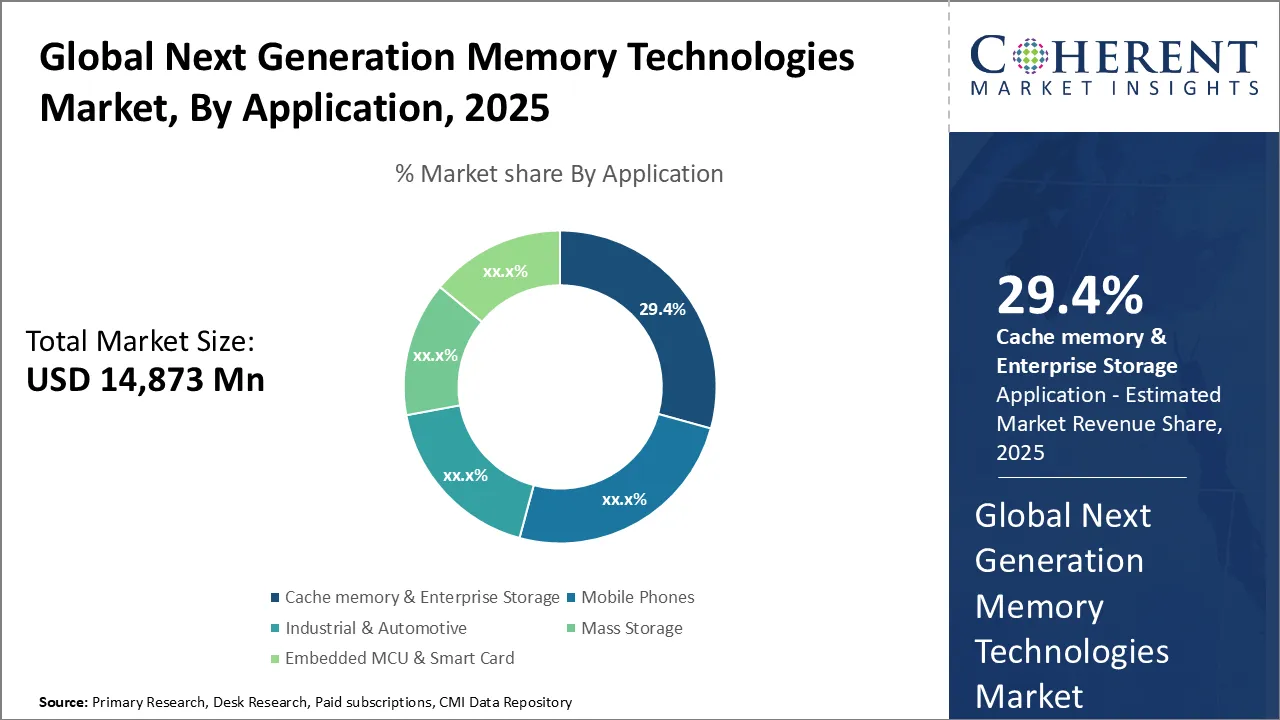
Next Generation Memory Technologies Market Insights, by Application - Cache memory & Enterprise Storage contribute the highest share of the market owing to its edge & AI‑driven workloads.
Cache memory & Enterprise Storage dominates the overall market with an estimated share of 30.4% in 2026. The Next Generation Memory Technologies Market drives demand for cache memory and enterprise storage by requiring faster data processing, low latency, and high reliability in AI, big data, and cloud computing applications. Innovations in memory technologies like MRAM and ReRAM provide enhanced endurance and non-volatility, making them well-suited for enterprise use. Increasing investments in data centers and digital infrastructure accelerate adoption, while the limitations of traditional memory systems compel companies to implement more efficient and scalable cache and storage solutions. For instance, in January 2025, AMD launched the ‘Fire Range’ HX3D mobile processor along with other HX Series SKUs built on Zen 5 desktop CPU silicon. The flagship ‘Fire Range’ Ryzen 9 9955HX3D chip features the Zen 5 architecture combined with AMD’s game-enhancing 3D V-Cache technology.
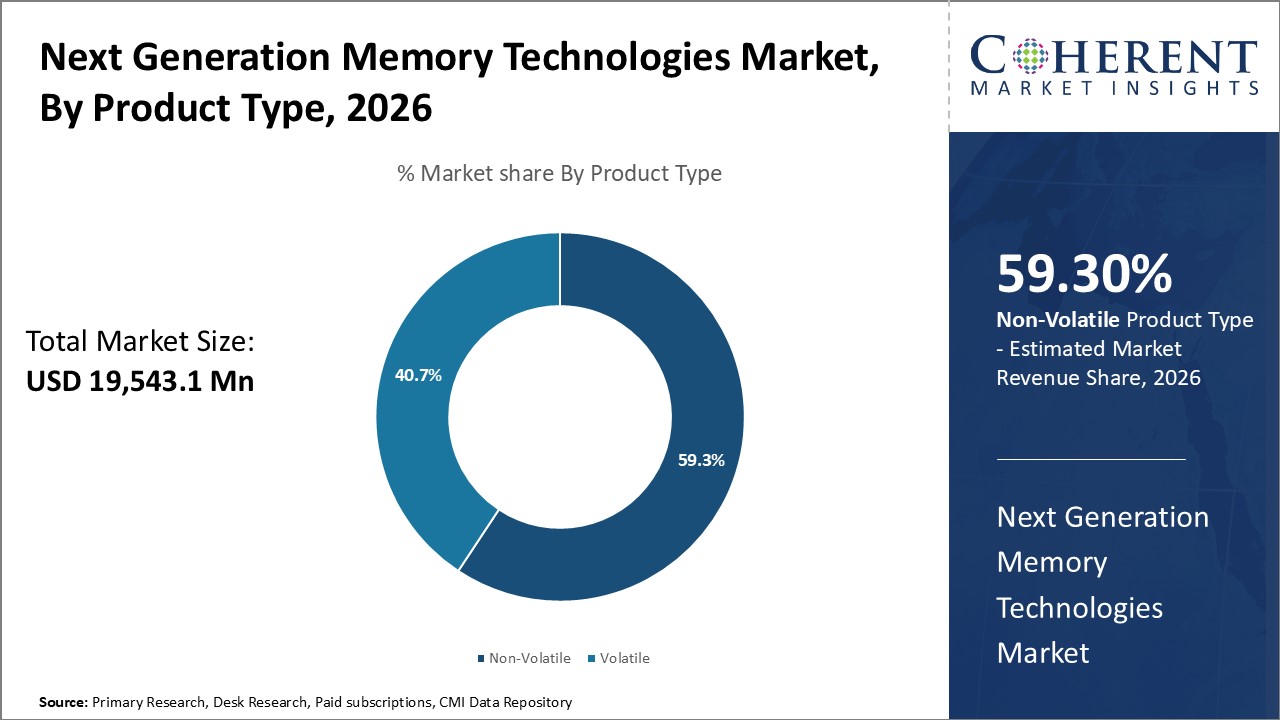
Next Generation Memory Technologies Market Insights, by Product Type - Non-volatile Memory contribute the highest share of the market owing to its automotive & industrial automation
The Next Generation Memory Technologies Market drives the growth of non-volatile memory by demanding faster data access, improved energy efficiency, and greater storage reliability. Applications like IoT, AI, and edge computing increase the adoption of technologies such as MRAM, ReRAM, and 3D XPoint. These memory solutions provide advantages like power-independent data retention, high endurance, and low latency. Additionally, companies invest heavily in data centers and consumer electronics, accelerating innovation and bringing non-volatile memory solutions to market faster. For instance, Cisco announced technology innovations for next-generation storage networking that help customers access, manage, and automate stored data to better achieve their digital business goals. The company also introduced support for Non-Volatile Memory Express (NVMe) over Fibre Channel (FC) specifically designed for flash memory appliances.
Next Generation Memory Technologies Market Insights, by Interface Type - SATA contribute the highest share of the market owing to its advances in NAND technology lowering costs
Widespread compatibility, cost-effectiveness, and reliable performance drive the growth of SATA in the Next Generation Memory Technologies Market. Enterprises and consumers increasingly demand efficient and scalable storage solutions, making SATA the preferred interface for connecting solid-state drives and hard disk drives. The rising use of cloud storage, data centers, and backup systems further strengthens SATA’s importance. Additionally, advancements in SATA technology improve data transfer speeds and energy efficiency, helping to meet evolving storage requirements. For instance, in August 2025, Biwin officially launched its highly anticipated 2025 product lineup, featuring a new generation of SSDs, memory modules, and memory cards. The Biwin M100 SSD delivers high-speed performance with a SATA 3.0 interface, providing read speeds up to 550 MB/s and write speeds up to 500 MB/s.
Regional Insights
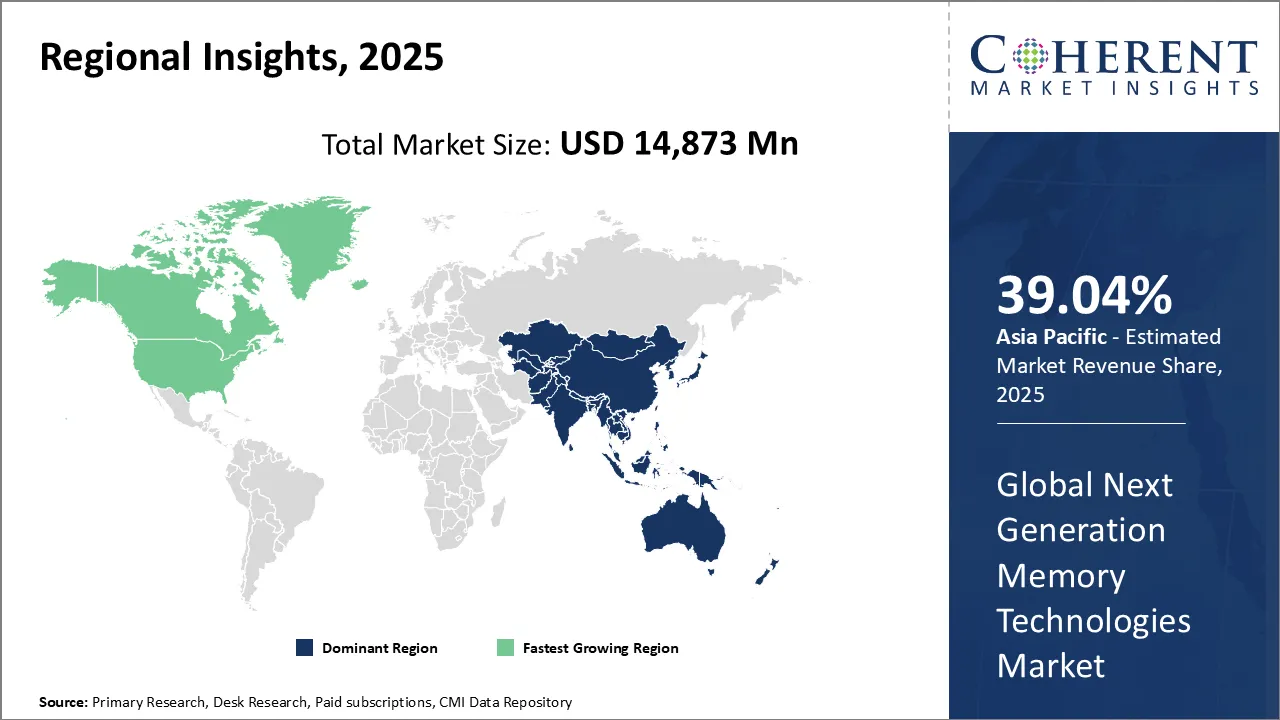
Asia Pacific Next Generation Memory Technologies Market Trends
Asia Pacific acquired the prominent share of 39.044% in 2026. Strong manufacturing capabilities and government initiatives drive the Asia Pacific region’s rapid advancement in next-generation memory technologies. Growing demand from consumer electronics, 5G deployment, and expanding data centers fuels market growth. Local companies invest heavily in developing cutting-edge memory solutions, while collaborations between industry leaders and startups accelerate technology adoption. Increasing focus on AI and automotive sectors further pushes the need for faster, more reliable memory, establishing Asia Pacific as a key hub for next-generation memory development. For instance, Samsung Electronics and Red Hat, Inc. announced a broad collaboration on software technologies for next-generation memory solutions. They will focus on developing and validating open-source software for existing and emerging memory and storage products, including NVMe SSDs and CXL memory.
North America Next Generation Memory Technologies Market Trends
North America holds the second largest market share of 31.616% in 2026. Tech giants and startups in North America drive leadership in next-generation memory technologies through strong innovation and substantial R&D investments. The region’s focus on AI, cloud computing, and high-performance computing applications fuels demand for advanced memory solutions like MRAM and ReRAM. Robust infrastructure, supportive government policies, and collaborations between academia and industry accelerate technology development. North America’s emphasis on cybersecurity and data privacy also encourages adoption of reliable, high-speed memory technologies, strengthening its position as a key market player.
United States Next Generation Memory Technologies Market Trends
United States dominates the overall market with an estimated share of 27% in 2026. Private companies and government programs in the United States drive leadership in next-generation memory technologies through heavy investment in research and development. U.S. firms focus on advancing AI, cloud services, and defense applications, pushing innovations in MRAM, ReRAM, and other emerging memory types. Universities, tech companies, and government agencies collaborate closely to accelerate commercialization. Additionally, the country emphasizes securing supply chains and fostering domestic manufacturing, which strengthens its competitive edge in the global memory technology market. For instance, in August 2026, Teradyne, Inc. introduced Magnum 7H, a next-generation memory tester designed to meet the rigorous demands of testing high bandwidth memory (HBM) devices integrated with GPUs and accelerators in high-performance generative AI servers.
China Next Generation Memory Technologies Market Trends
China expected to hold second largest market share of 17% in 2026. Significant government support and strategic investments in semiconductor manufacturing propel China to rapidly emerge as a key player in next-generation memory technologies. The country focuses on developing domestic memory solutions like MRAM and ReRAM to reduce dependence on imports. Growing demand from consumer electronics, 5G infrastructure, and AI applications drives innovation. State-owned enterprises and private firms form partnerships that accelerate technology advancements, while large-scale production capabilities position China as a strong competitor in the global memory technology market. For instance, in September 2026, in China Montage Technology announced the launch of its CXL® 3.1 Memory eXpander Controller, which complies with the CXL 3.1 Type 3 specification. The controller supports both CXL.mem and CXL.io protocols, providing high-bandwidth, low-latency memory expansion and pooling solutions for next-generation data center servers.
Market Report Scope
Next Generation Memory Technologies Market Report Coverage
| Report Coverage | Details | ||
|---|---|---|---|
| Base Year: | 2025 | Market Size in 2026: | USD 19,543.1 Mn |
| Historical Data for: | 2020 To 2024 | Forecast Period: | 2026 To 2033 |
| Forecast Period 2026 to 2033 CAGR: | 31.4% | 2033 Value Projection: | USD 1,32,178.7 Mn |
| Geographies covered: |
| ||
| Segments covered: |
| ||
| Companies covered: |
| ||
| Growth Drivers: |
| ||
| Restraints & Challenges: |
| ||
Next Generation Memory Technologies Market Trend
Rise of Non-Volatile Memory Technologies
Non-volatile memory such as MRAM, ReRAM, and 3D XPoint is gaining traction due to its ability to retain data without power. This trend reflects growing demand for faster, energy-efficient, and durable memory solutions across data centers, AI, and IoT applications. The shift from traditional volatile memory is accelerating as industries seek to overcome limitations related to speed, endurance, and power consumption, driving innovation and adoption of these advanced memory types.
Integration with AI and Machine Learning
Next-generation memory technologies increasingly support AI and machine learning workloads requiring massive data throughput and low latency. Enhanced memory architectures are being designed to optimize data processing directly at the hardware level, enabling faster training and inference. This integration trend fuels the demand for advanced memory with high bandwidth and persistence, facilitating real-time analytics and decision-making across sectors like healthcare, automotive, and finance.
Next Generation Memory Technologies Market News
- In May 2025, AIC collaborated with Micron and Intel to launch a CXL-enabled next-generation storage server. This cutting-edge platform integrates the Micron CZ122 memory expansion module based on the revolutionary Compute Express Link® (CXL) standard, marking a major advancement in data center solutions by enhancing scalability.
- In September 2025, SK hynix launched the first high NA EUV equipment to boost next-generation memory production. This next-generation photolithography device uses a larger numerical aperture (NA) than existing EUV systems, significantly improving resolution and playing a key role in reducing line width and enhancing integration density.
Analyst Opinion (Expert Opinion)
- The trajectory of next-generation memory technologies is undeniably reshaping the memory landscape, but the industry is at a critical inflection point where innovation alone won’t guarantee success. From my vantage, the true game-changer lies in the ability of emerging memory types like MRAM, ReRAM, and 3D XPoint to solve the longstanding bottlenecks of latency, endurance, and energy consumption—issues that traditional NAND and DRAM struggle with despite decades of incremental improvements.
- Take MRAM, for example. Its near-zero leakage power and endurance beyond 10^15 cycles provide a compelling alternative to SRAM and DRAM in cache applications, particularly as Intel’s recent investment in spin-transfer torque MRAM (STT-MRAM) production shows serious commitment from a leading semiconductor player. However, widespread adoption will hinge on overcoming fabrication complexity and cost hurdles—challenges that companies like Everspin and Samsung are aggressively tackling.
- Similarly, ReRAM’s potential for multi-level cell (MLC) storage and sub-nanosecond switching times stands out as revolutionary, especially for AI workloads demanding persistent memory with rapid access. Crossbar arrays developed by startups like Weebit Nano demonstrate promising prototypes, but scalability and integration with existing CMOS processes remain a significant barrier. These technical limitations explain why adoption remains limited to niche applications despite promising benchmarks.
- Crucially, the memory market’s evolution is increasingly influenced by system-level requirements, not just raw device specs. AI accelerators and edge devices need memory architectures that tightly couple compute and storage—ushering in architectures like computational memory. Here, the synergy between memory and processor design will dictate which technologies thrive. For example, the U.S. Department of Energy’s Exascale Computing Project is investing heavily in persistent memory to optimize HPC workloads, signaling a broader systemic shift.
- In conclusion, while next-generation memories offer transformative potential, I believe the market will see a bifurcation: mature technologies like 3D NAND will continue dominating mass storage, whereas specialized memories like MRAM and ReRAM will carve out strategic niches in AI, automotive, and edge applications. Success will ultimately depend on addressing fabrication costs, integration complexity, and aligning closely with evolving system architectures—areas where only the most innovative and well-capitalized players will prevail.
Speak to the analyst
Want personalized insights?
Take the findings above to one of our principal consultants, or have the report rebuilt around the segments, geographies and competitors you actually track.
Market Segmentation
- Global Next Generation Memory Technologies Market, By Product Type 2021 - 2033 (US$ Million)
- Non-Volatile Memory
- Magneto-Resistive Random-Access Memory (MRAM)
- Ferroelectric RAM (FRAM)
- Resistive Random-Access Memory (RERAM)/ Conductive-Bridging RAM (CBRAM)
- 3D XPoint (Quantx & Optane)
- Nano RAM (Nram)
- Others
- Volatile Memory
- Hybrid Memory Cube (HMC)
- High-Bandwidth Memory (HBM)
- Non-Volatile Memory
- Global Next Generation Memory Technologies Market, By Interface Type 2021 - 2033 (US$ Million)
- PCIe & I2C
- SATA
- SAS
- DDR
- Global Next Generation Memory Technologies Market, By Application, 2021 - 2033 (US$ Million)
- Mobile Phones
- Cache memory & Enterprise Storage
- Industrial & Automotive
- Mass storage
- Embedded MCU & Smart Card
- Global Next Generation Memory Technologies Market, By Region, 2021 - 2033 (US$ Million)
- North America
- U.S.
- Canada
- Europe
- Germany
- U.K.
- France
- Italy
- Russia
- Rest of Europe
- Asia Pacific
- China
- India
- Japan
- ASEAN
- Australia
- South Korea
- Rest of Asia Pacific
- Latin America
- Brazil
- Mexico
- Argentina
- Rest of Latin America
- Middle East & Africa
- GCC Countries
- Israel
- South Africa
- Rest of Middle East & Africa
- North America
- Key Players Insights
- Fujitsu Ltd.
- Winbond Electronics Corporation
- Renesas Electronics Corporation
- Samsung Electronics Co. Ltd.
- Texas Instruments Incorporated
Sources
Primary Research interviews
- Semiconductor industry experts
- Memory technology engineers and developers
- Data center architects and IT infrastructure managers
- Automotive electronics specialists
- AI and edge computing solution providers
Databases
- IEEE Xplore Digital Library
- Scopus
- Web of Science
- SpringerLink
- PubMed
Magazines
- IEEE Spectrum
- Semiconductor Engineering
- Electronic Design
- EE Times
- Tech Design Forums
Journals
- Journal of Solid-State Circuits
- IEEE Transactions on Electron Devices
- Journal of Applied Physics
- Advanced Functional Materials
- Nano Energy
Newspapers
- The Wall Street Journal – Technology Section
- Financial Times – Technology and Innovation
- The New York Times – Science & Technology
- Reuters Technology News
- Bloomberg Technology
Associations
- Semiconductor Industry Association (SIA)
- IEEE Solid-State Circuits Society
- The Memory Manufacturers Association
- JEDEC Solid State Technology Association
- International Technology Roadmap for Semiconductors (ITRS)
Public Domain sources
- U.S. Patent and Trademark Office (USPTO)
- World Intellectual Property Organization (WIPO)
- U.S. Department of Energy Reports
- National Institute of Standards and Technology (NIST) Publications
- Government-funded research papers and technical briefs
Proprietary Elements
- CMI Data Analytics Tool, and Proprietary CMI Existing Repository of information for last 8 years
Get access to 250+ pages report
Every segment, forecast, competitor profile and data table behind the analysis above — available for instant download.
- ESOMAR Member
- ISO 9001:2015 Certified
- D-U-N-S Registered
- GDPR & CCPA Compliant
Missing comfort of reading report in your local language? Find your preferred language:
Transform your Strategy with Exclusive Trending Reports
Frequently Asked Questions
The Next Generation Memory Technologies Market is estimated to be valued at USD 19,543.1 Mn in 2026 and is expected to reach USD 1,32,178.7 Mn by 2033.
The CAGR of the Next Generation Memory Technologies Market is projected to be 31.4% from 2026 to 2033.
Rising demand for high bandwidth memories and growing adoption in data centers and cloud infrastructure are the major factors driving the growth of the next generation memory technologies market.
Competition from established technologies and challenges of new entrants and technological hurdles and intellectual property concerns are the major factors hampering the growth of the next generation memory technologies market.
In terms of Technology, Non-volatile is estimated to dominate the market revenue share in 2026.
Fujitsu Ltd. , Winbond Electronics Corporation, Renesas Electronics Corporation, Samsung Electronics Co. Ltd., Texas Instruments Incorporated are the major players.
Asia Pacific is expected to lead the next generation memory technologies market.