

Aircraft Battery Charging And Testing Market Size and Share Analysis - Growth Trends and Forecast (2026 - 2033)
The global aircraft battery charging and testing market size is expected to reach approximately USD 882 Mn in 2026 and is projected to grow at a CAGR of 7.8% during the forecast period (2026-2033), totaling USD 1,494.2 Mn by 2033. This growth is attributable to increasing global aircraft fleet, rising demand for commercial and military aircraft maintenance, and growing adoption of advanced lithium-ion battery systems.
Key Takeaways from the Aircraft Battery Charging And Testing Market Report
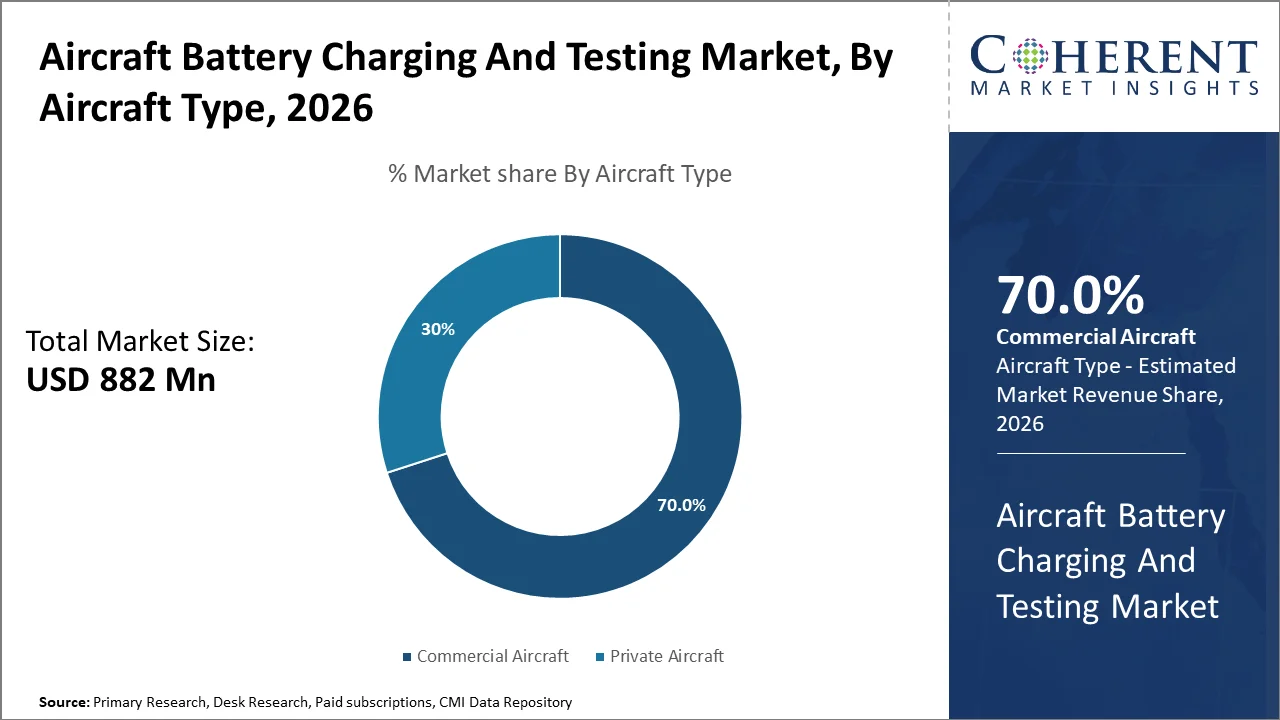
- Commercial aircraft segment is expected to lead the market with a share of 70% in 2026 due to its large global fleet size, high utilization rates as well as frequent maintenance requirements and stringent aviation safety regulations governing battery reliability. For instance, the global commercial aircraft fleet was estimated at approximately 35,550 aircraft, including around 30,300 active units and 5,250 stored aircraft as of June 2025.
- Lithium-ion batteries are slated to account for the largest share of 50% in 2026 due to their high energy density and increasing adoption in more electric aircraft. For instance, lithium-ion batteries are increasingly deployed across modern commercial aircraft platforms, including next-generation aircraft such as the Boeing 787 and Airbus A350, which rely heavily on electrical systems to replace traditional pneumatic and hydraulic functions.
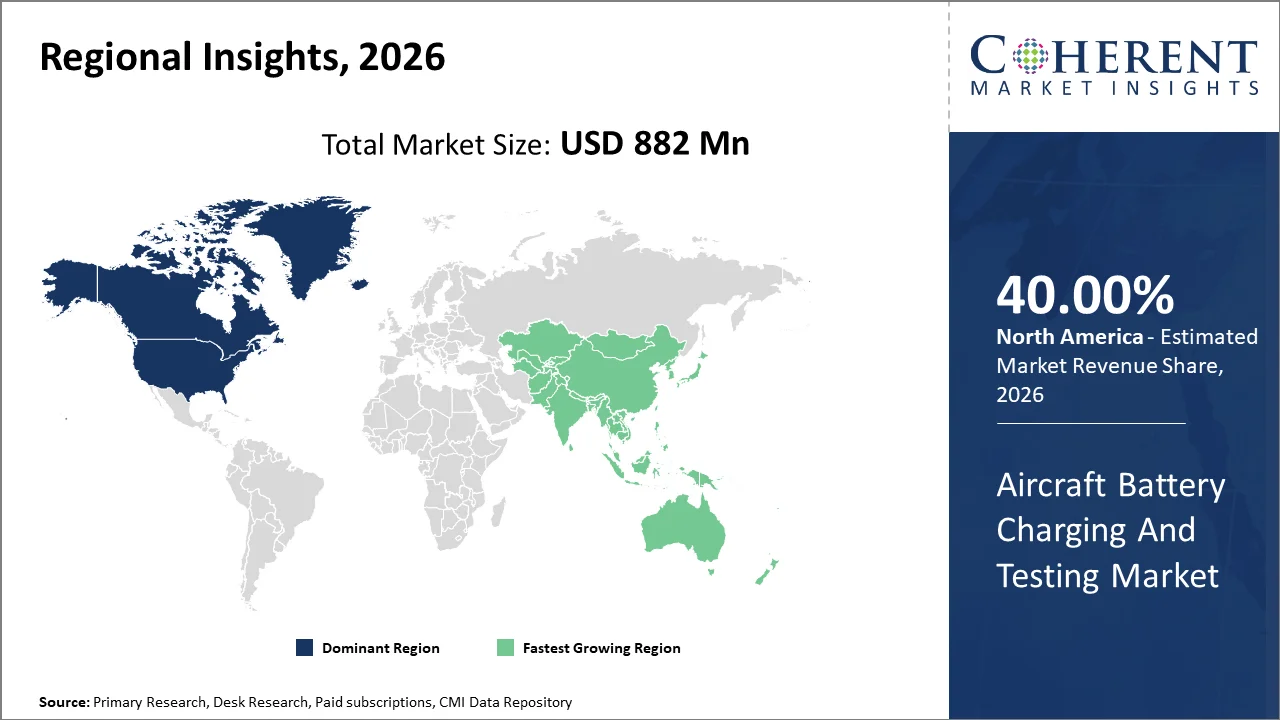
- North America is forecast to dominate the global aircraft battery charging and testing industry with a share of 40% in 2026, owing to strong aerospace manufacturing base, high MRO spending, and advanced aviation infrastructure. For example, the U.S. is home to leading aircraft OEMs such as Boeing as well as major aerospace system suppliers like RTX Corporation and GE Aerospace, which collectively drive the development and adoption of advanced aircraft electrical systems and associated battery testing requirements.
- Asia Pacific is anticipated to emerge as the fastest-growing market for aircraft battery charging and testing, registering a CAGR of 8.2 % during the forecast period, thanks to increasing airline investments and expanding fleets across nations like India and China.
Aircraft Battery Charging And Testing Market Overview
The global aircraft battery charging and testing market is poised to exhibit steady growth during the forecast period. This is primarily due to rising demand for more-electric aircraft architectures, increasing fleet modernization programs, and growing emphasis on improving operational reliability and safety standards in aviation.
Aircraft batteries play a critical role in modern aviation by supporting essential electrical functions across commercial, military, and general aviation aircraft. They are primarily used for engine starting in specific aircraft configurations, particularly for initiating auxiliary power units (APUs), which in turn support engine start operations in most commercial aircraft.
The growing emphasis on aircraft electrification, increasing fleet sizes, and rising demand for reliable power systems in next-generation aircraft are strengthening the importance of advanced battery technologies in the aviation sector. As a result, aircraft batteries remain a vital component in ensuring operational safety, efficiency, and system redundancy in both commercial and defense aviation sectors.
Growing concerns over battery-related safety risks are fueling demand for aircraft battery charging and testing solutions. According to UL Standards & Engagement, lithium-ion battery incidents in aviation increased by 28% between 2019 and 2023, with an average of two thermal runaway incidents reported each week. This trend is expected to create a favorable environment for the growth of the aircraft battery charging and testing market.
Growth of electric aviation & eVTOL platforms is likely to fuel demand for aircraft battery charging and testing equipment during the forecast period. Electric aircraft, hybrid aircraft, and advanced air mobility solutions like eVTOL rely heavily on high-performance batteries that require advanced charging infrastructure and strict testing protocols.
Segmental Insights
Which Aircraft Type Dominates the Global Market?
Commercial Aircraft Segment Accounts for the Largest Market Share in 2026
According to Coherent Market Insights’ latest aircraft battery charging and testing market analysis, commercial aircraft segment is slated to lead the market with a share of 70% in 2026. This dominance is due to the large global fleet of commercial aircraft, their high utilization rates, and the need for frequent and rigorous battery maintenance, charging, and testing cycles to ensure flight safety and operational reliability. In addition, stringent aviation safety regulations and standardized maintenance schedules across airlines significantly increase the demand for advanced battery testing and charging systems in the commercial aviation segment.
- Current Industry Events of 2026
- Market Size Estimation
- Regional Breakdown
- Competitive Landscape
- Customer Intelligence
- Segmental Analysis
- Pricing Analysis
- Key Market Drivers, Challenges & Future Trends
- Customized Insights Section
Which Battery Type Leads the Global Aircraft Battery Charging and Testing Industry?
Lithium-Ion Battery Dominates the Global Industry
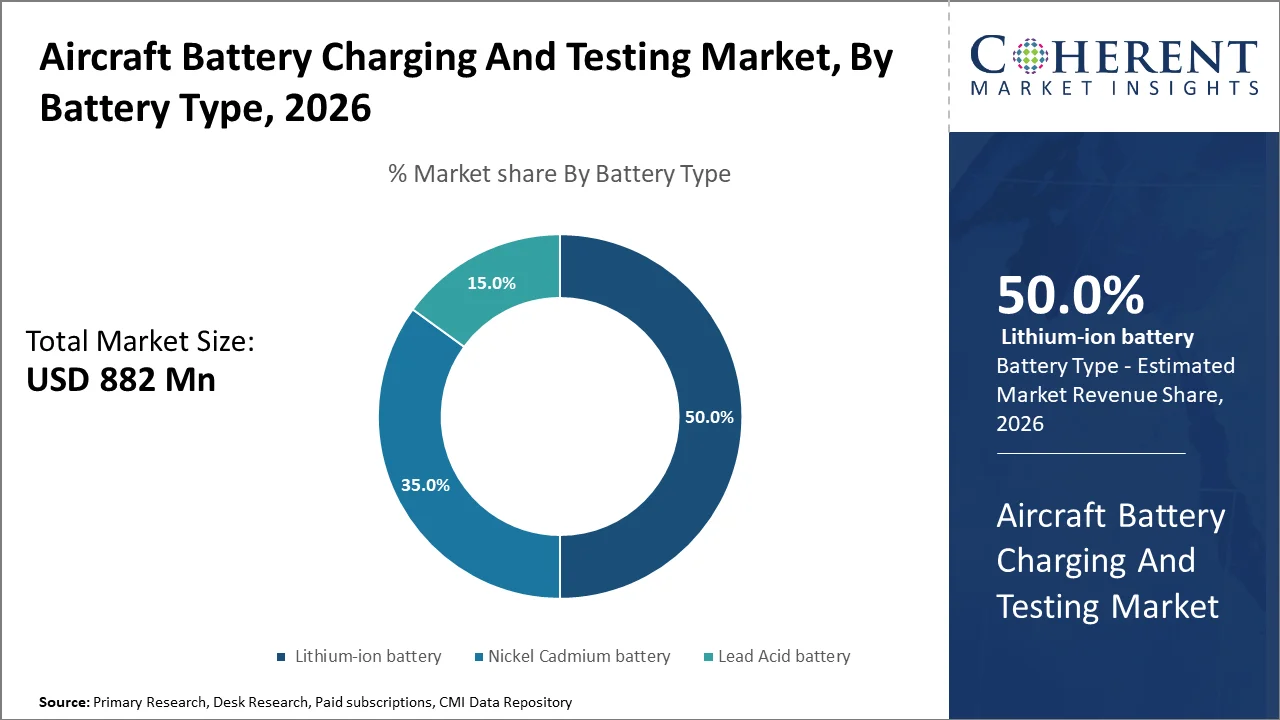
Based on battery type, lithium-ion batteries segment is expected to account for a prominent market share of 50% in 2026. This can be attributed to their high energy density, lightweight construction, and superior charge–discharge efficiency compared to conventional chemistries such as nickel-cadmium (Ni-Cd).
Lithium-ion batteries also offer longer lifecycle performance, faster charging capabilities as well as reduced maintenance requirements. This is making them highly suitable for modern aircraft systems and advanced ground-based charging and testing equipment. In addition, increasing electrification of aircraft subsystems and growing demand for fuel-efficient aviation technologies are encouraging their adoption.
Market Dynamics
Aircraft Battery Charging And Testing Market Growth Drivers
Expansion of global aircraft fleets
The continued expansion of global aircraft fleets is providing a strong impetus for the growth of aircraft battery charging and testing market. Rising commercial air passenger traffic, increasing aircraft deliveries, and fleet modernization initiatives are expanding the installed base of aircraft batteries that require regular charging, maintenance, inspection, and testing.
For example:
- In January 2026, Delta Air Lines placed an order for 31 widebody aircraft, including 16 A330-900 and 15 A350-900 aircraft, to support its international expansion and accelerate fleet renewal.
- In October 2025, IndiGo placed a firm order for 30 additional Airbus A350-900 aircraft, bringing its total A350 orders to 60 as part of its long-haul international expansion strategy.
As airlines continue to expand and modernize their fleets, the number of aircraft batteries requiring routine charging, maintenance, and performance testing is expected to increase significantly. This trend is anticipated to create strong demand for aircraft battery charging and testing equipment, services, and maintenance solutions throughout the forecast period.
Aircraft Battery Charging And Testing Market Opportunities
Shift Towards More-Electric Aircraft (MEA)
Increasing adoption of electric and hybrid-electric aircraft is expected to create lucrative growth opportunities for the aircraft battery charging and testing market during the forthcoming period. Aircraft design is rapidly shifting from hydraulic and mechanical systems toward electrified systems, including brakes, actuators, avionics, and power distribution. This transition increases the number of onboard batteries, their complexity, and the need for more frequent and precise testing. As a result, demand for advanced battery charging and testing solutions is expected to rise. For instance, in July 2024, JEKTA partnered with ZeroAvia to develop a hydrogen-electric amphibious aircraft. Similarly, VoltAero unveiled the production version of its Cassio 330 electric-hybrid aircraft in June 2026.
Aircraft Battery Charging And Testing Market Trends
Rising Focus on Aircraft Safety and Reliability
Increasing emphasis on enhancing aircraft safety and reliability is a key growth-shaping trend in the aircraft battery charging and testing market. Aviation is a safety-critical industry, and batteries play a vital role in powering emergency backup systems, avionics, and auxiliary power units (APUs). This is driving demand for battery charging and testing solutions, including predictive diagnostics, capacity testing, and charge acceptance testing, to ensure optimal battery performance, reliability, and regulatory compliance.
Current Events and Their Impact
Current Event | Description and its Impact |
Rising lithium battery safety incidents in aviation |
|
Stricter aviation battery safety and certification focus (FAA/EASA regulatory tightening) |
|
Regional Insights
North America to Retain its Market Dominance Through 2033
North America is projected to account for 40% of the global Aircraft Battery Charging and Testing Market share in 2026. The dominance is attributable to its large commercial and military aircraft fleet, increasing aircraft maintenance activities, and growing adoption of advanced battery technologies in modern aircraft. Rising investments in aircraft safety, fleet modernization, and maintenance, repair, and overhaul (MRO) operations are also fueling demand for battery charging and testing equipment in the region.
Continued expansion and maintenance of the aviation fleet, which increases the need for regular battery inspection, charging, and performance testing, is providing a strong impetus for the growth of North America aircraft battery charging and testing market. According to the International Air Transport Association (IATA), the global commercial aircraft backlog exceeded 17,000 aircraft in 2024, while the MRO market is expected to reach nearly USD 120 billion in 2025. This, in turn, is set to fuel demand for aircraft maintenance activities that require battery servicing and testing.
Asia Pacific Becoming a Central Hub for Industry Players
Asia Pacific is expected to emerge as the most lucrative market for Aircraft Battery Charging and Testing companies, registering a CAGR of 8.2% during the forecast period. This is mostly due to rapid expansion of commercial aviation, rising aircraft deliveries, increasing MRO investments, and growing defense aviation spending across nations like China, India, Japan, and South Korea. The region is also witnessing increased adoption of advanced and lithium-based aircraft batteries, creating higher demand for specialized charging and testing systems.
Rapid increase in aircraft fleets across emerging economies is boosting Asia Pacific aircraft battery charging and testing market. For example, India’s commercial aviation fleet size is forecast to almost triple, from around 850 aircraft currently to 2,250 aircraft in 2035, on account of robust passenger traffic growth and airline expansions. Such an increase in the number of aircraft would result in higher demands for battery management services.
Aircraft Battery Charging And Testing Market Outlook – Country-wise
U.S. Aircraft Battery Charging And Testing Market Trends
The United States is expected to remain a leading market for aircraft battery charging and testing solutions during the assessment period. This can be attributed to the country’s large commercial and military aircraft fleet, expanding MRO activities, and increasing adoption of advanced aircraft battery technologies. Growing investments in fleet modernization and aviation safety are also boosting demand for battery charging and testing equipment.
China Aircraft Battery Charging And Testing Market Forecast
China’s aircraft battery charging and testing market is poised to witness strong growth during the assessment period. This is due to expansion of the commercial aviation sector, rising domestic aircraft production, and increasing investments in aviation infrastructure. By the end of 2025, China operated 65 commercial airlines with a fleet of 4,574 commercial aircraft, including 220 domestically manufactured planes. The country’s growing focus on indigenous aircraft programs and airline fleet expansion is generating higher demand for battery maintenance and testing systems.
Who are the Major Companies in the Aircraft Battery Charging And Testing Market?
Some of the major players in aircraft battery charging and testing market are ATEQ AVIATION, Blue Skies Aviation, DUNCAN AVIATION INC., Saft, ARBIN INSTRUMENTS, Concorde Battery Corporation, Enersys, The Boeing Company, GS Yuasa Corporation, and Securaplane Technologies, Inc.
Key Strategies Adopted by Industry Players
Leading companies in the aircraft battery charging and testing market are adopting various strategies to expand their regional presence as well as gain a competitive advantage. These include new product launches, mergers, acquisitions, partnerships, facility expansions, and distribution agreements.
Recent Developments in the Aircraft Battery Charging And Testing Market
- In June 2026, EnerSys introduced EZSelect Lite, a battery-room management system designed for easy installation and operation. The system provides real-time monitoring and built-in diagnostics to help improve battery performance and maintenance.
- In September 2025, Duncan Aviation added aircraft battery services to its Scottsdale Satellite Shop in Arizona. The new facility offers battery testing, maintenance, repair, and replacement services for aircraft operators.
Market Report Scope
Aircraft Battery Charging And Testing Market Report Coverage
| Report Coverage | Details | ||
|---|---|---|---|
| Base Year: | 2025 | Market Size in 2026: | USD 882 Mn |
| Historical Data for: | 2020 To 2024 | Forecast Period: | 2026 To 2033 |
| Forecast Period 2026 to 2033 CAGR: | 7.8% | 2033 Value Projection: | USD 1,494.2 Mn |
| Geographies covered: |
| ||
| Segments covered: |
| ||
| Companies covered: | ATEQ AVIATION, Blue Skies Aviation, DUNCAN AVIATION INC., Saft, ARBIN INSTRUMENTS, Concorde Battery Corporation, Enersys, The Boeing Company, GS Yuasa Corporation, Securaplane Technologies, Inc. | ||
| Growth Drivers: |
| ||
| Restraints & Challenges: |
| ||
Analyst Opinion (Expert Opinion)
- Rising electrification in aircraft systems is increasing dependency on reliable batteries. Modern aircraft use more electrical systems for backup power and operations. This increases the need for frequent charging and accurate testing as well as fuels demand for advanced aircraft battery charging and diagnostic equipment.
- Shift toward lithium-ion batteries in aviation is changing maintenance needs. New-generation aircraft are adopting lithium-ion batteries for better efficiency and weight reduction, but they require strict monitoring and precise charging control. As a result, there is an increase in the adoption of smart battery testers and safety-focused charging systems.
- Safety standards in the aviation industry are mandating frequent battery test cycles. This is due to the need by the aviation authorities to ensure the batteries are always in good condition without risks of failure or overheating in the aircraft.
- According to the U.S. Federal Aviation Administration (FAA), more than 400 lithium battery-related incidents have been reported in aviation transport over the years, showing ongoing safety concerns. As a result, the demand for aircraft battery charging and testing services is expected to increase steadily during the forecast period.
Speak to the analyst
Want personalized insights?
Take the findings above to one of our principal consultants, or have the report rebuilt around the segments, geographies and competitors you actually track.
Market Segmentation
- By Aircraft Type Insights ( Revenue, USD Mn, 2021 - 2033)
- Commercial Aircraft
- Private Aircraft
- By Battery Type Insights ( Revenue, US$ Mn, 2021 - 2033)
- Nickel Cadmium battery
- Lead Acid battery
- Lithium-ion battery
- By Battery Charging Type Insights ( Revenue, US$ Mn, 2021 - 2033)
- Constant Voltage Charging (CP)
- Constant Current Charging
- By Battery Testing Type Insights ( Revenue, US$ Mn, 2021 - 2033)
- Capacity Test
- Charge Acceptance Test
- By Region Insights ( Revenue, US$ Mn, 2021 - 2033)
- North America
- U.S.
- Canada
- Latin America
- Brazil
- Argentina
- Mexico
- Rest of Latin America
- Europe
- Germany
- U.K.
- Spain
- France
- Italy
- Russia
- Rest of Europe
- Asia Pacific
- China
- India
- Japan
- Australia
- South Korea
- ASEAN
- Rest of Asia Pacific
- Middle East & Africa
- GCC Countries
- Israel
- Rest of Middle East & African
- North America
- Key Players in the Aircraft Battery Charging And Testing Market
- ATEQ AVIATION
- Blue Skies Aviation
- DUNCAN AVIATION INC.
- Saft
- ARBIN INSTRUMENTS
- Concorde Battery Corporation
- Enersys
- The Boeing Company
- GS Yuasa Corporation
- Securaplane Technologies, Inc.
Sources
Primary Research interviews
- Interviews conducted with aircraft maintenance engineers, aviation MRO professionals, airline technical staff, battery system manufacturers, and airport ground support equipment operators
Databases
- Government aviation databases
- Civil aviation regulatory databases
- Aircraft maintenance and safety databases
- Aerospace component registration databases
- Trade and customs databases
- International aviation safety data repositories
Magazines
- Aviation industry magazines
- Aerospace technology publications
- Aircraft maintenance and engineering magazines
- Airline operations journals
Journals
- Peer-reviewed aerospace engineering journals
- Electrical systems and battery technology journals
- Aviation maintenance and reliability engineering journals
- Energy storage technology research journals
Newspapers
- Leading national and international newspapers covering aviation developments
- Aerospace industry updates
- Energy storage advancements
- Transportation technology news
Associations
- Civil aviation authorities
- Aircraft maintenance and engineering associations
- Aerospace industry bodies
- Airline operator associations
- Battery technology and energy storage associations
Public Domain sources
- Government aviation safety reports
- Regulatory authority publications
- Publicly available technical white papers
- Aircraft manufacturer technical documentation
- Patent filings
- International aviation organization reports
Proprietary Elements
- CMI Data Analytics Tool
- Proprietary CMI Existing Repository of information for last 8 years.
Get access to 250+ pages report
Every segment, forecast, competitor profile and data table behind the analysis above — available for instant download.
- ESOMAR Member
- ISO 9001:2015 Certified
- D-U-N-S Registered
- GDPR & CCPA Compliant
Missing comfort of reading report in your local language? Find your preferred language:
Transform your Strategy with Exclusive Trending Reports
Frequently Asked Questions
The global market is estimated to be valued at US$ 882 Mn in 2026.
The global Aircraft Battery Charging And Testing Market value is expected to reach US$ 1,494.2 Mn by 2033.
The global market is poised to exhibit a CAGR of 7.8% from 2026 to 2033.
Major growth factors include the increase in air travel, expanding aircraft fleet, and rising demand for chargeable battery.
Commercial aircraft segment is expected to lead the market with a share of 70% in 2026.
Some major companies in the Aircraft Battery Charging And Testing Market include ATEQ AVIATION, Blue Skies Aviation, DUNCAN AVIATION INC., Saft, ARBIN INSTRUMENTS, Concorde Battery Corporation, Enersys, The Boeing Company, GS Yuasa Corporation, and Securaplane Technologies, Inc.
North America, with 40% share in 2026, is set to lead the market during the forecast period.