

Cable Glands Market Size & Forecast 2026-2033
Cable Glands Market is estimated to be valued at USD 2,222.4 Mn in 2026 and is expected to reach USD 3,408.5 Mn in 2033, exhibiting a compound annual growth rate (CAGR) of 6.3% from 2026 to 2033.
Key Takeaways
- Based on Type, the Non-Hazardous Area Cable Glands segment is expected to account for 75.3% of the market share in 2026, due to their critical role in ensuring safety and reliability in environments where explosive gases, vapors, or dust are present.
- Based on Cable Type, the Armored Cable Glands segment is projected to capture the largest share of the market in 2026, due to their ability to provide superior protection and reliability in harsh and industrial environments.
- Based on Material Type, the Brass Cable Glands segment is expected to hold the highest share of the market in 2026, due to their superior durability, corrosion resistance, and mechanical strength.
- Based End User Industry, the Oil and Gas segment is expected to hold the largest share of the global cable glands market, accounting for the greatest share in 2026, due to the critical need for safety, reliability, and protection in harsh and hazardous environments.
- Based on Region, Asia Pacific is expected to lead the global cable glands market in 2026 with a 29.2% share. While, North America, with a 27.3% share, will be the fastest-growing region.
Market Overview
The cable glands market is growing steadily, driven by accelerating demand across industries such as oil & gas, energy, mining, chemicals, and telecommunications. Cable glands, also known as cable fittings or connectors, play a vital role in securing and sealing cables, ensuring safety and protection against dust, moisture, and harsh conditions. Increasing adoption of flameproof and corrosion-resistant cable glands, along with stricter safety regulations, is boosting the cable glands market growth.
Current Events and their Impact on the Cable Glands Market
Current Event | Description and its Impact |
Industrial Automation and Industry 4.0 Adoption |
|
Renewable Energy Infrastructure Expansion |
|
Macro And Microeconomic Factors Affecting the Cable Glands Market
Macroeconomic Factors
- Industrial Growth & Infrastructure Development – Rapid expansion in manufacturing, energy, construction, and transportation sectors globally drives demand for cable glands as essential components for safe electrical and communication systems.
- Government Regulations & Safety Standards – Stricter compliance requirements and electrical safety regulations in developed and emerging economies boost adoption of certified cable glands.
- Technological Advancements – Innovations in materials (brass, stainless steel, plastic) and specialized designs (flameproof, corrosion-resistant, explosion-proof) create new opportunities for safer and efficient installations.
- Global Trade & Supply Chain Dynamics – Fluctuations in raw material prices, import-export policies, and tariffs influence manufacturing costs and market availability.
- Energy & Power Sector Expansion – Growth in renewable energy projects, grid modernization, and electrification programs increases the need for reliable cable management solutions.
Microeconomic Factors
- Customer Demand & Industry Requirements – Specific needs from oil & gas, construction, power utilities, and manufacturing sectors dictate product specifications, driving innovation and customization.
- Competitive Landscape & Pricing – Market players compete on price, quality, and service offerings, influencing demand for premium versus standard cable glands.
- Raw Material Availability & Cost – Price and accessibility of brass, aluminum, and plastic impact production costs and product pricing.
- Distribution Channels & Supplier Networks – Efficient supply chain and distributor networks ensure product availability across industrial hubs, enhancing market penetration.
- Technological Integration – Incorporation of IoT and smart monitoring features in cable glands increases product value and differentiation in the market.
- Current Industry Events of 2026
- Market Size Estimation
- Regional Breakdown
- Competitive Landscape
- Customer Intelligence
- Segmental Analysis
- Pricing Analysis
- Key Market Drivers, Challenges & Future Trends
- Customized Insights Section
Segmental Insights
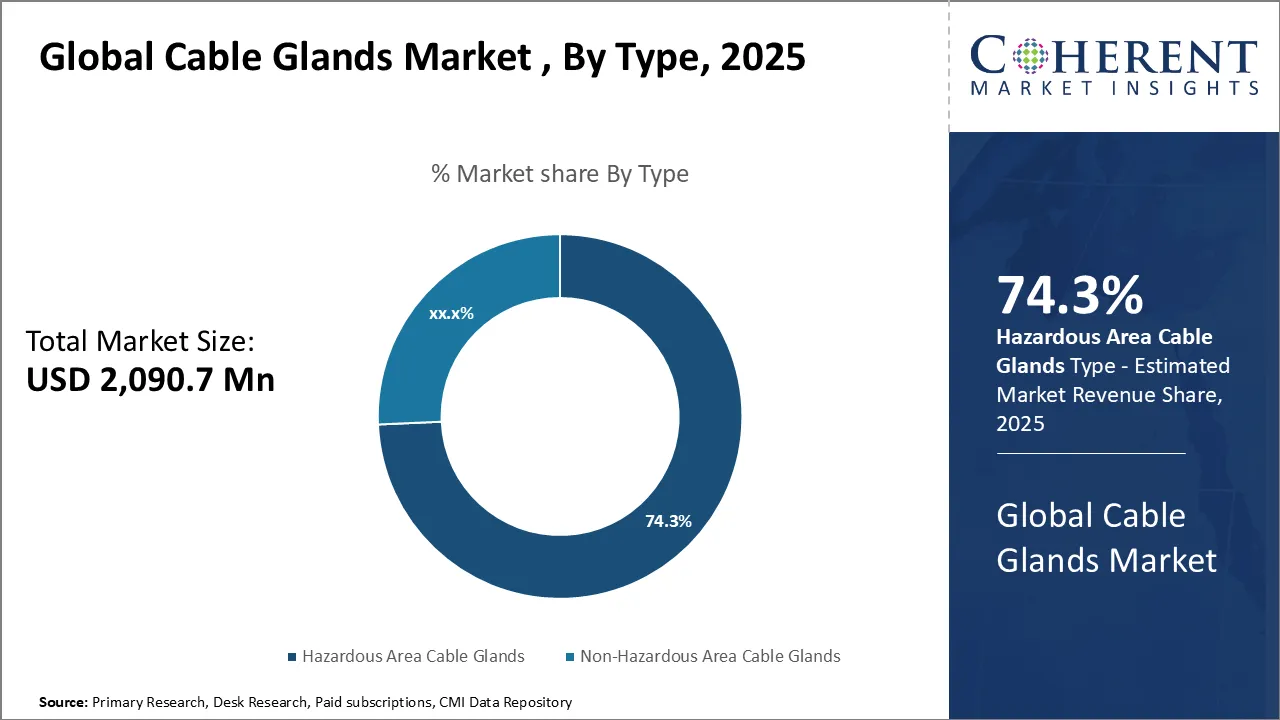
Cable Glands Market Insights, By Type: Hazardous Area Cable Glands Dominates as It Ensure Safety and Reliability In Hard Environment
In terms of type, the hazardous area cable glands segment remains the dominant in the cable glands market with a projected share of 75.3% in 2026 due to their critical role in ensuring safety and reliability in environments where explosive gases, vapors, or dust are present. Industries such as oil & gas, chemical processing, mining, and petrochemicals operate in high-risk zones where equipment failure or spark generation can lead to catastrophic accidents. Hazardous area cable glands are specifically designed to prevent ignition, provide robust sealing, and withstand extreme conditions, including high temperatures, pressure variations, and corrosive atmospheres. Increasing safety regulations and compliance standards globally, combined with the expansion of industrial facilities in emerging economies, are further driving the adoption of these specialized cable glands, making them a vital component in industrial electrical installations.
For instance, in March 2025, CabexIndia, a leading provider of industrial cable management solutions, launched a new range of Hazardous Area Cable Glands designed to meet stringent safety standards in explosive and flammable environments. These high-performance glands offer superior protection for electrical connections in sectors such as oil & gas, petrochemicals, mining, and manufacturing.
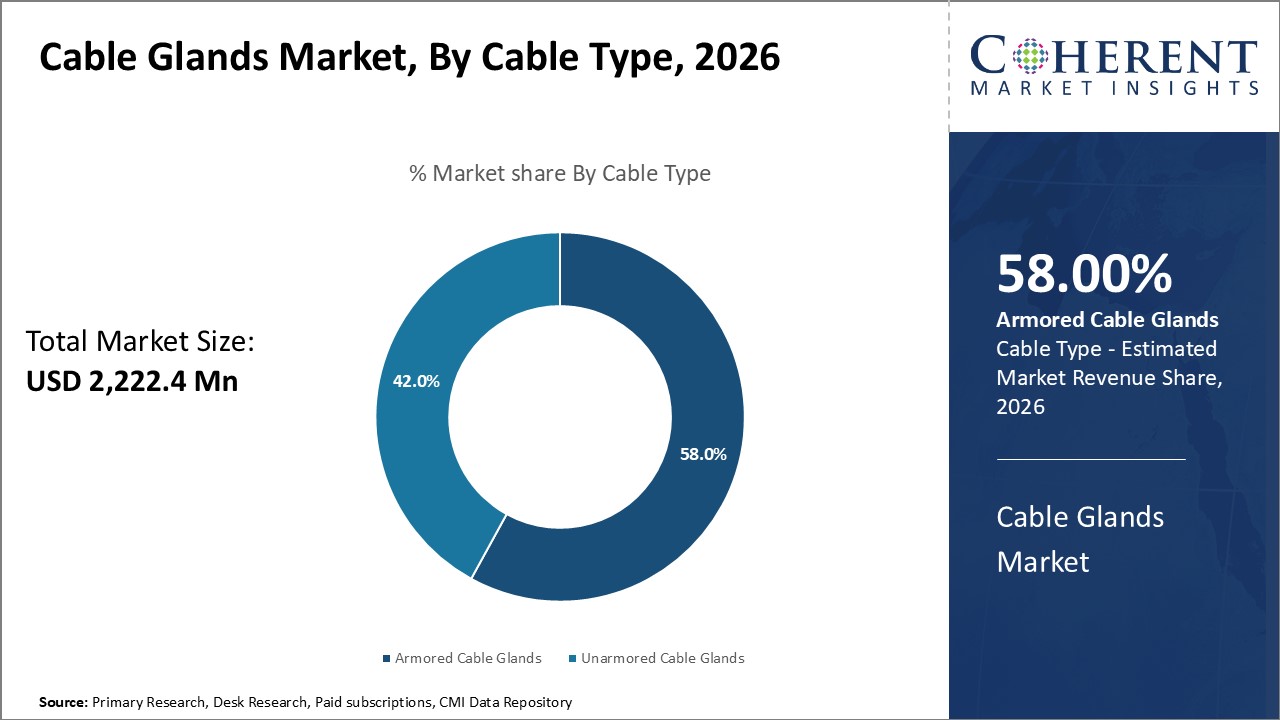
Cable Glands Market Insights, By Cable Type: Armored Cable Glands Segment Dominance is Driven by Its Ability to Provide Superior Protection and Reliability
In terms of cable type, the armored cable glands segment is expected to hold the largest share of the market in 2026, due to their ability to provide superior protection and reliability in harsh and industrial environments. These glands are designed to secure and terminate armored cables, which are commonly used in high-voltage, heavy-duty, and hazardous applications, including oil & gas, power generation, mining, and chemical processing. The armored design protects the cable from mechanical stress, crushing, vibration, and environmental factors such as moisture, dust, and chemicals, ensuring operational safety and longevity. Additionally, industries facing strict safety and compliance standards prefer armored cable glands to meet regulatory requirements and reduce the risk of electrical failures or accidents, making them a preferred choice across critical infrastructure projects.
For instance, in August 2024, Beisite Electric has highlighted significant advancements in metal cable glands, emphasizing their impact on electrical and engineering industries. The company notes that the adoption of stainless steel over traditional materials enhances corrosion resistance and mechanical strength, extending service life in harsh environments. Innovations such as armored cable glands with integrated clamping mechanisms simplify installations, reducing labor costs.
Cable Glands Market Insights, By Material Type: Brass Cable Glands leads the Market Propelled by Superior Durability and Corrosion Resistance
In terms of material type, the brass cable glands segment holds the highest share of the market in 2026, due to their superior durability, corrosion resistance, and mechanical strength. Brass offers excellent resistance to environmental factors such as moisture, chemicals, and extreme temperatures, making it ideal for both industrial and hazardous applications. For instance, HUMMEL Cable Glands are made from premium-quality plastic, brass, and stainless steel. It is widely used in oil & gas, power generation, construction, and manufacturing sectors where safety and reliability are critical. Additionally, brass cable glands provide effective shielding against electromagnetic interference (EMI) and ensure secure grounding, further increasing their adoption in high-performance electrical and instrumentation systems. Their versatility, longevity, and compliance with international safety standards make them a preferred choice for global cable management solutions.
Cable Glands Market Insights, By End User: Dominance of Oil and Gas Industry is Driven by the Need for Safety, Reliability and Protection in Harsh Environment
In terms of end user, the oil and gas segment is expected to hold the greatest share of the market in 2026, due to the critical need for safety, reliability, and protection in harsh and hazardous environments. Cable glands are essential for securing and sealing cables in refineries, offshore platforms, pipelines, and petrochemical plants, where exposure to flammable gases, dust, moisture, and extreme temperatures is common. Strict industry safety regulations and standards, such as ATEX and IECEx certifications, require the use of high-quality, explosion-proof, and flameproof cable glands. Additionally, the ongoing expansion of upstream and downstream oil and gas projects, along with investments in infrastructure modernization and digital automation, further fuels the adoption of durable and reliable cable glands in the sector.
For instance, in July 2025, LAPP India enhanced its cable gland portfolio with the SKINTOP® range, offering high-performance solutions for diverse industrial applications. The new range is designed to ensure safety, reliability, and durability in demanding environments, including the oil and gas sector.
Regional Insights
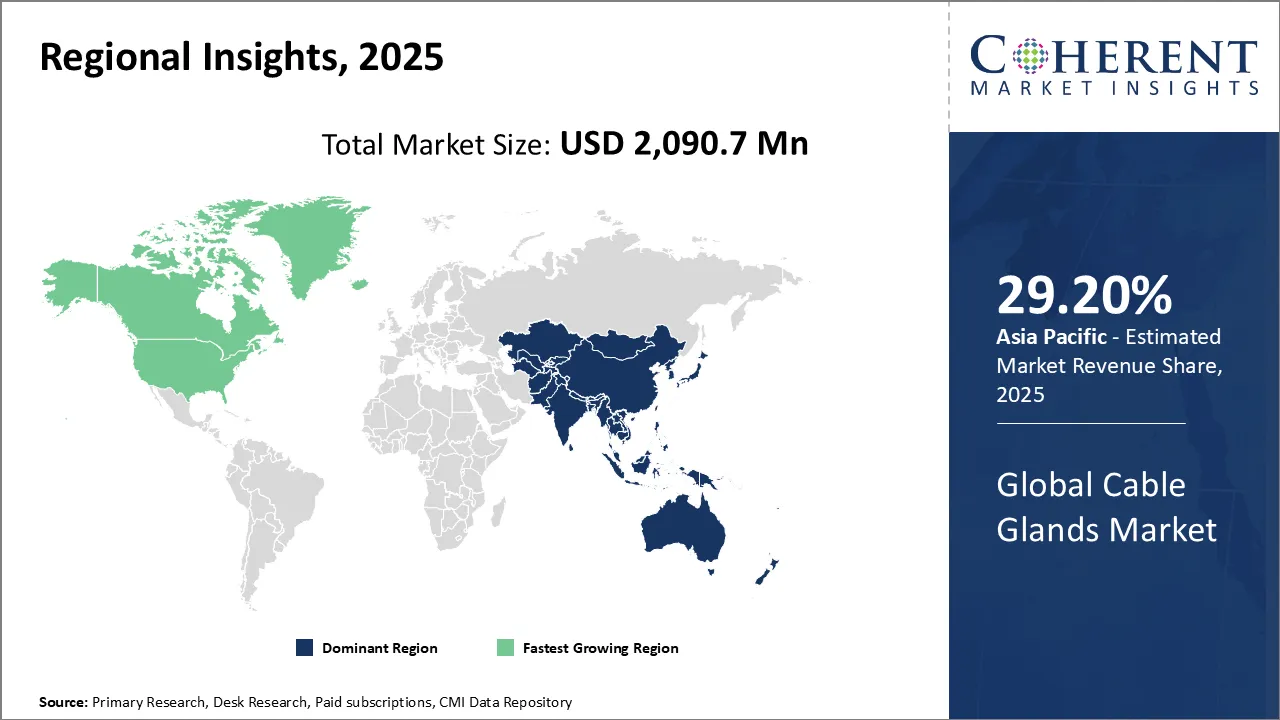
Asia Pacific Cable Glands Market Analysis & Trends
Asia Pacific is expected to lead the market, holding a share of 29.20% in 2026, due to rapid industrialization, urbanization, and infrastructure development across countries such as China, India, and Southeast Asian nations. Expanding sectors like power and utilities, manufacturing, construction, and telecommunications are driving the need for reliable cable management and protection solutions. Additionally, large-scale investments in renewable energy projects, smart grids, and industrial automation are further boosting the adoption of cable glands. The region’s focus on meeting safety standards and regulatory compliance in industrial and commercial facilities also contributes significantly to the growing market demand.
For instance, in July 2026, the Green Climate Fund (GCF) approved a USD 200 million funding initiative to support India's clean energy transition. This program, led by the Asian Development Bank (ADB), establishes the India Green Finance Facility (IGFF), a blended finance mechanism designed to mobilize both public and private investments in emerging clean energy technologies. The IGFF will provide concessional credit lines to India's development finance institutions (DFIs), enabling them to finance projects in sectors such as round-the-clock renewable energy, green hydrogen, compressed biogas, electric transport infrastructure in rural areas, and decentralized renewable energy solutions. Such initiatives are propelling the cable glands market demand across the region.
North America Cable Glands Market Analysis & Trends
North America region is expected to exhibit the fastest growth in the cable glands market share of 27.3% in 2026. The region has a high concentration of industrial, energy, and manufacturing facilities, which require reliable cable management solutions to ensure operational safety and efficiency. Strict government regulations and compliance standards, such as OSHA and NEC (National Electrical Code), mandate the use of certified cable glands to prevent electrical hazards and ensure worker safety. Additionally, ongoing investments in renewable energy projects, smart grid infrastructure, and industrial automation are driving the adoption of advanced and flameproof cable glands. The need for robust, durable, and corrosion-resistant cable glands in harsh or hazardous environments further fuels the market, positioning North America as a key growth region.
Cable Glands Market Outlook Country-Wise
The U.S. Cable Glands Market Trends
The cable glands market is strong in the U.S. due to a robust industrial base, including oil & gas, power, and manufacturing, which requires reliable cable management. Strict safety and electrical standards, along with growth in renewable energy, industrial automation, and infrastructure development, further boost cable glands market growth.
For instance, in June 2026, Amphenol Industrial Operations has launched the GuardXcel™ Series of industrial cable glands, designed to provide robust protection for cables and enclosures in harsh environments. These glands are available in materials such as nickel-plated brass, stainless steel, and plastic, offering versatility to meet diverse application needs. The series ensures reliable sealing and strain relief, preventing connection failures and cable damage.
China Cable Glands Market Trends
The Cable Glands Market is in high demand in China due to rapid industrialization, urbanization, and growth in power, telecom, oil & gas, and renewable energy sectors. Strict safety standards, adoption of durable and corrosion-resistant cable glands, and rising investments in smart factories and automated infrastructure are driving strong Cable Glands Market demand.
For instance, in August 2026, Hoonsun Connector participated in the 2026 China Public Security Expo (CPSE), held in Beijing, highlighting its advancements in cable gland technology. The company presented its Aluminum Alloy Flange Marine Cable Gland, designed for new energy charging stations. This product enhances waterproofing and durability, effectively blocking moisture and dust to protect internal components, thereby reducing risks like leakage and short circuits.
Market Report Scope
Cable Glands Market Report Coverage
| Report Coverage | Details | ||
|---|---|---|---|
| Base Year: | 2025 | Market Size in 2026: | USD 2,222.4 Mn |
| Historical Data for: | 2020 To 2024 | Forecast Period: | 2026 To 2033 |
| Forecast Period 2026 to 2033 CAGR: | 6.3% | 2033 Value Projection: | USD 3,408.5 Mn |
| Geographies covered: |
| ||
| Segments covered: |
| ||
| Companies covered: | Amphenol Corporation, BartecGroup, R.StahlAg, Eaton Group, and Emerson Industrial Automation | ||
| Growth Drivers: |
| ||
| Restraints & Challenges: |
| ||
Global Cable Glands Market Drivers
- Need for renewal and upgrading of existing networks in developed regions to propel the market growth
There are several electrical and communication networks in developed regions that are getting old with time. As per the estimates, several communication and electrical infrastructures in the U.S. have become more than a decade old. Along with the increasing technological development, the demand for modern infrastructure has also increased. Moreover, growing consumption of energy is also creating demand for upgradation of power grids all over the world. According to the World Energy Statistics, the global energy consumption increased by 2.2% in 2024. Thus, this factor is expected to propel growth of the global cable glands market revenue over the forecast period.
- Worldwide growth of construction industry to augment the market pace
The demand for cable glands is increasing across the globe due to rise in growth of construction industry, specifically in emerging regions. The construction industry is growing with higher rate in emerging countries such as India, UAE, and China. Thus, these regions are offering several opportunities for the growth of this market. For instance, India's construction industry to grow by 7.1% in real terms in 2025, driven by public and private sector investments in energy, industrial, and railway projects, coupled with government's plan to expand its nuclear capacity from 8.9GW in 2024 to 100GW by 2047.
Global Cable Glands Market Trends
- Growing digitalization and automation is a major trend in the market
The rise in trend of automation and digitalization is leading to proliferation of robotics in several industries. As per the International Monetary Fund, investments in robotics from Asia are important along with the production automation for the economies of this region, as more than half of the estimated industrial robot stock of the world is in use in the region. Thus, growing adoption of digitalization and automations is creating demand for cable glands in robotic applications. And this in turn is likely to boost the market growth.
- Increasing smart city projects across the globe is a recent trend
The number of smart city projects is increasing all over the world, along with the construction tenders, industry 4.0, and emerging market. This in turn is creating substantial demand for cables and connectors, which in turn is boosting the adoption of cable glands. In the Industry 4.0 era, a huge data volume is transmitted at a fast speed. A same on-going application, which was adapted a long ago in offices is now implemented in factories. Thus, cables are becoming leaner and are designed with insulation and technical tricks for helping save space and to make the devices compact. Thus, these factors are driving growth of the market across the globe.
Global Cable Glands Market: Key Developments
- In May 2025, Icotek launched a new series of cable glands designed to offer flexibility, efficiency, and space-saving benefits. The conical structure allows cables of varying diameters to be securely sealed, reducing the need for multiple gland sizes. This innovation simplifies inventory management and streamlines installation processes. The glands are suitable for applications requiring high-density cable routing, providing a compact solution without compromising on performance.
- In May 2025, Roxtec unveiled the HD 72, the latest addition to its high-density sealing solutions. Designed for advanced cabinets, terminal boxes, and smart junction boxes, the HD 72 accommodates up to 72 armored or non-armored cables in a single transit.
- In December 2024, ABB has acquired Solutions Industry & Building (SIB), a French manufacturer specializing in cable protection systems, to enhance its electrification and safety solutions portfolio. SIB produces premium cable glands, couplings, and accessories in brass, stainless steel, and plastic, catering to industries such as electrical, railway, shipping, and mining, including hazardous environments like oil and gas.
Market Segmentation
- By Type (Revenue, USD Mn, 2021 - 2033)
- Non-hazardous Area Cable Glands
- Hazardous Area Cable Glands
- By Cable Type (Revenue, USD Mn, 2021 - 2033)
- Armored Cable Glands
- Unarmored Cable Glands
- By Material Type (Revenue, USD Mn, 2021 - 2033)
- Brass
- Aluminum
- Plastic
- Stainless Steel
- Other Material Types
- By End User Industry (Revenue, USD Mn, 2021 - 2033)
- Aerospace
- Construction
- Manufacturing and Processing
- Oil and Gas
- Power and Utilities
- Other End user Industries (Marine, Mining, Chemicals)
- By Region (Revenue, USD Mn, 2021 - 2033)
- North America
- U.S.
- Canada
- Latin America
- Brazil
- Argentina
- Mexico
- Rest of Latin America
- Europe
- Germany
- U.K.
- Spain
- France
- Italy
- Russia
- Rest of Europe
- Asia Pacific
- China
- India
- Japan
- Australia
- South Korea
- ASEAN
- Rest of Asia Pacific
- Middle East
- GCC Countries
- Israel
- Rest of Middle East
- Africa
- South Africa
- North Africa
- Central Africa
- North America
- Cable Glands Market Companies
- Amphenol Corporation
- BartecGroup
- StahlAg
- Eaton Group
- Emerson Industrial Automation
Sources
Primary Research Interviews from the following stakeholders
Stakeholders
- Interviews with cable gland manufacturers, electrical equipment suppliers, industrial automation companies, EPC contractors, and distributors across global markets.
- Engagement with facility managers, electrical design engineers, plant operators, and procurement heads in oil & gas, power generation, mining, chemicals, marine, and railway sectors.
Specific Stakeholders
- Electrical and instrumentation engineers at oil & gas companies
- Project managers at renewable energy developers and utilities
- Plant maintenance heads at chemical and mining companies
- Operations managers at railway and metro corporations
- Electrical design consultants for industrial automation projects
- Procurement officers at shipbuilding and marine operators
- Product managers at electrical component OEMs and cable system suppliers
Databases
- World Trade Organization (WTO) Trade Statistics
- UN Comtrade Database
- International Energy Agency (IEA) Statistics
- Eurostat – Industrial Production & Trade
- U.S. Bureau of Economic Analysis (BEA)
- China Customs Statistics
- Japan External Trade Organization (JETRO)
- Korea Customs Service Data Portal
- Directorate General of Commercial Intelligence and Statistics (DGCIS), India
- International Electrotechnical Commission (IEC) Standards Database
Magazines
- Electrical Review
- Industrial Automation Asia
- Control Engineering Magazine
- Oil & Gas Middle East
- Power Engineering International
- MarineLink Magazine
- Mining Weekly – Electrical & Equipment section
- Construction Week (Infrastructure & Utilities section)
Journals
- IEEE Transactions on Industry Applications
- Journal of Electrical Engineering & Technology
- International Journal of Industrial Ergonomics (for safety aspects)
- Journal of Petroleum Technology
- Energy Reports (Elsevier)
- International Journal of Mining Science and Technology
Newspapers
- The Wall Street Journal – Energy & Industry
- The Economic Times – Energy & Infrastructure
- Financial Times – Power & Industry Reports
- Business Standard – Energy & Engineering
- Nikkei Asia – Industrial Manufacturing & Supply Chain
- South China Morning Post – Energy & Industry
Associations
- International Electrotechnical Commission (IEC)
- Institute of Electrical and Electronics Engineers (IEEE)
- National Electrical Manufacturers Association (NEMA), U.S.
- International Association of Drilling Contractors (IADC)
- European Committee for Electrotechnical Standardization (CENELEC)
- Confederation of Indian Industry (CII) – Electrical & Industrial Equipment Forum
- International Council on Mining and Metals (ICMM)
- International Marine Contractors Association (IMCA)
Public Domain Sources
- Ministry of Power, Government of India
- Bureau of Indian Standards (BIS) – Electrical Standards
- U.S. International Trade Commission (USITC)
- U.S. Department of Energy (DOE)
- National Institute of Standards and Technology (NIST), U.S.
- Ministry of Economy, Trade and Industry (METI), Japan
- European Commission – Energy and Industry Reports
- NITI Aayog – Infrastructure and Energy Reports
- Reserve Bank of India (RBI) – Industrial Output & Investment Reports
Proprietary Elements
- CMI Data Analytics Tool, and Proprietary CMI Existing Repository of information for last 8 years
Get access to 250+ pages report
Every segment, forecast, competitor profile and data table behind the analysis above — available for instant download.
- ESOMAR Member
- ISO 9001:2015 Certified
- D-U-N-S Registered
- GDPR & CCPA Compliant
Missing comfort of reading report in your local language? Find your preferred language:
Transform your Strategy with Exclusive Trending Reports
Frequently Asked Questions
The global Cable Glands Market size was valued at USD 2,222.4 Mn in 2026 and is expected to reach USD 3,408.5 Mn in 2033.
The global cable glands market size is estimated to be valued at USD 2,222.4 Million in 2026 and is expected to exhibit a CAGR of 6.3% between 2026 and 2033.
Need for renewal and upgrading of existing networks in developed regions and worldwide growth of construction industry are fuelling the market.
The hazardous area cable glands segment is the leading type segment in the market.
Amphenol Corporation, BartecGroup, R.StahlAg, Eaton Group, and Emerson Industrial Automation.
Cable glands provide secure cable entry, ensuring mechanical support, sealing, strain relief, grounding, and protection against dust, moisture, or hazardous conditions.
Leading Chinese manufacturers include Zhejiang Hummel, Wenzhou Aodi, Ningbo Sunbow, and Weidmüller China, serving domestic and global electrical connectivity markets.