

Elevator Control Market Size and Share Analysis- Growth Trends and Forecasts (2026-2033)
The Elevator Control Market size is anticipated to grow at a CAGR of 5.8% with USD 10.46 Bn in 2026 and is expected to reach USD 15.5 Bn in 2033. The growth of the market is being driven by rising urbanization, high-rise construction, smart building adoption, and increasing modernization of aging elevator infrastructure. Advanced solutions like destination dispatch controls, IoT-enabled monitoring, predictive maintenance, regenerative drive integration, and touchless access systems are improving traffic efficiency, passenger safety, energy use, and service reliability. Around 68% of the global population is projected to live in urban areas by 2050, thereby highlighting a stronger demand for intelligent elevator control systems worldwide.
Key Takeaways
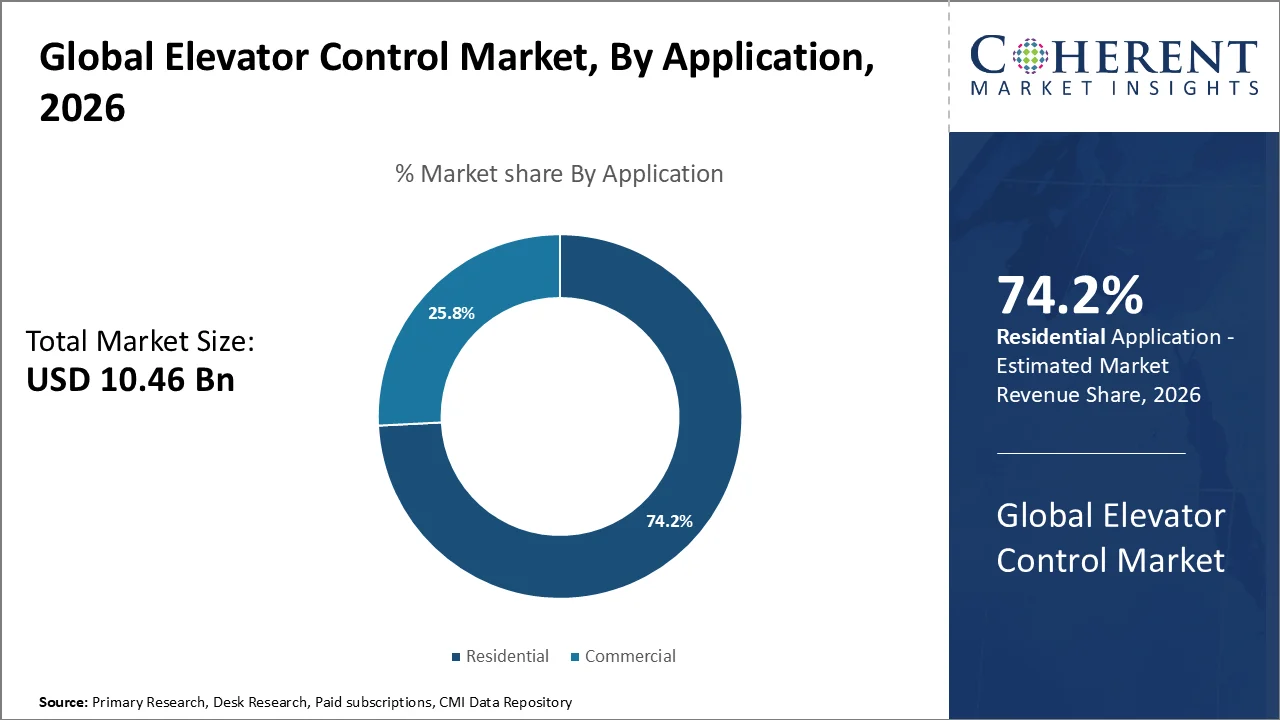
- Residential segment is expected to account for the largest share of 74.2% in 2026. The segment’s growth is owing to the rising construction of high-rise apartments, smart residential complexes, and urban housing projects. The elevator control systems are essential for passenger safety, floor access management, traffic optimization, and energy-efficient lift operations. The increasing modernization of old residential elevators is also supporting the demand for advanced controllers, destination dispatch systems, and IoT-enabled monitoring solutions.
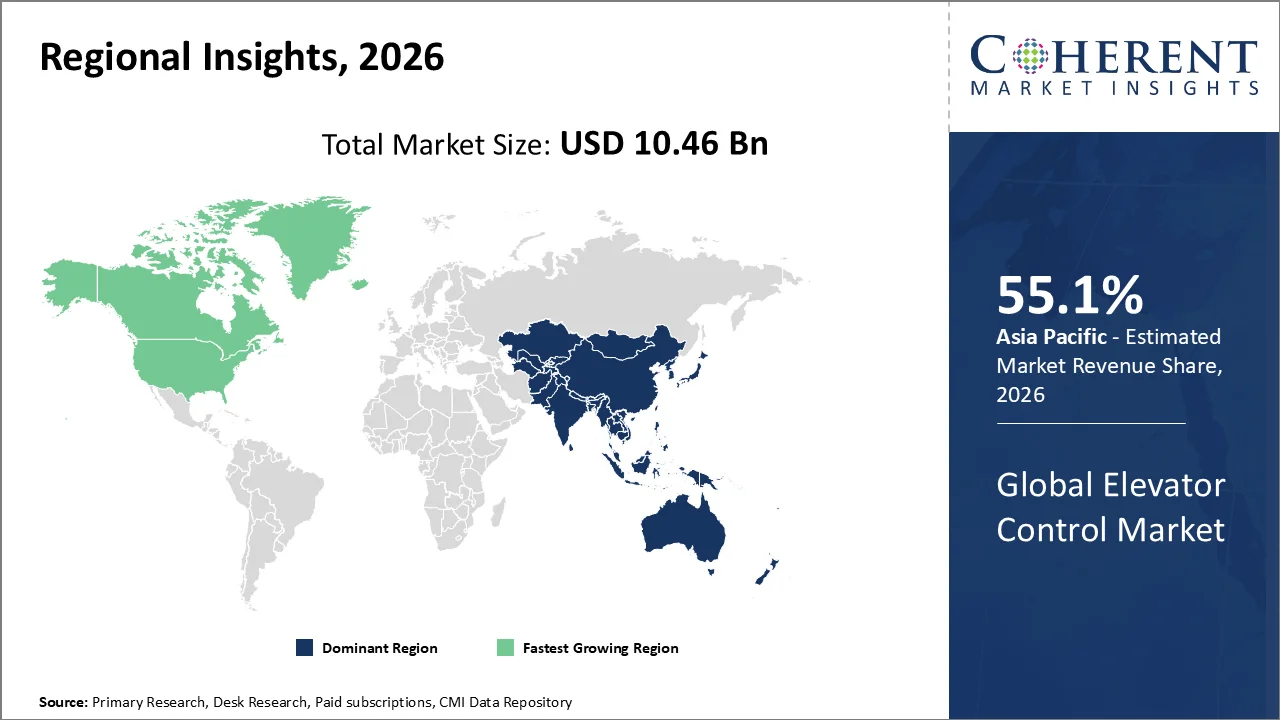
- Asia Pacific is expected to acquire the dominant share of 55.1% in 2026. The region’s growth is owing to the owing to rapid urbanization, large-scale residential construction, smart city development, and strong infrastructure investments across China, India, Japan, South Korea, and Southeast Asia. Asia already accounts for 54% of the global urban population, with more than 2.2 billion people living in cities, highlighting strong long-term demand for elevators and elevator control technologies.
Segmental Insights
Why the Residential Segment Is Acquiring the Highest Share in the Elevator Control Market
By application, residential segment is projected to account for the largest Elevator Control Market share of 74.2% in 2026. The segment’s growth is owing to the rapid urbanization and the proliferation of high-rise housing projects, which integrate smart-home technologies with elevator systems.
United Nations data indicates that over 55% of the global population now resides in urban areas, driving the demand for vertical residential construction and the corresponding need for advanced elevator controls that ensure safety, reliability, and energy efficiency.
In India, the regulatory frameworks like the Bureau of Indian Standards’ IS 17900, adopted by 15 states and one Union Territory, strengthen the adoption of safer and standardized elevator control solutions, thereby influencing product quality as well as pricing.
In February 2026, Arkel India invested ₹100 crore in a new Vadodara facility to manufacture advanced lift control systems. It included automated PCB assembly, MR, MRL, and slim control panels, with annual capacity of around 36,000 units in a single shift.
- Current Industry Events of 2026
- Market Size Estimation
- Regional Breakdown
- Competitive Landscape
- Customer Intelligence
- Segmental Analysis
- Pricing Analysis
- Key Market Drivers, Challenges & Future Trends
- Customized Insights Section
Market Drivers
Shift Toward Smart, Connected, and IoT-Based Elevator Controls is Transforming the Elevator Control Industry
The shift toward smart, connected, and IoT-based elevator controls is transforming the Elevator Control Market by combining safety automation, real-time monitoring, and regulatory traceability.
In India, the Lift and Escalator Act, 2024 has strengthened compliance by introducing mandatory registration for public, private, and government elevators. The official data shows that 12,600 consumer registrations have been completed, thus covering approximately 16,000 individual lifts. This highlights the growing importance of digital records, safety accountability, as well as lifecycle monitoring in the elevator operations.
In December 2024, KONE India launched its SMART elevator series at ISEE which included IS 17900-compliant models equipped with PESSRAL safety technology, AI-enabled 24/7 monitoring, secure system integration, energy-efficient operation, and low harmonic distortion. These developments indicate the rising demand for intelligent elevator controls in both modern commercial as well as residential buildings.
Energy-Efficient Regenerative Drive Controls: A Key Advancement in Elevator Control Marketplace
The energy-efficient regenerative drive controls are a key advancement in the Elevator Control Market. They convert elevator braking energy into reusable electricity instead of releasing it as waste heat through resistors. This technology is relevant in high-rise commercial buildings, hospitals, hotels, metro stations, premium residential towers, where frequent starts, stops, and load changes increase the energy consumption.
The 2025 NYC Energy Conservation Code is also supporting the incorporation by requiring new traction elevators with a rise of 75 feet or more to use power-conversion systems with regenerative drives. It also mandates automatic shutdown of cab lighting and ventilation after 15 minutes when elevators are stopped, unoccupied, and doors are closed.
According to the U.S. Department of Energy, regenerative elevator drives can recover about 25% of total elevator energy use. Otis’ Gen3 elevator, integrated with ReGen drive technology, supports up to 75% lower energy use than conventional hydraulic systems without regenerative controls.
Current Events and Their Impact
Current Event | Description and its Impact |
ASME A17.1-2025 / CSA B44:25 Elevator Safety Code Update |
|
EU Cyber Resilience Act and Machinery Regulation Transition |
|
Elevator Control Market Trends
- The rising adoption of smart elevator controllers, destination dispatch, and IoT-enabled monitoring is improving the passenger flow, uptime, safety, and energy management in high-rise and commercial buildings.
- Modernization of aging elevator fleets is propelling the demand for controller upgrades, variable-frequency drives, door control systems, sensors, and predictive diagnostic platforms.
- Cybersecurity and remote-monitoring requirements are reshaping connected elevator control design. The ASME A17.1/CSA B44 updates added cybersecurity, remote interaction, and test-enable operation requirements.
- Urban density and heavy vertical-transport usage is strengthening the replacement demand. The NEII states the U.S. has around 900,000 elevators, or nearly 1,000,000 when Canada is included, and U.S. elevators complete about 18 billion passenger trips annually.
- OEMs are expanding modular modernization packages. In July 2025, KONE’s Interact 30 Destination Operating Panel won a Red Dot Design Award, reflecting innovation in intelligent elevator destination control. The system improves passenger flow, accessibility, user interaction, and traffic efficiency in both modern commercial as well as high-rise buildings.
Regional Insights
Asia Pacific Elevator Control Market Leadership Driven by Safety Regulations and Modernization Incentives
Asia Pacific is set to account for the leading position in the Elevator Control Market. The region occupies a substantial 55.1% share in 2026. The growth is mainly driven by the rapid urbanization, high‑rise construction, and an aging installed base that necessitates advanced control systems.
In China, the official statistics indicate approximately 11.34 million registered elevators and escalators, with around 1.1 million units older than 15 years. This is creating substantial demand for advanced control systems to enhance safety and efficiency.
The regulatory frameworks are reinforcing this trend. The recently released ISO 8100
A notable industry development is Johnson Lifts’ majority acquisition of Toshiba Johnson Elevators India, aimed at expanding smart elevator offerings with enhanced control technologies for high-rise projects.
North America Elevator Control Market Trends
The North America region is poised to be as the fastest-growing region through 2026-2033. The region’s growth is owing to the increasing urbanization, modernization of aging elevator fleets, and stringent regulatory frameworks for safety and energy efficiency.
According to the official safety code sources, the U.S. elevators account for approximately 18 billion passenger trips annually, thereby highlighting the critical scale of operations and the need for advanced control systems.
In February 2026, Otis launched the Arise MOD Prime and Arise MOD Plus modernization packages. The firm offers updated control systems with integrated IoT analytics designed for low- to mid-rise buildings, thereby enhancing the safety, energy efficiency, and operational reliability in North America.
Regulatory and Digital Integration Mandates Accelerates Elevator Control Adoption in China
The China Elevator Control Market has seen robust growth. The growth is owing to the stringent safety regulations and increasing digital integration mandates. The 2023 Shanghai Elevator Safety Management Measures, effective May 1, 2023, strengthened oversight of production, operation, maintenance, and control systems.
In response, TK Elevator launched its cloud-based MAX platform in April 2022, integrating IoT analytics, predictive maintenance, and AGILE destination control. This solution enhances asset availability, optimizes passenger flow, and improves operational efficiency in large buildings, thereby reflecting the market’s shift toward smart, connected elevator control systems under regulatory guidance.
United States Elevator Control Market Trends
United States Elevator Control Market is rapidly evolving with the increasing adoption of energy-efficient technologies, smart building integration, and stringent safety regulations. The National Institutes of Health (NIH) reports that advanced deep learning controllers like the YOLO object detection framework can reduce commuter wait times by up to 15% and lower energy consumption by 20%.
In April 2025, Schindler Elevator Corporation launched the Schindler 5000, a machine room-less elevator in the U.S. The system incorporates advanced controls for energy efficiency, space optimization, and smoother ride performance, thereby showcasing the innovation aligned with the updated building codes and safety standards.
Who are the Major Companies in Elevator Control Industry
Some of the major key players in Elevator Control industry are SICK AG, Hitachi Ltd., Honeywell International Inc., Hyundai Elevator Co. Ltd., Nidec MCE, Toshiba Elevators and Building Systems, Thames Valley Controls, Mitsubishi Electric
Key News
- In May 2026, INVT Electric showcased its EC160A intelligent elevator controller for India retrofit projects, replacing proprietary systems and restoring elevator performance. The solution reduced maintenance dependency, enabled remote diagnostics, lowered costs, and supported modernization initiatives.
- In April 2026, Hangzhou Optimax Tech Co., Ltd. announced that the global shipments of its Optimax Elevator Control System exceeded 1.1 million units. This milestone reflects the company’s growing international presence and the rising adoption of intelligent elevator control solutions across the world.
Market Report Scope
Elevator Control Market Report Coverage
| Report Coverage | Details | ||
|---|---|---|---|
| Base Year: | 2025 | Market Size in 2026: | USD 10.46 Bn |
| Historical Data for: | 2020 To 2024 | Forecast Period: | 2026 To 2033 |
| Forecast Period 2026 to 2033 CAGR: | 5.8% | 2033 Value Projection: | USD 15.5 Bn |
| Geographies covered: |
| ||
| Segments covered: |
| ||
| Companies covered: | SICK AG, Hitachi Ltd., Honeywell International Inc., Hyundai Elevator Co. Ltd., Nidec MCE, Toshiba Elevators and Building Systems, Thames Valley Controls, Mitsubishi Electric | ||
| Growth Drivers: |
| ||
| Restraints & Challenges: |
| ||
Analyst Opinion
- Elevator control is driven by growing safety and mobility needs. U.S. elevators and escalators move people over 2.55 billion miles annually, which shows the market is not growing only because of new buildings, but it is growing because existing buildings need safer and smarter movement.
- Modernization is becoming as important as new installations. China renovated 280,000 old residential communities by end-2024 and prioritized elevator additions in existing buildings. This is creating a sustained demand for control panels, destination dispatch, drives, sensors, as well as remote monitoring.
- Smart elevator controls are gaining traction with the systems becoming more connected. The ASME A17.1/CSA B44 governs design, installation, inspection, maintenance, alteration, and repair in North America. In addition, Otis launched Arise MOD Prime and Plus in February 2026 to replace legacy control systems with digital technologies and phased upgrades.
Speak to the analyst
Want personalized insights?
Take the findings above to one of our principal consultants, or have the report rebuilt around the segments, geographies and competitors you actually track.
Market Segmentation
- By Application (Revenue, USD Bn, 2021-2033)
- Residential
- Commercial
- Global Elevator Control Market, By Region (Revenue, USD Bn, 2021-2033)
- North America
- U.S.
- Canada
- Latin America
- Brazil
- Mexico
- Argentina
- Rest of Latin America
- Europe
- Germany
- U.K.
- France
- Italy
- Spain
- Russia
- Rest of Europe
- Asia Pacific
- China
- India
- Japan
- Australia
- South Korea
- ASEAN
- Rest of Asia Pacific
- Middle East
- GCC
- Israel
- Rest of Middle East
- Africa
- South Africa
- Central Africa
- North Africa
- North America
- Key Players
- SICK AG
- Hitachi Ltd.
- Honeywell International Inc.
- Hyundai Elevator Co. Ltd.
- Nidec MCE
- Toshiba Elevators and Building Systems
- Thames Valley Controls
- Mitsubishi Electric
Sources
Primary Research Interviews
- Elevator Control System Manufacturers
- Elevator OEMs and Component Suppliers
- Elevator Modernization Contractors
- Lift Installation and Maintenance Service Providers
- Building Automation and Smart Building Solution Providers
- Facility Managers and Real Estate Developers
- Electrical and Control Panel Engineers
- Others
Databases
- Bloomberg Terminal
- Thomson Reuters Eikon
- Factiva
- Others
Magazines
- Elevator World
- Lift Industry News
- LIFTjournal
- Control Engineering Magazine
- Consulting-Specifying Engineer Magazine
- Buildings Magazine
- Others
Journals
- Elevator Technology – Proceedings of Elevcon
- Automation in Construction
- Building Services Engineering Research and Technology
- IEEE Transactions on Industrial Electronics
- IEEE Access
- Journal of Building Engineering
- Others
Newspapers
- Financial Times
- The Wall Street Journal
- Reuters
- Bloomberg News
- The Economic Times
- Construction Week
- Others
Associations
- National Elevator Industry, Inc. (NEII)
- National Association of Elevator Contractors (NAEC)
- European Lift Association (ELA)
- International Association of Elevator Engineers (IAEE)
- Elevator & Escalator Safety Foundation (EESF)
- Chartered Institution of Building Services Engineers (CIBSE) – Lifts Group
- Others
Public Domain Sources
- U.S. Occupational Safety and Health Administration (OSHA)
- U.S. Census Bureau – Construction and Building Statistics
- Eurostat – Construction and Building Activity Data
- Bureau of Indian Standards (BIS) – Lift and Elevator Standards
- International Organization for Standardization (ISO) – Lift Safety Standards
- ASME A17.1 / CSA B44 Elevator and Escalator Code References
- World Bank Open Data
- Others
Proprietary Elements
- CMI Data Analytics Tool
- Proprietary CMI Existing Repository of Information for the Last 10 Years
Get access to 250+ pages report
Every segment, forecast, competitor profile and data table behind the analysis above — available for instant download.
- ESOMAR Member
- ISO 9001:2015 Certified
- D-U-N-S Registered
- GDPR & CCPA Compliant
Missing comfort of reading report in your local language? Find your preferred language:
Transform your Strategy with Exclusive Trending Reports
Frequently Asked Questions
The Elevator Control Market is expected to reach USD 15.5 Billion in 2033.
The market outlook remains positive due to rapid urbanization, smart city development, growing construction of high-rise buildings, and increasing replacement of conventional elevator controllers with smart systems.
The high upfront capital expenditure, complex safety regulations, and integration challenges are the key factors hampering growth of the market.
The surge in high-rise construction, the demand for energy-efficient smart buildings, and advancements in IoT-enabled predictive maintenance is boosting demand for Elevator Control.
The Elevator Control Market is anticipated to grow at a CAGR of 5.8% between 2026 and 2033.
Among regions, Asia Pacific is expected to account for a largest market share in the global Elevator Control Market over the forecast period.
The market encompasses the hardware, software, and services used to operate, monitor, and optimize vertical transportation systems in residential, commercial, and industrial buildings.