

Global Quantum Sensors Market Size and Share Analysis – 2026 to 2033
The quantum sensors market is estimated to be valued at USD 948.6 Mn in 2026 and is expected to reach USD 2,648.9 Mn by 2033, growing at a compound annual growth rate (CAGR) of 15.8% from 2026 to 2033.
Key Takeaways
- Based on Product, Magnetic Sensors Segment holds the largest share of 37.6% in 2026. This is due to extensive technological advancements in this field and wide usage across various industries.
- Based on Industry Verticals, The Military & Defense Vertical Segment holds the largest share in the quantum sensors market with 39% in 2026. This is due to numerous critical application areas that rely on state-of-the-art sensing capabilities.
- The North American region currently dominates the global quantum sensors market owing 46.3% in 2026. This is due to significant investments being made in the region by both public and private entities towards quantum technologies and its applications.
Market Overview
Some key factors driving the growth of the quantum sensors market include rising investments in the development of quantum computing technology by governments and private organizations worldwide. Quantum sensors offer unprecedented precision and abilities that surpass their classical counterparts. Many technology giants and startups are investing heavily in building quantum computers, boosting the demand for high precision quantum sensors for use in areas like navigation, timing, and communication. There is also an increased focus on developing practical quantum technologies for applications in defense, cybersecurity, and medical diagnostics where quantum sensors can play a pivotal role.
Current Events and Its Impacts on Quantum Sensors Market
Current Events | Description and its impact |
Government-Funded Quantum Navigation Projects Accelerate Rollout of Real-World Sensors |
|
Application of Quantum Sensors in GPS-Free Navigation in Defense & Aerospace |
|
Role of Emerging Technologies
Quantum sensors are dependent on extremely sensitive measurement at the atomic or subatomic level, technological developments in such fields as cryogenics, nanofabrication, and lasers have enabled the stabilization and regulation of quantum states with significantly higher accuracy. For instance, advancements in miniature laser systems and ultra-low-noise electronics are contributing to miniaturization and lowering the power requirements of quantum sensors, making them easier to use in the field rather than being limited to laboratories.
Further, advancements in artificial intelligence and machine learning are paving the way for improved data interpretation from quantum sensing hardware, so that they can be used more consistently in dynamic or noisy environments such as in urban environments or defense situations. Meanwhile, advancements in photonics and integrated circuits are leading to miniaturization of quantum sensors so that they can fit into compact platforms like autonomous vehicles, wearable health monitors, and drones.
It is creating new applications in healthcare, navigation, and environmental monitoring, where conventional sensors are not sensitive or stable enough. Another disruptor is the expansion of quantum networking and computing, which is creating a larger quantum technology ecosystem—promoting cross-industry collaboration and accelerating commercialization. Together, these new technologies are not only improving the performance and availability of quantum sensors but also making them practical for everyday applications, bringing the benefits of quantum sensing to near-mainstream markets.
- Current Industry Events of 2026
- Market Size Estimation
- Regional Breakdown
- Competitive Landscape
- Customer Intelligence
- Segmental Analysis
- Pricing Analysis
- Key Market Drivers, Challenges & Future Trends
- Customized Insights Section
Market Trends
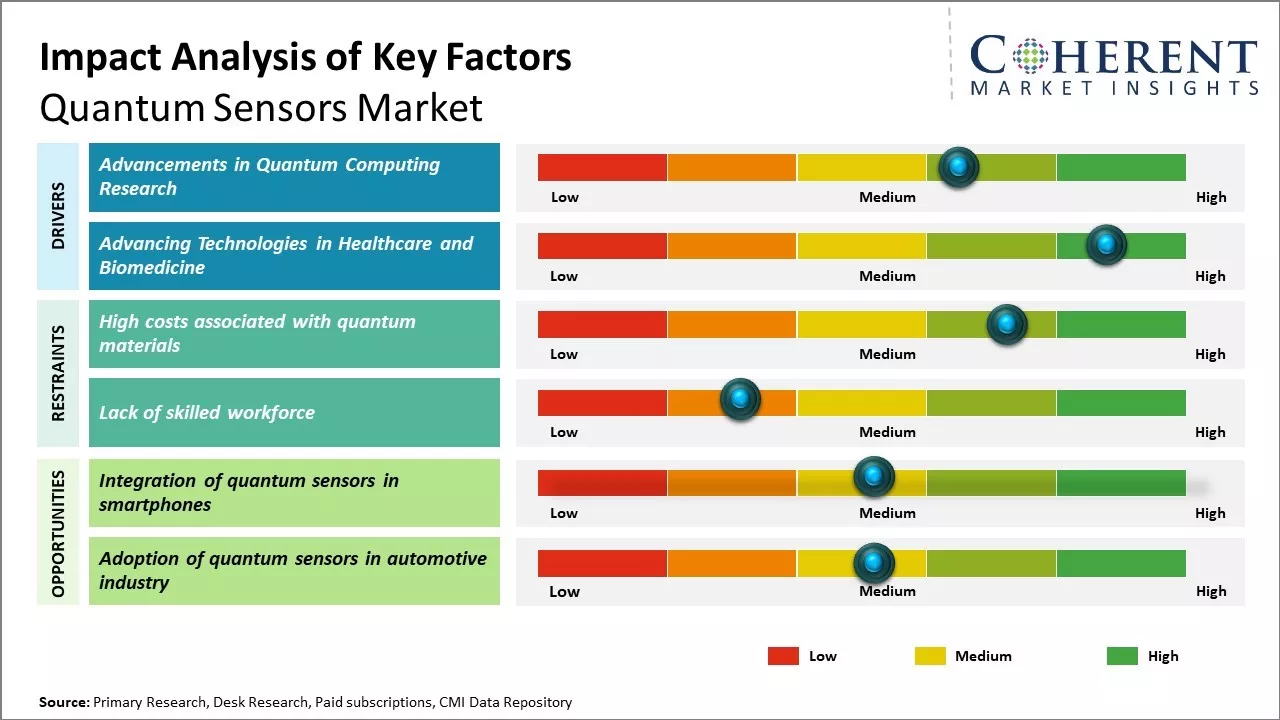
Advancements in Quantum Computing Research
One of the key drivers spurring growth in the quantum sensors market is the increasing research and development taking place in the field of quantum computing. As quantum computers utilize quantum bits that can represent both 1s and 0s simultaneously, they have the potential to massively outperform classical computers for certain computing tasks. Several large technology companies and governments worldwide have launched ambitious quantum computing initiatives in recent years, funneling billions of dollars into R&D.
Quantum sensors that can precisely measure quantum states and help control quantum systems are crucial components that quantum computing development relies on. Whether it is detecting small magnetic fields for controlling qubits, measuring subtle temperature changes, or monitoring quantum decoherence - quantum sensors provide vital sensing capabilities.
As basic quantum computing research continues to progress towards developing full-scale, fault-tolerant quantum machines, the need for highly precise and customizable quantum sensors is expected to grow exponentially. Researchers are working on designing new types of quantum sensors as well as integrating them with other lab equipment in order to gain deeper insights into the complex phenomena associated with quantum information processing.
This widespread research focuses on realizing the potential of quantum computing bodes very well for the future demand of quantum sensors across academic institutions and industrial labs engaged in the field.
- Advancing Technologies in Healthcare and Biomedicine
Another key market driver is the rising application of quantum technologies within areas like healthcare and biomedical sciences. Several startups as well as large medtech companies are actively exploring how quantum sensors may enhance medical imaging, diagnostics, and other areas.
For instance, ultra-sensitive magnetic field detectors based on quantum technologies hold promise for improving MRI scans. Similarly, quantum optical sensors could help develop advanced analysis tools for pathogen detection. Researchers are also investigating photonic quantum sensors for new types of endoscopic medical procedures with improved sensitivity and resolution compared to existing technologies.
The non-invasive and high-fidelity nature of measurements using quantum sensors make them well-suited for a variety of healthcare applications. Their ability to detect subtle biochemical changes or image biological structures at micro/nano scales could greatly benefit conditions ranging from cancer to neurological disorders.
Market Opportunities: Integration of quantum sensors in smartphones
Enabling vastly improved precision over classical alternatives has applications in microscopy, metrology, navigation, resource exploration, and others. Quantum technologies offer a new value proposition with exponential processing capabilities in the long run. Early market opportunities exist in niche industrial and scientific use cases such as gravitational wave and dark matter detection.
Segmental Insights
Quantum Sensors Market Insights, By Products
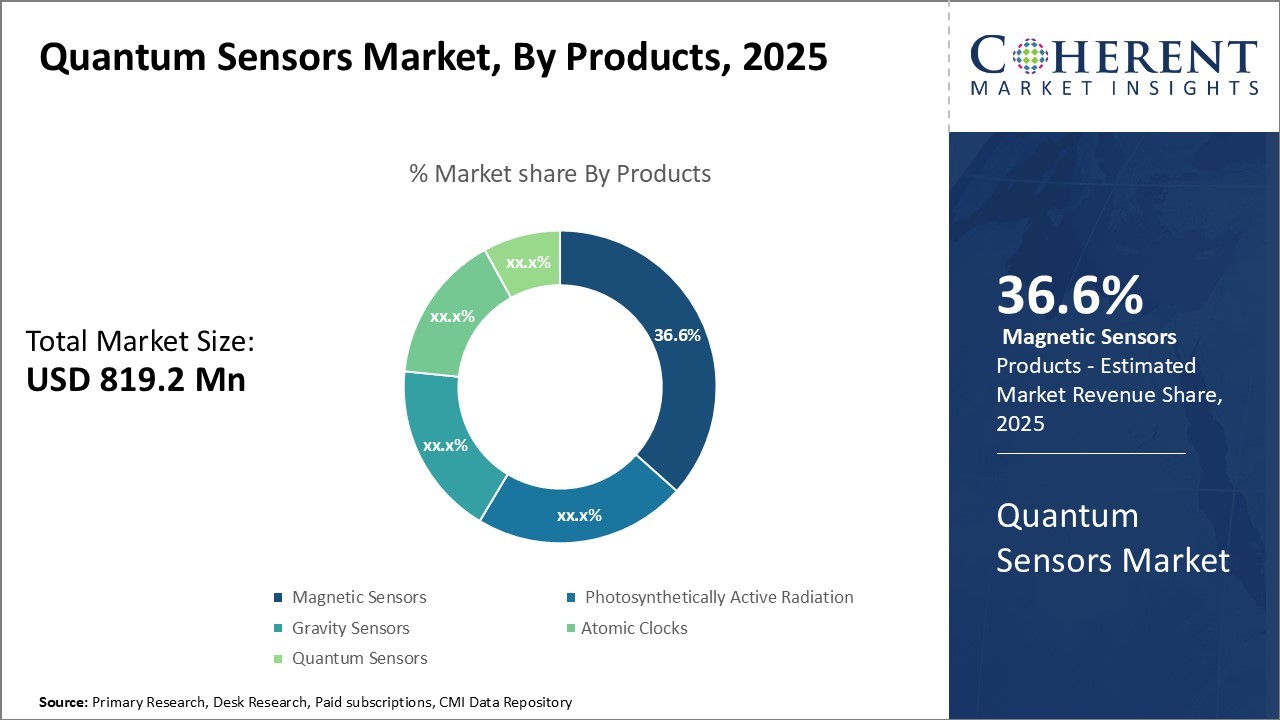
The magnetic sensors segment within the quantum sensors market holds the largest share of 37.6% in 2026 due to extensive technological advancements in this field. Magnetic sensors find wide usage across various industries owing to their ability to detect the smallest magnetic field. Traditionally, applications were limited due to constraints of conventional sensors. However, quantum magnetic sensors based on spin qubits and nitrogenvacancy centers in diamonds have enabled detection of magnetic fields with precision down to the femtotesla range.
These next-generation quantum sensors with great sensitivity to magnetic allow for ultra-sensitive detection and mapping of magnetic signals in applications ranging from healthcare to oil & gas. In the healthcare sector, quantum magnetic sensors are improving diagnostics and aiding research through biomagnetic measurements. Their ability to detect magnetic fields generated by the heart and brain activity with high spatial and temporal resolution has vast potential.
Similarly, quantum gravity gradiometers using atom interferometers can enable discovery of new oil and gas reserves by precisely mapping subsurface geology. Other key applications include quality control and non-destructive testing in manufacturing.
The immense progress in miniaturization of quantum sensors while maintaining high sensitivity has further boosted the magnetic sensors segment. Chip-scale atomic clocks and magnetometers allow for portable and deployable solutions across diverse industries. Overall, continued R&D toward developing cost-effective and robust quantum technologies will drive the magnetic sensors segment to a dominant position in the future quantum sensors market landscape.
Quantum Sensors Market Insights, By Industry Verticals
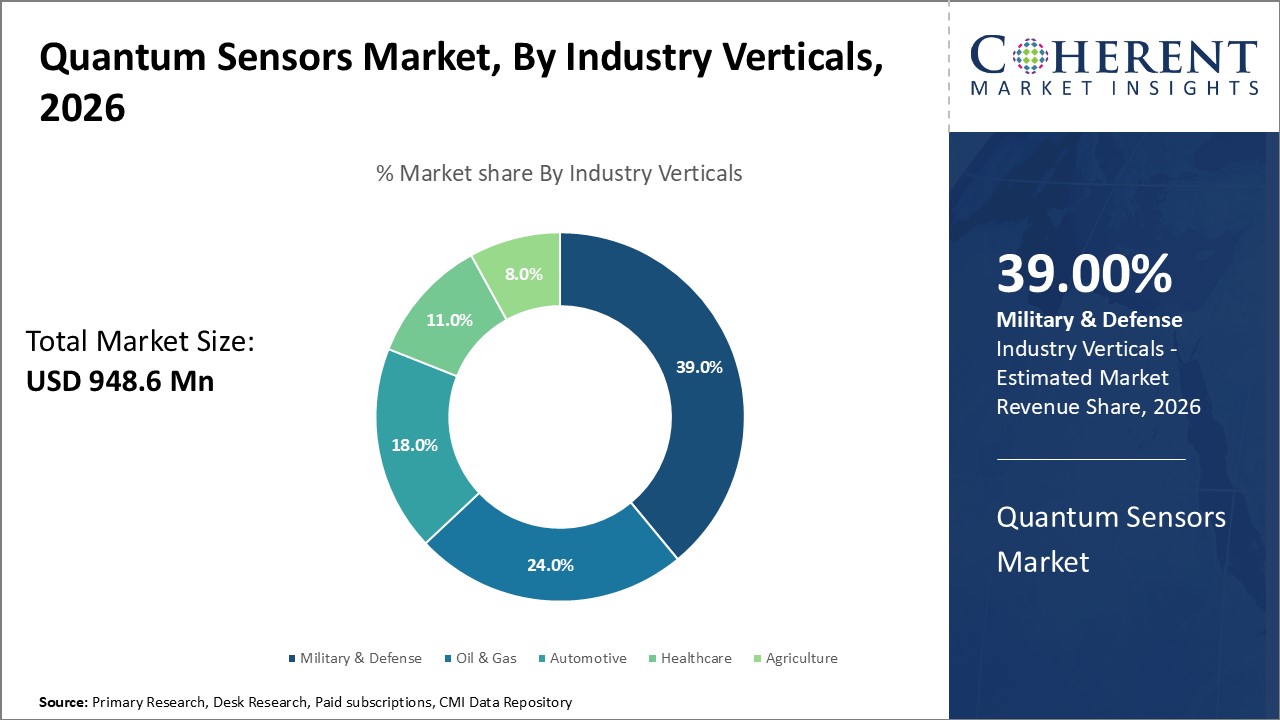
The military & defense vertical holds the largest share in the quantum sensors market with 39% in 2026 due to numerous critical application areas that rely on state-of-the-art sensing capabilities. Quantum technologies have enabled transformational capabilities related to precision navigation, timing, and detection of stealth targets for defense applications.
For instance, chip-scale atomic clocks provide unprecedented accuracy for timing in missile systems, secure communications, and GPS-free navigation. Similarly, quantum gravimeters and magnetometers deployed on submarine detection networks or incorporated into unmanned vehicles/drones enhance surveillance and reconnaissance. Their ultra-high sensitivity enables detection of barely perceptible anomalies.
Furthermore, quantum lidars based on atom interferometry help generate precise 3D maps essential for autonomous vehicles, weapons, and training simulations. Development of portable quantum sensors also allows soldiers to detect threats from radioactive/explosive materials with greater range and reliability.
Regional Insights
North America Quantum Sensors Market Analysis and Trends
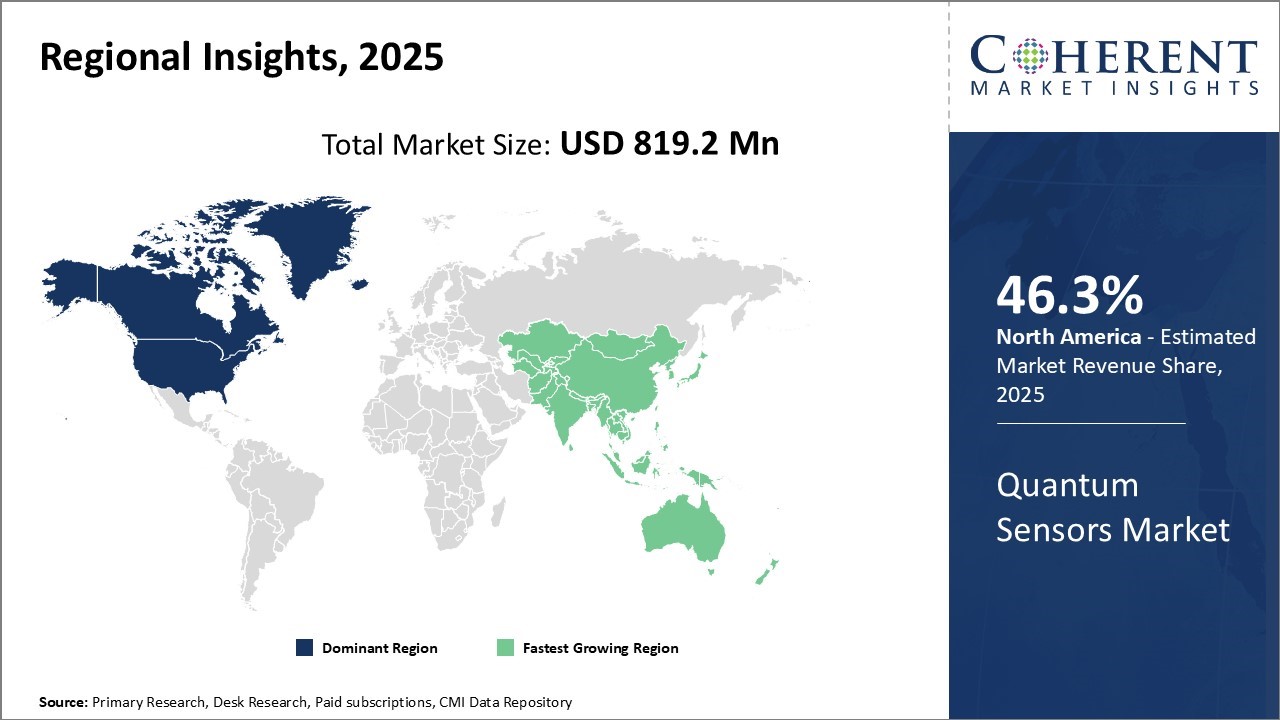
The North American region currently dominates the global quantum sensors market owing 46.3% in 2026. This can be attributed to significant investments being made in the region by both public and private entities towards quantum technologies and its applications. Many leading quantum technology companies are headquartered in the U.S. and Canada and are at the forefront of innovating new quantum sensing solutions.
Government organizations like NASA and the U.S. Department of Defense are actively funding quantum research programs. Additionally, initiatives like the National Quantum Initiative Act have accelerated investments towards developing versatile quantum sensors. Nanoscale quantum devices compatible for applications in defense, biomedical, and materials sector are a major focus area. The presence of a robust quantum technology supply chain further strengthens the regional market.
Asia Pacific Quantum Sensors Market Analysis and Trends
The Asia Pacific region, on the other hand, is poised to be the fastest growing regional market for quantum sensors globally. Countries like China, India, Japan, and South Korea are aggressively investing to build domestic quantum technology capabilities. While China leads in overall investments and industry activity, other countries are also steadily enhancing their quantum research infrastructure. For example, Japan excels in fields related to trapped ions and superconducting technologies.
The regional market is expected to witness a high demand for quantum sensors from key verticals including automotive, healthcare, and manufacturing. As industry giants increasingly explore smart and connected solutions based on quantum technology, it is likely to accelerate the commercialization of quantum sensing products. Partnerships between government labs, tech institutes, and private players have led to the emergence of startups focused on quantum image sensors, accelerometers, and magnetometers.
The region also benefits from local expertise in classical sensor fabrication which is redirecting efforts towards quantum variants. Growing intra-regional collaborations on joint quantum technology programs will further augment the rapid growth trajectory of the quantum sensors market in Asia Pacific.
United States Quantum Sensors Market Analysis and Trend
The U.S. dominates the quantum sensors market due to robust government investment, defense uses, and robust tech ecosystem. Key players such as Lockheed Martin and Honeywell, together with national labs and start-ups, are building quantum-enabled navigation, gravimetry, and communication technologies—particularly for aerospace and military applications.
Germany Quantum Sensors Market Analysis and Trend
Germany leads quantum sensor innovation in Europe based on its high-value manufacturing industry and public-private research partnerships. It is highly invested in industrial and automotive uses, applying quantum sensing for very precise positioning, magnetic field sensing, and smart factory quality control.
United Kingdom Quantum Sensors Market Analysis and Trend
The UK has been an important player with significant investments under its National Quantum Technologies Programme. It aims to build compact quantum sensors for GPS-free navigation and defense, as well as fund startups commercializing sensors for healthcare and infrastructure monitoring.
China Quantum Sensors Market Analysis and Trend
China is moving fast in the field of quantum technology, such as sensors, with massive government investment and research conducted at universities. The nation is building quantum sensors for military, seismic, and communications uses, seeking to minimize reliance on foreign technology and become a leader in quantum innovation.
Canada Quantum Sensors Market Analysis and Trend
Canada is present with a robust role from research centers such as the University of Waterloo and an increasing number of quantum start-ups. It is interested in employing quantum sensors in environmental monitoring, healthcare diagnostics, and secure communication and is supported by benign government funding and partnerships.
Market Report Scope
Quantum Sensors Market Report Coverage
| Report Coverage | Details | ||
|---|---|---|---|
| Base Year: | 2025 | Market Size in 2026: | USD 948.6 Mn |
| Historical Data for: | 2020 To 2024 | Forecast Period: | 2026 To 2033 |
| Forecast Period 2026 to 2033 CAGR: | 15.8% | 2033 Value Projection: | USD 2,648.9 Mn |
| Geographies covered: |
| ||
| Segments covered: |
| ||
| Companies covered: | Radix, Networking (Oscilloquartz), AdSense, GWR Instruments Inc., Technology (Microsemi), METER Group, Spectrum Technologies Inc., Adcon Telemetry Gmbh, Microchip, Apogee Instrument Inc., Impedance Ltd., Biospherical Instruments Inc, Thomas Industrial Network Inc., M-Squared Lasers Limited, ADVA, and Skye Instruments Ltd. | ||
| Growth Drivers: |
| ||
| Restraints & Challenges: |
| ||
Quantum Sensors Industry News
- In 2025, Airbus's innovation arm Acubed collaborated with Google offshoot SandboxAQ to fly test MagNav, a laser- and AI-powered quantum navigation system, on more than 150 hours of test flights across the U.S.—showing encouraging positioning precision in GPS-denied conditions.
- In May 2024, the UK, led by Infleqtion in partnership with BAE Systems and QinetiQ, successfully flew a quantum inertial navigation system (Q‑INS) on a Royal Air Force demonstrator aircraft, the first public airborne demonstration of GPS-resistant navigation technology.
Analyst View
- The quantum sensors industry is a revolutionizing edge of high-precision measurement technology, using quantum mechanical effects to realize sensitivity beyond anything seen before. Driving the market are rising needs for ultra-high-precision navigation systems in defense, expanding needs for next-generation medical imaging, and rising use in gravitational wave detection research. The capability to outperform conventional sensor limits makes it critical to future generations of scientific instrumentation and industrial technologies.
- Yet, important constraints impinge upon expansion in markets, mainly the sizeable technical subtlety of sustaining quantum coherence in practical situations. High levels of research expenditures and the necessity of expert skill levels discourage mass commercial use. Moreover, the necessity for advanced cooling systems and controlled environments restricts practically deployable situations, including the application of quantum sensors in the energy sector.
- North America is now the leading market due to heavy government investments in quantum research initiatives and the location of top technology firms. The region is also supported by robust collaboration between academia and industry as well as long-standing defense expenditure on quantum technologies. The Asia-Pacific is, however, the region with the quickest growth rate due to aggressive quantum technology efforts from China, Japan, and Singapore, accompanied by rising private investment.
- Market opportunities reside in miniaturization advancements that would potentially enable portable quantum sensors for field use. Artificial intelligence integration to optimize the quantum state offers further growth prospects.
Market Segmentation
- Products Insights (Revenue, USD Mn, 2021 - 2033)
- Atomic Clocks
- Photosynthetically Active Radiation (PAR)
- Gravity Sensors
- Magnetic Sensors
- Quantum Sensors
- Industry Verticals Insights (Revenue, USD Mn, 2021 - 2033)
- Oil & Gas
- Military & Defense
- Automotive
- Healthcare
- Agriculture
- Regional Insights (Revenue, USD Mn, 2021 - 2033)
- North America
- U.S.
- Canada
- Latin America
- Brazil
- Argentina
- Mexico
- Rest of Latin America
- Europe
- Germany
- U.K.
- France
- Italy
- Russia
- Rest of Europe
- Asia Pacific
- China
- India
- Japan
- Australia
- South Korea
- ASEAN
- Rest of Asia Pacific
- Middle East & Africa
- GCC Countries
- South Africa
- Rest of Middle East & Africa
- Key Players
- Radix
- Networking (Oscilloquartz)
- AdSense
- GWR Instruments Inc.
- Technology (Microsemi)
- METER Group
- Spectrum Technologies Inc.
- Adcon Telemetry Gmbh
- Microchip
- Apogee Instrument Inc.
- Impedance Ltd.
- Biospherical Instruments Inc.
- Thomas Industrial Network Inc.
- M-Squared Lasers Limited
- ADVA
- Skye Instruments Ltd.
Sources
Primary Research Interviews
- Quantum sensor manufacturers and technology developers
- Research institutions and quantum physics laboratories
- End-user industries (healthcare, defense, automotive, telecommunications)
- Government agencies and regulatory bodies
- Others
Databases
- IEEE Xplore Digital Library
- Nature Research Database
- Quantum Technology Database
- Others
Magazines
- Photonics Spectra Magazine
- Quantum Technology International
- Laser Focus World
- Physics Today Magazine
- Others
Journals
- Nature Quantum Information
- Physical Review Applied
- Quantum Science and Technology
- Others
Newspapers
- Financial Times
- The Wall Street Journal
- MIT Technology Review
- Science Daily
- Others
Associations
- Quantum Industry Coalition (QIC)
- International Association of Quantum Technologies
- Optical Society of America (OSA)
- Institute of Electrical and Electronics Engineers (IEEE)
- Others
Public Domain Sources
- National Institute of Standards and Technology (NIST)
- European Quantum Technologies Roadmap
- Government quantum technology initiatives and white papers
- Patent databases and filing records
- Others
Proprietary Elements
- CMI Data Analytics Tool
- Proprietary CMI Existing Repository of information for last 8 years
Get access to 250+ pages report
Every segment, forecast, competitor profile and data table behind the analysis above — available for instant download.
- ESOMAR Member
- ISO 9001:2015 Certified
- D-U-N-S Registered
- GDPR & CCPA Compliant
Missing comfort of reading report in your local language? Find your preferred language:
Transform your Strategy with Exclusive Trending Reports
Frequently Asked Questions
The Quantum Sensors Market size is estimated to be valued at USD 948.6 Mn in 2026, and is expected to reach USD 2,648.9 Mn by 2033.
The CAGR of the global Market is projected to be 15.8% from 2026 to 2033.
Advancements in quantum computing research and advances in quantum computing research are the major factors driving the growth of the global market.
High costs associated with quantum materials and Lack of skilled workforce are the major factors hampering the growth of the global market.
Major players in the Quantum Sensors industry include M Squared Lasers, Muquans, AOSense, Robert Bosch GmbH, ColdQuanta, and Qnami, among others leading innovations in precision sensing technologies.
North America is expected to lead the Quantum Sensors Market due to strong government funding, a robust defense sector, and a high concentration of quantum technology companies and research institutions.
Alkali metals like rubidium and cesium are the leading raw materials in quantum sensors, especially for atomic clocks and magnetometers, due to their favorable quantum properties.