

Metamaterials Market Size and Market Trends – 2026 to 2033
Metamaterials Market is estimated to be valued at USD 2,846.7 Mn in 2026 and is expected to reach USD 25,005.6 Mn in 2033, exhibiting a compound annual growth rate (CAGR) of 36.4% from 2026 to 2033.
Key Takeaways
- By Product Type, Electromagnetic are projected to hold the largest market share in 2026. Their dominance is attributed to their extensive applications across various industries, including telecommunications, aerospace, defense, and medical devices.
- By Application, Antenna and Radar segments are anticipated to dominate the metamaterials market in 2026. This is primarily due to the growing demand for advanced communication systems, particularly in defense, telecommunications, and aerospace industries, where high-performance antennas and radar systems are critical.
- By End-Use Industry, Aerospace and Defense are expected to be the leading end-use industries for metamaterials in 2026. The defense industry requires customized solutions for communication, and metamaterial devices such as antennas, shields, and cloaking devices are extensively used for secure communications.
- By Region, North America dominates the overall market in 2026, with a share of 40.1%. This growth is attributed to the growing focus on the development of new metamaterials for applications in the telecommunications and power industries.
Market Overview
Metamaterials are a type of composite material structures, which contain exceptional material properties such as acoustic, electrical, magnetic, and optical properties. They comprise arrays of resonators that manipulate electromagnetic waves or sound in ways not normally found in nature. The physical properties metamaterials exhibit are exceptional such as negative permittivity and permeability. The metamaterials permit engineers to control wave propagation by arranging the unit cells in various ways. In other words, metamaterials are artificial or manmade composite materials, which derive their properties through their internal microstructure rather than the chemical composition found in natural chemicals.
Current Events and Its Impact
Current Events | Description and its impact |
Advancements in 5G Technology |
|
Automotive Industry's Shift Towards Electric Vehicles |
|
Healthcare Applications of Metamaterials |
|
Healthcare Applications of Metamaterials |
|
Aerospace and Defense Applications |
|
Sustainable Energy Solutions |
|
End-User Feedback and Unmet Needs in Metamaterials
End-User Feedback in Metamaterials
End users of metamaterials—ranging from telecommunications companies and aerospace engineers to medical device developers and defense contractors—have shared a variety of insights based on their experience with these advanced materials.
- Performance Expectations and Real-World Challenges
Metamaterials have been preferred for their ability to manipulate waves in extraordinary ways, such as bending light backward, creating invisibility cloaks, or dramatically improving antenna performance. Many users report initial excitement over the potential for these properties to revolutionize products. For example, in the telecom sector, antennas embedded with metamaterials have demonstrated enhanced gain and bandwidth, improving signal clarity and reducing interference.
- Cost and Scalability Concerns
A major piece of feedback centers on the costliness of current metamaterial production techniques. Methods like electron-beam lithography or focused ion beam milling, which produce the intricate structures necessary at the nano or microscale, are prohibitively expensive for large-scale manufacturing. This cost barrier limits end users from adopting metamaterials beyond high-value, niche applications such as aerospace or defense.
- Integration and Compatibility Issues
End users highlight difficulties integrating metamaterials into existing systems. In optics, for instance, metamaterial coatings may not adhere well to conventional glass substrates or may require special conditions incompatible with standard device assembly lines. Similarly, RF components that incorporate metamaterials may face challenges interfacing with existing circuitry or maintaining signal integrity.
Compatibility with existing fabrication technologies and materials is essential for broader adoption. Users note that if metamaterials demand entirely new production or assembly methods, it creates additional costs and complexity, reducing appeal.
Unmet Needs in the Metamaterials Market
- Scalable and Affordable Manufacturing
Mass production methods that maintain quality while lowering costs are urgently needed to make metamaterials viable for mainstream applications.
- Standardization and Quality Control
The industry lacks clear standards and certification processes, which would build buyer confidence and accelerate commercialization.
- Broadband and Multi-Functional Materials
Users seek metamaterials that perform effectively over wider frequency ranges or combine multiple functions (e.g., electromagnetic and thermal control).
- Current Industry Events of 2026
- Market Size Estimation
- Regional Breakdown
- Competitive Landscape
- Customer Intelligence
- Segmental Analysis
- Pricing Analysis
- Key Market Drivers, Challenges & Future Trends
- Customized Insights Section
Segmental Insights
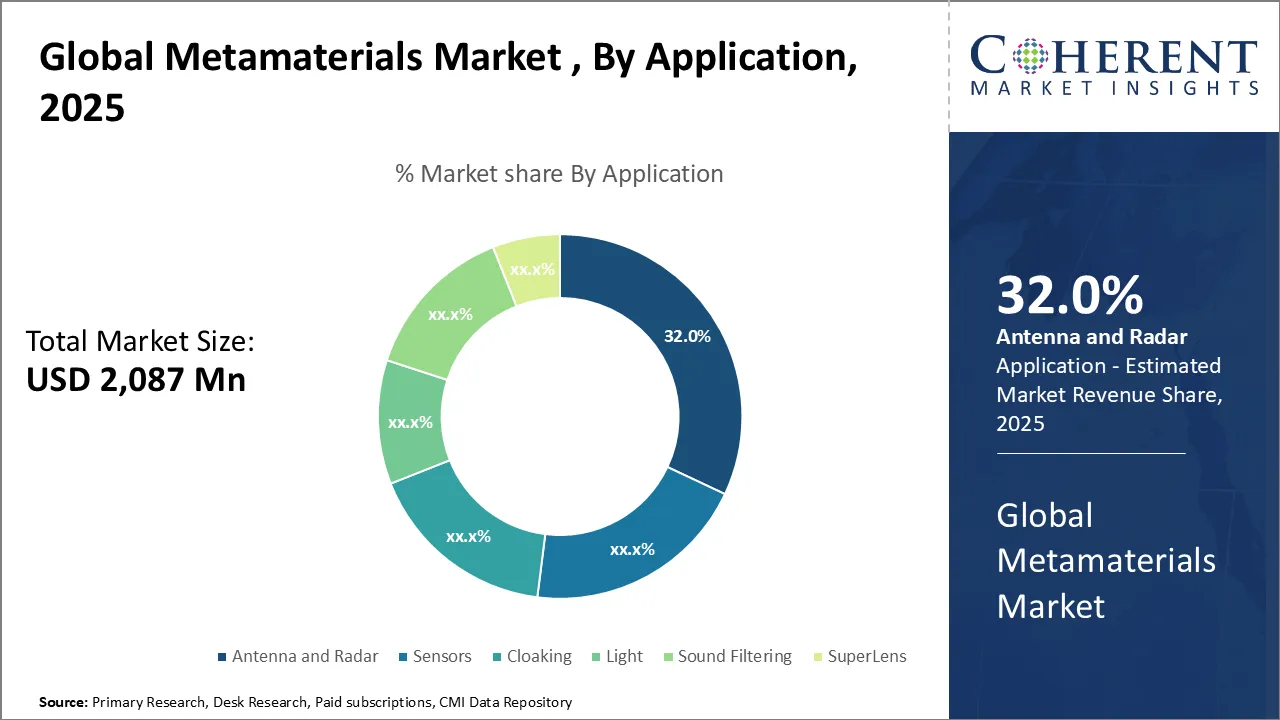
Metamaterials Markets insights, By Application - Antenna and Radar segments are anticipated to dominate due to the growing demand for advanced communication systems, particularly in defence, telecommunications, and aerospace industries.
Antenna and radar segments are anticipated to dominate the metamaterials market by application in 2026, driven by rising demand for advanced communication systems across defense, telecommunications, and aerospace sectors. Metamaterials enable the design of compact, high-performance antennas with improved bandwidth and radiation efficiency, making them ideal for 5G, 6G, and satellite communication. A study published in Micromachines emphasizes how metamaterial-based antennas offer reconfigurability and enhanced performance, supporting their growing use in wireless systems. In defense, metamaterials are being integrated into radar systems to improve stealth and detection capabilities. According to Military Embedded Systems, companies are leveraging metamaterial designs in electronically scanned arrays (MESAs) for enhanced radar performance in applications like UAV detection and battlefield situational awareness. These innovations underline the critical role of antenna and radar technologies in driving the adoption of metamaterials, reinforcing their dominance in the application segment of the metamaterials market.
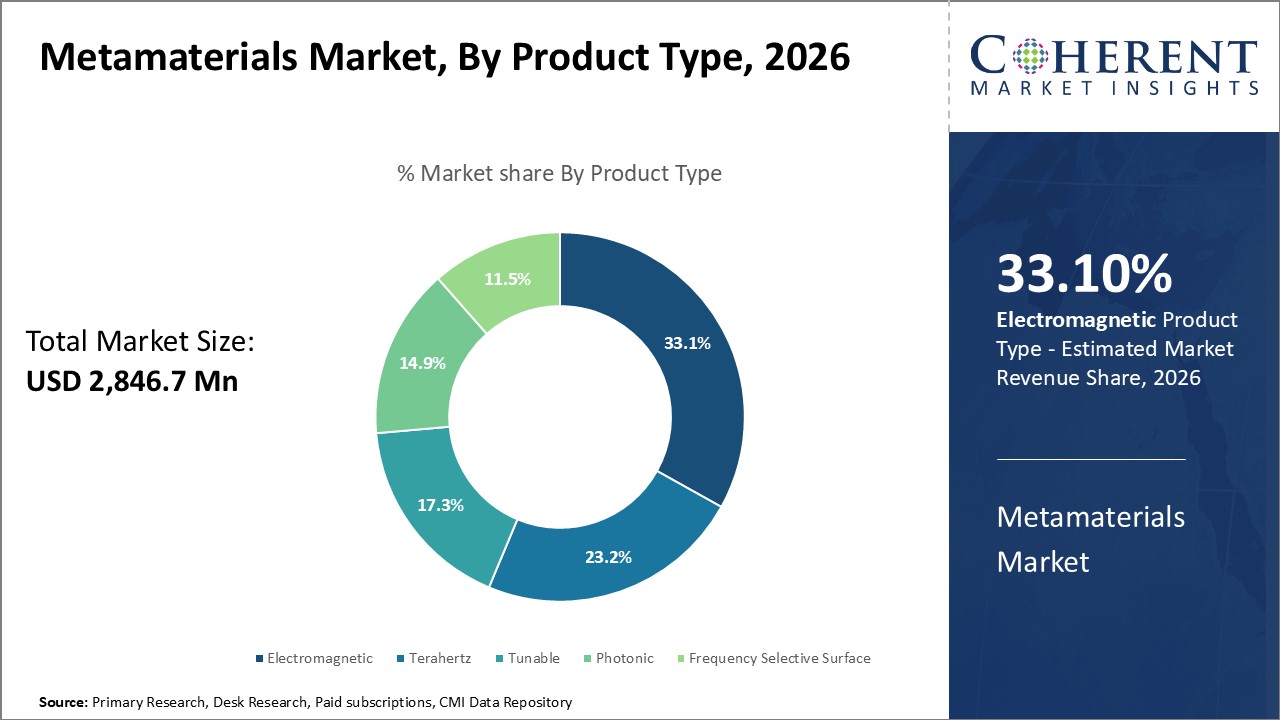
Metamaterials Markets insights, By Product, Type - Electromagnetic Metamaterials are projected to hold the largest market share in 2026
Electromagnetic metamaterials are projected to hold the largest market share by product type in 2026 due to their wide applicability across industries. In telecommunications, they are used to develop compact, efficient antennas for 5G and 6G networks. A study in Micromachines highlights their ability to improve bandwidth and reconfigurability, making them ideal for advanced wireless systems. They are also gaining traction in defense for stealth technologies. As noted by the Modern Physics Foundation, these materials can be used in radar-absorbing coatings and shields. Their role in enhancing medical imaging, such as in MRI, further supports their growing demand. The versatility of these materials across sectors ensures continued investment and integration into next-generation technologies
Metamaterials Markets insights, By End-Use Industry - Aerospace and Défense are expected to be the leading as defence industry requires customized solutions for communication, and metamaterial devices such as antennas, shields, and cloaking devices are extensively used for secure communications
Aerospace and defense are expected to be the leading end-use industries in the metamaterials market by 2026, driven by the demand for customized solutions in secure communications and stealth technology. The defense sector extensively uses metamaterial devices such as antennas, shields, and cloaking materials to enhance communication security and operational efficiency. For example, the U.S. Army announced to develop metamaterials based on magnetic shape anisotropy for ultracompact antennas operating in the microwave K-band, which are vital for secure military communications .Additionally, research at Arizona State University announced that is exploring the use of metamaterials to improve aircraft surface performance by enhancing aerodynamics and reducing drag. These passive metamaterial solutions aim to boost aircraft efficiency and mission capability, further demonstrating their strategic value in aerospace applications . This is further propelling the metamaterials market demand.
Regional Insights
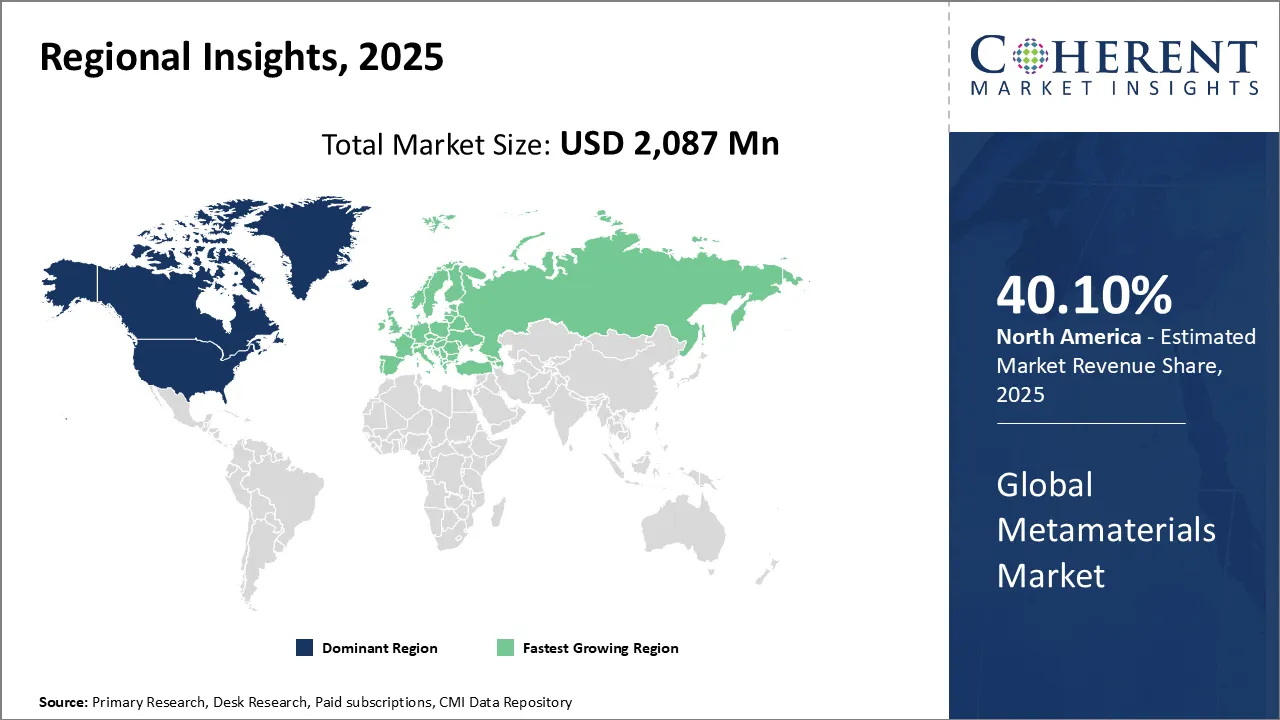
North America Metamaterials Market Trends
North America holds a dominant position in the global metamaterials market, accounting for approximately 40.1% of the market share in 2026. This leadership is driven by robust funding for research and development focused on expanding metamaterial applications across diverse sectors. The U.S. and Canada spearhead technological innovation and infrastructure, enabling the integration of metamaterial technologies in telecommunications, defense, and healthcare. Continuous investment from both government programs and private enterprises is accelerating advancements, particularly in next-generation antennas and stealth technologies. For instance, Meta Materials Inc., a creator of advanced functional materials and nanocomposites, announced that its fully owned UK subsidiary, Medical Wireless Sensing (“MediWise”), has received its first U.S. patent for the glucoWISE® non-invasive glucose monitoring system and the associated anti-reflection metamaterial films.
Asia Pacific Metamaterials Market Trends
The Asia Pacific region is the fastest-growing market for metamaterials, driven by strong focus on telecommunications and power industries. Rapid economic growth and government initiatives to modernize infrastructure in countries like China, India, Japan, and South Korea are accelerating adoption. The rising demand for advanced communication systems and renewable energy solutions further supports this growth. Innovations such as intelligent hydrodynamic metamaterials and developments in plasmonics and optical technologies. For instance, in April 2023, researchers developed a nanolattice metamaterial with an exceptionally high energy absorption capacity using ion track technology. They achieved a groundbreaking beam diameter of just 34 nm and showcased outstanding energy absorption and compressive strength.
Europe Metamaterials Market Trends
Europe is experiencing robust growth in the metamaterials market, particularly due to advancements in healthcare technology across countries such as Germany, France, and Sweden. The integration of metamaterials into medical imaging is a key driver. In May 2026, the University of Exeter received £19.6 million in funding to advance innovations that will enhance our lives through cutting-edge science. The university’s experts have been chosen to lead a facility named The MetaHub, focused on the development of metamaterials.
Germany Metamaterials Market Trends
Germany is at the forefront of metamaterials research, particularly in medical imaging applications. German institutions have contributed to advancements in radiofrequency (RF) coil designs for 7 Tesla (7T) MRI systems. A notable study discusses a parametric analysis of radiative dipole body array coils for 7T MRI, highlighting the role of German researchers in optimizing coil configurations for improved imaging efficiency. These developments underscore Germany's commitment to enhancing MRI technology through metamaterial innovations.
France Metamaterials Market Trends
France is significantly advancing the metamaterials market through initiatives like the European Commission-funded M-Cube project. Coordinated by Aix-Marseille University, the M-Cube consortium focuses on developing metamaterial-based antennas for ultra-high field MRI applications. The project has led to the creation of five prototype antennas targeting various imaging needs, including head, spinal cord, heart, prostate, and extremities. These innovations aim to enhance image quality and reduce power consumption in MRI procedures, reflecting France's leadership in integrating metamaterials into medical technology, further propelling the metamaterials market demand.
Global Metamaterials Market Drivers
Expansion of Metamaterials in Different Sectors
The increasing use of metamaterial in the medical and telecommunication sector for the development of metamaterial lenses, antennas, and sensors that are more efficient than conventional systems is expected to drive market growth over the forecast period. Furthermore, sensors and microwave antenna are the prime components of telemetry systems and metamaterials consist of electromagnetic properties, due to which the metamaterials are majorly adopted in the telecom sector.
Moreover, the demand for antennas and radars is expected to increase over the forecast period, owing to increasing safety requirements in the defense sector. Radars are used to detect any aerial obstacle and guide the aircraft. Metamaterials are majorly adopted for antenna and radars. These factors are expected to fuel demand for antennas and radars, thereby propelling the metamaterials market revenue over the forecast period.
Unveiling Extraordinary Properties for Diverse Applications
Metamaterials possess exceptional and rare properties that originate from the arrangement of constituent materials within them, rather than their composition. These constituent materials can have diverse shapes, sizes, geometries, and orientations, and their specific arrangement affects the behavior of electromagnetic radiation in unconventional ways. Consequently, metamaterials exhibit unique characteristics, such as negative permeability and permittivity, which are unattainable with conventional materials. The engineered properties of metamaterials make them highly valuable and applicable in numerous fields, including communication antennas, windscreens, solar panels, sensors, and medical imaging devices. As a result, federal agencies like the Department of Defense (DOD) and the Defense Advanced Research Projects Agency (DARPA) are heavily investing in research and development related to metamaterial applications within the aerospace and defense industries. The wide range of design functionalities offered by metamaterials drives the demand for their utilization across various applications.
Metamaterials Market Opportunities: Metamaterial-Based Antennas for Enhanced 5G Communications
Modern technology known as 5G offers seamless and adaptable connectivity. The performance of 5G networks is anticipated to be tailored to the demands of end users and to adapt to applications. Industry participants are working to create antennas based on metamaterials that could offer a much more advantageous radiation pattern with effective impedance matching over a bandwidth of 3-44 GHz, making them particularly well suited for operation at and beyond ultra-wideband applications and 5G communications. Such metamaterial-based antennas or radars can operate at much higher performance and efficiency levels than current products. As a result, metamaterial-based antennas will have a chance as 5G is developed and adopted.
Global Metamaterials Market- Trends
New Design Adaptability
Metamaterials have valuable and appealing qualities. These qualities are frequently incorporated into materials and used in a variety of industries, such as communication, transportation, electronics, and healthcare. Due to this variety of design options, the Department of Defense (DOD) and the Defense Advanced Research Project Agency (DARPA) have both made sizeable investments in the metamaterials industry. The aerospace and defense industries will benefit from these investments. The growth of the pharmaceutical industry is being aided by metamaterials made of graphene. The most sought-after metamaterials in communication-based systems are those that have the ability to absorb light, making them suitable for solar cell and optical sensor applications.
Metamaterials in Consumer Electronics and Healthcare Expanding Possibilities and Rapid Growth
The utilization of metamaterials in consumer electronics and the healthcare sector has witnessed significant growth in recent years. This trend is expected to accelerate in the coming years as the potential of metamaterials continues to be explored. For example, LG Electronics’ latest Chocolate BL40 mobile phone, part of its premium Black Label Series, feature a metamaterial antenna developed by San Diego-based start-up Rayspan, a prominent player in bringing metamaterials to market. The unique ability of metamaterials to manipulate electromagnetic waves makes them invaluable in Healthcare industry. Extensive research and development efforts are expanding the scope of the metamaterials industry, as there is still much to uncover regarding their capabilities. In applications such as radar and antennas, metamaterials play a crucial role in obstacle avoidance and operational improvements. These antennas have the capability to capture an impressive 95 percent of information from a wide range of 350 MHz radio signals. Additionally, their adaptive properties make them highly suitable for low-light conditions, further enhancing their utility in various applications.
Market Report Scope
Metamaterials Market Report Coverage
| Report Coverage | Details | ||
|---|---|---|---|
| Base Year: | 2025 | Market Size in 2026: | USD 2,846.7 Mn |
| Historical Data for: | 2020 To 2024 | Forecast Period: | 2026 To 2033 |
| Forecast Period 2026 to 2033 CAGR: | 36.4% | 2033 Value Projection: | USD 25,005.6 Mn |
| Geographies covered: |
| ||
| Segments covered: |
| ||
| Companies covered: | Acoustic Metamaterials Group Ltd, Advanced Research Projects Agency, Echodyne, Inc., Fractal Antenna Systems Inc., JEM Engineering, Kymeta Corporation, Metaboards Limited, Metamagnetics Inc., Metamaterial Technologies Inc., Nano-Meta Technologies, Inc., Palo Alto Research Center Incorporated, and TeraView | ||
| Growth Drivers: |
| ||
| Restraints & Challenges: |
| ||
Global Metamaterials Market: Key Developments
- In April 2025, engineers at MIT discovered a method to create a metamaterial that combines strength and flexibility. It is printed in detailed, precise patterns that result in a structure that is both durable and stretchable.
- In November 2024, the Indian Institute of Technology, Kanpur revealed a breakthrough in stealth technology with the introduction of the Metamaterials Surface Cloaking System, which is expected to bring revolutionary benefits to defense, national security, and specialized industries.
- In April 2025, researchers at Northwestern Engineering developed a machine learning framework that can predict and design the mechanical properties of spinodal metamaterials—specialized structures with fine, sponge-like architectures—using a small amount of high-quality experimental data.
- In November 2022, Meta Materials Inc., a producer of high-performance functional materials and nanocomposites, declared the opening of its new Dartmouth, Nova Scotia, headquarters and Centre of Excellence. The 68,000-square-foot cutting-edge facility is the only one in Canada that combines cutting-edge semiconductor packaging, distinctive materials, chemistry research, and the design and production of holographic and other optical products.
Analyst Opinion (Expert Opinion)
- The Metamaterials market is experiencing a pivotal evolution, driven largely by advancements in nanofabrication technologies and the expanding scope of 5G and advanced radar applications.
- Metamaterials are no longer just a research curiosity—they are rapidly becoming essential components in next-generation communication, defense, and medical systems. For instance, tunable electromagnetic metamaterials are now being embedded into 5G antennas to enhance beam steering and signal clarity. A recent collaboration between Kymeta Corporation and the U.S. Department of Defense demonstrated that metamaterial-based antennas could improve signal-to-noise ratios by 40%, optimizing satellite communications in complex environments.
- Government and defense spending is playing a critical role in commercializing metamaterials. In the U.S., DARPA has increased its funding for tunable metamaterials in stealth and radar evasion technologies, with projected investments crossing USD 250 million by 2026. Such initiatives are accelerating public-private partnerships and bringing lab-scale innovations into field-ready solutions.
- With the rise of wearable technologies and implantable medical devices, biocompatible metamaterials are gaining traction in healthcare. According to a study published in Nature Materials, researchers have developed bioresorbable metamaterials that can be used for non-invasive diagnostic imaging and localized therapy, potentially transforming postoperative monitoring and therapeutic delivery.
- Furthermore, aging infrastructure in developed economies is spurring interest in metamaterial-based sensors for structural health monitoring. Europe, facing significant maintenance costs across transportation and energy sectors, is integrating these smart materials into bridges and pipelines to detect micro-fractures and stress points in real time—improving safety and reducing long-term maintenance costs.
Speak to the analyst
Want personalized insights?
Take the findings above to one of our principal consultants, or have the report rebuilt around the segments, geographies and competitors you actually track.
Market Segmentation
- Global Metamaterials Market, By Product Type (Revenue, USD Mn, 2021 - 2033)
- Electromagnetic
- Terahertz
- Tunable
- Photonic
- Frequency Selective Surface (FSS)
- Global Metamaterials Market, By Application (Revenue, USD Mn, 2021 - 2033)
- Antenna and Radar
- Sensors
- Cloaking Devices
- Superlens
- Light
- Sound Filtering
- Global Metamaterials Market, By End-Use Industry (Revenue, USD Mn, 2021 - 2033)
- Healthcare
- Telecommunication
- Aerospace and Defense
- Electronics
- Automotive
Regional Insights (Revenue, USD Mn, 2021 - 2033)
- North America
- U.S.
- Canada
- Latin America
- Brazil
- Argentina
- Mexico
- Rest of Latin America
- Europe
- Germany
- U.K.
- Spain
- France
- Italy
- Russia
- Rest of Europe
- Asia Pacific
- China
- India
- Japan
- Australia
- South Korea
- ASEAN
- Rest of Asia Pacific
- Middle East
- GCC Countries
- Israel
- Rest of Middle East
- Africa
- South Africa
- North Africa
- Central Africa
- North America
- Company Profiles
- Acoustic Metamaterials Group Ltd
- Advanced Research Projects Agency
- Echodyne, Inc.
- Fractal Antenna Systems Inc.
- JEM Engineering
- Kymeta Corporation
- Metaboards Limited
- Metamagnetics Inc.
- Metamaterial Technologies Inc.
- Nano-Meta Technologies, Inc.
- Palo Alto Research Center Incorporated
- TeraView
Sources
Primary Research Interviews from the following stakeholders
Stakeholders
- Interviews with physicists, materials scientists, RF engineers, defense technology developers, electronics manufacturers, academic researchers, and industry experts specializing in advanced materials and electromagnetic applications.
Databases
- IEEE Xplore
- ScienceDirect
- Web of Science
Magazines
- Photonics Spectra
- Materials Today
- Electronics Weekly
- Optics & Photonics News
- Advanced Materials Magazine
Journals
- Nature Materials
- Advanced Functional Materials
- Journal of Applied Physics
- Metamaterials (Elsevier)
- Physical Review B
Newspapers
- The New York Times
- The Guardian
- The Wall Street Journal
- Financial Times
- The Washington Post
Associations
- The Metamaterials Society
- IEEE Antennas and Propagation Society (IEEE APS)
- Optical Society (OSA)
- Materials Research Society (MRS)
- SPIE – The International Society for Optics and Photonics
Public Domain Sources
- National Aeronautics and Space Administration (NASA)
- U.S. Department of Energy (DOE)
- European Commission Research and Innovation Portal
- National Science Foundation (NSF)
- Defense Advanced Research Projects Agency (DARPA)
Proprietary Elements
- CMI Data Analytics Tool, and Proprietary CMI Existing Repository of information for last 8 years
*Definition: Metamaterials market designates the area of the global economy that includes the creation, transfer, and consumption of metamaterials. Metamaterials are synthetic materials that have been designed to have special electromagnetic properties that are not present in naturally occurring substances. Instead of relying solely on their composition, these materials are created by modifying the structure and arrangement of their individual components.
Get access to 250+ pages report
Every segment, forecast, competitor profile and data table behind the analysis above — available for instant download.
- ESOMAR Member
- ISO 9001:2015 Certified
- D-U-N-S Registered
- GDPR & CCPA Compliant
Missing comfort of reading report in your local language? Find your preferred language:
Transform your Strategy with Exclusive Trending Reports
Frequently Asked Questions
The Metamaterials Market is estimated to be valued at USD 25,005.6 Mn in 2026, and is expected to reach USD 2,846.7 Mn by 2033.
The CAGR of the Metamaterials Market is projected to be 36.4% from 2026 to 2033.
The global Metamaterials Market is estimated to reach US$ 9759.8 Million by 2033.
Some of the key players in the Global Metamaterials Market are Acoustic Metamaterials Group Ltd, Advanced Research Projects Agency, Echodyne, Inc., Fractal Antenna Systems Inc., JEM Engineering, Kymeta Corporation, Metaboards Limited, Metamagnetics Inc., Metamaterial Technologies Inc., Nano-Meta Technologies, Inc., Palo Alto Research Center Incorporated, and TeraView.
Among application, the Antenna and Radar segment held the largest market share in 2026.
North America holds a dominant position in the global metamaterials market share in 2026.