

Spintronics Market Size and Share Analysis- 2026 To 2033
The global Spintronics Market size is anticipated to grow at a CAGR of 36.3%, valued at USD 3.03 Bn in 2026, and is expected to reach USD 26.54 Bn by 2033. The primary drivers are largely defined by the increasing demand for energy-efficient electronic devices, rising adoption of magnetoresistive random-access memory (MRAM), advancements in spin-based semiconductor technologies, growing applications in data storage and computing, and increasing investments in quantum computing and next-generation electronics. According to the U.S. Department of Energy's 2025 update, data centers could account for approximately 11.8% of total U.S. electricity consumption by 2030.
Key Takeaways
- The semiconductor-based spintronics is anticipated to dominate the market, with an estimated share of 42.0% in 2026. The segment is expected to grow on account of growing demand for energy-efficient semiconductor devices, development of spin-transfer torque technologies and integration of magnetic memory into next generation electronic systems. Global semiconductor sales reached USD 791.7 Bn in 2025, up 25.6% year-over-year, the Semiconductor Industry Association (SIA) said, driven by robust demand for advanced semiconductor technologies.
- Magnetic sensors segment is expected to hold the largest market share of 38.0% in 2026. This growth is driven by the increasing adoption of magnetic sensing technologies in electric vehicles, industrial automation, robotics and advanced power electronics. In October 2025, Allegro MicroSystems introduced the first commercial tunneling magnetoresistance (TMR) current sensor with 10 MHz bandwidth and 26 mA RMS noise, for high-speed and accurate current measurement in next-generation electronic systems.
- Asia Pacific is anticipated to hold the largest market share of 39.0% in 2026. The rising manufacturing capacity of semiconductors, growing electronics production, investments in advanced memory technologies, and the demand from automotive and industrial applications further bolster the region’s growth. In April 2026, SEMI’s report shows that the region’s dominance in semiconductor manufacturing is highlighted by the fact that combined China, Taiwan and South Korea accounted for 79% of total global semiconductor manufacturing equipment spending in 2025, up from 74% in 2024.
Market Drivers
Rising Demand for Energy-Efficient Memory Technologies is Accelerating the Spintronics Market
The global Spintronics Market is expected to grow significantly due to the increasing demand for low-power electronic devices, high-speed data processing and energy-efficient memory technologies. The increasing prevalence of AI, cloud computing and advanced semiconductor architectures is spurring the development of spintronic devices that use electron spin to improve data storage and processing efficiency. Technologies such as spin-transfer torque MRAM (STT-MRAM) and spin-orbit torque MRAM (SOT-MRAM) offer nonvolatile data storage, high endurance and low standby power consumption.
In August 2026, researchers at the University of Arizona, the University of Minnesota and the National Institute of Standards and Technology demonstrated magnetic tunnel junctions that could switch in less than a nanosecond, while consuming only 3.5 femtojoules per bit. The devices also demonstrated a tunneling magnetoresistance ratio up to 160% showing the potential for ultra-low-power spintronic memory applications.
In August 2026, researchers from the University of Texas at Austin, in collaboration with Taiwan Semiconductor Manufacturing Company (TSMC), showed that computing technology based on SOT-MRAM can perform write operations in just 2 nanoseconds, consuming ~2 picojoules per write .
Increasing Commercialization of MRAM and Advancements in Next-Generation Computing are Driving Market Growth
The growth of the Spintronics Market can be attributed to the growing commercialization of magnetoresistive random-access memory (MRAM), growing semiconductor manufacturing capabilities, and growing applications in aerospace, defense, industrial automation, and advanced computing. MRAM’s non-volatile data storage capability is making it an increasingly attractive option for mission-critical electronic systems that need high reliability, rapid data access and low energy consumption.
In April 2026, Everspin Technologies finalized a 10-year manufacturing agreement with Microchip Technology to boost U.S. manufacturing capacity for MRAM and tunnel magnetoresistive (TMR) sensor products. The agreement adds a new manufacturing source at Microchip’s Oregon facility, with first product shipments expected in the second half of 2027.
In June 2026, researchers from Tohoku University and the U.S. National Institute of Standards and Technology demonstrated an integrated spintronic probabilistic bit (p-bit) fabricated using a 130-nanometer CMOS semiconductor manufacturing process. Researchers have shown that it is possible to incorporate spintronic components into standard silicon chips for probabilistic computing applications.
Current Events and Their Impact on the Spintronics Market (regulatory shifts, government policies)
Current Event | Description and its Impact |
European Commission Proposes Chips Act 2.0 to Strengthen Advanced Semiconductor Manufacturing (June 2026) |
|
U.S. Treasury Proposes Expanded Outbound Investment Restrictions for Advanced Semiconductor and Quantum Technologies (October 2026) |
|
- Current Industry Events of 2026
- Market Size Estimation
- Regional Breakdown
- Competitive Landscape
- Customer Intelligence
- Segmental Analysis
- Pricing Analysis
- Key Market Drivers, Challenges & Future Trends
- Customized Insights Section
Segmental Insights
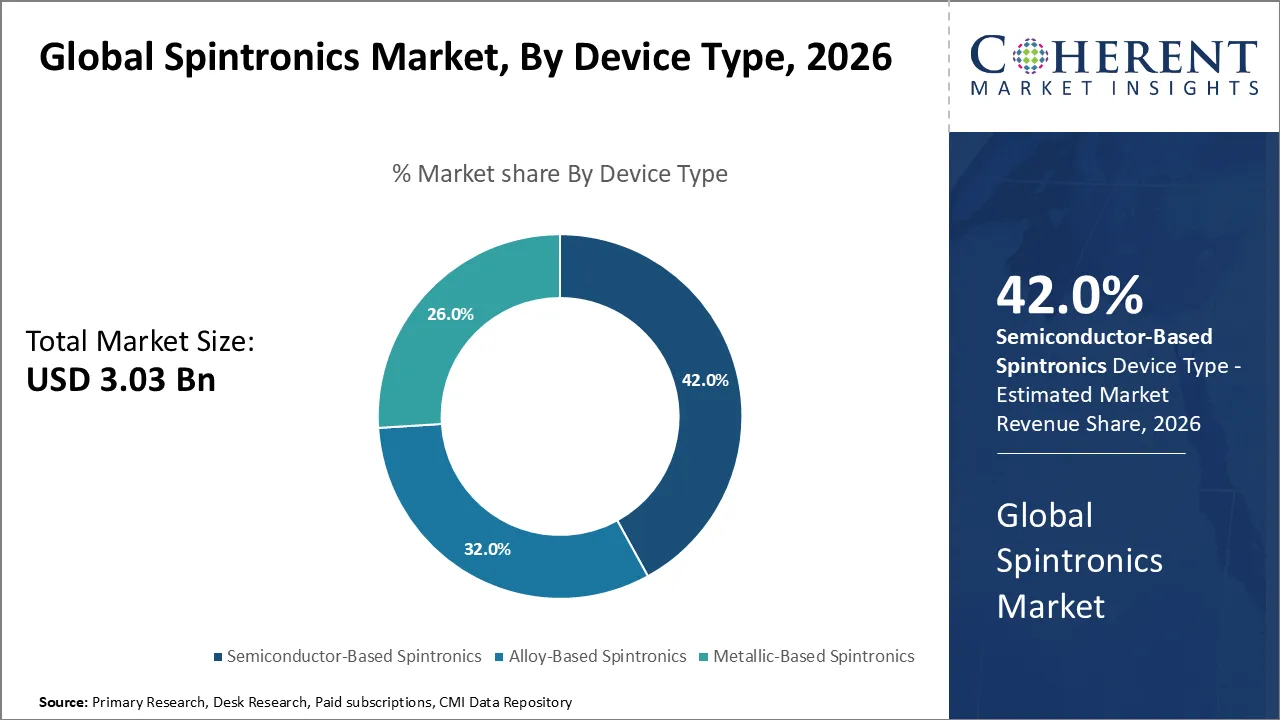
Why is Semiconductor-Based Spintronics Acquiring the Largest Market Share?
On the basis of device type, the semiconductor-based spintronics segment is projected to account for the largest Spintronics Market share of 42.0% in 2026. The segment’s growth is attributed to increasing demand for energy-efficient semiconductor devices, advancements in spin-based transistors, and the development of nonvolatile memory and next-generation computing architectures. The incorporation of electron-spin capabilities into semiconductor platforms is leading to new directions in artificial intelligence, quantum computing and high-end electronic systems.
The European SPIN-CHIP project was started in June 2026 with a total investment of €23.8 million and was planned to run for 42 months. The project, coordinated by Thales and supported by the EU Chips Joint Undertaking, is focused on magnetic tunnel junction technologies for advanced semiconductor memory, computing, sensing and radio-frequency applications.
In addition, in 2026, researchers at the National University of Singapore also demonstrated electrically controlled magnetism in a 2D semiconductor by doping platinum diselenide (PtSe2) with about 1% iron. The material showed ferromagnetic behavior up to 320 K. Whereas thinner semiconducting devices showed electrically tunable antiferromagnetism.
Why Does the Magnetic Sensors Segment Hold the Largest Market Share?
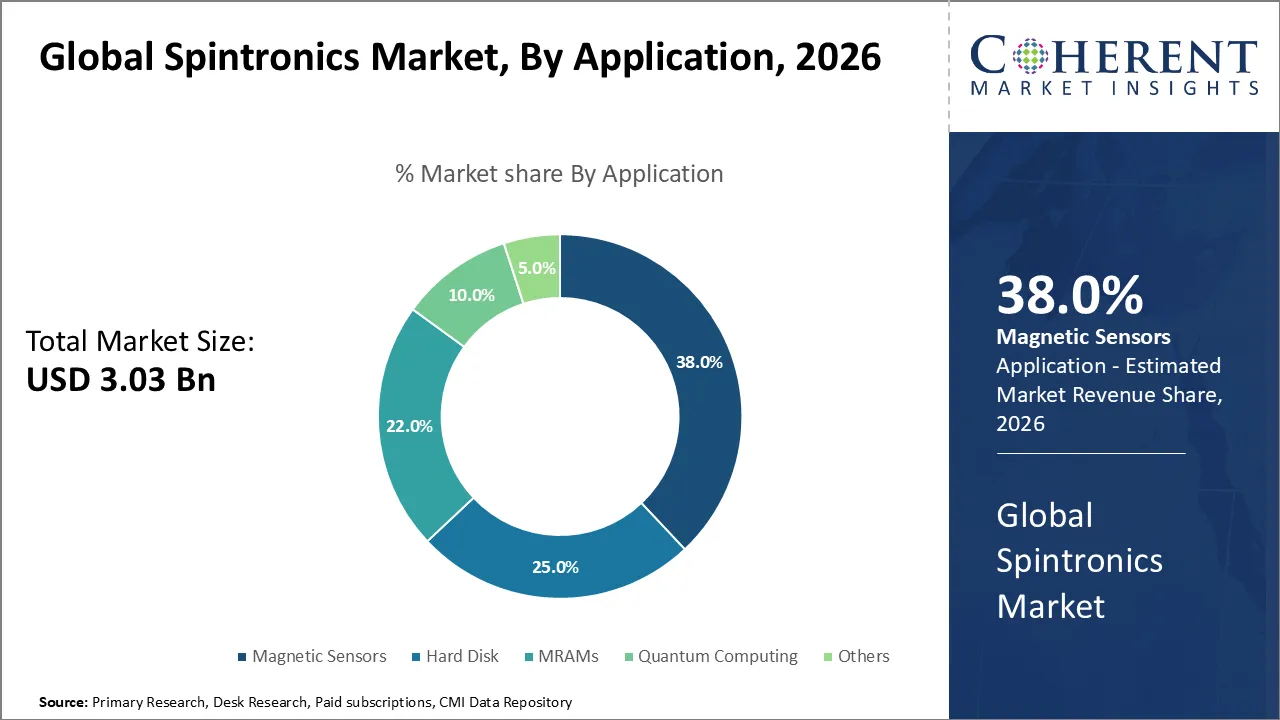
On the basis of application, the magnetic sensors segment is projected to lead the Spintronics Market with a 38.0% share in 2026. The segment’s growth is driven by increasing adoption of tunneling magnetoresistance (TMR) sensors in automotive electronics, industrial automation, robotics, consumer electronics, and advanced power management systems. Their high sensitivity, low power consumption, and accurate magnetic field detection make them suitable for position sensing, current measurement, and motion-control applications.
In June 2026, Infineon Technologies expanded its XENSIV portfolio of magnetic sensors with advanced TMR sensors for automotive, industrial and consumer applications. The company announced automotive qualified versions of the devices designed to ISO 26262 including single die solutions supporting ASIL D and dual die versions supporting 2x ASIL D functional safety architectures.
In May 2026, MultiDimension Technology announced the production supply of TMR2531 and TMR2539 magnetic sensors for smartphone camera stabilization. The devices have magnetic field measurement ranges of ±1,000 Gauss and ±1,500 Gauss, respectively, and are 0.8 × 0.5 × 0.25 mm in size.
Spintronics Market Trends
- Neuromorphic architectures and spintronic computing are increasingly used for complex optimization problems and artificial intelligence applications and require fast and energy-efficient processors. In a September 2026 Nature Electronics paper, researchers have shown a CMOS-integrated spintronic Ising machine that can perform spin-updates from 0.3–1 nanoseconds with energy consumption of less than 40 femtojoules per spin. The work highlights the promise of spin-based computing architectures.
- The increasing development of antiferromagnetic spintronic materials is opening the path to next-generation nonvolatile memory technologies that can switch faster and scale better. October 2026: A study published in Nature demonstrates electrically controlled spin-torque switching in antiferromagnetic tunnel junctions, opening up new possibilities for nanoscale magnetic memory and possible room-temperature terahertz devices.
- The increasing integration of spin wave technologies in telecommunications is creating opportunities for compact, energy-efficient signal-processing components. Researchers from Politecnico di Milano and Italy’s National Research Council demonstrated an integrated tunable spin-wave chip in January 2026 that includes an integrated magnetic field, which will enable future applications in advanced radio-frequency systems and beyond 6G telecommunications.
Regional Insights
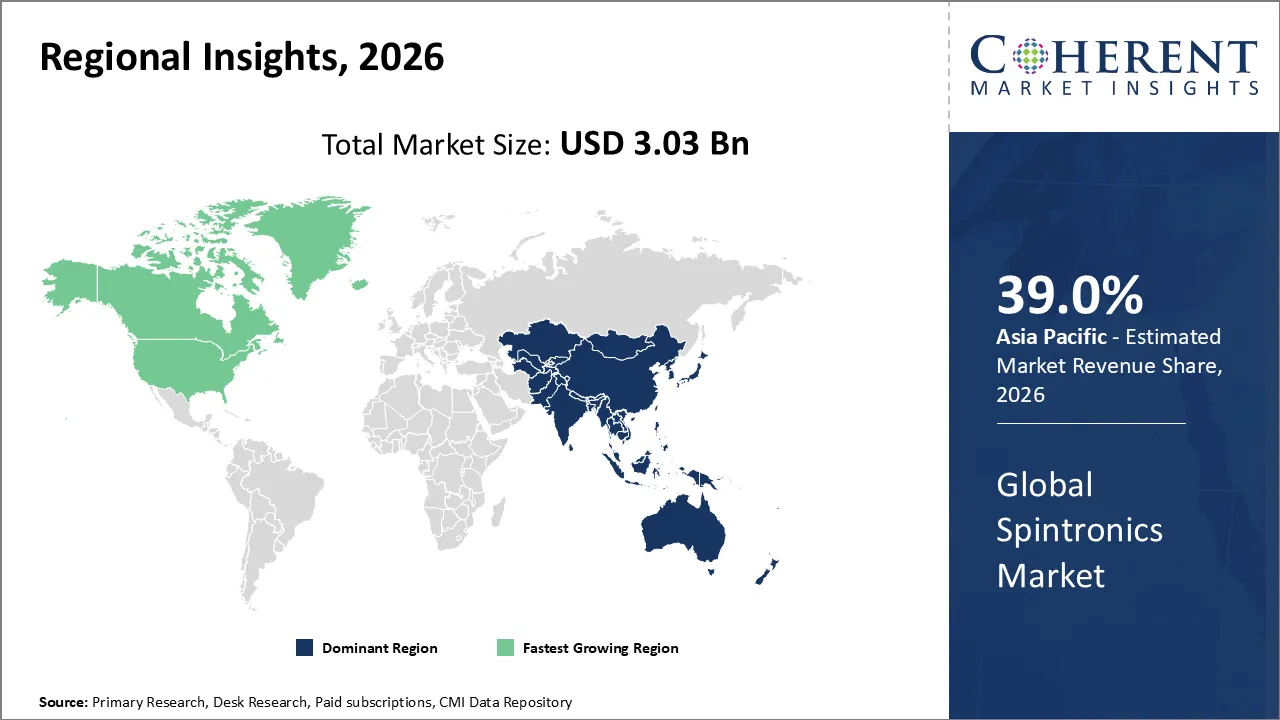
Asia Pacific Dominates Owing to Strong Semiconductor Manufacturing Capabilities and Advancements in Spintronic Technologies
Asia Pacific is expected to take the biggest share of the Spintronics Market, accounting for about 39.0% in 2026. The region’s growth is driven by its mature semiconductor manufacturing environment, growing investments in advanced memory technologies and strong research capabilities in China, Japan, South Korea and Taiwan. The rising demand for energy-efficient electronic devices, magnetic memory and spin-based computing technologies also supports regional market growth.
In January 2026, South Korea’s Ministry of Science and ICT announced its plans to invest KRW 235.1 billion (about USD 160 million) in core technology development programs in the semiconductor, display, and rechargeable battery sectors. The initiative will also increase access to semiconductor fabrication infrastructure, driving technology innovation and the development of advanced microelectronics.
In addition, Japan’s Science and Technology Agency (JST) is supporting international research collaboration on quantum magnonics, spin transport and spintronics through its ASPIRE program. A Japan–Netherlands research initiative scheduled for July 2026 through June 2031 aims to advance magnetism-based quantum information technologies.
North America Spintronics Market Trends
North America is projected to emerge as the fastest-growing region in the Spintronics Market during 2026–2033. The regional growth is attributed to the increasing investments in the research of semiconductors, growing domestic manufacturing capabilities, and rising requirements for high-performance MRAM technologies in aerospace, defense, data centers, and industrial automation. Leading semiconductor companies, national laboratories and academic research institutions are accelerating the development and commercialization of spin-based electronic technologies.
In May 2026, University of Minnesota announced the establishment of a USD 5.7 million Spin Technology Center in collaboration with Polar Semiconductor and Honeywell Aerospace. The project has USD 2.83 million in state funding and USD 2.8 million in industry contributions.
In April 2026, Everspin Technologies signed an approximately 30-month, USD 40 million agreement to support MRAM process technology development and domestic manufacturing capabilities for U.S. military and aerospace applications. The agreement is focused on engineering services, manufacturing process qualification and reliable domestic production of magnetic memory technologies, supporting the region’s growing commercialization opportunities.
Federal Research Funding and Advancements in Spin-Based Computing are Accelerating the Spintronics Market in the United States
The U.S. Spintronics Market is witnessing strong growth owing to increasing federal investments in advanced semiconductor research, rising demand for energy-efficient memory technologies, and the expanding development of spin-based computing architectures. Government-funded research programs and collaborations with universities, national labs and semiconductor manufacturers are driving innovation in magnetic memory, spintronic materials and next-generation electronic devices.
In August 2026, the U.S. National Science Foundation (NSF) announced USD 39.9 million in research funding for eight projects across 16 jurisdictions under its EPSCoR program. One of the funded proposals, Spin Control via Topology, Symmetry and Dimensionality, involves West Virginia University and the University of Delaware.
The NSF’s Electronic, Photonic, Magnetic, and Quantum Devices program also funds basic research in next generation semiconductor technologies including magnetic logic, spintronic memory, and quantum electronic devices. This research framework is expected to strengthen the development of low-power computing technologies and support future commercialization opportunities across the U.S. semiconductor industry.
China Spintronics Market Trends
China is expected to witness substantial growth in the Spintronics Market during the forecast period. Increasing investment in semiconductor research, advancements in magnetic memory technologies and the growing development of spintronic processors for artificial intelligence and next generation computing are all contributing to the country’s growth. The Chinese Academy of Sciences, first-class universities and domestic semiconductor developers have strong research and innovation capabilities, which promote technological innovation.
In June 2026, researchers at the Chinese Academy of Sciences created a spintronic hardware-assisted algorithm that reduced the total energy consumption of AI training by about 79% and achieved a recognition accuracy of over 97% in classifying handwritten digits. It used spin-orbit torque magnetic tunnel junctions (SOT-MTJs) and reduced the gradient-computation operations by nearly an order of magnitude, demonstrating the potential of spintronic hardware for energy-efficient AI processing.
In July 2026, researchers from Beihang University and Truth Memory Corporation reported progress in making orbital-torque-driven magnetic tunnel junctions on an 8-inch MRAM pilot production line. The experimental devices achieved switching pulses as short as 28.7 picoseconds, while the writing voltage was reduced to approximately one-fifth to one-eighth of that required by the comparison SOT-MRAM devices.
Who are the Major Companies in Spintronics Industry
Some of the major key players in Spintronics Market are Quantum Wise, NVE Corporation, Organic Spintronics, IBM Corporation, Plures Technologies, Advanced Micro Sensors, Everspin Technologies, Inc., Spin Transfer Technology, Crocus Technology, and Intel Corporation.
Key News
- In October 2026, Intel announced a definitive agreement to acquire Classiq, a quantum computing software company. The proposed acquisition would combine Intel's silicon spin-qubit manufacturing capabilities with Classiq's quantum algorithm synthesis platform.
- In September 2026, Everspin announced a partnership with Teledyne HiRel Semiconductors to expand the availability of its PERSYST STT-MRAM products for aerospace and defense applications. The collaboration initially covers 256 Mb MRAM devices, with customer availability anticipated in the fourth quarter of 2026.
Market Report Scope
Spintronics Market Report Coverage
Report Coverage | Details | ||
Base Year: | 2025 | Market Size in 2026: | USD 3.03 Bn |
Historical Data for: | 2020 to 2024 | Forecast Period: | 2026 to 2033 |
CAGR: | 36.3% | 2033 Value Projection: | USD 26.54 Bn |
Geographies covered: |
| ||
Segments covered: |
| ||
Companies covered: | Quantum Wise, NVE Corporation, Organic Spintronics, IBM Corporation, Plures Technologies, Advanced Micro Sensors, Everspin Technologies, Inc., Spin Transfer Technology, Crocus Technology, and Intel Corporation. | ||
Growth Drivers: |
| ||
Restraints & Challenges: |
| ||
Analyst Opinion
- The Thrust Vector Control System Market is witnessing strong growth owing to increasing space launch activities, government-backed space exploration programs, and rising demand for precise rocket guidance technologies. According to the U.S. Federal Aviation Administration (FAA) reported that commercial space operations set a record in FY 2024 with 148 licensed launches and reentries, a more than 30% increase over the previous year. The launch ecosystem is growing and this creates demand for reliable propulsion guidance and thrust vector control systems.
- Increasing defense expenditure and advancements in missile guidance technologies are strengthening the market outlook. In March 2026, Kratos Defense announced a US$49 million contract from the U.S. Naval Surface Warfare Center covering up to 36 Oriole solid rocket motors and three thrust vector control nozzle kits. The kit includes a TVC option valued at about US$10.1 million, reflecting direct defense-sector demand for advanced thrust vector control technologies applied in missile testing and hypersonic research.
- Government space agencies are rapidly developing and proving advanced thrust vector control technologies for launch vehicles and human spaceflight programs. July 2026: The Indian Space Research Organization (ISRO) successfully tested the solid rocket motor of its Sub-Orbital Launch Vehicle for Experiments (SOLVE) with a secondary injection thrust vector control system on the ground. This is to assist Gaganyaan crew-module parachute tests at 10-17 km altitude and demonstrate that specific thrust control technologies for space missions are still in development
Speak to the analyst
Want personalized insights?
Take the findings above to one of our principal consultants, or have the report rebuilt around the segments, geographies and competitors you actually track.
Market Segmentation
- By Device Type (Revenue, USD Bn, 2021-2033)
- Semiconductor-Based Spintronics
- Alloy-Based Spintronics
- Metallic-Based Spintronics
- By Application (Revenue, USD Bn, 2021-2033)
- Magnetic Sensors
- Hard Disk
- MRAMs
- Quantum Computing
- Others
- By Region (Revenue, USD Bn, 2021-2033)
- North America
- U.S.
- Canada
- Latin America
- Brazil
- Mexico
- Argentina
- Rest of Latin America
- Europe
- Germany
- U.K.
- France
- Italy
- Spain
- Russia
- Rest of Europe
- Asia Pacific
- China
- India
- Japan
- Australia
- South Korea
- ASEAN
- Rest of Asia Pacific
- Middle East
- GCC
- Israel
- Rest of Middle East
- Africa
- South Africa
- Central Africa
- North Africa
- North America
Sources
Primary Research Interviews
- Spintronics technology researchers and developers
- Semiconductor and magnetic memory technology experts
- Materials scientists specializing in magnetic and spintronic materials
- R&D heads from semiconductor and electronic component manufacturers
- MRAM and magnetic sensor technology developers
- Automotive, aerospace, defense, and consumer electronics procurement managers
- Key opinion leaders (KOLs) in spintronics, quantum computing, and advanced semiconductor technologies
Databases
- World Bank
- Organisation for Economic Co-operation and Development (OECD)
- National Science Foundation (NSF)
- Semiconductor Industry Association (SIA)
- U.S. Department of Energy (DOE)
- National Institute of Standards and Technology (NIST)
- European Commission – Research and Innovation Database
- SEMI – Semiconductor Equipment and Materials International
Magazines
- Semiconductor Engineering
- Semiconductor Digest
- EE Times
- IEEE Spectrum
- Electronic Design
- Electronics Weekly
Journals
- Nature Electronics
- Nature Nanotechnology
- npj Spintronics
- IEEE Transactions on Magnetics
- IEEE Transactions on Electron Devices
- Journal of Applied Physics
- Advanced Materials
- Physical Review Applied
Newspapers
- The New York Times
- The Guardian
- The Wall Street Journal
- Financial Times
- The Economic Times
- Nikkei Asia
Associations
- Institute of Electrical and Electronics Engineers (IEEE)
- Semiconductor Industry Association (SIA)
- SEMI – Semiconductor Equipment and Materials International
- Materials Research Society (MRS)
- American Physical Society (APS)
- IEEE Magnetics Society
- European Materials Research Society (E-MRS)
- International Society for Optics and Photonics (SPIE)
Public Domain Sources
- Company Annual Reports and Investor Presentations
- Government Semiconductor Research and Innovation Publications
- University Research Publications and Technology Transfer Reports
- Patent Databases such as WIPO, USPTO, and Google Patents
- Publicly Available Spintronics and MRAM Research Project Reports
- Semiconductor Manufacturing and Advanced Electronics Industry Reports
- Regulatory and Standards Publications Related to Semiconductor Devices and Magnetic Memory Technologies
Proprietary Elements
- CMI Data Analytics Tool
- Proprietary CMI Existing Repository of Information for the Last 10 Years
Get access to 250+ pages report
Every segment, forecast, competitor profile and data table behind the analysis above — available for instant download.
- ESOMAR Member
- ISO 9001:2015 Certified
- D-U-N-S Registered
- GDPR & CCPA Compliant
Missing comfort of reading report in your local language? Find your preferred language:
Transform your Strategy with Exclusive Trending Reports
Frequently Asked Questions
The global Spintronics Market is expected to reach USD 26.54 Bn by 2033, increasing from USD 3.03 Bn in 2026.
Major players operating in the global Spintronics Market include Quantum Wise, NVE Corporation, Organic Spintronics, IBM Corporation, Plures Technologies, Advanced Micro Sensors, Everspin Technologies, Inc., Spin Transfer Technology, Crocus Technology, and Intel Corporation.
High development and manufacturing costs, complex fabrication processes, technological integration challenges, and limited commercialization of emerging spintronic devices are the key factors hampering market growth.
Increasing demand for energy-efficient electronic devices, rising adoption of MRAM technologies, advancements in spin-based semiconductor devices, and growing applications in artificial intelligence and quantum computing are driving market growth.
The Spintronics Market is anticipated to grow at a CAGR of 36.3% between 2026 and 2033.
Among regions, Asia Pacific is expected to account for the largest market share of approximately 39.0% in 2026, supported by its strong semiconductor manufacturing ecosystem and increasing investments in advanced electronic technologies.
Spintronics, or spin electronics, is an emerging technology that utilizes the intrinsic spin of electrons, along with their electrical charge, to store, process, and transmit information in electronic devices.