

Global Flash Memory Market Size and Forecast – 2026-2033
The Global Flash Memory Market is estimated to be valued at USD 8.30 Bn in 2026 and is expected to reach USD 11.33 Bn by 2033, exhibiting a compound annual growth rate (CAGR) of 4.5% from 2026 to 2033.
Key Takeaways of the Global Flash Memory Market:
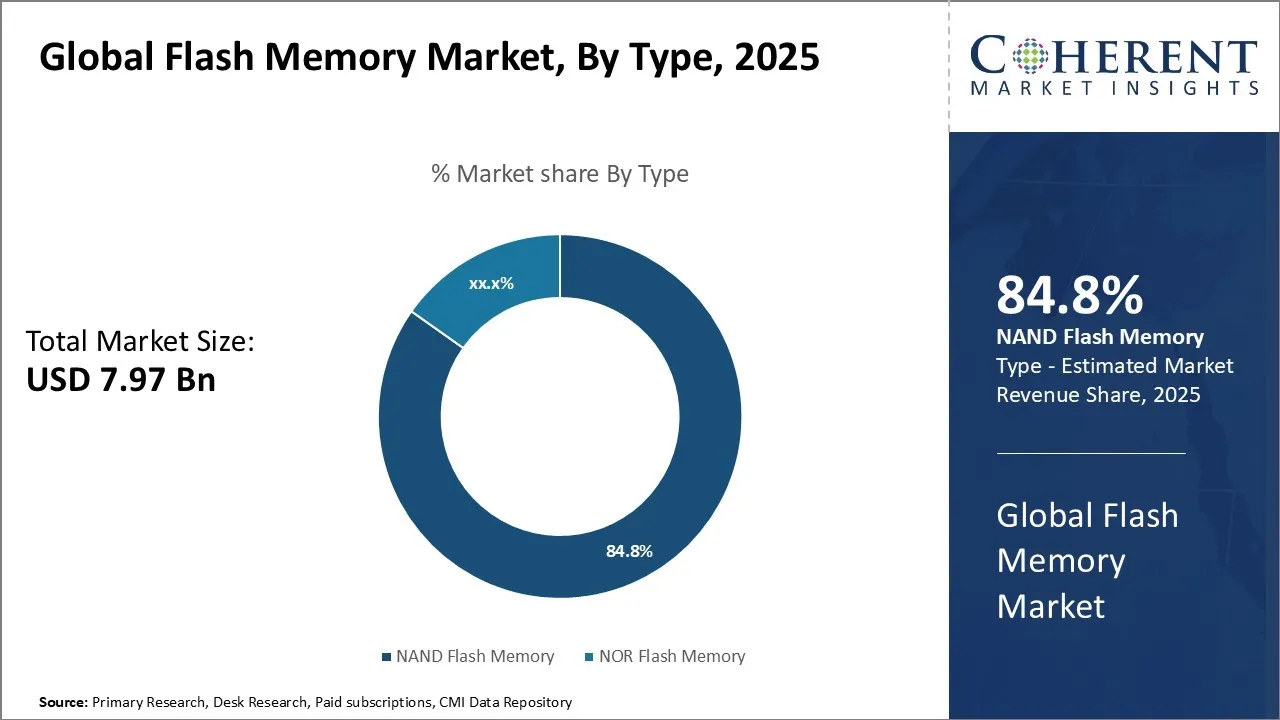
- The NAND flash memory segment is expected to lead the market holding an estimated share of 85.8 % in 2026.
- Among cell architecture, the triple-level cell segment is projected to dominate with a share of 51.3 % in 2026.
- Asia Pacific is estimated to lead the market with a share of 58.7 % in 2026. North America, holding a share of 20.6% in 2026, is projected to be the fastest growing region.
Market Overview:
The flash memory market is experiencing a significant upward trend, driven by the increasing demand for high-speed, reliable, and compact storage solutions across various industries. The popularity of smartphones, tablets, and other portable devices, coupled with the growing adoption of cloud computing and data centers, is creating demand for flash memory. Also, the market is going to benefit from the growing acceptance of advanced technologies, such as 5G networks, artificial intelligence, and the Internet of Things (IoT).
Current Events and Its Impact
Current Events | Description and its impact |
Geopolitical Tensions Impacting Semiconductor Supply Chains |
|
Technological Innovation and Market Competition |
|
Segmental Insights
- Current Industry Events of 2026
- Market Size Estimation
- Regional Breakdown
- Competitive Landscape
- Customer Intelligence
- Segmental Analysis
- Pricing Analysis
- Key Market Drivers, Challenges & Future Trends
- Customized Insights Section
Global Flash Memory Market Insights, by Type – NAND flash memory leads due to its superior performance and cost-effectiveness
NAND flash memory has emerged as the dominant segment in the global flash memory market, capturing the highest share of 85.8% in 2026 among the various types of flash memory. NAND Flash Memory offers faster read and write speeds, enabling quicker data access and transfer. This high-speed performance is useful for data-intensive applications, such as solid-state drives (SSDs), smartphones, and digital cameras.
To add to this, NAND flash memory is also cost-effectiveness. As manufacturing processes have advanced and production volumes have increased, the cost per gigabyte of NAND flash memory has decreased significantly over the years. This cost reduction has made NAND flash memory more accessible and affordable for a wide range of consumer and enterprise applications, further fueling its adoption and market share growth.
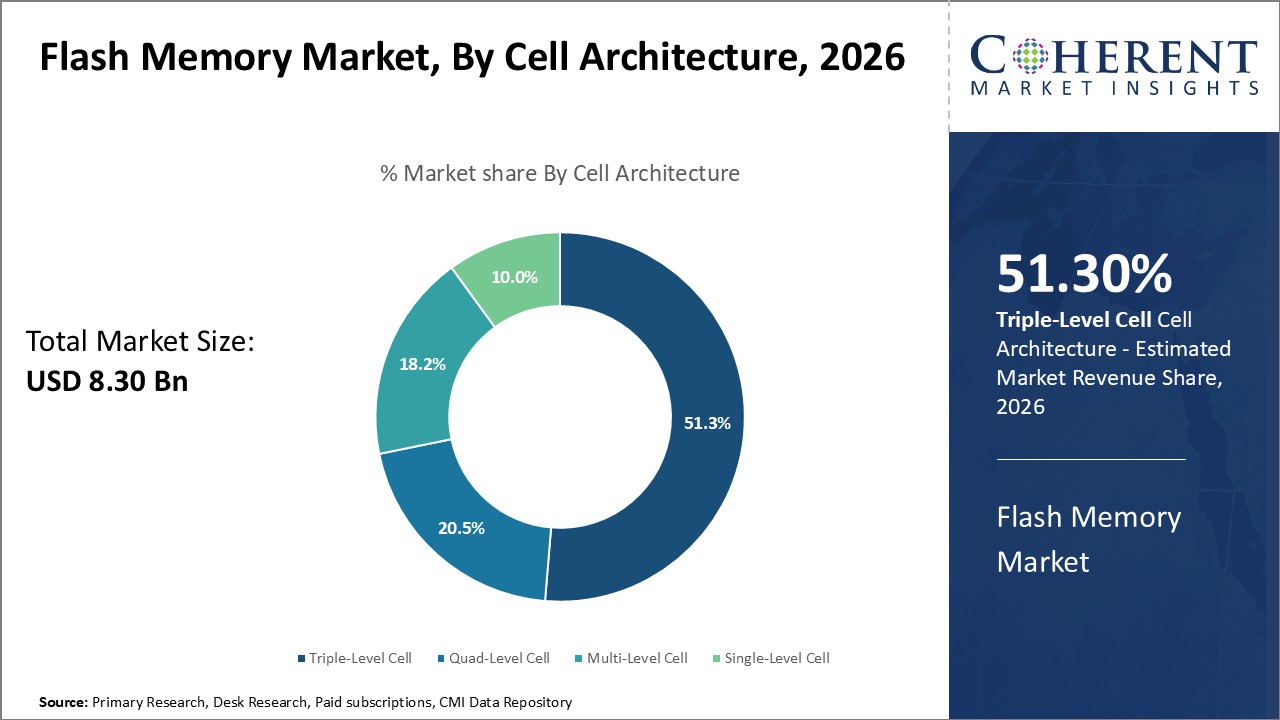
Global Flash Memory Market Insights, by Cell Architecture – Triple-Level Cell contributes the highest share of the market due to its optimal balance of storage capacity and cost.
Triple-Level Cell has emerged as the dominant segment in the global flash memory market, holding a share of 51.3% in 2026. Triple-Level Cell (TLC) technology allows for the storage of three bits of data per cell, providing higher storage densities compared to Single-Level Cell (SLC) and Multi-Level Cell (MLC). This increased storage capacity enables manufacturers to produce flash memory devices with larger capacities at lower costs per gigabyte. The cost-effectiveness of TLC has made it an attractive option for a wide range of applications, from consumer electronics to enterprise storage solutions.
The Role of Artificial Intelligence (AI) in the Flash Memory Market:
AI workloads—particularly those involving machine learning, neural networks, and real-time data processing—require rapid access to vast volumes of data. Flash memory, with its high-speed, low-latency performance, has become the preferred storage medium for AI data centers and edge devices.
As AI applications proliferate across industries such as healthcare, finance, autonomous driving, and robotics, the need for fast, reliable, and scalable storage solutions has intensified. This demand is pushing flash memory manufacturers to innovate further, developing advanced NAND architectures (like 3D NAND and QLC) that balance speed, endurance, and capacity.
In 2024, SK Hynix launched SSDs tailored for AI servers and machine learning workloads, featuring embedded algorithms that intelligently manage data flow and thermal performance to maximize efficiency. These AI-optimized SSDs not only meet the performance demands of AI inference and training models but also reduce energy consumption—an essential feature for hyperscale data centers.
Regional Insights:
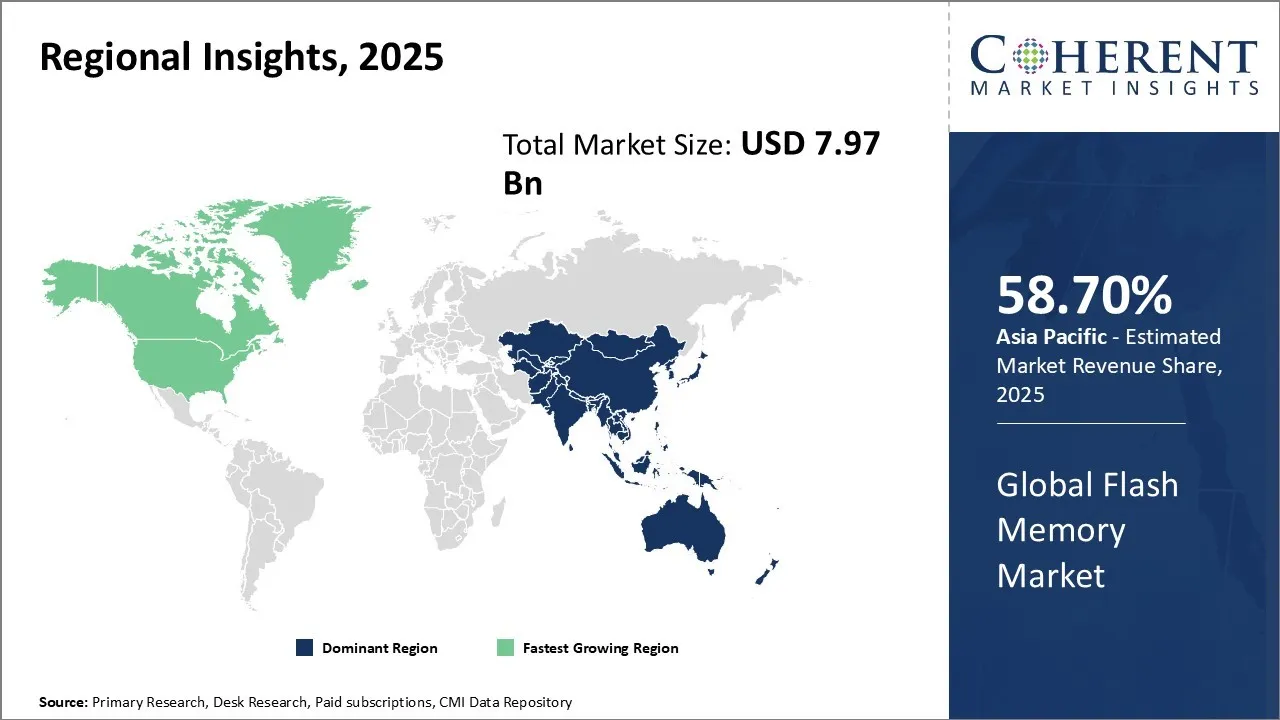
Asia Pacific Flash Memory Market Analysis and Trends
Asia Pacific, holding a share of 58.7% in 2026, is expected to dominate the global flash memory market. The region's growth is a result of economic development, increasing digitalization, and rising consumer demand for electronic devices. Countries like China and Japan have become major manufacturing hubs for flash memory products. The growing mobile device market has also created demand for flash memory in the region. Companies such as Samsung Electronics, SK Hynix, and Toshiba Memory Corporation have played an important role in driving innovation and market growth in the region.
North America Flash Memory Market Analysis and Trends
North America, holding a share of 20.6% in 2026, is expected to exhibit the fastest growth in the global flash memory market. The region has a strong market ecosystem, containing major technology companies and a high concentration of data centers. Notable companies such as Intel, Micron Technology, and Western Digital have significantly contributed to the region's dominance through their innovative product offerings and strategic partnerships.
Global Flash Memory Market Outlook for Key Countries:
U.S. Flash Memory Market Analysis and Trends
The U.S. flash memory market continues to thrive, driven by the increasing adoption of solid-state drives (SSDs) in data centers, enterprise storage, and consumer devices. The country's advanced technological infrastructure, coupled with the presence of major technology companies and a strong focus on research and development, has positioned it as a leader in the flash memory market. Key players such as Intel, Micron Technology, and Western Digital have been instrumental in driving innovation and meeting the growing demand for high-performance storage solutions in the United States.
China Flash Memory Market Analysis and Trends
China flash memory market has experienced significant growth, fueled by the country's vast consumer electronics industry and the increasing adoption of SSDs in personal computers and data centers. The government's initiatives to promote domestic semiconductor production and the development of advanced technologies have further boosted the flash memory market in China. Notable companies such as Yangtze Memory Technologies Company (YMTC) and Longsys have emerged as key players in China, focusing on developing cost-effective and high-capacity flash memory solutions to meet the growing demand.
Japan Flash Memory Market Analysis and Trends
Japan continues to hold a significant position in the global flash memory market, leveraging its long-standing expertise in semiconductor technology and advanced manufacturing capabilities. The country is home to major players such as Kioxia (formerly Toshiba Memory Corporation) and Renesas Electronics, which have been at the forefront of flash memory innovation. Japan has seen strong demand for flash memory in various applications, including automotive electronics, industrial automation, and consumer devices. The country's focus on quality, reliability, and miniaturization has enabled it to maintain a competitive edge in the market.
South Korea Flash Memory Market Analysis and Trends
South Korea flash memory market has been driven by the strong presence of industry giants such as Samsung Electronics and SK Hynix. These companies have made significant investments in research and development, leading to the introduction of cutting-edge flash memory technologies, such as 3D NAND and V-NAND. The country's advanced semiconductor manufacturing capabilities and robust supply chain have positioned it as a key player in the global flash memory market. The increasing demand for high-capacity storage solutions in smartphones, tablets, and other consumer electronics has further fueled the growth of the flash memory market in South Korea.
Market Players, Key Development, and Competitive Intelligence:
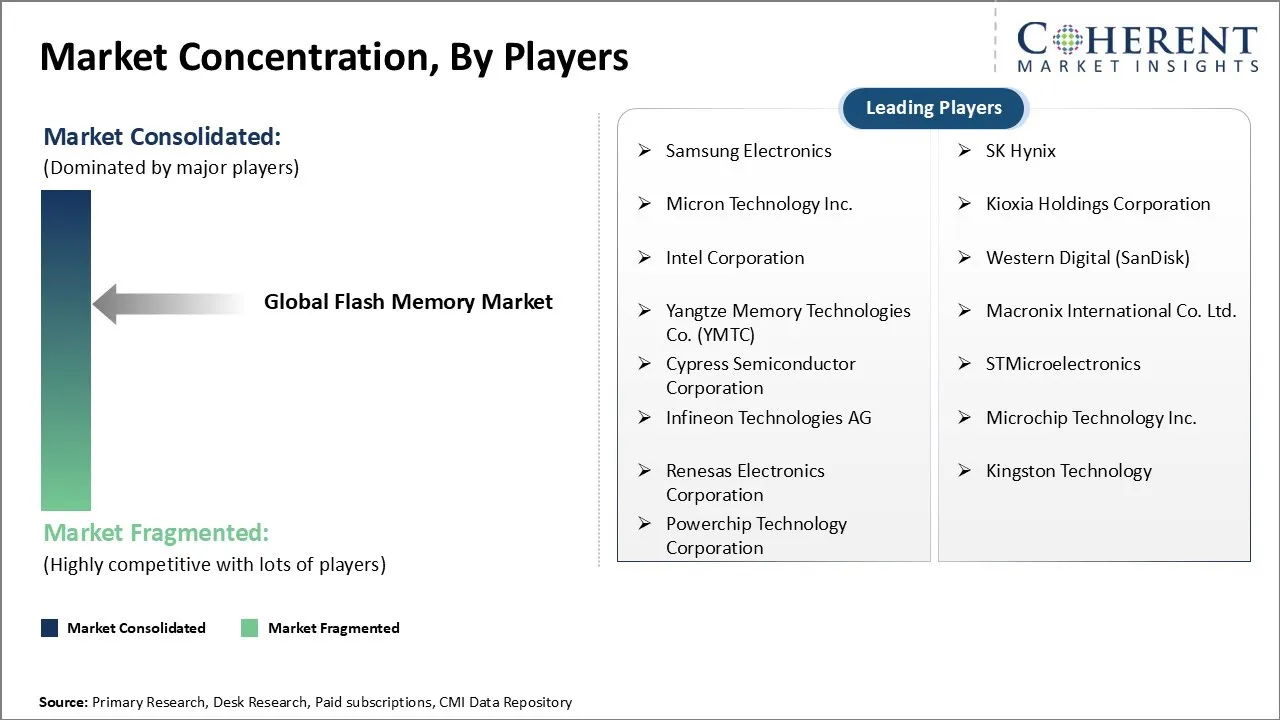
Key Developments:
- In March 2025, at MWC Barcelona 2025, Huawei, a China-based technology company, unveiled four New-Gen All-Flash Data Center products and two scenario-specific industry solutions designed to help customers build future-proof data storage power, accelerate intelligent transformation, and unleash the value of data in the AI era. The products included New-Gen OceanStor Dorado Converged All-Flash Storage for mission-critical applications, Next-Gen OceanProtect E8000 All-Flash Backup Storage for data backup, and Next-Gen OceanStor Pacific 9928 All-Flash Scale-Out Storage for data analysis.
- In February 2025, Kioxia Corporation, a provider of flash memory and SSDs, and Sandisk Corporation, a computer technology company, pioneered a state-of-the-art 3D flash memory technology, setting the industry benchmark with a 4.8Gb/s NAND interface speed, superior power efficiency, and heightened density.
- In August 2024, Samsung Electronics America, a leader in advanced memory technology, announced new 512GB capacities for its BAR Plus and FIT Plus USB 3.2 Gen1 Flash Drives.
- In July 2024, Micron Technology, Inc., a producer of computer memory and computer data storage, started shipping ninth-generation (G9) TLC NAND in SSDs.
Top Strategies Followed by Global Flash Memory Market Players
- Established players are investing heavily in R&D to develop advanced flash memory technologies, such as 3D NAND and NVMe, to meet the growing demand for faster and more efficient storage solutions. These players are also forming strategic partnerships with major industry players and original equipment manufacturers (OEMs) to solidify their market presence.
- For example, Samsung has partnered with Intel to develop and manufacture 3D NAND technology, while Toshiba has collaborated with Western Digital to invest in a new flash memory fabrication facility in Japan. Additionally, these established players are expanding their global distribution networks to enhance their market reach and cater to the increasing demand for flash memory products worldwide.
- Mid-level players are leveraging their expertise in manufacturing and supply chain management to produce quality products at competitive prices. They are also forming collaborations with other industry players to boost their technology and production capabilities, as well as their market presence.
- For instance, SK Hynix, a mid-level player, has partnered with Intel to develop and manufacture 3D NAND technology, which has helped the company to expand its product portfolio and market share.
- Small-scale players are leveraging their agility and flexibility to quickly adapt to changing market demands and introduce specialized products that cater to specific customer needs. They are also adopting cutting-edge technologies, such as AI and machine learning, to develop intelligent storage solutions that can analyze data patterns and optimize performance.
- Everspin develops MRAM products, which combine the speed of SRAM and the non-volatility of flash, catering to industrial, automotive, and enterprise storage segments.
Market Report Scope
Global Flash Memory Market Report Coverage
| Report Coverage | Details | ||
|---|---|---|---|
| Base Year: | 2025 | Market Size in 2026: | USD 8.30 Bn |
| Historical Data for: | 2020 To 2024 | Forecast Period: | 2026 To 2033 |
| Forecast Period 2026 to 2033 CAGR: | 4.5% | 2033 Value Projection: | USD 11.33 Bn |
| Geographies covered: |
| ||
| Segments covered: |
| ||
| Companies covered: | Samsung Electronics, SK Hynix, Micron Technology Inc., Kioxia Holdings Corporation, Intel Corporation, Western Digital (SanDisk), Yangtze Memory Technologies Co. (YMTC), Macronix International Co. Ltd., Cypress Semiconductor Corporation, STMicroelectronics, Infineon Technologies AG, Microchip Technology Inc., Renesas Electronics Corporation, Kingston Technology, and Powerchip Technology Corporation | ||
| Growth Drivers: |
| ||
| Restraints & Challenges: |
| ||
Market Dynamics
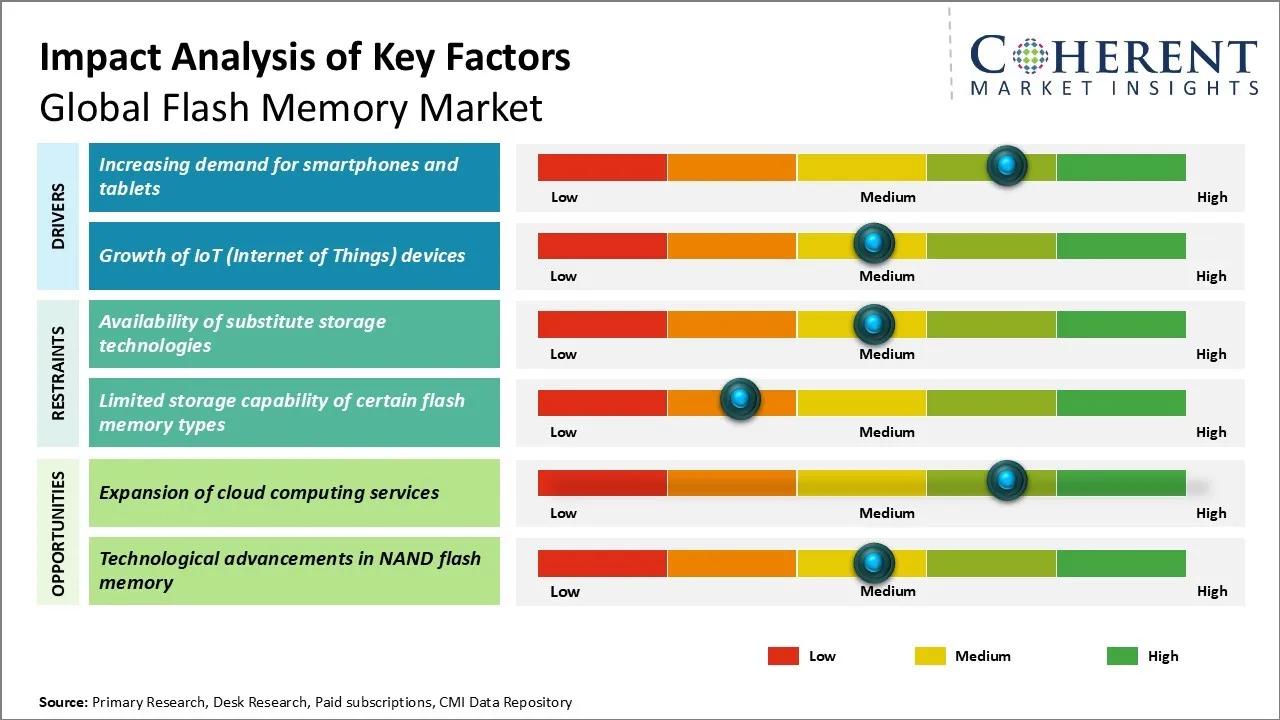
Global Flash Memory Market Driver - Increasing Demand for Smartphones and Tablets
The global flash memory market is experiencing a significant boost due to the skyrocketing demand for smartphones and tablets worldwide. As consumers increasingly rely on these portable devices for communication, entertainment, and productivity, the need for high-capacity, reliable, and fast storage solutions has become paramount. Flash memory, with its non-volatile nature, low power consumption, and quick access times, has emerged as the preferred choice for these devices.
Manufacturers are constantly pushing the boundaries of flash memory technology to accommodate the growing storage requirements of modern smartphones and tablets, which now feature high-resolution cameras, 4K video recording capabilities, and resource-intensive applications. Samsung’s flagship smartphones like the Galaxy S24 Ultra now offer up to 1TB of internal UFS 4.0 flash storage, supporting high-resolution cameras, 8K video recording, and advanced AI processing.
Global Flash Memory Market Opportunity - Expansion of Cloud Computing Services
As businesses increasingly adopt cloud-based solutions for data storage, processing, and delivery, the demand for high-performance and reliable storage technologies like flash memory is expected to surge. The low latency, high throughput, and superior endurance of flash memory make it an ideal choice for cloud infrastructure, enabling quick access to data and ensuring smooth operation of cloud-based applications.
Moreover, the increasing popularity of edge computing, which brings processing power closer to the data source, further drives the demand for flash memory in cloud environments. As edge devices collect and process vast amounts of data in real-time, flash memory's ability to provide fast and reliable storage becomes crucial. AWS Snowcone, a small edge computing and data transfer device, uses flash-based SSDs for secure, portable processing—perfect for remote or offline data collection.
Analyst Opinion (Expert Opinion):
- Ongoing conflicts such as the Russia-Ukraine war, China-Taiwan tensions, and the Middle East instability threaten the stability of global semiconductor supply chains. Many flash memory components—like silicon wafers, rare earth elements, and photolithography equipment—rely on international trade and tightly integrated logistics. Disruptions at key chokepoints (e.g., the Taiwan Strait or Red Sea routes) could delay shipments, drive up raw material prices, and cause production bottlenecks for major manufacturers like Samsung, SK Hynix, and Kioxia.
- Heightened global insecurity is prompting governments—especially in the U.S., EU, India, and Japan—to pour investments into domestic chip manufacturing and strategic reserves. This trend is accelerating initiatives like the U.S. CHIPS Act and the EU Chips Act, which include incentives for flash memory fab expansion. In the medium to long term, such policies could decentralize production and reduce reliance on East Asian supply chains, fostering a more regionally balanced, albeit costlier, flash memory market.
Speak to the analyst
Want personalized insights?
Take the findings above to one of our principal consultants, or have the report rebuilt around the segments, geographies and competitors you actually track.
Market Segmentation
- Type Insights (Revenue, USD Bn, 2021 - 2033)
- NAND Flash Memory
- NOR Flash Memory
- Cell Architecture Insights (Revenue, USD Bn, 2021 - 2033)
- Triple-Level Cell
- Quad-Level Cell
- Multi-Level Cell
- Single-Level Cell
- Regional Insights (Revenue, USD Bn, 2021 - 2033)
- North America
- U.S.
- Canada
- Latin America
- Brazil
- Argentina
- Mexico
- Rest of Latin America
- Europe
- Germany
- U.K.
- Spain
- France
- Italy
- Russia
- Rest of Europe
- Asia Pacific
- China
- India
- Japan
- Australia
- South Korea
- ASEAN
- Rest of Asia Pacific
- Middle East
- GCC Countries
- Israel
- Rest of Middle East
- Africa
- South Africa
- North Africa
- Central Africa
- North America
- Key Players Insights (Revenue, USD Bn, 2021 - 2033)
- Samsung Electronics
- SK Hynix
- Micron Technology Inc.
- Kioxia Holdings Corporation
- Intel Corporation
- Western Digital (SanDisk)
- Yangtze Memory Technologies Co. (YMTC)
- Macronix International Co. Ltd.
- Cypress Semiconductor Corporation
- STMicroelectronics
- Infineon Technologies AG
- Microchip Technology Inc.
- Renesas Electronics Corporation
- Kingston Technology
- Powerchip Technology Corporation
Sources
Primary Research Interviews:
Stakeholders:
- Consumer Electronics Manufacturers (e.g., Smartphone & Tablet Product Managers)
- Flash Memory Component Suppliers (e.g., Wafer Foundries, Controller Designers)
- Cloud Service Providers and Data Center Engineers
- Automotive OEMs and Tier-1 Suppliers (focused on in-vehicle storage systems)
- Semiconductor Fabrication Equipment Providers
- AI & Edge Computing Device Developers
Databases:
- Global Semiconductor Inventory Index (GSII)
- Memory Hardware Trade Statistics Bureau (MHTSB)
- International Digital Infrastructure Registry (IDIR)
- TechGlobal Export-Import Database
Magazines:
- TechMemory Monthly: Insights on flash innovation and memory chip design
- NextGen Computing Digest: Covers edge AI, HPC, and storage breakthroughs
- Data Storage Review: Focused on enterprise SSDs and server memory
- Semiconductor Systems & Design
Journals:
- Journal of Flash Memory Systems & Architecture
- International Journal of Semiconductor Applications and Storage
- Advanced Microelectronics & Memory Journal
- AI & Storage Integration Journal (ASIJ)
Newspapers:
- Tech Times Global
- Semiconductor Business Daily
- The Digital Infrastructure Post
- Asia Tech Review (ATR)
Associations:
- Global Flash Storage Alliance (GFSA)
- Non-Volatile Memory Industry Consortium (NVMIC)
- International Semiconductor Trade Federation (ISTF)
- AI-Optimized Hardware Association (AIOHA)
- Embedded Systems and Storage Society (ESSS)
Public Domain Sources:
- U.S. Census Bureau
- EUROSTAT
- World Bank
- United Nations Industrial Development Organization (UNIDO)
- ResearchGate
Proprietary Elements:
- CMI Data Analytics Tool, Proprietary CMI Existing Repository of information for last 8 years
Get access to 250+ pages report
Every segment, forecast, competitor profile and data table behind the analysis above — available for instant download.
- ESOMAR Member
- ISO 9001:2015 Certified
- D-U-N-S Registered
- GDPR & CCPA Compliant
Missing comfort of reading report in your local language? Find your preferred language:
Transform your Strategy with Exclusive Trending Reports
Frequently Asked Questions
The global flash memory market is estimated to be valued at USD 7.97 billion in 2025 and is expected to reach USD 10.70 billion by 2032.
The CAGR of the global flash memory market is projected to be 4.3% from 2025 to 2032.
Increasing demand for smartphones and tablets and growth of IoT (Internet of Things) devices are the major factors driving the growth of the global flash memory market.
Availability of substitute storage technologies and limited storage capability of certain flash memory types are the major factors hampering the growth of the global flash memory market.
In terms of type, the NAND flash memory segment is estimated to dominate the market revenue share in 2025.
Samsung Electronics, SK Hynix, Micron Technology Inc., Kioxia Holdings Corporation, Intel Corporation, Western Digital (SanDisk), Yangtze Memory Technologies Co. (YMTC), Macronix International Co. Ltd., Cypress Semiconductor Corporation, STMicroelectronics, Infineon Technologies AG, Microchip Technology Inc., Renesas Electronics Corporation, Kingston Technology, and Powerchip Technology Corporation are the major players.
Asia Pacific is expected to lead the global flash memory market in 2025.