

Vibration Sensors Market Size and Share Analysis- 2026 To 2033
The Vibration Sensors Market size is anticipated to grow at a CAGR of 5.7%, with USD 6.34 Bn in 2026, and is expected to reach USD 9.32 Bn in 2033. The primary drivers are largely defined by the rapid adoption of industrial automation, increasing deployment of predictive maintenance solutions, rising integration of IoT-enabled condition monitoring systems, and growing use of AI-based analytics across manufacturing and industrial operations. According to Deloitte’s reported in 2025 that 34% of manufacturers identified active sensors as a first- or second-priority investment for the next 24 months, while 41% prioritized factory automation hardware.
Key Takeaways
- The acceleration sensor segment is likely to dominate the market with 48.5% in 2026. The segment’s growth is owing to the widespread use of accelerometers for vibration measurement in rotating machinery, motors, pumps, turbines, compressors, and other industrial equipment. Analog Devices notes that vibration analysis is the most commonly used method for condition-based monitoring, while accelerometers are widely deployed to identify imbalance, misalignment, bearing faults, and other machine anomalies.
- Piezoelectric ceramics are expected to lead the material segment with a 46.2% share in 2026. Their growth is supported by high sensitivity, wide frequency range, reliable performance, and suitability for continuous vibration monitoring in industrial equipment. Analog Devices’ IEPE-compatible vibration measurement architecture supports piezoelectric accelerometers with bandwidth of up to 54 kHz, making it suitable for detecting high-frequency machinery vibrations and supporting condition-based maintenance.
- The process industries segment is set to dominate the end-user category with 56.8% in 2026. The segment’s growth is owing to the extensive use of rotating equipment across oil & gas, chemicals, power generation, mining, metals, and other continuous-process industries, where machinery failure can significantly affect production. Rockwell Automation’s 2025 North America investment data identified approximately USD 400 Bn in announced new energy capacity, USD 120 Bn in mining & metals, and USD 120 Bn in chemicals and pulp & paper, supporting continued deployment of industrial automation and equipment-monitoring technologies.
- The piezoelectric technology segment is projected to lead with 42.7% in 2026. The segment’s growth is owing to the strong adoption of IEPE/piezoelectric sensors for high-resolution vibration measurement, machine-condition monitoring, structural monitoring, and predictive maintenance.
- The automotive segment is likely to account for the largest application share of 20.8% in 2026. The segment’s growth is owing to increasing automation of vehicle and battery manufacturing, higher deployment of machine-health monitoring systems, and greater use of vibration measurement in engines, motors, powertrains, production equipment, and testing systems. Rockwell Automation reported approximately USD 200 Bn of announced Auto/EV/Battery manufacturing capacity investment in the U.S. and Canada, creating additional opportunities for industrial automation, sensing, and condition-monitoring systems.
- North America is expected to hold the largest market share of 34.8% in 2026. The region’s growth is owing to advanced manufacturing infrastructure, strong adoption of smart factories, large automotive, aerospace, semiconductor, and energy industries, and rising investments in automation and predictive maintenance. Rockwell Automation reported that around 95% of manufacturers are using or evaluating smart manufacturing technologies, while its 2025 investment analysis identified approximately USD 250 Bn of announced semiconductor capacity and USD 200 Bn of Auto/EV/Battery capacity in the U.S. and Canada.
Market Drivers
Rapid Adoption of Smart Manufacturing and Industrial Automation is Driving the Vibration Sensors Market
The Vibration Sensors Market is gaining strong momentum owing to the rapid adoption of smart manufacturing, factory automation, and connected sensing technologies. Modern manufacturing facilities increasingly rely on vibration sensors to continuously monitor motors, pumps, compressors, bearings, turbines, and other rotating equipment. The resulting vibration data enables manufacturers to identify abnormal operating patterns before they result in equipment failure.
According to Deloitte’s 2025 Smart Manufacturing and Operations Survey, 46% of manufacturers ranked process automation among their top two investment priorities for the following two years. Moreover, 41% identified factory automation hardware and 34% identified active sensors as first- or second-priority technology investments. This directly supports greater deployment of vibration sensing devices within automated manufacturing environments.
Predictive Maintenance and Rising Cost of Unplanned Downtime are Accelerating Vibration Sensor Adoption
Another key factor driving the Vibration Sensors Market is the growing use of predictive maintenance. Vibration monitoring helps companies identify early signs of equipment problems, such as bearing wear, imbalance, misalignment, and loose components, before they lead to major failures. This is especially important in industries where unexpected equipment shutdowns can result in significant production delays and financial losses.
According to Siemens’ 2026 Asset Lifecycle Report, 22% of respondents said that equipment failures and emergency repairs make up 25% to 50% of their maintenance work. Siemens also reported that unplanned downtime costs industrial plants about USD 260,000 per hour on average, while the cost can reach around USD 2.3 million per hour in the automotive industry.
Current Events and Their Impact on the Vibration Sensors Market
Current Event | Description and its Impact |
European Union Prepares for New Machinery Regulation Requirements (2026–2027) |
|
Government of India Supports Commercialization of Industrial AIoT and Machine-Condition Sensors (2026) |
|
- Current Industry Events of 2026
- Market Size Estimation
- Regional Breakdown
- Competitive Landscape
- Customer Intelligence
- Segmental Analysis
- Pricing Analysis
- Key Market Drivers, Challenges & Future Trends
- Customized Insights Section
Segmental Insights
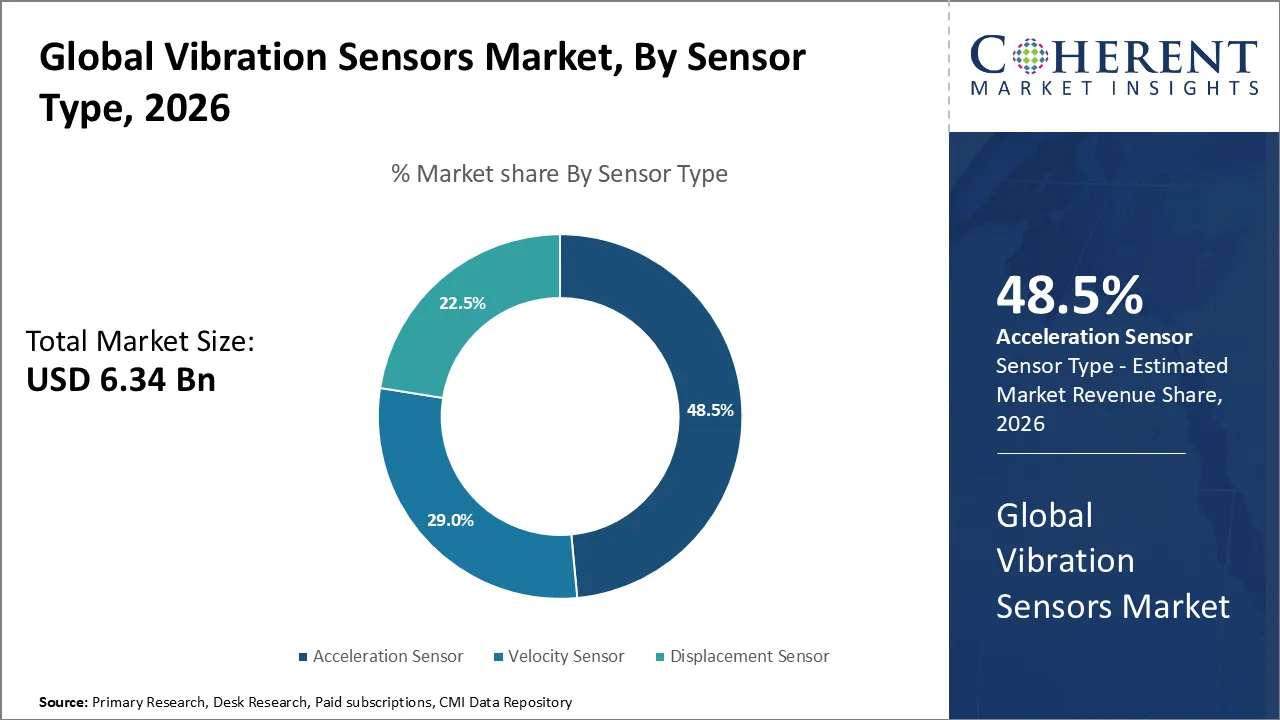
Why are Acceleration Sensors Acquiring the Largest Share?
On the basis of sensor type, the acceleration sensor segment is projected to account for the largest Vibration Sensors Market share of 48.5% in 2026. The segment’s growth is owing to the extensive use of accelerometers for detecting vibration amplitude, frequency, imbalance, misalignment, bearing deterioration, and mechanical faults across motors, pumps, compressors, turbines, gearboxes, and other rotating machinery.
TE Connectivity states that for bearing-condition monitoring, an accelerometer's frequency response should typically extend to around 40–50 times the shaft rotational frequency to identify relevant failure signatures. This requirement favors accelerometers capable of capturing a broad spectrum of machine vibrations rather than merely measuring overall movement.
TE Connectivity's industrial acceleration sensors currently provide measurement ranges extending from ±5 g to ±500 g, while selected models offer frequency responses reaching 18,000 Hz. This broad measurement capability supports acceleration sensors across both low-vibration precision machinery and high-vibration heavy industrial equipment.
Why are Piezoelectric Ceramics Acquiring the Largest Share?
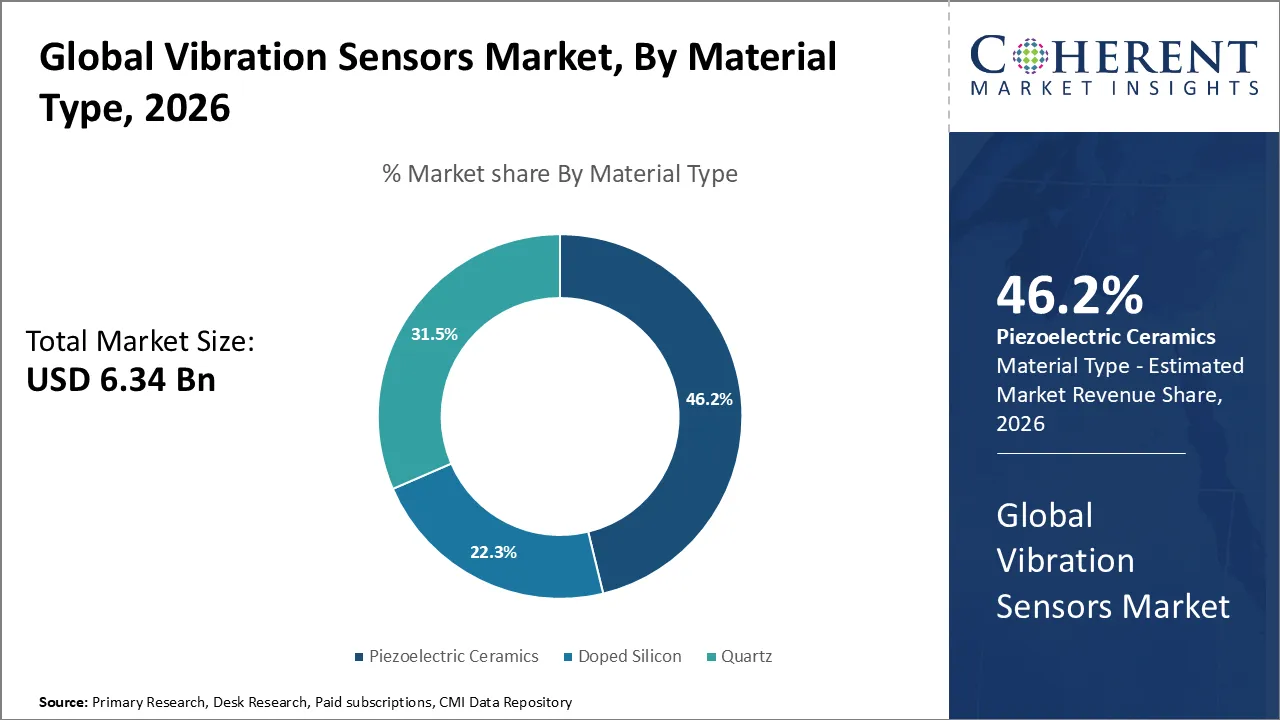
On the basis of material, the piezoelectric ceramics segment is expected to lead the Vibration Sensors Market with 46.2% in 2026. The segment’s growth is owing to the high sensitivity, long-term signal stability, wide dynamic range, broad operating-temperature capability, and strong suitability of piezoceramic sensing elements for continuous industrial vibration measurement.
TE Connectivity's Model 8201 condition-monitoring accelerometer uses a stable piezoceramic crystal operating in shear mode and provides measurement ranges between ±25 g and ±500 g. It also provides a frequency response of 2 Hz to 10,000 Hz, demonstrating the broad vibration spectrum that piezoceramic elements can capture.
Why are Process Industries Acquiring the Largest Share?
On the basis of end user, the process industries segment is projected to hold the largest Vibration Sensors Market share of 56.8% in 2026. The segment’s growth is owing to the large installed base of continuously operating pumps, motors, compressors, turbines, fans, blowers, and gearboxes across oil & gas, chemicals, refining, power generation, mining, metals, pulp & paper, and utilities.
A recent Emerson industrial reliability deployment demonstrated vibration-based predictive maintenance across more than 350 critical rotating assets, where advanced diagnostics helped prevent 19 equipment failure events. The operator plans to expand the wireless monitoring network to more than 5,600 sensors. This illustrates the increasing scale at which vibration monitoring is being deployed across process-intensive facilities.
Emerson also states that repairing an asset after failure can cost approximately 50% more than addressing the problem before failure. The high economic impact of equipment breakdowns is consequently encouraging process industries to expand continuous vibration monitoring and predictive-maintenance programs.
Why is Piezoelectric Technology Acquiring the Largest Share?
On the basis of technology, the piezoelectric technology segment is projected to lead the Vibration Sensors Market with 42.7% in 2026. The segment’s growth is owing to high-frequency response, strong signal resolution, wide dynamic range, low signal drift, and established adoption in industrial condition-monitoring systems.
Commercial development is also expanding piezoelectric sensing into wireless industrial monitoring. TE Connectivity's wireless piezoelectric vibration sensors provide bandwidth of more than 15 kHz, a resonant frequency of 35 kHz, embedded FFT analysis, and battery life of up to 10 years. These capabilities are facilitating migration from periodic manual vibration measurements toward continuous IIoT-enabled condition monitoring.
Why is Automotive Acquiring the Largest Share?
On the basis of application, the automotive segment is projected to account for the largest Vibration Sensors Market share of 20.8% in 2026. The segment’s growth is owing to extensive automation across vehicle assembly, machining, stamping, welding, painting, battery production, electric drivetrain manufacturing, and component testing, all of which require continuous monitoring of machinery health and vibration.
According to the International Federation of Robotics, U.S. automotive manufacturers added 13,700 industrial robots in 2024, which represents a 10.7% increase compared to the previous year. In 2024, nearly 40% of all new industrial robot installations in the U.S. were for automotive applications, underscoring the industry's high level of factory automation.
The use of automation is increasing worldwide. In 2024, Japan’s automotive industry installed around 13,000 industrial robots, an increase of 11%, while European automotive manufacturers installed about 23,000 robots, the second-highest level recorded in the past five years.
Vibration Sensors Market Trends
- The shift from periodic equipment checks to continuous predictive maintenance is increasing the use of vibration sensors in motors, pumps, compressors, turbines, gearboxes, and other rotating machinery. According to NI, vibration monitoring can detect early signs of wear, misalignment, and imbalance before they lead to equipment failure and downtime.
- The rise of wireless vibration sensors is making it easier to install these devices and is allowing condition monitoring for equipment that was previously difficult to wire or not cost-effective. TE Connectivity’s wireless vibration sensors, which support LoRaWAN and Bluetooth Low Energy, feature embedded FFT signal analysis and can last up to 4 years on a battery, making them ideal for scalable monitoring across industrial facilities.
- The increasing integration of AI-based diagnostics with vibration monitoring is enabling faster fault identification and more automated maintenance decisions. Fluke’s WATCHMAN analytics platform uses a diagnostic engine trained on 100 trillion data points collected over 30 years across 50 machinery components. Fluke reports that users can achieve up to a 90% reduction in Priority 1 and Priority 2 faults and a 30% reduction in vibration-program costs.
Regional Insights
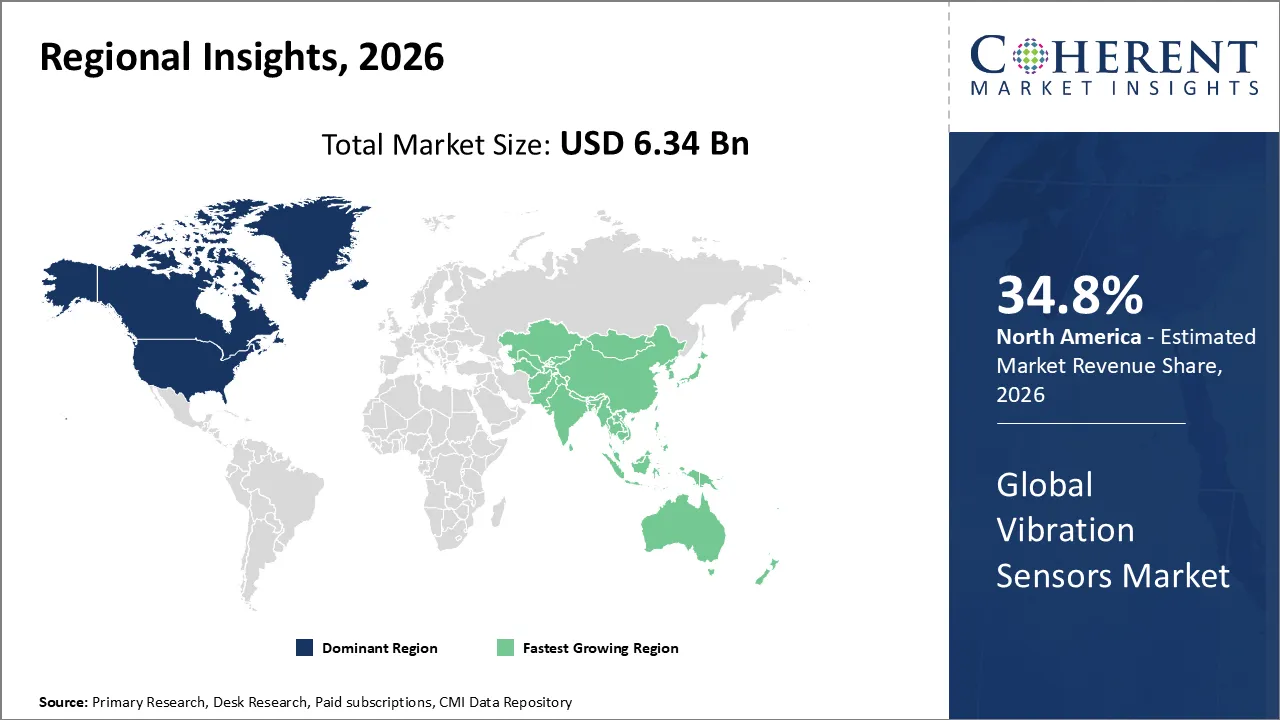
North America Dominates Owing to Advanced Industrial Automation and Predictive Maintenance Adoption
The North America region is expected to account for 34.8% of the Vibration Sensors Market share in 2026. The region’s growth is owing to the high penetration of factory automation, strong adoption of predictive maintenance, advanced automotive and aerospace manufacturing, and widespread deployment of Industrial IoT and connected condition-monitoring systems.
According to the International Federation of Robotics, North America reached a robot density of 204 industrial robots per 10,000 manufacturing employees in 2024, while the U.S. alone recorded 307 robots per 10,000 employees. This highly automated machinery base creates substantial demand for vibration monitoring across motors, bearings, gearboxes, robotic equipment, conveyors, and production systems.
In April 2025, U.S.-based Wilcoxon Sensing Technologies, an Amphenol company, launched the 883M digital triaxial accelerometer and temperature sensor for industrial vibration monitoring.
Asia Pacific is Expected to be the Fastest-Growing Region in the Vibration Sensors Market
Asia Pacific is expected to witness the fastest growth in the Vibration Sensors Market over the forecast period. The region’s growth is owing to rapid factory automation in China and India, expansion of electronics and automotive manufacturing, growing deployment of smart factories, and rising adoption of predictive maintenance and industrial IoT across large manufacturing ecosystems.
The International Federation of Robotics reported that Asia’s average robot density increased by 11% to 131 robots per 10,000 manufacturing employees in 2024. China remains the major growth engine: approximately 354,000 industrial robots were installed in China in 2025, up 20% year-on-year and accounting for 59% of global deployments.
In August 2026, Japan-based TDK Corporation launched the edgeRX PRO sensor module, expanding its SensEI predictive-maintenance platform for industrial equipment monitoring. The new module integrates vibration, acoustic, magnetic, temperature, and rotational-motion sensing with a 6-axis IMU and edge-AI processing inside an IP67-rated enclosure.
Advanced Factory Automation and Predictive Maintenance Adoption are Accelerating the Vibration Sensors Market in the United States
The U.S. Vibration Sensors Market is witnessing strong growth owing to the country’s high level of industrial automation, large installed base of rotating machinery, and increasing use of condition-monitoring and predictive-maintenance systems across automotive, food processing, electronics, machinery, aerospace, and other manufacturing industries.
According to the International Federation of Robotics, the U.S. installed around 38,000 industrial robots in 2025, representing an 11% year-on-year increase. Robot density also reached 307 industrial robots per 10,000 manufacturing employees.
China Vibration Sensors Market Trends
China is expected to witness strong growth in the Vibration Sensors Market owing to its large manufacturing base, rapid expansion of industrial automation, increasing deployment of industrial robots, and government support for Industrial Internet and AI-enabled equipment monitoring.
According to China’s National Bureau of Statistics, the country produced approximately 773,000 industrial robots in 2025, an increase of 28.0% compared with 2024. China also produced around 16.52 million new energy vehicles in 2025, up 25.1% year-on-year, further expanding highly automated manufacturing environments where vibration monitoring is used across motors, machining equipment, battery production systems, robotic equipment, and production lines.
Who are the Major Companies in Vibration Sensors Industry
Some of the major key players in Vibration Sensors Market are General Electric Company, Schaeffler Technologies AG & Co. KG, Analog Devices, Inc., National Instruments Corporation, Wilcoxon Sensing Technologies, ETS Solutions Asia Pte Ltd., SKF Group, Preditec/IRM (Alava Ingenieros Group), ABB AS, Waites Wireless Sensor Technologies LLC, Pruftechnik Dieter Busch AG, BeanAir Germany, I-Care Group, Evigia Systems, Inc.
Key News
- In April 2026, Wilcoxon launched the ILA210 inline adapter, which converts analog IEPE vibration signals into Modbus data for direct integration with PLC, DCS, and SCADA systems. The device supports acceleration, velocity, displacement, FFT spectrum, crest factor, and other vibration metrics, strengthening digital machine-health monitoring applications.
- In June 2025, Waites introduced its Universal Adapter product suite, enabling almost any industrial sensor using 0–5 V, 0–10 V, 4–20 mA, CT, or RTD interfaces to connect wirelessly to its predictive-maintenance platform.
Market Report Scope
Vibration Sensors Market Report Coverage
Report Coverage | Details | ||
Base Year: | 2025 | Market Size in 2026: | USD 6.34 Bn |
Historical Data for: | 2020 to 2024 | Forecast Period: | 2026 to 2033 |
CAGR: | 5.7% | 2033 Value Projection: | USD 9.32 Bn |
Geographies covered: |
| ||
Segments covered: |
| ||
Companies covered: | General Electric Company, Schaeffler Technologies AG & Co. KG, Analog Devices, Inc., National Instruments Corporation, Wilcoxon Sensing Technologies, ETS Solutions Asia Pte Ltd., SKF Group, Preditec/IRM (Alava Ingenieros Group), ABB AS, Waites Wireless Sensor Technologies LLC, Pruftechnik Dieter Busch AG, BeanAir Germany, I-Care Group, Evigia Systems, Inc. | ||
Growth Drivers: |
| ||
Restraints & Challenges: |
| ||
Analyst Opinion
- The Vibration Sensors Market is expected to benefit strongly from the continued expansion of industrial automation, as a larger installed base of robots, motors, bearings, gearboxes, and automated machinery creates more assets that require continuous condition monitoring. According to the International Federation of Robotics, 5 million industrial robots were operating in factories globally in 2025, while more than 600,000 new robots were installed during the year, representing an 11% increase in annual installations.
- Manufacturers are recognizing that sensing infrastructure is a core component of smart manufacturing, rather than just an optional maintenance tool. According to Deloitte’s 2025 Smart Manufacturing Survey, 34% of manufacturers have placed active sensors among their top two technology investment priorities for the next 24 months, while factory automation hardware is prioritized by 41%. According to the same survey, 78% of those surveyed are dedicating more than 20% of their overall improvement budgets to smart manufacturing initiatives, which creates a positive environment for the wider use of vibration sensors and connected machine-health systems.
- Predictive maintenance is likely to remain one of the strongest commercial use cases for vibration sensors because the financial impact of equipment failure remains substantial. 22% of surveyed organizations still had equipment breakdowns and emergency repairs accounting for 25%–50% of maintenance work orders. Siemens also estimates average unplanned downtime costs at approximately USD 260,000 per hour for an industrial plant, rising to about USD 2.3 million per hour in automotive manufacturing.
Speak to the analyst
Want personalized insights?
Take the findings above to one of our principal consultants, or have the report rebuilt around the segments, geographies and competitors you actually track.
Market Segmentation
- By Sensor Type (Revenue, USD Bn, 2021-2033)
- Velocity Sensor
- Displacement Sensor
- Acceleration Sensor
- By Material Type (Revenue, USD Bn, 2021-2033)
- Doped Silicon
- Quartz
- Piezoelectric Ceramics
- By End User (Revenue, USD Bn, 2021-2033)
- Process Industries
- Discrete Industries
- By Technology (Revenue, USD Bn, 2021-2033)
- Piezoelectric
- Strain Gauge
- Inductive
- Capacitive
- Piezoresistive
- By Application (Revenue, USD Bn, 2021-2033)
- Aircraft Design & Testing
- Food Processing Industry
- Automotive
- Coal & Quarry Sector
- Oil and Gas Industry
- Medical Sector
- Nuclear
- Automobile
- Consumer Electronics
- Mining
- Pharmaceuticals
- Electric Power Generator
- Semiconductors
- Global Vibration Sensors Market, By Region (Revenue, USD Bn, 2021-2033)
- North America
- U.S.
- Canada
- Latin America
- Brazil
- Mexico
- Argentina
- Rest of Latin America
- Europe
- Germany
- U.K.
- France
- Italy
- Spain
- Russia
- Rest of Europe
- Asia Pacific
- China
- India
- Japan
- Australia
- South Korea
- ASEAN
- Rest of Asia Pacific
- Middle East
- GCC
- Israel
- Rest of Middle East
- Africa
- South Africa
- Central Africa
- North Africa
- North America
Sources
Primary Research Interviews
- Vibration sensor manufacturers and component suppliers
- Condition monitoring and predictive maintenance solution providers
- Industrial automation and IIoT technology developers
- Reliability engineers and maintenance managers
- Plant engineering and operations heads from process industries
- Automotive, aerospace, energy, oil & gas, and manufacturing procurement managers
- Machinery OEMs, system integrators, and industrial sensor distributors
- Key opinion leaders (KOLs) in machine condition monitoring and industrial sensing
Databases
- World Bank
- Organisation for Economic Co-operation and Development (OECD)
- International Federation of Robotics (IFR)
- U.S. Bureau of Labor Statistics (BLS)
- U.S. Energy Information Administration (EIA)
- National Institute of Standards and Technology (NIST)
- Eurostat
- UN Industrial Development Organization (UNIDO)
Magazines
- Control Engineering
- Plant Engineering
- Automation World
- Design World
- Machine Design
- Sensors Magazine / Sensors Converge
- Manufacturing Today
Journals
- Measurement
- Sensors
- IEEE Sensors Journal
- Mechanical Systems and Signal Processing
- Journal of Sound and Vibration
- Measurement Science and Technology
- ISA Transactions
Newspapers
- The Wall Street Journal
- Financial Times
- Reuters
- Bloomberg
- The Economic Times
- Nikkei Asia
Associations
- International Society of Automation (ISA)
- International Federation of Robotics (IFR)
- Society for Maintenance & Reliability Professionals (SMRP)
- Association for Manufacturing Technology (AMT)
- National Electrical Manufacturers Association (NEMA)
- International Organization for Standardization (ISO)
- Vibration Institute
Public Domain Sources
- Company Annual Reports and Investor Presentations
- Company Product Catalogs, Datasheets, and Technical White Papers
- Government Manufacturing and Industrial Automation Publications
- Industrial Robot and Smart Manufacturing Statistics
- Patent Databases such as WIPO, USPTO, and Google Patents
- Regulatory and Standards Publications Related to Machinery Safety and Condition Monitoring
- Publicly Available Predictive Maintenance and Industrial IoT Case Studies
- Product Launches, Press Releases, and Technical Announcements from Vibration Sensor Manufacturers
Proprietary Elements
- CMI Data Analytics Tool
- Proprietary CMI Existing Repository of Information for the Last 10 Years
Get access to 250+ pages report
Every segment, forecast, competitor profile and data table behind the analysis above — available for instant download.
- ESOMAR Member
- ISO 9001:2015 Certified
- D-U-N-S Registered
- GDPR & CCPA Compliant
Missing comfort of reading report in your local language? Find your preferred language:
Transform your Strategy with Exclusive Trending Reports
Frequently Asked Questions
The Vibration Sensors Market is expected to reach USD 9.32 Bn in 2033, from USD 6.34 Bn in 2026.
Major players operating in the global Vibration Sensors Market include General Electric Company, Schaeffler Technologies AG & Co. KG, Analog Devices, Inc., National Instruments Corporation, Wilcoxon Sensing Technologies, ETS Solutions Asia Pte Ltd., SKF Group, Preditec/IRM (Alava Ingenieros Group), ABB AS, Waites Wireless Sensor Technologies LLC, Pruftechnik Dieter Busch AG, BeanAir Germany, I-Care Group, and Evigia Systems, Inc.
High initial installation and integration costs, along with sensor calibration and maintenance requirements, are the key factors hampering market growth.
Increasing adoption of predictive maintenance, rising deployment of industrial automation and smart manufacturing systems, growing integration of IoT-enabled condition monitoring, and increasing use of AI-based analytics are driving the Vibration Sensors Market.
The Vibration Sensors Market is anticipated to grow at a CAGR of 5.7% between 2026 and 2033.
Among regions, North America is expected to dominate the global Vibration Sensors Market, accounting for approximately 34.8% of the market share in 2026.
Asia Pacific is expected to witness the fastest growth over the forecast period, supported by rapid factory automation, expansion of automotive and electronics manufacturing, smart-factory deployment, and increasing adoption of predictive maintenance and Industrial IoT solutions.