

Smart Building Market Size and Trends: 2026 to 2033
Smart Building Market is estimated to be valued at USD 171.44 Bn in 2026 and is expected to reach USD 821.60 Bn in 2033, exhibiting a compound annual growth rate (CAGR) of 25.1% from 2026 to 2033.
Key Takeaways
- Based on component, the solution segment is expected to hold a share of 84.1% in 2026, owing to growing adoption of integrated building technologies, increasing demand for energy efficiency, and advances in security and operation management.
- By application, the commercial segment is expected to hold 61% of market share by 2026, owing to increasing usage of smart building technologies in office, retail, and industrial facilities, along with energy efficiency and automation.
- Based on Region, the North America market is likely to dominate the global smart building market and is estimated to hold a share of 33.56% by 2026. While the Asia Pacific is expected to be the fastest-growing region.
Market Overview
The global smart building market is an emerging market owing to the rise in demand for cost-effective energy-saving solutions. The growth of the Smart Building market is mainly driven by several factors, government initiatives, rising awareness about environmental issues, and cost-effective technology solutions.
Current Events and Its Impact on the Smart Building Market
Current Events | and its impact |
Global Energy Crisis and Rising Utility Costs |
|
Supply Chain Disruptions and Semiconductor Shortages |
|
Role of AI (Artificial Intelligence) in Smart Building Market
The smart building market is transforming the global built environment in 2025 by integrating intelligence, sustainability, and automation to meet evolving commercial, residential, and industrial demands. In the smart building industry, "smart" represents the use of state-of-the-art technologies like IoT sensors, AI-enabled analytics, energy management systems, intelligent security systems, and building automation platforms, which optimize operational efficiency and safety, ensuring comfort for the occupants.
With the growing emphasis on sustainability, energy efficiency, and regulatory compliance, especially in commercial buildings, which constitute the largest market share, the adoption of smart building solutions has been accelerated Moreover, the increased convergence of IoT with AI and cloud-based platforms empowers predictive maintenance, automated operations, and improved occupant experiences, therefore making buildings more responsive, cost-efficient, and environmentally friendly.
For instance, in June 2025, Honeywell announced an AI-powered platform called Honeywell Connected Solutions that will “integrate critical building software and technologies into one interface” for building operators.
- Current Industry Events of 2026
- Market Size Estimation
- Regional Breakdown
- Competitive Landscape
- Customer Intelligence
- Segmental Analysis
- Pricing Analysis
- Key Market Drivers, Challenges & Future Trends
- Customized Insights Section
Segmental Insights
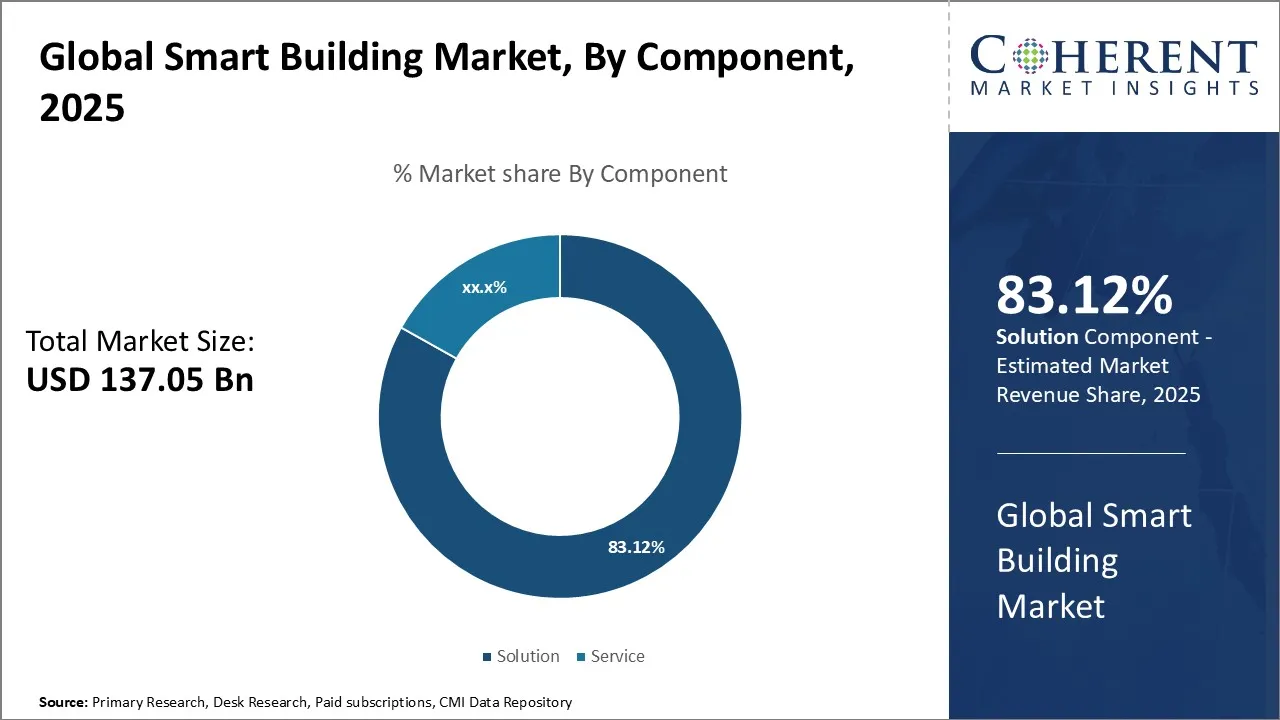
Smart Building Market Insights, By Component - Solution Segment Leads Due To Integration, Energy Efficiency, And Security Capabilities
In terms of component, the Solution segment contributed 84.1% of the global smart building market in 2024, driven by the growing adoption of integrated building technologies, increasing demand for energy efficiency, and enhanced security and operational management capabilities. These include building energy management systems, intelligent security systems, and building automation platforms that optimize operational efficiency, safety, and occupant comfort.
These solutions find their applications in commercial offices, retail outlets, hospitals, and residential complexes for the purpose of monitoring energy consumption, control of lighting and HVAC systems, and detection of security breaches. This shall further enable real-time insights for facility managers by combining the power of IoT, AI, and cloud-based platforms for predictive maintenance, automated operations, and better occupant experience, which will eventually lead to responsive, cost-efficient, and greener buildings.
For instance, in June 2025, Honeywell introduced the AI-Powered Building Management Solution, a fully integrated platform that brings together energy management, security, and predictive analytics on one dashboard.
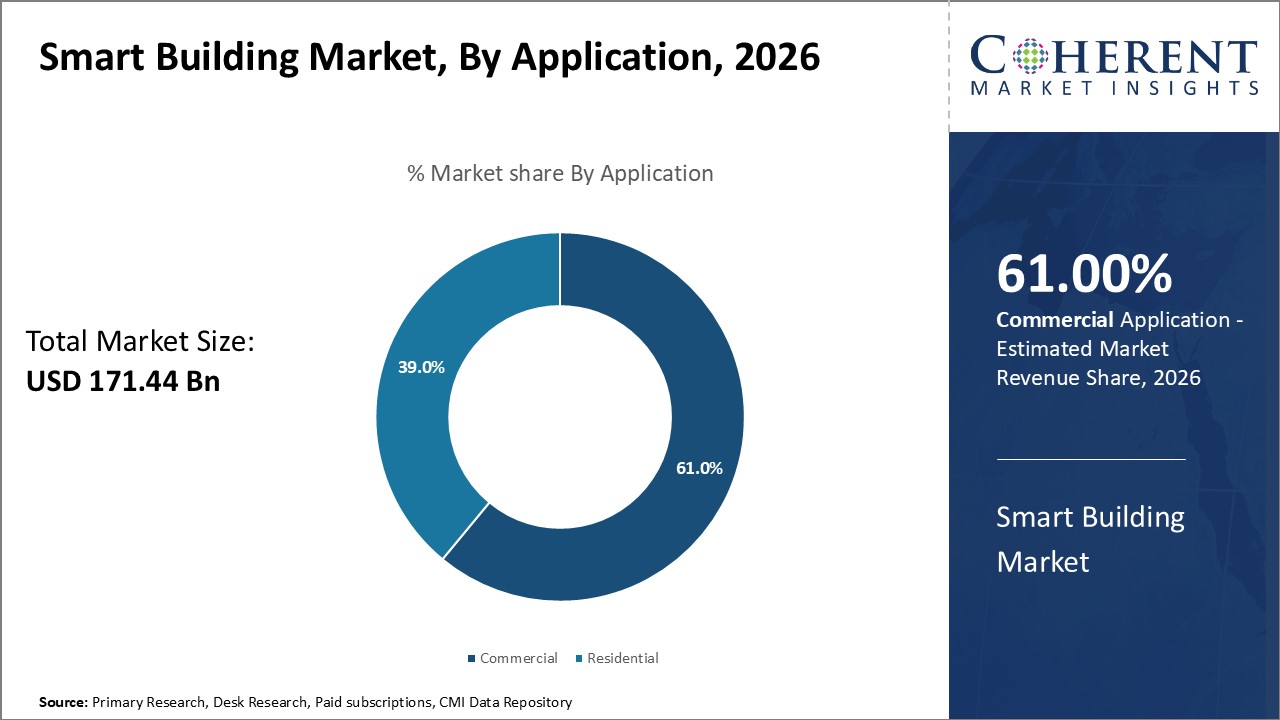
Smart Building Market Insights, By Application - Commercial Segment Dominates Due To Growing Adoption and Energy Efficiency Initiatives
In terms of application, the commercial segment accounted for 61% of the global smart building market revenue in 2026, driven by increasing adoption of smart building technologies in offices, retail, and industrial facilities. Commercial buildings benefit from solutions that reduce energy consumption, enhance automation, and improve occupant experience, aligning with corporate sustainability goals and regulatory compliance.
Smart building technologies in commercial spaces include IoT-enabled HVAC and lighting control, intelligent security systems, predictive maintenance analytics, and integrated building automation platforms. The adoption of these solutions assists organizations in reducing operational costs while lowering their carbon footprint and in providing a safer and more comfortable environment for occupants.
For instance, in November 2025, Siemens launched Building X, a cloud-based, modular platform designed for climate-neutral, integrated building management. It provides a unified interface for building operations, energy management, and security, allowing commercial facility managers to streamline operations and achieve sustainability targets.
Regional Insights
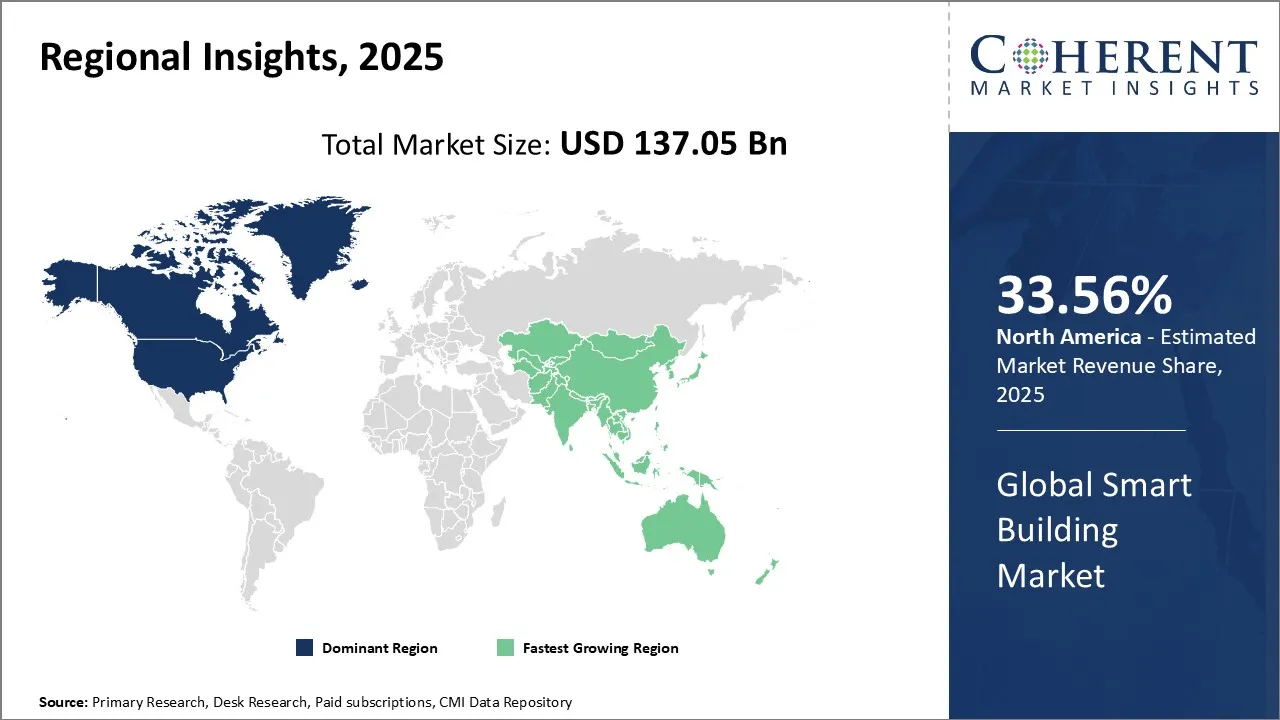
North America Smart Building Market Analysis & Trends
North America is expected to retain the top spot among regions in the global smart building market, accounting for over 33.56% in 2026, representative of the region's mature infrastructure, wide-ranging adoption of IoT/automation technologies, and key prospects for investments in energy efficiency in commercial/industrial smart buildings. Therefore, large enterprises, corporate campuses, healthcare, and institutional buildings in the region significantly drive the demand for advanced smart building solutions, such as energy management systems, automated HVAC, building security, and building management platforms. Advanced IT infrastructure, a regulatory push to make buildings more energy-efficient and green, coupled with high standards of building codes, have accelerated the uptake of smart-building technologies in North America.
For instance, in December 2024, Delta introduced DIBT - Delta Intelligent Building Technologies, a "one stop shop" for smart, sustainable building solutions across North America. It put together lighting, building automation, security/surveillance, and energy management systems all under one roof.
Asia Pacific Smart Building Market Analysis & Trends
The Asia Pacific is emerging as the fastest-growing region for smart building adoptions on the back of rapid urbanization, infrastructure modernization, government-backed smart city and smart infrastructure initiatives, and rising demand in both commercial and residential segments. Such growth can be attributed to various factors in the region, including large-scale construction activities, increasing internet and IoT penetration, growing disposable incomes, and an increasing focus on energy efficiency and sustainability in several countries including China, India, Japan, South Korea, among others.
For instance, in September 2026, during BEX Asia 2026 in Singapore / Southeast Asia, Inspur introduced its newest AI-powered smart building solutions such as modular building systems, AI-enhanced design automation, intelligent site management platforms, IoT-based "smart living" systems, and sustainable building technologies.
Smart Building Market Outlook Country-Wise
U.S. Smart Building Market Trends
United States Smart Building Market
The United States remains the leading market for smart building solutions in North America due to its mature infrastructure, high technology adoption, and stringent energy-efficiency regulations. Integrated building automation systems that incorporate energy management, HVAC controls, lighting, and intelligent security are increasingly being adopted for various building types, such as commercial offices, healthcare facilities, educational institutions, and industrial buildings. IoT, AI, and cloud-based analytics are being harnessed to achieve high returns through a reduction in operational costs, real-time monitoring of energy consumption, and enhanced occupant comfort.
For instance, in January 2024, Honeywell introduced Honeywell Advance Control for Buildings, a building management system designed to work with existing wiring to deliver energy management, automated control, improved operational efficiency, and enhanced occupant experience.
China Smart Building Market Trends
China is emerging as one of the fastest-growing smart building markets in the Asia-Pacific region, driven by rapid urbanization, government-backed smart city initiatives, and rising demand for energy-efficient buildings. Large-scale commercial, residential, and mixed-use projects are increasingly incorporating advanced building automation systems, IoT-enabled energy management platforms, and intelligent security solutions. The government's push toward sustainability, carbon reduction, and digital transformation in urban infrastructure is fueling investment in smart buildings.
Market Report Scope
Smart Building Market Report Coverage
| Report Coverage | Details | ||
|---|---|---|---|
| Base Year: | 2025 | Market Size in 2026: | USD 171.44 Bn |
| Historical Data for: | 2020 To 2024 | Forecast Period: | 2026 To 2033 |
| Forecast Period 2026 to 2033 CAGR: | 25.1% | 2033 Value Projection: | USD 821.60 Bn |
| Geographies covered: |
| ||
| Segments covered: |
| ||
| Companies covered: | Softdel (A UNIDEL Company), ABB Ltd., Hitachi Ltd., Honeywell International, Avnet Inc., Siemens AG, Legrand SA, Schneider Electric SE, Johnson Controls Inc., Huawei Technologies Co. Ltd., Cisco Systems, and IBM Corporation | ||
| Growth Drivers: |
| ||
| Restraints & Challenges: |
| ||
Smart Building Market Drivers
Increasing concerns regarding energy consumption to drive growth of the market
The use of energy in office buildings focuses on developing a healthy, comfortable and optimal environment for workers. The energy used in these buildings is mostly spend on things such as, lighting, ventilation, and air conditioning. However, in a food manufacturing plants, the energy used is spent on production processes, due to which, the energy needs are primarily focused on things such as ovens, steam systems, refrigeration units, and furnaces among others. These things account for largest share of energy consumption in this sector. Thus, growing concerns of energy consumption is thus expected to boost growth of the global smart building market over the forecast period.
Rise in initiatives from governments on smart infrastructure projects to fuel market growth
Smart infrastructure is a combination of the real and digital worlds in energy systems, industries, and buildings, which enhances the way people work and live, and it significantly can improve sustainability and efficiency. Smart buildings develop an ecosystem using data and technology, where they learn, interact and adapt to different conditions and requires different stakeholders in their life cycles. Several governments of countries around the world are taking initiatives on smart infrastructure projects, through smart cities and other projects. Thus, the demand for smart building is growing all over the world, which in turn is likely to drive growth of the global smart building market during the forecast period.
Smart Building Market Opportunities
The rapid technological development including cloud, AI, and edge computing is expected to create growth opportunities in the global smart building market during the forecast period. With growing development of such technologies, the smart building segment is witnessing evolution. Due to this, more solution innovations are being introduced in the market. IoT has become the most significant aspect in the digital market, and the use of IoT devices is growing building energy management systems. This factor in turn is likely to bring multiple opportunities in the global smart building market in the coming future.
Analyst Opinion (Expert Opinion)
- The smart building market is undergoing a structural transformation driven by the convergence of AI, IoT, and sustainability imperatives. Regulatory pressure for energy efficiency, such as California’s Title 24 Building Energy Efficiency Standards and China’s Green Building Evaluation Label, is forcing developers to adopt integrated building management systems that can optimize HVAC, lighting, and energy consumption in real time.
- Corporate tenants and commercial landlords are also enforcing operational standards, demanding real-time energy monitoring, predictive maintenance, and automated security controls. The pace of adoption is accentuating competitive differentiation, firms that can provide integrated, intelligent, and sustainable building solutions are winning both investor and tenant confidence while legacy building operators face increasing operational costs and regulatory scrutiny.
Speak to the analyst
Want personalized insights?
Take the findings above to one of our principal consultants, or have the report rebuilt around the segments, geographies and competitors you actually track.
Smart Building Industry News
- In November 2025, ABB launched ABB Ability™ BuildingPro, a cybersecure building‑operations integration platform that connects, manages, and optimizes building systems (HVAC, lighting, controls, energy, etc.) in real time.
- In June 2025, Honeywell launched Honeywell Connected Solutions, an AI‑powered building management platform that consolidates critical building systems (software, devices, controls) into a unified interface. Early adopters include large-scale customers like Verizon Communications and Vanderbilt University.
- In September 2025, Huawei unveiled a national‑scale cloud & AI architecture, named R.I.S.E, aimed at accelerating “industrial intelligence” and digital transformation of public‑sector infrastructure.
Market Segmentation
- Component Insights (Revenue, USD Bn & KT, 2026 - 2033)
- Solution
- Building Energy Management System
- Infrastructure Management System
- Intelligent Security System
- Services
- Solution
- Application Insights (Revenue, USD Bn & KT, 2026 - 2033)
- Residential
- Commercial
- Regional Insights (Revenue, USD Bn & KT, 2026 - 2033)
- North America
- U.S.
- Canada
- Latin America
- Brazil
- Argentina
- Mexico
- Rest of Latin America
- Europe
- Germany
- U.K.
- Spain
- France
- Italy
- Russia
- Rest of Europe
- Asia Pacific
- China
- India
- Japan
- Australia
- South Korea
- ASEAN
- Rest of Asia Pacific
- Middle East & Africa
- GCC Countries
- Israel
- Rest of Middle East & Africa
- North America
- Key Players Insights (Revenue, USD Bn, 2021 - 2033)
- Softdel (A UNIDEL Company)
- ABB Ltd.
- Hitachi Ltd.
- Honeywell International
- Avnet Inc.
- Siemens AG
- Legrand SA
- Schneider Electric SE
- Johnson Controls Inc.
- Huawei Technologies Co. Ltd.
- Cisco Systems
- IBM Corporation
Sources
Primary Research Interviews from the following stakeholders
Stakeholders
- Interviews with building owners, facility managers, system integrators, IoT solution providers, energy management consultants, and sustainability officers across major regional markets.
Specific stakeholders
- Facility management and operations heads at commercial, residential, and industrial building portfolios (e.g., CBRE, JLL, Brookfield)
- Procurement and innovation managers at smart building technology providers (e.g., Honeywell, Siemens, ABB, Schneider Electric)
- Energy efficiency and sustainability leads at government and public-sector building authorities (e.g., U.S. General Services Administration, China State Construction Green Building Division)
- Building automation engineers and IoT specialists at system integrators and technology companies (e.g., Cisco, IBM, Huawei)
- Security and safety operations heads implementing intelligent security systems (e.g., Johnson Controls, Legrand)
- R&D and innovation officers at real estate developers focusing on smart, sustainable, and energy-efficient buildings (e.g., Vanke, CapitaLand, Hines)
Databases
- United Nations Comtrade Database
- World Trade Organization (WTO) Trade Statistics
- Eurostat – Energy Consumption and Building Performance Database
- U.S. Energy Information Administration (EIA) – Commercial & Residential Building Data
- China National Energy Administration (NEA) – Energy Efficiency & Smart Building Data
- Directorate General of Commercial Intelligence and Statistics (DGCIS), India
- Japan External Trade Organization (JETRO) – Building Automation & IoT Data
- Korea Energy Agency – Smart Building & Energy Management Data
- U.S. Department of Energy (DOE) – Building Technologies Office Reports
- Indian Ministry of Housing & Urban Affairs – Smart Cities & Green Building Data
Magazines
- Building Design + Construction
- Smart Buildings Magazine
- Facility Executive
- Buildings
- IoT for All – Smart Buildings Section
- Energy Manager Today
- Architectural Record – Technology & Sustainability Section
- Control Engineering
- Green Building & Design (GBD)
- Eco-Business – Built Environment Section
Journals
- Energy and Buildings (Elsevier)
- Building and Environment (Elsevier)
- Journal of Building Performance Simulation (Taylor & Francis)
- Renewable and Sustainable Energy Reviews
- Journal of Cleaner Production – Smart Infrastructure Section
- Automation in Construction (Elsevier)
- International Journal of Sustainable Energy
- Journal of Intelligent & Robotic Systems – Building Applications
Newspapers
- The Wall Street Journal – Technology & Real Estate
- The Economic Times – Smart Cities & Infrastructure
- Business Standard – Energy & Building Automation
- Financial Times – Sustainability & Corporate Real Estate
- Nikkei Asia – Smart Building & IoT Technology
- The Hindu Business Line – Construction & Green Buildings
- South China Morning Post – Smart Building & IoT
- The Guardian – Energy Efficiency & Sustainable Infrastructure
Associations
- International Facility Management Association (IFMA)
- U.S. Green Building Council (USGBC)
- World Green Building Council (WGBC)
- Building Owners and Managers Association (BOMA) International
- European Facility Management Network (EuroFM)
- Smart Cities Council
- Indian Green Building Council (IGBC)
- Asia Pacific Smart Building Alliance (APSBA)
- National Institute of Building Sciences (NIBS)
Public Domain Sources
- U.S. Department of Energy – Building Technologies Office Reports
- U.S. Environmental Protection Agency (EPA) – Energy Efficiency and Green Building Programs
- European Environment Agency (EEA) – Building Energy Efficiency Data
- Ministry of Housing & Urban-Rural Development (MOHURD), China – Green Building Reports
- Organisation for Economic Co-operation and Development (OECD) – Energy Efficiency & Smart Infrastructure
- Central Public Works Department (CPWD), India – Green Building & Smart Building Guidelines
- European Commission – Energy Performance of Buildings Directive Reports
- United Nations Environment Programme (UNEP) – Smart and Sustainable Cities Reports
- International Energy Agency (IEA) – Energy Efficiency & Buildings Reports
- Department for Promotion of Industry and Internal Trade (DPIIT), India – Smart Cities & Infrastructure Data
Proprietary Elements
- CMI Data Analytics Tool
- Proprietary CMI Existing Repository of information for last 8 years
Definition: A smart building is an intelligent, integrated system of sensors, data, automation, communication and intelligence that provides the occupants and other stakeholders with better environments, improved productivity, and lower operating costs. Using intelligent technologies, smart buildings can reduce energy consumption, improve maintenance performance and help build healthier and happier workplaces.
Get access to 250+ pages report
Every segment, forecast, competitor profile and data table behind the analysis above — available for instant download.
- ESOMAR Member
- ISO 9001:2015 Certified
- D-U-N-S Registered
- GDPR & CCPA Compliant
Missing comfort of reading report in your local language? Find your preferred language:
Transform your Strategy with Exclusive Trending Reports
Frequently Asked Questions
The Smart Building Market is estimated to be valued at USD 171.44 Bn in 2026, and is expected to reach USD 821.60 Bn by 2033.
The CAGR of the Smart Building Market is projected to be 25.1% from 2026 to 2033.
Increasing concerns regarding energy consumption and rise in initiatives from governments on smart infrastructure projects are fuelling the market.
The Solution segment is the leading segment in the market
Lack of technology alignment and dearth of skilled workforce are the major factors restraining the market.
Softdel (A UNIDEL Company), ABB Ltd., Hitachi Ltd., Honeywell International, Avnet Inc., Siemens AG, Legrand SA, Schneider Electric SE, Johnson Controls Inc., Huawei Technologies Co. Ltd., Cisco Systems, and IBM Corporation
North America is expected to lead the global smart building market.