

Mixed Reality Market Size and Share Analysis - Growth Trends and Forecast (2026 - 2033)
The global mixed reality market is estimated to be valued at USD 8,400 Mn in 2026 and is projected to grow at a compound annual growth rate (CAGR) of 41% from 2026 to 2033, reaching USD 92,400 Mn by 2033. This can be attributed to increasing adoption of mixed reality across gaming, healthcare, and industrial training applications.
Key Takeaways from the Mixed Reality Market Report
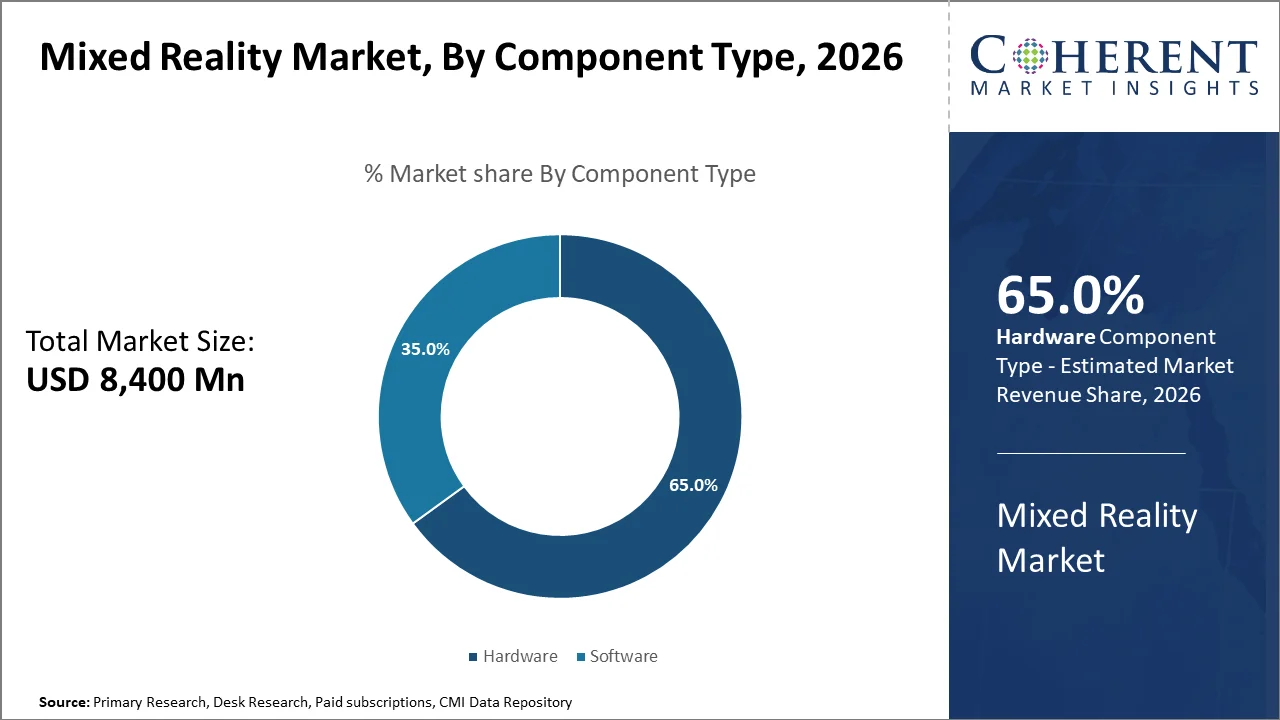
- By component type, the hardware segment is expected to lead the market with a 65% share in 2026, thanks to rising demand for headsets, sensors, processors, and head-mounted displays (HMDs).
- Based on application, gaming & entertainment segment is set to account for the largest market revenue share of 42% in 2026, owing to growing adoption of immersive gaming experiences and increasing demand for interactive entertainment content. According to the Entertainment Software Association (ESA) Essential Facts about the Video Game Industry 2024, 61% of Americans play video games on a weekly basis, highlighting the massive consumer base driving demand for interactive and immersive gaming content.
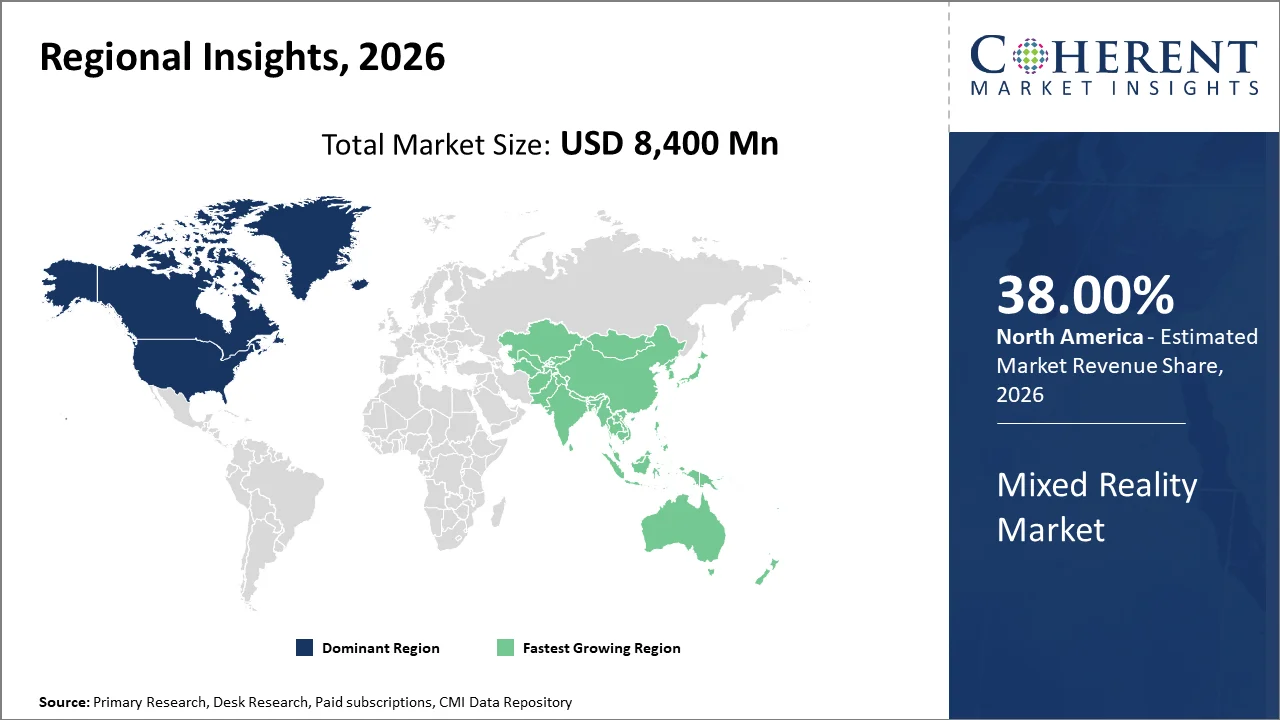
- North America is forecast to lead the global mixed reality industry with a share of 38% in 2026, mostly due to presence of major players like Microsoft, Meta, and Apple, along with strong enterprise adoption and an advanced technology ecosystem.
- Asia Pacific, holding a share of 30% in 2026, is anticipated to emerge as the fastest-growing market for mixed reality technologies during the forecast period, thanks to rapid digital transformation, increasing investments in AR/VR technologies, and expanding gaming and entertainment industry.
Segmental Insights
Which Component Type Dominates the Mixed Reality Market?
Hardware Holds the Largest Share Among Components
As per Coherent Market Insights’ latest mixed reality market analysis, hardware segment is poised to lead the market, accounting for a market revenue share of 65% in 2026. This dominance is mainly due to increasing demand for headsets, processors, sensors, and head-mounted displays (HMDs). About 54% of VR headset owners use their devices for less than two hours per week; 66% use them for around 45 minutes, and 37% for under 30 minutes per session.
Growing adoption of MR headsets across enterprise applications such as remote collaboration, industrial training, healthcare visualization, and defense simulation is significantly boosting hardware demand. These devices form the core infrastructure of mixed reality systems, enabling immersive and interactive experiences.
In addition, continuous advancements in processing power, display resolution, tracking accuracy, and battery efficiency are improving device performance and accelerating adoption. Heavy investments by leading technology companies in next-generation wearable devices are further supporting hardware innovation and market expansion.
- Current Industry Events of 2026
- Market Size Estimation
- Regional Breakdown
- Competitive Landscape
- Customer Intelligence
- Segmental Analysis
- Pricing Analysis
- Key Market Drivers, Challenges & Future Trends
- Customized Insights Section
Which Is the Most Lucrative Application of Mixed Reality?
Gaming & Entertainment Remain the Leading Revenue-Generating Segment
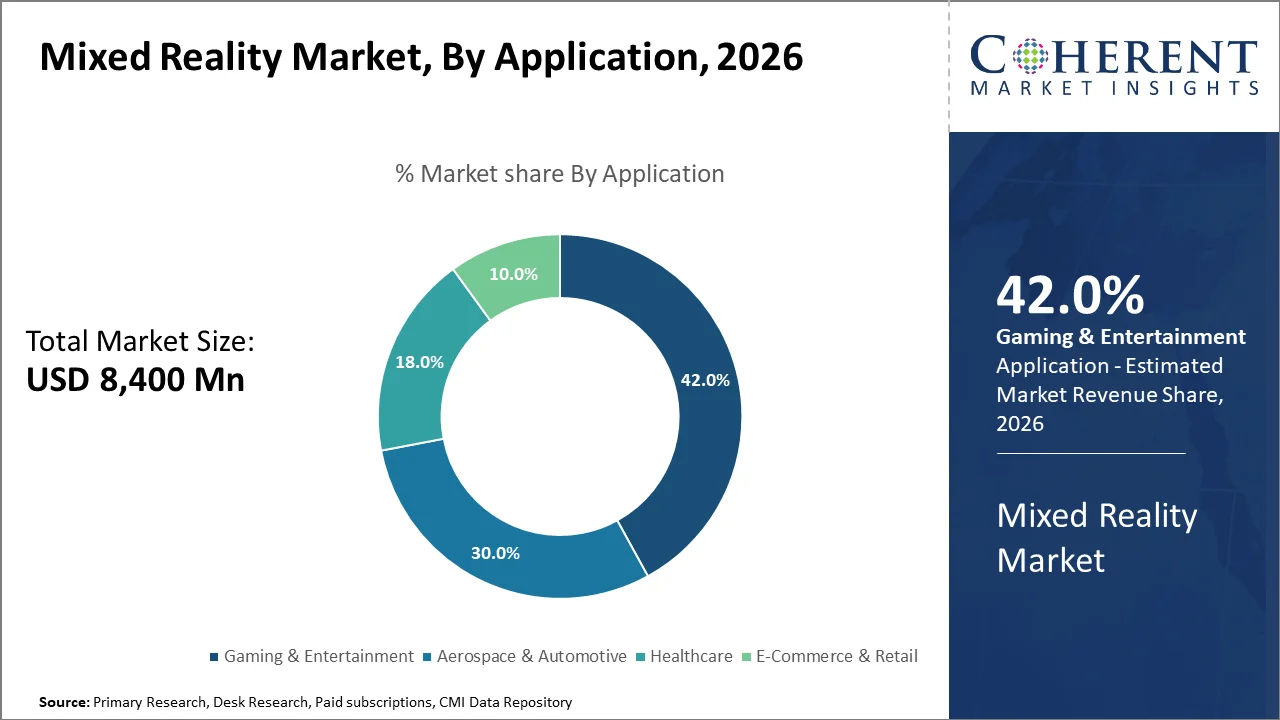
By application, the gaming & entertainment segment is expected to account for a 42% market revenue share in 2026. This dominance is driven by early adoption of immersive technologies such as augmented reality (AR) and virtual reality (VR), which enhance interactivity and gameplay realism. In 2024, 98 million people used VR hardware, while 23 million experimented with more advanced AR technology. Strong consumer demand for highly immersive, interactive, and multiplayer virtual environments, combined with continuous advancements in hardware such as headsets and motion tracking systems, is further accelerating revenue growth in this segment.
Mixed Reality Market Growth Drivers
Rising Adoption of Mixed Reality in Healthcare and Medical Sectors Increasing adoption of mixed reality in healthcare and medical sectors is expected to drive growth of the mixed reality market during the forecast period. Mixed reality is increasingly being utilized in surgical planning, medical training, and patient care, improving precision as well as operational efficiency.
Mixed reality is also being adopted by healthcare organizations to enhance visualization, diagnostics, and workflow efficiency. For instance, in September 2025, Brainlab announced that it received FDA 510(k) clearance and launched its Spine Mixed Reality Navigation system in the United States. This system uses mixed reality to help surgeons see important navigation information during spine surgery in real time.
Mixed Reality Market Opportunities
Rising Demand for Mixed Reality from Automotive Sector
Increasing demand from the automotive sector is expected to create lucrative growth opportunities for the global mixed reality market during the forthcoming period. Automotive companies are increasingly adopting mixed reality technologies for applications such as vehicle design, prototyping, manufacturing, and training, thereby driving overall market growth. In addition, some companies are leveraging augmented reality for marketing and customer engagement.
For instance, in 2024, Ford Motor Company deployed mixed reality (Microsoft HoloLens-based systems) on its manufacturing floors to support engine inspection and worker training through real-time digital guidance. Likewise, Porsche AG recently expanded its use of mixed reality solutions for immersive product development as well as technician training. These solutions have the tendency to allow engineers and service teams to interact with 3D vehicle models and receive remote expert assistance in real time.
Mixed Reality Market Innovations
Advancements in AI-Driven Immersive Experiences and Enterprise MR
The Mixed Reality (MR) market is evolving rapidly with the integration of artificial intelligence (AI), spatial computing, and advanced sensor technologies. Modern mixed reality platforms are increasingly focused on delivering highly immersive, context-aware experiences that blend physical and digital environments seamlessly. These innovations are expanding applications across enterprise training, healthcare, manufacturing, defense, and collaborative workspaces.
A key trend shaping the market is the convergence of mixed reality with AI-powered spatial computing, enabling more intuitive interactions, real-time environmental mapping, and intelligent virtual assistance within immersive environments. Hardware advancements such as lightweight headsets, higher-resolution optics, and improved field-of-view are also accelerating adoption across both consumer and enterprise segments. For instance,
- In 2025, Samsung introduced Galaxy XR, a mixed-reality headset based on the Android XR platform. It features integrated multimodal AI capabilities.
- In 2024, Apple Vision Pro by Apple introduced a new spatial computing platform with advanced MR-like capabilities, including eye tracking, gesture-based control, and ultra-high-resolution displays for productivity and immersive applications.
- In 2024, Varjo expanded its enterprise XR portfolio with the XR-4 series, designed for high-fidelity simulation, training, and mission-critical visualization in aerospace, defense, and industrial applications.
Current Events and Their Impact on the Mixed Reality Market
Current Event | Description and its Impact |
Apple Vision Pro launch and limited early-scale deployment |
|
Microsoft HoloLens 2 program shift and IVAS program restructuring |
|
Regional Insights
High Enterprise Adoption Making North America a Dominant Market
North America is expected to lead the global mixed reality market, holding around 38% share in 2026. This is mostly due to rising adoption of mixed reality solutions in healthcare, defense, automotive, education, and other industries. Companies are increasingly using mixed reality for training, remote collaboration, product design, and simulation, because it has the tendency to reduce operational costs and improve efficiency. Early adoption of advanced technologies and strong presence of key players like Meta, Microsoft, and Apple are also supporting market expansion.
Rising use of mixed reality for enterprise training and simulation is a key market trend in the U.S. For example, companies in manufacturing and healthcare are using mixed reality headsets to train workers in realistic virtual environments, helping reduce training costs by approximately 40% to 60% at scale compared to traditional methods. This rising focus on productivity and cost savings is set to boost growth of mixed reality market in North America during the forthcoming period.
Rapid Digitalization and Consumer Tech Growth is driving the demand in Asia Pacific
Asia Pacific is expected to witness the fastest growth in the mixed reality market, holding a global market share of 30% in 2026. This growth is mostly due to rapid digital transformation, rising disposable income, and strong adoption of immersive technologies in gaming, education, and industrial applications.
Nations like China, Japan, South Korea, and India are investing heavily in smart infrastructure, 5G networks, and digital learning platforms. This, in turn, is increasing demand for mixed reality devices and solutions.
Increasing use of mixed reality in gaming and entertainment is playing a key role in boosting Asia Pacific mixed reality market growth. For example, in India and China, rising popularity of immersive gaming experiences and AR/VR-based learning tools is significantly increasing demand. This is shown by the fast growth of the gaming industry in India, which is expanding at around 14% CAGR. The industry is also increasingly integrating immersive technologies to enhance user experience.
Mixed Reality Market Outlook – Country-wise
U.S. Mixed Reality Market Trends
The U.S. is expected to remain a leading market for mixed reality technologies during the forecast period, owing to rising enterprise adoption and integration of immersive technologies across industries such as healthcare, defense, education, and retail. Growing demand for remote collaboration tools, virtual training platforms, and product visualization solutions is also supporting market expansion.
In addition, continuous innovation by leading technology companies and increasing investment in spatial computing technologies are increasing adoption across enterprises and consumers. Increasing use of mixed reality in enterprise training and simulation is playing a key role in boosting market growth across the U.S.
Companies in the U.S. are increasingly adopting mixed reality headsets such as Microsoft HoloLens for industrial training and healthcare applications. Mixed reality–based simulation tools are also being used for surgical training and defense applications, helping improve procedural accuracy while reducing training time and operational costs.
China Mixed Reality Market Forecast
China is emerging as one of the fastest-growing markets for mixed reality (MR) solutions. This growth is mostly due to increasing investments in digital infrastructure, government support for advanced technologies, and increasing adoption of immersive solutions across gaming, education, manufacturing, and retail sectors. In addition, expansion of AI-driven ecosystems and industrial digitalization is boosting demand for mixed reality devices and applications.
Who are the Major Companies in the Mixed Reality Market?
Some of the major players in mixed reality market are Microsoft Corporation, Osterhout Design Group, Facebook Inc., Meta Company, Samsung Electronics Co, Ltd., Magic Leap, Inc., HTC Corporation, Canon Inc., Seiko Epson Corporation, Daqri LLC, and Recon Instruments, Inc.
Key Strategies Adopted by Industry Players
Leading mixed reality (MR) companies are increasingly investing heavily in research and development to create more realistic and immersive experiences. They are also making MR devices lighter, more affordable, and easier to use, which helps increase adoption among consumers and businesses. For example,
- In October 2025, Varjo launched new mixed reality headsets for training in air, land, and sea environments. The XR-4 Series is designed to improve training by combining traditional methods with modern technology.
- In April 2025, Lenovo and Meta partnered to shape the future of mixed reality. Under this partnership, Lenovo will start reselling Meta Quest devices to enterprise customers.
- In September 2024, Meta Platforms Inc. launched Meta Quest 3S powered by Snapdragon from Qualcomm Technologies Inc. to bring mixed reality to the masses. The device is designed to offer an affordable entry point into mixed reality experiences for consumers and businesses.
Market Report Scope
Mixed Reality Market Report Coverage
| Report Coverage | Details | ||
|---|---|---|---|
| Base Year: | 2025 | Market Size in 2026: | USD 8,400 Mn |
| Historical Data for: | 2020 To 2024 | Forecast Period: | 2026 To 2033 |
| Forecast Period 2026 to 2033 CAGR: | 41% | 2033 Value Projection: | USD 92,400 Mn |
| Geographies covered: |
| ||
| Segments covered: |
| ||
| Companies covered: | Microsoft Corporation, Osterhout Design Group, Facebook Inc., Meta Company, Samsung Electronics Co, Ltd., Magic Leap, Inc., HTC Corporation, Canon Inc., Seiko Epson Corporation, Daqri LLC, and Recon Instruments, Inc. | ||
| Growth Drivers: |
| ||
| Restraints & Challenges: |
| ||
Analyst Opinion (Expert Opinion)
- Mixed Reality is improving industrial efficiency. In enterprise pilots, AR-guided workflows (e.g., at Boeing) have shown fewer assembly errors and faster task completion in specific wiring and assembly processes, rather than across all operations.
- VR training shows strong measurable gains. For instance, VR learners were up to 4x faster to train than classroom learners in soft-skills scenarios, with higher confidence and better knowledge retention.
- Healthcare MR is still early but promising. Studies in AR-assisted surgery report improved accuracy and better spatial guidance, and in some cases reduced procedure time, mainly in pilot studies and simulations, not large-scale hospital use. As clinical validation expands, mixed reality is expected to drive increased hospital adoption and investment, supporting steady market growth in the coming years.
Speak to the analyst
Want personalized insights?
Take the findings above to one of our principal consultants, or have the report rebuilt around the segments, geographies and competitors you actually track.
Market Segmentation
- By Component Type Insights
- Hardware
- Software
- By Application Insights
- Aerospace & Automotive
- Healthcare
- Gaming & Entertainment
- E-commerce & Retail
- By Region Insights
- North America
- U.S.
- Canada
- Latin America
- Brazil
- Argentina
- Mexico
- Rest of Latin America
- Europe
- Germany
- U.K.
- Spain
- France
- Italy
- Russia
- Rest of Europe
- Asia Pacific
- China
- India
- Japan
- Australia
- South Korea
- ASEAN
- Rest of Asia Pacific
- Middle East & Africa
- GCC Countries
- South Africa
- Rest of Middle East & Africa
- North America
Sources
Primary Research Interviews
- Industry experts
- Technology developers,
- XR hardware manufacturers
- Software platform providers
- System integrators
- Enterprise end-users (healthcare, education, manufacturing)
- Distributors and innovation heads
Databases
- Eurostat
- World Bank
- OECD
- International Telecommunication Union
- UNESCO Institute for Statistics
Magazines
- Wired
- MIT Technology Review
- PCMag
- UploadVR
Journals
- IEEE Xplore
- ACM Digital Library
- SpringerLink
- ScienceDirect
Newspapers
- The New York Times
- The Guardian
- The Wall Street Journal
- The Times of India
Associations
- IEEE
- VR/AR Association
- Khronos Group
- GSMA
Public Domain sources
- Official company websites
- Annual reports
- Investor presentations
- Government publications
- White papers
- Patent filings
- Regulatory authority publications
Proprietary Elements
- CMI Data Analytics Tool
- Proprietary CMI Existing Repository of information for last 8 years
Get access to 250+ pages report
Every segment, forecast, competitor profile and data table behind the analysis above — available for instant download.
- ESOMAR Member
- ISO 9001:2015 Certified
- D-U-N-S Registered
- GDPR & CCPA Compliant
Missing comfort of reading report in your local language? Find your preferred language:
Transform your Strategy with Exclusive Trending Reports
Frequently Asked Questions
The global market is estimated to be valued at USD 8,400 Mn in 2026.
The global Mixed Reality Market value is expected to reach USD 92,400 Mn by 2033.
The global market is poised to exhibit a CAGR of 41% from 2026 to 2033.
Major growth factors include rapid enterprise digital transformation, and rising demand for immersive and interactive experiences.
Hardware segment, with about 65% share in 2026, dominates the market.
Some major companies in the Mixed Reality Market include Microsoft Corporation, Osterhout Design Group, Facebook Inc., Meta Company, Samsung Electronics Co, Ltd., Magic Leap, Inc., HTC Corporation, Canon Inc., Seiko Epson Corporation, Daqri LLC, and Recon Instruments, Inc.
North America, with 38% share in 2026, is set to lead the market during the forecast period.