

Global Residential Elevator Market Size and Forecast- 2026 to 2033
The Global Residential Elevator Market is estimated to be valued at USD 65.94 Bn in 2026 and is expected to reach USD 106.64 Bn by 2033, reflecting a compound annual growth rate (CAGR) of 7.1% from 2026 to 2033.
Key Takeaways of the Residential Elevator Market
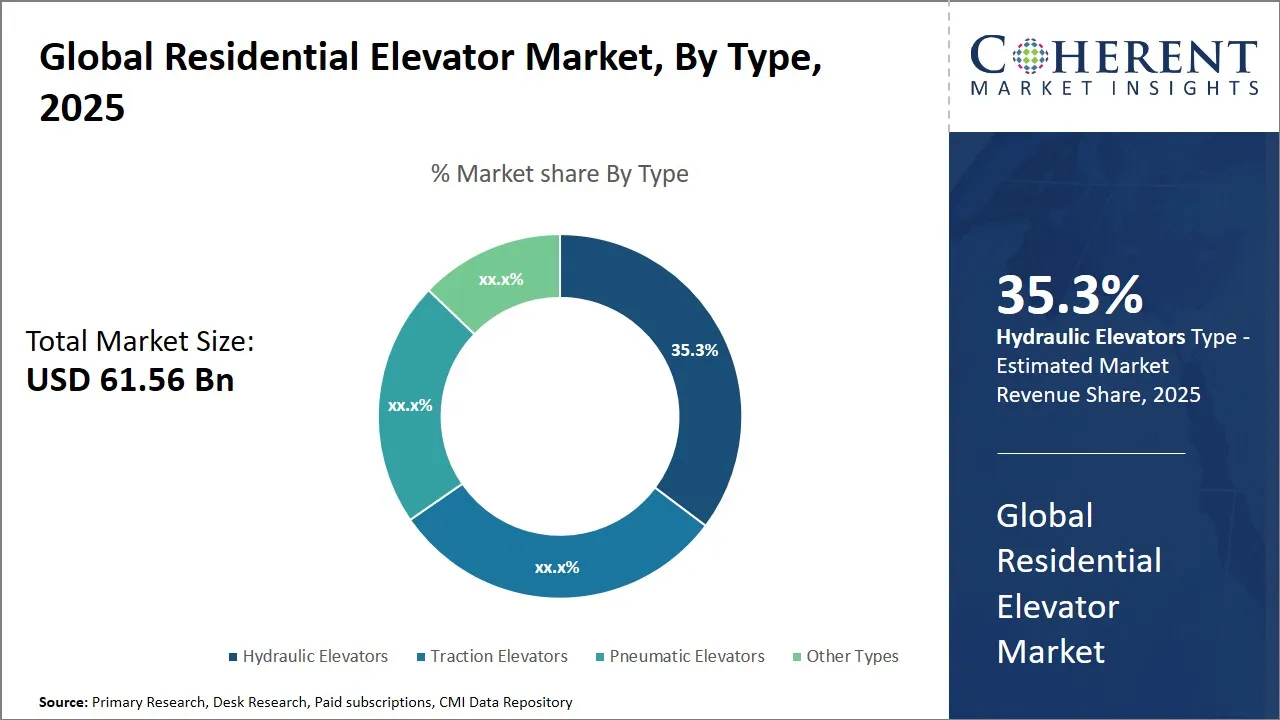
- Hydraulic elevators are expected to hold 36.3% of the market share in 2026.
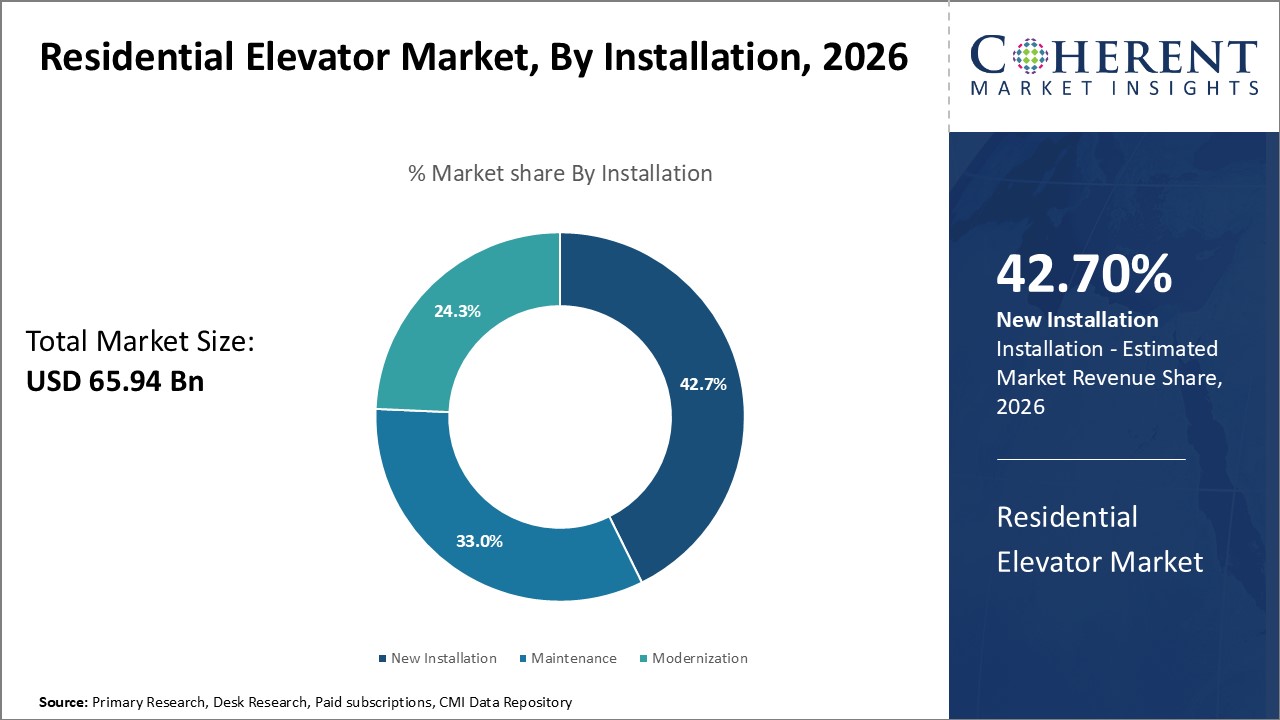
- New installation segment is estimated to account for 42.7% of the residential elevator market share in 2026.
- Homeowners segment is projected to account for 29.9% of the market share in 2026.
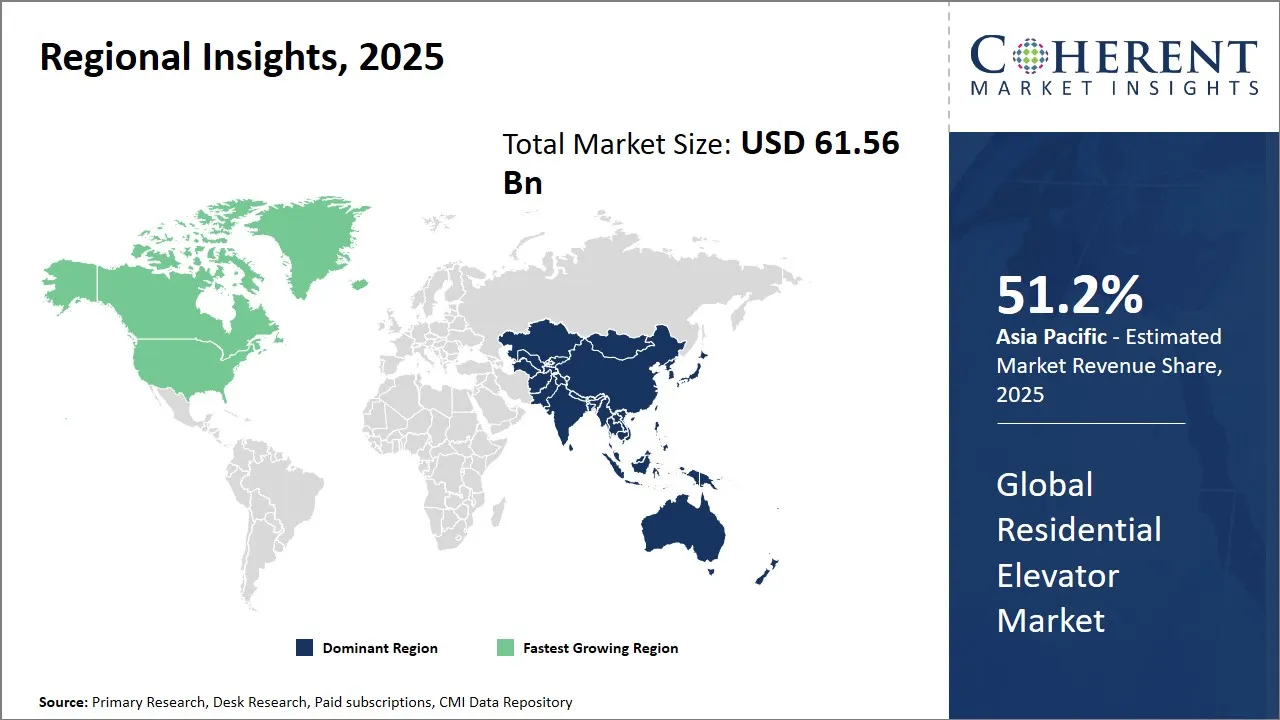
- Asia Pacific leads the residential elevator market in 2026 with an estimated 51.2% share.
- North America is expected to hold 16.3% share and record the fastest growth.
Market Overview
- Recent trends observed in the market point to the change in the direction of the smart and energy-saving residential elevators with the IoT features, to improve the convenience and safety of the user.
- Also, sustainability is emerging as a central theme, and manufacturers are developing to lower their energy use and environmental footprint.
- Increasing attention to the retrofitting of elevators in the existing houses and the increasing popularity of compact and space-saving models drive the market further and are in accordance with the changing lifestyles of consumers and the regulation norms all over the world.
Currents Events and Its Impact
Current Events | Description and its impact |
Machine-room-less (MRL) and compact shaft solutions gaining share |
|
IoT + predictive maintenance becoming a standard procurement clause |
|
Segmental Insights
- Current Industry Events of 2026
- Market Size Estimation
- Regional Breakdown
- Competitive Landscape
- Customer Intelligence
- Segmental Analysis
- Pricing Analysis
- Key Market Drivers, Challenges & Future Trends
- Customized Insights Section
Why Does Hydraulic Elevators Dominate the Residential Elevator Market in 2026?
Hydraulic elevators segment is expected to hold 36.3% of the market share in 2026, due to its reliability, affordability, and flexibility. The fact that hydraulic elevators are suitable in the low to mid-rise residential buildings is one of the primary factors that have made it to be the top share holder as it perfectly matches most residential buildings across the globe. Hydraulic systems have less space limitations compared to traction elevators, which need more complex installation and overhead equipment, and the hydraulic mechanism is installed at the base of the elevator car below the elevator car, which manifests as a hydraulic piston. This renders them very flexible in the use of personal homes where space is very important.
Moreover, hydraulic elevators provide comfortable and unshaken movements, which is attractive to house owners who want to have comfort and even safety at the same time. This is because they can carry heavier loads at moderate speeds, unlike other types such as pneumatic elevators, and is therefore suitable in homes that have people with mobility problems or where families need to move bulky loads down or up the stairs. Also, there are advancements in hydraulic technology that have contributed a great deal to energy efficiency that minimizes the cost of operation and environmental impact, which is becoming a crucial aspect in consideration by a residential consumer.
Why are New Installation Driving Growth in the Residential Elevator Market?
The new installation segment is expected to capture 42.7% of the residential elevator market share in 2026, which is still going through urbanization and increased demands of smart and convenient living quarters in the year 2026. The growth of urban housing development and the development of multi-story residential buildings are the most significant events that are fueling the number of people requiring new elevator installation. With space becoming a luxury commodity in metropolitan areas, architectural designers and real estate developers have progressively added residential elevators during the developmental processes of buildings so as to add more functionality and selling potential.
The other major driver in the new installations is the changing demographic profile as the number of the aged and people with disabilities is on the increase across the world. Such a demographic change highlights the importance of the introduction of elevators in new homes, which would facilitate mobility, as well as aging-in-place policies. Since most governments and local authorities are sensitizing on the standards of accessibility, in most cases, the installation of elevators in newly built housing units is enforced or encouraged to spur this segment even more.
Homeowners Lead End User Category with Rising Demand for Accessibility and Luxury
Homeowners segment is projected to hold 29.9% of the market share in 2026. The basis of this dominance is mainly founded on the increased focus on the accessibility of the home and the integration of life-enhancing facilities within the residential homes. The elevators are becoming icons of importance to homeowners for not only overcoming the mobility issues related to aging or physical disabilities, but also becoming convenient in their daily living.
The shift to the use of multi-story single-family houses, particularly in the suburban and high-end urban regions, has heightened the need to use residential lifts. To such homeowners, the presence of elevators represents the symbol of luxury and ease of living, and it enhances the general lifestyle as well as introduces a real value to the house. In addition, as custom-built houses and building renovations to future-proof the house have become a common solution, elevators have also been included to meet the diverse requirements of users, including shopping groceries to caring services.
Regional Insights
Asia Pacific Residential Elevator Market Analysis and Trends
The Asia Pacific region is projected to lead the market with a 51.2% share in 2026. Propelled by rapid urbanization, rising disposable incomes, and increasing awareness about convenience and elderly care. The major drivers of growth in the form of tremendous infrastructural projects and the growing residential construction business in places such as China, India, and Japan are critical growth drivers. This market expansion is being supported by the government efforts to enhance the living standards and the changes in the regulations favoring building safety and accessibility.
The technological penetration and market reach are supported by the existence of large-sized manufacturers like the Mitsubishi Electric, Toshiba, and Hyundai Elevator that have strong local presence. The trade environment in the region is positive and there are trade agreements to regional trade that promote cross-border partnerships and supply chain optimization that have enhanced residential elevator market presence in Asia Pacific.
North America Residential Elevator Market Analysis and Trends
The North America region is expected to exhibit the fastest growth in the market contributing 16.3% share in 2026, because of the developed market ecosystem in terms of technological adoption and awareness, developed construction sectors and awareness of consumers on the issue of home accessibility and luxury. The area will have the advantage of having strict building codes and government subsidies that encourage accessibility among older citizens that will drive the residential lifts markets.
Moreover, some of the major industry players like Otis Elevator Company, Thyssenkrupp and Savaria Corporation, are located in North America and they provide their input in terms of innovation in smart elevator systems, energy efficiency solutions, and customization of their products to meet residential environments. The large real estate market which is specialized in multi-level homes offers additional support to the leadership of North Americas. The active trade infrastructures and favorable policies make it easy to conduct business and have supply chain efficiencies among the manufacturers and distributors across the region.
Global Residential Elevator Market Outlook for Key Countries
U.S. Residential Elevator Market Trends
The residential elevator market in the U.S. is described as being dominated by a high number of retrofit and new constructions that are aimed at improving the level of access to homes, especially among the elderly. Having large corporations like Otis and Savaria that have robust research and development capabilities adds to developments of personalized elevator systems and products that are energy efficient. Government programs such as the Americans with Disabilities Act (ADA) strengthen market demand using accessibility standards. The high-controlled construction industry and demand by consumers on high-quality solutions to elevators continue to keep the market dynamic.
China Residential Elevator Market Trends
The Chinese residential elevator market is growing at a very high rate because of the incessant urbanization process and the rising number of multi-story residential buildings. Residential infrastructure development and smart cities development are strongly supported by the government, which stimulates its uptake. Other manufacturers like Mitsubishi Electric and OTIS have already developed manufacturing and service networks in the region which has improved market penetration.
Moreover, the emergence of the home automation and Internet of Things (IoT) integration into elevators adds to the demand in the products of high technologies. Supply chain efficiency and cost competitiveness is facilitated by favorable trade policies and local manufacturing capabilities.
Is Germany Setting the Pace for Europe’s Residential Elevator Market?
Germany still remains ahead of the pack in Europe in terms of high-level technological integration and high safety standards that control installations of elevators in residential houses. Thyssenkrupp and Stannah Elevators are the domestic players, and they also play a significant role by offering customized and high-end elevator solutions tailored to both retrofit and new buildings.
Building codes to enhance accessibility and energy efficiency are strengthened by government support to encourage uptake in the market. The high-quality residential elevator manufacturing and innovation also lead to the fact that Germany strong mechanical engineering industry and export strengths contribute to its high level of leadership.
India Residential Elevator Market Trends
The residential elevator market in India is on a speedy growth due to the boom in real estate industry particularly in the cities. The consumer base is being increased by raising awareness on the availability of homes and by the growing disposable incomes whereas the inclusion in the development of the infrastructure is encouraged by the government policies on urban housing.
Major actors such as Hyundai Elevator and Toshiba have stepped up to even greater levels with local relations and network of service providers, which facilitate the process of installing elevators. It has got a young work force that is relatively inexpensive and the emerging manufacturing infrastructure that is reinforced with the trade policies that encourage foreign investments and transfer of technological expertise.
Japan Residential Elevator Market Trends
The Japanese residential elevator market is characterized by such features as the concern with the needs of the aging population and the high-tech solutions. The domestic companies like Mitsubishi Electric and Fujitec are the pioneers with innovative products which have more focus on safety, compact design, and smart controls that will fit in small residential areas. Government policies are very encouraging on accessibility in housing, which promotes retrofits and new installations.
The development of the IoT and the introduction of AI to the electronics and automation of residential elevator systems are possible due to the proficiency of the country and its infrastructure in these areas. Strong trade relations and local production power also help in the development of the market
Technology Preference Mapping
This component charts preferences for elevator technologies, with traction and MRL elevators leading due to energy efficiency and space savings in high-rises. IoT, AI-driven predictive maintenance, and regenerative drives dominate trends, especially in urbanizing Asia-Pacific markets like China and India. Preferences shift toward smart, connected systems for real-time monitoring and reduced downtime.
Regional Regulatory Impact
Regional building codes heavily influence installations, with Europe emphasizing sustainability and energy standards, North America focusing on safety compliance, and Asia-Pacific navigating rapid urbanization amid varying regulations. Strict codes in the EU and US boost modernization demand, while emerging markets face enforcement challenges that slow MRL adoption. These factors create compliance costs but opportunities for certified, tech-integrated solutions
Market Players, Key Development, and Competitive Intelligence
Key Developments
- In October 2025, Otis Korea will acquire Schindler Elevator Company in South Korea to strengthen its local market presence. The move supports Otis’s goal to expand service and modernization offerings in the region. The acquisition is expected to finalize in the fourth quarter of 2025, pending regulatory approval. This strategic step aims to enhance customer service and operational capabilities in South Korea.
- In August 2025, Otis Worldwide has been awarded a contract to install 76 elevators in a luxury high-rise residential project in Dubai. The project includes Skyrise, Arise, and Gen2 machine-roomless elevators across six towers. Each tower has 71 floors, with elevators reaching speeds up to 6 meters per second. The EMS Panorama 2.0 system will enhance efficiency and passenger experience.
Top Strategies Followed by Global Residential Elevator Market Players
Player Type | Strategic Focus | Example |
Established Market Leaders | Heavy investment in R&D and innovation | Otis, KONE, Schindler, and TK Elevator who constantly launched innovative safety systems, regenerative drives, predictive maintenance, and intelligent connectivity that can optimally serve the residential environment. |
Mid-Level Players | Cost-effective solutions with balanced quality | Cibes features a range of space-efficient home lifts, which require only slight civil work to install and would suit villas and retrofit developments. |
Small-Scale Players | Niche specialization & innovative variants | Firms such as Stiltz Lifts, Lifton, and new regional manufacturers are companies that specialize in compact home elevators, shaft-less models, or greener materials to fulfill unmet demands. |
Market Report Scope
Global Residential Elevator Market Report Coverage
| Report Coverage | Details | ||
|---|---|---|---|
| Base Year: | 2025 | Market Size in 2026: | USD 65.94 Bn |
| Historical Data for: | 2020 To 2024 | Forecast Period: | 2026 To 2033 |
| Forecast Period 2026 to 2033 CAGR: | 7.1% | 2033 Value Projection: | USD 106.64 Bn |
| Geographies covered: |
| ||
| Segments covered: |
| ||
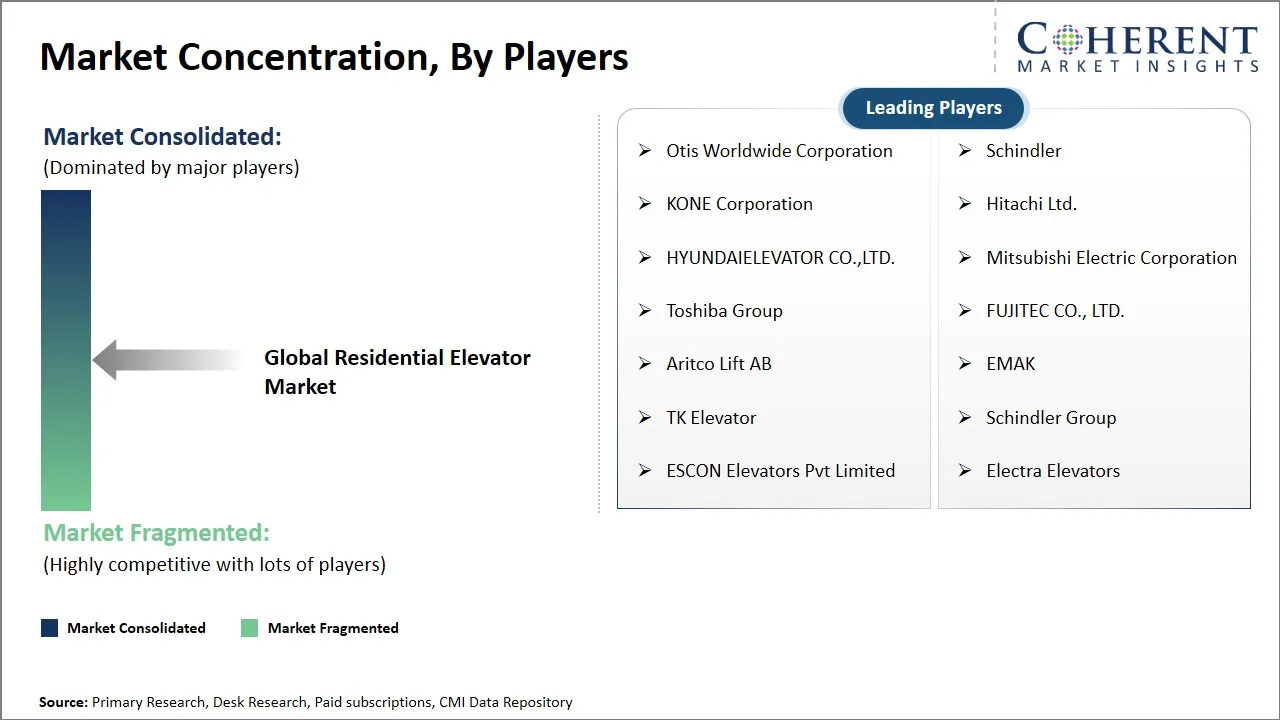
| Companies covered: | Otis Worldwide Corporation, Schindler, KONE Corporation, Hitachi Ltd., HYUNDAIELEVATOR CO.,LTD., Mitsubishi Electric Corporation, Toshiba Group, FUJITEC CO., LTD., Aritco Lift AB, EMAK, TK Elevator, Schindler Group, ESCON Elevators Pvt Limited, and Electra Elevators | ||
| Growth Drivers: |
| ||
| Restraints & Challenges: |
| ||
Residential Elevator Market Dynamics
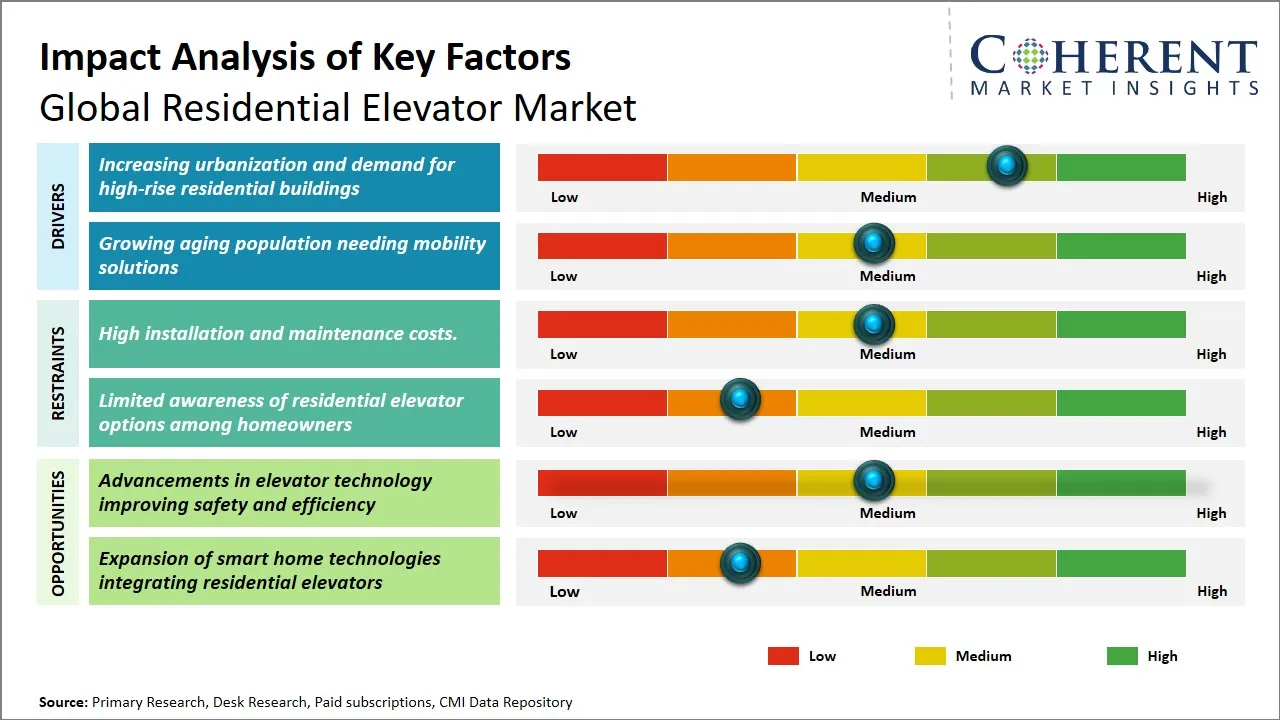
Residential Elevator Market Driver - Increasing Urbanization and Demand for High-Rise Residential Buildings
The rapid urbanization in the world has greatly changed the residential environment with more high-rise residential structures being set up particularly in heavily populated metropolitan regions. With urban populations rapidly growing, developers are facing the challenge of promoting development in tall formats, and it is a trend of constructing high-rise apartment blocks, and multi-storey condos that have been erected to accommodate as many people as possible, with only a limited number of available spaces. This trend is the main driver of the residential elevators purchases since they are necessary to offer smooth and safe vertical transportation in these high-rise buildings.
As an example, Otis ONE digital platform on residential elevator systems, where relevant sensors and cloud intelligence are used to predict maintenance needs and minimize unplanned outages in high-rise housing complexes.
Residential Elevator Market Opportunity - Advancements in Elevator Technology Enhancing Safety and Efficiency
The global residential elevator market has an opportunity to enjoy the advantages of unabated improvement in the technology of elevators and escalators which is transformation of safety and performance. Smart sensors, predictive maintenance systems, and drive mechanisms that use less energy are some of these changes in innovation that are raising the safety standards of residential buildings, hence raising consumer confidence and adoption rates. Such technologies allow monitoring the work of the elevators in real time and predict the possible failure, minimizing the downtime and the number of accidents to minimum.
As an example, KONE has already introduced its residential elevator product lineup with AI-enabled predictive maintenance and regenerative drive systems, enhancing energy efficiency and increasing the lifespan of equipment in the multi-storey apartments buildings.
Analyst Opinion (Expert Opinion)
- The residential elevator market is growing particularly due to the rising demand of accessibility solution in multi-story houses as well as the rising trend of aging in place. The information available at the International Elevator and Escalator Expo (2023) and the Home Accessibility Conference (2022) demonstrated some important developments, and the companies such as Otis and Thyssenkrupp were the pioneers of improvements in compact and tailored elevator designs.
- The very recent release of a space saving elevator by Thyssenkrupp targeted directly at home use clearly shows that the industry is clearly dedicated to integrating features with visual appeal, which is very important in the contemporary home design. Conferences here have highlighted the need to integrate smart technology to allow home automation system to provide better experience and convenience to users.
- The availability of expensive installation, and regulatory compliance had been cited as significant hurdles in market expansion. The firms concentrated on constructing user-friendly and cost-effective solutions and making strategic alliances with constructors and architects have a good chance to obtain a competitive advantage. Finally, the success of the residential elevator market will be determined by its innovation capacity, coupled with its capacity to meet emerging demands of the homeowners who would like to have a taste of luxury and functionality in their homes.
Speak to the analyst
Want personalized insights?
Take the findings above to one of our principal consultants, or have the report rebuilt around the segments, geographies and competitors you actually track.
Market Segmentation
- Type Insights (Revenue, USD Bn, 2021 - 2033)
- Hydraulic Elevators
- Traction Elevators
- Pneumatic Elevators
- Other Types
- Installation Insights (Revenue, USD Bn, 2021 - 2033)
- New Installation
- Maintenance
- Modernization
- End User Insights (Revenue, USD Bn, 2021 - 2033)
- Homeowners
- Real Estate Developers
- Builders/Contractors
- Regional Insights (Revenue, USD Bn, 2021 - 2033)
- North America
- U.S.
- Canada
- Latin America
- Brazil
- Argentina
- Mexico
- Rest of Latin America
- Europe
- Germany
- U.K.
- Spain
- France
- Italy
- Russia
- Rest of Europe
- Asia Pacific
- China
- India
- Japan
- Australia
- South Korea
- ASEAN
- Rest of Asia Pacific
- Middle East
- GCC Countries
- Israel
- Rest of Middle East
- Africa
- South Africa
- North Africa
- Central Africa
- North America
- Key Players Insights
- Otis Worldwide Corporation
- Schindler
- KONE Corporation
- Hitachi Ltd.
- HYUNDAIELEVATOR CO.,LTD.
- Mitsubishi Electric Corporation
- Toshiba Group
- FUJITEC CO., LTD.
- Aritco Lift AB
- EMAK
- TK Elevator
- Schindler Group
- ESCON Elevators Pvt Limited
- Electra Elevators
Sources
Primary Research Interviews
- CEO – Leading Residential Elevator Manufacturer (e.g., Otis Residential or Savaria equivalent)
- Supply Chain Director – Major Elevator Components Distributor
- Production Lead – Home Elevator Systems Fabricator
- Sustainability Officer – Accessibility Equipment Certification Body
Stakeholders
- Manufacturers
- End-use Sectors
- Luxury Home Builders and Renovators
- Aging-in-Place Solution Providers
- Multi-Family Residential Developers
- Regulatory & Certification Bodies (e.g., ASME A17.1 for safety standards, ADA compliance in US, National Building Code Part-8 Sec-5 in India)
- E-commerce Platforms and Retailers (Amazon, Home Depot, Savaria Direct, Alibaba Industrial Suppliers)
- Technology Integration Players: Smart home automation firms (e.g., integrating with Crestron or Control4) and vacuum elevator innovators
Databases
- UN Comtrade Database (HS Code 8428 for elevators)
- USITC DataWeb (US imports/exports of residential elevators)
- Eurostat Trade Statistics (Machinery and equipment for elevators)
- India EXIM Database (Lift and elevator imports)
Magazines
- Elevator World – Trends in residential vertical transportation
- ELEVATOR WORLD India – Home elevator market innovations
- Buildings Magazine – Residential accessibility upgrades
Journals
- Journal of Architectural Engineering – Elevator systems in high-rise residences
- Building and Environment – Energy-efficient home lifts
- Journal of Accessibility and Design for All – Residential elevator standards
Newspapers
- The Wall Street Journal – Luxury home elevator demand
- Business Standard (India) – Residential lift imports growth
- Reuters – Elevator industry supply chain updates
Associations
- National Elevator Industry, Inc. (NEII)
- National Association of Elevator Contractors (NAEC)
- AEMA (Association of Members of the Accessibility Industry)
- Elevator & Escalator Component Manufacturers' Assoc. of India (EECMAI)
- International Union of Elevator Constructors
Public Domain Sources
- ASME – A17.1/CSA B44 Safety Code for Elevators
- U.S. Department of Housing and Urban Development (HUD) – Accessibility guidelines
- European Commission – Machinery Directive 2006/42/EC for lifts
- Bureau of Indian Standards (BIS) – IS 14665 and IS 15259 for home lifts
- OSHA – Elevator installation and maintenance standards
Proprietary Elements
- CMI Data Analytics Tool
- Proprietary CMI Existing Repository of information for last 8 years.
Get access to 250+ pages report
Every segment, forecast, competitor profile and data table behind the analysis above — available for instant download.
- ESOMAR Member
- ISO 9001:2015 Certified
- D-U-N-S Registered
- GDPR & CCPA Compliant
Missing comfort of reading report in your local language? Find your preferred language:
Transform your Strategy with Exclusive Trending Reports
Frequently Asked Questions
The global residential elevator market is estimated to be valued at USD 65.94 Bn in 2026 and is expected to reach USD 106.64 Bn by 2033.
The CAGR of global residential elevator market is projected to be 7.1% from 2026 to 2033.
Increasing urbanization and demand for high-rise residential buildings and growing aging population needing mobility solutions are the major factors driving the growth of the global residential elevator market.
High installation and maintenance costs and limited awareness of residential elevator options among homeowners are the major factor hampering the growth of the global residential elevator market.
In terms of type, hydraulic elevators are estimated to dominate the market revenue share in 2026.
Otis Worldwide Corporation, Schindler, KONE Corporation, Hitachi Ltd., HYUNDAIELEVATOR CO.,LTD., Mitsubishi Electric Corporation, Toshiba Group, FUJITEC CO., LTD., Aritco Lift AB, EMAK, TK Elevator, Schindler Group, ESCON Elevators Pvt Limited, and Electra Elevators are the major players.
Asia Pacific is expected to lead the global residential elevator market in 2026.