

Smart Sensors Market Size and Forecast — 2026-2033
The Global Smart Sensors Market size is estimated to be valued at USD 50.91 billion in 2026 and is expected to reach USD 108.39 billion by 2033, exhibiting a compound annual growth rate (CAGR) of 11.4% from 2026 to 2033.
Overview
Smart sensors are integrated devices that combine sensing elements, microprocessors, and communication modules to deliver processed and actionable data. These products include temperature, pressure, motion, proximity, image, and gas sensors used across consumer, industrial, and automotive applications. They feature embedded processing, self-calibration, digital interfaces (I²C, SPI, BLE, or Wi-Fi), and intelligent algorithms for real-time analysis. Modern smart sensors come equipped with IoT connectivity, edge AI capabilities, and low-power operation, allowing seamless integration into smart cities, wearable devices, industrial automation, and environmental monitoring systems.
Key Takeaways
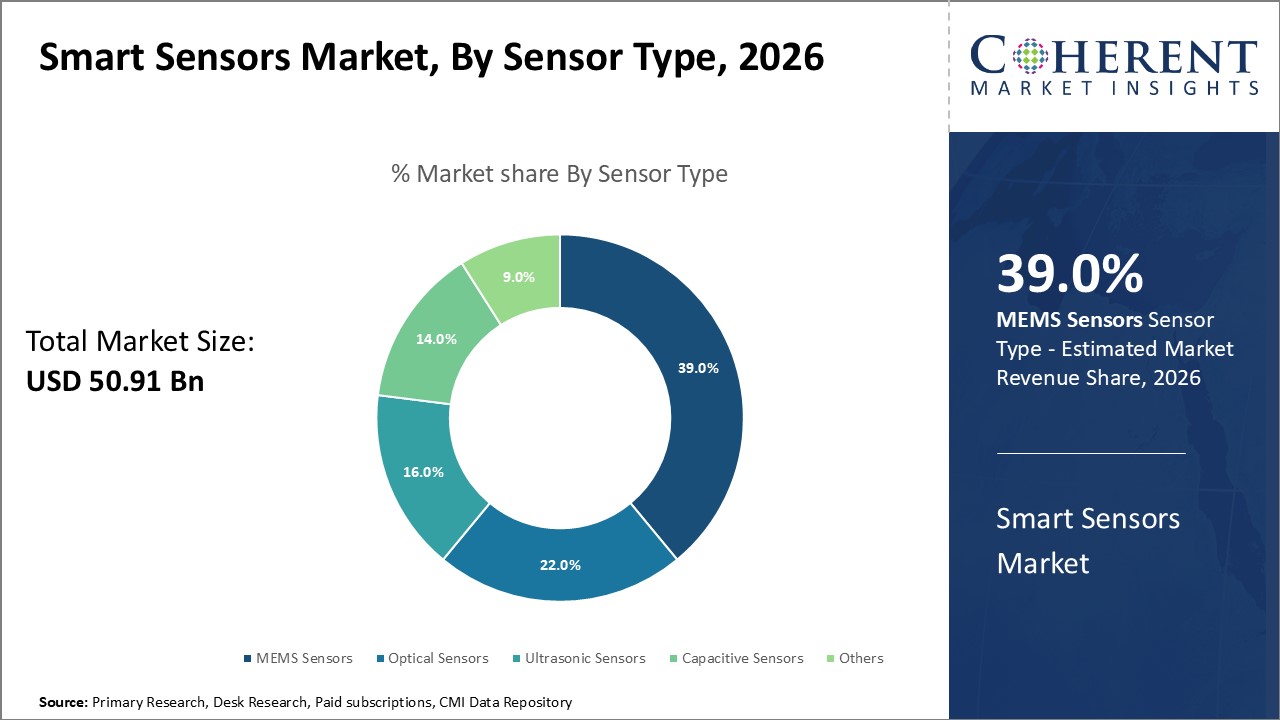
The MEMS sensor segment continues to dominate the Smart Sensors Market share at 39% due to its versatility and cost-efficiency in applications such as smartphones and automotive systems.
Meanwhile, optical sensors are the fastest-growing subsegment, driven by rising demand in health diagnosis and environmental sensing solutions.
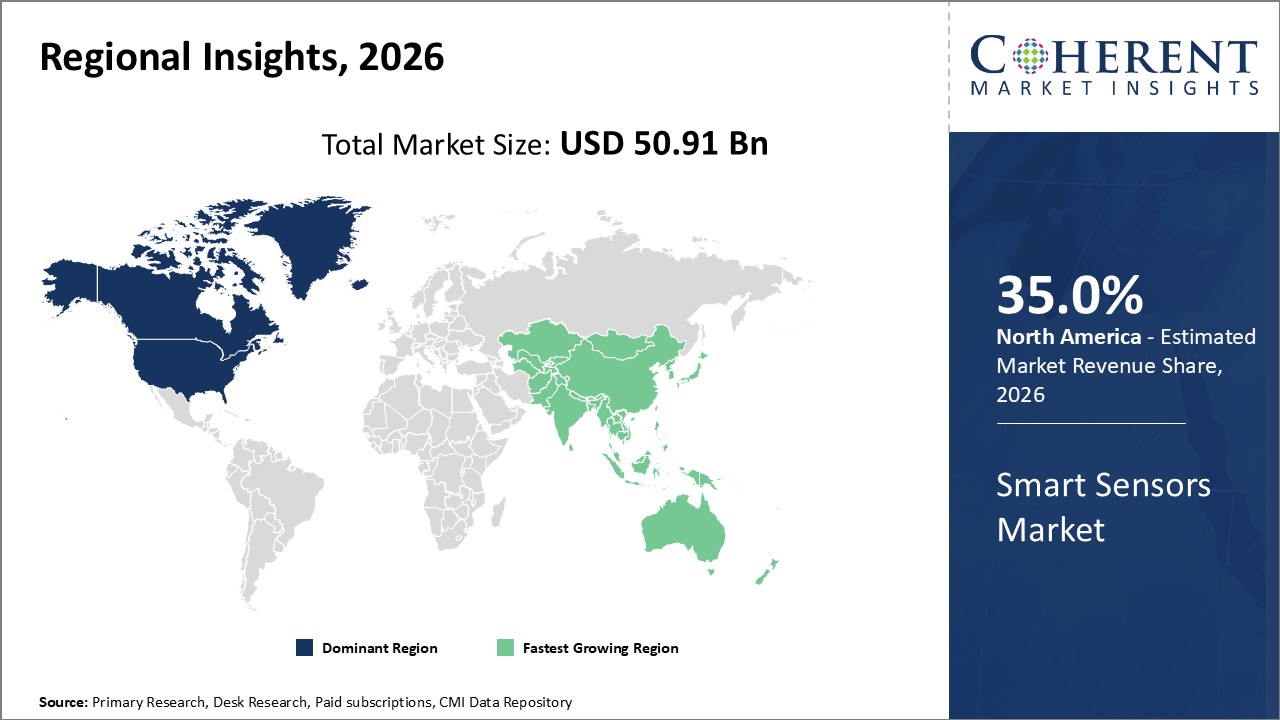
Regionally, North America leads the industry share with extensive presence of key market companies and robust innovation ecosystems.
Conversely, Asia Pacific exhibits the highest CAGR reflecting supportive government policies, manufacturing hubs, and rising adoption in consumer electronics and automotive sectors.
Smart Sensors Market Segmentation Analysis
Smart Sensors Market Insights, By Sensor Type
MEMS Sensors dominate the market share due to their scalability, miniaturization, and cost-effectiveness. MEMS sensors are widely used in smartphones, automotive safety systems, and wearable devices owing to their precision and reliability. Optical Sensors stand out as the fastest-growing subsegment, driven by increasing demand in healthcare for accurate diagnostics and in environmental monitoring applications. Ultrasonic Sensors find application predominantly in industrial automation for distance measurement and object detection, while Capacitive Sensors are crucial in touchscreen technologies and proximity sensing.
Smart Sensors Market Insights, By Application
Automotive dominates the market segment, propelled by rising demand for advanced driver assistance systems and electric vehicles, which require multiple sensor types for safety and navigation features. The healthcare application is the fastest-growing, attributed to the surge in remote patient monitoring devices and wearable sensorsConsumer Electronics maintains steady growth, with smart sensors embedded in smartphones, wearables, and home automation devices for enhanced user experience. Industrial automation holds significant relevance, leveraging smart sensors for predictive maintenance and quality control, while Aerospace & Defense applications focus on precision sensing for navigation and security.
Smart Sensors Market Insights, By Technology
Wired sensors currently dominate the market due to their reliability and widespread deployment in industrial automation and automotive systems, which prioritize low latency and high data integrity. The Wireless sensor subsegment is the fastest-growing, gaining traction in consumer electronics and smart city applications where flexibility and ease of installation are critical. Hybrid technologies combining wired and wireless capabilities are emerging, facilitating enhanced network resilience and adaptability across complex system architectures. These hybrid systems are particularly relevant in industrial IoT ecosystems that require seamless integration of multiple sensor types under diverse operating conditions.
Smart Sensors Market Trends
Market trends reflect the increasing emphasis on AI-enabled smart sensing solutions and integrated sensor modules, optimizing real-time data collection and analysis for predictive and automated applications.
For example, in 2025, smart sensor deployments in healthcare monitoring devices surged by over 31%, owing to rising demand for remote health management.
Additionally, growth in autonomous vehicle production accelerated smart sensor adoption in the automotive segment, with ADAS-equipped vehicles comprising 46% of global new car sales in 2026.
Smart Sensors Market Insights, By Geography
North America Smart Sensors Market Analysis and Trends
In North America, the dominance in the Smart Sensors Market is attributable to a matured technological ecosystem, significant R&D investments, and the presence of key market companies such as Honeywell and Texas Instruments. The U.S. leads this region with extensive adoption of smart sensors across automotive and healthcare industries, accounting for nearly 30% industry share. Governmental initiatives toward smart city developments and advanced manufacturing further bolster growth dynamics.
Asia Pacific Smart Sensors Market Analysis and Trends
Meanwhile, the Asia Pacific region exhibits the fastest growth with a CAGR exceeding 13%, driven by rising manufacturing hubs in China, India, and Taiwan. Expansion of consumer electronics manufacturing and rising government incentives to boost Industry 4.0 adoption are primary growth factors. Companies like Bosch Sensortec and Murata Manufacturing have increased regional production capabilities, facilitating faster market penetration.
Smart Sensors Market Outlook for Key Countries
USA Smart Sensors Market Analysis and Trends
The USA's market continues to lead in innovation and adoption, driven by significant investments in autonomous vehicle technologies and smart healthcare systems. In 2026, smart sensors were integrated into over 80% of advanced medical devices sold domestically. Major players such as Honeywell and Texas Instruments have established strategic partnerships with automotive OEMs, accelerating deployment of sophisticated sensing technologies for electric and autonomous vehicles. Additionally, government programs promoting smart infrastructure have fueled accelerated implementation of sensor-enabled smart buildings and traffic systems, enhancing the country’s market revenue and share.
China Smart Sensors Market Analysis and Trends
China's smart sensors market is rapidly expanding due to an increase in domestic manufacturing capability and government support for IoT and smart city projects. Chinese companies, alongside international market players, are collaborating to develop cost-effective sensor solutions tailored to local demand. The country witnessed a 20% rise in smart sensor shipments in consumer electronics and industrial automation during 2025. Such dynamics are enhancing China’s market scope, positioning it as a key driver of regional business growth with growing export activities impacting global supply chains.
Analyst Opinion
Demand-side dynamics reveal that the rising implementation of smart sensors in automotive safety systems has significantly contributed to market size expansion, with over 70 million vehicles integrated with advanced driver assistance systems (ADAS) globally in 2025. This trend signals the automotive sector’s increasing dependency on precision sensing for collision avoidance and autonomous driving capabilities.
Production capacity improvements, especially in MEMS (Micro-Electro-Mechanical Systems) sensor fabrication, have enhanced supply-side capabilities. For instance, a major semiconductor fabricator reported a 17% increase in wafer output dedicated to sensor chips in the first half of 2026, directly impacting the overall market revenue by reducing lead times and costs.
Market research indicates that import-export flows of smart sensors between Asia Pacific and North America surged by 18% in 2025, reflecting global trade dynamics and demand centers. The rising integration of smart sensors in consumer electronics, particularly wearable devices, underpins this trade volume increase.
Diverse use cases spanning healthcare, where smart sensors monitor vital signs remotely, have influenced market growth strategies. For example, deployment of smart sensors in remote patient monitoring devices surged by 25% in 2026, accentuating the market’s penetration into healthcare and fitness verticals.
- Current Industry Events of 2026
- Market Size Estimation
- Regional Breakdown
- Competitive Landscape
- Customer Intelligence
- Segmental Analysis
- Pricing Analysis
- Key Market Drivers, Challenges & Future Trends
- Customized Insights Section
Market Scope
| Report Coverage | Details | ||
|---|---|---|---|
| Base Year: | 2025 | Market Size in 2026: | USD 50.91 billion |
| Historical Data for: | 2020 To 2024 | Forecast Period: | 2026 To 2033 |
| Forecast Period 2026 to 2033 CAGR: | 11.4% | 2033 Value Projection: | USD 108.39 billion |
| Geographies covered: |
| ||
| Segments covered: |
| ||
| Companies covered: | Honeywell International Inc., STMicroelectronics, Infineon Technologies AG, TE Connectivity Ltd., NXP Semiconductors N.V., Murata Manufacturing Co., Ltd., Maxim Integrated Products, Inc., Panasonic Corporation, Sony Corporation, Samsung Electronics Co., Ltd., Hitachi, Ltd | ||
| Growth Drivers: |
| ||
Smart Sensors Market Growth Factors
Several critical growth drivers are propelling the smart sensors market expansion. The increasing penetration of Industry 4.0 in manufacturing has led to higher adoption of smart sensors for predictive maintenance and asset tracking. For example, manufacturing units utilizing smart sensors reported a 22% improvement in operational efficiency in 2025. Growing consumer electronics demand, especially in wearable health monitors and smartphones, has amplified market revenue, demonstrated by the shipment of over 500 million wearable devices equipped with smart sensors in 2026. Government initiatives promoting smart city implementations globally, including sensor-enabled traffic and environmental monitoring, further catalyze market scope. Additionally, rising investments in autonomous vehicles are pushing market growth strategies toward highly reliable and miniaturized sensor technologies, with a reported 30% increase in R&D funding in 2025.
Smart Sensors Market Development
In April 2025, CallPass LLC launched the LANA IoT Smart Sensor Solution to provide commercial users with real-time property and asset monitoring capabilities. This expansion of the company's LANA platform combines wireless smart sensors with cloud-based analytics to help businesses protect their assets and enhance operational efficiency across industries like hospitality and multi-family residential properties.
In August 2025, Renesas Electronics Corporation launched an ultra-compact smart sensor platform for advanced air quality monitoring, combining multi-sensor integration with edge intelligence to detect key pollutants such as volatile organic compounds (VOCs), carbon dioxide (CO₂), particulate matter (PM2.5), temperature, and humidity. The device features low-power operation and embedded AI algorithms, allowing it to deliver real-time environmental analytics for smart home, industrial, and automotive applications.
Key Players
Leading Companies of the Market
Honeywell International Inc.
STMicroelectronics
Infineon Technologies AG
TE Connectivity Ltd.
NXP Semiconductors N.V.
Murata Manufacturing Co., Ltd.
Maxim Integrated Products, Inc.
Panasonic Corporation
Sony Corporation
Samsung Electronics Co., Ltd.
Hitachi, Ltd.
Some leading market companies have adopted competitive strategies optimized to expand regional footprints and enhance product portfolios. For instance, in 2026, a key player successfully secured partnerships with several automotive OEMs across Europe, resulting in a 16% revenue growth increment driven by supply contracts for smart sensor modules used in electric vehicles. Another market player employed strategic acquisitions to integrate AI-driven sensor technology, boosting their industrial automation solutions and increasing market share in the Asia Pacific by approximately 9% over FY 2025.
Smart Sensors Market Future Outlook
The future of the smart sensors market is expected to be defined by the proliferation of IoT ecosystems, 5G connectivity, and AI-driven analytics. Demand will accelerate as industries pursue autonomous and energy-efficient operations, with sensors becoming critical for digital twins and predictive analytics platforms. Growth will also stem from sustainability initiatives, such as smart energy grids and waste management systems, which rely on real-time environmental data. Emerging applications in electric vehicles, telemedicine, and robotics will expand the market’s technological depth. Furthermore, declining chip costs and improvements in sensor fusion are anticipated to make smart sensing solutions more accessible for small- and mid-scale industries globally.
Smart Sensors Market Historical Analysis
The smart sensors market has evolved significantly since the early 2000s, driven by the rapid adoption of automation and the miniaturization of semiconductor components. Initially, demand was concentrated in the automotive and consumer electronics sectors, where smart sensors were primarily used for airbag systems, temperature monitoring, and motion detection. The rise of Industry 4.0 around 2015 accelerated their deployment across manufacturing and logistics for predictive maintenance and machine monitoring. Over the past decade, advances in MEMS technology, low-power processing, and wireless connectivity have transformed sensors into intelligent, self-calibrating systems capable of real-time decision-making. The integration of AI and edge computing has further expanded their use in smart cities, healthcare wearables, and environmental monitoring applications.
Sources
Primary Research Interviews:
IoT Engineers
Automation Specialists
Semiconductor Product Managers
Industrial System Integrators
Smart Device Manufacturers
Databases:
IEEE Xplore Digital Library
Magazines:
Sensors Online
Electronic Design
IoT World Today
Automation.com
Journals:
Sensors and Actuators
IEEE Internet of Things Journal
Journal of Micromechanics and Microengineering
Measurement Science and Technology
Newspapers:
The Wall Street Journal (Tech
Financial Times (Innovation)
The Economic Times (Technology)
The Guardian (Science)
Associations:
IEEE Sensors Council
International Society of Automation (ISA)
Industrial Internet Consortium
SEMI Global
Get access to 250+ pages report
Every segment, forecast, competitor profile and data table behind the analysis above — available for instant download.
- ESOMAR Member
- ISO 9001:2015 Certified
- D-U-N-S Registered
- GDPR & CCPA Compliant
Missing comfort of reading report in your local language? Find your preferred language:
Transform your Strategy with Exclusive Trending Reports
Frequently Asked Questions
Key market players include Honeywell International, Bosch Sensortec, STMicroelectronics, Texas Instruments, and Analog Devices, commanding major shares through technological innovations and strategic partnerships.
The smart sensors market is projected to reach USD 108.39 billion by 2033 from USD 50.91 billion in 2026, exhibiting an 11.4% CAGR reflecting robust demand across verticals.
The automotive and industrial automation sectors present the largest growth opportunities due to rising integration of sensors in electric vehicles, autonomous driving, and smart manufacturing.
Trends toward multi-sensor integration, AI-enhanced sensing, and low-power, sustainable sensors will shape market development, enabling smarter, efficient, and eco-friendly solutions.
The market is fragmented with intense competition surrounding innovation, cost optimization, and regional expansion; challenges include supply chain constraints and technological standardization.
Companies leverage strategic partnerships with OEMs, technology acquisitions, regional expansion, and product portfolio diversification to strengthen market positioning and capture new revenue streams.