

Wearable Sensors Market Size and Share Analysis- Growth Trends and Forecasts (2026-2033)
The Wearable Sensors Market size is anticipated to grow at a CAGR of approximately 21.2%, with a market value of USD 2.84 Bn in 2026, and is expected to reach approximately USD 10.94 Bn by 2033. The primary growth drivers are largely defined by the rising adoption of wearable health and fitness devices, increasing demand for continuous and real-time health monitoring, growing integration of sensors in smartwatches and medical wearables, and advancements in miniaturized, flexible, and wireless sensing technologies. According to NIH, a wearable smartwatch study generated more than 250,000 bodily measurements per participant per day, demonstrating the increasing capability of wearable sensors to continuously collect physiological information and support early health-event detection.
Key Takeaways
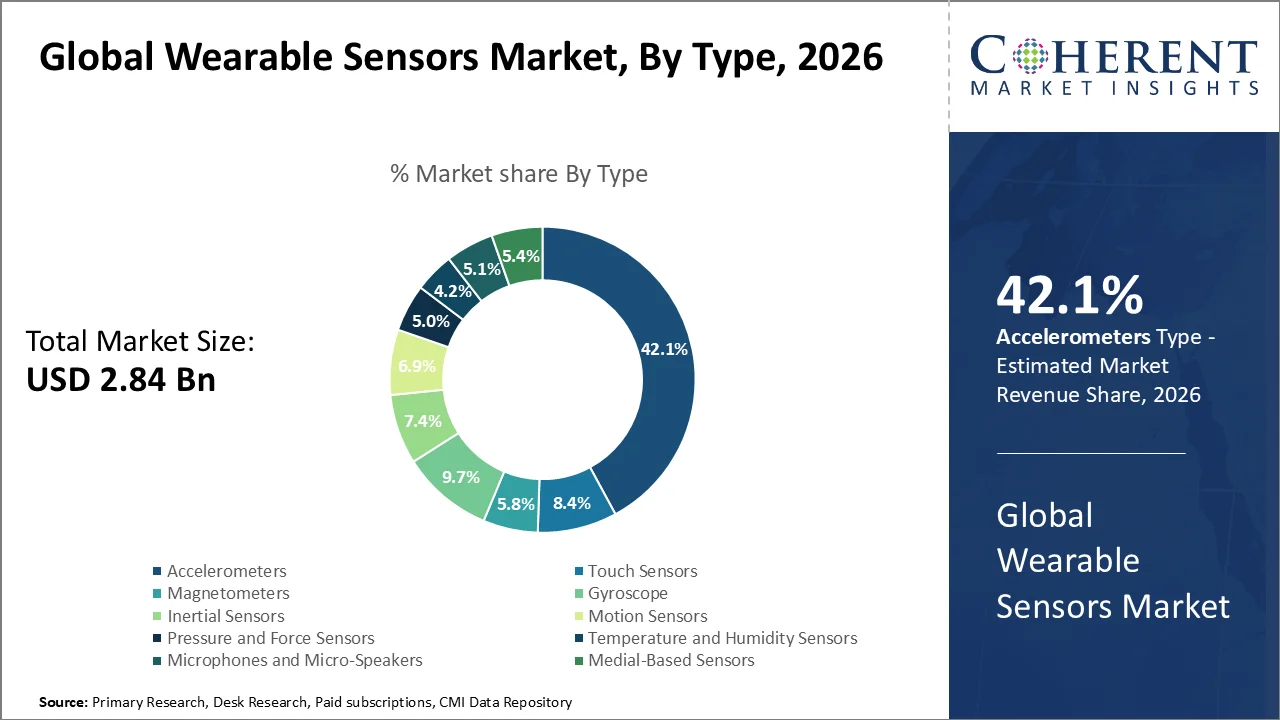
- The accelerometers segment is likely to dominate the market with 42.1% in 2026. The segment’s growth is owing to the widespread integration of accelerometers in smartwatches, fitness trackers, activity monitors, and other wearable devices for step counting, motion detection, fall detection, gesture recognition, and activity tracking. In May 2025, STMicroelectronics unveiled its latest innovation, the LSM6DSV320X, which is an advanced inertial sensor that comes in a small package of 3 mm × 2.5 mm and features two MEMS accelerometers that can sense movements of up to 16 g and high impact of up to 320 g.
- The wrist-wear segment will lead with 50.8% in 2026. The growth of this segment is attributed to high use of smartwatches and fitness bands, integration of various sensors such as heart rate, motion, temperature, and SpO2 sensors, as well as the increasing inclination among consumers towards health and fitness monitoring via wrist-based wearables. According to IDC, global wearable device shipments totaled 611.5 million in 2025, representing a year-over-year increase of 9.1%, whereas wristband shipments increased by 14.7%.
- The consumer goods segment is projected to hold the highest position with 54.4% in 2026, equivalent to the Consumers/General Public end user category in the current market evaluations. The growth in the segment is driven by increasing expenditure by consumers on smartwatches, fitness trackers, smart bands, hearables, and wellness devices, along with rising popularity of personalized health and fitness. Wearable technology was positioned as the No. 1 worldwide fitness trend for 2025 in the evaluation by the American College of Sports Medicine (ACSM), which conducted a survey of about 2,000 clinicians, researchers, and fitness experts.
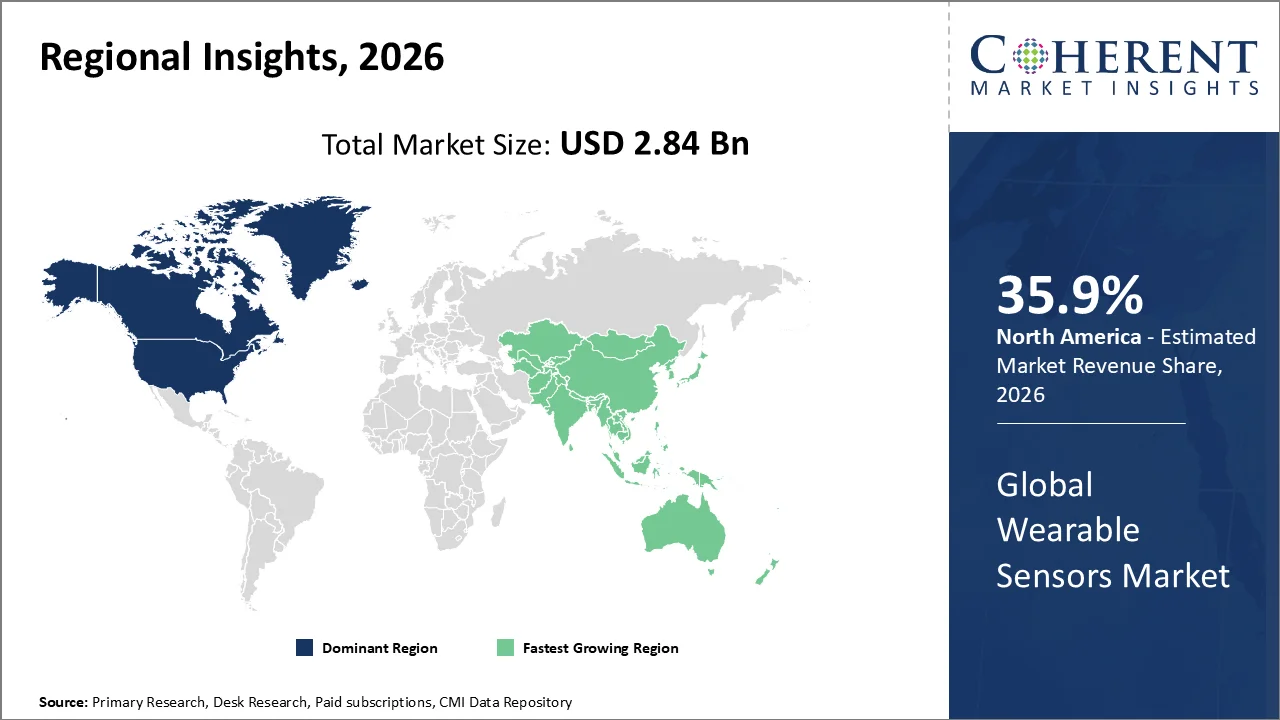
- North America is forecasted to lead the global wearable sensors market with about 35.9% market share in 2026. This dominance is attributed to the widespread availability of smartwatch and fitness band devices, presence of wearable technology companies and semiconductor companies, an advanced digital healthcare ecosystem, and growing adoption of wearable sensors for health and physical activities monitoring. According to the report by Circana, there was an 88% increase in the sale of fitness bands in the United States from 2024 to 2025, whereas sales of smart rings increased by 195%.
Market Drivers
Rapid Sensor Miniaturization and Edge AI Integration are Transforming the Wearable Sensors Market
The global wearable sensors market is progressing at an accelerating pace due to advancements made by sensor providers toward developing smaller, more power-efficient, and intelligent MEMS sensors that can perform computations right inside the wearables. As a result, it has become possible for manufacturers to incorporate more types of sensors into wearables.
Bosch Sensortec shipped over 1 billion MEMS sensors that have microcontrollers integrated into them in 2024. It estimates that about 90 percent of its sensors will be equipped with integrated capabilities starting from 2027. The company is expected to sell more than 10 billion intelligent MEMS sensors by 2030. It shows the growth in the commercial application of intelligent sensors in consumer products.
Growing Chronic Disease Monitoring Needs are Expanding Medical Wearable Sensor Applications
The rising number of cases of chronic illness presents a wealth of chances for devices that can facilitate continuous monitoring of glucose levels, cardiac status, physical activities, rehabilitation, sleeping and home care of patients. These devices can continuously gather physiological data in non-conventional settings and thereby improve their contribution to preventive and personalized healthcare.
According to the International Diabetes Federation’s 2025 Diabetes Atlas, there are about 589 million adults between the age groups of 20-79 years suffering from diabetes worldwide, which is equal to almost 1 out of every 9 adults. The figure will grow to around 853 million by the year 2050, marking a growth of around 46%. Furthermore, about 252 million diabetics are still undiagnosed
Current Events and Their Impact on the Wearable Sensors Market
Current Event | Description and its Impact |
FDA Launches TEMPO Digital Health Devices Pilot and Selects First Participant (2026) |
|
CMS ACCESS Model Expands Government Support for Wearables and Remote Monitoring (2026) |
|
- Current Industry Events of 2026
- Market Size Estimation
- Regional Breakdown
- Competitive Landscape
- Customer Intelligence
- Segmental Analysis
- Pricing Analysis
- Key Market Drivers, Challenges & Future Trends
- Customized Insights Section
Segmental Insights
Why are Accelerometers Acquiring the Largest Share?
On the basis of type, the accelerometers segment is expected to take the highest Wearable Sensors Market share of 42.1% in 2026. Accelerometers continue to be integral parts of smartwatches, fitness trackers, smart rings, hearables, and other wearables since they help in counting steps, recognizing activities, detecting gestures, falls, sleep patterns, and motion sensing.
In January 2026, TDK introduced three new SmartMotion IMUs that have been developed for uses such as wearable devices, hearables, and smart glasses. These smart motion inertial measurement units work based on the concept of a 6-axis using a combination of a 3-axis accelerometer and a 3-axis gyroscope.
In December 2025, Murata Manufacturing announced the SCH16T-K20, expanding its high-performance six-axis IMU portfolio with a new MEMS accelerometer based on Murata's 3D MEMS technology.
Why is Wrist-wear Acquiring the Largest Share?
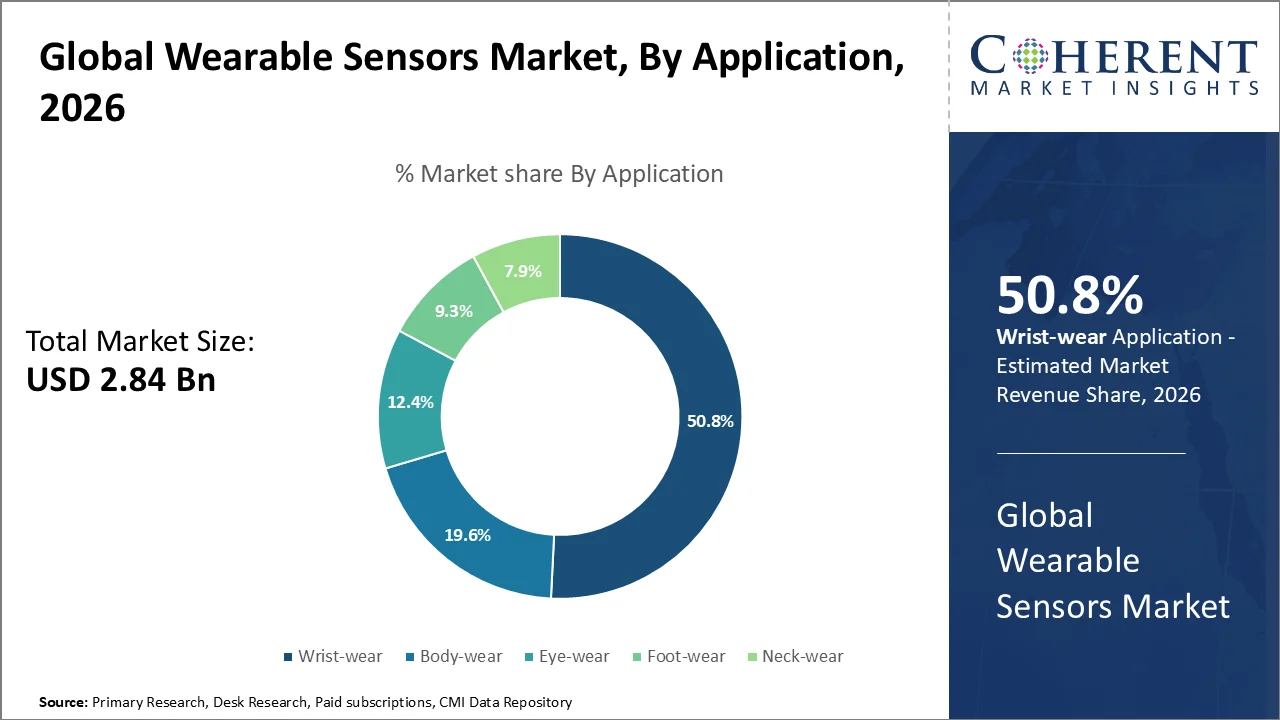
On the basis of application, the wrist-wear segment is set to lead the global Wearable Sensors Market with 50.8% in 2026. This dominance is due to the increased adoption of smartwatches and fitness bands, their relatively developed consumer environment, and their ability to integrate several types of sensors including movement, heart rate, temperature, blood oxygen levels, sleep and activity monitoring sensors into one device.
According to IDC, global smartwatch shipment volume was 120 million units for the first three quarters of 2025, growing by 7.3% from the previous year. At the same time, global wristband shipment volume was 32.86 million units and had grown by 21.3% year-over-year.
In July 2026, Samsung Electronics unveiled the Galaxy Watch9 and Galaxy Watch Ultra2, strengthening its wrist-worn digital-health portfolio.
Consumer Goods Holds the Largest Market Share
Based on vertical, the consumer goods segment is expected to dominate the market share of 54.4% in 2026 due to the high adoption rate of consumers towards smartwatches, health bands, smart rings, and wearable health technology products. The consumers' adoption rate is based on the 2025 Rock Health survey titled, "Consumer Adoption of Digital Health Survey," carried out among 8,000 Census-matched U.S. adults in June 2026.
In October 2025, Oura introduced the Oura Ring 4 Ceramic, expanding its consumer wearable portfolio with four ceramic finishes. The device incorporates Oura’s Smart Sensing technology, which continuously adapts signal pathways to the wearer’s finger to collect physiological information for sleep, activity, recovery, stress, and overall health monitoring.
Regional Insights
North America Dominates Owing to High Adoption of Advanced Smartwatches and Health-Monitoring Wearables
North America is expected to account for approximately 35.9% of the global Wearable Sensors Market in 2026. The region’s leadership is owing to its mature consumer-electronics ecosystem, strong presence of leading wearable-device and semiconductor companies, high penetration of premium smartwatches, and growing adoption of sensor-enabled devices for health, fitness, and remote monitoring.
The North American market is also highly oriented toward sensor-intensive premium devices. According to Counterpoint Research, approximately 84% of the North American smartwatch market comprised advanced smartwatch models in Q2 2025. Apple Watch Series 10 remained the region’s best-selling smartwatch series for the fourth consecutive quarter, while Apple increased its shipment share by two percentage points year-on-year.
In June 2026, Dexcom announced expanded U.S. access to its Stelo Glucose Biosensor, including pediatric clearance and a redesigned Stelo app scheduled for rollout in July 2026. Stelo is a wearable biosensor that continuously tracks glucose and is designed to make sensor-based metabolic monitoring more accessible without requiring traditional clinical monitoring infrastructure.
Asia Pacific Wearable Sensors Market Trends
Asia Pacific is expected to be the fastest-growing region in the Wearable Sensors Market, registering an estimated CAGR of approximately 20.4% from 2026 to 2033. The region’s growth is owing to its large consumer base, rising disposable incomes, expanding local electronics manufacturing, government support for consumer electronics, and rapid adoption of smartwatches and fitness devices.
According to IDC, China shipped 17.6 million units of wrist wearables in Q1 2025, recording a 37.6% growth compared to the same period last year. Among the two categories of wrist wearables, smartwatches grew by 25.3% to 11.4 million.
In May 2026, China-based Xiaomi launched the Smart Band 10 Pro, incorporating an upgraded PPG sensing module with dual light sources and dual photodetectors (PD) for improved heart-rate measurement.
Advanced Medical-Grade Wearables and Strong Digital Health Ecosystem are Accelerating the Wearable Sensors Market in the U.S.
The U.S. Wearable Sensors Market is witnessing substantial growth owing to the growing use of sensor-equipped wearable devices for applications such as heart rate monitoring, glucose monitoring, sleep monitoring, neurological monitoring, and telemedicine services. The availability of a technologically advanced semiconductor industry, digital health ecosystem, and a relatively developed regulatory environment in the country is helping in transforming wearable technology from fitness wearables to clinical wearables.
According to the American Heart Association's 2025 scientific statement, nearly 130 million U.S. adults have some form of cardiovascular disease, while more than 70% have overweight or obesity, more than half have Type 2 diabetes or prediabetes, and nearly half have hypertension.
China Wearable Sensors Market Trends
China is expected to witness strong growth in the Wearable Sensors Market, owing to its large consumer-electronics manufacturing base, rapidly expanding smart-wearable ecosystem, government support for digital-device consumption, and increasing use of health, motion, optical, and environmental sensors across smartwatches, smart bands, smart glasses, and hearables.
According to IDC, China shipped 73.9 million wrist-worn devices in 2025, representing 20.8% year-on-year growth. IDC also stated that government subsidies and promotional activity were major contributors to the expansion and that this influence is expected to continue into 2026
Who are the Major Companies in Wearable Sensors Industry
Some of the major key players in Wearable Sensors Market are Google, Panasonic Corporation, Freescale Semiconductor, Fossil Groups, InvenSense, Facebook, Amazon, Apple, Microsoft, Infineon Technologies AG, ST Microelectronics, and Analog Devices, Inc.
Key News
- In May 2026, Google introduced the Fitbit Air, a new screenless wearable designed for continuous 24/7 health tracking. The device monitors heart rate, SpO₂, HRV, breathing rate, skin-temperature variation, activity, sleep, and signs of atrial fibrillation and connects the sensor data with the new Google Health ecosystem and Gemini-powered health coaching.
- In April 2026, STMicroelectronics introduced the VD55G4 and VD65G4 ultralow-power global-shutter image sensors under its BrightSense portfolio for wearables, AR/VR/XR headsets, medical devices, and smart electronics.
Market Report Scope
Wearable Sensors Market Report Coverage
| Report Coverage | Details | ||
|---|---|---|---|
| Base Year: | 2025 | Market Size in 2026: | USD 2.84 Bn |
| Historical Data for: | 2020 To 2024 | Forecast Period: | 2026 To 2033 |
| Forecast Period 2026 to 2033 CAGR: | 21.2% | 2033 Value Projection: | USD 10.94 Bn |
| Geographies covered: |
| ||
| Segments covered: |
| ||
| Companies covered: | Google, Panasonic Corporation, Freescale Semiconductor, Fossil Groups, InvenSense, Facebook, Amazon, Apple, Microsoft, Infineon Technologies AG, ST Microelectronics, and Analog Devices, Inc. | ||
| Growth Drivers: |
| ||
| Restraints & Challenges: |
| ||
Analyst Opinion
- The Wearable Sensors Market is moving beyond traditional fitness tracking toward a broader ecosystem of smartwatches, rings, smart glasses, hearables, and medical wearables. According to IDC, global wearable-device shipments reached 145.7 million units in Q1 2026, increasing 4.3% year-on-year. Smart-glasses shipments are forecast to reach 13.6 million units in 2026, up 41.4%, while smart-ring shipments are expected to increase 12.8% to 4.9 million units.
- Clinical validation is reinforcing the application of wearables in continuous disease monitoring. A study by Nature Medicine published in March 2026 on 217 patients suffering from heart failure showed that an AI model using smartwatch had a correlation of 0.85 with clinical cardiopulmonary fitness measures.
- Evidence that wearable technologies can influence patient behavior is strengthening their value proposition within healthcare. In July 2026, the American Heart Association reported a meta-analysis of 14 clinical trials involving 1,057 participants with cardiovascular disease.
Speak to the analyst
Want personalized insights?
Take the findings above to one of our principal consultants, or have the report rebuilt around the segments, geographies and competitors you actually track.
Market Segmentation
- By Type (Revenue, USD Bn, 2021-2033)
- Touch Sensors
- Accelerometers
- Magnetometers
- Gyroscope
- Inertial Sensors
- Motion Sensors
- Pressure And Force Sensors
- Temperature And Humidity Sensors
- Microphones And Micro-Speakers
- Medial-Based Sensors
- By Application (Revenue, USD Bn, 2021-2033)
- Wrist-wear
- Eye-wear
- Foot-wear
- Neck-wear
- Body-wear
- By Vertical (Revenue, USD Bn, 2021-2033)
- Healthcare
- Industrials
- Consumer Goods
- By Region (Revenue, USD Bn, 2021-2033)
- North America
- U.S.
- Canada
- Latin America
- Brazil
- Mexico
- Argentina
- Rest of Latin America
- Europe
- Germany
- U.K.
- France
- Italy
- Spain
- Russia
- Rest of Europe
- Asia Pacific
- China
- India
- Japan
- Australia
- South Korea
- ASEAN
- Rest of Asia Pacific
- Middle East
- GCC
- Israel
- Rest of Middle East
- Africa
- South Africa
- Central Africa
- North Africa
- North America
Sources
Primary Research Interviews
- Wearable sensor manufacturers and component suppliers
- MEMS and semiconductor technology developers
- Smartwatch, fitness tracker, smart ring, and hearable manufacturers
- Digital health and remote patient monitoring experts
- Biomedical engineers and wearable medical-device researchers
- R&D heads from consumer electronics and healthcare technology companies
- Procurement managers from healthcare, industrial, and consumer electronics companies
- Key opinion leaders (KOLs) in wearable technology, biosensors, and digital health
Databases
- U.S. Food and Drug Administration (FDA) Medical Device Database
- Centers for Disease Control and Prevention (CDC)
- National Institutes of Health (NIH)
- World Health Organization (WHO)
- World Bank
- Organisation for Economic Co-operation and Development (OECD)
- U.S. Centers for Medicare & Medicaid Services (CMS)
- European Commission – Medical Devices/EUDAMED Database
Magazines
- IEEE Spectrum
- Medical Device and Diagnostic Industry (MD+DI)
- EE Times
- Electronic Design
- Sensors Magazine / Fierce Electronics
- Medical Design & Outsourcing
Journals
- IEEE Sensors Journal
- Sensors
- Biosensors and Bioelectronics
- npj Digital Medicine
- Nature Biomedical Engineering
- Journal of Medical Internet Research
- Advanced Healthcare Materials
- ACS Sensors
Newspapers
- The Wall Street Journal
- Financial Times
- The New York Times
- Reuters
- The Economic Times
- Nikkei Asia
Associations
- Institute of Electrical and Electronics Engineers (IEEE)
- MEMS & Sensors Industry Group (SEMI MSIG)
- Consumer Technology Association (CTA)
- American College of Sports Medicine (ACSM)
- American Heart Association (AHA)
- Digital Medicine Society (DiMe)
- Bluetooth Special Interest Group (Bluetooth SIG)
- Continua / Personal Connected Health Alliance
Public Domain Sources
- Company Annual Reports and Investor Presentations
- Company Product Launches and Press Releases
- FDA Device Clearances and Digital Health Publications
- NIH and CDC Research Publications
- CMS Remote Patient Monitoring and Digital Health Publications
- University Research Publications on Wearable Sensors and Biosensors
- Patent Databases such as WIPO, USPTO, EPO, and Google Patents
- Semiconductor Manufacturer Technical Datasheets and Product Documentation
- Publicly Available Clinical Studies on Smartwatches, CGMs, Smart Rings, and Wearable Biosensors
- Regulatory and Standards Publications Related to Medical Wearables, Sensor Accuracy, Data Security, and Wireless Connectivity
Proprietary Elements
- CMI Data Analytics Tool
- Proprietary CMI Existing Repository of Information for the Last 10 Years
Get access to 250+ pages report
Every segment, forecast, competitor profile and data table behind the analysis above — available for instant download.
- ESOMAR Member
- ISO 9001:2015 Certified
- D-U-N-S Registered
- GDPR & CCPA Compliant
Missing comfort of reading report in your local language? Find your preferred language:
Transform your Strategy with Exclusive Trending Reports
Frequently Asked Questions
The Wearable Sensors Market is expected to reach approximately USD 10.94 Bn by 2033, up from USD 2.84 Bn in 2026.
Major players operating in the global Wearable Sensors Market include Google, Panasonic Corporation, NXP Semiconductors/Freescale Semiconductor, InvenSense, Meta Platforms, Amazon, Apple, Microsoft, Infineon Technologies AG, STMicroelectronics, and Analog Devices, Inc.
The high development and manufacturing costs, data privacy and cybersecurity concerns, limited battery life, sensor accuracy issues, interoperability challenges, and regulatory complexities are some of the key factors hampering market growth. The collateral specifically identifies high development and manufacturing costs and data privacy and cybersecurity concerns as major challenges.
The rising adoption of wearable devices for health and fitness monitoring, continuous physiological monitoring, remote patient monitoring, chronic disease management, and AI-enabled smart wearables is driving market growth. Increasing miniaturization and development of low-power MEMS sensors are also supporting broader wearable-device adoption.
The Wearable Sensors Market is anticipated to grow at a CAGR of approximately 21.2% between 2026 and 2033.
Among regions, North America is expected to account for the largest share of the global Wearable Sensors Market, with approximately 35.9% market share in 2026.
Asia Pacific is expected to be the fastest-growing region over the forecast period, supported by rapid adoption of smartwatches and fitness devices, expanding electronics manufacturing, and strong growth in China’s wrist-worn device market.