

Laser Processing Market Size and Share Analysis: (2026 - 2033)
The Laser Processing Market is forecast to expand at a CAGR of 10%, with a market size of USD 30,862.1 Mn in 2026, reaching USD 62,075.1 Mn in 2033. The need for precision manufacturing, the use of lasers for cutting and welding operations, the increase in industrial automation, and the rise in applications in the automotive, electronics, aerospace, and medical industries will drive market growth.
Key Takeaways from the Laser Processing Market Report
- The Fiber Lasers category will lead the market with a market share of around 42% by 2026 on account of its high efficiency and low operating cost, coupled with growing use for precision cutting and welding purposes. According to the International Energy Agency, there is an observed increase in electricity usage globally in the industrial sector.
- Material Processing segment is projected to capture the highest market share of almost 58% by 2026 due to the extensive usage in cutting, drilling, welding, engraving, and surface finishing applications. According to the International Federation of Robotics, more than 540,000 industrial robots were installed each year globally, indicating the rapid industrialization that favors laser material processing technology.
- Automotive segment is expected to capture considerable market share, amounting to around 27% in 2026, attributed to increasing production of electric cars, light-weight cars, and high-precision components. According to information released by International Organization of Motor Vehicle Manufacturers, global production of motor vehicles exceeded 93 million in the past few years.
- Asia-Pacific region is anticipated to hold the largest share in the Laser Processing Market, with around 46% share by 2026 due to the high level of industrialization, presence of a robust electronics industry, growth in automotive production, and use of automation technologies in China, Japan, South Korea, and India. As per the International Federation of Robotics, 70% of total installations of industrial robots worldwide take place in the Asia region.
Rising Industrial Automation and Precision Manufacturing is Accelerating the Laser Processing Market Growth
Automation in industries and the increasing need for precision manufacturing have become some of the major factors contributing to the adoption of laser processing technology in industries such as automobiles, electronics, aerospace, and even heavy manufacturing. Fiber lasers and more advanced lasers are being used increasingly by manufacturers in operations such as cutting, welding, engraving, drilling, and microprocessing because of their efficiency and accuracy, among other reasons.
Additionally, the International Energy Agency reported rising industrial electrification and increasing manufacturing electricity demand globally, supporting adoption of energy-efficient laser technologies in modern production facilities.
Electric Vehicle Manufacturing Expansion is Boosting Laser Processing Adoption
The rapid expansion of electric vehicles (EVs) is driving the need for laser processing equipment in batteries, lightweight parts manufacturing, and welding operations. Laser equipment is commonly used in EV manufacturing for battery tab welding, motor parts manufacturing, sensor manufacturing, and chassis assembly because of their high level of accuracy and automation capabilities. The increased spending on EV factories and battery gigafactories is driving the adoption of laser processing equipment.
Moreover, the creation of EV battery gigafactories on a scale of several GWh of production capacity (ranging from 20 to 100 GWh per plant) in both Europe and Asia in response to growing demand for electric vehicles is facilitating the adoption of laser welding and micro processing technology in automotive production environments.
- Current Industry Events of 2026
- Market Size Estimation
- Regional Breakdown
- Competitive Landscape
- Customer Intelligence
- Segmental Analysis
- Pricing Analysis
- Key Market Drivers, Challenges & Future Trends
- Customized Insights Section
Current Events and Their Impact on the Laser Processing Market
Current Event | Description and its Impact |
Rapid Expansion of EV Manufacturing and Battery Gigafactories (2025–2026) |
|
Global Industrial Electrification and Automation Acceleration (Industry 4.0 Push) |
|
Segmental Insights
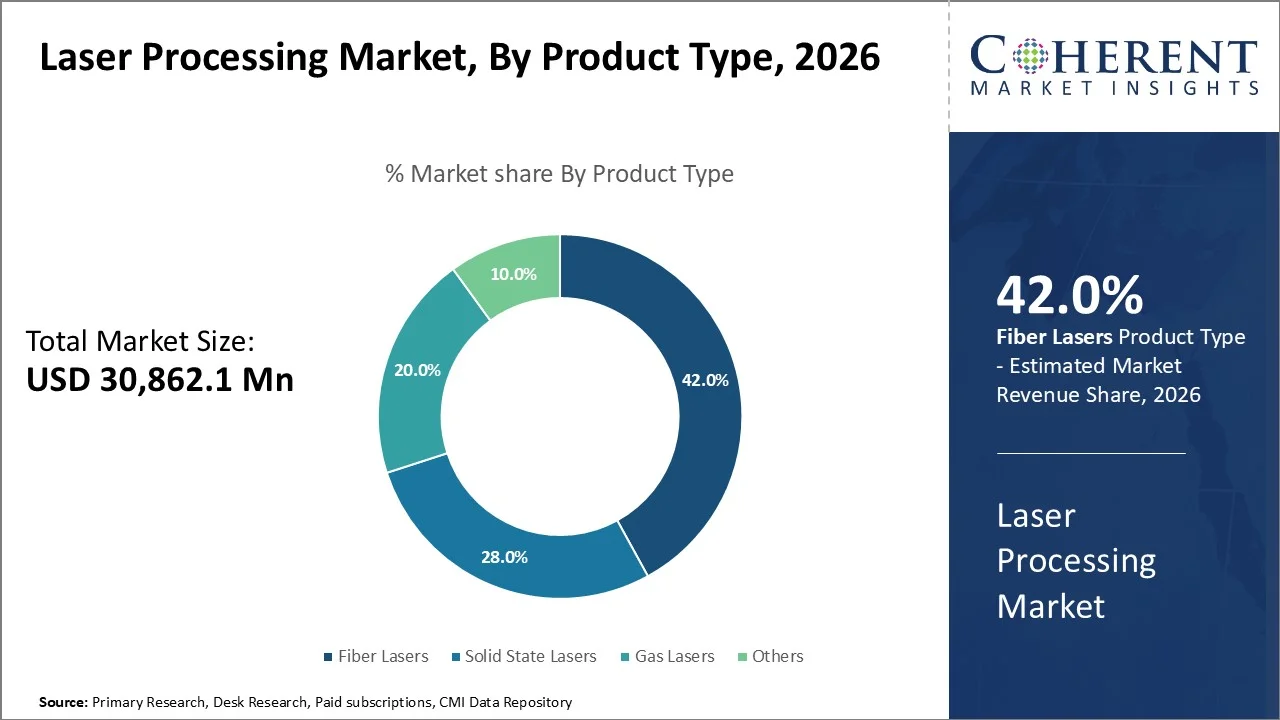
Why is Fiber Lasers Segment Acquiring the Largest Market Share?
Fiber Lasers are expected to dominate the laser processing market by accounting for the maximum market share of around 42%. The reason behind this can be attributed to its high energy efficiency, reduced maintenance, better beam quality, and suitability in terms of precision in industrial operations such as cutting, welding, and microprocessing.
Fiber lasers have gained immense importance in current manufacturing processes because they can provide high levels of electrical/optical efficiency (typically more than 30-40%). These factors greatly cut down operational expenses and enhance production speed and accuracy in automated production processes.
In June 2025, TRUMPF, introduced its next-generation TruFiber fiber laser systems designed for high-power industrial applications ranging from precision welding to advanced cutting and additive manufacturing.
Which Process Segment Dominates the Market ?
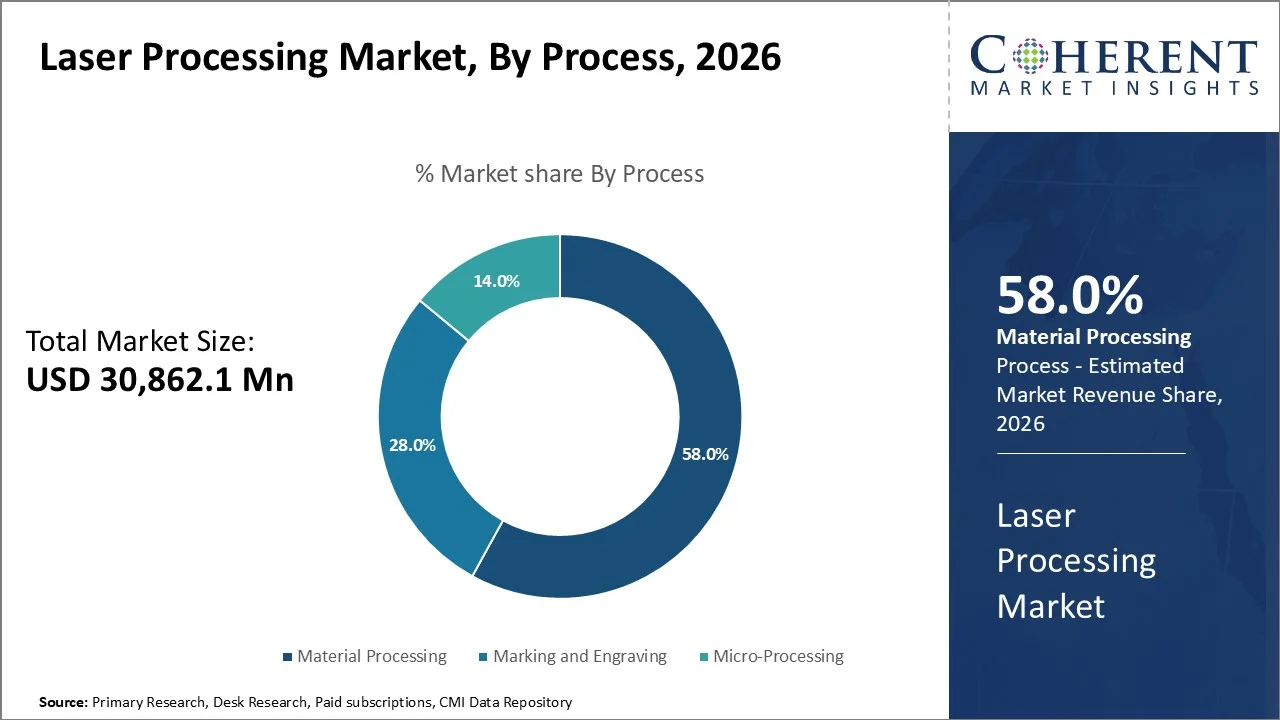
The Material Processing segment is estimated to have the highest market share of around 58%, based on its wide-ranging applicability in operations such as cutting, drilling, welding, marking, and surface treatments within the industrial manufacturing industry.
This trend is highly reinforced by the development of automated production systems and the tendency towards the use of non-contact manufacturing processes. Laser processing offers advantages in terms of shorter cycle times, less material wastage, and higher accuracy than traditional machining processes.
In March 2025, TRUMPF announced its entry into complete automated solutions for 3D laser material processing, integrating laser cutting, welding, and quality control systems into unified production platforms.
Which End-Use Industry Segment Dominates the Market?
The Automotive Segment will dominate the market share with an estimated 27%, due to increased production of electric vehicles, light vehicles, and growing demand for precise component production.
Laser processing is an integral part of automotive manufacturing, which includes battery tab welding, manufacture of powertrain components, body-in-white manufacturing, and sensor integration. This technology is necessary in the manufacture of EVs and future vehicles.
In May 2026, Ford Motor Company highlighted its rapid development of next-generation electric vehicle platforms at its EV Development Center in Long Beach, focusing on advanced manufacturing methods for its upcoming affordable EV lineup.
Laser Processing Market Trends
- Expansion of semiconductor fabrication capacity expansion, with forecasts indicating that the total industry value will exceed USD 600 billion. The Semiconductor Industry Association has pointed out robust capacity expansion worldwide.
- Growing application of laser-based material processing in aircraft construction, backed by forecasted high aircraft demand (40,000+) over the coming decades. The International Air Transport Association forecasts strong future aviation sector growth.
- Shift toward Industry 4.0 and smart factories is accelerating adoption of automated laser systems integrated with robotics and AI for high-speed, precise manufacturing. International Federation of Robotics confirms continuous growth in industrial automation adoption.
Regional Insights
Laser Processing Market Regional Trends
Asia-Pacific Dominates the Laser Processing Market
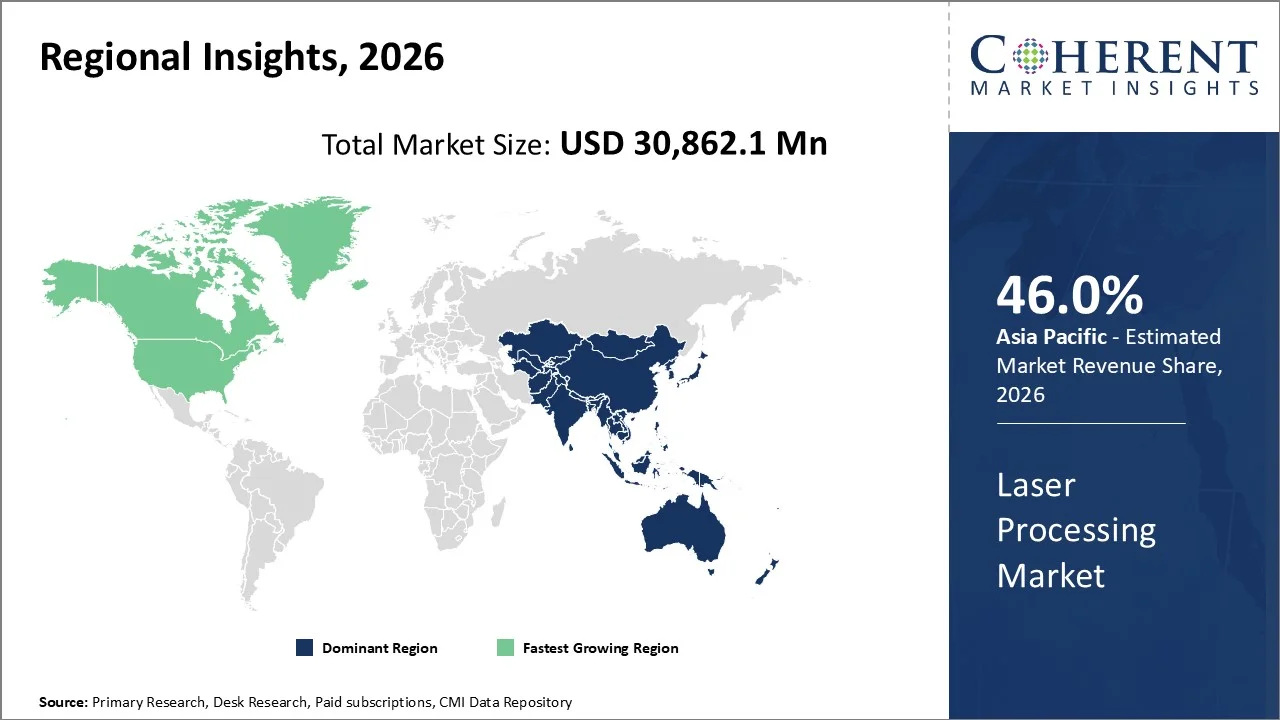
The Asia-Pacific region is estimated to hold the largest market share of 46%, attributable to factors such as industrialization, manufacturing base in electronics, growing manufacturing of automotive vehicles, and increased adoption of automation technology in China, Japan, South Korea, and India. Leadership in the market in the Asia-Pacific region is fueled by huge manufacturing bases, which includes semiconductor manufacturing and consumer electronics production, with laser technology playing a key role in cutting and welding operations.
In February 2026, Electro Optic Systems (EOS), an Australian technology company, inaugurated a new production centre in Singapore to serve as its Asia-Pacific hub for manufacturing, integration, and testing of advanced laser systems, including high-energy laser-based technologies for industrial and defense applications.
North America Laser Processing Market Trends
The North American market is likely to become the fastest growing region till 2026-2033 due to high penetration of cutting-edge manufacturing technology, heavy automation investments, and rising production of electric vehicles and aircrafts. This region enjoys an established industrial base and increased use of fiber laser machines in automotive and semiconductor production.
Furthermore, North America continues to be an important center for semiconductor production and aerospace engineering, both industries that depend on high-accuracy laser processing technology in micro machining and drilling operations. According to the Semiconductor Industry Association, there is increased development in chip production capacity within the country.
Growing Advanced Manufacturing & EV Expansion is Accelerating Laser Processing Market Demand in United States
The United States laser processing market is witnessing substantial growth, fueled by significant growth of manufacturing activities in automotive, semiconductors, aerospace, and industrial automation sectors. Growth in usage of fiber laser solutions for applications such as welding, cutting, and micro-processing is contributing to this trend.
Expanding Industrial Automation is Driving Laser Processing Adoption in Japan
The Japan laser processing market is experiencing stable growth due to its solid industrial base, high automation, and growing use of precision engineering technology. Japan is known as one of the leading nations in robotics, electronics, car manufacture, and semiconductor manufacture, all major end users of laser processing equipment.
In April 2026, Kyocera Corporation announced a share purchase agreement to acquire Ushio Inc.’s semiconductor laser device business, including the transfer of laser-related operations into a newly established company.
Who are the Major Companies in Laser Processing Industry
Some of the major key players in Laser Processing are Trumpf GmbH + Co. KG, Prima Industrie S.p.A., Universal Laser Systems Inc., Epilog Laser Inc., Coherent Inc., Eurolaser GmbH, IPG Photonics Corporation, Bystronic Laser AG, Newport Corporation, and Rofin-Sinar Technologies Inc.
Key News
- In June 2025, Coherent Corp. introduced the LEAP 600C excimer laser (600 W class) designed for high-volume industrial processing applications including pulsed laser deposition, semiconductor manufacturing, and advanced materials processing.
- In June 2025, TRUMPF GmbH + Co. KG launched a new TruFiber high-power fiber laser series (up to 50 kW) for industrial welding applications, including electric vehicle battery manufacturing and metal processing.
Market Report Scope
Laser Processing Market Report Coverage
| Report Coverage | Details | ||
|---|---|---|---|
| Base Year: | 2025 | Market Size in 2026: | USD 30,862.1 Mn |
| Historical Data for: | 2020 To 2024 | Forecast Period: | 2026 To 2033 |
| Forecast Period 2026 to 2033 CAGR: | 10% | 2033 Value Projection: | USD 62,075.1 Mn |
| Geographies covered: |
| ||
| Segments covered: |
| ||
| Companies covered: | Trumpf GmbH + Co. KG, Prima Industrie S.p.A., Universal Laser Systems Inc., Epilog Laser Inc., Coherent Inc., Eurolaser GmbH, IPG Photonics Corporation, Bystronic Laser AG, Newport Corporation, and Rofin-Sinar Technologies Inc. | ||
| Growth Drivers: |
| ||
| Restraints & Challenges: |
| ||
Analyst Opinion
- Requirements for laser processing are significantly motivated by change within the industry and not mere improvements. There is an ever-growing need for manufacturing processes to be more precise, automated, and highly efficient.
- Adoption of fiber lasers has been increasing across the world, and according to estimates, this technology contributes to 40%-45% of total installations within the industry due to its efficiency and ability to scale up production.
- The industry is largely fueled by growth in the production of EVs and batteries, where laser welding is critical for connecting battery tabs, bonding copper and aluminum, and assembling power electronics. Growth in EV production will greatly increase the need for precision laser solutions in the coming years.
- Industrial automation and robotics integration are reshaping manufacturing workflows, with over 500,000+ industrial robots installed annually worldwide, increasing the need for synchronized laser-based processing in smart factories.
- Manufacturing semiconductors and electronics products is turning into one of the growth drivers because laser microprocessing techniques are vital for producing AI and supercomputing devices.
Speak to the analyst
Want personalized insights?
Take the findings above to one of our principal consultants, or have the report rebuilt around the segments, geographies and competitors you actually track.
Market Segmentation
- By Product Type (Revenue, USD Mn, 2021-2033)
- Gas Lasers
- Solid State Lasers
- Fiber Lasers
- Others
- By Process (Revenue, USD Mn, 2021-2033)
- Material Processing
- Marking and Engraving
- Micro- Processing
- By End-use Industry (Revenue, USD Mn, 2021-2033)
- Automotive
- Aerospace
- Original Equipment Manufacturer (OEM)
- Electronic and Micro-electronic
- Medical Devices and treatments
- Packaging
- By Region (Revenue, USD Mn, 2021-2033)
- North America
- U.S.
- Canada
- Latin America
- Brazil
- Mexico
- Argentina
- Rest of Latin America
- Europe
- Germany
- U.K.
- France
- Italy
- Spain
- Russia
- Rest of Europe
- Asia Pacific
- China
- India
- Japan
- Australia
- South Korea
- ASEAN
- Rest of Asia Pacific
- Middle East
- GCC
- Israel
- Rest of Middle East
- Africa
- South Africa
- Central Africa
- North Africa
- North America
- Key Players
- TRUMPF GmbH + Co. KG
- Prima Industrie S.p.A.
- Universal Laser Systems Inc.
- Epilog Laser Inc.
- Coherent Inc.
- Eurolaser GmbH
- IPG Photonics Corporation
- Bystronic Laser AG
- Newport Corporation
- Rofin-Sinar Technologies Inc.
Sources
Primary Research Interviews
- Manufacturing plant managers
- Laser system manufacturers
- Automotive OEM engineers
- Semiconductor fabrication specialists
- Aerospace & defense production experts
- Industrial automation consultants
- Key opinion leaders (KOLs) in photonics & laser technology
Databases
- International Energy Agency (IEA)
- International Federation of Robotics (IFR)
- Semiconductor Industry Association (SIA)
- Organisation for Economic Co-operation and Development (OECD)
- World Bank Industrial Data Repository
Magazines
- Laser Focus World
- Industrial Laser Solutions
- Photonics Spectra
- Manufacturing Engineering Magazine
Journals
- Journal of Laser Applications
- Optics & Laser Technology
- Applied Physics B – Lasers and Optics
- Journal of Manufacturing Processes
Newspapers / Business Sources
- Bloomberg
- Reuters
- Financial Times
- The Wall Street Journal
Associations
- Laser Institute of America (LIA)
- European Photonics Industry Consortium (EPIC)
- SPIE – International Society for Optics and Photonics
- International Organization for Standardization (ISO – Laser Safety & Manufacturing Standards)
Public Domain Sources
- Company Annual Reports and Investor Presentations
- Government manufacturing and industrial policy reports
- Trade statistics from national industry ministries
- Patent databases (WIPO, USPTO)
- Clinical and industrial trial registries where applicable
Proprietary Elements
- Coherent Market Insights (CMI) Data Analytics Tool
- Proprietary CMI historical market database (last 10+ years of industry tracking data)
Get access to 250+ pages report
Every segment, forecast, competitor profile and data table behind the analysis above — available for instant download.
- ESOMAR Member
- ISO 9001:2015 Certified
- D-U-N-S Registered
- GDPR & CCPA Compliant
Missing comfort of reading report in your local language? Find your preferred language:
Transform your Strategy with Exclusive Trending Reports
Frequently Asked Questions
The Laser Processing Market is expected to reach USD 62,075.1 Mn in 2033, growing from USD 30,862.1 Mn in 2026.
Major players operating in the global Laser Processing Market include Trumpf GmbH + Co. KG, Prima Industrie S.p.A., Universal Laser Systems Inc., Epilog Laser Inc., Coherent Inc., Eurolaser GmbH, IPG Photonics Corporation, Bystronic Laser AG, Newport Corporation, and Rofin-Sinar Technologies Inc.
High equipment cost, expensive maintenance, and requirement of skilled operators are major factors limiting adoption, especially among small and medium manufacturers.
Increasing demand for precision manufacturing, growth in EV production, expansion of semiconductor industry, and rising adoption of industrial automation are key growth drivers.
The Laser Processing Market is anticipated to grow at a CAGR of 10% between 2026 and 2033.
Among regions, Asia-Pacific is expected to dominate the global Laser Processing Market, accounting for nearly 46% market share in 2026, driven by strong manufacturing and electronics industries.