

Lithotripsy Devices Market Size and Share Analysis- 2026 To 2033
The Lithotripsy Devices Market size is anticipated to grow at a CAGR of 5.1%, from USD 1.84 Bn in 2026 to approximately USD 2.61 Bn by 2033. The primary drivers are largely defined by the rising prevalence of kidney and urinary tract stones, increasing preference for minimally invasive and non-invasive stone management procedures, technological advancements in extracorporeal shock wave lithotripsy and intracorporeal lithotripsy systems, and growing adoption of advanced laser-based lithotripsy technologies. Increasing healthcare expenditure, expanding urology infrastructure, and the rising availability of technologically advanced lithotripsy devices are further supporting market growth across hospitals, specialty clinics, and ambulatory surgical centers. A systematic review and meta-analysis covering 22 studies and 1,276,826 participants estimated the global prevalence of urolithiasis at 10.85%, with prevalence higher among males (12.93%) than females (8.91%).
Key Takeaways
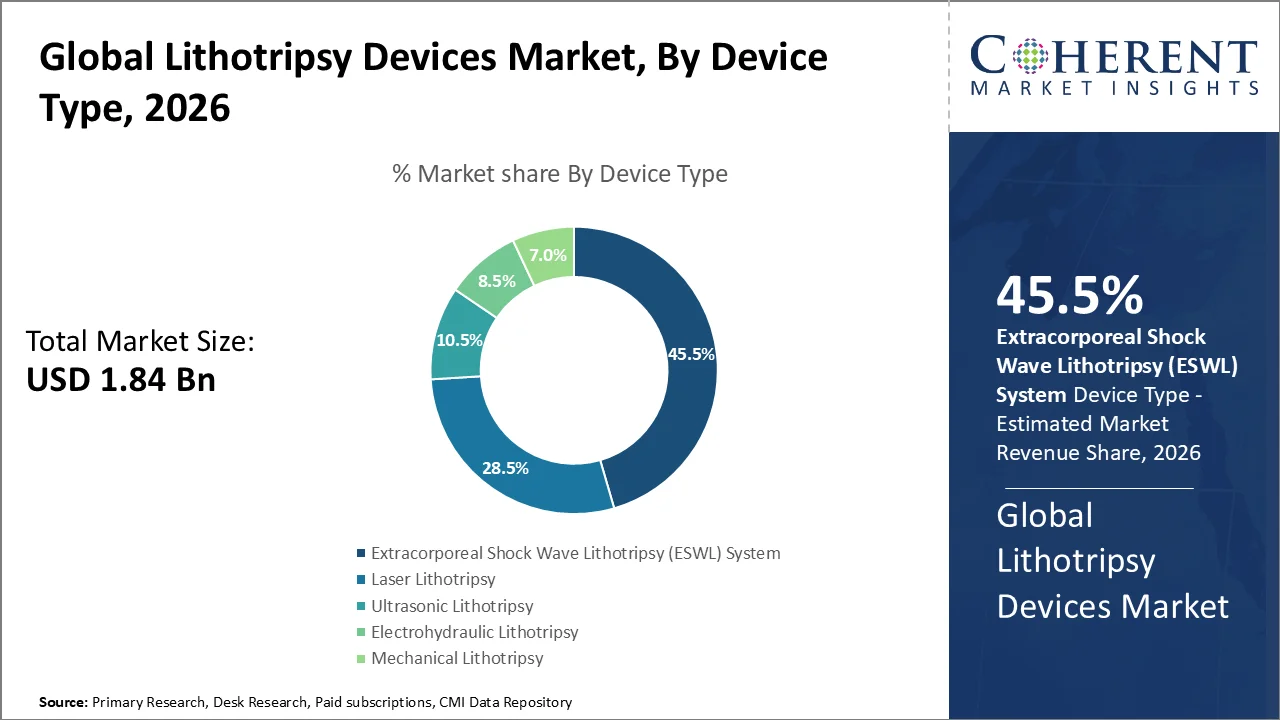
- The extracorporeal shock wave lithotripsy (ESWL) system segment is likely to dominate the market with approximately 45.5% in 2026. The segment’s growth is owing to its non-invasive treatment approach, relatively short procedure time, established use in renal and ureteral stone management, and continued technological improvements in stone localization and shock-wave delivery. In January 2026, the U.S. FDA approved SonoMotion’s Break Wave system under 510(k), an extracorporeal shock-wave lithotripter for urological use, highlighting ongoing innovation in non-invasive stone-fragmentation technologies.
- The hospitals segment is anticipated to hold the largest share of about 68.5% in 2026. The segment is growing due to the high volume of kidney stone procedures conducted in hospitals, access to urologists and advanced imaging systems and the availability of multiple treatment modalities like ESWL, ureteroscopy and laser lithotripsy. The 2026 European Association of Urology (EAU) Guidelines reference a large multicenter comparison which found that only 12% of patients treated with ureteroscopy required further intervention compared with 26% of patients treated with shock-wave lithotripsy.
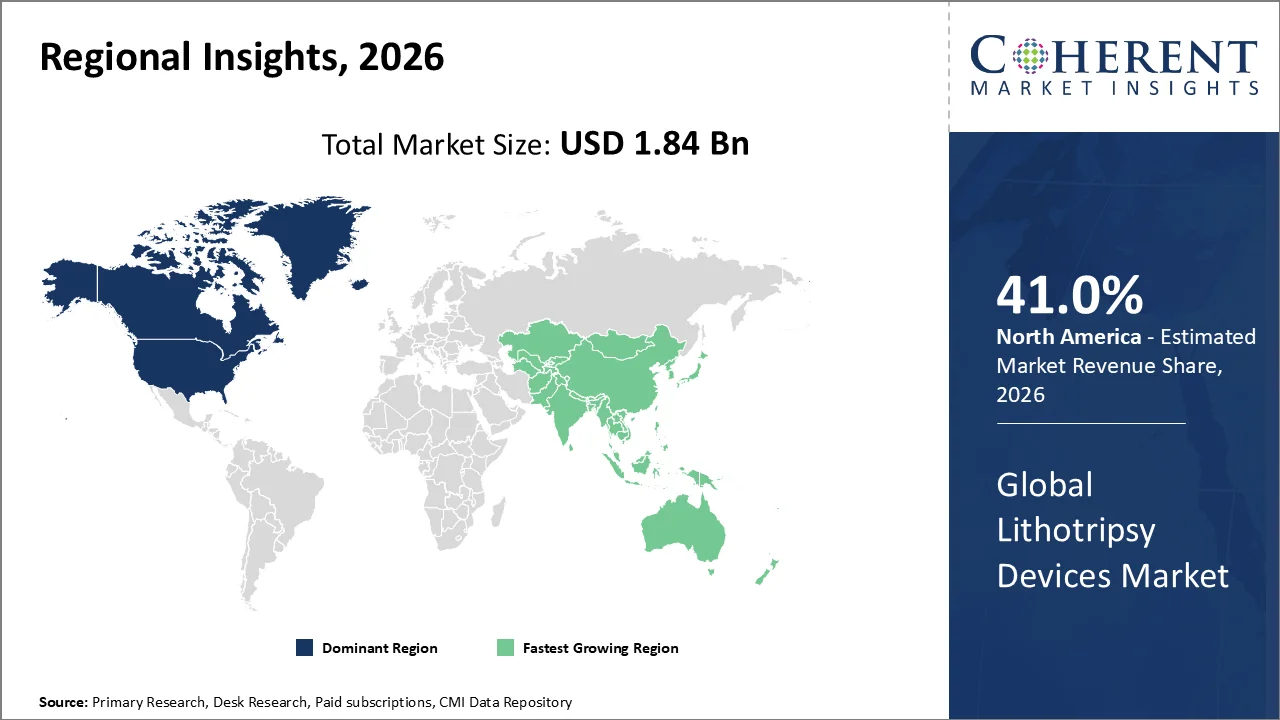
- North America is anticipated to be the largest market in the world with a share of 41.0% in 2026. The growth is attributed to the considerable kidney-stone burden, existing urology infrastructure, availability of technologically advanced lithotripsy systems and adoption of next-generation laser technologies in the U.S. A recent study using U.S. NHANES data showed an increase in kidney-stone prevalence in adults with obesity from 11.0% to 12.5% indicating a large at-risk population supporting continued demand for stone-management procedures.
Market Drivers
Growing Global Burden of Urolithiasis is Driving Demand for Lithotripsy Devices
The rising prevalence of kidney and urinary stones is one of the key factors fueling the Lithotripsy Devices Market. The increasing incidence of stones in aging populations, metabolic disorders, dietary changes, obesity and inadequate hydration is resulting in an increasing number of patients who need active stone removal procedures. This is driving demand for extracorporeal shock wave lithotripsy, laser lithotripsy and other intracorporeal stone fragmentation systems.
A 2025 cohort study of 36,811 adults found those with metabolic syndrome were 60.5% more likely to develop nephrolithiasis (HR 1.61). Both obesity and hypertension were independently associated with an increased risk of stones, and greater age was associated with greater risk among patients with metabolic syndrome.
Rapid Advances in Laser Lithotripsy Technology are Accelerating Market Growth
Technological advancements in laser based stone fragmentation is expected to be a major growth driver for the lithotripsy devices market. The shift from traditional holmium systems to thulium fiber laser (TFL) platforms is improving fragmentation efficiency, reducing stone retropulsion, allowing the use of smaller laser fibers, and allowing for faster ureteroscopic procedures.
A prospective randomized controlled trial in 2026 demonstrated a reduction in mean laser time to 3.02 minutes compared to 5.78 minutes and a 100% three-month stone-free rate compared to 78.9% for holmium. The study also found that TFL was associated with a significantly lower rate of stone retropulsion.
Current Events and Their Impact on the Lithotripsy Devices Market
Current Event | Description and its Impact |
CMS Establishes New Reimbursement Code for Suction-Enabled Lithotripsy Procedures (July 2026) |
|
FDA Quality Management System Regulation Becomes Effective for Medical Device Manufacturers (February 2026) |
|
- Current Industry Events of 2026
- Market Size Estimation
- Regional Breakdown
- Competitive Landscape
- Customer Intelligence
- Segmental Analysis
- Pricing Analysis
- Key Market Drivers, Challenges & Future Trends
- Customized Insights Section
Segmental Insights
Why is Extracorporeal Shock Wave Lithotripsy (ESWL) System Acquiring the Largest Share?
On the basis of device type, the extracorporeal shock wave lithotripsy (ESWL) system segment is projected to account for the largest Lithotripsy Devices Market share of approximately 45.5% in 2026. The segment’s growth is owing to its non-invasive treatment approach, avoidance of surgical incisions, established clinical use for renal and ureteral stones, and continuing improvements in shock-wave generation, imaging guidance, and stone targeting.
A systematic review and meta-analysis in 2025, which included 12 studies and 2,673 patients, demonstrated a significantly better stone-free outcome with ultrasound-guided ESWL compared with fluoroscopy-guided ESWL. The study also pointed to ultrasound guidance as an attractive alternative to reduce radiation exposure in ESWL procedures.
In May 2026, SonoMotion announced U.S. FDA 510(k) clearance for its next-generation Break Wave extracorporeal lithotripsy device featuring therapy probes with a 31% smaller footprint, weighing less and easier to handle.
Why do Hospitals Hold the Largest Market Share?
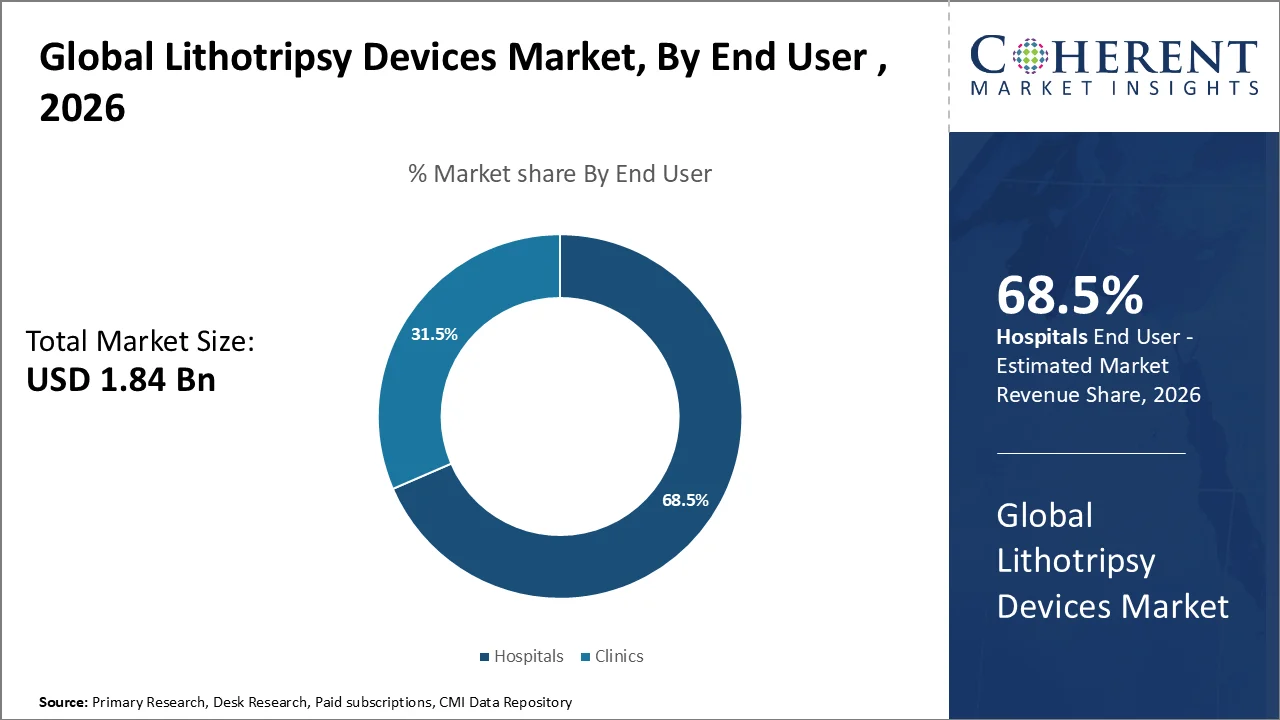
On the basis of end user, the hospitals segment is projected to lead the Lithotripsy Devices Market with approximately 68.5% share in 2026. The segment’s growth is owing to the concentration of urology specialists, operating rooms, anesthesia support, advanced imaging technologies, and multiple stone-treatment modalities within hospital settings. Hospitals are also better positioned to manage complex kidney and ureteral stones, high-risk patients, postoperative complications, and procedures requiring ureteroscopy or laser lithotripsy.
A 2025 study from a tertiary medical center evaluated 1454 patients undergoing ureteroscopy with lithotripsy, demonstrating the high volumes of stone-management procedures performed by advanced hospital-based urology services. The study also highlighted the necessity of perioperative assessment and management in hospital for high-risk patients with patients with HbA1c levels of 8.0-9.9% having 4.42 times higher odds of postoperative sepsis and patients with HbA1c ≥10% having 8.17 times higher odds.
In May 2026, Fortis Hospital, Mohali was the first hospital in North India to install MOSES 2.0 Holmium Laser system for minimally invasive treatment of kidney stones and benign prostatic hyperplasia.
Lithotripsy Devices Market Trends
- Intracorporeal lithotripsy is being revolutionized by the rapid adoption of thulium fiber laser (TFL) technology with faster stone fragmentation, less retropulsion and shorter operative times than traditional holmium systems. In 2026, a systematic review and meta-analysis of 5 randomized controlled trials with 441 patients showed that TFL had a significantly higher stone-free rate and shorter lasering time (5.06 minutes) and overall operating time when compared with holmium lithotripsy.
- The growing integration of real-time intrarenal pressure monitoring into ureteroscopy and laser lithotripsy systems is improving procedural safety. A 2025 U.S. real-world study comparing 208 patients treated with a pressure-monitoring single-use ureteroscope with 416 patients treated using other single-use ureteroscopes reported 30-day postoperative infection rates of 8.2% versus 15.4%, respectively. This is encouraging the development of smarter lithotripsy platforms combining visualization, pressure monitoring, and stone fragmentation.
- Increasing use of suction-enabled ureteral access sheaths is supporting more efficient stone evacuation during flexible ureteroscopic lithotripsy. A large international randomized trial in European Urology involving 720 patients from 12 centers showed that flexible ureteroscopy with a navigable suction sheath was noninferior to mini-PCNL for stone clearance in 2–3 cm renal stones, with a reduction in postoperative hospitalization of approximately 2.5 days.
Regional Insights
North America Dominates Owing to Advanced Urology Infrastructure and Rapid Adoption of Next-Generation Stone Management Technologies
North America is projected to account for 41.0% share of the Lithotripsy Devices Market by the year 2026. The region’s dominance is attributed to the high prevalence of ureteroscopy and lithotripsy procedures, well-developed hospital-based urology infrastructure, easy availability of advanced ESWL and laser systems, and rapid adoption of technologies like suction-assisted stone evacuation, thulium fiber lasers, and pressure-monitoring ureteroscopes.
A 2025 U.S. Medicare study of 290,610 patients aged 65 years and older undergoing ureteroscopy for the management of kidney stones underscores such a significant procedural base in the country. The need for interventional stone-management technologies was great, with 73.2% of patients undergoing 1 ureteroscopy procedure and 20.8% undergoing 2 procedures during the study period.
In May 2026, U.S.-based Calyxo said it has treated over 40,000 patients using its CVAC System. It also unveiled advanced image-processing software to aid visualization during kidney-stone procedures. Such continued product adoption and technology upgrades are strengthening North America's position as a major market for advanced lithotripsy and endourology devices.
Asia Pacific Lithotripsy Devices Market Trends
Asia Pacific is expected to be the fastest-growing region in the Lithotripsy Devices Market during the forecast period. Growth is owing to the large urolithiasis patient population, rapidly expanding hospital and urology infrastructure, increasing access to minimally invasive stone procedures, and growing adoption of flexible ureteroscopy, laser lithotripsy, and ambulatory stone-treatment models across China, India, Japan, and other regional markets. CMI also identifies Asia Pacific as a fast-growing lithotripsy-device market.
Clinical practice is also shifting toward more efficient minimally invasive treatment. A 2026 study from Peking University involving 174 flexible ureteroscopic lithotripsy procedures reported stone-free rates of 82.95% for ambulatory patients and 80.23% for inpatients.
In June 2026, India-based Biorad Medisys launched Quantino 20W Thulium Fiber Laser (TFL) system for kidney stone management in UROLITHOCON 2026, Bengaluru, India. The compact lithotripsy platform adds to the company's existing Quantino portfolio of 40W and 75W systems and is intended for stone fragmentation procedures in hospitals and urology centers.
Advanced Endourology Infrastructure and Rapid Product Commercialization are Accelerating the Lithotripsy Devices Market in the United States
The U.S. Lithotripsy Devices Market is witnessing a strong growth owing to the presence of well-developed infrastructure for urology treatment, high adoption of minimally invasive stone management procedures and rapid commercialization of advanced laser, suction and single-use ureteroscopy technologies. The market is increasingly evolving toward integrated platforms that offer stone fragmentation, visualization, irrigation and active fragment evacuation.
A U.S. randomized clinical trial in 2025, in 196 patients, evaluated an investigational microbubble-enhanced method during ureteroscopic laser lithotripsy. Adverse events were reported in 35% of patients treated with the investigational treatment compared to 46% in the control group, demonstrating ongoing U.S. clinical research to improve the safety and efficacy of laser stone fragmentation.
In September 2025, Dornier MedTech America launched the Dornier Hoover Flexible and Navigable Suction Ureteral Access Sheath and Axis II Slim single-use ureteroscope across the U.S.
China Lithotripsy Devices Market Trends
China is expected to witness strong growth in the Lithotripsy Devices Market over the forecast period. This growth is attributed to the large patient pool in the country, increasing endourology capabilities, growing domestic manufacturing of medical devices, and increasing clinical adoption of disposable ureteroscopes, suction assisted lithotripsy, and intelligent intrarenal pressure-control technologies.
A 2025 Chinese study of 140 patients found that intelligent pressure-controlled disposable ureteroscopy combined with laser lithotripsy achieved an initial stone-clearance rate of 90.0% versus 67.1% for conventional disposable ureteroscopy. The total clearance rate reached 95.7% versus 85.7%, while the overall complication rate was 2.86% compared with 21.43% in the conventional group.
Who are the Major Companies in Lithotripsy Devices Industry
Some of the major key players in Lithotripsy Devices Market are Medispec Ltd., Siemens Ltd., Boston Scientific Corporation, Olympus Corporation, Direx Group, Cook Medical, C. R. Bard, Inc., Lumenis, Karl Storz SE & Co. KG, and Dornier MedTech.
Key News
- In March 2026, Boston Scientific received U.S. FDA 510(k) clearance for its Asurys Fluid Management System, designed for irrigation management during ureteroscopy, PCNL, cystoscopy, and other urological procedures.
- In March 2025, Cook Medical introduced Magneto technology on its Litho 100 W and Litho 150 W high-power Ho laser systems. Magneto enables pulse widths of up to 2,000 µs and reduces peak power to as low as 500 W, helping reduce stone retropulsion and enable finer dusting during urinary lithotripsy procedures.
Market Report Scope
Lithotripsy Devices Market Report Coverage
| Report Coverage | Details | ||
|---|---|---|---|
| Base Year: | 2025 | Market Size in 2026: | USD 1.84 Bn |
| Historical Data for: | 2020 To 2024 | Forecast Period: | 2026 To 2033 |
| Forecast Period 2026 to 2033 CAGR: | 5.1% | 2033 Value Projection: | USD 2.61 Bn |
| Geographies covered: |
| ||
| Segments covered: |
| ||
| Companies covered: | Medispec Ltd., Siemens Ltd., Boston Scientific Corporation, Olympus Corporation, Direx Group, Cook Medical, C. R. Bard, Inc., Lumenis, Karl Storz SE & Co. KG, and Dornier MedTech. | ||
| Growth Drivers: |
| ||
| Restraints & Challenges: |
| ||
Analyst Opinion
- The Lithotripsy Devices Market is moving toward integrated stone-fragmentation and evacuation platforms, rather than standalone lithotripsy systems. New combinations of laser lithotripsy, flexible ureteroscopy, navigable suction, and direct in-scope suction are improving stone clearance and reducing repeat procedures. A 2026 EAU Endourology study demonstrated the combined FIRST suction-ureteroscopy technique resulted in a 30-day stone-free rate of 83.8% versus 70.4%, and zero-residual-fragment rates of 72.9% compared to 48.1%.
- Device reliability, procedural economics and sustainability are becoming increasingly important purchasing considerations for hospitals, with the growing adoption of single-use ureteroscopes and suction-assisted lithotripsy systems. A prospective multicenter study of 607 patients from 12 international centers in 2026 repoarted a 30-day stone-free rate of 87.5% with reused disposable ureteroscopes and NSAIDs.
- The development of lithotripsy technology will progress to the next phase, where improvements in laser and shock-wave performance will be combined with the integration of AI-enabled clinical decision support, procedure monitoring, and complication prediction. In a 2026 study of 927 patients undergoing ureteroscopic lithotripsy, machine learning-based models were developed to predict postoperative urosepsis. The XGBoost model achieved an AUC of 0.98 in internal testing and 0.99 in external validation, demonstrating the potential for AI to improve patient selection and perioperative risk management in advanced stone-treatment workflows.
Speak to the analyst
Want personalized insights?
Take the findings above to one of our principal consultants, or have the report rebuilt around the segments, geographies and competitors you actually track.
Market Segmentation
- By Device Type (Revenue, USD Bn, 2021-2033)
- Laser Lithotripsy
- Electrohydraulic Lithotripsy
- Ultrasonic Lithotripsy
- Mechanical Lithotripsy
- Extracorporeal Shock Wave Lithotripsy (ESWL) System
- By End User (Revenue, USD Bn, 2021-2033)
- Hospitals
- Clinics
- By Region (Revenue, USD Bn, 2021-2033)
- North America
- U.S.
- Canada
- Latin America
- Brazil
- Mexico
- Argentina
- Rest of Latin America
- Europe
- Germany
- U.K.
- France
- Italy
- Spain
- Russia
- Rest of Europe
- Asia Pacific
- China
- India
- Japan
- Australia
- South Korea
- ASEAN
- Rest of Asia Pacific
- Middle East
- GCC
- Israel
- Rest of Middle East
- Africa
- South Africa
- Central Africa
- North Africa
- North America
Sources
- Primary Research Interviews
- Urologists and endourologists
- Lithotripsy device manufacturers
- Medical device R&D and product development professionals
- Hospital urology department heads
- Biomedical and clinical engineers
- Hospital procurement and capital equipment managers
- Distributors and suppliers of urology and lithotripsy equipment
- Key opinion leaders (KOLs) in urolithiasis and endourology
Databases
- U.S. Food and Drug Administration (FDA)
- Centers for Medicare & Medicaid Services (CMS)
- European Medicines Agency / European Commission Medical Device Databases
- EUDAMED
- World Health Organization (WHO)
- World Bank
- OECD Health Statistics
- ClinicalTrials.gov
- PubMed / National Library of Medicine
Magazines
- Urology Times
- Medical Device Network
- MedTech Dive
- Medical Design & Outsourcing
- Medical Product Outsourcing
- Healthcare Purchasing News
Journals
- Journal of Endourology
- European Urology
- European Urology Focus
- World Journal of Urology
- Urolithiasis
- The Journal of Urology
- BJU International
- International Urology and Nephrology
Newspapers
- The Wall Street Journal
- Financial Times
- Reuters
- The Economic Times
- Business Standard
- Nikkei Asia
Associations
- American Urological Association (AUA)
- European Association of Urology (EAU)
- Endourological Society
- International Alliance of Urolithiasis
- Urological Society of India (USI)
- Chinese Urological Association (CUA)
- Japanese Urological Association (JUA)
Public Domain Sources
- Company Annual Reports and Investor Presentations
- Company Product Portfolios and Technical Documentation
- FDA 510(k), PMA, and Medical Device Registration Databases
- European MDR and EUDAMED Publications
- CMS Reimbursement and Procedure Coding Publications
- ClinicalTrials.gov and Other Clinical Trial Registries
- Hospital and Academic Medical Center Publications
- Peer-Reviewed Clinical Studies on ESWL, Laser Lithotripsy, and Ureteroscopy
- Government Healthcare Expenditure and Procedure Statistics
- Patent Databases such as WIPO, USPTO, and Google Patents
Proprietary Elements
- CMI Data Analytics Tool
- Proprietary CMI Existing Repository of Information for the Last 10 Years
Get access to 250+ pages report
Every segment, forecast, competitor profile and data table behind the analysis above — available for instant download.
- ESOMAR Member
- ISO 9001:2015 Certified
- D-U-N-S Registered
- GDPR & CCPA Compliant
Missing comfort of reading report in your local language? Find your preferred language:
Transform your Strategy with Exclusive Trending Reports
Frequently Asked Questions
The Lithotripsy Devices Market is expected to reach approximately USD 2.61 Bn by 2033, increasing from USD 1.84 Bn in 2026.
Major players operating in the global Lithotripsy Devices Market include Medispec Ltd., Siemens Ltd., Boston Scientific Corporation, Olympus Corporation, Direx Group, Cook Medical, C. R. Bard, Inc., Lumenis, Karl Storz SE & Co. KG, and Dornier MedTech.
The high investment and equipment acquisition cost and limited access to advanced lithotripsy systems in emerging markets are the key factors hampering market growth.
The rising prevalence of kidney and urinary stones and increasing adoption of minimally invasive stone-treatment procedures are major factors driving the market. Technological advancements in ESWL, intracorporeal lithotripsy, and advanced laser-based systems are also supporting market growth.
The Lithotripsy Devices Market is anticipated to grow at a CAGR of 5.1% between 2026 and 2033.
North America is expected to dominate the global Lithotripsy Devices Market with approximately 41.0% market share in 2026, supported by advanced urology infrastructure, high utilization of stone-management procedures, and rapid adoption of advanced lithotripsy technologies.
Asia Pacific is expected to be the fastest-growing region during the forecast period, supported by a large urolithiasis patient population, expanding urology infrastructure, and increasing adoption of flexible ureteroscopy, laser lithotripsy, and ambulatory stone-treatment procedures.