

Anesthesia Monitoring Devices Market Size and Forecast – 2026 to 2033
Anesthesia Monitoring Devices Market is estimated to be valued at USD 3,279.3 Mn in 2026 and is expected to reach USD 6,765.6 Mn in 2033, exhibiting a compound annual growth rate (CAGR) of 10.9% from 2026 to 2033.
Key Takeaways
- By Product, Basic Anesthesia Monitor hold the largest market share in 2026 owing to the global rise in surgical procedures.
- By End User, Hospitals acquired the prominent share in 2026 as high surgical volume & case complexity.
- By Region, North America dominates the overall market with an estimated share of 43.1% in 2026 owing to the advanced healthcare infrastructure & high surgical volume.
Market Overview
An increasing number of surgical procedures, a higher prevalence of chronic diseases, and a strong focus on patient safety are driving the Anesthesia Monitoring Devices Market growth. Medical professionals are adopting advanced monitoring technologies, including integrated systems and real-time data analytics, to improve clinical decision-making. Hospitals and surgical centers continue to lead demand due to their need for precise, continuous monitoring. In emerging regions, expanding healthcare infrastructure and ongoing innovation from leading medical device companies further boost market expansion.
Current Events and their Impact on the Anesthesia Monitoring Devices Market
Current Events | Description and its impact |
Technological Advances |
|
Regulatory and Policy Developments |
|
Healthcare Trends and Demographic Shifts |
|
End-user Feedback and Unmet Needs in the Anesthesia Monitoring Devices Market
- Demand for User-Friendly Interfaces: End-users emphasize the need for anesthesia monitors with intuitive, easy-to-navigate interfaces. Complex systems can increase the risk of errors during critical moments. Simplified displays and customizable alerts help clinicians respond faster and more accurately, improving workflow efficiency and patient safety in high-pressure environments.
- Need for Enhanced Portability and Compact Design: Healthcare providers seek lightweight, portable anesthesia monitoring devices suitable for varied settings like ambulatory centers and remote locations. Bulky or stationary equipment limits flexibility. Compact and battery-powered monitors enable easier transportation and quick deployment, ensuring consistent monitoring during patient transfers or in field environments.
- Integration with Hospital Systems: Users report challenges with anesthesia monitors that do not seamlessly integrate with electronic health records (EHR) and other hospital IT systems. Lack of interoperability causes data silos and workflow disruptions. Enhanced connectivity and standardized data sharing can improve documentation, real-time analytics, and overall clinical decision-making.
- Current Industry Events of 2026
- Market Size Estimation
- Regional Breakdown
- Competitive Landscape
- Customer Intelligence
- Segmental Analysis
- Pricing Analysis
- Key Market Drivers, Challenges & Future Trends
- Customized Insights Section
Segmental Insights
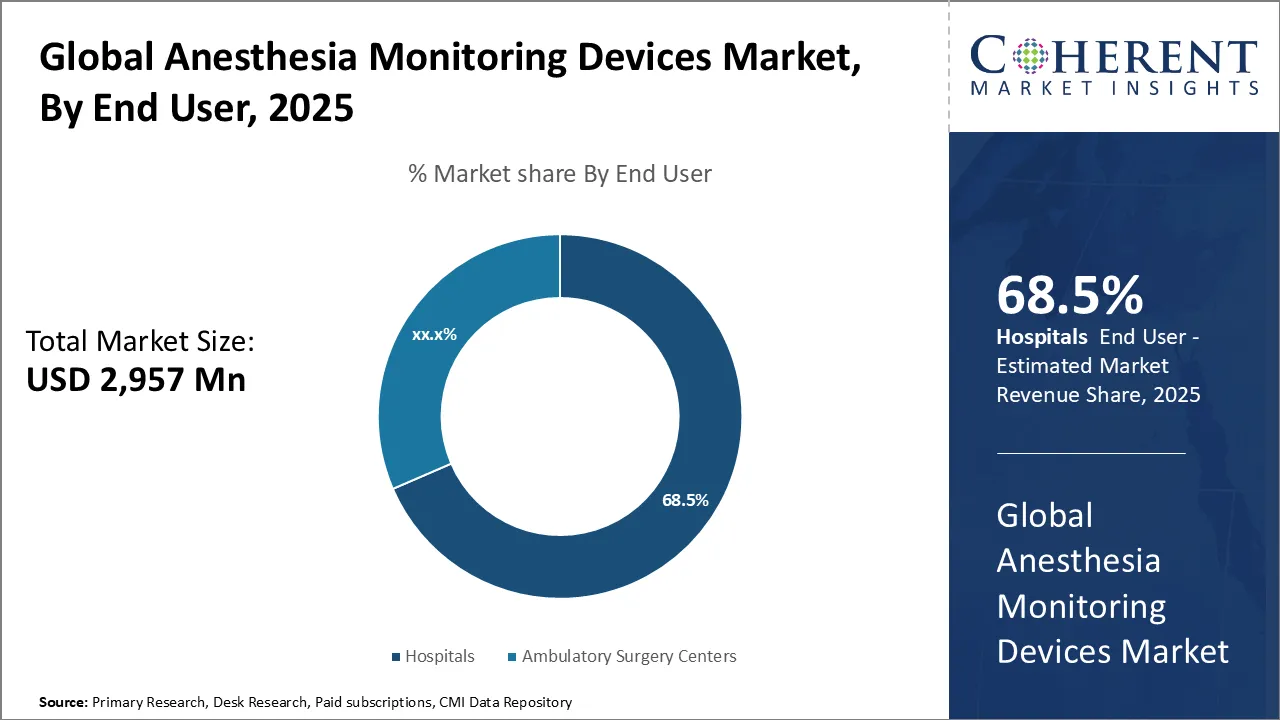
Anesthesia Monitoring Devices Market Insights, by End User: Hospitals contribute the highest share of the market owing to its rising demand from aging & chronic disease burden.
Hospitals drive the demand for anesthesia monitoring devices by performing a large number of surgeries and managing complex medical cases within advanced healthcare settings. They prioritize investments in modern monitoring equipment to enhance patient safety and meet strict regulatory standards. Medical teams rely on these systems in well-equipped operating rooms to ensure precision during procedures. As central providers of emergency and specialized care, hospitals consistently use anesthesia monitoring devices to support better surgical outcomes and uphold high levels of clinical care. For instance, in December 2024, The Hal family in San Diego, USA, donated a state-of-the-art anesthesia machine and its operating equipment, valued at Shs 200 million, to Mbarara Regional Referral Hospital and Mbarara University of Science and Technology (MUST).
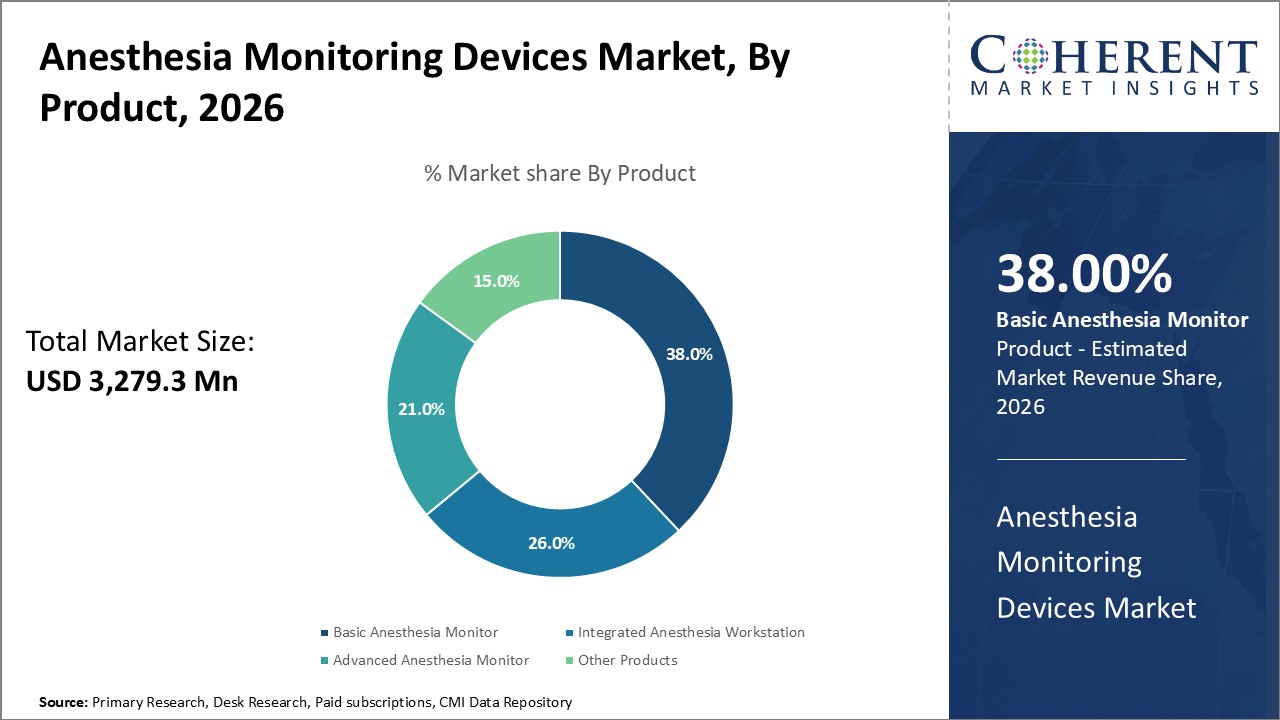
Anesthesia Monitoring Devices Market Insights, by Product: Basic Anesthesia Monitor contribute the highest share of the market as it is favored for routine and secondary monitoring.
Healthcare providers are increasingly choosing basic anesthesia monitors for their cost-effectiveness, simplicity, and vital role in everyday surgical procedures. These monitors track essential vital signs, making them highly useful in smaller clinics and resource-constrained environments. Larger hospitals also rely on them as dependable backup systems during standard operations. Efforts to expand surgical services in developing regions further drive the adoption of these devices, as governments and organizations prioritize basic monitoring tools to strengthen essential medical infrastructure and improve patient care access.
Draeger released the Perseus A500 anesthesia workstation, marking one of their largest development projects ever. This innovative device delivers unprecedented configurability, high-performance ventilation, enhanced ergonomics, and automation to streamline the operating room workflow.
Regional Insights
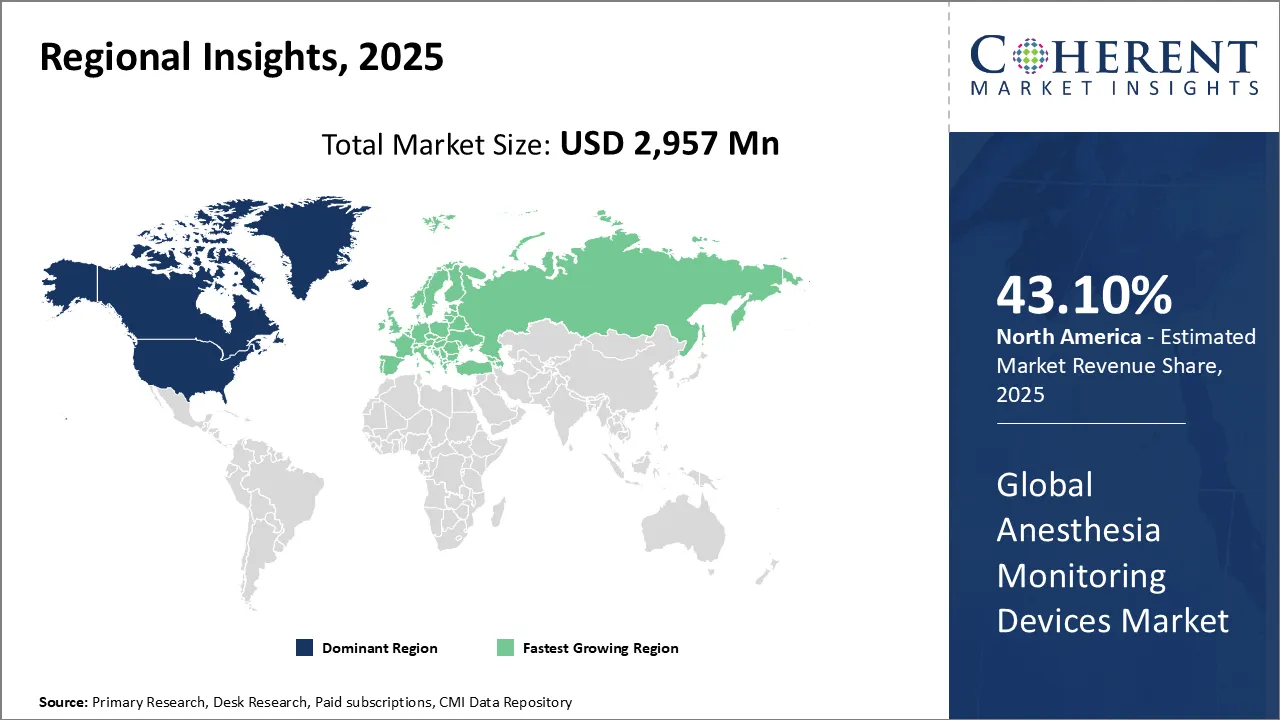
North America Anesthesia Monitoring Devices Market Trends
North America dominates the overall market with an estimated share of 43.1% in 2026. Advanced healthcare infrastructure, rapid adoption of innovative technologies, and a high volume of surgical procedures are driving growth in North America’s anesthesia monitoring devices market. Hospitals and surgical centers actively implement smart monitoring systems to improve patient safety and optimize workflows. Regulatory support and the presence of major medical device manufacturers further fuel market expansion. Additionally, the growing preference for outpatient surgeries increases the need for compact and efficient monitoring solutions across different healthcare settings.
Europe Anesthesia Monitoring Devices Market Trends
Technological advancements and strict patient safety regulations are shaping the evolution of Europe’s anesthesia monitoring devices market. Healthcare providers actively adopt integrated monitoring solutions to enhance surgical accuracy and outcomes. Well-established healthcare infrastructure and increasing demand for minimally invasive surgeries support this growth. Governments promote healthcare modernization and invest in medical technology, accelerating market expansion. Additionally, rising awareness of perioperative care and the growth of outpatient services increase the demand for reliable, advanced anesthesia monitoring devices throughout Europe.
In May 2026, Philips introduced the VeriSight Pro 3D Intracardiac Echocardiography (ICE) catheter in Europe. This advanced catheter gives physicians real-time 3D imaging from inside the heart, enhancing clarity during complex procedures and often removing the need for general anesthesia.
Sweden Anesthesia Monitoring Devices Market Trends
Sweden’s anesthesia monitoring devices market continues to grow steadily as hospitals increase the use of advanced surgical procedures and prioritize patient safety. Companies are driving innovation through AI integration, wireless technology, and precision monitoring tools. Swedish firm Senzime is leading this transformation with its next-generation TetraGraph systems. Healthcare providers are also adopting more multiparameter and portable monitoring systems to improve efficiency in operating rooms. These developments show Sweden’s active efforts to modernize its healthcare system with cutting-edge technology. For instance, in October 2024, in Sweden, Senzime unveiled its next-generation TetraGraph® system at ANESTHESIOLOGY, developed with global anesthesiologists to redefine TOF monitoring through advanced algorithms and precision technology.
India Anesthesia Monitoring Devices Market Trends
Improving healthcare infrastructure and a rise in surgical procedures are driving growth in India’s anesthesia monitoring devices market. Hospitals and diagnostic centers are increasingly adopting advanced monitoring technologies to improve patient safety and surgical accuracy. Government initiatives aimed at expanding healthcare access and upgrading medical facilities actively support market expansion. Additionally, growing awareness of anesthesia risks and the growth of private healthcare providers boost demand. Both urban hospitals and rural healthcare settings actively seek cost-effective, reliable monitoring solutions across India. For instance, in April 2026, Drager, a global leader in medical and safety technology, has launched the Atlan® A100 anesthesia workstation in India. This innovative system is designed to enhance patient care and streamline workflows in the operating room (OR).
Market Report Scope
Anesthesia Monitoring Devices Market Report Coverage
| Report Coverage | Details | ||
|---|---|---|---|
| Base Year: | 2025 | Market Size in 2026: | USD 3,279.3 Mn |
| Historical Data for: | 2020 To 2024 | Forecast Period: | 2026 To 2033 |
| Forecast Period 2026 to 2033 CAGR: | 10.9% | 2033 Value Projection: | USD 6,765.6 Mn |
| Geographies covered: |
| ||
| Segments covered: |
| ||
| Companies covered: | Koninklijke Philips NV, Dragerwerk AG & Co. KgaA, Schiller AG, Infinium Medical, Masimo Corporation, Nihon Kohden Corporation, GE Healthcare, Medtronic PLC, and Mindray Medical International Limited, among others | ||
| Growth Drivers: |
| ||
| Restraints & Challenges: |
| ||
Anesthesia Monitoring Devices Market Trend
Growth of Ambulatory Surgical Centers (ASCs)
The expansion of outpatient and ambulatory surgical centers is reshaping the anesthesia monitoring market. ASCs require compact, portable, and user-friendly devices to accommodate faster patient turnover and limited space. This shift encourages manufacturers to design lightweight monitors with wireless capabilities and intuitive interfaces, optimizing efficiency in diverse clinical environments. Increasing preference for minimally invasive and day surgeries fuels this trend, driving demand for reliable anesthesia monitoring in non-traditional settings.
Anesthesia Monitoring Devices Market Opportunity
Expansion in Emerging Economies
Emerging markets present significant growth opportunities as improving healthcare infrastructure and increased surgical demand drive the need for anesthesia monitoring devices. Many regions are focusing on upgrading medical facilities and enhancing patient safety protocols. Affordable, reliable, and easy-to-use anesthesia monitors tailored to these markets can capture a large customer base. Collaborations with local healthcare providers and governments can further facilitate product adoption and long-term growth in these underserved regions.
Anesthesia Monitoring Devices News
- In June 2025, GE HealthCare Korea launched the Carestation 600 series V2, a compact gas anesthesia machine designed for small operating rooms. It automatically calculates predicted body weight from the patient’s height for personalized anesthesia delivery.
- In August 2025, A new startup, BIOPAC Medical Systems LP, launched through a licensing agreement and collaboration between Johns Hopkins APL, Johns Hopkins School of Medicine, BLOCKsynop, Inc., and BIOPAC Systems, Inc. The company will seek regulatory approval and commercialize a device that offers real-time, objective monitoring of regional anesthetic effectiveness.
Analyst Opinion (Expert Opinion)
- The anesthesia monitoring devices market is at a pivotal juncture where innovation must outpace mere incremental improvements. The increasing complexity of surgical procedures demands next-generation monitors that go beyond basic vital sign tracking to offer predictive analytics and integrated decision support. For instance, Philips’ IntelliVue series, which integrates real-time data analytics, exemplifies the future by enabling anesthesiologists to anticipate complications before they arise, reducing perioperative risks significantly.
- Moreover, the market’s evolution is being shaped heavily by the growing emphasis on minimally invasive and outpatient surgeries. This shift necessitates devices that are not only highly accurate but also portable and interoperable with hospital IT systems. GE Healthcare’s Avance CS2 anesthesia machine with its compact monitor and enhanced connectivity capabilities is a prime example meeting these evolving demands, particularly in ambulatory surgical centers.
- However, despite advances, a notable gap persists in addressing affordability and usability, especially in emerging markets where surgical volumes are rising rapidly. The challenge lies in balancing cutting-edge features with cost-effective solutions that smaller hospitals and clinics can deploy without extensive training. Companies like Mindray are making strides here, but widespread impact remains limited until scalability improves.
Speak to the analyst
Want personalized insights?
Take the findings above to one of our principal consultants, or have the report rebuilt around the segments, geographies and competitors you actually track.
Market Segmentation
- Global Anesthesia Monitoring Devices Market, By Product (Revenue, USD Mn, 2021 - 2033)
- Basic Anesthesia Monitor
- Integrated Anesthesia Workstation
- Advanced Anesthesia Monitor
- Other Products
- Global Anesthesia Monitoring Devices Market, By End User (Revenue, USD Mn, 2021 - 2033)
- Hospitals
- Ambulatory Surgery Centers
- Global Anesthesia Monitoring Devices Market, By Geography (Revenue, USD Mn, 2021 - 2033)
- North America
- U.S.
- Canada
- Latin America
- Brazil
- Argentina
- Mexico
- Rest of Latin America
- Europe
- Germany
- U.K.
- Spain
- France
- Italy
- Russia
- Rest of Europe
- Asia Pacific
- China
- India
- Japan
- Australia
- South Korea
- ASEAN
- Rest of Asia Pacific
- Middle East
- GCC Countries
- Israel
- Rest of Middle East
- Africa
- South Africa
- North Africa
- Central Africa
- North America
- Key Players Insights
- Koninklijke Philips NV
- Dragerwerk AG & Co. KgaA
- Schiller AG
- Infinium Medical
- Masimo Corporation
- Nihon Kohden Corporation
- GE Healthcare
- Medtronic PLC
- Mindray Medical International Limited
Sources
Primary Research interviews
- Discussions with anesthesiologists, surgical staff, and biomedical engineers across public and private hospitals
- Interviews with procurement managers in multi-specialty hospitals and surgical centers
- Insights from anesthesia device manufacturers and distributors
- Consultations with regulatory professionals and healthcare administrators
Databases
- World Health Organization (WHO) Medical Device Data
- U.S. Food and Drug Administration (FDA) Medical Devices Database
- European Medicines Agency (EMA) medical technology reports
- PubMed and Medline search datasets
- Global Health Observatory (GHO) data repository
Magazines
- Anesthesiology News
- Medical Device & Diagnostic Industry (MD+DI)
- HealthTech Magazine
- MedTech Innovation News
Journals
- British Journal of Anaesthesia
- Journal of Clinical Monitoring and Computing
- Anesthesia & Analgesia
- Journal of Clinical Anesthesia
- The Lancet Digital Health
Newspapers
- The New York Times – Health Section
- The Guardian – Global Health Coverage
- The Wall Street Journal – Medical Technology News
- Financial Times – Healthcare and Equipment
Associations
- American Society of Anesthesiologists (ASA)
- European Society of Anaesthesiology and Intensive Care (ESAIC)
- International Federation of Nurse Anesthetists (IFNA)
- World Federation of Societies of Anaesthesiologists (WFSA)
- Association for the Advancement of Medical Instrumentation (AAMI)
Public Domain sources
- World Bank Healthcare Spending and Infrastructure Reports
- National Institutes of Health (NIH) Clinical Trials Database
- Centers for Medicare & Medicaid Services (CMS)
- OECD Health Data and Indicators
- Government health ministry publications and tenders
Proprietary Elements
- CMI Data Analytics Tool, and Proprietary CMI Existing Repository of information for last 8 years
Get access to 250+ pages report
Every segment, forecast, competitor profile and data table behind the analysis above — available for instant download.
- ESOMAR Member
- ISO 9001:2015 Certified
- D-U-N-S Registered
- GDPR & CCPA Compliant
Missing comfort of reading report in your local language? Find your preferred language:
Transform your Strategy with Exclusive Trending Reports
Frequently Asked Questions
The Anesthesia Monitoring Devices Market is estimated to be valued at USD 3,279.3 Mn in 2026, and is expected to reach USD 6,765.6 Mn by 2033.
The CAGR of the Anesthesia Monitoring Devices Market is projected to be 10.9% from 2026 to 2033.
Increase in number of surgical procedures and increase in prevalence of chronic diseases across the world is fueling the growth of the market.
Basis Anesthesia Monitor segment is the leading product segment in the market
High cost of anesthesia monitoring devices and availability of conventional techniques are major factors restraining growth of the market.
Major players operating in the market are Koninklijke Philips NV, Dragerwerk AG & Co. KgaA, Schiller AG, Infinium Medical, Masimo Corporation, Nihon Kohden Corporation, GE Healthcare, Medtronic PLC, and Mindray Medical International Limited, among others.