

Non Invasive Hemodynamic Monitoring System Market Size and Forecast — 2026 - 2033
The Global Non Invasive Hemodynamic Monitoring System Market size is estimated to be valued at USD 1.85 billion in 2026 and is expected to reach USD 3.7 billion by 2033, exhibiting a compound annual growth rate (CAGR) of 10.5% from 2026 to 2033.
Overview
Non-invasive hemodynamic monitoring systems are advanced medical devices used to assess cardiovascular performance without the need for invasive catheters. These systems measure parameters such as cardiac output, blood pressure, stroke volume, and vascular resistance using technologies like bioimpedance, bioreactance, Doppler ultrasound, and pulse wave analysis. Key product types include wearable monitoring devices, bedside monitoring systems, and portable or handheld units designed for use in intensive care units, emergency departments, and perioperative settings. They are widely adopted due to improved patient safety, reduced infection risk, and real-time data accuracy. Growing demand for minimally invasive diagnostics is driving continuous innovation in this market.
Key Takeaways
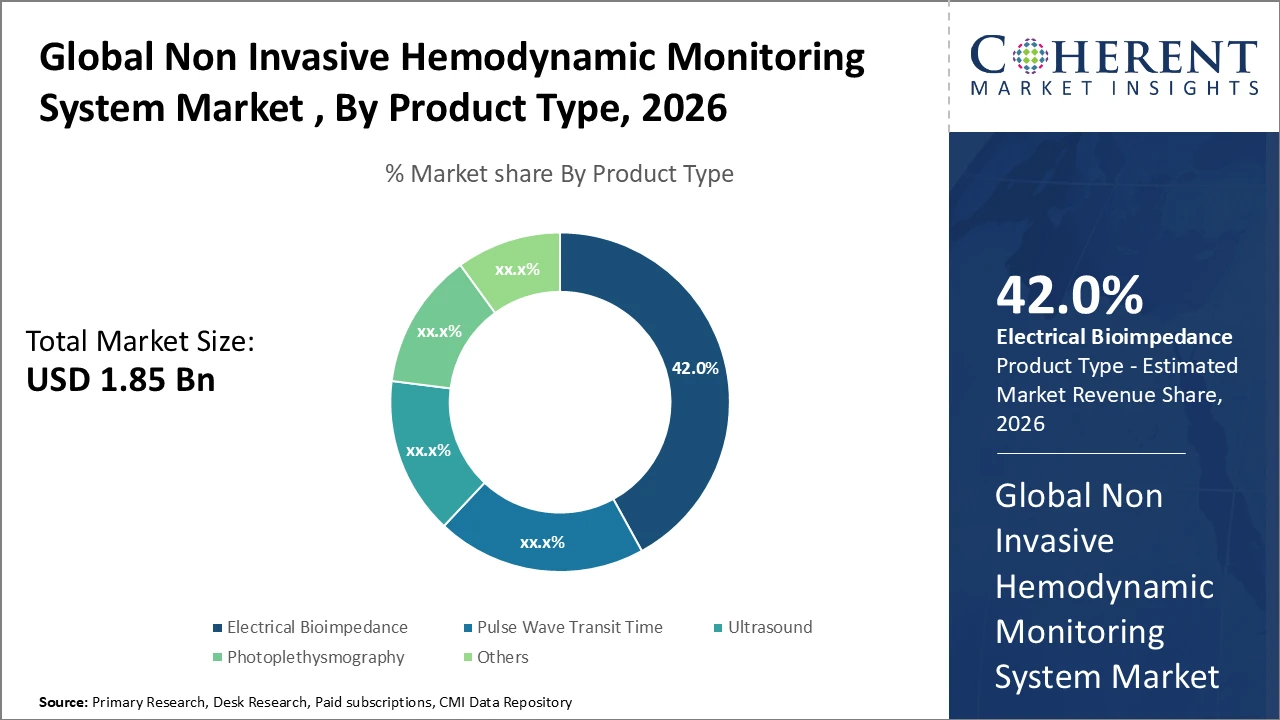
Electrical Bioimpedance devices dominate the product segment with a commanding 42% market share, driven by enhanced accuracy, non-invasive measurement capability, and cost-effectiveness in clinical settings.
The critical care application segment holds the largest industry share, supported by rising ICU admissions, increasing adoption of real-time patient monitoring, and continued digital health infrastructure investments.
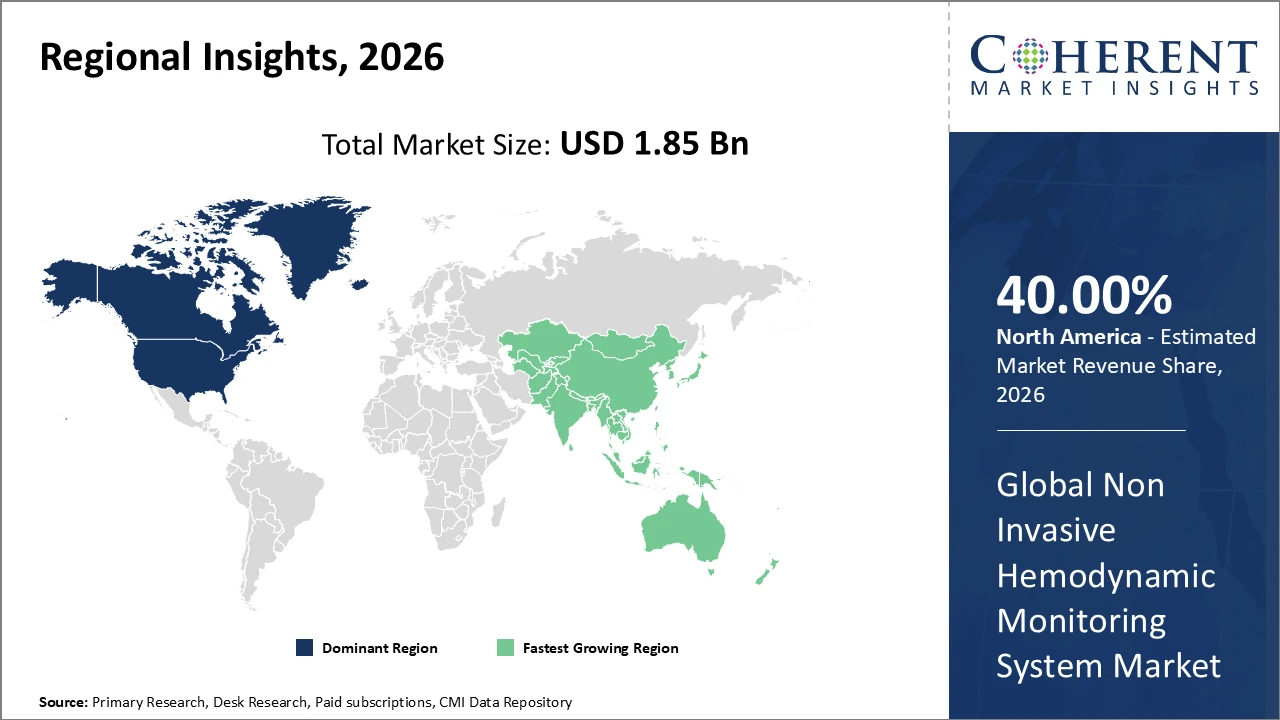
North America remains the leading regional market, contributing over 40% of the total share due to advanced healthcare infrastructure, strong R&D funding, and high adoption of innovative monitoring technologies.
Asia Pacific is the fastest-growing region, recording a double-digit CAGR driven by improving healthcare access, expanding hospital capacity, and a rising burden of cardiovascular and chronic diseases.
Non Invasive Hemodynamic Monitoring System Market Segmentation Analysis
Non Invasive Hemodynamic Monitoring System Market Insights, By Product Type
Electrical Bioimpedance dominates the market with approximately 42% share, driven by its high accuracy, non-invasive nature, and cost-effectiveness across critical care and outpatient settings. Continuous improvements in sensor technology have strengthened its ability to provide real-time cardiovascular monitoring, further supporting adoption. Pulse Wave Transit Time is the fastest-growing subsegment due to its compatibility with wearable devices and integration with mobile health platforms, making it increasingly popular in home care and ambulatory settings. Ultrasound-based systems offer high precision but experience moderate growth due to higher costs. Photoplethysmography is expanding in remote monitoring, while other emerging technologies like near-infrared spectroscopy remain niche but promising.
Non Invasive Hemodynamic Monitoring System Market Insights, By Application
Critical Care dominates the application segment, driven by rising ICU admissions and the increasing complexity of surgical procedures that require continuous hemodynamic monitoring. In 2025, hospital procurement data showed a 14% increase in critical care device adoption, reflecting the need for real-time, high-precision cardiovascular data in life-saving interventions. Operating Rooms form a mature segment, supported by advancements in surgical techniques and the need for intraoperative patient monitoring, contributing stable revenues with moderate growth. Ambulatory Surgery is the fastest-growing subsegment due to the rise in minimally invasive and outpatient procedures, recording a 10% revenue uplift in 2024. Home Care is expanding rapidly with telemedicine adoption and aging populations, while other segments include EMS and specialty clinics.
Non Invasive Hemodynamic Monitoring System Market Insights, By End User
Hospitals remain the dominant end-user segment in the non-invasive hemodynamic monitoring system market, accounting for the largest share due to established infrastructure, high patient inflow, and continuous requirements in critical care and surgical settings. Ambulatory Surgical Centers are rapidly increasing adoption, driven by cost efficiency goals, rising outpatient procedure volumes, and advancements in portable monitoring technologies supported by favorable reimbursement frameworks. Home Healthcare is the fastest-growing segment, fueled by the rising burden of chronic diseases, expanding telehealth ecosystems, and increasing preference for remote patient monitoring through wearable devices. Specialty Clinics and other facilities, including diagnostic centers, contribute niche demand for condition-specific cardiovascular monitoring solutions.
Non Invasive Hemodynamic Monitoring System Market Trends
The Non-Invasive Hemodynamic Monitoring System market is witnessing strong adoption of AI-enabled monitoring solutions, improving real-time data accuracy, predictive analytics, and overall patient outcomes in critical care settings.
For example, Philips Healthcare’s AI-integrated monitoring platforms deployed in European ICUs in 2026 reportedly improved hemodynamic event prediction accuracy by 15%, demonstrating the growing clinical value of intelligent monitoring systems.
The increasing demand for portable monitoring devices designed for chronic disease management is a key trend, supported by the expansion of telemedicine and healthcare decentralization, particularly across North America.
Integration with electronic health records (EHR) is enhancing workflow efficiency by enabling seamless data sharing, reducing manual errors, and improving clinical decision-making across healthcare systems.
Non Invasive Hemodynamic Monitoring System Market Insights, By Geography
North America Non Invasive Hemodynamic Monitoring System Market Analysis and Trends
North America dominates the Non-Invasive Hemodynamic Monitoring System market due to its advanced healthcare infrastructure, high adoption of digital health technologies, and strong focus on innovation-driven patient care. Government initiatives and reimbursement support for advanced monitoring solutions further accelerate market penetration across hospitals and critical care settings. The United States contributes the largest share of over 40% within the region, driven by substantial investments in cardiovascular care infrastructure and a high prevalence of chronic diseases requiring continuous monitoring. Additionally, the strong presence of key market players and ongoing R&D activities enhances product availability and supports sustained market growth across healthcare facilities.
Asia Pacific Non Invasive Hemodynamic Monitoring System Market Analysis and Trends
Meanwhile, the Asia Pacific region is emerging as the fastest-growing market for non-invasive hemodynamic monitoring systems, registering a CAGR exceeding 12%. This growth is driven by rapid expansion of healthcare infrastructure in countries such as China, India, and Southeast Asia, along with rising investments in critical care facilities. The increasing prevalence of cardiovascular diseases and aging populations is further accelerating demand for continuous monitoring solutions. Additionally, improving reimbursement policies and government initiatives supporting adoption of advanced medical technologies are enhancing market accessibility. Growing awareness of patient safety and the shift toward digital healthcare are further strengthening regional market expansion and adoption rates.
Non Invasive Hemodynamic Monitoring System Market Outlook for Key Countries
USA Non Invasive Hemodynamic Monitoring System Market Analysis and Trends
The U.S. market plays a pivotal role in driving revenue growth in the non-invasive hemodynamic monitoring system industry, supported by rising adoption in critical care units and expanding use in ambulatory care settings. Federal healthcare modernization initiatives and digital transformation programs have further strengthened device penetration across hospital networks. Leading companies such as Edwards Lifesciences and Masimo have significantly increased R&D investments in advanced bioimpedance and pulse wave transit time technologies, collectively capturing over 35% of the national market share in 2025. A strong regulatory framework and widespread integration of these systems into large healthcare institutions continue to support sustained market expansion.
Germany Non Invasive Hemodynamic Monitoring System Market Analysis and Trends
The Germany non-invasive hemodynamic monitoring system market is witnessing steady growth driven by a high burden of cardiovascular diseases, rising ICU admissions, and strong adoption of advanced patient monitoring technologies. The country’s well-developed healthcare infrastructure and emphasis on minimally invasive and non-invasive diagnostic solutions are accelerating market penetration. Hospitals and critical care units increasingly deploy bioimpedance and pulse wave-based systems for real-time cardiovascular assessment. Integration of digital health platforms and AI-enabled monitoring tools is further enhancing clinical decision-making efficiency. Additionally, Germany’s aging population and increasing surgical volumes are boosting demand for continuous monitoring, positioning the market for sustained long-term growth.
Analyst Opinion
The rising adoption of continuous hemodynamic monitoring systems, driven by their ability to deliver real-time cardiovascular data, is significantly contributing to market expansion. In 2025, hospitals in North America increased procurement activities by 12%, aligning with broader healthcare digitalization initiatives.
Demand-side dynamics show a clear shift from invasive to non-invasive systems due to lower infection risks, improved patient comfort, and ease of use. In 2024, ambulatory surgical centers recorded a 15% increase in adoption, reflecting strong preference from outpatient care providers.
On the supply side, improved interoperability with electronic health record (EHR) systems has accelerated deployment in critical care environments. A 2026 hospital survey indicates a 20% rise in integrated monitoring setups, highlighting rapid adoption of smart healthcare technologies.
Microindicator analysis reveals growing expansion into home care settings, with revenue from home-use systems increasing by nearly 18% in 2025, driven by chronic disease management and telehealth growth.
- Current Industry Events of 2026
- Market Size Estimation
- Regional Breakdown
- Competitive Landscape
- Customer Intelligence
- Segmental Analysis
- Pricing Analysis
- Key Market Drivers, Challenges & Future Trends
- Customized Insights Section
Market Scope
| Report Coverage | Details | ||
|---|---|---|---|
| Base Year: | 2025 | Market Size in 2026: | USD 1.85 billion |
| Historical Data for: | 2020 To 2024 | Forecast Period: | 2026 To 2033 |
| Forecast Period 2026 to 2033 CAGR: | 10.5% | 2033 Value Projection: | USD 3.7 billion |
| Geographies covered: |
| ||
| Segments covered: |
| ||
| Companies covered: | Masimo Corporation, Philips Healthcare, GE Healthcare, Medtronic PLC, Stryker Corporation, Nihon Kohden Corporation, Nonin Medical, Inc., Ornim Medical LTD | ||
| Growth Drivers: |
| ||
Non Invasive Hemodynamic Monitoring System Market Growth Factors
Technological innovation remains a key growth driver in the non-invasive hemodynamic monitoring system market, with advancements in sensor accuracy and wireless data transmission contributing to a 14% surge in market revenue in 2025. The rising global prevalence of cardiovascular diseases has further increased demand, with patient admissions in critical care settings growing by 11% in 2026. Strong regulatory support for non-invasive technologies across North America and Europe has accelerated market entry and widespread adoption. Additionally, the shift toward value-based care models is encouraging the use of continuous monitoring systems to reduce hospital stays, supporting a 9% rise in ambulatory usage in 2024.
Non Invasive Hemodynamic Monitoring System Market Development
In April 2026, BD (Becton, Dickinson and Company) announced the launch of the HemoSphere Stream Module, a new technology that provides continuous, noninvasive blood pressure monitoring. It delivers real-time, beat-to-beat arterial waveform data from a finger cuff to compatible patient monitors, helping clinicians bridge gaps between intermittent measurements.
Key Players
Leading Companies of the Market
Masimo Corporation
Philips Healthcare
GE Healthcare
Nihon Kohden Corporation
Nonin Medical Inc.
Medtronic PLC
Ornim Medical LTD
Stryker Corporation
Competitive strategies in the non-invasive hemodynamic monitoring system market are increasingly centered on innovation, partnerships, and portfolio expansion. Edwards Lifesciences has significantly invested in research and strategic collaborations, resulting in an 8% increase in market share in 2025 driven by advancements in sensor accuracy and monitoring precision. Philips Healthcare strengthened its position through strategic partnerships focused on integrating AI-based analytics into its monitoring platforms, which led to a 12% rise in product adoption across Europe in 2026. Meanwhile, GE Healthcare has expanded its product portfolio by introducing modular upgrade solutions, enhancing accessibility and contributing to a 10% increase in its presence across emerging markets in 2024.
Non Invasive Hemodynamic Monitoring System Market Future Outlook
The future outlook of the non-invasive hemodynamic monitoring system market is highly promising, driven by increasing demand for continuous patient monitoring, rising cardiovascular disease prevalence, and rapid digitalization of healthcare systems. Advancements in wearable technologies, AI-powered analytics, and wireless connectivity are expected to further enhance diagnostic accuracy and clinical decision-making. Growing preference for minimally invasive and home-based care solutions will expand market adoption beyond traditional hospital settings. Additionally, integration with electronic health records and telemedicine platforms will streamline workflow efficiency. Strong regulatory support and expanding healthcare infrastructure in emerging economies are anticipated to sustain robust market growth over the forecast period.
Non Invasive Hemodynamic Monitoring System Market Historical Analysis
The historical analysis of the non-invasive hemodynamic monitoring system market shows steady evolution driven by advancements in medical technology and increasing demand for safer patient monitoring solutions. Initially, invasive techniques dominated cardiovascular assessment, but growing awareness of infection risks and patient discomfort led to gradual adoption of non-invasive alternatives. From the early 2010s, improvements in bioimpedance, Doppler ultrasound, and pulse wave technologies significantly enhanced measurement accuracy and reliability. Hospital digitalization and ICU modernization further accelerated adoption. By the late 2010s and early 2020s, rising chronic disease prevalence and expanding critical care infrastructure globally established a strong foundation for sustained market growth.
Sources
Primary Research Interviews:
Cardiologists, intensivists, anesthesiologists, and critical care specialists involved in the use and evaluation of non-invasive hemodynamic monitoring systems in hospitals and ICUs
Hospital procurement managers, biomedical engineering heads, and clinical informatics teams responsible for selecting and integrating patient monitoring technologies
Medical device company executives, R&D engineers, and product development teams working on bioimpedance, pulse wave analysis, Doppler ultrasound, and wearable hemodynamic monitoring systems
Magazines:
Medical Device Network – Updates on patient monitoring technologies and critical care innovations
Fierce Biotech – Industry news on medical devices, wearable monitoring systems, and digital health solutions
MedTech Dive – Market trends, regulatory updates, and product launches in patient monitoring technologies
Journals:
Journal of Clinical Monitoring and Computing – Research on hemodynamic monitoring accuracy, algorithms, and clinical applications
Critical Care Medicine – Studies on ICU monitoring, cardiovascular assessment, and patient outcomes
IEEE Journal of Biomedical and Health Informatics – Innovation in wearable sensors, signal processing, and AI-based monitoring systems
Newspapers:
The Wall Street Journal – Healthcare technology investments and medical device industry trends
Financial Times – Global healthcare innovation and digital transformation in patient monitoring
Reuters Health – Regulatory approvals, clinical adoption, and healthcare technology updates
Bloomberg Healthcare – Market analysis, company performance, and healthcare monitoring trends
Associations:
Society of Critical Care Medicine (SCCM) – Guidelines and research on ICU monitoring and critical care practices
American Heart Association (AHA) – Cardiovascular monitoring standards and clinical recommendations
European Society of Cardiology (ESC) – Clinical guidelines for cardiac monitoring and hemodynamic assessment
Get access to 250+ pages report
Every segment, forecast, competitor profile and data table behind the analysis above — available for instant download.
- ESOMAR Member
- ISO 9001:2015 Certified
- D-U-N-S Registered
- GDPR & CCPA Compliant
Missing comfort of reading report in your local language? Find your preferred language:
Transform your Strategy with Exclusive Trending Reports
Frequently Asked Questions
The market is led by major companies such as GE Healthcare, Masimo Corporation, and Philips Healthcare, which collectively hold significant market share through continuous innovation and strategic expansion.
The market is expected to nearly double from USD 1.85 billion in 2026 to USD 3.7 billion by 2033, reflecting strong growth driven by technological advancements and increasing clinical demand.
Hospitals represent the largest growth opportunity due to ongoing hospital digital transformation and increasing patient acuity requiring advanced, real-time monitoring solutions.
Market trends are expected to evolve with increased integration of AI-powered analytics, wider adoption of wearable monitoring devices for home care, and improved interoperability with hospital information systems to enhance patient care delivery.
The competitive landscape is highly innovation-driven, with companies focusing on technological advancements and partnerships. However, challenges include high initial investment costs and complex regulatory approval processes, especially in emerging markets.
Leading players adopt strategies such as strategic collaborations, expansion of product portfolios, and differentiation through advanced technologies to strengthen market presence and expand across regions.