

Cardiac Surgery Instrument Market Analysis & Forecast: 2026-2033
Cardiac Surgery Instrument Market is estimated to be valued at USD 1.92 Bn in 2026 and is expected to reach USD 2.54 Bn in 2033, exhibiting a compound annual growth rate (CAGR) of 4.1% from 2026 to 2033.
Key Takeaways
- Based on Product Type, the Catheters & Guidewires segment is projected to account for the largest share of the market in 2026, driven by the rising demand for minimally invasive cardiac procedures.
- Based on Application, the Coronary Artery Bypass Grafting (CABG) segment is expected to capture 44% share in 2026, driven by high coronary artery disease prevalence and advanced surgical techniques.
- Based on End User, the Hospital segment is projected to hold the highest share of the market in 2026, due to advanced facilities, specialized staff, and high procedure volumes.
- Based on Region, North America is expected to lead the global cardiac surgery instrument market in 2026 with a 35% share. While, Asia Pacific, with an estimated share of 29.5% in 2026, is expected to be the fastest growing region.
Market Overview
The Cardiac Surgery Instrument Market demand is witnessing steady growth, driven by the rising prevalence of cardiovascular diseases, increasing geriatric population, and advancements in minimally invasive cardiac procedures. Surgeons are adopting innovative instruments for enhanced precision, safety, and efficiency. Growing hospital infrastructure and rising awareness about cardiac health are further fueling Cardiac Surgery Instrument Market demand globally.
Current Events and their Impact on the Cardiac Surgery Instrument Market
Current Event | Description and its Impact |
Regulatory Evolution and Compliance Challenges |
|
Demographic and Disease Burden Transformation |
|
End-User Feedback & Unmet Needs in the Cardiac Surgery Instrument Market:
- Ergonomic and Lightweight Instruments: Surgeons demand tools that reduce hand fatigue and improve precision during lengthy cardiac procedures.
- Reusable Instruments: Preference for durable instruments that can withstand repeated sterilization without losing performance or quality.
- Compatibility with Advanced Imaging Systems: Instruments need to integrate seamlessly with imaging technologies for minimally invasive surgeries.
- Robotic-Assisted Surgery Integration: Tools compatible with robotic platforms enhance precision, reduce operation times, and improve patient outcomes.
- Enhanced Adoption & Market Potential: Meeting these end-user needs is critical for manufacturers to increase usage and market share.
- Current Industry Events of 2026
- Market Size Estimation
- Regional Breakdown
- Competitive Landscape
- Customer Intelligence
- Segmental Analysis
- Pricing Analysis
- Key Market Drivers, Challenges & Future Trends
- Customized Insights Section
Role of AI (Artificial Intelligence) in Cardiac Surgery Instrument
AI plays a transformative role in cardiac surgery instruments by enhancing precision, safety, and efficiency. Intelligent systems assist surgeons through real-time data analysis, improved imaging, and robotic guidance, enabling minimally invasive procedures with greater accuracy. AI-driven tools can predict complications, optimize surgical plans, and monitor patient vitals during operations. Machine learning algorithms also help in instrument calibration and adaptive control, reducing human error and procedure time.
In August 2025, Narayana Health developed an AI model that detects heart failure from standard ECG images within 10 seconds. Created by the hospital’s Clinical Research Team and Medha AI, it predicts left ventricular ejection fraction (EF) to identify early heart failure signs quickly. Designed to aid over 10 million Indians with limited access to echocardiography, the model was trained on 100,000+ ECG and echo pairs and achieved 97% accuracy in detecting severely reduced EF (≤35%) in a multi-centre study of 57,000 patients.
Segmental Insights
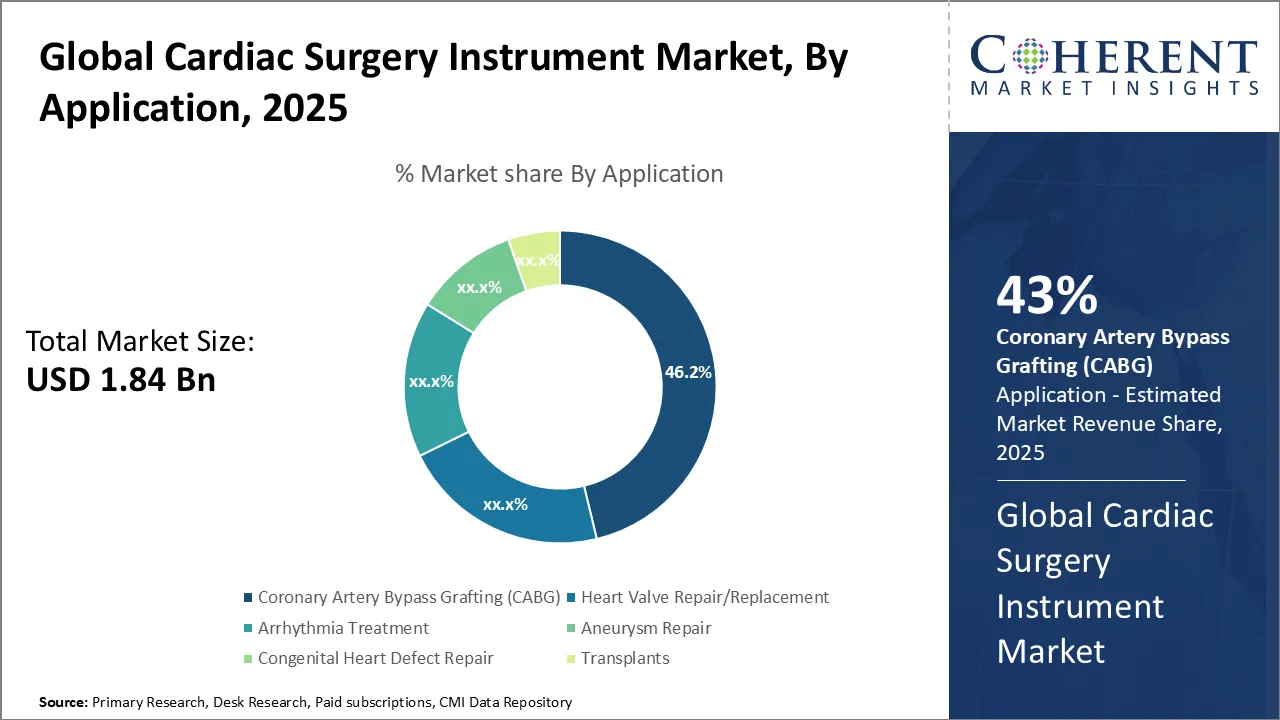
Cardiac Surgery Instrument Market Insights, By Application: Coronary Artery Bypass Grafting (CABG) is Driven by High Coronary Artery Disease Prevalence and Advanced Surgical Techniques
In terms of application, the Coronary Artery Bypass Grafting (CABG) segment is projected to account for 44% share in 2026, driven by the high prevalence of coronary artery disease and increasing surgeries globally. Rising adoption of minimally invasive and robotic-assisted techniques, coupled with advancements in surgical instruments for precision and safety, boosts Cardiac Surgery Instrument Market demand, particularly in North America and Europe.
For instance, in September 2026, Aster Medcity Hospital in Kochi performed a robotic-assisted coronary artery bypass grafting (CABG) on a 42-year-old woman with severe triple vessel disease. Opting for a minimally invasive direct coronary artery bypass (MIDCAB) procedure, the patient was discharged just four days post-surgery. The advanced robotic system enabled enhanced precision and faster recovery, with reduced scarring and complications.
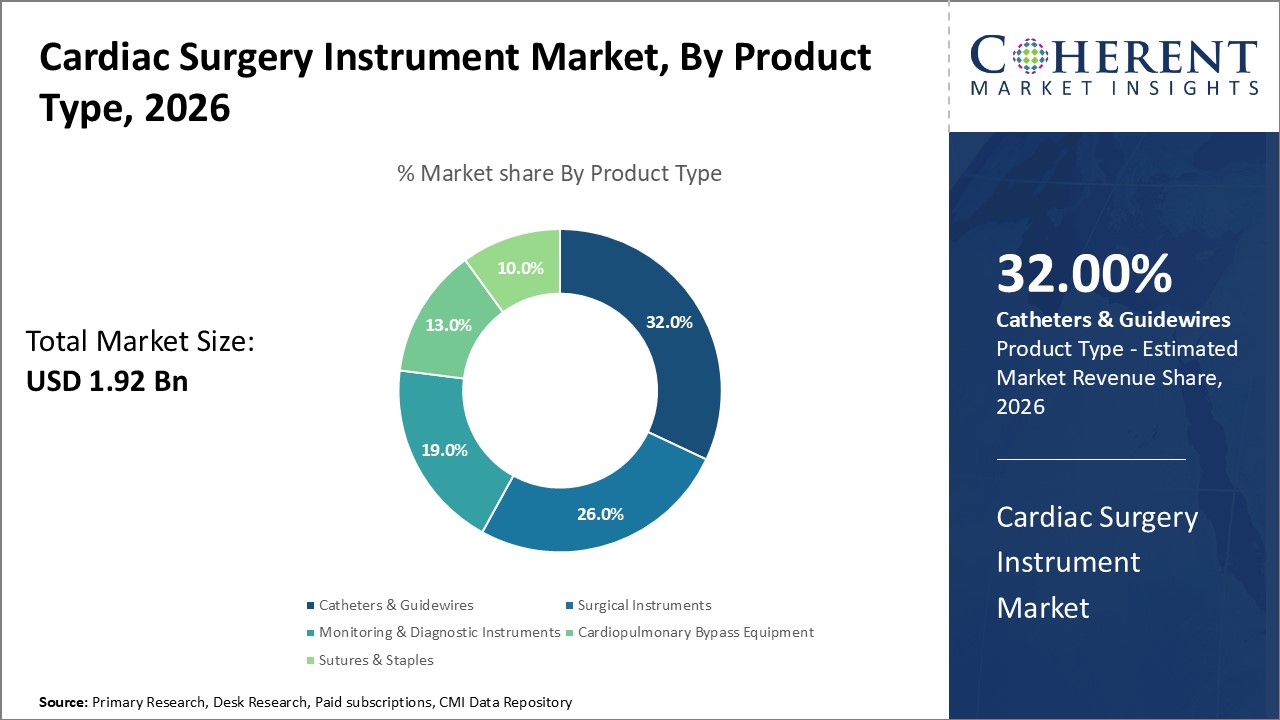
Cardiac Surgery Instrument Market Insights, By Product Type: Catheters & Guidewires is Driven by the Rising Demand for Minimally Invasive Cardiac Procedures
In terms of product type, the catheters & guidewires segment is expected to hold the largest share of the market in 2026. This dominance is driven by the increasing prevalence of cardiovascular diseases, advancements in minimally invasive procedures, and the growing demand for diagnostic and therapeutic interventions. Catheters and guidewires play a crucial role in procedures such as angioplasty, stent placement, and electrophysiological studies, contributing significantly to the market's growth. Additionally, the rise in outpatient procedures and the shift towards less invasive treatments further bolster the demand for these instruments.
For instance, in October 2024, Boston Scientific introduced Journey™ Guidewire, a 0.014" guidewire designed for challenging, small-vessel peripheral angioplasty procedures. The device enhances precision and tracking, addressing physician needs in treating arteries below the knee. Dr. James Benenati, Medical Director at Baptist Cardiac and Vascular Institute, praised its exceptional torque and flexibility in complex cases.
Cardiac Surgery Instrument Market Insights, By End User: Hospital is Leading Due To Advanced Facilities, Specialized Staff, And High Procedure Volumes
In terms of end user, the hospital segment is expected to capture the highest share of the market in 2026, due to factors such as the increasing prevalence of cardiovascular diseases, advancements in surgical technologies, and the growing number of cardiac procedures performed in hospital settings. Hospitals offer comprehensive facilities, specialized medical staff, and advanced equipment, making them the primary end-users of cardiac surgery instruments. While Ambulatory Surgical Centers (ASCs) and Research Institutes also contribute to the market, their share is comparatively smaller due to limited infrastructure and specialized services. Therefore, Hospitals are expected to maintain the largest market share in the cardiac surgery instrument sector in 2025.
For instance, in June 2025, Cardinal Health launched the Kendall DL™ Multi System, a single-use monitoring device that continuously tracks cardiac activity, blood oxygen levels, and body temperature through a single connection. Designed for patient use from admission to discharge, it enhances clinician workflows and reduces cross-contamination risks associated with reusable lead wires. The system also minimizes false alarms and motion artifacts in ECG tracings, improving clinical efficiency.
Regional Insights
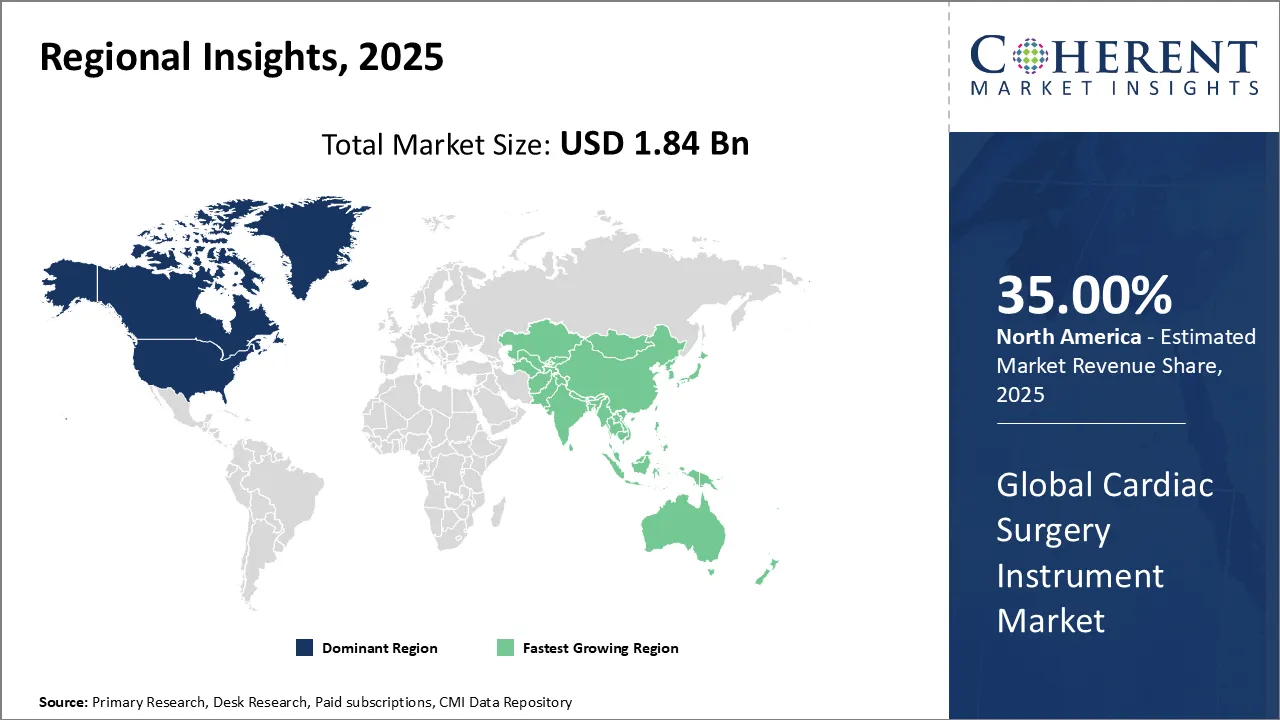
North America Cardiac Surgery Instrument Market Analysis & Trends
North America is the largest market for cardiac surgery instrument, accounting for a share of over 35.0% in 2026 North America has historically been a major market for cardiac surgery instruments due to the presence of advanced healthcare infrastructure, skilled medical professionals, and a high prevalence of cardiovascular diseases. The U.S. and Canada are key contributors to the market. Technological innovations and a focus on minimally invasive procedures have driven market growth in this region.
For instance, in May 2026, Johnson & Johnson MedTech introduced the SOUNDSTAR CRYSTAL™ Ultrasound Catheter in the U.S., enhancing 2D intracardiac imaging during cardiac ablation procedures. This advanced catheter offers superior image clarity and integrates seamlessly with the CARTO™ 3 Mapping System, including the AI-powered CARTOSOUND™ FAM module, improving workflow efficiency for electrophysiologists.
Asia Pacific Cardiac Surgery Instrument Market Analysis & Trends
Asia Pacific is the fastest-growing market for cardiac surgery instrument, accounting for a share of over 29.5% in 2026. The Asia-Pacific region has shown rapid growth in the healthcare sector, including cardiac surgery. Countries like China, India, Japan, and South Korea have witnessed an increase in healthcare spending, leading to improved healthcare facilities and greater access to advanced medical equipment. Rising cardiovascular disease rates and an aging population have also contributed to the demand for cardiac surgery instruments.
For instance, in July 2026, Johnson & Johnson MedTech launched its VARIPULSE™ Platform across the Asia-Pacific region to enhance atrial fibrillation (AFib) treatment. This platform integrates pulsed field ablation (PFA) technology with the CARTO™ 3 electroanatomical mapping system, enabling precise, real-time visualization during catheter ablation procedures. Approved in Japan, Hong Kong, China, Australia, Taiwan, and Korea, the VARIPULSE™ Platform aims to improve procedural accuracy and patient outcomes in AFib care.
Cardiac Surgery Instrument Market Outlook Country-Wise
The U.S. Cardiac Surgery Instrument Market Trends
The United States dominates the global Cardiac Surgery Instrument Market due to a high number of cardiac procedures, well-established healthcare infrastructure, and significant investments in advanced medical technologies. Strong adoption of minimally invasive surgeries, presence of leading hospitals, and continuous innovation in surgical instruments further drive market growth, ensuring high demand for precise and reliable cardiac surgery tools.
For instance, in August 2026, Cleveland Clinic performed the world's first robotic-assisted aortic valve replacement using Corcym's Perceval Plus sutureless valve. The minimally invasive procedure, known as AVATAR (Advanced Videoscopic Aortic valve surgery by Transcervical Approach using Robot assistance), was conducted through a small incision in the patient's neck. This innovative approach, combining Corcym's valve with CardioPrecision's CoreVista Robot Enabling Platform, aims to reduce patient recovery time and hospital stay.
Japan Cardiac Surgery Instrument Market Trends
Japan’s demand for cardiac surgery instruments is fueled by its rapidly aging population, which increases the prevalence of cardiovascular diseases requiring surgical interventions. Advanced healthcare infrastructure, high adoption of cutting-edge medical technologies, and government support for modern medical procedures further drive the market. Hospitals and specialized cardiac centers prioritize state-of-the-art instruments to improve surgical outcomes and patient care.
For instance, in September 2026, Toray Industries introduced the "Inoue Balloon™ for Aortic Valve," a balloon valvuloplasty catheter designed to treat aortic valve stenosis. This launch follows the receipt of 510(k) clearance from the U.S. Food and Drug Administration (FDA), marking a significant advancement in cardiovascular medical devices.
Market Report Scope
Cardiac Surgery Instrument Market Report Coverage
| Report Coverage | Details | ||
|---|---|---|---|
| Base Year: | 2025 | Market Size in 2026: | USD 1.92 Bn |
| Historical Data for: | 2020 To 2024 | Forecast Period: | 2026 To 2033 |
| Forecast Period 2026 to 2033 CAGR: | 4.1% | 2033 Value Projection: | USD 2.54 Bn |
| Geographies covered: |
| ||
| Segments covered: |
| ||
| Companies covered: | Medtronic, Murray Surgical, SternMed GmbH, CARDIC INSTRUMENTS, Edwards Lifesciences Corporation., Abbott, Boston Scientific Corporation, LivaNova, Inc., Terumo Corporation, Getinge, Artivion, Inc., MicroPort Scientific Corporation, B. Braun SE, and Stryker | ||
| Growth Drivers: |
| ||
| Restraints & Challenges: |
| ||
Cardiac Surgery Instrument Market Opportunities
- Technological Innovation: Ongoing advancements in medical technology provide opportunities to develop more sophisticated and efficient cardiac surgery instruments. This includes the development of robotic-assisted surgical systems, advanced imaging techniques, and tools that enable more precise and minimally invasive procedures.
- Personalized Medicine: The concept of personalized medicine, tailoring treatments to an individual's unique characteristics, offers opportunities in the cardiac surgery instrument market. Instruments and technologies that enable personalized treatment plans based on a patient's genetic makeup, medical history, and specific cardiovascular condition can lead to more effective interventions.
Analyst Opinion
The cardiac surgery instruments market value is undergoing a significant transformation, driven by technological advancements and evolving surgical practices. A notable trend is the increasing adoption of robotic-assisted surgeries, which are enhancing precision and reducing recovery times. For instance, Intuitive Surgical's da Vinci system has revolutionized minimally invasive procedures by offering enhanced dexterity and control. The introduction of the da Vinci 5 model further refines these capabilities, promising improved patient outcomes and operational efficiency.
In parallel, artificial intelligence (AI) is making inroads into cardiac surgery. A recent development in Chile showcased an AI-guided autonomous camera system that enabled a surgeon to perform a gallbladder removal surgery solo. This innovation exemplifies the potential of AI to support surgical procedures, offering real-time adjustments and enhancing procedural accuracy.
Geographically, North America continues to lead the market, accounting for a substantial share due to its advanced healthcare infrastructure and high healthcare spending. However, the Asia-Pacific region is emerging as a significant growth area, driven by increasing healthcare expenditures and improved access to advanced surgical instruments.
Speak to the analyst
Want personalized insights?
Take the findings above to one of our principal consultants, or have the report rebuilt around the segments, geographies and competitors you actually track.
Recent Developments
- In August 2025, Sarvodaya Hospital introduced robotic heart surgery as a transformative advancement in cardiac care. This minimally invasive procedure employs computer-assisted robotic systems, enabling surgeons to perform complex surgeries with enhanced precision. Benefits include reduced blood loss, lower infection risk, and faster recovery times.
- In September 2024, Medtronic launched the VitalFlow™ ECMO System, a configurable, all-in-one solution designed to bridge bedside care and intra-hospital transport. Featuring a user-friendly touchscreen interface and incorporating the Medtronic Nautilus™ oxygenator, VitalFlow aims to simplify ECMO procedures for clinicians of all experience levels.
- In August 2023, Teleflex Incorporated, a global provider of medical technologies, announced the U.S Food and Drug Administration (FDA) has cleared the QuikClot Control Hemostatic Device to include mild and moderate bleeding in cardiac surgical procedures and bone surface bleeding following a sternotomy. This allows clinicians to use the QuikClot Control Device to control all bleeding in cardiac surgical procedures.
Market Segmentation
- By Product Type (Revenue, USD Bn, 2021 - 2033)
- Surgical Instruments
- Monitoring & Diagnostic Instruments
- Cardiopulmonary Bypass Equipment
- Sutures & Staples
- Catheters & Guidewires
- By Application (Revenue, USD Bn, 2021 - 2033)
- Coronary Artery Bypass Grafting (CABG)
- Heart Valve Repair/Replacement
- Arrhythmia Treatment
- Aneurysm Repair
- Congenital Heart Defect Repair
- Transplants
- By End User (Revenue, USD Bn, 2021 - 2033)
- Hospitals
- Ambulatory Surgical Centers
- Research Institutes
- By Region (Revenue, USD Bn, 2021 - 2033)
- North America
- U.S.
- Canada
- Latin America
- Brazil
- Argentina
- Mexico
- Rest of Latin America
- Europe
- Germany
- U.K.
- Spain
- France
- Italy
- Russia
- Rest of Europe
- Asia Pacific
- China
- India
- Japan
- Australia
- South Korea
- ASEAN
- Rest of Asia Pacific
- Middle East
- GCC Countries
- Israel
- Rest of Middle East
- Africa
- South Africa
- North Africa
- Central Africa
- North America
- Cardiac Surgery Instrument Market Companies
- Medtronic
- Murray Surgical
- SternMed GmbH
- CARDIC INSTRUMENTS
- Edwards Lifesciences Corporation.
- Abbott
- Boston Scientific Corporation
- LivaNova, Inc.
- Terumo Corporation
- Getinge
- Artivion, Inc
- MicroPort Scientific Corporation
- Braun SE
- Stryker
Sources
Primary Research Interviews from the following stakeholders
Stakeholders
- Interviews with cardiac surgeons, hospital procurement heads, surgical nurses, biomedical engineers, operating room managers, and medical device distributors across leading global markets.
Specific stakeholders
- Cardiac surgeons and interventional cardiologists at leading hospitals
- Procurement and supply chain heads at tertiary care hospitals and multi-specialty hospitals
- Biomedical engineers and OR equipment managers at hospitals and cardiac care centers
- Product managers at medical device OEMs and surgical instrument manufacturers
- Regulatory affairs specialists for medical devices at healthcare institutions and distributors
- Distributors and importers of cardiac surgery instruments across regional markets
Databases
- World Health Organization (WHO) Global Health Observatory
- UN Comtrade Database – Medical Devices
- S. Food & Drug Administration (FDA) Medical Device Databases
- European Medicines Agency (EMA) Device Database
- Ministry of Health and Family Welfare (MoHFW), India
- Centers for Medicare & Medicaid Services (CMS), U.S.
- Japan External Trade Organization (JETRO) – Medical Devices
- Korea Health Industry Development Institute (KHIDI)
- Directorate General of Commercial Intelligence and Statistics (DGCIS), India
Magazines
- Medical Device Network
- Cardiovascular Business
- OR Manager
- The Cutting Edge (Surgical Innovations Magazine)
- MedTech Insight
- Becker’s Hospital Review – Cardiac Care & Devices
- Hospital Management Asia – Surgery & Medical Equipment Section
Journals
- Journal of Thoracic and Cardiovascular Surgery
- Annals of Thoracic Surgery
- European Journal of Cardio-Thoracic Surgery
- Journal of Cardiac Surgery
- Heart Surgery Forum
- Innovations: Technology and Techniques in Cardiothoracic and Vascular Surgery
Newspapers
- The Wall Street Journal – Health & Medical Devices
- The Economic Times – Healthcare & Medical Technology
- The Hindu Business Line – Healthcare & Technology
- Financial Times – Medical Devices & Healthcare Technology
- Nikkei Asia – Health Tech & Supply Chain
- South China Morning Post – Medical Devices & Industry
Associations
- Society of Thoracic Surgeons (STS)
- American College of Cardiology (ACC)
- European Association for Cardio-Thoracic Surgery (EACTS)
- Association of Surgical Technologists (AST)
- Medical Device Manufacturers Association (MDMA)
- Confederation of Indian Industry (CII) – Medical Devices & Healthcare Technology
- Japan Medical Device Manufacturers Association (JMDMA)
Public Domain Sources
- Ministry of Health & Family Welfare (India)
- S. Food & Drug Administration (FDA) – Medical Device Reports
- European Medicines Agency (EMA) – Device Safety Data
- Centers for Medicare & Medicaid Services (CMS) – Device Utilization Reports
- NITI Aayog – Healthcare & Medical Technology Reports
- India Investment Grid – Medical Devices Sector
- World Health Organization (WHO) – Surgical Care & Device Statistics
- Reserve Bank of India (RBI) Reports on Healthcare Equipment Imports
Proprietary Elements
- CMI Data Analytics Tool, and Proprietary CMI Repository of cardiac surgery instrument data spanning over 8 years across device types, hospital adoption, and regional deployments.
*Definition: Cardiac surgery instruments are specialized medical devices and tools designed for use during surgical procedures related to the heart and cardiovascular system. These instruments assist surgeons in performing various cardiac interventions, including coronary artery bypass grafting, heart valve repair/replacement, and other procedures aimed at treating heart conditions.
Get access to 250+ pages report
Every segment, forecast, competitor profile and data table behind the analysis above — available for instant download.
- ESOMAR Member
- ISO 9001:2015 Certified
- D-U-N-S Registered
- GDPR & CCPA Compliant
Missing comfort of reading report in your local language? Find your preferred language:
Transform your Strategy with Exclusive Trending Reports
Frequently Asked Questions
The Cardiac Surgery Instrument Market is estimated to be valued at USD 1.92 Bn in 2026, and is expected to reach USD 2.54 Bn by 2033.
The CAGR of the Cardiac Surgery Instrument Market is projected to be 4.1% from 2026 to 2033.
Rising prevalence of cardiovascular diseases, aging population, and increasing awareness about advanced treatment options.
The Catheters & Guidewires from product type segment are the leading product in the cardiac surgery instrument market
Medtronic, Murray Surgical , SternMed GmbH, CARDIC INSTRUMENTS, Edwards Lifesciences Corporation., Abbott, Boston Scientific Corporation, LivaNova, Inc., Terumo Corporation, Getinge, Artivion, Inc., MicroPort Scientific Corporation, B. Braun SE, and Stryker
North America is expected to lead the cardiac surgery instrument market