

Cell Culture Monitoring Biosensor Market Size and Share Analysis: 2026 - 2033
The cell culture monitoring biosensor market was valued at USD 471.5 Mn in 2026 and is forecast to reach a value of USD 873.0 Mn by 2033 at a CAGR of 10.5% between 2026 and 2033.
Key Takeaways
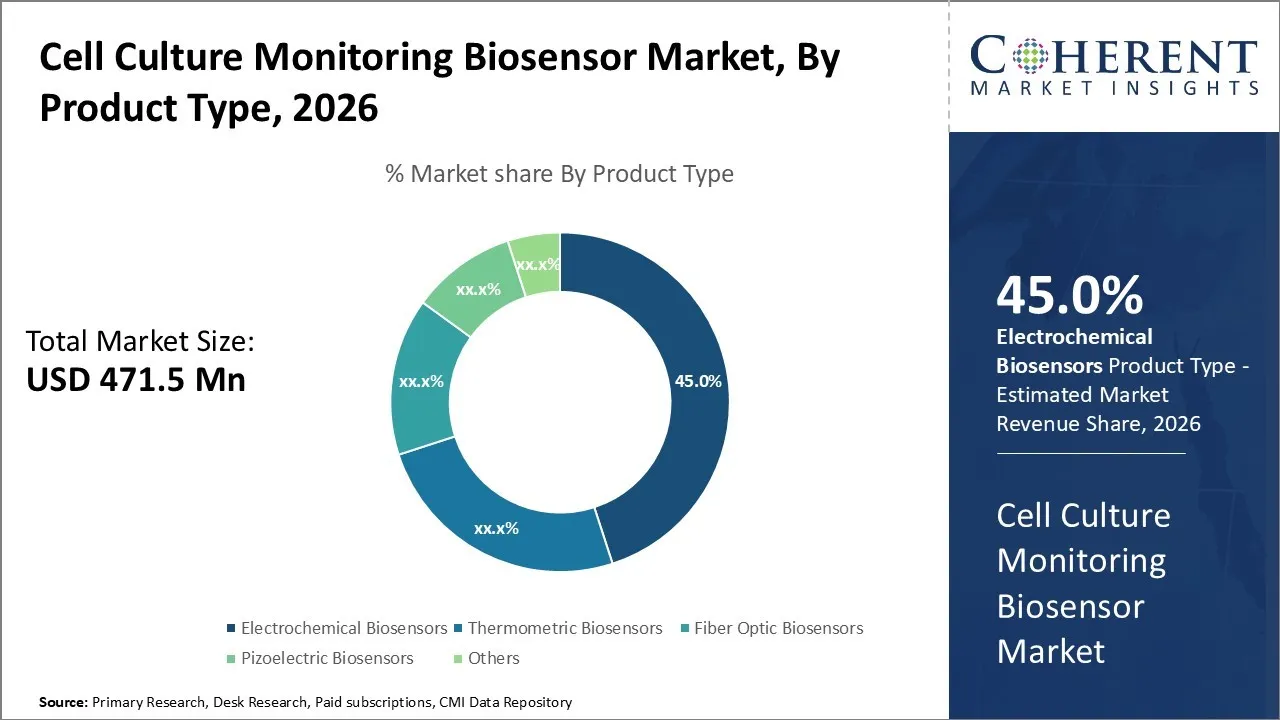
- Based on product type, the electrochemical biosensors segment is expected to hold 45% share of the market in 2026.
- Based on end user, the pharmaceutical industry segment is projected to account for 52% share of the market in 2026.
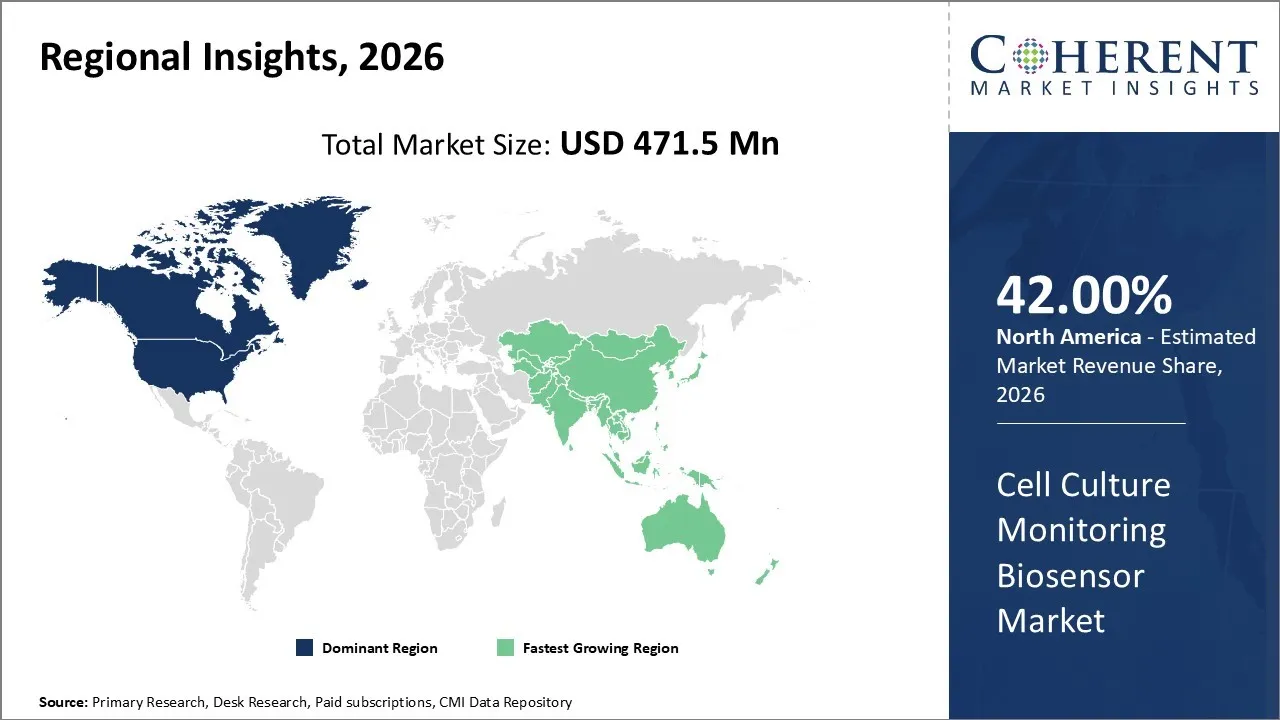
- Based on Region, North America is set to lead the cell culture monitoring biosensor market with 42% share in 2026. While, Asia Pacific is anticipated to be the fastest growing region.
Market Overview
The Cell Culture Monitoring Biosensors Market refers to the global industry that designs, develops, and sells biosensor devices used to monitor the conditions of living cell cultures in real time. These biosensors measure critical parameters such as glucose, pH, dissolved oxygen, metabolites, and extracellular acidification to ensure optimal cell growth, productivity, and quality. Increasing cell culture applications in research and product development is an important factor driving growth of the global cell culture monitoring biosensor market. Application of cell culture is quite significant and pronounced in every research and product development in the food, pharmaceutical, biotechnology, and other sectors.
Current Events and their Impacts on the Cell Culture Monitoring Biosensor Market
Current Event | Description and its Impact |
Launch of Hamilton’s GlucoSense for Real-Time In-Situ Glucose Monitoring |
|
PHCbi Launches LiCellGrow Cell Expansion System |
|
Segmental Insights
- Current Industry Events of 2026
- Market Size Estimation
- Regional Breakdown
- Competitive Landscape
- Customer Intelligence
- Segmental Analysis
- Pricing Analysis
- Key Market Drivers, Challenges & Future Trends
- Customized Insights Section
Cell Culture Monitoring Biosensor Market Insights, By Product Type - Electrochemical Biosensors represent the largest share, owing to their high sensitivity, specificity, and compatibility with real-time monitoring of cellular processes
In terms of product type, the electrochemical biosensors segment is expected to lead the market with 45% share in 2026. Electrochemical biosensors works by converting the biochemical reaction signals into measurable electrical signals, enabling continuous as well as accurate monitoring of cell culture environments such as pH, oxygen levels, glucose concentration, other metabolites, etc. This capacity is particularly important for biopharmaceutical companies as well as research institutions focused on optimizing cell growth conditions to enhance product yields and ensure cell viability.
The Food and Drug Administration (FDA) and several US National Institutes of Health (NIH) funded projects have emphasized the importance of integrating electrochemical biosensors into bioprocess monitoring systems, particularly because these sensors provide rapid and accurate feedback that can be used to adjust culture conditions in real time.
Cell Culture Monitoring Biosensor Market Insights, By End User - Pharmaceutical industry dominates the market
In terms of end user, the pharmaceutical industry segment is expected to hold 52% share of the market in 2026. Primarily owing to its consistent demand for reliable, real-time monitoring of cell cultures in drug development and large-scale biopharmaceutical manufacturing processes. Pharmaceutical companies need advanced biosensors to make sure that medicines made from cells are safe, effective, and accurate, because the industry has strict quality and safety rules.
For instance, prominent pharmaceutical firms like Pfizer, Johnson & Johnson, etc., increasingly connect sophisticated cell culture monitoring biosensors within their bioprocess systems to understand critical parameters such as pH, dissolved oxygen, as well as metabolite concentrations.
Regional Insights
North America Cell Culture Monitoring Biosensor Market Analysis & Trends
North America is expected to dominate the Cell Culture Monitoring Biosensor market with 42% share in 2026, owing primarily to its advanced biotechnology infrastructure, strong regulatory framework, as well as significant investments in research and development. The United States, as the largest economy in North America, holds an instrumental role by promoting innovation through government-sponsored initiatives such as the National Institutes of Health (NIH), which religiously funds advanced research in cell culture technologies.
For instance, Accurate, real-time monitoring of the extracellular acidification is crucial for understanding the dynamics of cellular metabolism. The sensor employs a two-electrode configuration made up of Ag/AgCl and RuO2 electrodes. The sensor showed excellent analytical capabilities, a consistent Nernst response with high sensitivity (−93 mV/pH), repeatability, and reproducibility.
Asia Pacific Cell Culture Monitoring Biosensor Market Analysis & Trends
Asia Pacific is expected to exhibit the fastest growth, fueled by an unprecedented surge in biotech startups, support by governmental authorities, as well as growing healthcare infrastructure investments across countries such as China, India, Japan, South Korea, and Singapore. The region’s rapid expansion is closely tied to its burgeoning biopharmaceutical sector, which highly relies on cell culture monitoring biosensors to ensure process optimization as well as product consistency.
For instance, the value of outbound licensing and drug development deals by Chinese pharmaceutical firms surged 161% in 2025 to nearly USD 136 billion. This surge shows the region’s rising investment in cutting-edge biopharmaceutical research, which directly drives demand for advanced biosensor technologies to support scalable as well as high-quality cell culture processes.
Cell Culture Monitoring Biosensor Market Outlook Country-Wise
The U.S. Cell Culture Monitoring Biosensor Market Trends
owing to several critical factors tightly linked to the region’s technological infrastructure, well-established biopharmaceutical industry, and strong emphasis on precision medicine. The United States, as a dominant player in the region, leads due to its robust network of research institutions as well as extensive investment in innovative biosensor technologies integrated into cell culture monitoring systems.
For instance, in December 2025, Nanocrine, a biotech startup in Maryland, announced its new RT-Chip technology. This is a next-generation biosensor that lets scientists watch tumor cells in real time. The technology is part of the cell culture monitoring biosensors market, which helps research labs, biotech companies, and pharmaceutical firms monitor cells more accurately for drug development and cancer research.
China Cell Culture Monitoring Biosensor Market Trends
China contributes the highest share in the cell culture monitoring biosensor market in the region due to its substantial advancements in biotechnology as well as life sciences infrastructure, supported heavily by initiatives by government authorities and investments. The Chinese government authorities have been aggressively promoting biopharmaceutical research and innovative biosensor technologies through programs such as the "Made in China 2025" and the National Medium- and Long-Term Program for Science and Technology Development, which focuses on developing high-tech industries including biotechnology.
For instance, institutions like the Chinese Academy of Sciences are pioneering the development of real-time biosensors capable of monitoring cell viability as well as metabolism in bioreactors, which are important for optimizing biologics manufacturing and regenerative medicine.
Market Report Scope
Cell Culture Monitoring Biosensor Market Report Coverage
| Report Coverage | Details | ||
|---|---|---|---|
| Base Year: | 2025 | Market Size in 2026: | USD 471.5 Mn |
| Historical Data for: | 2020 To 2024 | Forecast Period: | 2026 To 2033 |
| Forecast Period 2026 to 2033 CAGR: | 10.5% | 2033 Value Projection: | USD 873.0 Mn |
| Geographies covered: |
| ||
| Segments covered: |
| ||
| Companies covered: | C-CIT Sensors AG, Sarissa Biomedical Ltd, Lonza, Lifeonics ltd., Nova Biomedical, Cardea, Conductive Technologies Inc., and Bruker Corporation | ||
| Growth Drivers: |
| ||
| Restraints & Challenges: |
| ||
Cell Culture Monitoring Biosensor Market Driver
Rising demand for biopharmaceuticals
The rising demand for biopharmaceuticals has become a critical driver behind the expansion of the Cell Culture Monitoring Biosensor Market. Biopharmaceuticals, which encompass therapeutic proteins, monoclonal antibodies, vaccines, and gene therapies, require precise and controlled manufacturing environments to ensure product efficacy and safety. Cell culture processes play an essential role in the production of these biologics, as living cells are the production hosts for many biopharmaceutical substances.
Increasing adoption of advanced cell culture techniques
The increasing adoption of advanced cell culture techniques is significantly propelling the growth of the Cell Culture Monitoring Biosensor Market by enhancing the precision, scalability, and efficiency of cell-based research and biomanufacturing processes. Modern cell culture methods—such as three-dimensional (3D) cell cultures, organ-on-a-chip technologies, and microfluidic systems, demand sophisticated monitoring tools to accurately measure critical parameters like pH, dissolved oxygen, glucose levels, and cellular metabolites in real time.
Cell Culture Monitoring Biosensor Market Opportunity
Expansion in stem cell and regenerative medicine applications
The expansion in stem cell and regenerative medicine applications is poised to represent a significant opportunity within the Cell Culture Monitoring Biosensor Market. Stem cell technologies and regenerative therapies rely heavily on the ability to precisely monitor cell environments, viability, and differentiation status in real time to ensure optimal growth conditions and therapeutic efficacy. Advances in biosensor technology facilitate this by enabling continuous, non-invasive monitoring of critical parameters such as pH, dissolved oxygen, glucose concentration, and lactate levels during cell culture processes.
Analyst Opinion (Expert Opinion)
- The Cell Culture Monitoring Biosensor Market is experiencing significant momentum, driven primarily by the increasing adoption of biopharmaceuticals and personalized medicine. As cell-based therapies and regenerative medicine continue to gain traction, real-time monitoring of cell cultures has become critical to ensure the quality and efficacy of biological products.
- Better biosensors, with higher sensitivity and links to IoT and AI, are helping the market grow by making monitoring more accurate and automatic.
- However, challenges such as high initial investment costs along with the complexity of integrating biosensor systems into existing workflows may hinder widespread adoption, particularly among smaller research firms as well as laboratories. Additionally, stringent regulatory requirements for biosensor validation might pose barriers to entry, potentially slowing down market expansion.
- Despite these restraints, there are promising opportunities in emerging markets where biopharmaceutical infrastructures are rapidly developing. Asia-Pacific stands out as the fastest-growing region due to increasing initiatives by government authorities, rising healthcare expenditure, and expanding biotechnology sectors in countries like China, India, and Japan. Moreover, the rising prevalence of chronic diseases worldwide is bolstering demand for reliable cell culture monitoring systems, essential for building innovative treatments.
Speak to the analyst
Want personalized insights?
Take the findings above to one of our principal consultants, or have the report rebuilt around the segments, geographies and competitors you actually track.
Global Cell Culture Monitoring Biosensor Market: Key Developments
- In December 2025, Hamilton launched GlucoSense, a new glucose sensor for cell culture bioreactors. It is the first reusable sensor that can measure glucose continuously and in real time inside the bioreactor. This sensor makes controlling glucose in cell cultures as easy and routine as checking pH or oxygen levels.
- In March 2026, PHCbi, a company from Japan that makes lab and cell growth equipment, launched a new cell expansion system called LiCellGrow. This system helps scientists grow cells better and faster for new advanced therapies. It lets researchers see changes in cell metabolism in real time and automatically control the cell culture conditions. By using this system, labs and biotech companies will need more cell culture monitoring biosensors to track and manage cell growth.
Market Segmentation
- By Product Type
- Electrochemical Biosensors
- Thermometric Biosensors
- Fiber Optic Biosensors
- Pizoelectric Biosensors
- Others
- By End User
- Pharmaceutical Industry
- Biotechnology Organizations
- Research Laboratories
- By Region
- North America
- U.S.
- Canada
- Latin America
- Brazil
- Argentina
- Mexico
- Rest of Latin America
- Europe
- Germany
- U.K.
- Spain
- France
- Italy
- Russia
- Rest of Europe
- Asia Pacific
- China
- India
- Japan
- Australia
- South Korea
- ASEAN
- Rest of Asia Pacific
- Middle East & Africa
- GCC Countries
- Israel
- Rest of Middle East & Africa
- North America
- Key Players
- C-CIT Sensors AG
- Sarissa Biomedical Ltd
- Lonza
- Lifeonics ltd.
- Nova Biomedical
- Cardea
- Conductive Technologies Inc.
- Bruker Corporation
Sources
Primary Research Interviews
- Bioprocess Engineers
- R&D Heads in Biotechnology Firms
- Product Development Managers in Biosensor Companies
- Clinical Research Scientists
- Others
Databases
- Bloomberg Terminal
- BioWorld Intelligence Database
- Pharma Intelligence Database
- Others
Magazines
- BioProcess International
- Genetic Engineering & Biotechnology News (GEN)
- Lab Manager Magazine
- BioTechniques
- Others
Journals
- Biosensors and Bioelectronics
- Journal of Biotechnology
- Analytical Chemistry
- Sensors and Actuators B: Chemical
- Others
Newspapers
- The Wall Street Journal
- Financial Times
- The Business Standard
- The Economic Times
- Others
Associations
- International Society for Cell & Gene Therapy (ISCT)
- American Society for Microbiology (ASM)
- European Biosensors & Bioelectronics Association (EBBA)
- Biotechnology Innovation Organization (BIO)
- Others
Public Domain Sources
- U.S. Food and Drug Administration (FDA) Reports
- World Health Organization (WHO) Publications
- National Institutes of Health (NIH) Data
- Centers for Disease Control and Prevention (CDC) Resources
- Others
Proprietary Elements
- CMI Data Analytics Tool
- Proprietary CMI Existing Repository of Information for the Last 10 Years
Get access to 250+ pages report
Every segment, forecast, competitor profile and data table behind the analysis above — available for instant download.
- ESOMAR Member
- ISO 9001:2015 Certified
- D-U-N-S Registered
- GDPR & CCPA Compliant
Missing comfort of reading report in your local language? Find your preferred language:
Transform your Strategy with Exclusive Trending Reports
Frequently Asked Questions
The global cell culture monitoring biosensor market size was valued at USD 471.5 Mn in 2026 and is expected to reach USD 873.0 Mn in 2033.
Major players operating in the market include C-CIT Sensors AG, Sarissa Biomedical Ltd, Lonza, Lifeonics ltd., Nova Biomedical, Cardea, Conductive Technologies Inc., and Bruker Corporation
Among product type, the electrochemical biosensors segment estimated significant revenue in 2026.
Factors impacting growth of the global cell culture monitoring biosensor market include rising focus of pharmaceutical and biotechnology companies on drug development for personalized medicines, biological, and biosimilars.
The market is estimated to exhibit a CAGR of 10.5% till 2033.
Among region, North America is expected to witness significant growth over the forecast period.