

Disposable Medical Gloves Market Size & Forecast: 2026-2033
Disposable Medical Gloves Market is estimated to be valued at USD 9.32 Bn in 2026 and is expected to reach USD 17.83 Bn in 2033, exhibiting a compound annual growth rate (CAGR) of 9.7% from 2026 to 2033.
Key Takeaways
- Based on Type, the Natural Rubber Gloves segment is expected to dominate the global disposable medical gloves market with a share of 45.7% in 2026, due to their superior comfort, elasticity, and tactile sensitivity.
- Based on Application, the Examination segment is expected to account for the largest share of the market in 2026, due to their critical role in preventing cross-contamination between patients and healthcare providers.
- Based on Form, the Powered segment represents the highest share of the market in 2026, due to their ease of use, affordability, and effectiveness in high-volume environments.
- Based on Region, North America is expected to lead the market, holding a share of 41. 8% in 2026. While, Asia Pacific is anticipated to be the fastest-growing region during the forecast period.
Market Overview
The disposable medical gloves market is witnessing steady growth driven by increasing awareness of hygiene, infection control measures, and rising healthcare needs worldwide. The demand for disposable gloves has surged significantly across hospitals, diagnostic laboratories, dental clinics, and even non-clinical sectors like food processing and sanitation. Growing incidences of chronic diseases and the rising number of surgical procedures, particularly in aging populations, are further boosting the disposable gloves market demand. One of the key trends is the rising preference for nitrile gloves due to their durability, chemical resistance, and hypoallergenic properties.
Current Events and Its Impacts
Current Event | Description and Its Impact |
Regulatory and Security Compliance Pressures |
|
Demand Surge and Market Restructuring |
|
End User Feedback and Unmet Needs in the Global Disposable Medical Gloves Market
Key End User Feedback
- Comfort and Fit
A consistent concern among users is discomfort during extended use, especially with lower-quality products. Poor ergonomics, tightness, or inadequate sizing ranges contribute to hand fatigue and reduced dexterity, particularly during lengthy procedures. - Durability and Puncture Resistance
Users frequently cite glove tearing and puncturing—especially during high-stress procedures—as a significant issue. This not only compromises safety but also disrupts workflow and increases usage rates, thereby driving up costs. - Allergic Reactions and Skin Sensitivity
Although latex gloves have traditionally offered superior tactile sensitivity and fit, they are associated with allergic reactions. There is a growing demand for hypoallergenic alternatives, such as nitrile and neoprene, with equivalent or superior performance characteristics. - Tactile Sensitivity and Precision
Medical professionals, particularly surgeons and dental practitioners, emphasize the need for gloves that allow high tactile precision. The trade-off between protection and sensitivity remains a critical challenge in product development. - Ease of Donning and Removal
Difficulties in quickly donning or removing gloves—especially in high-pressure environments—were frequently mentioned. This is particularly relevant in emergency care and during PPE changes in infection control protocols.
Unmet Needs and Opportunities
- Advanced Material Innovation
There is significant demand for next-generation glove materials that offer an optimal balance between comfort, sensitivity, durability, and allergen-free composition. - Customization and Sizing Flexibility
A more diverse sizing matrix, including gender-specific fits and options for smaller or larger hands, could improve user satisfaction and performance. - Sustainable and Eco-Friendly Options
Growing environmental awareness has led to calls for biodegradable or recyclable gloves without compromising barrier protection or regulatory compliance.
- Current Industry Events of 2026
- Market Size Estimation
- Regional Breakdown
- Competitive Landscape
- Customer Intelligence
- Segmental Analysis
- Pricing Analysis
- Key Market Drivers, Challenges & Future Trends
- Customized Insights Section
Import Analysis of Medical Gloves
Between October 2023 and September 2024, India imported a total of 1,563 shipments of medical gloves, sourced from 76 international exporters and delivered to 100 Indian buyers. In September 2024 alone, India received 142 shipments, representing a 48% increase compared to September 2023 and a 30% rise from August 2024.
India primarily sources its medical gloves from Malaysia, Thailand, and Vietnam.
On the global stage, the United States, Vietnam, and India are the top three importers of medical gloves. The U.S. ranks first with 26,003 shipments, followed by Vietnam with 11,672, and India in third place with 6,247 shipments.
Segmental Insights
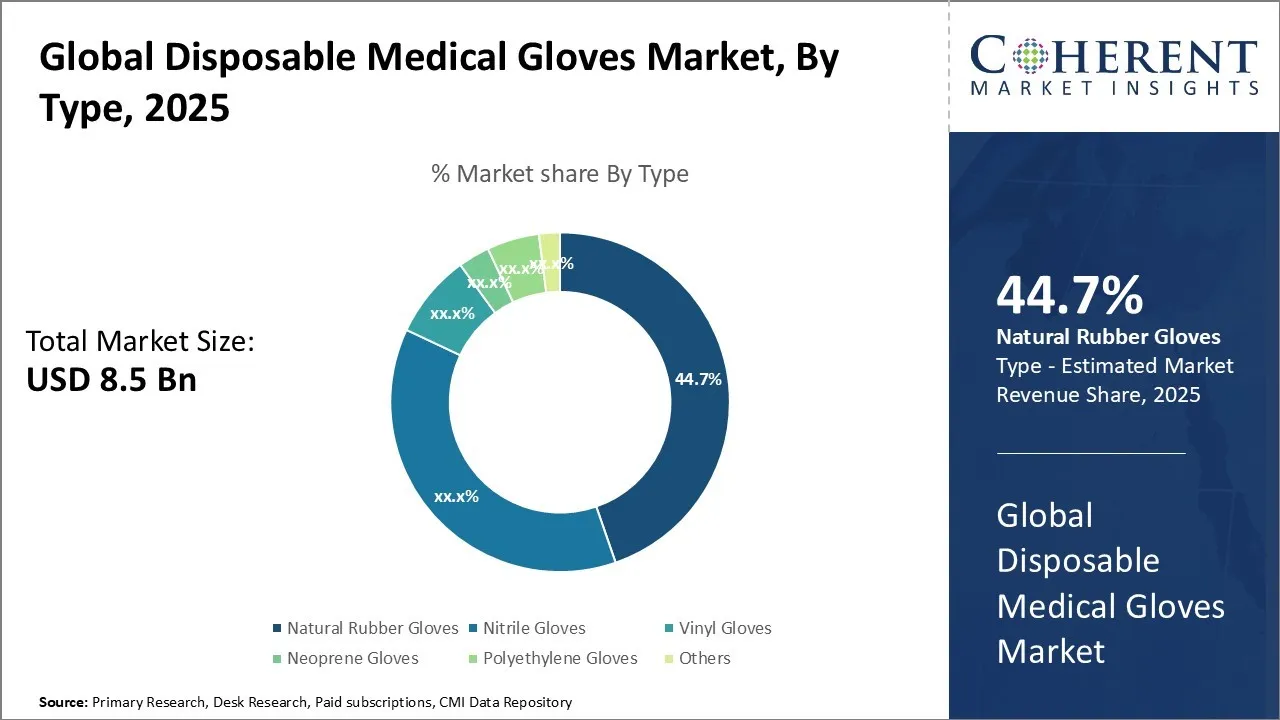
Disposable Medical Gloves Market Insights, By Type
Natural Rubber Gloves Dominates the Overall Market owing to its Superior Comfort and Elasticity
In terms of type, the natural rubber gloves segment is expected to command the share of 45.7% of the global disposable medical gloves market in 2026, due to their superior comfort, elasticity, and tactile sensitivity, which are essential for precision in surgical and diagnostic procedures. These gloves offer excellent barrier protection against pathogens and contaminants, making them ideal for preventing infections during patient care. Their snug fit enhances dexterity and control, especially in delicate tasks such as suturing or administering injections. Additionally, natural rubber gloves are cost-effective and widely available, making them a preferred choice in hospitals, clinics, and labs. Despite allergy concerns, their performance advantages continue to drive strong demand in the healthcare sector.
In August 2024, Sri Trang Gloves (Thailand) PCL has begun shipping its first EUDR‑compliant natural rubber gloves to European markets, marking a milestone ahead of the EU’s Deforestation Regulation enforcement. The gloves are sourced from traceable, EUDR‑verified latex via parent Sri Trang Agro‑Industry are destined for medical and industrial sectors in markets like Greece. This is further propelling the disposable medical gloves market share.
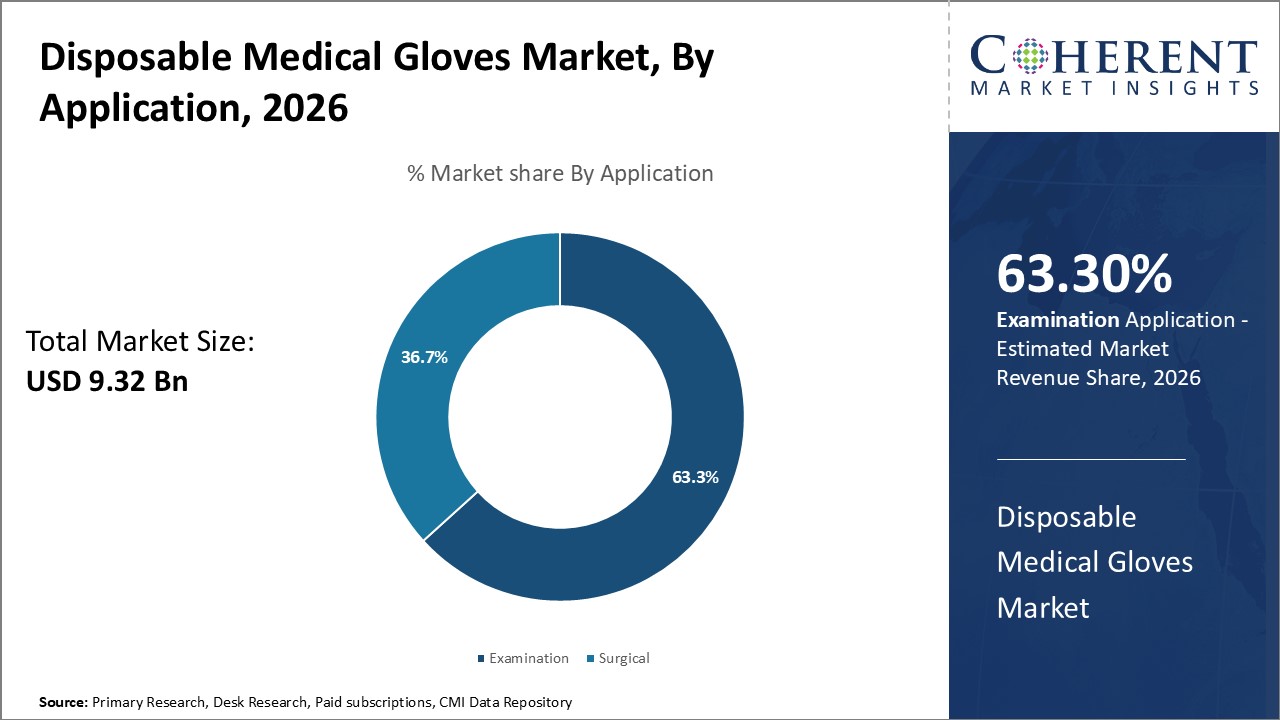
Disposable Medical Gloves Market Insights, By Application
Examination Acquires the Dominant Share owing to Preventing Cross-Contamination
In terms of application, the examination segment is expected to contribute the highest market share in 2026, due to their critical role in preventing cross-contamination between patients and healthcare providers. During medical examinations, gloves act as a primary barrier against the transmission of infectious agents, including bacteria, viruses, and bodily fluids. This is especially important in high-contact scenarios like blood draws, wound care, or general physical assessments.
The demand has also surged due to heightened awareness around infection control, stricter hygiene protocols, and rising cases of infectious diseases. In outpatient clinics, emergency rooms, and diagnostic labs, examination gloves are considered essential for routine patient handling and minor procedures. Additionally, non-sterile gloves used in examinations are cost-effective and easy to dispose of, making them ideal for single-use scenarios. The growing geriatric population, increased patient volumes, and more frequent health check-ups have further amplified the need for disposable medical gloves in clinical examinations.
In December 2024, The Union Health Ministry has amended India’s Medical Devices Rules (MDR), 2017, officially classifying surgical and medical examination gloves as regulated medical devices.
Disposable Medical Gloves Market Insights, By Form
Powder Form Acquires the Dominant share owing to its Affordability and Effectiveness in High-Volume Environments
In terms of form, the powder segment holds the highest share of the market in 2026, due to their ease of use, affordability, and effectiveness in high-volume environments. The powder, usually cornstarch, helps absorb moisture and makes the gloves easier to put on and remove, especially during prolonged use or in fast-paced medical and laboratory settings. This makes them particularly useful in situations where quick glove changes are necessary, such as in surgical prep, emergency care, or dental procedures.
Additionally, powdered gloves tend to be more cost-effective compared to powder-free alternatives, making them appealing for budget-conscious facilities, especially in developing regions. Despite some regulatory restrictions in certain countries (such as the U.S. FDA ban on powdered surgical gloves due to allergy and inflammation risks), powdered gloves continue to see usage in non-surgical or general-purpose healthcare and industrial applications where these risks are minimal. Their demand persists in regions where regulations are less strict or where powder-related complications are not a significant concern.
Regional Insights
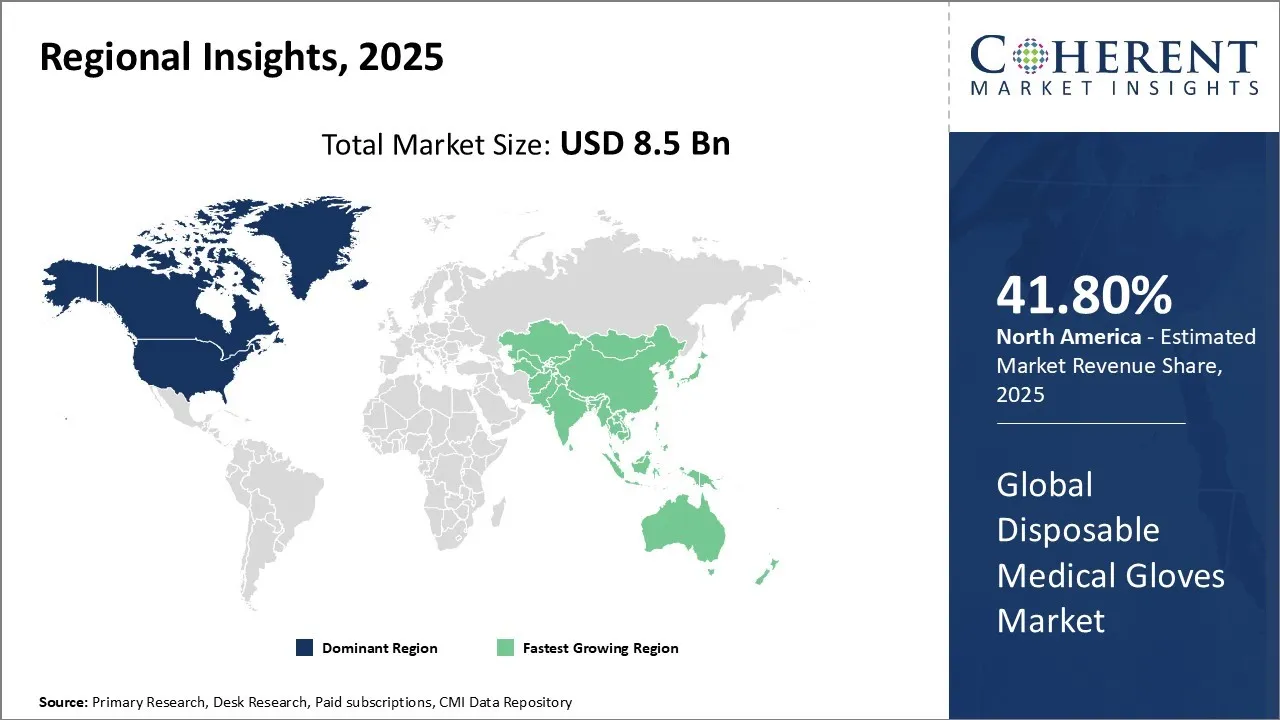
North America Disposable Medical Gloves Market Analysis & Trends
North America, the dominance in the global disposable medical gloves market, holding the share of 41.80% in 2026, driven by the strict regulatory environment, standards from agencies like OSHA and Joint Commission require routine glove use in patient care, sanitation, and surgical settings. Moreover, high hospitalization rates and increased chronic disease prevalence necessitate regular use of examination and surgical gloves during diagnostics, procedures, and patient handling.
Recent industry observations show that hospitals are implementing AI and IoT-based facility systems to monitor consumption, predict restocking needs, and ensure compliance with infection control protocols. These measures enhance operational efficiency and safety, reinforcing glove usage as a key aspect of facility management.
However, there’s growing concern about the environmental impact of single-use gloves. A recent study highlighted that disposable medical items, including gloves account for a significant share of healthcare waste and carbon emissions, prompting providers to explore recycling programs and reusable alternatives. Overall, the combination of regulatory mandates, clinical necessity, and institutional focus on patient safety ensures strong disposable medical gloves market demand in North America.
Asia Pacific Disposable Medical Gloves Market Analysis & Trends
Asia Pacific region is expected to exhibit the fastest growth in the disposable medical gloves market due to the several converging trends and recent policy shifts. Countries like China and India lead consumption as public hospitals expand and outpatient visits rise. In India, under the Ayushman Bharat Health Infrastructure Mission, glove procurement in public hospitals increased by nearly 25% since 2021, and private providers like Apollo Hospitals have scaled up PPE budgets to reinforce patient safety. In China, investments under the “Healthy China 2030” initiative have modernized rural clinics and city hospitals, further driving glove use.
Meanwhile, regional manufacturers, especially Malaysia are capitalizing on global supply chain shifts. In 2026, following new U.S. tariffs on Chinese-made gloves, Malaysian companies like Top Glove are expected to capture additional market share, highlighting Asia’s central role in global glove distribution. This reflects how trade policy changes and cost-competitive manufacturing in Asia are bolstering disposable glove supply to meet increasing healthcare demand.
Furthermore, heightened focus on infection control, growing hospitalization rates, and expanding healthcare capacity across Asia are reinforcing the need for reliable glove supply in hospitals, clinics, and diagnostic centers. These developments underscore the region’s critical contribution to overall disposable medical gloves market growth.
Disposable Medical Gloves Market Outlook Country-Wise
The U.S. Disposable Medical Gloves Trends
The United States shows strong demand for disposable medical gloves due to its high surgical volume, strict infection control standards, and large healthcare workforce. Regulatory bodies like the CDC and OSHA mandate glove use across all medical settings. Recent updates in hospital hygiene protocols have further increased glove consumption, especially in ICUs and surgical units. Major hospital networks have reported notable increases in glove procurement, reinforcing the country’s role in driving disposable medical gloves market growth.
India Disposable Medical Gloves Trends
India is witnessing strong demand for disposable medical gloves due to the expansion of public healthcare under schemes like Ayushman Bharat and rapid growth of private hospitals. Increased patient volume has led to stricter hygiene protocols, especially in government hospitals and ICUs. State-run hospitals have seen a 25–30% rise in glove procurement over the past two years, driven by infection control needs. Domestic manufacturers are also scaling up production under the “Make in India” push, supporting rising demand across both public and private sectors. This is further accelerating the disposable gloves market share.
China Disposable Medical Gloves Trends
China is a major driver of disposable medical gloves market, fueled by healthcare reforms under the "Healthy China 2030" initiative. Investments in upgrading rural clinics and urban hospitals have increased outpatient visits and clinical procedures, raising the need for gloves in infection control. For example, in 2024, provinces like Sichuan and Henan saw expanded use of gloves due to public health upgrades. Rising elderly care and chronic disease management also contribute to growing glove consumption across China.
In April 2026, INTCO Medical, glove manufacturer in China, launched Syntex™ synthetic disposable latex gloves, a revolutionary alternative to natural rubber variants. Syntex™ gloves deliver exceptional performance, boasting up to 650% elasticity, robust puncture and chemical resistance, and a latex-like feel, while eliminating allergy risks tied to natural latex. Certified under EN 455, EN 374, ASTM D6319, and approved by FDA and EU CE standards, they meet stringent safety benchmarks. This is further proliferating the disposable medical gloves market growth in China.
Market Report Scope
Disposable Medical Gloves Market Report Coverage
| Report Coverage | Details | ||
|---|---|---|---|
| Base Year: | 2025 | Market Size in 2026: | USD 9.32 Bn |
| Historical Data for: | 2020 To 2024 | Forecast Period: | 2026 To 2033 |
| Forecast Period 2026 to 2033 CAGR: | 9.7% | 2033 Value Projection: | USD 17.83 Bn |
| Geographies covered: |
| ||
| Segments covered: |
| ||
| Companies covered: | Cardinal Health, Inc., Adventa Berhad, Ansell Ltd., Dynarex Corporation, Hartalega Holdings Berhad, Supermax Corporation Berhad, Semperit AG Holding, Top Glove Corporation BHD, Rubberex Corporation (M) Berhad, and Kossan Rubber Industries BHD, among others. | ||
| Growth Drivers: |
| ||
| Restraints & Challenges: |
| ||
Global Disposable Medical Gloves Market Drivers
High prevalence of chronic diseases to propel market growth
One of the key factors expected to augment growth of the global disposable medical gloves market during the forecast period is the increasing prevalence of chronic diseases across the world. Such a high burden of chronic diseases (such as cardiovascular diseases and cancer) leads to an increased number of surgical procedures and is expected to augment the growth of the market. According to the U.S. Centers for Disease Control and Prevention (CDC), chronic diseases such as heart disease, cancer, and diabetes are the leading causes of death and disability in the United States. This in turn is expected to increase demand for disposable medical gloves in the region.
Increasing number of surgical procedures to drive market growth
Another factor which is driving the growth of the global disposable medical gloves market is the increasing number of surgical procedures across the globe. For instance, with the rising number of surgical procedures, the use or demand for disposable medical gloves is also increasing with rapid pace. According to the National Center for Biotechnology Information (NCBI), worldwide, around 310 million major surgeries are performed each year; around 40 to 50 million in the United States and over 20 million in Europe. The volume of surgical procedures is rising worldwide, positively impacting the growth of the global disposable medical gloves market.
Global Disposable Medical Gloves Market Opportunities
The disposable medical gloves market is set for continued growth, driven by innovations in materials, sustainability, and smart technology, fueling strong Disposable Medical Gloves Market forecast.
New glove materials like improved nitrile and neoprene offer enhanced comfort and chemical resistance while avoiding latex allergens. Eco-friendly options, including biodegradable and plant-based gloves, are gaining popularity for reducing medical waste. Meanwhile, smart gloves with embedded sensors can detect punctures in real time, improving safety and monitoring.
Design upgrades that reduce hand fatigue and improve fit are enhancing comfort for healthcare workers. The shift toward powder-free, accelerator-free, and sustainable gloves is accelerating, supported by regulatory pressure and green initiatives.
Global Disposable Medical Gloves Market Trends
High demand for biodegradable gloves is a recent trend
Each year, over 1.4 billion tonnes of disposable gloves are used worldwide in the healthcare sector, food industry and by the general consumer. The gloves are used only once and cannot be degraded, which in turn contribute to environmental pollution. Biodegradable gloves are the biodegradable alternative to a traditional disposable glove, while meeting all the required quality and certification parameters. Hence, there is an increasing demand for biodegradable gloves around the world and this trend is expected continue over the forecast period.
Analyst Opinion (Expert Opinion)
The Disposable Medical Gloves Market value is undergoing a fundamental shift in demand dynamics, raw material strategies, and procurement priorities, particularly driven by heightened regulatory scrutiny and supply chain regionalization.
Nitrile gloves have firmly outpaced latex in institutional preference, not merely due to allergy concerns, but because of superior chemical resistance and durability. According to the U.S. Bureau of Labor Statistics, nitrile gloves are now the standard in 86% of hospitals and outpatient care facilities across North America. Furthermore, global nitrile production has increased by over 200% since 2018, with Thailand and Malaysia continuing to dominate supply, although newer production lines in India and Vietnam are beginning to mitigate supply concentration risk.
Companies like Top Glove and Hartalega have begun to invest heavily in synthetic rubber and butadiene production facilities, ensuring better margin control and reducing price volatility. This move also signals a shift in competitive advantage from low-cost labor to logistics, automation, and upstream control.
From a technology adoption standpoint, smart glove dispensers and inventory-linked RFID tracking are reshaping hospital procurement practices. For instance, NHS hospitals in the UK that adopted RFID-based glove dispensing reduced per-patient glove wastage by 32% within six months. This efficiency-driven consumption pattern is creating a secondary demand layer, where hospitals are not just buying more gloves, but buying them more precisely.
There is also an observable surge in demand from non-traditional segments, particularly in the pharmaceutical, biotechnology, and personal care sectors. These industries require higher-grade, powder-free nitrile gloves compliant with USP <800> standards. The increasing frequency of cytotoxic drug handling and sterile manufacturing procedures is a major contributor.
Environmental concerns are now being operationalized rather than merely acknowledged. Several European distributors, such as Abena and Polyco Healthline, have started offering biodegradable gloves with EN374 and EN455 compliance. While still a niche, these alternatives are gaining traction among environmentally certified clinics and labs. The adoption remains sluggish, primarily due to cost and shelf-life limitations, but regulatory nudges, especially from the EU’s Green Deal framework will make non-compliance increasingly expensive.
Speak to the analyst
Want personalized insights?
Take the findings above to one of our principal consultants, or have the report rebuilt around the segments, geographies and competitors you actually track.
Key Developments
- In May 2025, Hyderabad’s Wadi Surgicals introduced India’s first accelerator‑free nitrile gloves under its Enliva brand, developed through extensive R&D and international collaboration. Eliminating common allergenic accelerators like thiurams, carbamates, and MBTs, the gloves use alternative crosslinking agents, ensuring skin safety without compromising strength or chemical resistance.
- In February 2025, The Ministry of Chemicals & Fertilisers published a draft Quality Control Order (QCO) under the Medical and Surgical Gloves (Single‑Use Medical Examination Gloves) regime. Set to take effect six months post-notification, the order mandates compliance with Indian Standard IS 15354 (Part 1): 2023, requiring gloves made from rubber latex or solution to bear the BIS Standard Mark under Scheme‑I of Schedule II.
- In November 2024, Sybron introduced biodegradable nitrile single‑use gloves, targeting hospitality, education, healthcare, facilities management (FM), construction, automotive, food manufacturing, cleaning, and utility sectors.
- In October 2024, Unigloves and KluraLabs unveiled CrossGuard, the first nitrile glove engineered to eliminate 99.99 % of selected bacteria within 60 seconds. The gloves feature an advanced, active-ingredient‑free formulation that optimises surface chemistry, offering rapid microbial protection ideal for healthcare settings.
Market Segmentation
- Global Disposable Medical Gloves Market, By Type (Revenue, USD Bn, 2021 - 2033)
- Natural Rubber Gloves
- Nitrile Gloves
- Vinyl Gloves
- Neoprene Gloves
- Polyethylene Gloves
- Others
- Global Disposable Medical Gloves Market, By Application (Revenue, USD Bn, 2021 - 2033)
- Examination
- Surgical
- Global Disposable Medical Gloves Market, By Form (Revenue, USD Bn, 2021 - 2033)
- Powdered
- Non-powdered
- Global Disposable Medical Gloves Market, By Geography (Revenue, USD Bn, 2021 - 2033)
- North America
- U.S.
- Canada
- Latin America
- Brazil
- Argentina
- Mexico
- Rest of Latin America
- Europe
- Germany
- U.K.
- Spain
- France
- Italy
- Russia
- Rest of Europe
- Asia Pacific
- China
- India
- Japan
- Australia
- South Korea
- ASEAN
- Rest of Asia Pacific
- Middle East
- GCC Countries
- Israel
- Rest of Middle East
- Africa
- South Africa
- North Africa
- Central Africa
- North America
- Key Companies Insights (Revenue, USD Bn, 2021 - 2033)
- Cardinal Health, Inc.
- Adventa Berhad
- Ansell Ltd.
- Dynarex Corporation
- Hartalega Holdings Berhad
- Supermax Corporation Berhad
- Semperit AG Holding
- Top Glove Corporation BHD
- Rubberex Corporation (M) Berhad
- Kossan Rubber Industries BHD
Sources
Primary Research Interviews from the following stakeholders
Stakeholders
- Interviews with glove manufacturers, hospital procurement officers, clinical supply managers, infection control specialists, supply chain directors, regulatory compliance officers, and R&D heads in the medical consumables sector.
Specific stakeholders
- Procurement and materials management teams at hospitals and healthcare chains
- Supply chain and hygiene leads at pharmaceutical companies
- Regulatory and quality assurance officials at glove production facilities in Malaysia, Thailand, India, and China
- Infection prevention experts and sterilization officers in diagnostic labs and clinical research organizations
- Sustainability and materials R&D teams at glove raw material producers
- Procurement leads at public health agencies and emergency medical supply departments
- Representatives from healthcare worker unions and safety committees
Databases
- U.S. Food and Drug Administration (FDA) 510(k) database
- European Medical Device Nomenclature (EMDN)
- World Health Organization (WHO) – Global Health Expenditure Database
- UN Comtrade – HS Codes 4015.11, 4015.19 (rubber and plastic gloves)
- Directorate General of Foreign Trade (DGFT), India – Export/Import statistics
- Eurostat – Healthcare and protective equipment datasets
- Japan Customs – Trade Statistics for Disposable Medical Goods
- Malaysia External Trade Statistics System (MATRADE)
- Occupational Safety and Health Administration (OSHA) – PPE Compliance Data
Magazines
- Medical Device and Diagnostic Industry (MD+DI)
- Infection Control Today
- Healthcare Purchasing News
- Rubber Asia
- Polymer Update
- Global Healthcare Insights
- Manufacturing Today – Medical Devices Edition
- BioSpectrum Asia
Journals
- Journal of Infection Prevention
- American Journal of Infection Control (AJIC)
- Journal of Occupational and Environmental Hygiene
- International Journal of Polymer Science
- Journal of Hospital Infection
- Materials Today Proceedings – Medical Polymers
- Journal of Healthcare Engineering
Newspapers
- The Economic Times – Healthcare & Manufacturing
- The Hindu Business Line – Medical Devices and PPE
- Financial Times – Healthcare Supply Chain
- The Straits Times – Malaysian Rubber Glove Industry
- Nikkei Asia – PPE Export Trends
- South China Morning Post – Health & Industry Reports
Associations
- Indian Rubber Manufacturers Research Association (IRMRA)
- Malaysian Rubber Glove Manufacturers Association (MARGMA)
- U.S. Occupational Safety & Health Administration (OSHA)
- International Safety Equipment Association (ISEA)
- Bureau of Indian Standards (BIS) – PPE Division
- European Safety Federation (ESF)
- All India Medical Devices Industry (AiMeD)
- World Federation of Public Health Associations (WFPHA)
Public Domain Sources
- Central Drugs Standard Control Organization (CDSCO), India
- European Medicines Agency (EMA)
- U.S. Centers for Disease Control and Prevention (CDC)
- Ministry of Health and Family Welfare, India
- National Health Service (NHS), UK – PPE Procurement & Safety Reports
- Ministry of International Trade and Industry (MITI), Malaysia
- NITI Aayog – PPE and Domestic Manufacturing Policy Reports
- India Rubber Board – Glove Grade Natural Rubber Data
- U.S. Bureau of Labor Statistics – Medical Glove Usage in Healthcare Occupations
Proprietary Elements
- CMI Data Analytics Tool, and Proprietary CMI Existing Repository of information for last 8 years
Get access to 250+ pages report
Every segment, forecast, competitor profile and data table behind the analysis above — available for instant download.
- ESOMAR Member
- ISO 9001:2015 Certified
- D-U-N-S Registered
- GDPR & CCPA Compliant
Missing comfort of reading report in your local language? Find your preferred language:
Transform your Strategy with Exclusive Trending Reports
Frequently Asked Questions
The Disposable Medical Gloves Market is estimated to be valued at USD 9.32 Bn in 2026, and is expected to reach USD 17.83 Bn by 2033.
The CAGR of the Disposable Medical Gloves Market is projected to be 9.7% from 2026 to 2033.
Increasing prevalence of chronic diseases and increasing number of surgical procedures across the globe is fueling the market.
Natural Rubber Gloves segment is the leading component segment in the market.
Toxic reactions associated with certain gloves and environmental concerns are some major factors restraining market.
Major players operating in the market are Cardinal Health, Inc., Adventa Berhad, Ansell Ltd., Dynarex Corporation, Hartalega Holdings Berhad, Supermax Corporation Berhad, Semperit AG Holding, Top Glove Corporation BHD, Rubberex Corporation (M) Berhad, and Kossan Rubber Industries BHD, among others.
Latex, nitrile, vinyl, and neoprene are common glove materials, each offering varying levels of protection, comfort, and cost.