

Global 3d Printed Medical Devices Market Size and Forecast – 2026 to 2033
The Global 3d Printed Medical Devices Market is estimated to be valued at USD 1.6 Bn in 2026 and is expected to reach USD 4.2 Bn by 2033, exhibiting a compound annual growth rate (CAGR) of 14.2% from 2026 to 2033.
Key Takeaways
- By Application Type, Orthopedic Implants hold the largest market share of 43.4% in 2026 owing to its growing demand for patient‑specific & customized implants.
- By Technology, Digital Light Processing (DLP) expected to hold largest market share of 34.2% in 2026 owing to the high precision & resolution for medical‑grade parts.
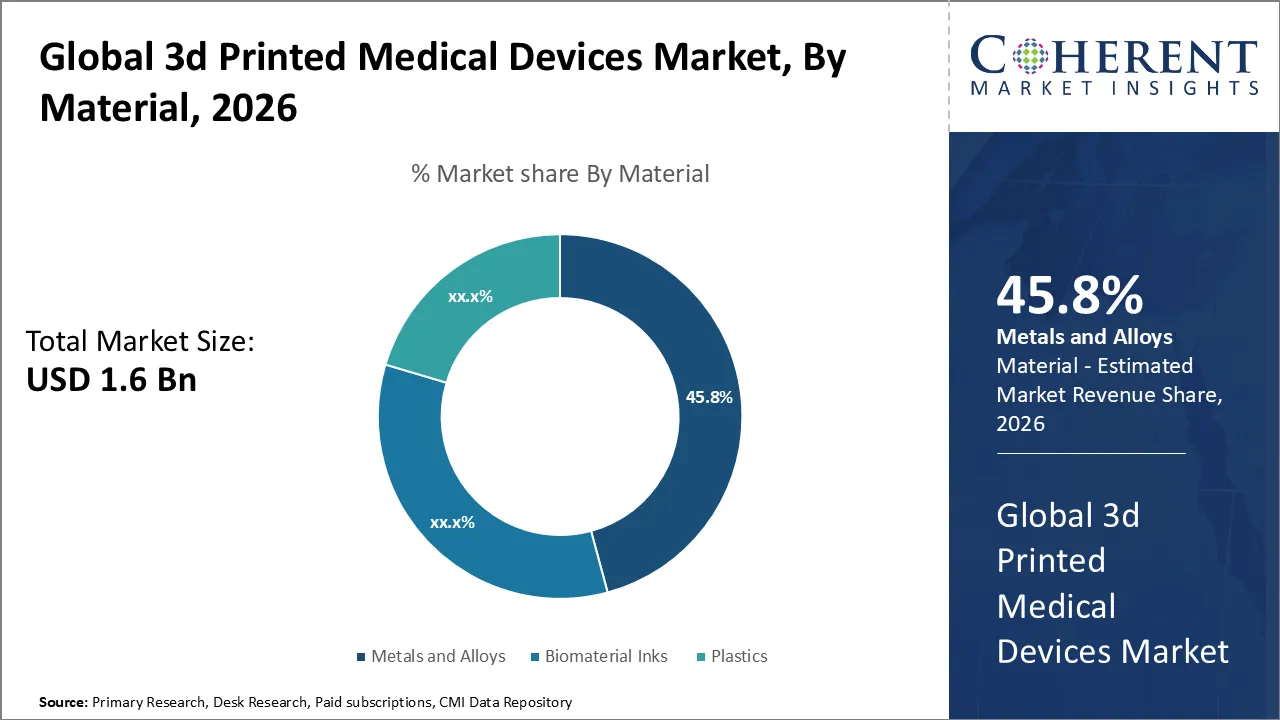
- By Material, Metals and Alloys acquired the prominent market share of 45.8% in 2026 owing to the rising demand for customized, patient‑specific implants.
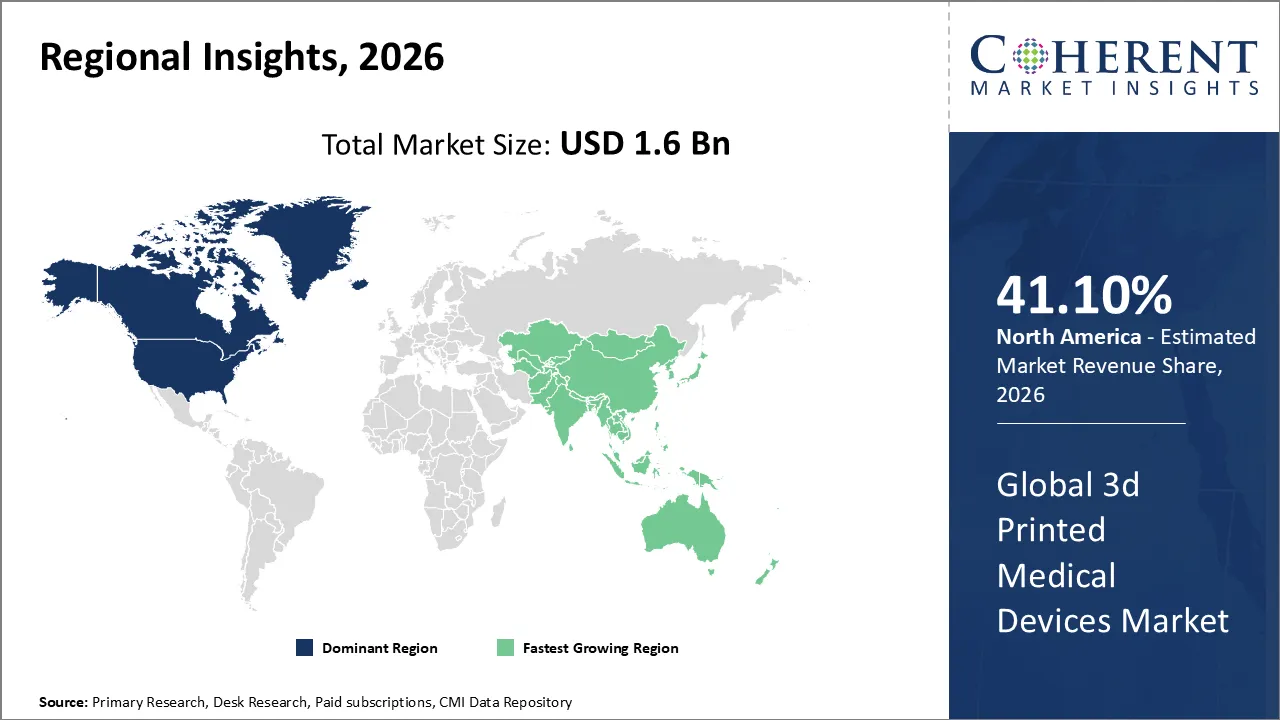
- By Region, North America dominates the overall market with an estimated share of 41.1% in 2026 owing to the advanced healthcare infrastructure & technology adoption.
Market Overview
The Global 3D Printed Medical Devices Market actively transforms healthcare by producing patient‑specific implants, prosthetics, surgical guides, anatomical models, and dental devices through additive manufacturing. Advanced printer technologies, biocompatible materials, and streamlined digital workflows allow manufacturers to produce devices faster and improve clinical outcomes. Hospitals and research centers increasingly operate in‑house 3D printing for planning, fabrication, and complex device creation. The market grows as major regions invest in healthcare technology and strengthen regulatory frameworks.
Current Events and their Impact on the Global 3d Printed Medical Devices Market
Current Events | Description and its impact |
Technological Advancements in 3D Printing Materials and Processes |
|
Regulatory Landscape and Compliance Changes |
|
Economic Factors and Healthcare Investment Trends |
|
Segmental Insights
- Current Industry Events of 2026
- Market Size Estimation
- Regional Breakdown
- Competitive Landscape
- Customer Intelligence
- Segmental Analysis
- Pricing Analysis
- Key Market Drivers, Challenges & Future Trends
- Customized Insights Section
Global 3d Printed Medical Devices Market Insights, By Application Type: Orthopedic Implants contribute the highest share of the market owing to its industry innovation & adoption by healthcare providers.
Orthopedic Implants hold the largest market share of 43.4% in 2026. The orthopedic implants segment in the global 3D printed medical devices market grows as healthcare providers increasingly demand anatomically precise, patient-specific solutions that enhance surgical accuracy and minimize complications. Rising incidences of bone disorders, trauma cases, and age-related joint issues continue to drive the need for advanced implants. 3D printing technology allows manufacturers to create complex porous structures that improve bone integration and durability, while supporting better recovery outcomes. Increasing clinical trust and wider adoption of customized implants further propel segment growth. For instance, in August 2025, OIC International (USA), Medi Mold (AMTZ, India), and AddUp (France) formed a strategic partnership to set up a 3D-printed, precision-engineered orthopedic implant facility at AMTZ, India’s premier medical device park.
Global 3d Printed Medical Devices Market Insights, By Technology: Digital Light Processing (DLP) contribute the highest share of the market owing to its customization & personalized medical devices.
Digital Light Processing (DLP) expected to hold largest market share of 34.2% in 2026. Digital Light Processing (DLP) accelerates growth in the global 3D printed medical devices market by producing high-resolution, complex medical components with smooth surface quality. It cures entire layers at once, increasing speed and efficiency for rapid manufacturing and prototyping. Healthcare providers expand its use in dental and surgical applications, while manufacturers develop biocompatible resins to support adoption. Seamless integration with digital design and imaging systems improves precision, and rising demand for customized medical solutions further drives its use. For instance, CollPlant has launched BioFlex, a ready-to-print kit based on its proprietary rhCollagen platform for Digital Light Processing (DLP) 3D bioprinting applications.
Global 3d Printed Medical Devices Market Insights, By Material: Metals and Alloys contribute the highest share of the market owing to its growth in orthopedic, dental & surgical device applications.
Metals and Alloys acquired the prominent market share of 45.8% in 2026. Metals and alloys strengthen the global 3D printed medical devices market by offering high durability, strength, and reliability for critical applications. Manufacturers actively utilize materials like titanium and cobalt-chrome to create implants capable of handling mechanical stress and ensuring long-term performance. Additive manufacturing allows them to design complex geometries and porous structures that improve stability and support bone integration. Rising demand for high-performance implants in orthopedic and dental fields, along with ongoing material innovations, continues to drive the adoption of metal-based 3D printing.
Regional Insights
North America Global 3d Printed Medical Devices Market Trends
North America dominates the overall market with an estimated share of 41.1% in 2026. North America drives key trends in the global 3D printed medical devices market by rapidly adopting patient-specific solutions, integrating digital health technologies, and expanding in-hospital 3D printing labs. Strong healthcare infrastructure and supportive regulatory frameworks promote continuous innovation and clinical application. Technology companies and medical institutions actively collaborate to advance development, while increased use of biocompatible materials and AI-powered design tools improves precision, optimizes workflows, and enables broader use across diverse medical specialties. For instance, in March 2026, 3D Systems received full EU MDR 2017/745 certification, confirming its quality system, documentation, and clinical evidence meet strict medical device standards. The company will now launch MDR-compliant dental products across European markets in a phased rollout.
Asia Pacific Global 3d Printed Medical Devices Market Trends
Asia Pacific is rapidly advancing in the global 3D printed medical devices market as healthcare providers expand infrastructure, attract medical tourism, and invest in advanced manufacturing technologies. Governments and private companies actively foster innovation, driving adoption across hospitals and research centers. Healthcare stakeholders increasingly demand cost-effective, customized solutions and utilize digital design tools to broaden applications. A large patient population and a stronger focus on local manufacturing further accelerate the region’s development in this market. For instance, in November 2025, the Korea Institute of Machinery and Materials (KIMM) has launched a global research network linking China and Vietnam, strengthening collaboration with Jilin University in 3D printing, precision manufacturing, and biomimetic technology.
United States Global 3d Printed Medical Devices Market Trends
The United States drives key trends in the global 3D printed medical devices market by widely adopting patient-specific implants, surgical guides, and anatomical models. Hospitals and research centers actively implement in-house 3D printing to streamline surgical planning and shorten production times. Medical device manufacturers and technology companies collaborate closely to foster innovation, while FDA regulatory clarity enables faster clinical approvals. Increased use of biocompatible materials, AI-powered design, and digital workflows enhances precision, efficiency, and the delivery of customized medical care.
China Global 3d Printed Medical Devices Market Trends
China drives trends in the global 3D printed medical devices market by expanding healthcare infrastructure, increasing demand for personalized medical solutions, and investing in advanced manufacturing technologies. Hospitals and research centers actively implement 3D printing to produce customized implants, surgical models, and prosthetics. Local medical device companies collaborate with technology providers to accelerate innovation, while wider access to biocompatible materials and digital design tools improves precision and efficiency. A large patient population and emphasis on domestic production further boost market growth. For instance, in November 2025, Aether launched RapidPrint, a polymer filament line that speeds up 3D printing by up to 5X for high-performance engineering materials, enhancing productivity for aerospace, defense, and industrial users.
Global 3d Printed Medical Devices Market Trend
Rise of Patient-Specific and Customized Devices
The market increasingly emphasizes personalized healthcare solutions, with 3D printing enabling implants, prosthetics, and surgical guides tailored to individual patient anatomy. Clinicians and hospitals leverage imaging data to produce highly accurate, patient-specific devices, improving surgical outcomes and comfort. This trend drives demand for advanced printers and flexible materials capable of producing complex geometries, while encouraging innovation in design software that integrates seamlessly with clinical workflows to meet the growing need for customized medical solutions.
Expansion of Point-of-Care 3D Printing
Hospitals and surgical centers are establishing in-house 3D printing labs to produce anatomical models, implants, and prosthetics on-site. This trend shortens lead times, enhances surgical planning, and allows rapid prototyping for complex cases. By integrating point-of-care printing, healthcare providers improve responsiveness to patient needs, reduce dependency on external manufacturers, and optimize clinical workflows, positioning 3D printing as a practical, everyday tool rather than a specialized service limited to high-end research facilities.
Global 3d Printed Medical Devices Market Opportunity
Expansion in Personalized and Patient-Specific Implants
The growing demand for customized medical solutions presents a significant opportunity for manufacturers to produce implants, prosthetics, and surgical guides tailored to individual patients. By leveraging advanced imaging, AI, and 3D printing technologies, companies can create devices that improve surgical precision, reduce recovery time, and enhance patient outcomes. Hospitals and clinics increasingly seek these solutions to differentiate care quality, making patient-specific production a lucrative avenue for innovation and market growth.
Market Report Scope
3d Printed Medical Devices Market Report Coverage
| Report Coverage | Details | ||
|---|---|---|---|
| Base Year: | 2025 | Market Size in 2026: | USD 1.6 Bn |
| Historical Data for: | 2020 To 2024 | Forecast Period: | 2026 To 2033 |
| Forecast Period 2026 to 2033 CAGR: | 14.2% | 2033 Value Projection: | USD 4.2 Bn |
| Geographies covered: |
| ||
| Segments covered: |
| ||
| Companies covered: | 3D Systems, Inc., Arcam AB, Stratasys Ltd., FabRx Ltd., EOS GmbH Electro Optical Systems, EnvisionTEC, Cyfuse Biomedical K.K., Bio3D Technologies, PrinterPrezz, Carima, Nexxt Spine, and Aurora Labs. | ||
| Growth Drivers: |
| ||
| Restraints & Challenges: |
| ||
Global 3d Printed Medical Devices Market News
- In October 2025, Aptech Limited and WOL3D partnered to launch a structured 3D printing product design program, combining Aptech’s professional learning expertise with WOL3D’s additive manufacturing knowledge to equip students with industry-ready skills.
Analyst Opinion (Expert Opinion)
- The global 3D printed medical devices market is no longer a peripheral innovation but a mainstream clinical manufacturing ecosystem, underpinned by robust clinical evidence and institutional adoption. Over 500 3D‑printed devices have secured regulatory clearance in the U.S., including spinal implants, cranial plates, and dental prostheses, reflecting meaningful clinical validation beyond early prototypes and research curiosity. Clinical use data show orthopedics and oncology dominate applications, with patient‑specific surgical guides and implants regularly yielding superior anatomical fit and outcome predictability compared with conventional counterparts, reducing intraoperative adjustments and improving stability.
- Despite narrative hype, the most palpable value sits in complex, patient‑specific use cases where conventional implants fail to match unique geometries. For example, customized titanium lattice structures in spinal cages and hip cups have redefined osseointegration and mechanical performance, enabling surgeons to confront challenging reconstructions that were previously impractical. Industry players like 3D Systems have evolved into certified clinical manufacturing partners, not just hardware vendors, streamlining regulatory pathways through ISO‑13485 facilities and shortening development cycles from years to months. Organic adoption by clinicians — choosing specific 3D printing tools in peer‑reviewed trials without vendor sponsorship — underscores that value creation is rooted in real clinical efficacy, not marketing claims.
Speak to the analyst
Want personalized insights?
Take the findings above to one of our principal consultants, or have the report rebuilt around the segments, geographies and competitors you actually track.
Market Segmentation
- By Application Type
- Orthopedic Implants
- Dental Implants
- Cranio-maxillofacial Implants
- Internal and External Prostheses
- By Technology
- Stereo Lithography (SLA) – Liquid Based 3D Printing
- Selective Layer Sintering (SLS) – Powder Based 3D Printing
- Digital Light Processing (DLP)
- Fused Deposition Modeling (FDM)
- Plastic Filament Extrusion Based
- PolyJet / InkJet 3D Printing
- Electronic Beam Melting (EBM))
- By Material
- Plastics
- Thermoplastics
- Photopolymers
- Biomaterial Inks
- Polymers
- Ceramics
- Hydrogels
- Metals and Alloys
- Plastics
- By Regional Insights
- North America
- U.S.
- Canada
- Latin America
- Brazil
- Argentina
- Mexico
- Rest of Latin America
- Europe
- Germany
- U.K.
- Spain
- France
- Italy
- Russia
- Rest of Europe
- Asia Pacific
- China
- India
- Japan
- Australia
- South Korea
- ASEAN
- Rest of Asia Pacific
- Middle East
- GCC Countries
- Israel
- Rest of Middle East
- Africa
- South Africa
- North Africa
- Central Africa
- North America
- Key Players Insights
- 3D Systems, Inc.
- Arcam AB
- Stratasys Ltd.
- FabRx Ltd.
- EOS GmbH Electro Optical Systems
- EnvisionTEC
- Cyfuse Biomedical K.K.
- Bio3D Technologies
- PrinterPrezz
- Carima
- Nexxt Spine
- Aurora Labs
Sources
Primary Research interviews
- Industry experts in medical device manufacturing
- Additive manufacturing engineers and specialists
- Hospital procurement managers and biomedical engineers
- Regulatory and compliance officers in medical technology
Databases
- U.S. FDA Medical Device Databases
- European Database on Medical Devices (EUDAMED)
- ClinicalTrials.gov
- WHO Global Health Observatory
Magazines
- Medical Device and Diagnostic Industry (MD+DI)
- 3D Printing Industry Magazine
- MedTech Dive
- Healthcare Design Magazine
Journals
- Journal of 3D Printing in Medicine
- International Journal of Medical Robotics and Computer Assisted Surgery
- Additive Manufacturing Journal
- Journal of Biomedical Materials Research
Newspapers
- The New York Times – Health Section
- The Guardian – Science and Technology
- The Washington Post – Health & Science
Associations
- Association for the Advancement of Medical Instrumentation (AAMI)
- International Society for Medical Innovation and Technology (ISMIE)
- ASTM International – Committee F42 on Additive Manufacturing
- Medical Device Manufacturers Association (MDMA)
Public Domain sources
- WHO publications on medical devices
- National Institutes of Health (NIH) reports
- U.S. Centers for Disease Control and Prevention (CDC) data
- Government health department press releases and reports
Proprietary Elements
- CMI Data Analytics Tool
- Proprietary CMI Existing Repository of information for last 8 years
Get access to 250+ pages report
Every segment, forecast, competitor profile and data table behind the analysis above — available for instant download.
- ESOMAR Member
- ISO 9001:2015 Certified
- D-U-N-S Registered
- GDPR & CCPA Compliant
Missing comfort of reading report in your local language? Find your preferred language:
Transform your Strategy with Exclusive Trending Reports
Frequently Asked Questions
3D printed medical devices are implants, prosthetics, surgical guides, anatomical models, and dental appliances manufactured using additive manufacturing.
Applications include orthopedics (spinal implants, joint replacements), dental (crowns, bridges), surgical planning models, prosthetics, and personalized implants for cranial or maxillofacial reconstruction.
North America dominates due to advanced healthcare infrastructure, strong R&D investment, and supportive regulatory pathways.
Key drivers include rising demand for patient-specific devices, advancements in 3D printing technologies and materials, the expansion of in-hospital printing facilities, and regulatory support that accelerates adoption in clinical settings.
Metals like titanium and cobalt-chrome, biocompatible polymers, and specialized resins are widely used.