

Artificial Discs Market Size and Forecast – 2026 to 2033
Artificial Discs Market is estimated to be valued at USD 888.0 Mn in 2026 and is expected to reach USD 1,370.9 Mn in 2033, exhibiting a compound annual growth rate (CAGR) of 6.4% from 2026 to 2033.
Key Takeaways
- By Product Type, Cervical Artificial Discs hold the largest market share of 69% in 2026 owing to the increasing prevalence of degenerative cervical spine disorders.
- By Material, Metal-on-Metal expected to hold largest market share in 2026 owing to its high durability and strength.
- By End User, Hospitals acquire the prominent market share in 2026 owing to the advanced surgical infrastructure & technology availability.
- By Region, North America dominates the overall market with an estimated share of 38.0% in 2026 owing to the high prevalence of degenerative disc disorders & spine‑related conditions.
Market Overview
The artificial discs market is growing steadily as more people are diagnosed with degenerative spine disorders and choose motion-preserving surgeries instead of traditional spinal fusion. Innovations in biomaterials and surgical methods have improved implant durability and surgical outcomes, driving global adoption. Hospitals and surgical centers are actively performing artificial disc procedures because they offer faster recovery and better mobility for patients. Increasing patient awareness and the expansion of healthcare infrastructure in emerging regions are also fueling the market’s continued growth.
Current Events and their Impact on the Artificial Discs Market
Current Events | Description and its impact |
Technological Advancements in Spinal Implant Materials |
|
Regulatory and Reimbursement Changes Globally |
|
Geopolitical and Economic Factors |
|
End-user Feedback and Unmet Needs in the Artificial Discs Market
- Comfort and Mobility Enhancement: Users often report the need for artificial discs that offer more natural spinal movement. Current options sometimes feel rigid, limiting flexibility. Enhanced comfort and smoother motion post-surgery are primary concerns, with patients seeking implants that closely mimic natural disc behavior to improve daily mobility and reduce stiffness.
- Longevity and Durability Challenges: Many patients express concerns about the lifespan of artificial discs. Wear and tear over time can necessitate revision surgeries. Users desire longer-lasting implants that maintain performance without degradation, reducing the need for future interventions and ensuring sustained pain relief and spinal stability.
- Pain Management Post-Implantation: End-users report varying levels of residual pain following artificial disc replacement. There is a demand for implants that minimize postoperative discomfort and inflammation. Improved biocompatibility and advanced design could address chronic pain, enhancing overall patient satisfaction and quicker recovery periods.
- Current Industry Events of 2026
- Market Size Estimation
- Regional Breakdown
- Competitive Landscape
- Customer Intelligence
- Segmental Analysis
- Pricing Analysis
- Key Market Drivers, Challenges & Future Trends
- Customized Insights Section
Segmental Insights
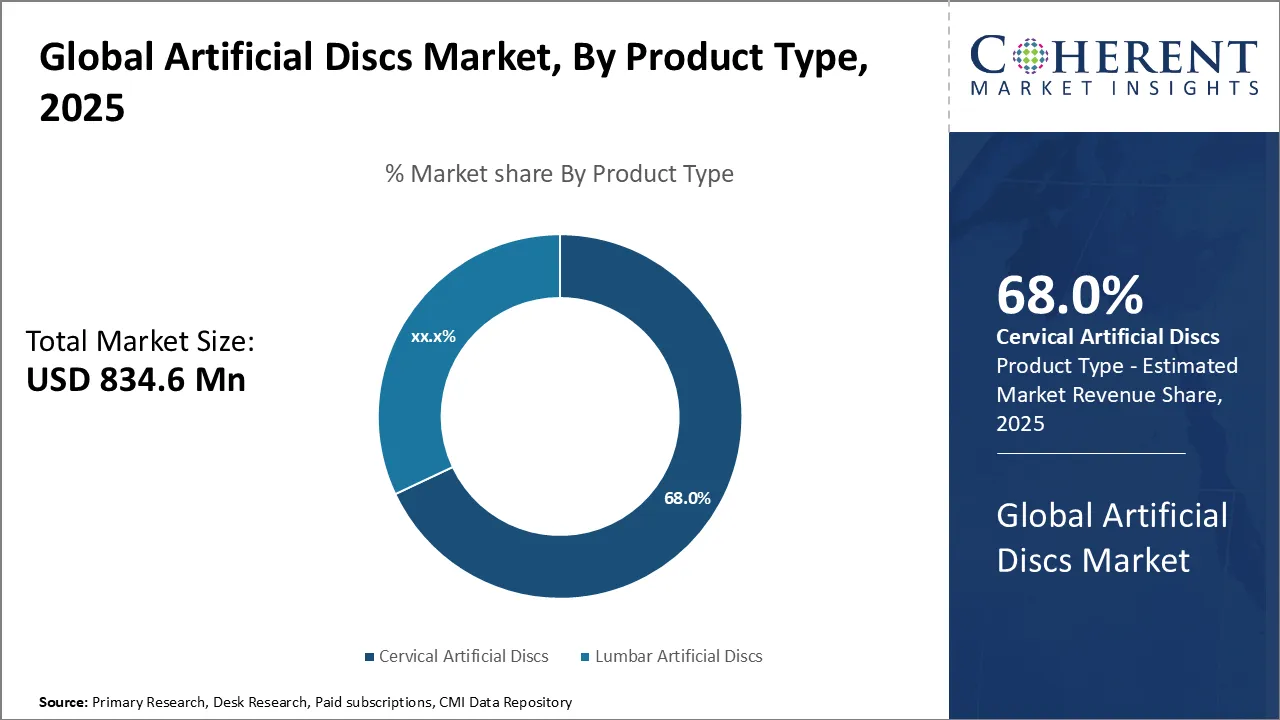
Artificial Discs Market Insights, by Product Type: Cervical Artificial Discs contribute the highest share of the market owing to its growing geriatric population.
Cervical Artificial Discs hold the largest artificial discs market share of 69.0% in 2026. The cervical artificial discs market continues to expand as patients choose less invasive therapies that preserve natural neck movement rather than spinal fusion. The rise in cervical disc degeneration, particularly among older persons and those who lead sedentary lifestyles, is increasing need for effective treatments. Surgeons prefer cervical disc replacement because it helps to prevent neighboring segment disease. Advances in device design and great clinical outcomes are encouraging more healthcare practitioners, particularly those in advanced medical institutions, to implement these revolutionary procedures.
For instance, in July 2025, Highridge Medical licensed the U.S. rights to activL and announced to launch its own activL lumbar disc. As a pioneer in cervical disc replacement, the company already leads the market with its Mobi-C cervical disc, approved for one- and two-level replacements.
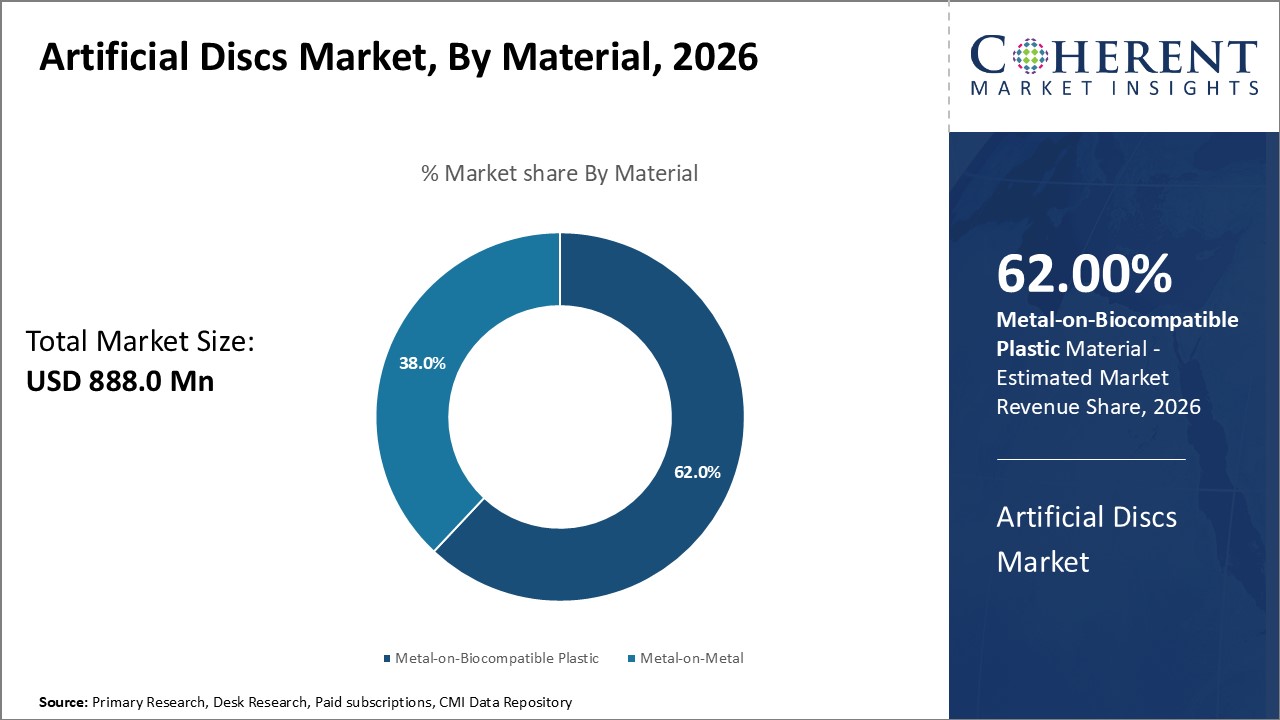
Artificial Discs Market Insights, by Material: Metal-on-Metal contribute the highest share of the market owing to its proven history / clinical data.
The demand for metal-on-metal artificial discs is increasing due to their outstanding durability and ability to withstand high mechanical stress, making them appropriate for patients with busy lifestyles. Their durable design guarantees an extended implant lifespan and reduces wear-related concerns. Surgeons like how well these discs preserve spinal stability and motion. Metal alloys and surface treatments have evolved to improve their compatibility with the body while lowering dangers. With growing clinical trust, medical professionals are increasingly using metal-on-metal alternatives for difficult spine disorders.
Artificial Discs Market Insights, by End User: Hospitals contribute the highest share of the market owing to its reimbursement & insurance partnerships.
Hospitals are actively implementing artificial discs by investing in sophisticated surgical technologies and forming competent multidisciplinary teams to manage complex spine procedures. As more patients and doctors seek motion-preserving operations that result in faster recovery and better outcomes, hospitals are expanding their spinal care services. Favorable payment rules and rising patient demand encourage the use of these implants. Hospitals also use artificial disc replacement to differentiate their services, attract more patients, and keep a competitive edge in the ever-changing healthcare market.
For instance, in August 2025, Joseph Osorio, MD, PhD, a neurosurgeon at UC San Diego Health, holds the world’s first fully personalized anterior cervical spine implant, developed using advanced imaging, AI-assisted planning, and 3D printing.
Regional Insights
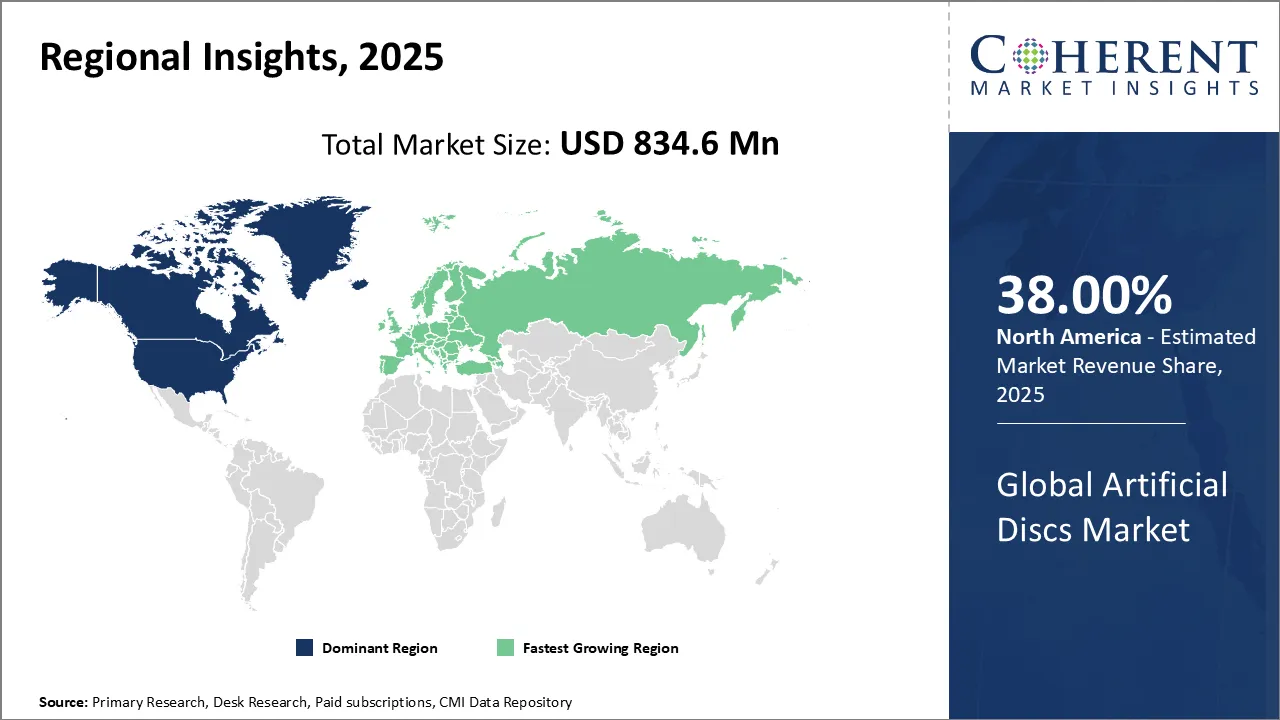
North America Artificial Discs Market Trends
North America dominates the overall market with an estimated share of 38.0% in 2026. Technological innovation and increased patient awareness are propelling the artificial discs market in North America. Hospitals and medical centers are increasingly using minimally invasive techniques to speed up recovery and improve outcomes. Key industry actors and ongoing clinical research actively encourage continual product development. Favorable insurance coverage and a robust healthcare infrastructure allow for widespread access to these modern treatments. Furthermore, the rising number of spinal problem instances among the elderly and active populations is driving rapid market growth throughout the area.
For instance, Centinel Spine®, LLC, a global leader in medical devices for cervical and lumbar spinal disease, launched Angled Endplate implants for the prodisc® L Lumbar Total Disc Replacement System. Such innovations are accelerating the artificial discs market demand.
Europe Artificial Discs Market Trends
Healthcare providers in Europe are developing the artificial discs market by focusing on minimally invasive spine procedures that improve patient recovery and mobility. Increased investment in R&D is driving the development of novel implant designs that serve a wide range of patient needs. Medical device manufacturers and clinical institutes are actively collaborating to accelerate technological adoption. Furthermore, as patients and surgeons become more aware of the benefits of motion-preserving operations, the market expands. Strong healthcare systems and acceptable reimbursement regulations also contribute to the acceptance of artificial discs across Europe.
United States Artificial Discs Market Trends
Hospitals and surgeons in the United States are rapidly changing the artificial disc industry by implementing innovative technologies that preserve spinal motion and reduce recovery times. Increased financing for spine research is accelerating the development of next-generation implants that are more durable and biocompatible. Medical device manufacturers and healthcare providers actively collaborate to accelerate clinical acceptance. Growing patient knowledge of minimally invasive therapies is driving up demand. Additionally, supportive insurance coverage and a solid healthcare system are increasing accessibility, fueling the continuous growth of artificial disc use across the country.
For instance, in July 2026, Dymicron®, a privately held medical device company specializing in advanced spinal technologies, has received Investigational Device Exemption (IDE) approval from the U.S. Food and Drug Administration (FDA) to begin a pivotal clinical study of its Triadyme®–C cervical artificial disc.
United Kingdom Artificial Discs Market Trends
Healthcare professionals in the United Kingdom are propelling the artificial discs industry forward by progressively implementing motion-preserving spinal procedures, which enhance patient outcomes and minimize hospital stays. Investments in sophisticated implant technology and continuing clinical trials are driving constant innovation. Manufacturers actively work with the NHS to smoothly integrate new gadgets into clinical practice. As patients become more aware of alternatives to standard spinal fusion, demand grows. Furthermore, government healthcare regulations and reimbursement mechanisms encourage more widespread access to these advanced treatments nationwide.
Artificial Discs Market Trend
Integration of Advanced Biomaterials
The market is increasingly shifting towards the use of innovative biomaterials that offer better biocompatibility and durability. These materials aim to reduce wear, inflammation, and rejection risks, thereby improving implant lifespan. This trend is driven by research focused on mimicking natural disc properties, encouraging smoother movement, and enhancing patient comfort. The push for materials that facilitate bone growth and reduce the need for revision surgeries is shaping future artificial disc designs.
Focus on Motion Preservation Techniques
Unlike traditional spinal fusion surgeries, artificial disc replacements prioritize preserving natural spinal motion. The trend is moving towards devices that maintain biomechanical function and reduce adjacent segment degeneration. There is increasing demand for technologies that replicate physiological disc behavior, promoting flexibility while stabilizing the spine. This approach supports quicker recovery and reduces the risk of long-term complications, marking a significant shift in spinal treatment philosophies.
Artificial Discs Market Opportunity
Expansion of Reimbursement and Insurance Coverage
Improving insurance reimbursement policies globally offers a significant growth opportunity. Enhanced coverage can make artificial disc replacement surgeries more affordable and accessible to a broader patient base. This shift can drive higher procedure volumes as financial barriers diminish, allowing healthcare providers to adopt advanced spinal solutions more widely and stimulate demand across different economic segments.
Market Report Scope
Artificial Discs Market Report Coverage
| Report Coverage | Details | ||
|---|---|---|---|
| Base Year: | 2025 | Market Size in 2026: | USD 888.0 Mn |
| Historical Data for: | 2020 To 2024 | Forecast Period: | 2026 To 2033 |
| Forecast Period 2026 to 2033 CAGR: | 6.4% | 2033 Value Projection: | USD 1,370.9 Mn |
| Geographies covered: |
| ||
| Segments covered: |
| ||
| Companies covered: | Medtronic, DePuy Synthes (Johnson & Johnson), Stryker Corporation, NuVasive, Inc., Globus Medical Inc., Orthofix International N.V., Zimmer Biomet Holdings, Inc., Alphatec Holdings, Inc., B. Braun Melsungen AG, and Centinel Spine LLC | ||
| Growth Drivers: |
| ||
| Restraints & Challenges: |
| ||
Artificial Discs Market News
- In July 2025, Highridge Medical has licensed the U.S. rights to activL® and will soon begin production to launch its own activL lumbar disc.
- In June 2025, Strenge Spine Center has launched advanced technologies and innovative treatments, including the EOSedge system. Led by Dr. K. Brandon Strenge, a specialist in artificial disc replacement, the center focuses on motion preservation and cutting-edge implant solutions.
- In September 2024, Centinel Spine® has completed 7,500 U.S. cases using its prodisc C Vivo and prodisc C SK Cervical TDR System, part of its leading total disc replacement platform.
Analyst Opinion (Expert Opinion)
- The artificial discs market is at a critical inflection point, driven less by volume expansion and more by the qualitative leap in technology and clinical outcomes. While adoption has historically been hindered by concerns over implant longevity and biomechanical performance, recent data suggests these barriers are rapidly eroding.
- Moreover, innovation in biomaterials, particularly the introduction of polycarbonate urethane composites, is redefining durability benchmarks—outperforming traditional metal-on-polymer constructs in wear testing by over 40%, according to recent lab analyses from Johns Hopkins University. This directly addresses a critical failure point that has long frustrated surgeons and patients alike.
- Another paradigm shift is the integration of AI-assisted surgical planning, which has already reduced revision rates by approximately 15% in select leading hospitals, such as the Cleveland Clinic. This tech adoption is not incremental but transformative, enabling more precise implant positioning that directly correlates with improved postoperative mobility and reduced adjacent segment disease.
- However, the market remains constrained by heterogeneous reimbursement policies across geographies, which continue to slow broader clinical uptake. Yet, the example of Germany’s expanded coverage model, which led to a 30% increase in disc replacement surgeries within two years, illustrates a clear roadmap for other markets.
- In summary, the artificial discs market is evolving from an experimental niche to a standard of care for spinal degeneration, propelled by technological innovation and improving clinical evidence. Companies that can deliver durable, motion-preserving implants coupled with data-driven surgical solutions will decisively outpace those relying on legacy designs. The future of spinal surgery will be defined not by the quantity of implants sold but by the quality and sophistication embedded in each device.
Speak to the analyst
Want personalized insights?
Take the findings above to one of our principal consultants, or have the report rebuilt around the segments, geographies and competitors you actually track.
Market Segmentation
- By Product Type (Revenue, USD Mn, 2021 - 2033)
- Cervical Artificial Discs
- Lumbar Artificial Discs
- By Material (Revenue, USD Mn, 2021 - 2033)
- Metal-on-Metal
- Metal-on-Biocompatible Plastic
- By End User (Revenue, USD Mn, 2021 - 2033)
- Hospitals
- Specialty Clinics
- Ambulatory Surgery Centers
- By Region (Revenue, USD Mn, 2021 - 2033)
- North America
- U.S.
- Canada
- Latin America
- Brazil
- Argentina
- Mexico
- Rest of Latin America
- Europe
- Germany
- U.K.
- Spain
- France
- Italy
- Russia
- Rest of Europe
- Asia Pacific
- China
- India
- Japan
- Australia
- South Korea
- ASEAN
- Rest of Asia Pacific
- Middle East
- GCC Countries
- Israel
- Rest of Middle East
- Africa
- South Africa
- North Africa
- Central Africa
- North America
- Key Players Insights
- Medtronic
- DePuy Synthes (Johnson & Johnson)
- Stryker Corporation
- NuVasive, Inc.
- Globus Medical Inc.
- Orthofix International N.V.
- Zimmer Biomet Holdings, Inc.
- Alphatec Holdings, Inc.
- Braun Melsungen AG
- Centinel Spine LLC
Sources
Primary Research interviews
- Spine surgeons and orthopedic specialists
- Hospital procurement managers
- Medical device distributors
- Rehabilitation therapists
Databases
- PubMed
- ClinicalTrials.gov
- FDA Medical Device Databases
- WHO Global Health Observatory
Magazines
- Spine Technology Today
- Orthopedics Today
- MedTech Insight
- Biomedical Engineering News
Journals
- Spine
- The Journal of Bone and Joint Surgery
- European Spine Journal
- The Spine Journal
Newspapers
- The New York Times Health Section
- The Guardian Health & Science
- The Washington Post Health
- Financial Times Healthcare
Associations
- North American Spine Society (NASS)
- International Society for the Advancement of Spine Surgery (ISASS)
- American Academy of Orthopaedic Surgeons (AAOS)
- European Spine Society (EuroSpine)
Public Domain sources
- World Health Organization (WHO) Reports
- U.S. National Institutes of Health (NIH) Publications
- Centers for Disease Control and Prevention (CDC) Data
- Open Access Scientific Repositories
Proprietary Elements
- CMI Data Analytics Tool
- Proprietary CMI Existing Repository of information for last 8 years
Get access to 250+ pages report
Every segment, forecast, competitor profile and data table behind the analysis above — available for instant download.
- ESOMAR Member
- ISO 9001:2015 Certified
- D-U-N-S Registered
- GDPR & CCPA Compliant
Missing comfort of reading report in your local language? Find your preferred language:
Transform your Strategy with Exclusive Trending Reports
Frequently Asked Questions
The Artificial Discs Market is estimated to be valued at USD 888.0 Mn in 2026, and is expected to reach USD 1,370.9 Mn by 2033.
High cost of cervical and lumbar artificial discs and stringent regulatory guidelines are the key factors hampering the growth of the artificial discs market.
Increasing prevalence of degenerative disc diseases, technological advancements in artificial disc designs, and minimally invasive spine surgery procedures are the major factors driving the artificial discs market growth.
The cervical artificial discs segment is leading segment in product type segment in the artificial discs market.
The major players operating in the artificial discs market are Medtronic, DePuy Synthes (Johnson & Johnson), Stryker Corporation, NuVasive, Inc., Globus Medical Inc., Orthofix International N.V., Zimmer Biomet Holdings, Inc., Alphatec Holdings, Inc., B. Braun Melsungen AG, and Centinel Spine LLC.
The North America region is expected lead the artificial discs market in terms of size.
The CAGR of the Artificial Discs Market is projected to be 6.4% from 2026 to 2033.