

Eye Anatomical Model Market Size and Share Analysis - 2026 To 2033
The eye anatomical model market is anticipated to grow at a CAGR of 4.17% with USD 370.58 Mn in 2026 and is expected to reach USD 493.98 Mn in 2033. Rising number of ophthalmic diseases (Globally, at least 2.2 billion people) leading to increasing patient consultation and number of ophthalmic surgeries is expected to propel growth of eye anatomical model market in near future, as these models would be used highly by doctors as well as healthcare staff to provide information to their respective patients.
Key Takeaways
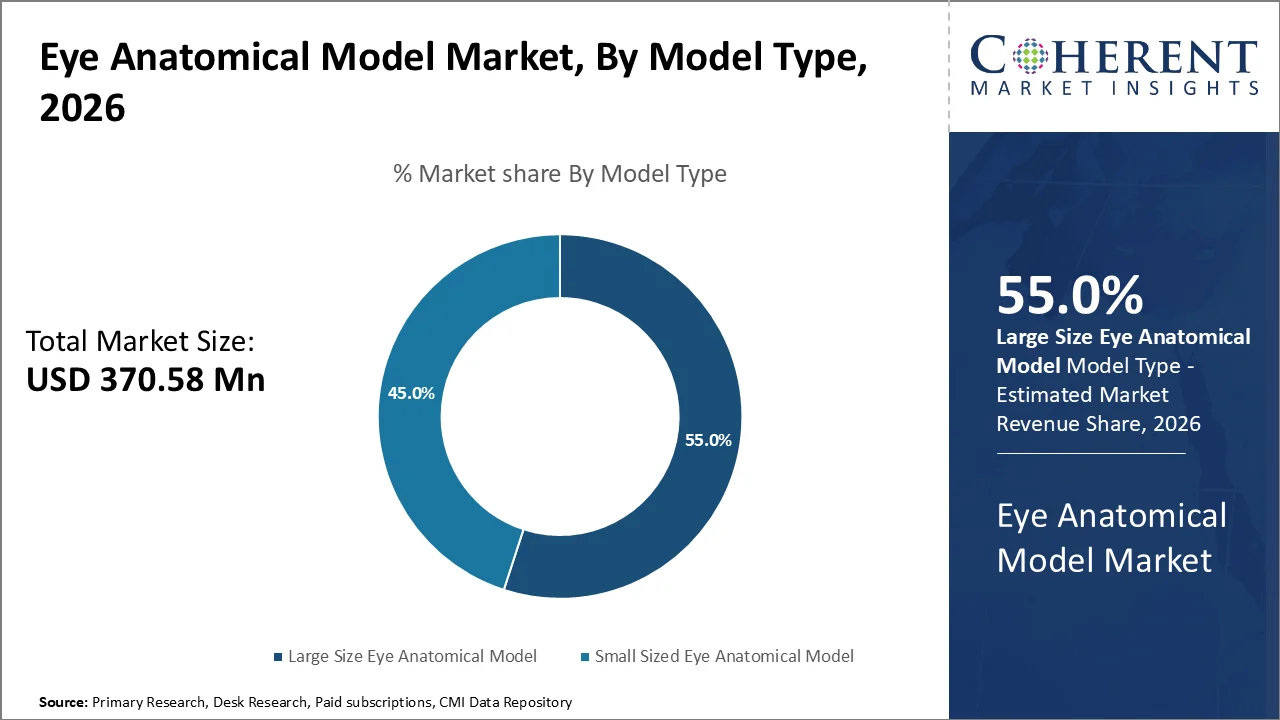
- Large size eye anatomical model segment is expected to account the largest share of 55.0% in 2026, large models are commonly used for patient education, surgical discussions, and ophthalmic training programs. There are more than 510 centers offering ophthalmology training and over 32 centers providing specialized training in different areas of eye care.
- Educational institutes segment will dominate with 45.0% in 2026, as medical schools, universities, nursing colleges, as well as allied healthcare institutions are the largest users of anatomical models. Students who used 3D-printed models achieved about 11% higher scores in objective assessments compared with students who learned through traditional teaching methods.
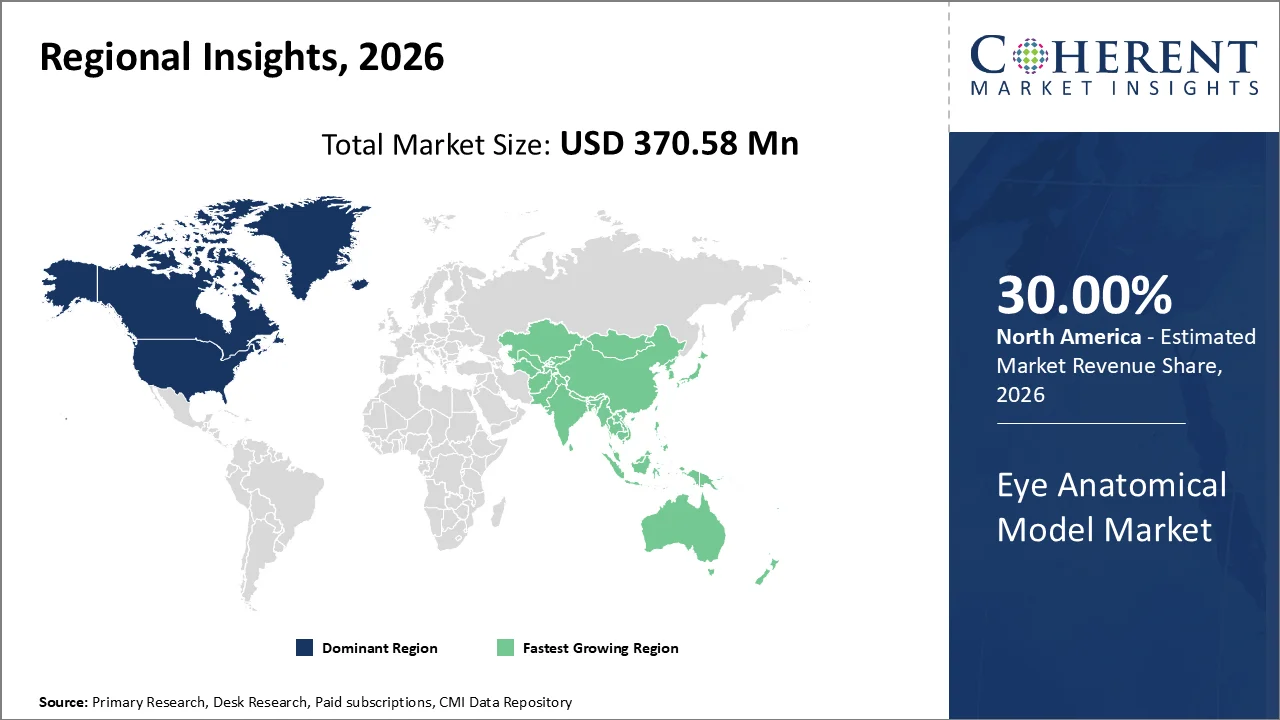
- North America is expected to acquire the dominant share of 30.00% in 2026, with increased investment in healthcare training infrastructure. The United States currently has 158 accredited medical schools that offer MD degrees and 37 accredited schools that offer DO degrees.
Segmental Insights
Why is Large Size Eye Anatomical Model Segment Acquiring the Largest Market Share?
Large size eye anatomical model segment is projected to account for the largest share of solutions in 2026, representing approximately 55.0% of the total volume. Owing to its widespread adoption across medical education institutions, ophthalmology training centers, and advanced clinical simulation programs that demand highly detailed and visually accurate anatomical representations of the human eye. There are more than 510 ophthalmology training centers and over 32 subspecialty training centers worldwide
The dominance of large-sized eye anatomical models in the global market can be attributed to several compelling factors that collectively reinforce their position as the preferred choice among educators, medical professionals, and research institutions worldwide.
Amazon India offers large-sized human eye anatomical models, such as the ARTISOUL® Eye Ball Model Study Kit, designed for anatomical education and medical learning.
Large Size Eye Anatomical Models have long established themselves as an indispensable tool in medical colleges, universities, and specialized ophthalmology training facilities primarily because of their superior ability to display intricate anatomical structures in magnified detail.
- Current Industry Events of 2026
- Market Size Estimation
- Regional Breakdown
- Competitive Landscape
- Customer Intelligence
- Segmental Analysis
- Pricing Analysis
- Key Market Drivers, Challenges & Future Trends
- Customized Insights Section
Educational Institutes Segment holds the Largest Market Share
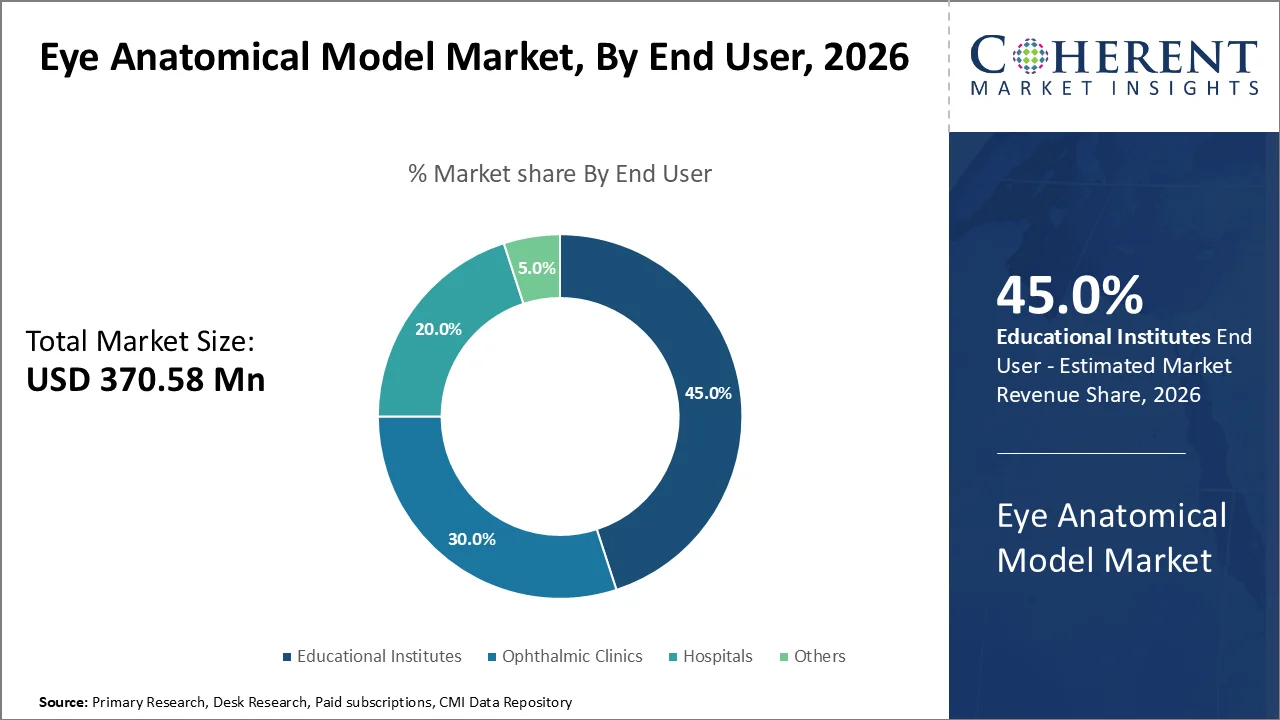
Based on end user, educational institutes segments dominates the market, accounting for a significant 45.0% share in 2026. The deeply entrenched role of anatomical models as foundational pedagogical tools in medical, optometry, as well as allied health science education worldwide is propelling the market.
The demand from educational institutes is fundamentally stimulated by the universal requirement to provide students with a tactile, three-dimensional understanding of ocular anatomy that textbooks as well as two-dimensional illustrations simply cannot replicate.
Medical schools, universities offering optometry as well as ophthalmology programs, nursing colleges, and paramedical training centers all rely heavily on eye anatomical models as a standard component of their laboratory and classroom infrastructure.
Organizations such as the World Health Organization (WHO), through its initiatives under the Vision 2020 program as well as its successor the World Report on Vision published in 2019, have consistently emphasized the critical need to expand the ophthalmology and optometry workforce globally, particularly in low- and middle-income countries.
Market Drivers
Shift from Traditional to Digital Anatomical Models is transforming the Eye Anatomical Model Industry
For decades, physical plastic eye models served as the primary educational tool in ophthalmology training as well as medical education. As these models provided basic structural understanding, they were also inherently limited in showing dynamic functions such as pupillary response, accommodation mechanisms, pathological changes, etc., within ocular tissues.
The emergence of digital as well as hybrid models has fundamentally changed this landscape. Contemporary eye anatomical models now integrate multiple technologies simultaneously, creating overall learning platforms rather than simple display objects. This advancement shows a major change in medical education toward experiential, indulgent learning methodologies that focus on functional understanding over passive observation.
3D Printing Technology: Customization and Precision: A major breakthrough in Eye Anatomical Model
One revolutionizing technological advancements is the high use of advanced 3D printing technologies. High-resolution 3D printing now enables the production of anatomically precise eye models that replicate individual patient-specific ocular structures with extraordinary accuracy.
Companies as well as academic institutions are leveraging multi-material 3D printing to build models that simultaneously represent corneal transparency, lens opacity variations, retinal layering, as well as vitreous humor consistency using different material densities and optical properties. These patient-specific models are bringing invaluable in pre-surgical planning for complex procedures such as retinal detachment repairs, glaucoma surgeries, as well as cataract extractions.
The ability to replicate diseased or abnormal eye anatomy through 3D printing is particularly significant. Surgeons can practice on models that accurately represent pathological conditions specific to their upcoming patient cases, dramatically improving surgical preparedness as well as lowering intraoperative complications. This application is driving high adoption across ophthalmic surgical training programs globally.
For instance, November 2025, Stratasys Ltd. announced that Addion GmbH and Eyecer.at GmbH in Austria are using Stratasys Digital Anatomy technology to build first 3D-printed eye models of Europe for eyelid surgery training. The technology is being used at the University of Innsbruck to aid surgeons as well as medical students practice eye procedures with realistic models, improving training quality and patient care.
Current Events and Their Impact on the Eye Anatomical Model Market
Current Event | Description and its Impact |
Government initiatives promoting medical education infrastructure expansion (2025–2026) |
|
Growing adoption of simulation-based medical education policies (2025–2026) |
|
Eye Anatomical Model Market Trends
- The market is going through a fundamental transformation as end-users are highly demanding anatomically precise, high-detail models over conventional low-fidelity replicas. The integration of augmented reality (AR) with virtual reality (VR) components into physical eye anatomical models is gaining attention, enabling hybrid learning experiences.
- Three-dimensional printing technology is advancing the manufacturing industry of anatomical models. In 2023, around 71% of companies globaly have adopted 3D printing technology, showing the escalating the use of this technology across industries. In addition, approximately 67% of manufacturers use 3D printing for prototyping, aid them develop and test new designs faster as well as more efficiently.
- Global epidemiological data consistently highlights an alarming rise in ophthalmic conditions including diabetic retinopathy, age-related macular degeneration (AMD), glaucoma, and myopia particularly across aging populations in developed economies and urbanizing populations in emerging markets.
- Beyond institutional training, an escalating application of eye anatomical models is in patient counseling as well as pre-surgical education. Ophthalmologists and optometrists are highly adopting detailed eye models during consultations to visually explain conditions and surgical procedures (e.g., LASIK, cataract extraction, vitreoretinal surgery) to patients, improving informed consent processes, treatment adherence, and patient satisfaction scores.
- In response to growing environmental consciousness among institutional procurement departments, manufacturers are pivoting toward bio-safe, recyclable, and non-toxic polymer-based materials in the production of anatomical models.
Regional Insights
North America dominates owing to Well Established Medical Education Infrastructure
North America account 30.00% market share in 2026, owing to the deeply established medical education infrastructure, widespread adoption of simulation-based learning tools, and the strong presence of ophthalmology training institutions across the United States and Canada. Companies using simulation-based training can reduce training costs by around 20–30% compared with traditional training methods in some cases.
The American Academy of Ophthalmology (AAO) has consistently focused on the incorporation of anatomical models in residency training programs, advocating for hands-on learning tools that allow medical students and practicing ophthalmologists to better understand ocular structures.
According to the AAO's educational guidelines, simulation and model-based training are considered as major components of ophthalmology residency curricula, which directly drives the demand for eye anatomical models within North American academic medical centers as well as teaching hospitals.
Furthermore, the Association of American Medical Colleges (AAMC) reported a continuous expansion in the number of active medical school enrollments across the United States, resulting in a higher requirement for anatomical teaching aids, including detailed eye models.
Asia Pacific Eye Anatomical Model Market Trends
The Asia Pacific region is poised to be the fastest-growing region through 2026-2033, expanding at a CAGR of approximately 6.8%. Rapidly expanding medical school enrollments, government-led healthcare workforce development initiatives, as well as escalating awareness regarding standardized ophthalmic education across emerging economies are the growth inducing factors.
Countries including India, China, Japan, South Korea, Australia, etc., are witnessing unprecedented growth in their medical education sectors. According to , the Indian government allocated Rs. 99,858 crore (USD 11.48 billion) for the healthcare sector in the Union Budget 2025–26.
The National Health Commission of China has been actively scaling medical workforce capacity under its Healthy China 2030 initiative, which particularly targets improvements in specialized medical education, including ophthalmology, necessitating modernized anatomical training resources in medical institutions.
Robust Healthcare Training Ecosystem is Accelerating the Eye Anatomical Model Market Demand in U.S.
The U.S. contributes the highest share in the eye anatomical model market in North America, owing to its robust healthcare training ecosystem, as well as the high institutional adoption of anatomical simulation tools across academic medical centers, ophthalmology training programs, etc.
The United States is a hub for most prestigious medical institutions across the world, including Johns Hopkins School of Medicine, Harvard Medical School, and the University of California San Francisco (UCSF), all of which have deeply integrated anatomical modeling into their ophthalmology and optometry curricula.
According to the Association of American Medical Colleges (AAMC), the United States has over 155 accredited medical schools actively training future physicians, a significant proportion of which incorporate ocular anatomical models in foundational and advanced vision science coursework.
China Eye Anatomical Model Market Trends
China contributes the highest share in the Eye Anatomical Model market in APAC, owing to its expansive healthcare system modernization initiatives, and the sheer scale of its ophthalmology training ecosystem.
The National Health Commission of China has consistently prioritized ophthalmology as a major healthcare domain, particularly given that the World Health Organization estimates that China accounts for approximately 18% of the global population living with visual impairment, generating unprecedented demand for trained ophthalmologists and optometrists who require anatomical eye models during their clinical training programs.
Furthermore, China's "Healthy China 2030" policy blueprint has directly stimulated investment in medical education tools as well as simulation-based training equipment, which includes anatomical models used for pre-clinical ophthalmology education. The Chinese Ophthalmological Society, one of the largest professional ophthalmology bodies in Asia, regularly advocates for enhanced simulation-based training, further driving institutional purchasing behavior.
Who are the Major Companies in Eye Anatomical Model Industry
Some of the major key players in eye anatomical model market include, 3B Scientific, SOMSO, GPI Anatomicals, Erler-Zimmer, Edutek Instrumentation, Sakamoto Model Corporation, Honglian Medical Tech, Xincheng, Kanren and others.
Key News
- In November 2025, Stratasys Ltd., along with Austrian medical training companies Addion GmbH and Eyecer.at GmbH, introduced Europe’s first 3D-printed anatomical eye models using Stratasys Digital Anatomy technology. The models are being used for eyelid surgery training at the University of Innsbruck to help surgeons and medical students practice procedures with realistic anatomical structures.
- In 2025, Bioniko’s 3D-printed eye model has been evaluated as a training tool for ophthalmic procedures, including internal limiting membrane peeling. Research has explored its feasibility as a realistic simulation platform for ophthalmology trainees.
Market Report Scope
Eye Anatomical Model Market Report Coverage
| Report Coverage | Details | ||
|---|---|---|---|
| Base Year: | 2025 | Market Size in 2026: | USD 370.58 Mn |
| Historical Data for: | 2020 To 2024 | Forecast Period: | 2026 To 2033 |
| Forecast Period 2026 to 2033 CAGR: | 4.17% | 2033 Value Projection: | USD 493.98 Mn |
| Geographies covered: |
| ||
| Segments covered: |
| ||
| Companies covered: | 3B Scientific, SOMSO, GPI Anatomicals, Erler-Zimmer, Edutek Instrumentation, Sakamoto Model Corporation, Honglian Medical Tech, Xincheng, Kanren and others | ||
| Growth Drivers: |
| ||
| Restraints & Challenges: |
| ||
Analyst Opinion
- The eye anatomical model market is witnessing steady momentum, primarily driven by the growing emphasis on medical education and healthcare training across institutions worldwide.
- Escalating enrollment in ophthalmology programs, optometry schools, as well as general medical colleges has substantially increased the demand for realistic and detailed anatomical models. In 2026, the United States has 13 top optometry schools. These schools awarded around 1,443 optometry degrees, showing the high demand for eye care education as well as training. These models serve as indispensable training tools, enabling students as well as professionals to understand complex ocular structures without depending completely on cadaveric specimens.
- Furthermore, high awareness regarding eye health as well as the rising prevalence of ocular disorders such as glaucoma, cataracts, macular degeneration, etc., are forcing educational institutions to invest in advanced training aids. In 2026, around 200 million people worldwide are affected by age-related macular degeneration (AMD), a common eye disease that can cause vision loss.
- However, the market faces notable restraints, including high costs associated with premium-quality models and the gradual shift toward digital simulation technologies that offer interactive three-dimensional learning experiences.
- Significant opportunities lie in the integration of augmented reality and 3D printing technologies into anatomical model development, enabling cost-effective customization and enhanced learning outcomes. Additionally, the expansion of telemedicine and remote medical education is creating fresh demand for portable and affordable eye models.
Speak to the analyst
Want personalized insights?
Take the findings above to one of our principal consultants, or have the report rebuilt around the segments, geographies and competitors you actually track.
Market Segmentation
- By Model Type (Revenue, USD Mn, 2021-2033)
- Small Sized Eye Anatomical Model
- Large Sized Eye Anatomical Model
- By End User (Revenue, USD Mn, 2021-2033)
- Hospitals
- Ophthalmic Clinics
- Educational Institutes
- Others
- By Region (Revenue, USD Mn, 2021-2033)
- North America
- U.S.
- Canada
- Latin America
- Brazil
- Mexico
- Argentina
- Rest of Latin America
- Europe
- Germany
- U.K.
- France
- Italy
- Spain
- Russia
- Rest of Europe
- Asia Pacific
- China
- India
- Japan
- Australia
- South Korea
- ASEAN
- Rest of Asia Pacific
- Middle East
- GCC
- Israel
- Rest of Middle East
- Africa
- South Africa
- Central Africa
- North Africa
- North America
Sources
Primary Research Interviews
- Ophthalmology Equipment Manufacturers
- Medical Education & Training Institutions
- Online Medical Model Retailers & Distributors
- Healthcare Simulation & E-Learning Providers
- Others
Databases
- IBISWorld
- Global Trade Atlas (GTA)
- Hoovers Business Database
- Others
Magazines
- Medical Product Outsourcing (MPO) Magazine
- Ophthalmology Times
- MedTech Intelligence Magazine
- Health Products Business Magazine
- Others
Journals
- Journal of Ophthalmic Education & Training
- Medical Science Educator Journal
- Clinical Ophthalmology (Dove Medical Press)
- Others
Newspapers
- The Wall Street Journal
- Financial Times
- MedCity News
- Others
Associations
- American Academy of Ophthalmology (AAO)
- Medical Device Manufacturers Association (MDMA)
- Association of Medical Illustrators (AMI)
- International Council of Ophthalmology (ICO)
- Others
Public Domain Sources
- American Academy of Ophthalmology (AAO)
- Medical Device Manufacturers Association (MDMA)
- Association of Medical Illustrators (AMI)
- International Council of Ophthalmology (ICO)
- Others
Proprietary Elements
- CMI Data Analytics Tool
- Proprietary CMI Existing Repository of information for last 10 years
Get access to 250+ pages report
Every segment, forecast, competitor profile and data table behind the analysis above — available for instant download.
- ESOMAR Member
- ISO 9001:2015 Certified
- D-U-N-S Registered
- GDPR & CCPA Compliant
Missing comfort of reading report in your local language? Find your preferred language:
Transform your Strategy with Exclusive Trending Reports
Frequently Asked Questions
The eye anatomical model market is expected to reach USD 493.98 Mn in 2033.
Major players operating in the global eye anatomical model market include 3B Scientific, SOMSO, GPI Anatomicals, Erler-Zimmer, Edutek Instrumentation, Sakamoto Model Corporation, Honglian Medical Tech, Xincheng, Kanren and others.
High cost of advanced and premium quality eye anatomical models limiting adoption in developing regions are the major factors that is expected to hamper growth of the market over the forecast period.
Technological advancements leading to development of highly detailed and realistic eye models is driving growth of the global Eye Anatomical Model market.
The eye anatomical model market is anticipated to grow at a CAGR of 4.17% between 2026 and 2033.
Among regions, North America is expected to account for a largest market share in the global eye anatomical model market over the forecast period.
An anatomical eye model typically features the cornea, iris, and lens. These removable or labeled pieces show the outer, middle, and inner layers of the human eye.