

Cementless Neck Stems Market Size and Share Analysis- 2026 to 2033
The Cementless Neck Stems Market size is anticipated to grow at a CAGR of 5.2%, with USD 3.85 Bn in 2026 and is expected to reach USD 5.49 Bn in 2033. The primary drivers are, to a large extent, the increasing number of total hip arthroplasties, the growing preference for cementless femoral fixation, growing demand from younger and more active patients, and advances in the development of porous coatings and implant surface technologies that promote biological fixation and long-term osseointegration. Data reported through the American Joint Replacement Registry (AJRR) show that only approximately 5.1% of elective primary total hip arthroplasty procedures performed in the U.S. in 2023 employed cemented femoral stems, with approximately 94.9% employing cementless fixation, illustrating the robust clinical adoption of cementless stems in one of the world’s largest orthopedic markets.
Key Takeaways
- The Primary (First Time) procedure segment is likely to dominate the market with 89.0% in 2026. The segment’s growth is owing to the substantially larger volume of primary total hip arthroplasty procedures compared with revision surgeries, rising osteoarthritis burden, and increasing use of cementless stems during first-time hip replacement. According to the UK Health Security Agency’s 2024-2025 surgical-site surveillance report showed that, of the recorded hip replacements, primary procedures made up 93.2% and revision procedures just 6.8%, confirming the strong procedural dominance of primary implantation.
- The 65–74 years age group segment is expected to lead the market with 35.5% in 2026. The segment’s growth is owing to the high incidence of degenerative hip disease in this age group, increasing surgical eligibility among active older adults, and greater preference for biological fixation where adequate bone quality supports osseointegration. The National Joint Registry 22nd Annual Report 2025 reported that recipients of uncemented primary hip replacements were a median age of 65 years, with an interquartile range of 58–72 years, based on 626,642 uncemented procedures.
- The women segment is set to dominate with 54.4% in 2026. The segment is expected to grow owing to the higher prevalence of osteoarthritis in women, longer life expectancy of women, age-related deterioration of joint health and the subsequent demand for hip replacement procedures. A 2025 CDC study reported an age-standardized osteoarthritis prevalence of 15.0% among women compared with 8.5% among men in the U.S.; prevalence also increased to 28.4% among people aged 65–74 years.
- The private healthcare facility sector is anticipated to lead with 58.0% in 2026. The segment’s growth is owing to shorter elective-surgery waiting times, greater availability of specialized orthopedic centers, higher procedure throughput, and increasing access to premium implant technologies in private hospitals. According to the Australian Orthopaedic Association National Joint Replacement Registry (AOANJRR), 64.5% of all hip replacement procedures in Australia were undertaken in private hospitals in 2024; the private sector recorded 38,972 hip replacements, compared with 21,442 procedures in the public sector.
- North America is expected to acquire the prominent share of 37.0% in 2026. The region’s growth is owing to the high volume of total hip arthroplasty, strong adoption of cementless femoral fixation, well-established orthopedic implant manufacturers, advanced surgical infrastructure, and favorable access to joint replacement procedures. The AAOS American Joint Replacement Registry currently contains data on more than 5 million hip and knee replacement procedures across the U.S., demonstrating the region’s substantial arthroplasty ecosystem.
Market Drivers
Rising Hip Arthroplasty Volumes are Accelerating Demand for Cementless Neck Stems
The Cementless Neck Stems Market is witnessing steady growth owing to the increasing number of primary total hip arthroplasty procedures worldwide. Rising osteoarthritis prevalence, population aging, improving access to orthopedic surgery, and increasing willingness to undergo joint replacement are expanding the addressable patient population for cementless femoral stems.
In 2025, a study published in the Journal of Arthroplasty analyzed the trends in arthroplasty in the U.S. Medicare population. The study estimated that the number of primary total hip arthroplasty procedures performed annually would increase to 594,981 in 2022 and approximately 2.17 million by 2040, with an estimated annual growth rate of 7.6% from 2023 to 2040.
Current Events and Their Impact on the Cementless Neck Stems Market
Current Event | Description and its Impact |
FDA Implements New Quality Management System Regulation for Medical Device Manufacturers (2026) |
|
CMS Launches Mandatory TEAM Model Covering Lower Extremity Joint Replacement (2026) |
|
- Current Industry Events of 2026
- Market Size Estimation
- Regional Breakdown
- Competitive Landscape
- Customer Intelligence
- Segmental Analysis
- Pricing Analysis
- Key Market Drivers, Challenges & Future Trends
- Customized Insights Section
Segmental Insights
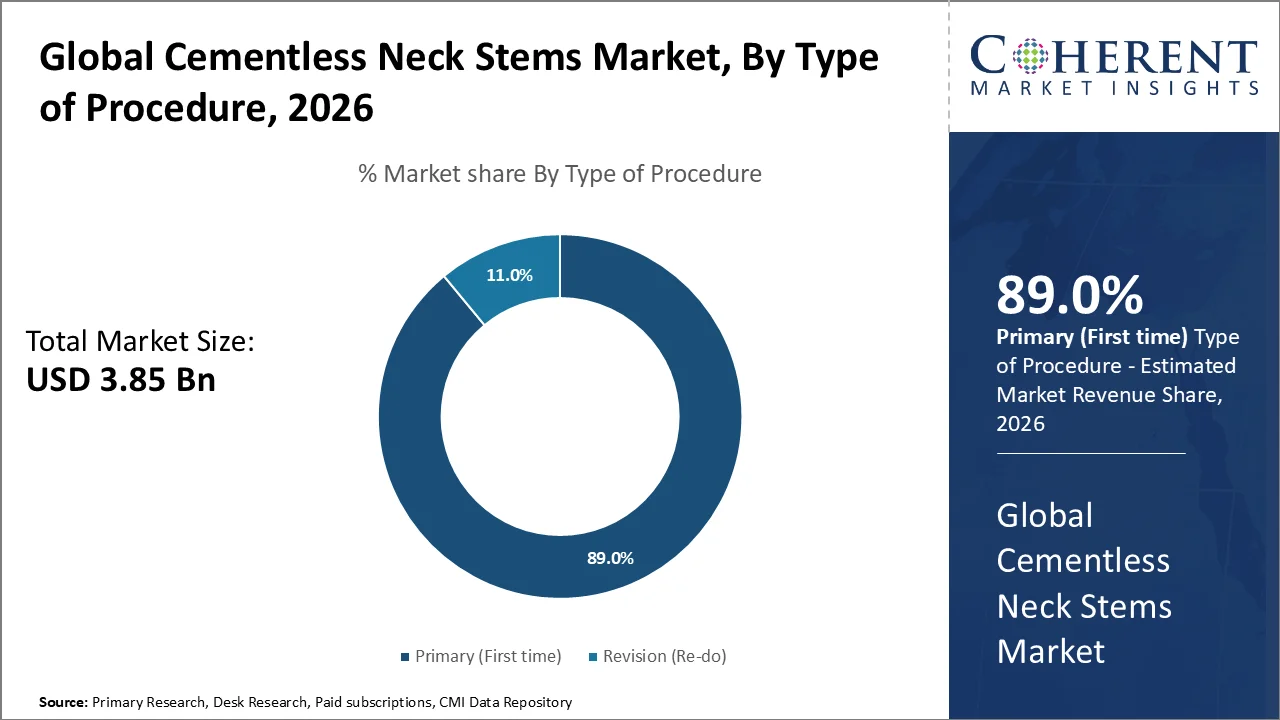
Why is the Primary (First Time) Procedure Segment Acquiring the Largest Share?
On the basis of type of procedure, the Primary (First Time) segment is projected to account for the largest Cementless Neck Stems Market share of 89.0% in 2026. The segment’s growth is owing to the substantially higher volume of first-time total hip replacement procedures, rising osteoarthritis burden, increasing surgical intervention among aging populations, and widespread use of cementless fixation in primary total hip arthroplasty.
According to the UK Health Security Agency’s 2024–2025 surveillance report, 40,764 of 43,752 hip replacement procedures, or 93.2%, were primary procedures, while revision procedures accounted for only 6.8%. This demonstrates the substantially larger procedure pool available for primary femoral stem implantation.
In May 2026, Ortho Development Corporation announced the full commercial launch of its Trivicta Hip Stem in the U.S. The Trivicta is a cementless triple-taper femoral component specifically designed for primary total hip arthroplasty and is now available through the company’s nationwide authorized distribution network.
Why is the 65–74 Years Age Group Acquiring the Largest Share?
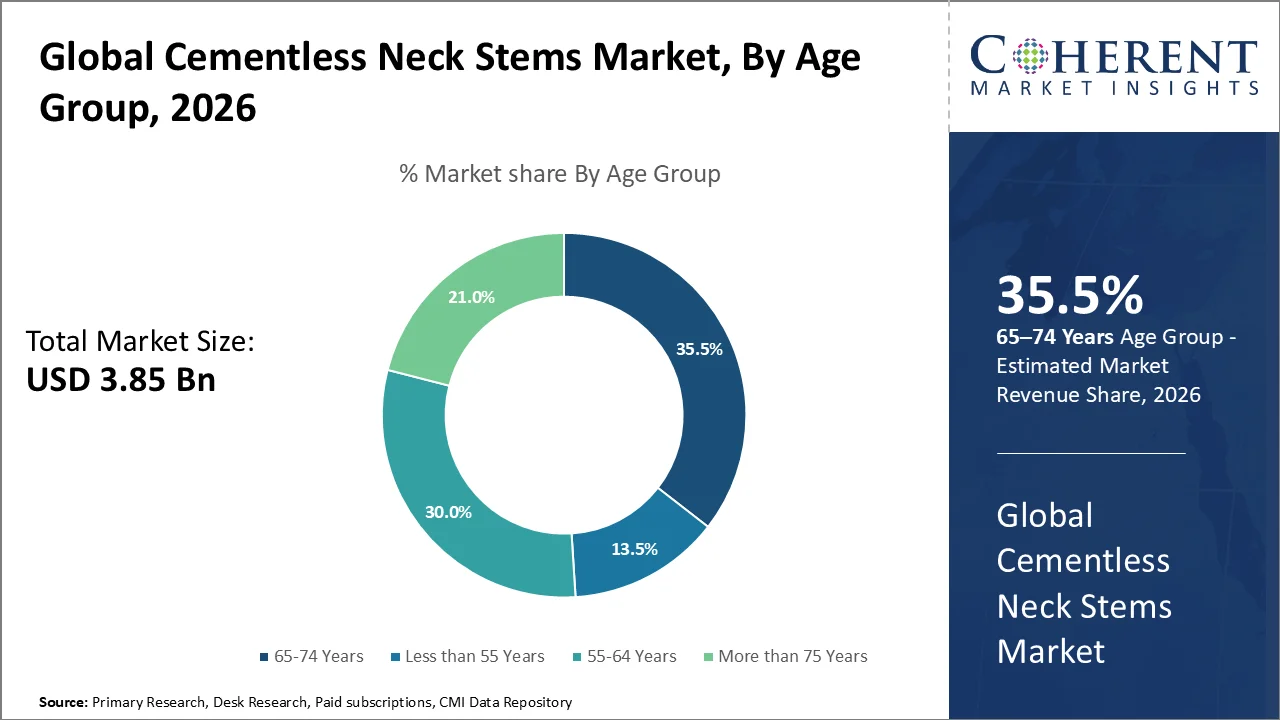
On the basis of age group, the 65–74 years segment is projected to account for the largest Cementless Neck Stems Market share of 35.5% in 2026. The segment’s growth is owing to the high prevalence of degenerative hip disorders at this age, increasing eligibility for total hip arthroplasty, relatively favorable bone quality compared with very elderly patients, and greater suitability for biological fixation using cementless stems.
The National Joint Registry 22nd Annual Report 2025 states that the majority of patients undergoing total hip replacement are between 65 and 75 years of age. Across more than 1.68 million primary hip replacement procedures, the median age at primary surgery was 69 years.
Why are Women Acquiring the Largest Market Share?
On the basis of gender, the women segment is projected to lead the Cementless Neck Stems Market with a 54.4% share in 2026. The segment’s growth is owing to the higher prevalence of osteoarthritis among women, increasing longevity, age-related deterioration of hip joints, and the resulting higher lifetime requirement for hip replacement procedures.
In 2025, a study published by the U.S. Centers for Disease Control and Prevention (CDC) reported an age-standardized prevalence of osteoarthritis of 15.0% for women and 8.5% for men. This means that women have an osteoarthritis prevalence 1.8 times higher than men.
In March 2026, Maxx Orthopedics launched the Libertas Keystone™ Hip System, a new short, cementless metaphyseal fit-and-fill femoral stem designed for direct anterior total hip arthroplasty.
Why is the Private Healthcare Facility Sector Acquiring the Largest Share?
On the basis of healthcare facility sector, the private segment is projected to account for the largest Cementless Neck Stems Market share of 58.0% in 2026. The segment’s growth is owing to high elective orthopedic procedure volumes, shorter surgical waiting times, greater availability of specialized joint-replacement centers, access to premium implant technologies, and stronger purchasing capacity for advanced cementless femoral stems.
The Private Healthcare Information Network (PHIN) reported 28,070 primary hip replacement admissions in the UK private healthcare sector in 2025. About 15,590 were self-pay procedures and 12,480 were covered by private medical insurance, indicating strong demand for elective hip replacement across both major private-payment channels.
Cementless Neck Stems Market Trends
- Collared cementless femoral stems are becoming more popular, so manufacturers are focusing on improving initial stability and decreasing the likelihood of periprosthetic fracture and loosening when choosing an implant. Registry analysis of 168,493 primary TH in 2026As found that collared cementless stems had a 42% lower risk of revision for aseptic loosening and a 35% lower risk of all-cause revision compared with non-collared stems.
- The increasing use of short cementless stems with tissue-sparing surgical techniques is promoting bone-preserving hip reconstruction. In 2026 Registry study of 30,753 primary uncemented THAs found, short femoral stems were used in 58.6% of direct anterior approach procedures versus 24.8% of lateral/posterolateral procedures.
- Increasing emphasis on risk-stratified cementless stem selection in elderly women is fueling the adoption of safer stem designs. An August 2026 Swiss National Joint Registry study involving 32,874 women aged 70 years and above found that periprosthetic femoral fracture incidence differed substantially across uncemented stem designs.
Regional Insights
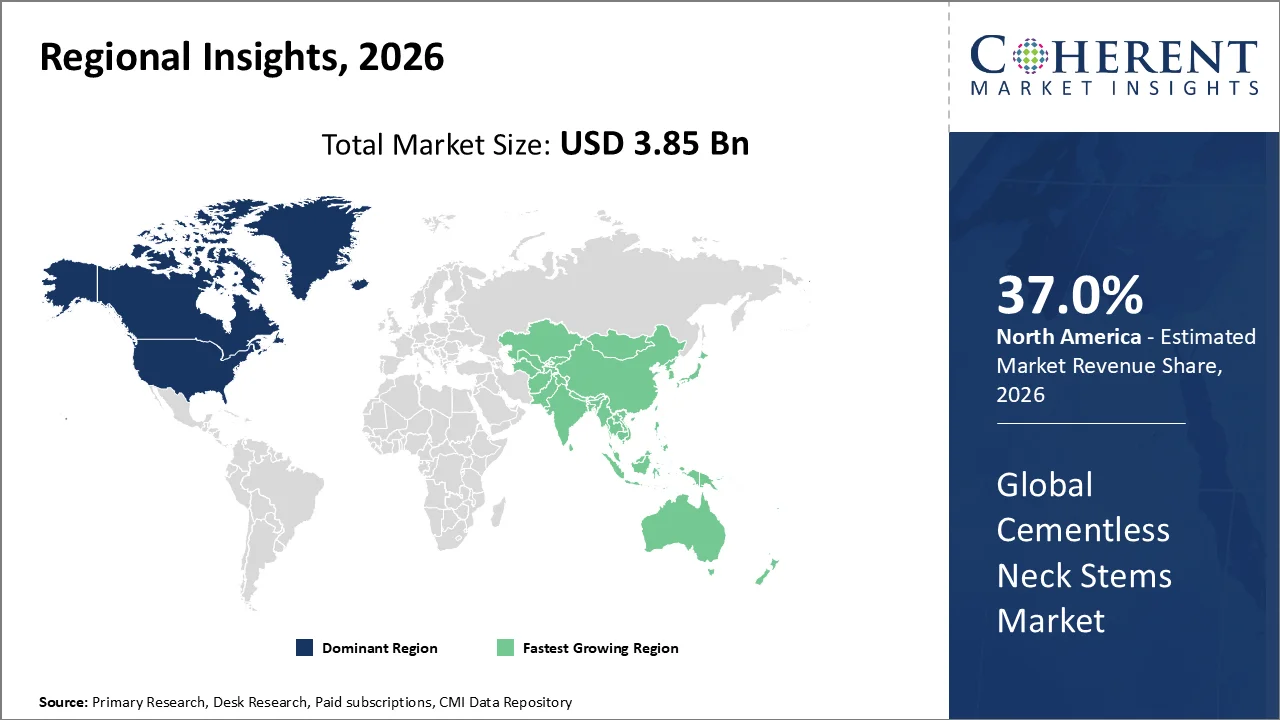
North America Dominates Owing to High Arthroplasty Volumes and Advanced Orthopedic Infrastructure
The North America region accounts for 37.0% of the Cementless Neck Stems Market share in 2026. The region’s dominance is owing to the high volume of total hip arthroplasty procedures, strong adoption of cementless femoral fixation, well-established orthopedic implant manufacturers, advanced surgical infrastructure, and increasing integration of robotic and digitally assisted hip replacement procedures.
The American Joint Replacement Registry (AJRR) 2025 Annual Report analyzed more than 4.4 million hip and knee arthroplasty procedures collected across all 50 U.S. states, the District of Columbia, and Puerto Rico. This represented an 8.8% increase compared with the preceding report, demonstrating the expanding scale of the U.S. joint replacement ecosystem.
In April 2026, Zimmer Biomet received U.S. FDA 510(k) clearance for the Avenir® Müller Stem and Avenir Complete™ Hip System. The FDA clearance covers the Avenir Müller uncemented hip stems for cementless use in total or hemi hip arthroplasty, including procedures for conditions such as osteoarthritis and avascular necrosis.
Asia Pacific Cementless Neck Stems Market Trends
Asia Pacific is expected to be the fastest-growing region in the Cementless Neck Stems Market over the forecast period. The region’s growth is owing to rapidly expanding joint-replacement capacity, increasing healthcare infrastructure, rising prevalence of degenerative hip diseases, growing access to orthopedic surgery, and strong utilization of cementless fixation across major Asian markets. Coherent Market Insights specifically identifies APAC as the fastest-growing region for cementless neck stems.
Recent clinical evidence demonstrates the large addressable arthroplasty population in Japan. A Japanese nationwide study from 2026 identified 198,102 patients aged ≥ 65 years who received primary total hip arthroplasty for osteoarthritis, osteonecrosis, or rheumatoid arthritis.
In June 2026, Japan Medical Dynamic Marketing (Japan MDM) announced that its China joint venture, Changzhou Waston Ortho Medical Appliance (WOMA), has obtained NMPA regulatory approval for locally manufactured in China artificial hip joint products.
High Cementless Fixation Adoption and Large Arthroplasty Base are Supporting the Cementless Neck Stems Market in the United States
The U.S. Cementless Neck Stems Market is showing steady growth due to the high preference for biological femoral fixation, high volumes of primary total hip arthroplasties, increasing adoption of collared and bone-preserving stem designs, and extensive clinical experience with cementless implants. Ongoing product innovation and adoption are being further driven by the existing orthopedic infrastructure and the presence of major hip implant manufacturers.
A 2025 study using the American Joint Replacement Registry (AJRR) assessed 79,022 primary total hip arthroplasties in patients aged 65 years and older. Of these, 61,854 procedures (approximately 78.3%) were associated with cementless collared metadiaphyseal-filling femoral stems compared with 17,168 using cemented fixation. This demonstrates the substantial penetration of modern cementless stem designs even among older U.S. patients.
China Cementless Neck Stems Market Trends
The China Cementless Neck Stems Market is expected to witness strong growth over the forecast period owing to rapidly expanding joint-replacement volumes, a large aging population, increasing orthopedic surgical capacity, improving access to advanced implants, and growing domestic production of hip replacement systems.
According to the National Bureau of Statistics of China, the population aged 65 years and above reached 223.65 million in 2025, representing 15.9% of the country's population and increasing by approximately 3.42 million people from 2024.
Who are the Major Companies in Cementless Neck Stems Industry
Some of the major key players in Cementless Neck Stems Market are Limacorporate S.p.a., DePuy Synthes, Smith & Nephew, Waldemar LINK GmbH & Co. KG, Altimed JSC, B. Braun Melsungen AG, DJO Global, Inc., Biotechni S.A.S, Imeco S.A., Stryker.
Key News
- In June 2026, DePuy Synthes launched VELYS™ Hip Navigation with AI Assistance in the U.S. The system supports total hip arthroplasty by automatically interpreting images and identifying anatomical landmarks during surgery.
- In January 2025, Stryker launched the Insignia® Hip Stem in India for total hip and hemiarthroplasty procedures. The stem is compatible with Mako SmartRobotics™ Total Hip 4.1 and was developed using Stryker’s SOMA anatomical database incorporating information from more than 1,300 patient CT scans.
Market Report Scope
Cementless Neck Stems Market Report Coverage
| Report Coverage | Details | ||
|---|---|---|---|
| Base Year: | 2025 | Market Size in 2026: | USD 3.85 Bn |
| Historical Data for: | 2020 To 2024 | Forecast Period: | 2026 To 2033 |
| Forecast Period 2026 to 2033 CAGR: | 5.2% | 2033 Value Projection: | USD 5.49 Bn |
| Geographies covered: |
| ||
| Segments covered: |
| ||
| Companies covered: | Limacorporate S.p.a., DePuy Synthes, Smith & Nephew, Waldemar LINK GmbH & Co. KG, Altimed JSC, B. Braun Melsungen AG, DJO Global, Inc., Biotechni S.A.S, Imeco S.A., Stryker. | ||
| Growth Drivers: |
| ||
| Restraints & Challenges: |
| ||
Analyst Opinion
- The Cementless Neck Stems Market is increasingly shifting toward advanced collared stem designs, as manufacturers focus on reducing early periprosthetic femoral fractures while maintaining biological fixation. A 2026 American Joint Replacement Registry study evaluating 8,432 modern noncemented collared stems, 74,300 noncemented collarless stems, and 9,293 cemented stems found that modern collared cementless stems recorded the lowest two-year all-cause revision rate at 1.32%, compared with 2.22% for collarless cementless stems. Periprosthetic femoral fracture incidence was also 0.19% versus 0.65%, respectively.
- The growing clinical acceptance of short and bone-preserving cementless stems is expected to expand their role in younger and more active total hip arthroplasty patients. A recent registry-based analysis covering 5,876 short-stem primary THAs reported a 10-year cumulative revision rate of 1.4% for cementless short stems, compared with 1.9% for conventional cementless femoral stems. This supports continued movement toward shorter metaphyseal-fixing designs that preserve femoral bone stock and potentially simplify future revision surgery.
- Future market growth is expected to become increasingly patient- and risk-stratified rather than driven by universal cementless adoption. A 2025 analysis of 372,967 primary total hip replacements, representing more than 2.12 million prosthesis-years, found that collared cementless stems demonstrated the lowest major-reoperation rates among men aged 68 years and above, whereas cemented polished-taper stems performed better among women aged 75 years and above.
Speak to the analyst
Want personalized insights?
Take the findings above to one of our principal consultants, or have the report rebuilt around the segments, geographies and competitors you actually track.
Market Segmentation
- By Type of Procedure (Revenue, USD Bn, 2021-2033)
- Primary (First time)
- Revision (Re-do)
- By Age Group (Revenue, USD Bn, 2021-2033)
- Less than 55 year old
- 55-64 year old
- 65-74 year old
- More than 75 year old
- By Gender (Revenue, USD Bn, 2021-2033)
- Men
- Women
- By Healthcare Facility Sector (Revenue, USD Bn, 2021-2033)
- Private
- Public
- By Region (Revenue, USD Bn, 2021-2033)
- North America
- U.S.
- Canada
- Latin America
- Brazil
- Mexico
- Argentina
- Rest of Latin America
- Europe
- Germany
- U.K.
- France
- Italy
- Spain
- Russia
- Rest of Europe
- Asia Pacific
- China
- India
- Japan
- Australia
- South Korea
- ASEAN
- Rest of Asia Pacific
- Middle East
- GCC
- Israel
- Rest of Middle East
- Africa
- South Africa
- Central Africa
- North Africa
- North America
Sources
Primary Research Interviews
- Orthopedic surgeons specializing in total hip arthroplasty
- Joint replacement and arthroplasty specialists
- Orthopedic implant manufacturers and product managers
- Hip implant design and R&D engineers
- Hospital orthopedic procurement managers
- Private and public hospital administrators
- Key opinion leaders (KOLs) in hip reconstruction and cementless fixation
Databases
- American Joint Replacement Registry (AJRR)
- National Joint Registry (NJR)
- Australian Orthopaedic Association National Joint Replacement Registry (AOANJRR)
- U.S. Food and Drug Administration (FDA)
- Centers for Medicare & Medicaid Services (CMS)
- European Database on Medical Devices (EUDAMED)
- PubMed / MEDLINE
Magazines
- Orthopedics Today
- Orthopedic Design & Technology
- Medical Device and Diagnostic Industry (MD+DI)
- Medical Product Outsourcing
- Becker’s Spine Review
- Orthoworld
Journals
- The Journal of Arthroplasty
- The Bone & Joint Journal
- Clinical Orthopaedics and Related Research
- Journal of Orthopaedic Research
- International Orthopaedics
- Journal of the American Academy of Orthopaedic Surgeons
- Hip International
Newspapers
- The Wall Street Journal
- Financial Times
- Reuters
- The Guardian
- The Economic Times
- Business Standard
Associations
- American Academy of Orthopaedic Surgeons (AAOS)
- American Association of Hip and Knee Surgeons (AAHKS)
- European Federation of National Associations of Orthopaedics and Traumatology (EFORT)
- British Orthopaedic Association (BOA)
- Australian Orthopaedic Association (AOA)
- International Society for Technology in Arthroplasty (ISTA)
- Orthopaedic Research Society (ORS)
Public Domain Sources
- Company Annual Reports and Investor Presentations
- Product Launches and Company Press Releases
- FDA 510(k), PMA, and Medical Device Registration Records
- European MDR and EUDAMED Regulatory Publications
- National Joint Replacement Registry Reports
- Government Healthcare and Reimbursement Publications
- Clinical Trial Registries and Peer-Reviewed Research Publications
- Hospital Procurement and Tender Documents
- Patent Databases such as WIPO, USPTO, and Google Patents
Proprietary Elements
- CMI Data Analytics Tool
- Proprietary CMI Existing Repository of Information for the Last 10 Years
Get access to 250+ pages report
Every segment, forecast, competitor profile and data table behind the analysis above — available for instant download.
- ESOMAR Member
- ISO 9001:2015 Certified
- D-U-N-S Registered
- GDPR & CCPA Compliant
Missing comfort of reading report in your local language? Find your preferred language:
Transform your Strategy with Exclusive Trending Reports
Frequently Asked Questions
The Cementless Neck Stems Market is expected to reach USD 5.49 Bn in 2033, from USD 3.85 Bn in 2026.
Major players operating in the global Cementless Neck Stems Market include Limacorporate S.p.a., DePuy Synthes, Smith & Nephew, Waldemar LINK GmbH & Co. KG, Altimed JSC, B. Braun Melsungen AG, DJO Global, Inc., Biotechni S.A.S, Imeco S.A., and Stryker.
The high implant and procedure cost and risk of intraoperative femoral fracture are the key factors hampering growth of the Cementless Neck Stems Market.
The increasing volume of primary total hip arthroplasty procedures and rising adoption of cementless femoral fixation are the major factors driving market growth. Advancements in porous coatings, implant surface technologies, and growing demand from younger and more active patients are also supporting adoption.
The Cementless Neck Stems Market is anticipated to grow at a CAGR of 5.2% between 2026 and 2033.
Among regions, North America is expected to dominate the Cementless Neck Stems Market, accounting for approximately 37.0% of the market share in 2026. The region benefits from high hip arthroplasty volumes, strong cementless fixation adoption, advanced orthopedic infrastructure, and the presence of established implant manufacturers.
Asia Pacific is expected to be the fastest-growing region over the forecast period. Growth is supported by expanding joint-replacement capacity, increasing healthcare infrastructure, rising prevalence of degenerative hip diseases, and improving access to orthopedic surgery.