

Closed Blood Sampling System Market Size and Share Analysis - 2026 To 2033
The Closed Blood Sampling System Market size is anticipated to grow at a CAGR of 6.9% with USD 1,030 Mn in 2026 and is expected to reach USD 1,650 Mn in 2033. The primary drivers are defined by rising intensive-care admissions, frequent arterial blood testing, stronger infection-control practices, and efforts to reduce iatrogenic blood loss and occupational exposure. CDC estimates that hospital-based healthcare personnel sustain approximately 385,000 needlestick and other sharps-related injuries annually. Additionally, a systematic review in NIH’s PubMed Central found that closed blood sampling devices reduced diagnostic blood loss by 25%. These safety and blood-conservation benefits are strengthening demand for closed sampling systems and accessories across intensive care units, emergency departments, operating rooms, hospitals, and nursing homes.
Key Takeaways
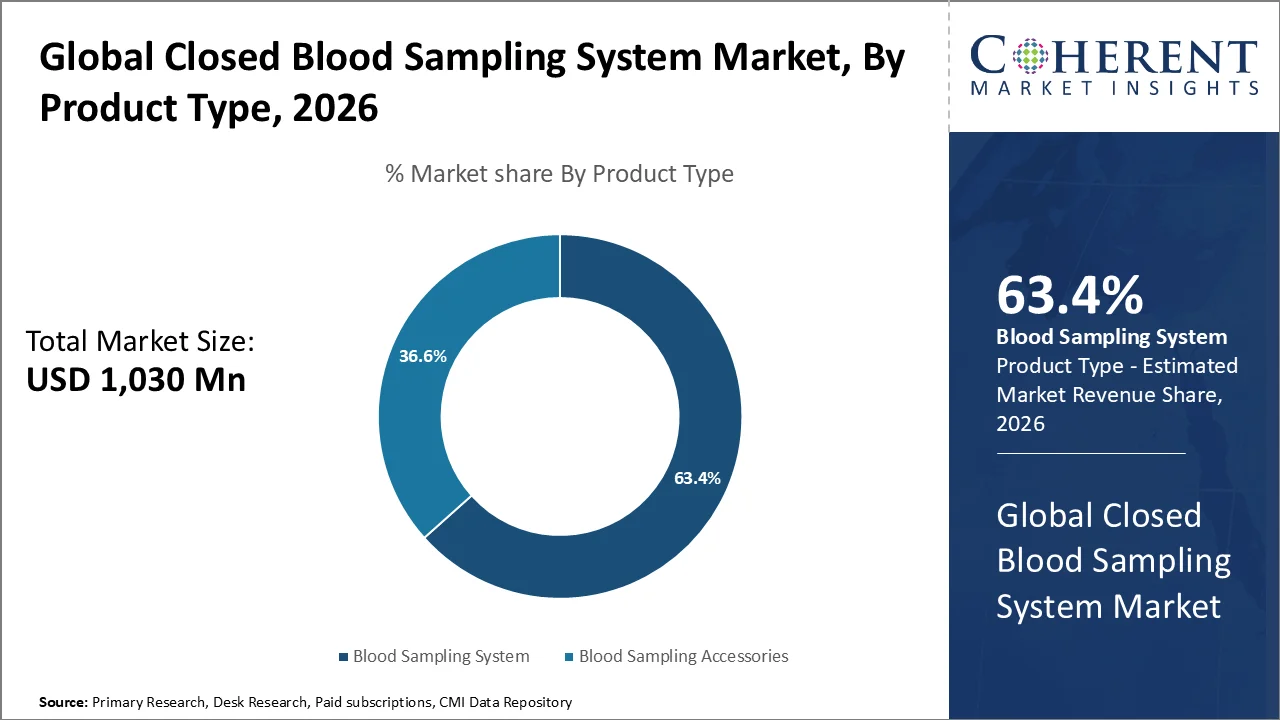
- The blood sampling system segment is likely to dominate the market with 63.4% in 2026. The segment’s growth is owing to the frequent blood collection requirements in intensive care, emergency, and sepsis management. The CDC reports that at least 1.7 Mn U.S. adults develop sepsis annually.
- The diagnostic segment is set to lead with 68.7% in 2026. The segment’s growth is owing to the high volume of laboratory investigations used for disease detection and treatment monitoring. Around 14 billion laboratory tests are performed annually across more than 266,000 CLIA-certified U.S. laboratories.
- The hospitals and nursing homes segment is set to dominate the market with 45.2% in 2026. The segment’s growth is owing to the high inpatient and critical-care testing volumes. The U.S. records 155.4 Mn emergency visits annually, including 17.8 Mn hospital admissions.
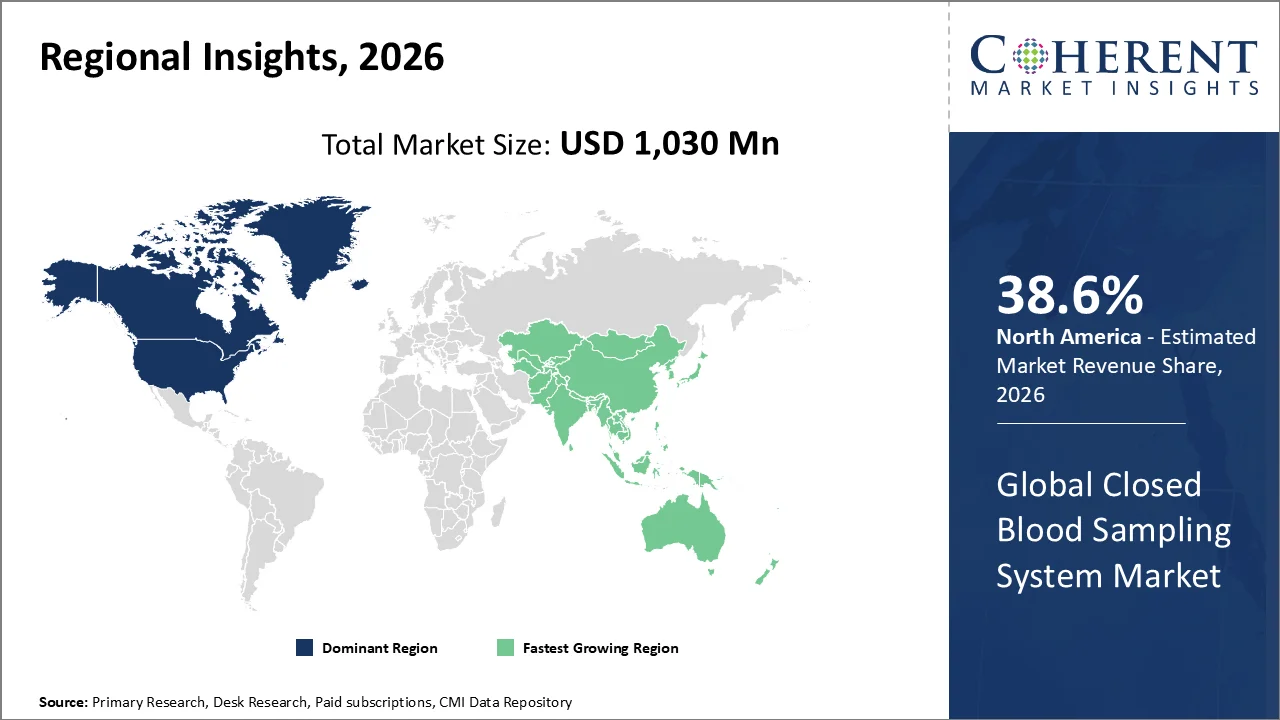
- North America is expected to acquire the prominent share of 38.6% in 2026. The region’s growth is owing to the advanced hospital infrastructure and strong healthcare spending. S. healthcare expenditure reached USD 5.3 trillion in 2024, equivalent to USD 15,474 per person.
Segmental Insights
Why is Blood Sampling System Segment Acquiring the Largest Share?
On the basis of product type, the blood sampling system segment is projected to account for the largest Closed Blood Sampling System Market share of 63.4% in 2026. The segment’s growth is owing to the hospitals’ need for repeated samples while limiting blood exposure, contamination, discarded clearing volume, and venipunctures.
CDC’s laboratory review found hospital blood-culture contamination rates ranging from 0.6% to 12.5%, despite an accepted maximum of 3%, supporting systems that standardize collection and reduce handling-related contamination. Closed sampling reservoirs can return clearing blood to patients, making them valuable in intensive care, operating rooms, neonatal care, and arterial monitoring.
- Current Industry Events of 2026
- Market Size Estimation
- Regional Breakdown
- Competitive Landscape
- Customer Intelligence
- Segmental Analysis
- Pricing Analysis
- Key Market Drivers, Challenges & Future Trends
- Customized Insights Section
Diagnostic hold the Largest Market Share
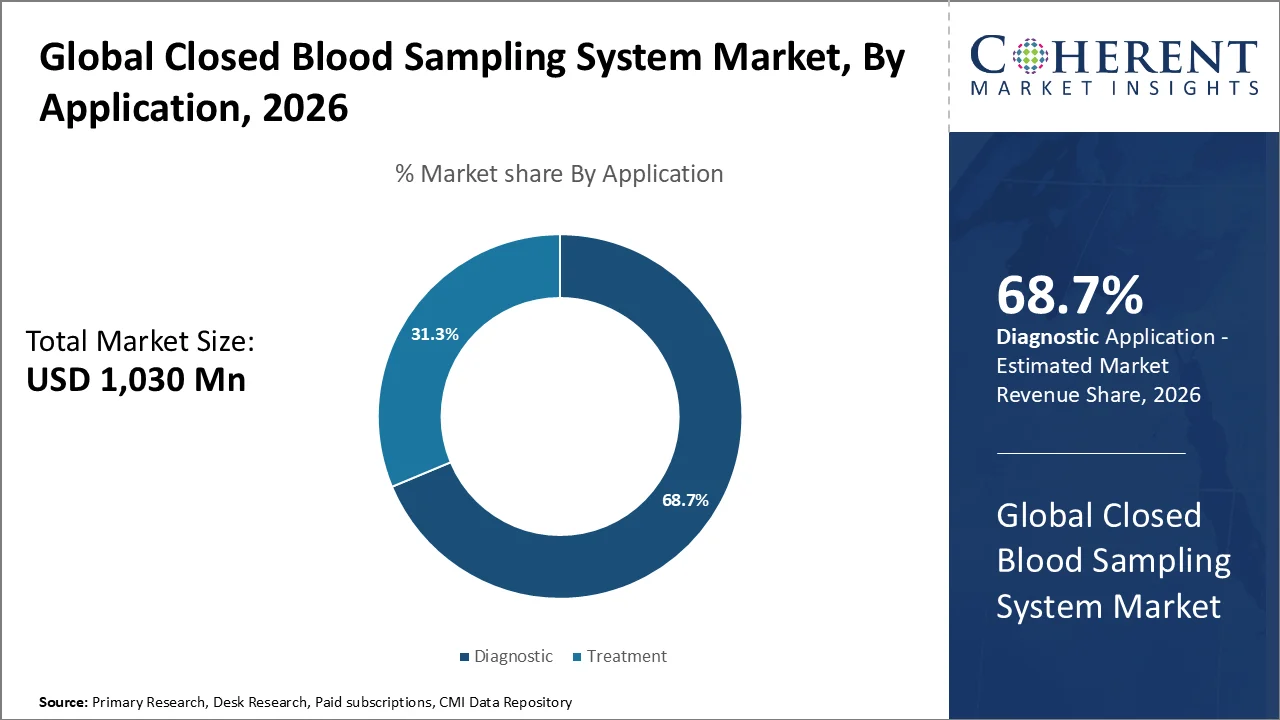
On the basis of application, the diagnostic segment lead with a major 68.7% share in 2026. The growth is owing to the central role of blood testing in clinical decision-making and infection diagnosis.
CDC reports that around 14 billion laboratory tests are performed annually in the U.S., sustaining demand for reliable, low-contamination specimen collection. CDC also states that 70% of medical decisions depend on laboratory test results, emphasizing the importance of sample integrity, repeatable access, and fewer pre-analytical errors.
In December 2025, BD Indonesia launched the BD Nexiva Closed IV Catheter System, expanding access to integrated closed vascular-access technology. Its compatibility with PIVO Pro needle-free blood-draw technology supports blood collection through existing IV access and strengthens diagnostic workflow adoption.
Market Drivers
Rising Innovations in Needle-Free Blood Collection Are Transforming the Closed Blood Sampling System Market in the U.S.
The U.S. market is shifting from conventional venipuncture-based blood collection toward technologies that permit blood to be drawn from an existing peripheral intravenous catheter. This model is designed to reduce repeated needle insertions, improve the patient experience, simplify nursing workflows, and support hospital efforts to create a “one-stick” care pathway. Needle-free peripheral-line systems typically introduce a flexible internal flow tube through the existing catheter so that blood can be collected beyond the catheter tip, where flow conditions are more suitable for obtaining a reliable specimen.
In January 2025, Becton, Dickinson and Company and Carilion Clinic announced the implementation of the BD PIVO Pro Needle-free Blood Collection Device across Carilion’s inpatient care environment. Carilion became the first health system in Virginia and the southeastern U.S. to offer the technology for inpatient needle-free blood draws. The system uses an existing peripheral IV catheter and is intended to reduce additional needlesticks, discomfort, and anxiety while supporting the collection of reliable blood specimens. Carilion serves more than one million people, providing a substantial implementation environment for evaluating workflow and patient-care benefits.
Closed-Loop Blood Conservation and Initial-Specimen Diversion: Major Breakthroughs in the Closed Blood Sampling System Market
Closed-loop blood conservation systems are designed to maintain a sealed connection between the patient’s vascular catheter, pressure-monitoring line, sampling reservoir, and collection port. During arterial or central-line sampling, the system draws the saline-diluted clearing volume into an in-line reservoir. Once the diagnostic specimen is collected, the clearing volume can be returned to the patient. This reduces blood waste, limits unnecessary line disconnections, and lowers opportunities for environmental exposure or intraluminal contamination.
Clinical evidence demonstrates a meaningful reduction in diagnostic blood loss. In the ENCLOSE randomized pilot trial, patients using a closed-loop collection system recorded mean daily blood loss of 15.5 mL, compared with 32.7 mL for patients using open sampling. Another blood-saving bundle combining a closed arterial-line system, small-volume tubes, and reduced sampling frequency lowered mean daily diagnostic blood loss from 43.3 mL to 15.0 mL. The study also recorded red-cell transfusion in 8.0% of intervention patients, compared with 31.7% in the control group, although its longitudinal design requires cautious interpretation.
Current Events and Their Impact on the Closed Blood Sampling System Market
Current Event | Description and its Impact |
FDA Quality Management System Regulation Implementation in the U.S.
|
|
Mandatory EUDAMED Modules Across the European Union |
|
Closed Blood Sampling System Market Trends
- Rising adoption of needleless, closed in-line sampling systems reduces blood exposure, contamination risks, unnecessary discard volumes, and workflow interruptions in critical-care settings.
- Integration with arterial catheters, central venous lines, and disposable pressure transducers enables simultaneous hemodynamic monitoring and repeated blood collection without opening the circuit.
- Patient blood management programs increasingly favor blood-conservation devices that return clearing volume to patients, helping limit iatrogenic blood loss and transfusion requirements.
- Growing emphasis on healthcare-worker safety supports demand for engineered closed sampling devices. CDC estimates that 62%–88% of sharps injuries could be prevented through safer medical devices. Needleless blood sampling therefore strengthens occupational protection and reduces exposure to bloodborne pathogens.
- Stronger diagnostic-quality requirements accelerate adoption of standardized, contamination-resistant collection practices. In March 2026, CDC emphasized monitoring blood-culture contamination and single-set collection rates, noting that proper collection prevents misdiagnosis and treatment delays.
Regional Insights
North America Dominates Owing to the Strong Hospital Safety and Diagnostic Infrastructure
The North America region accounts for 38.6% of the market share in 2026. The region’s growth is owing to the hospital safety programs, advanced laboratory infrastructure, and demand for needle-free blood collection.
CDC reported that the BD continuous-monitoring blood culture platform is used in about half of U.S. laboratories, indicating a large installed base for standardized blood-culture collection workflows.
In February 2025, the U.S. FDA cleared BD’s PIVO Pro needle-free blood collection device for collecting venous specimens into vacuum tubes, syringes, and blood-culture bottles from peripheral IV catheters. The clearance added blood-culture collection at initial catheter placement and extended shelf life to three years.
Asia Pacific Closed Blood Sampling System Market Trends
Asia Pacificis expected to witness strong growth in market over the forecast period. The region’s growth is owing to the expanding hospital activity, intensive-care demand, and initiatives to reduce repeated venipuncture.
Australia recorded 12.8 million hospitalizations in 2024–25, including 7.7 million in public hospitals, indicating substantial demand for routine inpatient blood collection. The Australian Institute of Health and Welfare also reported 156,000 hospitalizations involving level 3 intensive-care units during 2024–25, where frequent sampling and blood-conservation practices are particularly relevant.
In a February 2026 development, the Australian New Zealand Clinical Trials Registry listed the PIVO Trial as recruiting, with a target enrolment of 1,148 adults across four Queensland hospitals. The randomized study is evaluating whether the PIVO Pro needle-free collection device, used through newly inserted peripheral intravenous catheters, can reduce blood-culture contamination and underfilled bottles versus standard collection.
Efforts to Reduce Blood-Culture Contamination is Accelerating the Closed Blood Sampling System Market in United States
In the United States, the Closed Blood Sampling System Market is influenced by the efforts to improve blood-culture accuracy and reduce preanalytical contamination. CDC analyzed more than 5.2 million blood-culture episodes and identified unequal contamination risks across patient and facility groups, highlighting the need for standardized, protected collection workflows.
In March 31, 2026, CDC released its updated Prevent Adult Blood Culture Contamination Quality Tool, incorporating contamination and single-set monitoring methods for laboratories. This development encourages hospitals to adopt closed, needleless blood-draw technologies that limit environmental exposure, support specimen collection, and improve diagnostic reliability across emergency departments, intensive-care units, and inpatient laboratories.
China Closed Blood Sampling System Market Trends
China is emerging as a major growth market for Closed Blood Sampling System. The growth is owing to the expanding hospital workloads and demand for safer, standardized specimen collection. China’s National Health Commission reported 2.67 billion hospital visits during January–July 2025, including 2.24 billion visits to public hospitals, creating substantial recurring demand for blood-draw and laboratory consumables.
In April 2025, the National Medical Products Administration recorded approval of Smiths Medical’s arterial blood sampler kit, with approval dated April 3. This regulatory development broadens access to dedicated arterial sampling technology and supports adoption in intensive-care, respiratory, emergency, and perioperative settings requiring frequent, contamination-controlled blood-gas collection.
Who are the Major Companies in Closed Blood Sampling System Industry
Some of the major key players in Closed Blood Sampling System Market are Edwards Lifesciences Crop, ICU Medical, Inc., Smiths Medical, CardioMed Supplies Inc., Argon Medical Devices, Inc., Utah Medical Products, Inc., fannin Ltd., Velano Vascular, Inc., Ashcon International Inc., and Merit Medical Systems, Inc.
Key News
- In September 2024, Braun Medical received FDA 510(k) clearance for its Introcan Safety 2 Deep Access IV Catheter. The device offers extended lengths, automatic needlestick protection, and multi-access blood control, supporting vascular access, dwell times, and lower blood exposure.
- In October 2023, B. Braun Medical launched the Introcan Safety 2 IV Catheter with Multi-Access Blood Control. The device combines automatic needlestick protection with repeated blood-control functionality, helping reduce clinicians’ exposure to bloodborne pathogens, blood spillage, cleanup workload and costs.
Market Report Scope
Closed Blood Sampling System Market Report Coverage
| Report Coverage | Details | ||
|---|---|---|---|
| Base Year: | 2025 | Market Size in 2026: | USD 1,030 Mn |
| Historical Data for: | 2020 To 2024 | Forecast Period: | 2026 To 2033 |
| Forecast Period 2026 to 2033 CAGR: | 6.9% | 2033 Value Projection: | USD 1,650 Mn |
| Geographies covered: |
| ||
| Segments covered: |
| ||
| Companies covered: | Edwards Lifesciences Crop, ICU Medical, Inc., Smiths Medical, CardioMed Supplies Inc., Argon Medical Devices, Inc., Utah Medical Products, Inc., fannin Ltd., Velano Vascular, Inc., Ashcon International Inc., and Merit Medical Systems, Inc. | ||
| Growth Drivers: |
| ||
| Restraints & Challenges: |
| ||
Analyst Opinion
- Modern closed blood sampling systems are driven by clinical need. Nearly 97% of critically ill patients become anemic within the first eight days of admission, while diagnostic sampling can remove 40–70 mL of blood daily. Demand therefore reflects patient safety rather than a temporary trend.
- Blood conservation is another major growth factor. CDC guidance states that one adult blood-culture set requires 20–30 mL of blood, increasing cumulative diagnostic blood loss when multiple sets are collected and supporting closed, waste-reducing sampling systems.
- Clinical evidence increasingly supports wider hospital use. A systematic review found blood-conservation devices reduced laboratory blood collection volumes by 19%–80%, while a 2026 review reported that closed blood-sampling devices may lower transfusion requirements. These outcomes are expected to encourage adoption across intensive care, cardiac surgery, emergency, and neonatal settings, while supporting hospitals’ patient blood management, infection-control, and occupational-safety priorities worldwide.
Speak to the analyst
Want personalized insights?
Take the findings above to one of our principal consultants, or have the report rebuilt around the segments, geographies and competitors you actually track.
Market Segmentation
- By Product Type (Revenue, USD Mn, 2021-2033)
- Blood Sampling System
- Blood Sampling Accessories
- By Application (Revenue, USD Mn, 2021-2033)
- Diagnostic
- Treatment
- By End User (Revenue, USD Mn, 2021-2033)
- Hospitals and Nursing Homes
- Blood Banks
- Surgical Clinics
- Diagnostic Centers
- Research and Academic Organizations
- Others
- By Region (Revenue, USD Mn, 2021-2033)
- North America
- U.S.
- Canada
- Latin America
- Brazil
- Mexico
- Argentina
- Rest of Latin America
- Europe
- Germany
- U.K.
- France
- Italy
- Spain
- Russia
- Rest of Europe
- Asia Pacific
- China
- India
- Japan
- Australia
- South Korea
- ASEAN
- Rest of Asia Pacific
- Middle East
- GCC
- Israel
- Rest of Middle East
- Africa
- South Africa
- Central Africa
- North Africa
- North America
Sources
Primary Research Interviews
- Critical care physicians
- Anesthesiologists
- Emergency medicine physicians
- Intensivists
- Registered nurses
- Phlebotomists
- Hospital laboratory managers
- Infection control specialists
- Hospital procurement managers
- Medical device distributors
- Closed blood sampling system manufacturers
- Key opinion leaders (KOLs) in critical care and blood management
Databases
- World Health Organization (WHO)
- Centers for Disease Control and Prevention (CDC)
- National Institutes of Health (NIH)
- U.S. Food and Drug Administration (FDA)
- European Medicines Agency (EMA)
- Organisation for Economic Co-operation and Development (OECD)
- Eurostat
- ClinicalTrials.gov
Magazines
- Critical Care News
- Medical Device and Diagnostic Industry
- Healthcare Purchasing News
- Medical Design & Outsourcing
- MedTech Dive
Journals
- Critical Care
- Intensive Care Medicine
- Journal of Clinical Monitoring and Computing
- Journal of Intensive Care Medicine
- Transfusion
- Anesthesia & Analgesia
- American Journal of Infection Control
- Journal of Hospital Infection
Newspapers
- The New York Times
- The Guardian
- The Wall Street Journal
- Financial Times
- The Washington Post
Associations
- Society of Critical Care Medicine
- American Society of Anesthesiologists
- Association for the Advancement of Blood & Biotherapies
- Infusion Nurses Society
- International Council of Nurses
- European Society of Intensive Care Medicine
- Association for Professionals in Infection Control and Epidemiology
- International Federation of Clinical Chemistry and Laboratory Medicine
Public Domain Sources
- Company annual reports and investor presentations
- Government health ministry publications
- Hospital procurement and tender databases
- Medical device regulatory databases
- Clinical trial registries such as ClinicalTrials.gov
- Product approval and safety databases of the U.S. FDA
- Publicly available hospital and healthcare utilization statistics
- Peer-reviewed research articles and conference proceedings
Proprietary Elements
- CMI Data Analytics Tool
- Proprietary CMI Existing Repository of Information for Last 10 Years
Get access to 250+ pages report
Every segment, forecast, competitor profile and data table behind the analysis above — available for instant download.
- ESOMAR Member
- ISO 9001:2015 Certified
- D-U-N-S Registered
- GDPR & CCPA Compliant
Missing comfort of reading report in your local language? Find your preferred language:
Transform your Strategy with Exclusive Trending Reports
Frequently Asked Questions
What are the growth estimates for Closed Blood Sampling System Market till 2033?
Major players operating in the global Closed Blood Sampling System Market include Edwards Lifesciences Crop, ICU Medical, Inc., Smiths Medical, CardioMed Supplies Inc., Argon Medical Devices, Inc., Utah Medical Products, Inc., fannin Ltd., Velano Vascular, Inc., Ashcon International Inc., and Merit Medical Systems, Inc.
The high cost of advanced devices, a shortage of trained healthcare professionals, and equipment incompatibility issues are the key factors hampering growth of the market.
The urgent need to protect healthcare workers from needlestick injuries, strict safety regulations mandated by organizations like OSHA, and the rising prevalence of chronic illnesses requiring frequent blood monitoring is boosting the demand for Closed Blood Sampling System.
The Closed Blood Sampling System Market is anticipated to grow at a CAGR of 6.9% between 2026 and 2033.
Among regions, North America is expected to account for a largest market share in the global Closed Blood Sampling System Market over the forecast period.
The market outlook is positive owing to the rising prevalence of chronic diseases, a surge in surgical procedures, and a strong push for infection control and iatrogenic anemia prevention.