

Catheters Market Size and Forecast – 2026 to 2033
Catheters Market is estimated to be valued at USD 65.99 Bn in 2026 and is expected to reach USD 103.22 Bn in 2033, exhibiting a compound annual growth rate (CAGR) of 6.6% from 2026 to 2033.
Key Takeaways
- By Product, Cardiovascular Catheters acquired the prominent share of 29% in 2026 on account of the rising prevalence of cardiovascular diseases.
- By End Use, Hospital stores hold the largest market share in 2026 owing to the growing hospitalization.
- By Region, North America dominates the overall market with an estimated share of 31.7% in 2026 owing to the high prevalence of chronic diseases & aging population.
Market Overview
The global catheters market demand is experiencing strong growth owing to the increasing demand for catheters and increasing prevalence of chronic disorders across the world. Moreover, rising number of minimally invasive surgeries and growing geriatric population across the globe is expected to boost the growth of the market.
Current Events and their Impact on the Catheters Market
Current Events | Description and its impact |
Technological Advancements in Catheter Materials and Design |
|
Regulatory and Policy Changes by Region |
|
Economic and Healthcare Spending Trends |
|
End-user Feedback and Unmet Needs in the Catheters Market
- High Cost of Advanced Catheters: Healthcare facilities, especially in resource-constrained regions, often find the high costs of advanced catheters with features like antimicrobial coatings and smart technologies prohibitive. This financial barrier limits their adoption, leading to reliance on traditional, less effective alternatives and impacting patient outcomes.
- Risk of Complications and Infections: Despite technological advancements, catheter-related complications such as urinary tract infections, bladder spasms, and urethral injuries remain significant concerns. These risks discourage both patients and healthcare providers from using catheters appropriately, particularly in home settings, affecting overall market opportunities.
- Limited Availability of Specialized Catheters: In regions like Asia-Pacific and Latin America, there's a notable gap in specialized catheter solutions tailored for specific medical conditions. This limitation arises from infrastructural challenges, inadequate distribution networks, and insufficient training among healthcare providers, hindering effective catheter utilization.
- Current Industry Events of 2026
- Market Size Estimation
- Regional Breakdown
- Competitive Landscape
- Customer Intelligence
- Segmental Analysis
- Pricing Analysis
- Key Market Drivers, Challenges & Future Trends
- Customized Insights Section
Segmental Insights
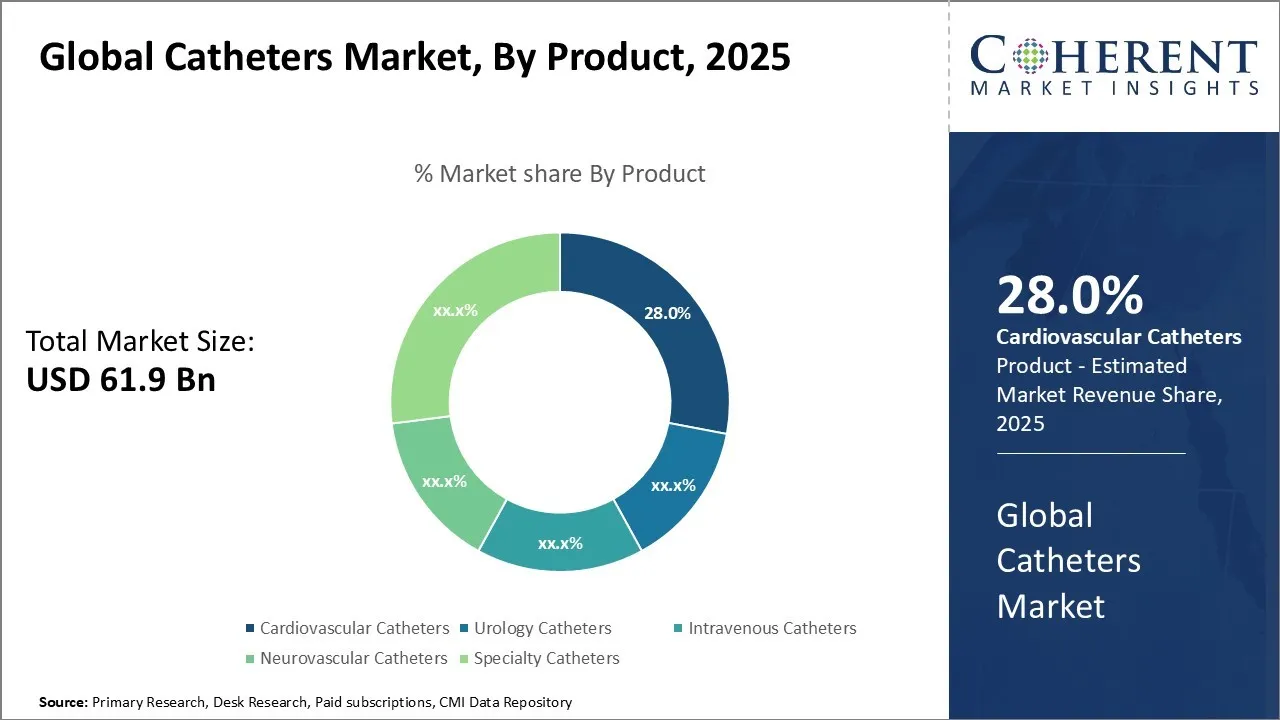
Catheters Market Insights, By Product: Cardiovascular Catheters contribute the highest share of the market owing to its enhanced imaging & ai integration
Cardiovascular Catheters acquired the prominent share of 29.0% in 2026. Cardiovascular catheters are gaining traction in the catheters market as rising cases of heart-related conditions increase the need for effective treatment options. Healthcare providers increasingly choose minimally invasive procedures for their faster recovery times and lower risk of complications. Manufacturers continue to drive innovation with advancements such as drug-eluting and steerable catheters, as well as integration with AI and enhanced imaging. Growing healthcare infrastructure and heightened awareness of cardiac health further accelerate the adoption of these devices in both developed and emerging regions.
For instance, in May 2025, Johnson & Johnson MedTech launched the SoundStar Crystal ultrasound catheter in the U.S. to support intracardiac echocardiography (ICE) imaging during cardiac ablation procedures.
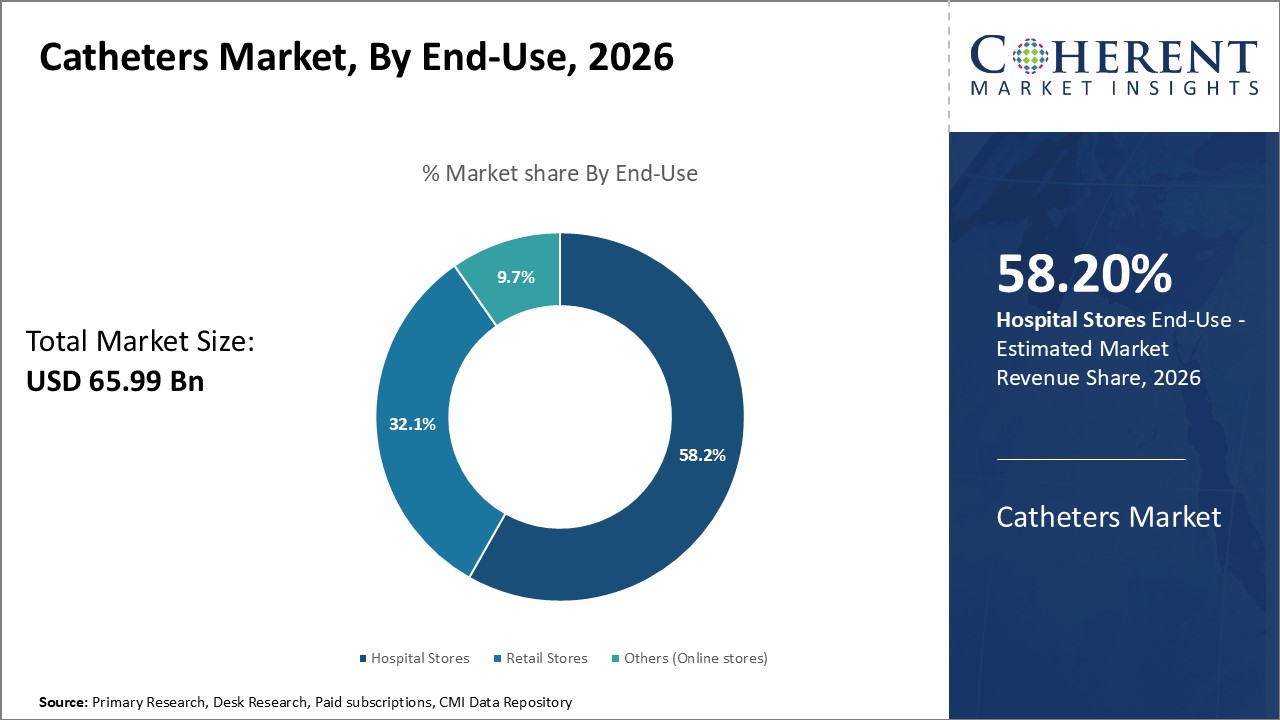
Catheters Market Insights, By End-Use: Hospital Store contribute the highest share of the market owing to its advanced storage & handling practices
Hospital stores contribute to the growth of the catheters market by maintaining reliable and timely access to various catheter types needed for diverse medical procedures. They manage centralized procurement systems that enable bulk purchasing, lower costs, and streamline supply operations. By implementing advanced inventory systems and adhering to strict regulatory standards, they ensure efficient storage and safe handling. As hospitals expand services and adopt new technologies, hospital stores actively support procedural demands and ensure a steady supply of essential catheter products.
Regional Insights
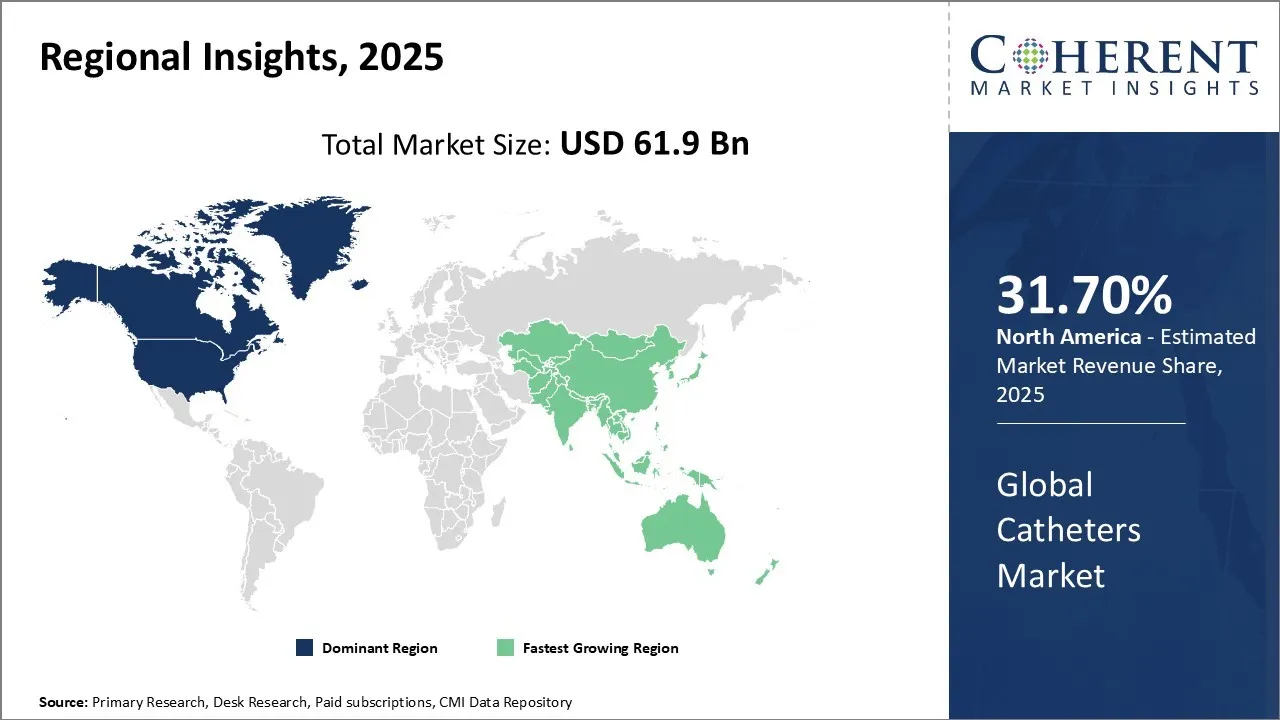
North America Catheters Market Trends
North America dominates the overall market with a share of 31.70%. The catheter market in North America grows steadily as chronic disease cases rise and the population ages. Leading med-tech companies actively drive innovation, while healthcare providers adopt catheter-based technologies for their precision, efficiency, and minimally invasive nature. Hospitals and clinics use advanced devices to streamline procedures, supported by strong regulatory systems and high clinical awareness. Skilled medical professionals and robust infrastructure further boost adoption. Increasing procedural volumes, especially in cardiovascular and neurovascular care, continue to propel the catheters market share across multiple medical specialties. For instance, in March 2026, Shockwave Medical, a part of Johnson & Johnson MedTech, launched its Javelin Peripheral IVL Catheter in the U.S. to treat peripheral artery disease (PAD). The new intravascular lithotripsy (IVL) platform is designed to break up calcium and navigate extremely narrowed vessels in patients with PAD.
Asia Pacific Catheters Market Trends
Healthcare providers across Asia-Pacific are actively adopting catheter-based interventions as chronic diseases become more widespread and demand grows for minimally invasive procedures. Hospitals continue to expand infrastructure to meet this rising need. Increased healthcare spending, better access to care, and a booming medical tourism industry draw more patients, encouraging hospitals to broaden services and extend their reach for catheter-based treatments.
For instance, in July 2026, Johnson & Johnson (J&J) MedTech launched the Varipulse platform in the Asia-Pacific region to support catheter ablation procedures for treating atrial fibrillation (AF).
Japan Catheters Market Trends
As the number of surgeries increases across medical specialties, healthcare providers are using more catheter systems in both inpatient and outpatient settings, driving wider market adoption. Manufacturers continue to improve catheter safety and efficiency by introducing antimicrobial coatings, smart features, and advanced materials to reduce infection risks. The shift toward home-based care for chronic conditions further fuels demand for portable, user-friendly catheters. Patients increasingly rely on self-catheterization and home dialysis, which expands catheter use beyond traditional hospital environments. In June 2026, Kaneka Corporation began sales of its bronchodilatation balloon catheter, SUKEDACHI™, launched in June. Developed in collaboration with Osaka University, the product combines Kaneka’s precision molding expertise with the university’s clinical and research experience, leading to successful commercialization.
India Catheters Market Trends
Innovators are enhancing patient comfort and reducing infection risks by developing hydrophilic-coated, antimicrobial, and smart catheters. Healthcare providers increasingly adopt these advanced devices, especially for minimally invasive procedures, to ensure safer and more effective treatments. Additionally, investments in healthcare infrastructure, including new hospitals and clinics, expand catheter-based treatment availability, particularly in tier 2 and tier 3 cities, where access to advanced medical devices continues to improve and drive the catheters market growth.
For instance, in May 2026, Abbott, a global healthcare company, unveiled the TactiFlex Sensor Enabled Ablation Catheter, the world’s first ablation catheter to feature both a flexible tip and contact force technology in India.
Market Report Scope
Catheters Market Report Coverage
| Report Coverage | Details | ||
|---|---|---|---|
| Base Year: | 2025 | Market Size in 2026: | USD 65.99 Bn |
| Historical Data for: | 2020 To 2024 | Forecast Period: | 2026 To 2033 |
| Forecast Period 2026 to 2033 CAGR: | 6.6% | 2033 Value Projection: | USD 103.22 Bn |
| Geographies covered: |
| ||
| Segments covered: |
| ||
| Companies covered: | Medtronic, ConvaTec, Inc., Smith Medical (Smith Group Plc.), Boston Scientific Corporation, Hollister Incorporated, and Edwards Lifesciences Corporation, among others | ||
| Growth Drivers: |
| ||
| Restraints & Challenges: |
| ||
Catheters Market Trend
- Advancements in Antimicrobial and Smart Catheters
Manufacturers are developing catheters with antimicrobial coatings and smart technologies to reduce infection risks and enhance patient safety. These innovations are particularly beneficial in minimally invasive procedures, leading to increased adoption among healthcare providers seeking safer and more effective treatment options.
Catheters Market Opportunity
- Development of Innovative Catheter Technologies
Continuous advancements in catheter technology, such as the development of new materials, improved lubricity, enhanced maneuverability, and reduced complications, are driving the adoption of catheters. These technological advancements have made catheter-based procedures safer, more effective, and less invasive. For instance, the introduction of smart catheters equipped with sensors for real-time monitoring enhances treatment accuracy, improving patient outcomes.
Catheters Market News
- In May 2025, Imperative Care expanded the Zoom stroke system by launching Zoom DuoPort technology, enabling physicians to apply the novel continuous dual aspiration technique (CDAT) on two Zoom aspiration catheters at the same time using a single vacuum source.
- In February 2025, Johnson & Johnson MedTech launched the Cereglide 92 Catheter System, a next-generation catheter designed for treating patients with acute ischemic stroke. The system features a 0.92” catheter along with the company’s Innerglide 9 delivery aid.
- In March 2025, Shockwave Medical launched its Shockwave Javelin peripheral intravascular lithotripsy (IVL) catheter in the U.S., a platform designed to break up calcium and navigate narrowed vessels in patients with peripheral artery disease (PAD).
- In December 2024, Terumo Interventional Systems (TIS), a division of Terumo Corporation, launched and made its R2P™ NaviCross® peripheral support catheter commercially available in the U.S., further expanding its radial-to-peripheral (R2P) portfolio.
Analyst Opinion (Expert Opinion)
- The catheter market stands at a critical inflection point where technological innovation is no longer a luxury but a necessity. Advanced features like antimicrobial coatings and AI-driven navigation systems are transforming clinical outcomes, drastically reducing catheter-associated infections, which historically accounted for nearly 40% of all hospital-acquired infections globally.
- Moreover, the shift towards home-based care is redefining product design priorities. Devices must now balance clinical efficacy with ease of use, durability, and patient compliance. In the U.S., where over 1.5 million patients perform intermittent self-catheterization annually, manufacturers who fail to invest in ergonomics and patient education risk losing relevance. The rise of connected smart catheters, capable of transmitting real-time data to healthcare providers, is another game-changer. These technologies not only improve procedural accuracy but also enable proactive complication management, ultimately lowering hospital readmission rates.
- From a competitive standpoint, only companies that aggressively integrate digital health solutions and invest in biomaterials will sustain growth. Traditional catheter designs are rapidly becoming commoditized, forcing innovation-centric firms to explore niche applications, such as neurovascular or pediatric catheters, where clinical needs are complex and unmet.
Speak to the analyst
Want personalized insights?
Take the findings above to one of our principal consultants, or have the report rebuilt around the segments, geographies and competitors you actually track.
Market Segmentation
- Global Catheters Market, By Product (Revenue, USD Bn, 2021 - 2033)
- Cardiovascular Catheters
- Urology Catheters
- Intravenous Catheters
- Neurovascular Catheters
- Specialty Catheters
- Global Catheters Market, By End Use (Revenue, USD Bn, 2021 - 2033)
- Hospital Stores
- Retail Stores
- Others (Online stores)
- Global Catheters Market, By Geography (Revenue, USD Bn, 2021 - 2033)
- North America
- U.S.
- Canada
- Latin America
- Brazil
- Argentina
- Mexico
- Rest of Latin America
- Europe
- Germany
- U.K.
- Spain
- France
- Italy
- Russia
- Rest of Europe
- Asia Pacific
- China
- India
- Japan
- Australia
- South Korea
- ASEAN
- Rest of Asia Pacific
- Middle East
- GCC Countries
- Israel
- Rest of Middle East
- Africa
- South Africa
- North Africa
- Central Africa
- North America
- Key Players Insights
- Medtronic
- ConvaTec, Inc.
- Smith Medical (Smith Group Plc.)
- Boston Scientific Corporation
- Hollister Incorporated
- Edwards Lifesciences Corporation
Sources
Primary Research Interviews
- Product managers and R&D heads from catheter manufacturing companies
- Procurement officers from multispecialty hospitals and surgical centers
- Interventional cardiologists, urologists, and neurologists
- Senior executives from home healthcare equipment distributors
- Biomedical engineers and regulatory affairs specialists
Databases
- PubMed Central
- U.S. FDA MAUDE Database (Manufacturer and User Facility Device Experience)
- World Bank Health Statistics
- WHO Global Health Observatory
- ClinicalTrials.gov
- Global Health Data Exchange (GHDx)
Magazines
- MedTech Innovation News
- Medical Device and Diagnostics Industry (MD+DI)
- Today's Medical Developments
- HealthTech Magazine
- BioSpectrum Asia
Journals
- Journal of Urology
- Catheterization and Cardiovascular Interventions
- American Journal of Infection Control
- Journal of Biomedical Materials Research
- International Journal of Medical Engineering and Informatics
Newspapers
- The New York Times – Health Section
- The Guardian – Global Development Professionals Network
- The Economic Times – Healthworld
- The Hindu – Science and Health
- The Washington Post – Healthcare & Policy
Associations
- U.S. Food and Drug Administration (FDA)
- Centers for Disease Control and Prevention (CDC)
- Association for the Advancement of Medical Instrumentation (AAMI)
- European Association of Urology (EAU)
- American Urological Association (AUA)
- American College of Cardiology (ACC)
Public Domain Sources
- WHO publications and global health reports
- Open-access medical device registries
- Ministry of Health and Family Welfare (India)
- National Health Service (NHS UK) guidance and procurement data
- European Medicines Agency (EMA) notifications
- Health Canada – Medical Devices Active Licence Listing
Proprietary Elements
- CMI Data Analytics Tool, and Proprietary CMI Existing Repository of information for last 8 years
Get access to 250+ pages report
Every segment, forecast, competitor profile and data table behind the analysis above — available for instant download.
- ESOMAR Member
- ISO 9001:2015 Certified
- D-U-N-S Registered
- GDPR & CCPA Compliant
Missing comfort of reading report in your local language? Find your preferred language:
Transform your Strategy with Exclusive Trending Reports
Frequently Asked Questions
The Catheters Market is estimated to be valued at USD 65.99 Bn in 2026, and is expected to reach USD 103.22 Bn by 2033.
The CAGR of the Catheters Market is projected to be 6.6% from 2026 to 2033.
Increasing demand for catheters and increasing prevalence of chronic disorders across the globe is fueling the growth of the global catheters market.
The Cardiovascular Catheters segment is the leading component segment in the global catheters market.
Risks and complications associated with catheters and presence of the substitutes are major factors restraining growth of the global catheters market.
Major players operating in the global catheters market are Medtronic, ConvaTec, Inc., Smith Medical (Smith Group Plc.), Boston Scientific Corporation, Hollister Incorporated, and Edwards Lifesciences Corporation, among others.