

Global Medical Tourism Market Size and Forecast – 2026 To 2033
The global medical tourism market is expected to grow from USD 234.79 Bn in 2026 to USD 523.92 Bn by 2033, registering a compound annual growth rate (CAGR) of 12.2% from 2026 to 2033. The market for global medical tourism is poised for significant expansion, fueled by the high healthcare costs in major source markets, which encourage patients to consider lower-cost treatment destinations abroad.
According to the Organisation for Economic Co-operation and Development, average health spending across OECD countries reached nearly USD 6,000 per capita in 2024, while the U.S. recorded more than USD 14,880 per person, or 2.5 times the OECD average, underscoring the substantial healthcare-cost differential that can encourage patients to seek treatment abroad.
Key Takeaways of the Global Medical Tourism Market
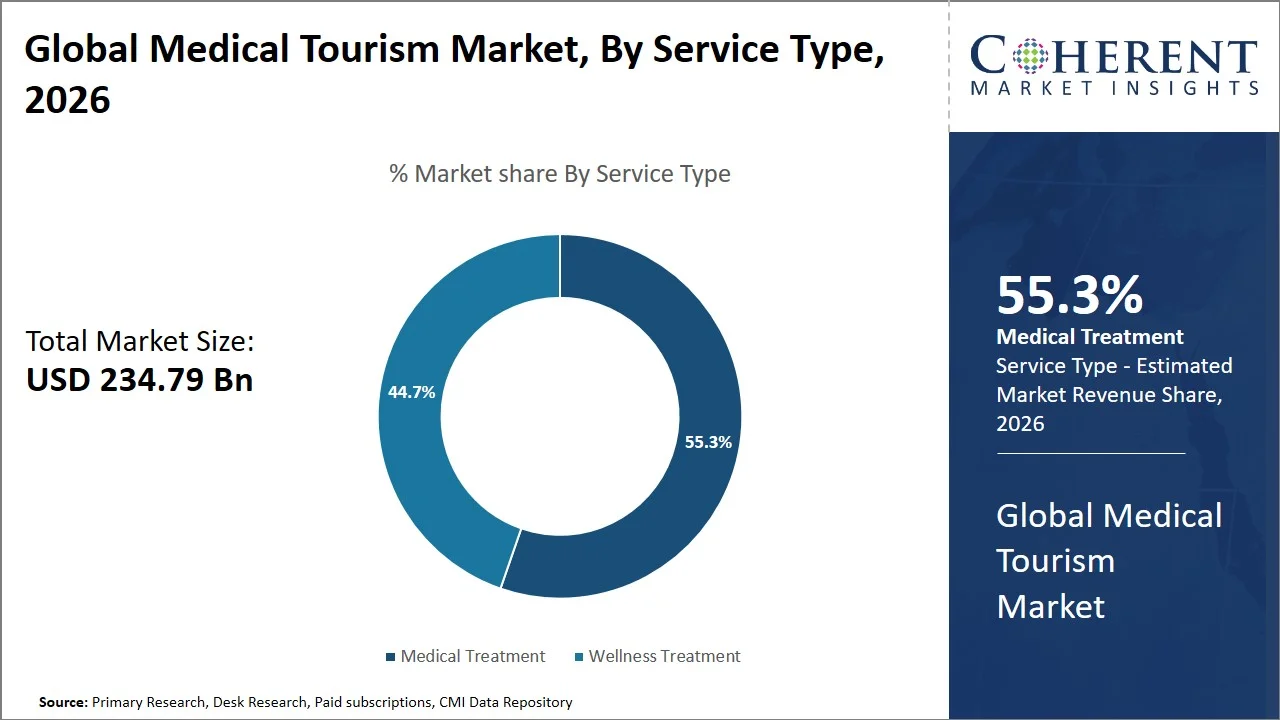
- Medical Treatment is projected to hold 55.3 % of the global medical tourism market share in 2026, making it dominant service type segment, with Asia-Pacific emerging as a leading regional market due to its established network of hospitals serving international patients and focus on accredited clinical care. For instance, India’s National Accreditation Board for Hospitals & Healthcare Providers (NABH) applies dedicated accreditation standards covering patient care, medication management, infection control, and patient safety, supporting quality assurance in hospitals catering to medical travelers.
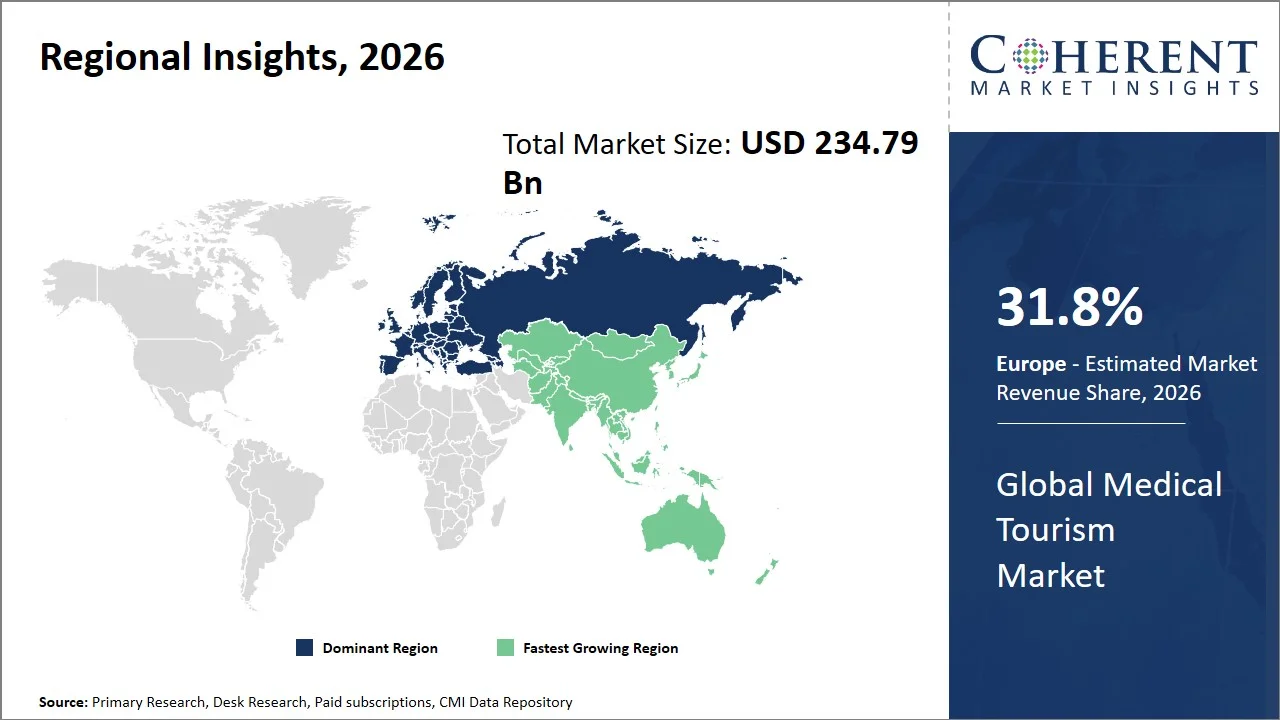
- Europe market maintains dominance with an expected share of 31.8 % in 2026, bolstered by the established cross-border healthcare mechanisms and coordinated patient-access frameworks. For instance, the European Commission’s Cross-Border Healthcare Directive provides patients with a framework for accessing healthcare services in another EU Member State and obtaining reimbursement under specified conditions.
- Asia Pacific is expected to exhibit the fastest growth in the global medical tourism market, registering an estimated CAGR of 15.4 % during 2026–2033, driven by expanding medical value travel infrastructure and government-supported international patient services. For instance, Thailand’s Department of Health Service Support (DHSS) operates the Medical Hub Division, which oversees initiatives aimed at developing Thailand as an international medical hub.
Segmental Insights
Why Do Medical Treatment Dominate the Global Medical Tourism Market?
Medical treatment is projected to hold the market share of 55.3% in 2026, due to the demand for specialized medical care, comprehensive treatment packages and the need for medical care based in developed medical tourism destination sites. The demand is boosted by the countries actively investing into developing medical tourism infrastructure and policies. For instance, Thailand’s Ministry of Public Health’s 2025 – 2034 Medical Hub Strategy aim to strengthen the nation as a health tourism hub of choice, with expanded integrated services and healthcare innovation capabilities, to boost international patient arrivals and high-value treatment capacity.
- Current Industry Events of 2026
- Market Size Estimation
- Regional Breakdown
- Competitive Landscape
- Customer Intelligence
- Segmental Analysis
- Pricing Analysis
- Key Market Drivers, Challenges & Future Trends
- Customized Insights Section
Current Events and their Impact
Current Events | Description and its Impact |
India Announces Five Regional Medical Tourism Hubs (February 2026) |
|
Türkiye Expands List of Authorized International Health Providers (August 2026) |
|
Türkiye Updates International Health Tourism Regulation (May 2025) |
|
Medical Tourism Market Dynamics
Market Drivers
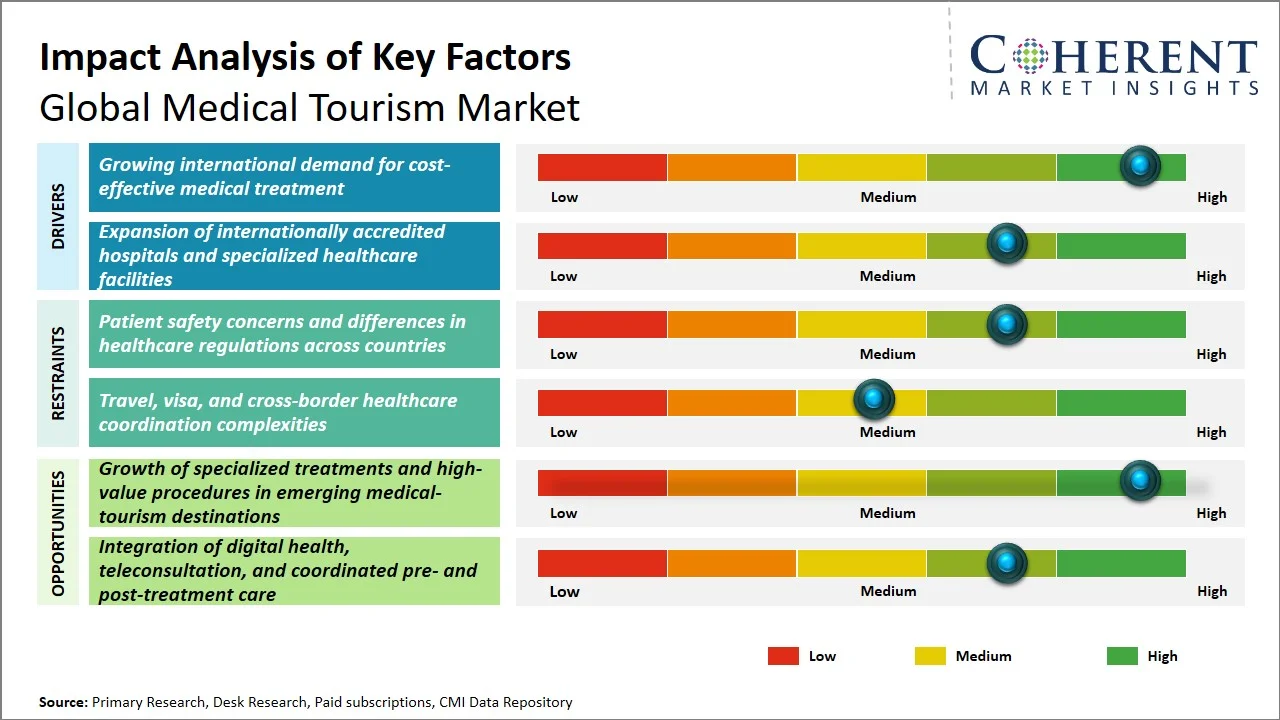
- Growing international demand for cost-effective medical treatment: Rising healthcare costs and differences in treatment pricing across countries are encouraging patients to consider overseas care, particularly for elective and specialized procedures. The availability of defined international-patient pricing can further improve cost transparency and simplify treatment-cost comparisons for prospective medical tourists. For instance, in January 2026, Thailand’s Ministry of Public Health issued its 2025 healthcare-service fee manual specifically for foreign patients, providing defined service rates for foreigners treated within its public healthcare system.
- Expansion of internationally accredited hospitals and specialized healthcare facilities: The expansion of internationally accredited hospitals and specialized treatment facilities is strengthening the capacity of medical-tourism destinations to handle complex procedures and international patients. Accreditation provides a standardized framework for patient safety, clinical quality, and continuity of care, helping hospitals demonstrate their readiness to serve overseas patients. For instance, in 2025, India’s National Accreditation Board for Hospitals & Healthcare Providers (NABH) accredited hospitals across international markets, including KIST Medical College in Nepal, IBN Sina Medical College Hospital in Bangladesh, and Amiri Medical Complex in Afghanistan, under its 5th Edition hospital standards.
- Expansion of government-led medical tourism facilitation frameworks: Governments are increasingly simplifying the administrative process for international patients by introducing dedicated medical-visa categories and centralized platforms for healthcare information. These measures can reduce friction in arranging overseas treatment and improve access to verified hospitals and healthcare providers. For instance, in February 2025, the Government of India reported that its e-medical visa and e-medical attendant visa facilities had been extended to nationals of 167 countries, while the Advantage Healthcare India portal provides international patients with information on medical treatment and healthcare providers.
Emerging Trends
- AI-enabled patient matching and treatment planning: Medical tourism platforms are increasingly using AI to analyze medical records, match patients with suitable hospitals and specialists, and provide preliminary treatment comparisons before travel. This is shifting patient acquisition from traditional facilitator-led referrals toward technology-assisted care navigation.
- Integration of robotic-assisted procedures into medical tourism offerings: Advanced robotic surgery is becoming an increasingly visible differentiator for international hospitals, particularly for complex and minimally invasive procedures. Medical-tourism destinations are increasingly positioning access to robotic-assisted treatment as part of their premium international-patient offerings.
- Development of end-to-end international patient ecosystems: Hospitals and medical-tourism networks are moving beyond treatment coordination toward integrated journeys covering hospital selection, remote assessment, travel arrangements, insurance, appointments, and post-treatment monitoring. This is creating more structured, digitally connected pathways for international patients.
Regional Insights
Why is Europe a Strong Market for Medical Tourism?
Europe leads the global medical tourism market, accounting for an estimated 31.8% share in 2026, attributed to the presence of well-developed healthcare system infrastructure, extensive experience and specialist clinical knowledge and maturity of the system of cross-border healthcare. An integrated patient-access system ensures easy flow of patients for planned medical procedures across European countries which also implies definite rights and reimbursement conditions.
For instance, the European Commission's Cross-Border Healthcare Directive enables EU patients to acquire rights to obtain planned healthcare abroad within another EU Member State and defines the circumstances in which their healthcare system in their country of origin is required to provide compensation. Furthermore, availability of highly specialized medical treatments coupled with mature healthcare infrastructure makes the continent attractive to both European medical tourists and those from overseas.
Why Does Asia Pacific Medical Tourism Market Exhibit High Growth?
Asia Pacific is expected to exhibit the fastest growth in the global medical tourism market, registering an estimated CAGR of 15.4% during 2026–2033. The region is projected to account for approximately 28.0% of the global market in 2026, owing to lower treatment cost, growth in healthcare facilities and rise of specialized services. The region is growing as a major global healthcare hotspot with advanced treatment capabilities combined with low treatment costs. The relaxation of medical visa procedures, investment in healthcare infrastructure and target-specific investment approaches of some countries such as India, China, Japan, and Thailand add much to boost the development of medical tourism market of the region.
Furthermore, enhanced international accreditation of healthcare facilities and integration of services would make the region even more popular. For instance, the Singapore’s Ministry of Health has launched national quality and safety monitoring regime in the area of healthcare, ensuring consistent standard of healthcare delivery in the entire island.
Global Medical Tourism Market Outlook for Key Countries
Why is the UK Leading Innovation and Adoption in the Medical Tourism Market?
The UK is ideally placed to benefit from innovations in medical tourism with expertise in all the key areas of clinical research, health tech and private care capacity. Its health innovation system driven by the NHS provides the perfect framework for supporting innovators to develop and deploy new diagnostic, therapeutic and digital health solutions and upcoming regulation from the MHRA in 2025 for AI in healthcare will further expedite its safe and efficient deployment.
Is India a Favorable Market for Medical Tourism Market?
India is seen as an attractive market for medical tourism driven by country’s well-developed medical treatments eco-system and rising numbers of inbound international patients particularly for treatments of chronic diseases or complex surgery treatments are positive aspects. The Medical- Travel Facilitation in India further strengthens by different visa and health-tourism packages. For instance, India received 644,387 foreign tourists for medical purposes in 2024, while e-Medical and e-Ayush visa facilities are available to travelers from 171 countries.
Is China Emerging as a Key Growth Hub for the Medical Tourism Market?
China represents an emerging rather than a developed opportunity driven by specialized medical zones and cutting-edge treatment in the area of advanced and specialized medicine, as well as improved access to the world's best medical technologies. In addition, the scope of its medical tourism ecosystem is broadening beyond traditional cures to cover precision medicine, rehabilitation, aesthetic medical care and Traditional Chinese Medicine (TCM).
Why Does Germany Top the European Medical Tourism Market?
Germany constitutes a significant and mature market for medical tourism reinforced by Germany's well-developed, specialized healthcare environment that offers proven expertise in diagnostics, advanced treatment, medical technology and research-oriented medicine. Its broad base of doctors and facilities offers global patients wide coverage for the provision of tertiary and ultra-specialized treatment and therapies.
Is Medical Tourism Market Developing in Japan?
Japan is becoming a prime destination for medical tourism, due to the country’s high medical technologies, planned medical and non-medical services for international patients, as well as state assistance for medical travel. Japan is expanding the preparation and medical cooperation framework and supporting mechanisms to serve patients seeking medical services abroad, especially for specialized areas of medicine, to prepare for medical inbound programs.
Health Expenditure per Capita in Selected Medical Tourism Markets, 2024
Country | Health Expenditure per Capita, 2024 |
U.S. | 14,885 |
Switzerland | 9,963 |
Germany | 9,365 |
Norway | 9,393 |
The Netherlands | 8,436 |
Australia | 7,469 |
France | 7,367 |
Canada | 7,301 |
UK | 6,774 |
Japan | 5,790 |
South Korea | 4,979 |
Mexico | 1,588 |
Türkiye | 2,309 |
Thailand | 1,102 |
OECD Average | 5,967 |
How is the growth of specialized treatments and high-value procedures in emerging medical-tourism destinations creating new growth opportunities in the medical tourism market?
The medical tourism industry is becoming increasingly segmented with emerging destinations developing specialization in various complex procedures to target overseas patients. At the same time, the overall value proposition for medical tourism is enhancing as international facilities continue to invest and expand specialized care services for cardiology, orthopedics, oncology, and fertility among others. For instance, in June 2025, Dubai Health Authority gave initial go-ahead to set up the country’s first proton therapy center that will open in 2028 offering advanced cancer therapy for patients across the region.
Market Players, Key Development, and Competitive Landscape
Key Developments
- In July 2026, CureMeAbroad signed strategic Memoranda of Understanding (MoUs) with Asia Cosmetics in Thailand and Dr. Brenda’s Clinic in Mexico to expand cross-border access to cosmetic and aesthetic treatments for patients from Western markets. The partnerships strengthen patient referral, treatment coordination, quality standards, and post-treatment support, expanding organized medical-tourism corridors across key international destinations.
- In October 2025, The Medical Travel Company raised USD 4.5 million in seed funding to expand its UK–India medical travel platform, strengthen digital patient-management systems, and expand clinical partnerships across India. The company’s model combines UK medical oversight with treatment at internationally accredited Indian hospitals and post-treatment support, highlighting growing investment in structured cross-border healthcare services.
- In May 2025, BAPIO Training Academy (BTA), The Medical Travel Company (TMTC), and Marengo Asia Hospitals announced a global partnership to establish a medical value travel pathway between the UK and India, offering consultations, treatment at BTA-accredited hospitals, specialized aftercare, and post-treatment insurance for returning UK patients.
Competitive Landscape
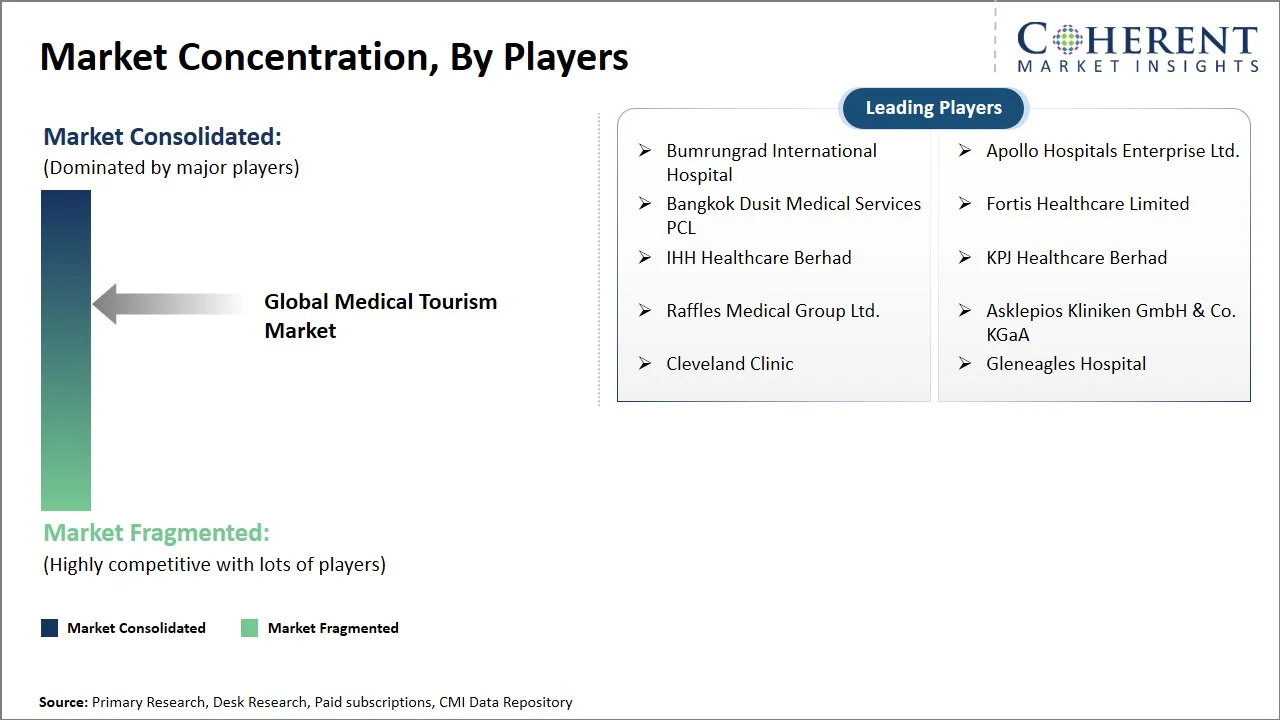
The global medical tourism market is moderately competitive, with market dynamics shaped by clinical expertise, treatment affordability, specialized healthcare infrastructure, international patient management, accreditation, and digital healthcare capabilities. Market participants are increasingly focusing on strengthening specialized treatment capacity, improving international patient coordination, expanding quality-assured healthcare services, and integrating medical care with travel and post-treatment support. Key focus areas include:
- Expansion of specialized and complex treatment capabilities
- Strengthening internationally accredited hospitals and quality-assurance systems
- Development of dedicated international patient coordination and facilitation services
- Integration of digital health, teleconsultation, and remote follow-up services
- Expansion of integrated treatment, rehabilitation, wellness, and post-treatment care pathways
Market Report Scope
Medical Tourism Market Report Coverage
| Report Coverage | Details | ||
|---|---|---|---|
| Base Year: | 2025 | Market Size in 2026: | USD 234.79 Bn |
| Historical Data for: | 2020 To 2024 | Forecast Period: | 2026 To 2033 |
| Forecast Period 2026 to 2033 CAGR: | 12.2% | 2033 Value Projection: | USD 523.92 Bn |
| Geographies covered: |
| ||
| Segments covered: |
| ||
| Companies covered: | Bumrungrad International Hospital, Apollo Hospitals Enterprise Ltd., Bangkok Dusit Medical Services PCL, Fortis Healthcare Limited, IHH Healthcare Berhad, KPJ Healthcare Berhad, Raffles Medical Group Ltd., Asklepios Kliniken GmbH & Co. KGaA, Cleveland Clinic, Gleneagles Hospital | ||
| Growth Drivers: |
| ||
| Restraints & Challenges: |
| ||
Analyst Opinion (Expert Opinion)
- In the coming years, global medical tourism market is expected to move from a primarily cost-driven model toward a value-, specialization-, and outcomes-driven model. Future growth will increasingly be shaped by specialized procedures, internationally accredited healthcare infrastructure, digital pre- and post-treatment coordination, and integrated patient journeys. Providers that can combine clinical expertise with transparent pricing, seamless international-patient services, and continuity of care are likely to gain a stronger competitive position.
- The maximum opportunities are foreseen within medical treatment for specialized/complex procedures in India. The country offers a combination of comparatively competitive treatment costs, expanding advanced-care capabilities, a large pool of specialized medical professionals, and established international-patient infrastructure. Within medical treatment, cardiovascular, oncology, orthopedic, transplant, and fertility procedures are particularly attractive areas for expansion as patients increasingly seek complex care with shorter waiting times and greater affordability.
- In order to gain a competitive advantage market players should prioritize specialization rather than competing solely on treatment cost by developing centers of excellence around high-value procedures and strengthening international patient pathways. Investment in multilingual patient coordination, virtual pre-consultation, remote post-treatment monitoring, transparent treatment packages, and partnerships with overseas healthcare providers can improve patient conversion and continuity of care. Providers should also build destination-specific strategies based on the treatment needs, affordability expectations, and travel accessibility of key source markets.
Speak to the analyst
Want personalized insights?
Take the findings above to one of our principal consultants, or have the report rebuilt around the segments, geographies and competitors you actually track.
Market Segmentation
- Service Type Insights (Revenue, USD Bn, 2021 - 2033)
- Medical Treatment
- Wellness Treatment
- Regional Insights (Revenue, USD Bn, 2021 - 2033)
- North America
- U.S.
- Canada
- Latin America
- Brazil
- Argentina
- Mexico
- Rest of Latin America
- Europe
- Germany
- U.K.
- Spain
- France
- Italy
- Russia
- Rest of Europe
- Asia Pacific
- China
- India
- Japan
- Australia
- South Korea
- ASEAN
- Rest of Asia Pacific
- Middle East
- GCC Countries
- Israel
- Rest of Middle East
- Africa
- South Africa
- North Africa
- Central Africa
- North America
- Key Players Insights
- Bumrungrad International Hospital
- Apollo Hospitals Enterprise Ltd.
- Bangkok Dusit Medical Services PCL
- Fortis Healthcare Limited
- IHH Healthcare Berhad
- KPJ Healthcare Berhad
- Raffles Medical Group Ltd.
- Asklepios Kliniken GmbH & Co. KGaA
- Cleveland Clinic
- Gleneagles Hospital
Sources
Primary Research Interviews
- Hospitals and healthcare providers serving international patients
- Medical tourism facilitators and international patient management companies
- Government tourism and healthcare authorities
- Health insurance providers and international health insurers
- Airlines, travel agencies, and medical-travel service providers
- Accreditation and healthcare quality-assurance organizations
- Telemedicine and digital-health service providers
- Pharmaceutical, medical-device, and diagnostic service providers supporting international patients
Stakeholders
- Hospitals and healthcare providers serving international patients
- Medical tourism facilitators and international patient service providers
- Government healthcare and tourism authorities
- Health insurance and international assistance providers
- Travel, hospitality, and medical-travel service providers
- End-use Sectors
- Multispecialty and tertiary-care hospitals
- Specialty healthcare centers
- Fertility and reproductive healthcare centers
- Dental and cosmetic treatment centers
- Rehabilitation and wellness facilities
- International patient and medical-value-travel centers
- Regulatory & Health Bodies
- World Health Organization (WHO)
- Ministry of Tourism, Government of India
- Ministry of Health and Family Welfare, Government of India
- European Commission – Cross-Border Healthcare
- Centers for Disease Control and Prevention (CDC)
Databases
- WHO Global Health Observatory
- OECD Health Statistics
- World Bank – World Development Indicators
- UN Tourism Data and Statistics
Journals
- Journal of Travel Medicine
- BMC Health Services Research
- The Lancet
Associations
- World Medical Association (WMA)
- International Hospital Federation (IHF)
- International Society for Quality in Health Care (ISQua)
Public Domain Sources
- WHO publications on cross-border healthcare and international travel
- Government of India medical-tourism publications
- UN Tourism health-tourism publications
- OECD healthcare statistics
- European Commission cross-border healthcare publications
Proprietary Elements:
- CMI Data Analytics Tool, Proprietary CMI Existing Repository of information for last 10 years.
Get access to 250+ pages report
Every segment, forecast, competitor profile and data table behind the analysis above — available for instant download.
- ESOMAR Member
- ISO 9001:2015 Certified
- D-U-N-S Registered
- GDPR & CCPA Compliant
Missing comfort of reading report in your local language? Find your preferred language:
Transform your Strategy with Exclusive Trending Reports
Frequently Asked Questions
The global medical tourism market is estimated to be valued at USD 234.79 Bn in 2026 and is expected to reach USD 523.92 Bn by 2033.
Medical treatment dominates due to the rising demand for specialized, complex, and cost-effective healthcare services unavailable or less affordable in patients’ home countries.
Medical tourism is the practice of traveling across international borders to access medical, surgical, or wellness-related healthcare services.
Patients increasingly choose medical tourism to access specialized healthcare, lower treatment costs, shorter waiting times, and advanced medical facilities.
Significant differences in healthcare costs between countries encourage patients to seek comparable treatments in destinations offering more affordable care.
International accreditation strengthens patient confidence by demonstrating adherence to recognized standards for healthcare quality, safety, and clinical processes.
Teleconsultations, digital patient platforms, and remote follow-up services are simplifying treatment planning and improving coordination throughout the international patient journey.