

Deep Brain Stimulation Devices Market for Parkinson’s Disease Size and Forecast – 2026 -2033
The Deep Brain Stimulation Devices Market for Parkinson’s Disease is anticipated to grow at a CAGR of 10.7% with USD 1.6 Bn share in 2026 and is expected to reach USD 3.4 Bn in 2033. The Deep Brain Stimulation Devices Market for Parkinson’s Disease grows because more people develop neurological conditions like Parkinson’s disease, essential tremor, and epilepsy, and the global population continues to age. Parkinson’s disease affects more than 1.1 million people in the U.S., with nearly 90,000 new cases diagnosed each year.
Key Takeaways
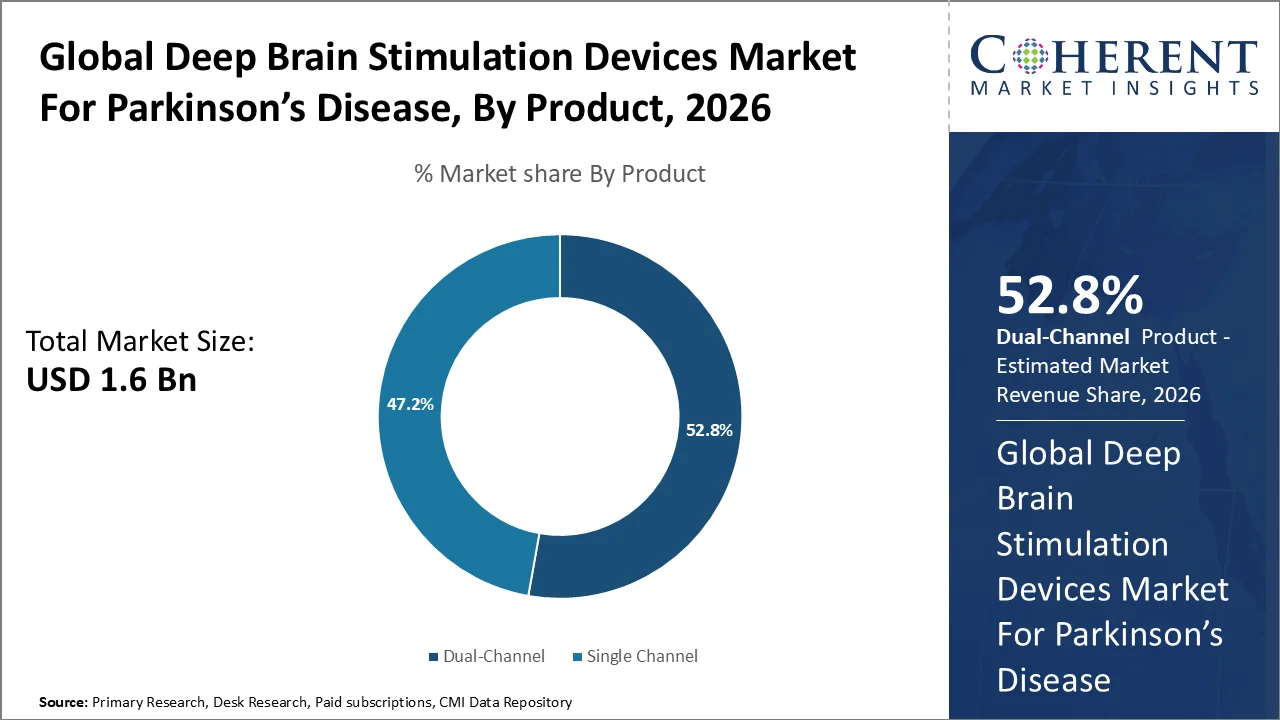
- Dual-Channel holds the largest market share of 52.8% in 2026 owing to the rising neurological disorder burden. An estimated 43% of the global population lives with a neurological disorder, including autism, learning disorders, dementia, and stroke.
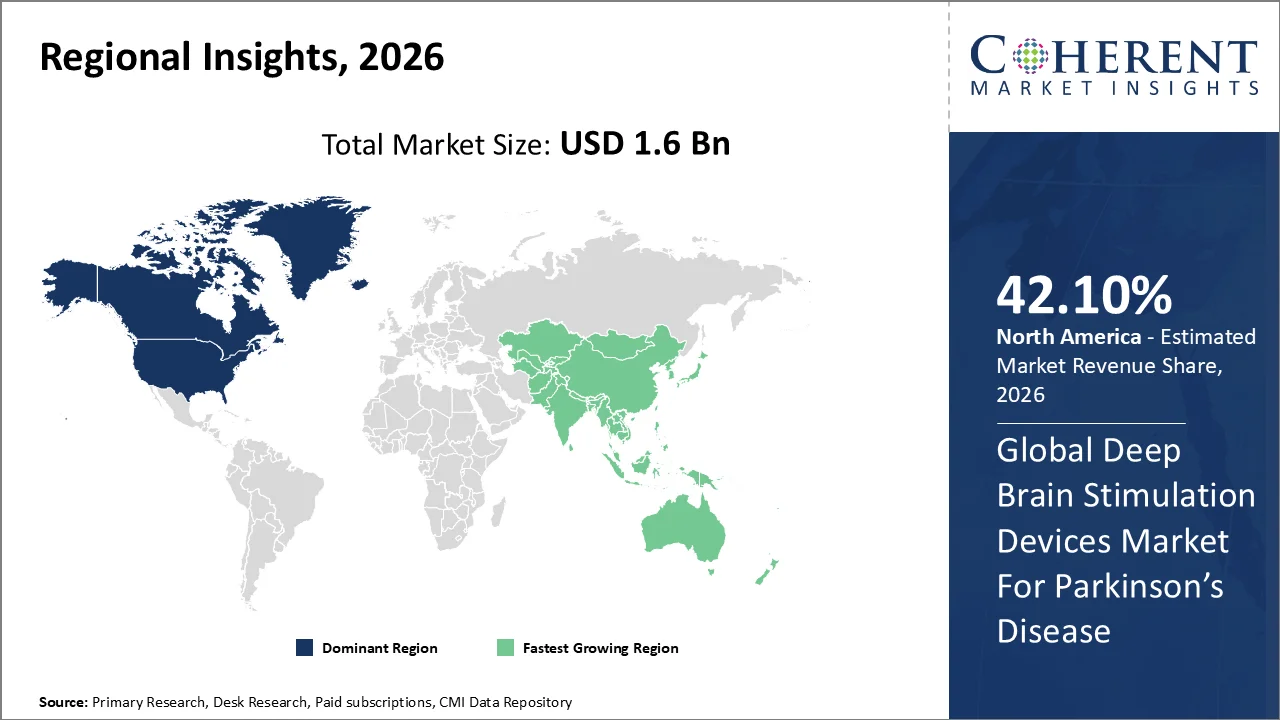
- North America is expected to acquire the dominant share of 42.10% in 2026 owing to its advanced healthcare infrastructure and neurosurgical expertise. The U.S. has about 14,000–15,000 active neurologists.
Current Events and Their Impact on the Deep Brain Stimulation Devices Market for Parkinson’s Disease
Current Event | Description and its Impact |
U.S. FDA Approval of Medtronic BrainSense Adaptive DBS (February 2025) |
|
U.S. FDA Expansion of Boston Scientific Vercise DBS Indications (February 2024) |
|
Segmental Insights
- Current Industry Events of 2026
- Market Size Estimation
- Regional Breakdown
- Competitive Landscape
- Customer Intelligence
- Segmental Analysis
- Pricing Analysis
- Key Market Drivers, Challenges & Future Trends
- Customized Insights Section
Why is Dual-Channel Acquiring the Largest Market Share?
Dual-Channel holds the largest market share of 52.8% in 2026. Increasing prevalence of neurological disorders such as Parkinson’s disease, essential tremor, and dystonia drives demand for dual-channel deep brain stimulation devices, as these conditions often require bilateral or multi-target stimulation. Advancements in DBS technology, including programmable pulse generators and directional leads, enable clinicians to deliver more precise and individualized therapy. Physicians increasingly adopt personalized neuromodulation as clinical indications expand and surgical outcomes improve. They also prefer flexible programming and enhanced symptom control, which further supports the use of dual-channel systems. For instance, Medtronic plc announced that the U.S. Food and Drug Administration has approved its Percept RC Deep Brain Stimulation system. The device features BrainSense technology that records brain signals to help clinicians personalize and adjust therapy, and it is designed as the smallest and thinnest dual-channel neurostimulator for DBS.
Deep Brain Stimulation Devices Market for Parkinson’s Disease Trends
- Rising demand for minimally invasive neurosurgical procedures supports DBS adoption, as patients and clinicians prefer safer interventions with reduced hospital stay and faster recovery.
- Increasing use of personalized neuromodulation, including adaptive stimulation and programmable pulse generators, enhances treatment precision and improves symptom control in movement and psychiatric disorders. In February 2025, Medtronic received FDA approval for its BrainSense Adaptive Deep Brain Stimulation (aDBS) system and BrainSense Electrode Identifier for Parkinson’s patients. Medtronic’s Percept DBS neurostimulators now include BrainSense Adaptive technology, which adjusts therapy in real time based on the patient’s brain activity in both clinical and everyday settings.
- Growing prevalence of neurological disorders such as Parkinson’s disease, essential tremor, dystonia, epilepsy, and treatment-resistant psychiatric conditions significantly increases the need for advanced DBS therapies worldwide. Parkinson’s disease alone affects more than 10 million people globally, with incidence rising sharply with age.
- Favorable reimbursement frameworks and insurance coverage in developed healthcare systems improve patient access to DBS procedures and encourage wider clinical adoption. In the United States, Medicare covers DBS for approved indications such as Parkinson’s disease and essential tremor when medically necessary, supporting increased procedural uptake among eligible patients.
Regional Insights
North America dominates owing to strong presence of leading medical device companies
North America is expected to acquire the dominant share of 42.10% in 2026. High prevalence of neurological disorders such as Parkinson’s disease, essential tremor, and dystonia drives North America’s Deep Brain Stimulation Devices Market for Parkinson’s Disease, as patients increasingly seek advanced surgical treatments. Nearly 250,000 people in the U.S. have dystonia, the third most common movement disorder after essential tremor and Parkinson’s disease. The region maintains strong healthcare infrastructure, and skilled neurosurgeons deliver care through specialized movement disorder centers.
Asia Pacific Deep Brain Stimulation Devices Market for Parkinson’s Disease Trends
The Asia Pacific Deep Brain Stimulation Devices Market for Parkinson’s Disease is driven by the rising incidence of neurological disorders such as Parkinson’s disease, while an aging population increases demand for advanced neurological treatments. With Parkinson’s disease prevalence in India estimated at 15–43 per 100,000 people, the country is becoming a major global hub for PD cases. Healthcare systems continue to improve, and neurosurgical capabilities expand across the region. Clinicians and patients show greater awareness and acceptance of these devices. Ongoing investment in medical technology, wider hospital networks, medical tourism growth, and advancements in minimally invasive procedures, along with supportive regulatory policies, further accelerate adoption. In March 2026, Manipal Hospital Sarjapur Road introduced Adaptive Deep Brain Stimulation (aDBS) services at its DBS Clinic for patients with movement disorders and neurological conditions. The hospital reports that the system actively adjusts stimulation levels in real time based on the patient’s brain activity.
United States Deep Brain Stimulation Devices Market for Parkinson’s Disease Trends
Rising cases of Parkinson’s disease, essential tremor, and treatment-resistant epilepsy drive demand for deep brain stimulation devices in the United States, while an expanding elderly population increases the need for advanced neurological interventions. Essential tremor is the most common tremor disorder, affecting up to 5% of the global population and an estimated 10 million people in the United States. Companies such as Medtronic plc, Boston Scientific Corporation, and Abbott Laboratories actively develop directional leads, closed-loop systems, and rechargeable implants that improve patient outcomes. Clinicians rely on strong clinical evidence, FDA approvals, and supportive reimbursement policies, and hospitals expand neurosurgical capabilities, which together boost adoption and procedure volumes across specialized care centers nationwide. In December 2025, the U.S. Food and Drug Administration has approved Flow Neuroscience’s FL-100 transcranial direct-current stimulation (tDCS) system, authorizing it as the first at-home, prescription neuromodulation therapy in the United States for adults with moderate to severe major depressive disorder (MDD).
Japan Deep Brain Stimulation Devices Market for Parkinson’s Disease Trends
Japan’s rapidly aging population drives demand for Deep Brain Stimulation devices as more patients develop movement disorders such as Parkinson’s disease and essential tremor. Hospitals and clinicians increasingly adopt advanced neurological treatments due to rising awareness and strong clinical outcomes. Japan’s well-developed healthcare system supports early adoption of neurotechnology, while ongoing surgical advancements improve treatment precision. Expanded access to specialists and government-supported healthcare coverage further increase the use of Deep Brain Stimulation systems in modern neurosurgical practice across the country.
Who are the Major Companies in Deep Brain Stimulation Devices Industry
Some of the major key players in Deep Brain Stimulation Devices are Boston Scientific Corporation, MEDTRONIC, Inc., St Jude Medical, Inc., Sapiens Neuro, and Aleva Neurotherapeutics SA.
Market Report Scope
Deep Brain Stimulation Devices Market for Parkinson’s Disease Report Coverage
| Report Coverage | Details | ||
|---|---|---|---|
| Base Year: | 2025 | Market Size in 2026: | USD 1.6 Bn |
| Historical Data for: | 2020 To 2024 | Forecast Period: | 2026 To 2033 |
| Forecast Period 2026 to 2033 CAGR: | 10.7% | 2033 Value Projection: | USD 3.4 Bn |
| Geographies covered: |
| ||
| Segments covered: |
| ||
| Companies covered: | Boston Scientific Corporation, MEDTRONIC, Inc., St Jude Medical, Inc., Sapiens Neuro, and Aleva Neurotherapeutics SA. | ||
Analyst Opinion
- Deep Brain Stimulation (DBS) demand is fundamentally driven by neurological disease burden rather than elective technology adoption. In Parkinson’s disease alone, over 10 million people are affected globally, and clinical evidence shows that up to 1 in 3 patients with advanced disease become candidates for DBS when medication response declines. This creates a persistent surgical need base rather than cyclical demand.
- DBS has also moved from a last-resort intervention to an earlier-line neuromodulation option in refractory cases. Long-term clinical studies report sustained symptom reduction of around 50–60% in motor scores for Parkinson’s patients undergoing DBS, reinforcing physician confidence and expanding eligibility criteria in real-world practice.
- The procedural momentum is further strengthened by outcomes in movement disorder management. For example, essential tremor cases treated with DBS show tremor reduction exceeding 70% in many cohorts, which significantly improves functional independence in daily activities such as eating and writing.
- Importantly, adoption is concentrated in high-volume neuro centers where multidisciplinary programming expertise exists. Hospitals such as Mayo Clinic and Cleveland Clinic have demonstrated that iterative device programming and adaptive stimulation protocols materially improve long-term outcomes, which continues to accelerate physician preference for DBS over purely pharmacological escalation.
Speak to the analyst
Want personalized insights?
Take the findings above to one of our principal consultants, or have the report rebuilt around the segments, geographies and competitors you actually track.
Market Segmentation
- By Product (Revenue, USD Bn, 2021-2033)
- Single Channel
- Dual-Channel
- By Region (Revenue, USD Bn, 2021-2033)
- North America
- U.S.
- Canada
- Latin America
- Brazil
- Mexico
- Argentina
- Rest of Latin America
- Europe
- Germany
- U.K.
- France
- Italy
- Spain
- Russia
- Rest of Europe
- Asia Pacific
- China
- India
- Japan
- Australia
- South Korea
- ASEAN
- Rest of Asia Pacific
- Middle East
- GCC
- Israel
- Rest of Middle East
- Africa
- South Africa
- Central Africa
- North Africa
- North America
Sources
Primary Research interviews
- Neurologists, neurosurgeons, and movement disorder specialists involved in Deep Brain Stimulation procedures
- Hospital procurement managers and neurotechnology department heads
- Clinical researchers working on Parkinson’s disease and essential tremor treatment pathways
Databases
- PubMed clinical studies and neurological procedure datasets
- National health registries and hospital episode statistics
- WHO neurological disorder prevalence datasets
- ClinicalTrials.gov for ongoing and completed DBS device studies
Magazines
- Neurology Today
- The Lancet Neurology feature updates
- MedTech industry clinical innovation publications
- Neurotechnology-focused medical magazines
Journals
- Journal of Neurosurgery
- Movement Disorders Journal
- Brain Stimulation Journal
- Neuromodulation: Technology at the Neural Interface
Newspapers
- The New York Times (health and neuroscience reporting)
- The Guardian (medical innovation coverage)
- The Hindu (healthcare and neurology developments in India context)
- Financial Times (health technology reporting)
Associations
- International Parkinson and Movement Disorder Society (MDS)
- American Association of Neurological Surgeons (AANS)
- World Society for Stereotactic and Functional Neurosurgery (WSSFN)
- Parkinson’s Foundation
Public Domain sources
- World Health Organization (WHO) neurological disorder reports
- National Institutes of Health (NIH) publications
- Government health ministry reports (US, EU, Japan, India)
- University hospital research publications and open-access clinical studies
Proprietary Elements
- CMI Data Analytics Tool
- Proprietary CMI Existing Repository of information for last 10 years
Get access to 250+ pages report
Every segment, forecast, competitor profile and data table behind the analysis above — available for instant download.
- ESOMAR Member
- ISO 9001:2015 Certified
- D-U-N-S Registered
- GDPR & CCPA Compliant
Missing comfort of reading report in your local language? Find your preferred language:
Transform your Strategy with Exclusive Trending Reports
Frequently Asked Questions
The Deep Brain Stimulation Devices Market for Parkinson’s Disease is anticipated to grow at a CAGR of 10.7% with USD 1.6 Bn in 2026 and is expected to reach USD 3.4 Bn in 2033.
Increasing prevalence of Parkinson’s disease and increasing geriatric population are the factors fueling growth of the market.
The dual-channel segment is the leading product segment in the market.
Excise tax on medical devices and use of deep brain stimulation limited to highly refractory patients and conditions, typically in the context of expert multidisciplinary care and clinical research are factors hindering growth of the market.
Major players operating in the market include, Boston Scientific Corporation, MEDTRONIC, Inc., St Jude Medical, Inc., Sapiens Neuro, and Aleva Neurotherapeutics SA
North America region is expected to hold dominant position in the market over the forecast period.