

Mannequin-Based Simulation Market Size and Forecast — 2026 - 2033
The Global Mannequin-Based Simulation Market size is estimated to be valued at USD 1.2 billion in 2026 and is expected to reach USD 2.9 billion by 2033, exhibiting a compound annual growth rate (CAGR) of 13.4% from 2026 to 2033. This impressive market forecast underlines the significant industry size and market revenue potential reinforcing strong market growth and business growth opportunities ahead.
Overview
Mannequin-Based Simulation is a training method that uses life-sized, computer-controlled mannequins to replicate human patients in realistic clinical scenarios. These mannequins can simulate vital signs, breathing, heart sounds, speech, and physiological responses to medical interventions. Commonly used in healthcare education, this approach allows students and professionals to practice procedures, clinical decision-making, teamwork, and emergency responses in a safe, controlled environment. Mannequin-based simulation helps bridge the gap between theory and real patient care by improving technical skills, confidence, and patient safety without risk to actual patients.
Key Takeaways
The high-fidelity simulators segment holds the largest market share, supported by hospitals and educational institutions that emphasize realistic, hands-on training environments.
Military training applications are experiencing rapid growth, driven by increasing defense budgets and technological advancements that improve simulation accuracy and realism.
North America leads the mannequin-based simulation market with around 40% share, supported by advanced healthcare infrastructure and strong funding for training programs.
Asia Pacific is the fastest-growing region, with a CAGR of about 16%, driven by rising healthcare investments and government-led simulation education initiatives in countries such as India and China.
Mannequin-Based Simulation Market Segmentation Analysis
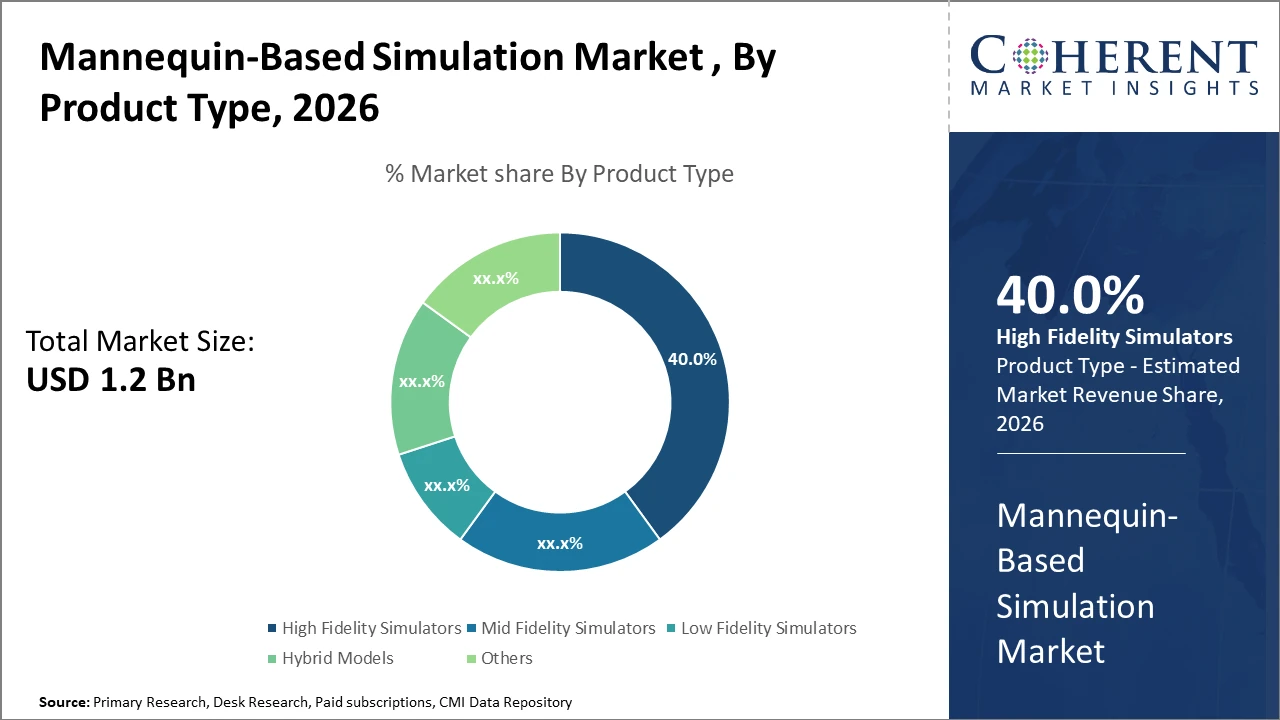
Mannequin-Based Simulation Market Insights, By Product Type
High-fidelity units are preferred for their realistic, dynamic physiological responses and are highly valued in clinical training for complex scenarios such as surgery and emergency care. However, their high cost and technological complexity are driving rapid growth in mid-fidelity simulators, especially in emerging markets where affordability and adequate functional realism are key. Mid-fidelity models support diverse training needs, including resuscitation and patient monitoring. Low-fidelity simulators maintain steady demand for basic skills training, while hybrid models combining mannequins with digital feedback systems are emerging to meet evolving training requirements.
Mannequin-Based Simulation Market Insights, By Application
Military training dominates the market growth, driven by rising global defense budgets and a strong focus on combat readiness and injury simulation. High-fidelity mannequins capable of replicating battlefield physiological responses are increasingly used to simulate combat trauma scenarios and improve preparedness. Emergency response training is expanding steadily due to the growing frequency of natural disasters and pandemics that require rapid skill deployment. Firefighter training utilizes specialized mannequins for smoke inhalation and rescue scenarios, maintaining a smaller but stable market share, while aviation and industrial safety applications contribute niche yet important segments.
Mannequin-Based Simulation Market Insights, By End-User
Educational institutions represent the largest segment as medical schools worldwide increasingly integrate simulation-based training into their curricula, with mid-fidelity and hybrid simulators seeing rapid adoption on campuses. Military and defense organizations continue to invest heavily in customized mannequins that replicate combat injuries and tactical scenarios, driving significant revenue growth. Emergency services are progressively adopting simulation tools for disaster management and first-responder training, while private research institutes and other users employ mannequins for specialized experimental and training applications, contributing steady incremental gains to the overall market.
Mannequin-Based Simulation Market Trends
The market is shifting toward hybrid models that integrate physical mannequins with augmented reality and virtual reality technologies, creating more immersive and interactive training experiences.
Technology-driven learning tools are gaining traction, highlighted by the introduction of AR-integrated simulators that have demonstrated notable reductions in training time.
Demand for portable and cost-effective simulators is increasing in emerging economies, particularly in Southeast Asia, where healthcare infrastructure is expanding rapidly.
There is growing emphasis on personalized and procedure-specific training modules, with customized simulation solutions increasingly adopted by hospitals, especially across Europe.
Mannequin-Based Simulation Market Insights, By Geography
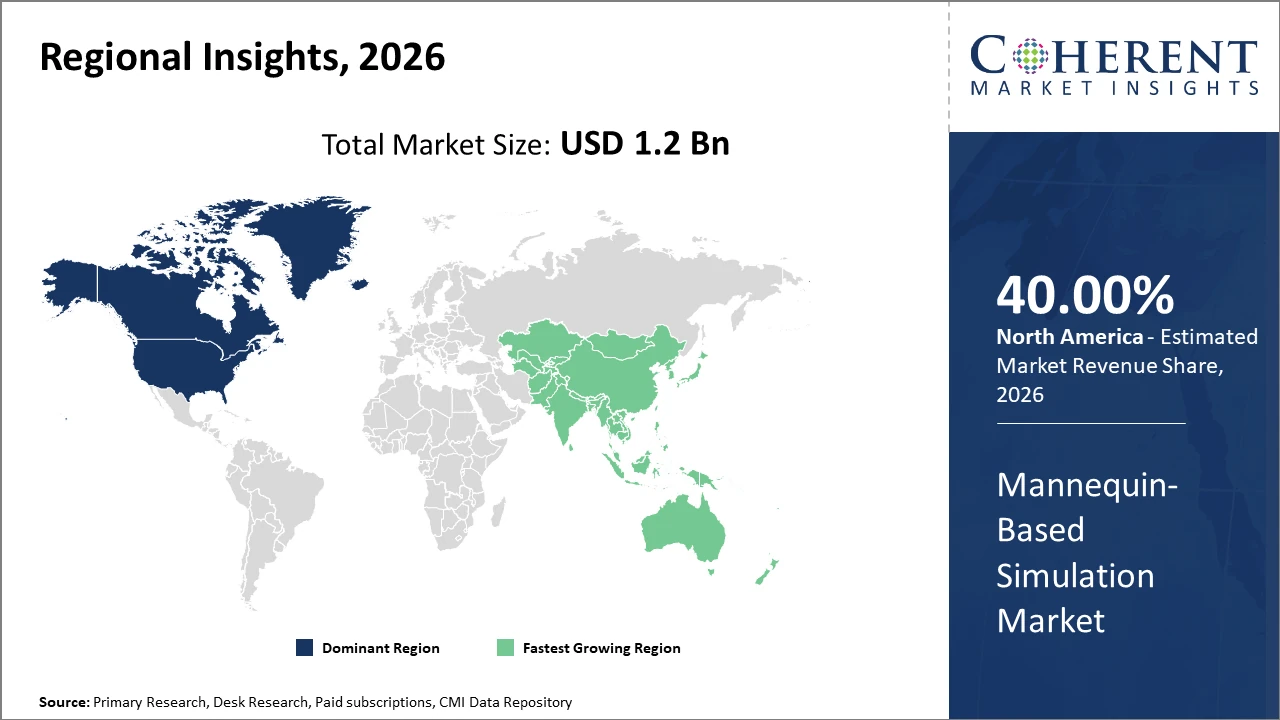
North America Mannequin-Based Simulation Market Analysis and Trends
In North America, leadership in the mannequin-based simulation market is supported by advanced healthcare infrastructure and strong government and private-sector funding. The United States accounts for roughly 40% of the regional market, driven by regulations promoting simulation-based certification for healthcare professionals and significant investments in defense training programs. Major companies such as Laerdal Medical and CAE Healthcare play a crucial role, with continuous innovation strengthening market expansion, revenue generation, and adoption across medical and military training environments.
Asia Pacific Mannequin-Based Simulation Market Analysis and Trends
Meanwhile, the Asia Pacific region demonstrates the fastest growth, with a CAGR of around 16%, driven by rapid healthcare expansion and rising government investment in education and training. Countries such as India and China are significantly increasing the adoption of mannequin-based simulation in medical colleges and training centers. This growth is supported by public initiatives, including India’s National Health Mission, which emphasizes upgrading training infrastructure and strengthening clinical skill development through simulation-based learning.
Mannequin-Based Simulation Market Outlook for Key Countries
USA Mannequin-Based Simulation Market Analysis and Trends
The United States continues to be the largest contributor to the mannequin-based simulation market, driven by widespread adoption across healthcare and defense training programs. Strong integration of simulation in clinical education and military preparedness underpins sustained demand. Increased spending by organizations such as the Department of Veterans Affairs highlights the importance of mannequin-based training in workforce skill development. Major players, including Laerdal Medical and CAE Healthcare, have strengthened their presence through partnerships with academic institutions and defense agencies, enhancing competitive positioning and advancing technological innovation nationwide.
Germany Mannequin-Based Simulation Market Analysis and Trends
Germany’s mannequin-based simulation market is experiencing strong growth, driven by the country’s advanced healthcare system, well-established medical education infrastructure, and emphasis on clinical skill development. High-fidelity mannequins and anatomical models dominate demand, while digital solutions, including virtual reality and augmented reality-based simulators, are among the fastest-growing segments. Collaborations between technology providers and academic or clinical institutions are fostering customized training solutions, and government initiatives support wider adoption to address skill gaps and enhance patient safety. Overall, the market reflects technological advancement, integration of immersive tools, and increasing investment in healthcare training.
Analyst Opinion
The growing use of high-fidelity mannequins in healthcare simulation centers is driving market share by improving training effectiveness, with over 70% of North American teaching hospitals increasing investments in simulation-based training in 2024, a 15% rise from 2023, boosting advanced patient simulator segments.
Import data from 2025 shows rising demand in Asia Pacific for low- to mid-fidelity mannequins, fueled by expanding medical schools and government-supported healthcare initiatives, such as India’s Ministry of Health allocating around USD 45 million for simulation education.
Increased production capacity among leading companies has reduced unit costs by approximately 8% between 2024 and 2026, promoting wider adoption in emerging applications like disaster management and military training, strengthening overall industry share.
Applications beyond healthcare, including firefighter training and aviation safety exercises, have expanded demand, with European countries reporting a 12% year-over-year increase in procurement of specialty mannequins from 2024 to 2026, supporting sustained market growth and resilience.
- Current Industry Events of 2026
- Market Size Estimation
- Regional Breakdown
- Competitive Landscape
- Customer Intelligence
- Segmental Analysis
- Pricing Analysis
- Key Market Drivers, Challenges & Future Trends
- Customized Insights Section
Market Scope
| Report Coverage | Details | ||
|---|---|---|---|
| Base Year: | 2025 | Market Size in 2026: | USD 1.2 billion |
| Historical Data for: | 2020 To 2024 | Forecast Period: | 2026 To 2033 |
| Forecast Period 2026 to 2033 CAGR: | 13.4% | 2033 Value Projection: | USD 2.9 billion |
| Geographies covered: |
| ||
| Segments covered: |
| ||
| Companies covered: | Laerdal Medical, CAE Healthcare, Gaumard Scientific, 3D Systems Corporation, Simulaids, MedVision, Philips Healthcare, Limbs & Things, Trucorp, Nasco Healthcare, Surgical Science, Ambu A/S | ||
| Growth Drivers: |
| ||
Mannequin-Based Simulation Market Growth Factors
Growing demand for enhanced clinical skill acquisition continues to drive market growth, particularly in developed countries where simulation-based training helps reduce patient care risks. Increased healthcare spending, supported by government policies in regions such as North America and Europe, has significantly boosted market revenue. Rapid technological advancements, including the integration of virtual reality with mannequin-based simulation, have further expanded market size by improving training realism and engagement. Additionally, applications in defense and emergency preparedness, fueled by rising global security concerns, have diversified market segments, exemplified by the U.S. Department of Defense increasing its simulation training budget by nearly 18% in 2025, further accelerating market dynamics.
Mannequin-Based Simulation Market Development
In 2024, the mannequin-based simulation market witnessed significant advancements with a focus on high-risk and complex clinical procedure training. Manufacturers introduced upgraded high-fidelity surgical simulators and advanced ultrasound models that provide more realistic imaging and procedural responses, enhancing the effectiveness of clinical education. There has also been a growing shift toward hybrid solutions, combining physical mannequins with virtual reality platforms, as seen in collaborations like SimX and Elevate Healthcare, which aim to create immersive, technology-driven training environments.
Regional adoption trends highlight strong growth in Asia Pacific, driven by increased investment in low- to mid-fidelity mannequins to support expanding medical schools and healthcare programs. Technological innovations such as wireless connectivity, AI-assisted feedback, and multi-function mannequins were introduced to improve training efficiency and user engagement. These developments, coupled with strategic partnerships and government-supported initiatives, are strengthening market penetration across healthcare, defense, and emergency preparedness applications, ensuring sustained growth in 2024 and beyond.
Key Players
Leading Companies of the Market
Laerdal Medical
CAE Healthcare
Gaumard Scientific
3D Systems Corporation
Simulaids
Philips Healthcare
MedVision
Trucorp
Nasco Healthcare
Ambu A/S
Surgical Science
Among key market players, Laerdal Medical strengthened its leadership by expanding its portfolio through strategic acquisitions, increasing its market share by 10% between 2024 and 2026. CAE Healthcare focused on developing AI-integrated mannequins that enhanced training realism, leading to a 15% rise in client retention during 2025. Meanwhile, Gaumard Scientific introduced customizable simulation platforms aimed at emerging markets, driving revenue growth in Latin America by around 20% in 2026, highlighting the impact of innovation and targeted regional strategies on overall market dynamics.
Mannequin-Based Simulation Market Future Outlook
The future outlook for the mannequin-based simulation market is highly positive, with strong growth expected over the next decade. Demand is driven by the need for realistic, risk-free training in healthcare, defense, and emergency preparedness. Technological advancements integrating virtual reality, augmented reality, and AI are enhancing simulation fidelity and interactivity, improving training outcomes. High adoption in developed regions, combined with rapid expansion in emerging markets such as Asia Pacific due to increasing healthcare infrastructure and government initiatives, is fueling market growth. Diversified applications and continuous innovation are expected to sustain robust global expansion through the 2030s.
Mannequin-Based Simulation Market Historical Analysis
The mannequin‑based simulation market has evolved significantly over the past decade, gaining traction from early, rudimentary training aids to today’s sophisticated systems. Initial simulators such as the Harvey cardiac mannequin, developed in 1968, laid the groundwork for standardized clinical skills training. Over the 2018‑2023 period, global adoption accelerated as medical schools and hospitals increasingly valued simulation to reduce patient risk and improve competence, contributing to robust growth in simulation centers worldwide.
Sources
Primary Research Interviews:
Simulation Center Directors
Clinical Educators (Nursing/Medical)
Hospital Training & Development Managers
Simulation Technicians/Engineers
Databases:
Global Health Observatory (WHO)
OECD Health Data
Frost & Sullivan Healthcare Insights
Magazines:
Medical Design & Outsourcing
Healthcare Simulation News
Simulation in Healthcare Magazine
HealthTech Magazine
Journals:
Simulation in Healthcare Journal
Journal of Clinical Simulation
Advances in Simulation
Biomedical Simulation & Training Research
Newspapers:
The New York Times (Health)
The Guardian (Health)
Financial Times (Healthcare)
The Hindu (Health)
Reuters Health
Associations:
Society for Simulation in Healthcare (SSH)
International Nursing Association for Clinical Simulation and Learning (INACSL)
International Nursing Association for Clinical Simulation
Healthcare Simulation Industry Association (HSIA)
Get access to 250+ pages report
Every segment, forecast, competitor profile and data table behind the analysis above — available for instant download.
- ESOMAR Member
- ISO 9001:2015 Certified
- D-U-N-S Registered
- GDPR & CCPA Compliant
Missing comfort of reading report in your local language? Find your preferred language:
Transform your Strategy with Exclusive Trending Reports
Frequently Asked Questions
Leading market companies include Laerdal Medical, CAE Healthcare, Gaumard Scientific, Kyoto Kagaku, and 3B Scientific, known for innovation in high-fidelity mannequins and diversified product portfolios.
The market size is projected to grow from USD 1.2 billion in 2026 to USD 2.9 billion by 2033, driven by rising demand across healthcare and educational sectors globally.
Educational institutions represent the largest segment.
The integration of AI and hybrid simulation models combining virtual and physical mannequins will significantly influence market dynamics and expand applications across medical disciplines.
The competitive landscape is characterized by technological innovation, product diversification, and strategic partnerships, while challenges include high initial costs and integration complexities.
Market players focus on product differentiation, collaborations with healthcare institutions, and investing in R&D to introduce next-gen simulation solutions tailored to regional requirements.