

3D Printing for Medical Sector Market Size and Trends - 2026 to 2033
The 3D Printing for Medical Sector Market is estimated to be valued at USD 3,650 Mn in 2026 and is expected to reach USD 13,600 Mn by 2033, growing at a compound annual growth rate (CAGR) of 17.8% from 2026 to 2033.
Key Takeaways
- Based on Technology, the Laser Beam Melting segment is expected to lead the market with 34.20% share in 2026, due to high precision implant manufacturing.
- Based on Application, the Surgical Implants segment is expected to hold 40.35% share of the market in 2026, driven by customized patient-specific implants.
- Based on End User, the Hospitals & Clinics segment is expected to hold 47.80% share of the market in 2026, driven by point-of-care 3D printing.
- Based on Region, North America is set to lead the market with 39.65% share in 2026. while Asia Pacific is anticipated to be the fastest growing region.
Market Overview
The 3D printing for medical sector market provides advanced additive manufacturing systems and biocompatible material technologies primarily for patient-specific healthcare solutions and high-precision medical device production. This market includes sophisticated bioprinters, metal- and polymer-based additive systems, and integrated 3D scanning and modeling software, along with clinical-grade materials, surgical planning services, and long-term regulatory compliance support.
The global demand for patient-specific healthcare and surgical precision is being identified more frequently each year, thus creating a greater need for end-to-end additive manufacturing workflows among hospitals and specialized medical device facilities. Healthcare providers and manufacturers recognize the critical importance of 3D printing for anatomical modeling, custom prosthetics, and long-term supply chain resilience for essential surgical components. The government regulatory agencies now require stringent biocompatibility and sterilization monitoring, which makes automated traceability and validated digital inspection systems a standard requirement in medical-grade 3D printing operations.
With the implementation of rigorous medical device safety laws and hygiene standards, the market is growing steadily, particularly in the Asia Pacific region, where healthcare infrastructure is expanding rapidly. The market is also highly significant in regions with advanced biomedical ecosystems and high capital expenditure, including the US and Europe. Companies are working on next-generation systems by incorporating artificial intelligence for real-time process monitoring and generative design algorithms. Operators of medical facilities prefer next-generation systems, as they facilitate hyper-personalized production, minimize material waste, and make it possible to manufacture precisely patient-matched implants on demand.
Current Events and Its Impacts on the 3D Printing for Medical Sector Market
Current Event | Description and the Impact |
Technological Advancements and Integration
|
|
Economic and Healthcare Market Trends
|
|
Clinical Trials and Research Collaborations
|
|
Role Of Artificial Intelligence (AI) In 3D Printing for Medical Sector Market
Artificial intelligence acts as a vital tool in industry by improving design management and operational efficiency. AI systems utilize machine learning and data analysis for identifying subtle patterns in patient scans. These systems predict the most effective structural designs for implants before the manufacturing process begins. AI-powered design software automates bone modeling and uses smart simulation technologies to provide precise adjustments to digital files. This technology supports the growing trend of point-of-care manufacturing while ensuring device safety and accuracy.
Moreover, creative AI and automated algorithms solve complex geometric problems by providing personalized structural support and efficient material layouts. AI simplifies the transition from medical imaging to printable files and improves the production schedules for healthcare providers. The use of these technologies significantly reduces manufacturing errors and material waste. As a result, these advancements improve the overall quality of life for patients who are fitted with custom medical devices.
For instance, in October 2025, CustoMED revealed that it successfully completed the funding round, increasing the total capital raised to USD 6 million. The company’s cloud-based platform utilizes AI and automation with 3D printing to produce patient-specific surgical tools and implants, thus facilitating quicker and more precise orthopedic procedures.
- Current Industry Events of 2026
- Market Size Estimation
- Regional Breakdown
- Competitive Landscape
- Customer Intelligence
- Segmental Analysis
- Pricing Analysis
- Key Market Drivers, Challenges & Future Trends
- Customized Insights Section
Segmental Insights
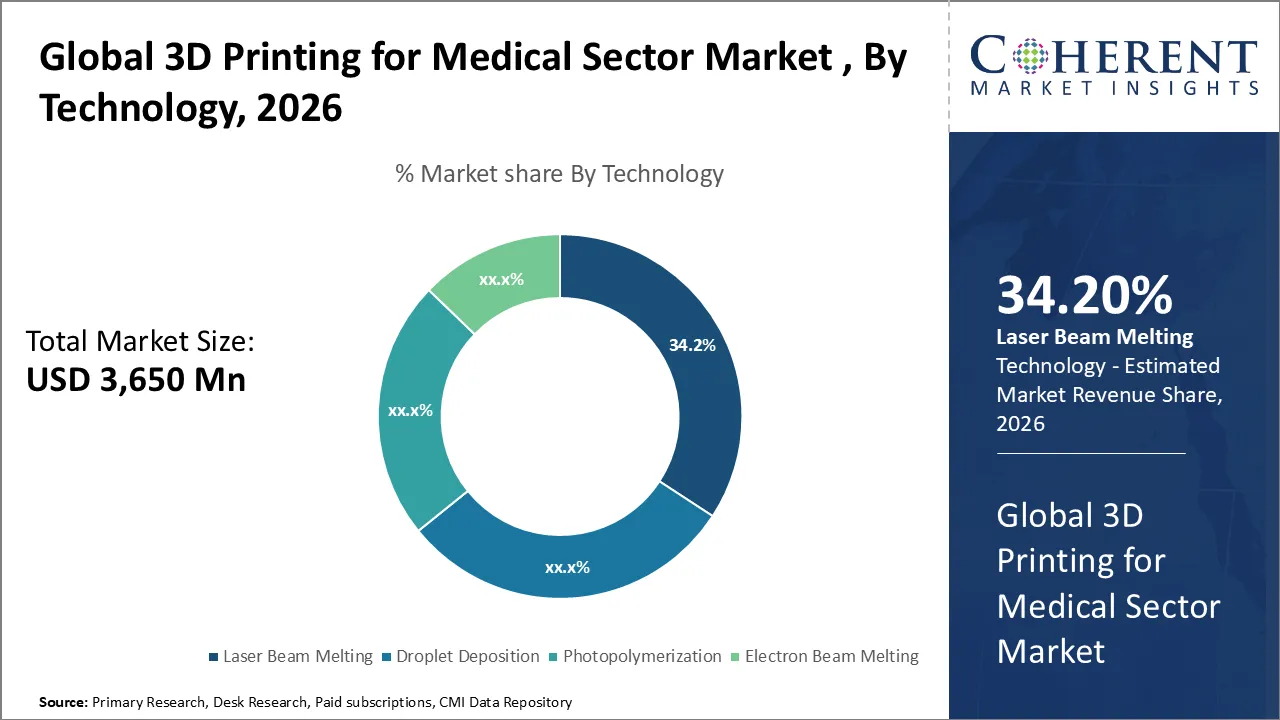
3D Printing for Medical Sector Market Insights By, Product Type - High Precision Implant Manufacturing Drives Preference for Laser Beam Melting
In terms of technology, the laser beam melting segment contributes the highest share of 34.20% in 2026 of the market owing to their unparalleled ability to produce high-strength biocompatible metal parts. This technology uses high-power lasers to fuse fine metallic powders into complex, dense structures that are ideal for permanent medical use. Its applications are valued for their accuracy in forming porous surface geometrics on implants, ensuring a greater bone-foreign material integration level. With a rising trend among medical professionals adopting high-performance alloys such as titanium and cobalt chromium, this segment is predicted to grow as a major method in the production of orthopedic and dental implants.
For instance, in September 2025, Croom Medical, a company specializing in orthopedic implant technology, announced the introduction of Biofuse™, a 3D-printed porous ingrowth substrate manufactured using Laser-Powder-Bed-Fusion (L-PBF) technology. Biofuse™ seamlessly incorporates interconnected porous structures directly into implant geometries, providing OEMs with precise regulation of pore size, porosity, and lattice gradients.
3D Printing for Medical Sector Market Insights By, Application - Surgical Implants Lead as They Provide Customized Patient-Specific Implants
In terms of application, the surgical implants segment contributes the highest share of 40.35% in 2026 of the market owing to the rising global demand for personalized healthcare solutions and the increasing prevalence of chronic orthopedic conditions. Traditional manufacturing techniques may not always satisfy the precise fit needed in complex bone reconstructions. 3D printing ensures the production of implants according to the patient's specific data. This leads to improved medical results such as reduced surgery time and lower risks of rejecting an implant. The shift from mass-produced components to bespoke spinal, hip, and cranial hardware has redefined the industry standard for individualized patient care. This growth is also attributable to the aging population, which requires frequent joint replacements and reconstructive surgeries.
For instance, in August 2023, Materialise speeds up the supply of patient-specific medical implants to patients in the US through the establishment of a new 3D printing facility. Surgeons are progressively adopting 3D printing technologies as they acknowledge the benefits it offers for personalized patient care, such as more reliable and precise surgical results and reduced operative time.
3D Printing for Medical Sector Market Insights By, End User - Hospitals & Clinics Leads with Point-of-care 3D Printing
In terms of end user, the hospitals & clinics segment contributes the highest share of 47.80% in 2026 of the market, as these institutions increasingly implement additive manufacturing capabilities directly at the point of care. Several modern medical centers have established dedicated 3D printing labs to produce anatomical models that allow surgeons to visualize and rehearse complex operations before entering the theater. This in-house approach reduces the turnaround time for developing custom surgical guides for patient-specific tools, which ultimately streamlines hospital workflows and lowers costs. By maintaining control over the production process, hospitals and clinics can ensure that customized medical aids are delivered precisely when they are needed for critical procedures.
For instance, in December 2025, Amandeep Hospitals, working together with Ujala Cygnus, inaugurated North India's first hospital-based facility for 3D printing and virtual reality technology. The new facility establishes Amritsar as a regional hub for sophisticated surgical planning and personalized patient care.
Regional Insights
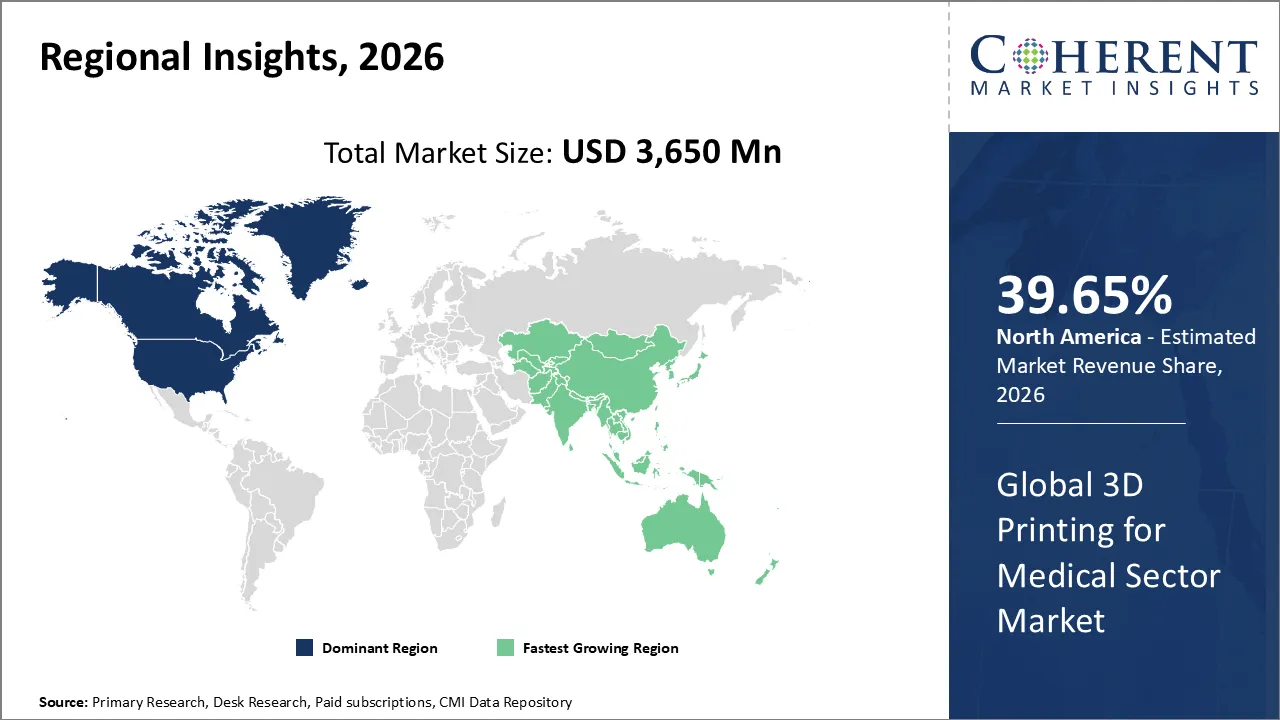
North America 3D Printing for Medical Sector Market Analysis & Trends
North America has remained the dominant region with 39.65% in 2026 of the global 3D Printing for Medical Sector Market over the past decade. This is owing to its cutting-edge healthcare infrastructure and a strong emphasis on technological innovation. The region has made substantial investments in research and development, accompanied by a well-established regulatory framework that facilitates the swift approval and adoption of 3D printed medical devices. The presence of major players and prominent academic institutions creates a collaborative ecosystem that promotes the commercialization of innovative bioprinting and metal printing technologies. Furthermore, the high prevalence of chronic conditions and an aging population in North America create a consistent and growing demand for advanced personalized medicine interventions.
For instance, in January 2025, Health Canada, the federal regulatory agency, has approved the clinical trial design of U.S. medical device startup Nanochon, thereby permitting the initiation of a first-in-human study for its 3D-printed Chondrograft knee implant.
Asia Pacific 3D Printing for Medical Sector Market Analysis & Trends
The Asia Pacific market is currently undergoing a period of rapid change, emerging as a primary hub for global progress in healthcare manufacturing. This growth is fundamentally fueled by a shift toward personalized medicine, where the ability to create custom implants and prosthetics allows for a better physical fit and improved surgery results. The national governments in the region, mainly in China and Japan, have implemented supportive policies and research funding to encourage local production and minimize the healthcare systems' reliance on improved medical tools. The market is moving beyond basic anatomical models toward advanced biological printing and the development of specialized frameworks that help the body regrow its own tissue. While developed nations lead in high-precision bone and dental applications, the growing economies are greatly adopting the technology to meet the needs of large populations with limited access to traditional custom care.
For instance, in October 2025, Aptech Limited and WOL3D announced an alliance to launch India's inaugural comprehensive 3D printing and product design program focused on creative and industrial applications. The curriculum shall be provided through Aptech's MAAC and Arena Animation training centers.
3D Printing for Medical Sector Market Outlook Country-Wise
The U.S. 3D Printing for Medical Sector Market Trends
The US holds a leading position in the industry owing to its advanced healthcare infrastructure and a strong network of technology innovators. A primary driver of growth in this market is the high demand for personalized healthcare. 3D printing is used to create custom implants and surgical guides that match a patient's unique anatomy. The presence of clear, regular pathways has encouraged multiple hospitals to set up their own on-site printing labs. This trend allows surgeons to plan complex procedures using 3D printed models, which helps reduce time spent in the operating room and improves patient safety.
China 3D Printing for Medical Sector Market Trends
China leads the market in terms of huge production capacities and strong government support. The growth is attributable to national initiatives that provide funding for research and development to make the country a leader in high-tech medical devices. The growing aging population of the country is creating a high demand for affordable and custom-made orthopedic and dental solutions. The integration of 3D printing into the country's biotechnology sector is speeding up the development of biological printing. Researchers are placing a greater emphasis on creating living tissues and specialized frameworks to treat various chronic conditions across the countries.
Market Report Scope
3D Printing for Medical Sector Market Report Coverage
| Report Coverage | Details | ||
|---|---|---|---|
| Base Year: | 2025 | Market Size in 2026: | USD 3,650 Mn |
| Historical Data for: | 2020 To 2024 | Forecast Period: | 2026 To 2033 |
| Forecast Period 2026 to 2033 CAGR: | 17.8% | 2033 Value Projection: | USD 13,600 Mn |
| Geographies covered: |
| ||
| Segments covered: |
| ||
| Companies covered: | EnvisionTEC, Inc., Arcam AB, 3D Systems, Inc., Eos GmbH Electro Optical Systems, Renishaw PLC, Stratasys Inc., Materialise NV, Organovo Holdings, Inc., and 3T RPD, Ltd. | ||
| Growth Drivers: |
| ||
| Restraints & Challenges: |
| ||
3D Printing for Medical Sector Market Drivers
Rising demand for customized solutions
The demand for customized solutions for medical treatments is driving the growth of the 3D printing for the medical sector market. The reason for this is that conventional mass-produced devices are unable to provide a perfect fit for each person due to their unique physical structure. In more instances, those devices may result in discomfort and may also result in life-threatening surgical complications. The solution for this problem lies in 3D printing. The process for medical devices uses specific imaging of a person's unique structure for a perfect and complementary match.
This high level of precision ensures better surgical outcomes, speeds up recovery times, and improves overall comfort for the user. Several hospitals now make use of on-site printing to create patient-specific models and surgical guides. These tools allow doctors to plan complex operations with greater accuracy before entering the operating room. This transition from standardized care to tailored solutions rapidly expands the global market.
Analyst Opinion (Expert Opinion)
The 3D printing for medical sector market is advancing steadily, supported by rising demand for patient-specific solutions, improved clinical outcomes, and increasing integration of additive manufacturing into hospital workflows. The technology is widely adopted for custom implants, surgical guides, prosthetics, dental devices, and anatomical models, enabling higher precision and reduced procedural variability. Industry data indicates that a majority of tertiary hospitals and specialty clinics now use 3D printed models for pre-surgical planning, contributing to measurable reductions in operating time and post-surgical complications.
Materials innovation is a critical growth enabler. Medical-grade polymers, titanium alloys, ceramics, and bioresorbable materials are increasingly used due to their strength, biocompatibility, and suitability for complex geometries. Orthopedics and dentistry remain the most established application areas, driven by high procedure volumes and the need for customization. Dental laboratories, in particular, have transitioned toward large-scale adoption of additive manufacturing for crowns, aligners, and surgical templates.
Regulatory clarity around customized and patient-matched devices has improved approval efficiency, encouraging faster clinical deployment. Hospitals with in-house printing capabilities report shorter lead times and lower dependence on external suppliers, improving cost efficiency and supply reliability. Looking forward, integration of advanced imaging, design automation, and bioprinting research is expected to expand clinical applications, reinforcing the role of 3D printing as a core enabler of personalized and precision medicine.
Speak to the analyst
Want personalized insights?
Take the findings above to one of our principal consultants, or have the report rebuilt around the segments, geographies and competitors you actually track.
3D Printing for Medical Sector Industry News
- In August 2025, OIC International from US, Medi Mold, a division of the Andhra Pradesh Medtech Zone (AMTZ) from India, and AddUp, a subsidiary of Fives Group from France, announced the formation of a strategic alliance to develop an advanced orthopaedic implant manufacturing facility utilizing 3D printing and precision engineering.
- In April 2025, Syensqo unveiled White Radel®, the newest addition to its portfolio of Radel® polyphenyl sulfone (PPSU) solutions, designed for robust applications in biopharmaceuticals, surgical instruments, and medical devices. Radel® filaments have effectively broadened the scope of 3D printing applications for rapid prototyping and small-scale production runs.
- In February 2025, Katie Weimer, a leading figure in 3D Systems' medical 3D printing initiatives, has announced the establishment of GenesisTissue Inc., a business dedicated to bioprinting customized regenerative tissue implants.
- In June 2024, 3D printer supplier Stratasys recently revealed the introduction of its novel J5 Digital Anatomy 3D printer, designed specifically for the healthcare industry. This pioneering system is engineered to fulfill the increasing requirement for economical and precise anatomical models. The printer is designed for utilization by healthcare facilities, medical device manufacturers, and research institutions.
Market Segmentation
- Technology Insights (Revenue, USD Mn, 2026 - 2033)
- Electron Beam Melting
- Laser Beam Melting
- Droplet Deposition
- Photopolymerization
- Application Insights (Revenue, USD Mn, 2026 - 2033)
- Tissue Engineering
- Surgical Implants
- Healthcare Wearable Devices
- Others (Drug testing and Anatomical models)
- End User Insights (Revenue, USD Mn, 2026 - 2033)
- Hospital & Clinics
- Medical Industries
- Academic and Research Institutions
- Regional Insights (Revenue, USD Mn, 2026 - 2033)
- North America
- U.S.
- Canada
- Latin America
- Brazil
- Argentina
- Mexico
- Rest of Latin America
- Europe
- Germany
- U.K.
- France
- Italy
- Russia
- Rest of Europe
- Asia Pacific
- China
- India
- Japan
- Australia
- South Korea
- ASEAN
- Rest of Asia Pacific
- Middle East
- GCC
- Israel
- Rest of Middle East
- Africa
- North Africa
- Central Africa
- South Africa
- Key Players Insights
- EnvisionTEC, Inc.
- Arcam AB
- 3D Systems, Inc.
- Eos GmbH Electro Optical Systems
- Renishaw PLC
- Stratasys Inc.
- Materialise NV
- Organovo Holdings, Inc.
- 3T RPD, Ltd.
Sources
Primary Research Interviews
- Medical Device Manufacturers (Implants, Prosthetics, Surgical Instruments)
- 3D Printing Hardware Manufacturers (Medical-grade Printers)
- Biomaterials & Medical Polymer Suppliers
- Hospitals & Surgical Centers (Orthopedic, Dental, CMF)
- Healthcare Technology Integrators
- Regulatory & Quality Assurance Consultants (Medical Devices)
- Others
Databases
- Bloomberg Terminal
- Thomson Reuters Eikon
- PitchBook
- Crunchbase
- Others
Magazines
- Medical Device and Diagnostic Industry (MDDI)
- 3D Printing Industry Magazine
- Additive Manufacturing Magazine
- Medical Design & Outsourcing
- Nature Reviews Materials
- Others
Journals
- Additive Manufacturing (Elsevier)
- Journal of 3D Printing in Medicine
- Biomaterials
- Materials Today
- Journal of Biomedical Materials Research
- Rapid Prototyping Journal
- Others
Newspapers
- Financial Times
- The Wall Street Journal
- Reuters
- Bloomberg News
- The Economic Times
- Others
Associations
- Additive Manufacturing Users Group (AMUG)
- ASTM International – Additive Manufacturing Committee (F42)
- Radiological Society of North America (RSNA – 3D Printing SIG)
- Medical Device Manufacturers Association (MDMA)
- America Makes (National Additive Manufacturing Innovation Institute)
- Others
Public Domain Sources
- U.S. Food and Drug Administration (FDA) – Medical Devices & 3D Printing Guidance
- National Institutes of Health (NIH)
- European Medicines Agency (EMA)
- European Commission – Medical Device Regulation (MDR)
- World Health Organization (WHO)
- National Institute of Standards and Technology (NIST)
- Others
Proprietary Elements
- CMI Data Analytics Tool
- Proprietary CMI Existing Repository of Information for the Last 8 Years
Definition: The 3D Printing for Medical Sector Market leverages sophisticated design software and advanced additive manufacturing systems to produce highly precise, patient-specific healthcare solutions. This sector utilizes robotics and automated digital workflows to handle complex tasks like anatomical modeling, prosthetic fabrication, and the engineering of biocompatible implants with microscopic accuracy. These systems are integrated into hospitals and surgical centers where speed, sterilization, and personalized care are essential components of modern clinical practice. Specialized equipment and digital assembly lines assist in minimizing surgical risks by providing tactile preoperative guides and reducing the reliance on generic mass-produced medical devices. The demand for these solutions comes from surgical centers, dental clinics, and biopharmaceutical companies.
Get access to 250+ pages report
Every segment, forecast, competitor profile and data table behind the analysis above — available for instant download.
- ESOMAR Member
- ISO 9001:2015 Certified
- D-U-N-S Registered
- GDPR & CCPA Compliant
Missing comfort of reading report in your local language? Find your preferred language:
Transform your Strategy with Exclusive Trending Reports
Frequently Asked Questions
The 3D Printing for Medical Sector Market is estimated to be valued at USD 3,650 Mn in 2026, and is expected to reach USD 13,600 Mn by 2033.
The CAGR of the 3D Printing for Medical Sector Market is projected to be 17.8% from 2026 to 2033.
The rising demand for customized solutions and increasing surgical procedures are the major factors driving the growth of the 3D Printing for Medical Sector Market.
The high costs, complex regulatory hurdles, and shortage of skilled personnel are the major factors hampering the growth of the 3D Printing for Medical Sector Market.
In terms of technology, the laser beam melting segment is estimated to dominate the market revenue share in 2026.
EnvisionTEC, Inc., Arcam AB, 3D Systems, Inc., Eos GmbH Electro Optical Systems, Renishaw PLC, Stratasys Inc., Materialise NV, Organovo Holdings, Inc., and 3T RPD, Ltd. are the major players.
North America is expected to lead the 3D Printing for Medical Sector Market in 2026.