

Medical Implants Market Analysis & Forecast
Medical Implants Market is estimated to be valued at USD 135.64 Bn in 2026 and is expected to reach USD 223.56 Bn in 2033, exhibiting a compound annual growth rate (CAGR) of 7.4% from 2026 to 2033.
Key Takeaways
- By Product Type, the Orthopedic Implants segment is projected to dominate the global medical implants market with a 38.8% share in 2026.
- By Region, North America is expected to lead the global medical implants market, accounting for a substantial 43.90% share in 2026.
Market Overview
The global Medical Implants Market is witnessing consistent growth, driven by rising cases of chronic diseases, an aging population, and advancements in implant technologies. Medical implants offer long-term solutions for orthopedic, cardiovascular, and dental conditions, improving patient outcomes and quality of life. The orthopedic implants segment leads due to high demand in joint and bone-related treatments. North America dominates the market owing to advanced healthcare infrastructure, while Asia Pacific emerges as a key growth region with increasing healthcare investments.
Current Events and its Impact on the Medical Implants Market
Current Event | Description and its impact |
Regulatory Approvals and Fast-Track Programs |
|
Mergers, Acquisitions, and Strategic Collaborations |
|
Raw Material Cost Fluctuations and Supply Chain Pressures |
|
Pipeline Analysis: Medical Implants Market
The global medical implants market is witnessing a strong pipeline of innovative products, driven by advances in biomaterials, 3D printing, and smart implant technologies. Leading companies are focusing on next-generation orthopaedic, cardiovascular, and neurostimulation implants that offer enhanced biocompatibility, real-time monitoring, and improved integration with the human body.
Several orthopaedic implants using 3D-printed porous titanium for better bone ingrowth are currently in clinical trials. In the cardiovascular segment, bioresorbable stents and AI-integrated cardiac implants are being developed to reduce long-term complications.
Meanwhile, neurostimulators with wireless charging and remote programmability are progressing through regulatory review stages. Start-ups and established firms alike are investing in AI-enabled diagnostics and implant customization platforms to support precision medicine.
As regulatory bodies streamline approval pathways, especially in the U.S. and Europe, these innovations are expected to enter the market faster, offering improved patient outcomes and opening new avenues for growth across the global medical implants landscape.
- Current Industry Events of 2026
- Market Size Estimation
- Regional Breakdown
- Competitive Landscape
- Customer Intelligence
- Segmental Analysis
- Pricing Analysis
- Key Market Drivers, Challenges & Future Trends
- Customized Insights Section
Patent Landscape: Medical Implants Market
The patent landscape of the global medical implants market reflects a strong focus on innovation, with a surge in filings related to advanced materials, 3D printing technologies, and smart implantable devices. Key industry players such as Medtronic, Stryker, Zimmer Biomet, and Johnson & Johnson dominate patent activity, particularly in orthopaedic, cardiovascular, and neurological implants.
Recent patents emphasize the development of biocompatible alloys, antimicrobial coatings, and sensor-integrated implants that enable real-time health monitoring. The United States leads in patent grants, followed by Europe and Japan, supported by robust R&D infrastructure and streamlined intellectual property systems. Emerging markets like China and India are also witnessing an uptick in patent filings, especially in cost-effective and locally manufactured implants.
Cross-licensing agreements and strategic partnerships are increasingly common, as firms aim to strengthen their IP portfolios and accelerate product development. The growing complexity and specialization of implant technologies make patent protection a key competitive advantage in the market.
Reimbursement Scenario: Medical Implants Market
The reimbursement landscape for medical implants varies significantly across regions and plays a critical role in shaping market access and adoption. In the United States, reimbursement is managed through Medicare, Medicaid, and private insurers. Most implants, such as orthopaedic and cardiovascular devices, are reimbursed under bundled payments through Diagnosis-Related Groups (DRGs), which can pressure hospitals to control costs while maintaining quality care.
In Europe, reimbursement decisions are country-specific and often influenced by health technology assessment (HTA) bodies such as NICE in the UK and IQWiG in Germany. These agencies assess clinical efficacy and cost-effectiveness before coverage approval. In Asia-Pacific, countries like Japan offer relatively streamlined reimbursement systems, while China and India are gradually expanding access through government healthcare reforms and tender-based models.
Globally, manufacturers must build strong clinical and economic evidence to secure favourable reimbursement, as coverage policies directly impact the adoption rate, pricing, and profitability of medical implants.
Prescribers’ Preference: Medical Implants Market
Prescribers’ preferences in the medical implants market are largely influenced by clinical outcomes, ease of use, patient safety, and post-operative recovery time. Orthopaedic surgeons, cardiologists, and dental professionals typically favour implants backed by strong clinical evidence, long-term performance data, and regulatory approvals.
Physicians increasingly prefer implants made from biocompatible materials like titanium and cobalt-chromium alloys, as well as those featuring antimicrobial coatings and anatomical customization. Minimally invasive implants and those compatible with robotic-assisted surgery are gaining traction due to reduced surgical complications and faster patient recovery.
Additionally, ease of handling during surgery, manufacturer support, and availability of training programs plays a vital role in influencing physician choices. Trusted brands with a history of reliability and innovation are often preferred over new entrants unless the latter offer a significant improvement in outcomes or cost-effectiveness. Overall, prescribers seek implants that combine proven efficacy, surgical efficiency, and enhanced patient satisfaction.
Medical Implants Market Trends
- Rise in burden of chronic diseases to drive market growth
One of the key factors expected to augment the growth of the global medical implants market over the forecast period is the increase in prevalence of chronic disease, such as cardiovascular diseases (CVDs). Cardiac implantable electronic devices are designed to help control or monitor irregular heartbeats in people with certain heart rhythm disorders and heart failure.
In February 2022, Abbott announced the world's first patient implants of a dual-chamber leadless pacemaker system as part of the AVEIR DR i2i pivotal clinical study. Abbott's investigational Aveir dual-chamber leadless pacemaker represents a significant technological milestone for leadless pacing technology and is the first to occur around the world within the pivotal trial.
In June 2025, The Times of India reported that Eastern India recorded its first dual-heart rhythm implant procedure combining Bachmann’s Bundle pacing with Left Bundle Branch Area Pacing (LBBAP) at Medica Super specialty Hospital in Kolkata. This novel implant replicates the heart’s natural electrical activity more precisely than traditional pacemakers and was successfully performed on a young patient with complex arrhythmias.
- Growing geriatric population to propel market growth
Another factor which is driving the growth of the global medical implants market is the growing geriatric (aging) population around the world. For instance, increasing number of older individuals is accompanied by increasing health concerns, presenting unique demand for the medical devices. Cardiovascular disease, ischemic heart disease, vascular dementia, urinary incontinence, multiple sclerosis, and other diseases are more common among older adults.
According to the World Health Organization (WHO), by 2030, one in six people in the world will be aged 60 years or over, and by 2050, the world’s population of people aged 60 years and older will double (2.1 billion). This in turn is expected to increase demand for medical implants.
In June 2025, The Times of India reported that the L V Prasad Eye Institute in Hyderabad is pioneering the use of pig-tissue cornea implants derived from porcine collagen to treat advanced keratoconus. The implants have shown significant improvement in vision with no rejection in initial trials, offering a viable alternative to donor corneas.
Opportunities in the Medical Implants Market
- Rising Product Innovations and Increasing Disease Burden Drive Growth Potential
Rise in adoption or demand for medical implants across the globe is expected to provide significant growth opportunities for players in the medical implants market. For instance, with the increasing disease burden and increase in awareness among people, the demand for safe and effective medical implants is also increasing with the rapid pace.
In February 2022, 4WEB Medical launched array of Hyperlordotic lateral spine implants, the Hyperlordotic Lateral Spine Truss System (LTST). A new addition to the LTST portfolio includes 18, 24, and 300 lordotic angles in anterior longitudinal release procedures for spine correction.
Increasing prevalence/incidence of musculoskeletal disorders (MSD) around the world is expected to offer significant growth opportunities for players in the medical implants market. For instance, musculoskeletal disorders are injuries or disorders of the muscles, nerves, tendons, joints, cartilage, and spinal discs. Therefore, with the rise in burden of musculoskeletal disorders, the demand for medical implants is also growing.
In February 2022, DeGen Medical, Inc. announced the launch of Impulse AM, a 3D-printed porous titanium implant for posterior interbody fusion. Impulse AM comes in a variety of sizes and anatomical designs to accommodate a range of patient anatomy.
Segmental Insights
Medical Implants Market Insights, By Product
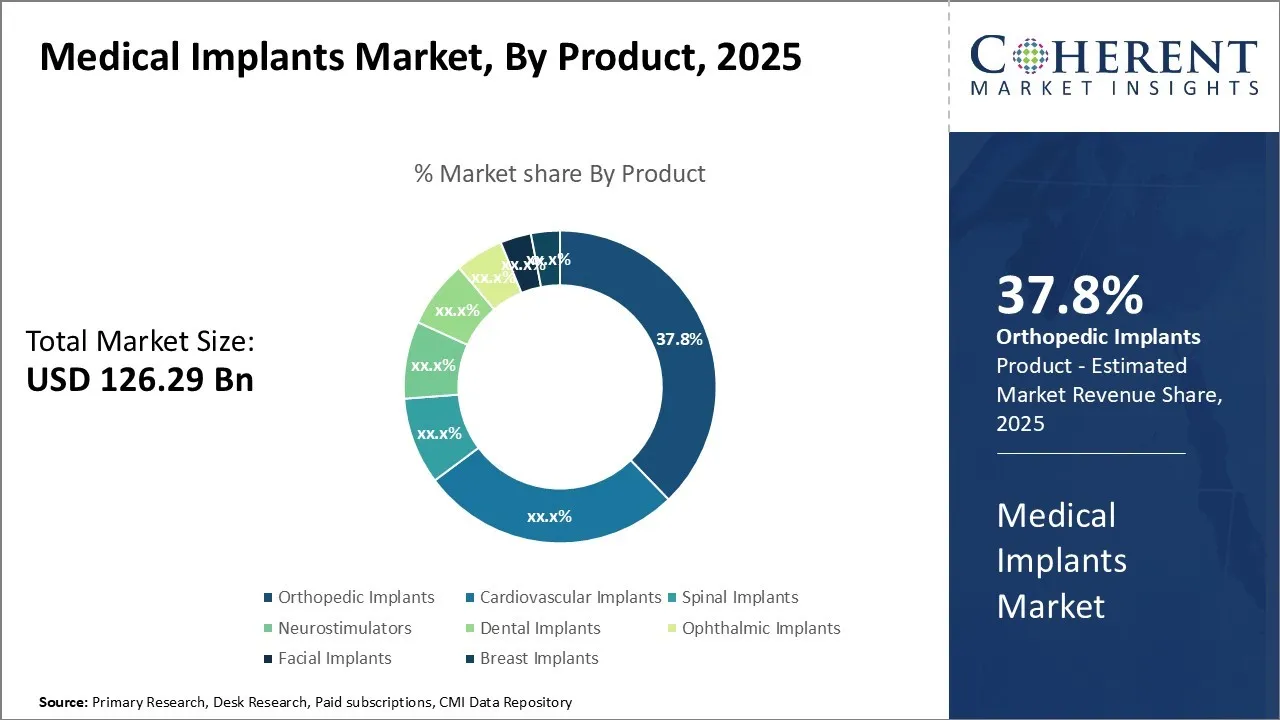
The orthopaedic implants segment is projected to dominate the global medical implants market with a 38.8% share in 2026, underlining its pivotal role in treating musculoskeletal disorders. This leadership is driven by the growing prevalence of conditions such as osteoarthritis, osteoporosis, and traumatic fractures, particularly among the aging global population.
Orthopaedic implants are increasingly favoured for their durability, biocompatibility, and effectiveness in restoring mobility and improving quality of life. Advances in materials such as porous titanium, cobalt-chromium alloys, and 3D-printed components have significantly enhanced implant longevity and surgical outcomes.
While cardiovascular and dental implants are gaining traction, orthopaedic implants continue to lead due to their essential role in both emergency and elective surgeries, strong reimbursement frameworks, and rising adoption in emerging healthcare systems.
Medical Implants Market – Regional Insights
North America Medical Implants Market Trends and Analysis
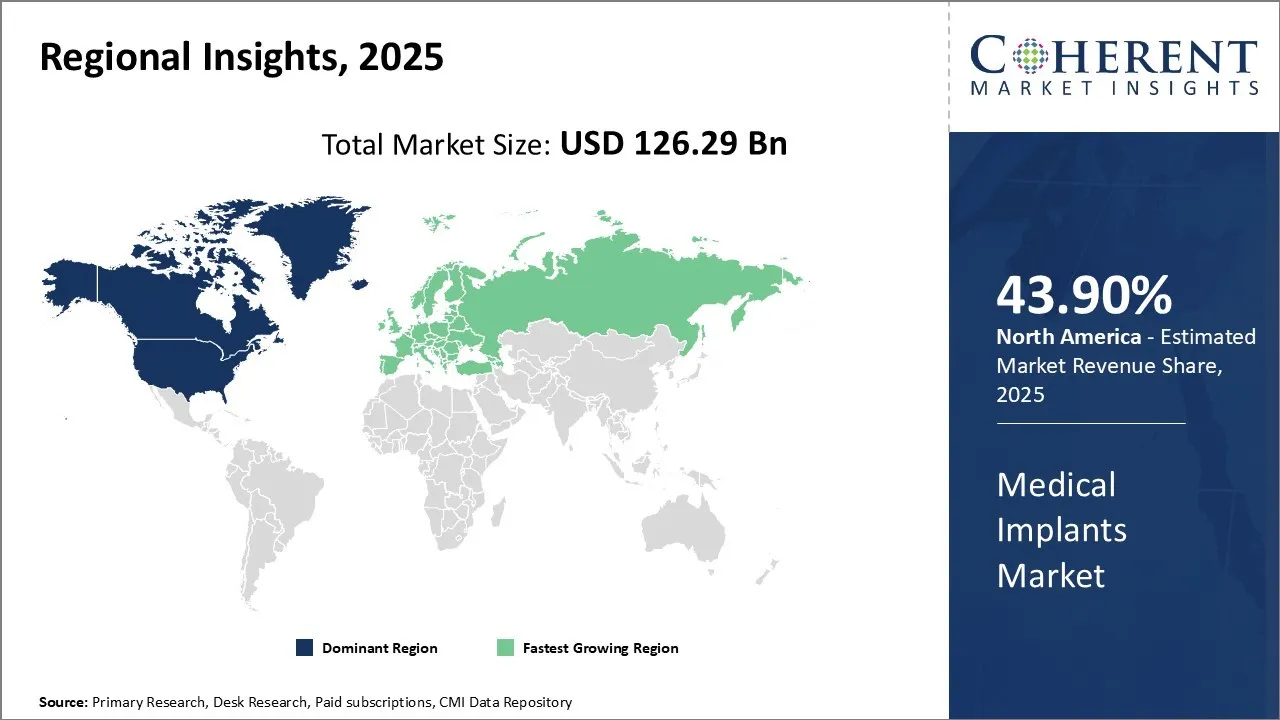
North America is expected to lead the global medical implants market, accounting for a substantial 43.90% share in 2026. This dominance is driven by the region’s advanced healthcare infrastructure, high healthcare spending, and early adoption of innovative implant technologies.
The U.S. plays a pivotal role, supported by a strong presence of key medical device manufacturers, robust R&D capabilities, and favourable reimbursement frameworks. The increasing incidence of chronic diseases such as cardiovascular conditions and orthopaedic disorders, coupled with a growing elderly population, further amplifies demand.
Additionally, the region benefits from strong regulatory systems that ensure patient safety and accelerate the adoption of next-generation implants.
Europe Medical Implants Market Trends and Analysis
Europe holds a significant position in the global medical implants market, driven by a well-established healthcare system, aging demographics, and a high prevalence of musculoskeletal and dental conditions. Countries such as Germany, France, and the U.K. are leading contributors due to their strong surgical capabilities, supportive insurance models, and continuous technological advancements in implant design and materials.
The region’s focus on quality care, along with government initiatives promoting early diagnosis and intervention, sustains steady market growth. Moreover, growing demand for minimally invasive procedures and biocompatible implants is reshaping product development strategies across the continent.
Medical Implants Market Dominating Countries
United States and Canada
The United States is a global leader in the medical implants market, driven by its advanced healthcare infrastructure, high per capita healthcare spending, and early adoption of innovative implant technologies. The presence of major medical device manufacturers like Medtronic, Stryker, and Zimmer Biomet reinforces the country’s leadership. Additionally, favourable reimbursement policies and a strong focus on R&D contribute to rapid innovation and product approval.
Canada also plays a significant role in regional growth, supported by its universal healthcare system, rising demand for orthopaedic and cardiovascular implants, and increasing investments in minimally invasive surgical technologies. The country’s focus on patient safety and technological advancement helps sustain steady market expansion.
Market Report Scope
Medical Implants Market Report Coverage
| Report Coverage | Details | ||
|---|---|---|---|
| Base Year: | 2025 | Market Size in 2026: | USD 135.64 Bn |
| Historical Data for: | 2020 To 2024 | Forecast Period: | 2026 To 2033 |
| Forecast Period 2026 to 2033 CAGR: | 7.4% | 2033 Value Projection: | USD 223.56 Bn |
| Geographies covered: |
| ||
| Segments covered: |
| ||
| Companies covered: | Biotronik, Inc., Livanova Plc, NuVasive, Inc., and Institute Straumann AG, among others. | ||
| Growth Drivers: |
| ||
| Restraints & Challenges: |
| ||
Analyst Viewpoint – Medical Implants Market
- Analysts maintain a positive outlook on the global medical implants market, driven by the increasing prevalence of chronic diseases, rising geriatric population, and advancements in implantable technologies. Orthopaedic, cardiovascular, and dental implants are highlighted as key growth segments due to their critical role in improving patient mobility, cardiac health, and oral function. The integration of smart technologies, such as sensor-enabled and 3D-printed implants, is seen as a transformative trend enhancing clinical outcomes and patient monitoring.
- Experts also point to the growing demand for minimally invasive and biocompatible implants as a defining market shift. There is an increased focus on custom-fit implants and biologically adaptive materials that reduce rejection rates and promote faster recovery, particularly in orthopaedic and spinal applications.
- Regionally, North America dominates due to its robust healthcare infrastructure and high adoption of advanced surgical procedures. However, analysts view Asia Pacific especially China and India as the fastest-growing region, driven by expanding healthcare access, medical tourism, and government support for local manufacturing. Europe continues to show strong demand, supported by aging demographics and policy-driven healthcare spending.
- Looking ahead, analysts expect the market's trajectory to be shaped by regulatory streamlining, reimbursement reforms, and sustained R&D investment. Strategic collaboration between manufacturers, healthcare providers, and regulatory bodies will be crucial in driving innovation, ensuring affordability, and expanding access across developed and emerging economies.
Medical Implants Market: Key Development
- In April 2025, Medline UNITE received FDA 510(k) clearance for its dynamic, biplanar-compression foot and ankle implant, combining nitinol staples with locking plates designed for MTP fusion and Lapidus procedures. This marks an important step in offering more precise, stable fixation and addresses a niche in foot/ankle reconstruction.
- In March 2025, J&J showcased innovative VELYS robotic-assisted knee replacement and ATTUNE smart knee system at AAOS 2025. These connect surgical robotics with data-driven platforms to enhance precision, optimize workflows, and improve outcomes, signalling the shift toward digital orthopaedics.
- In May 2025, Hyalex received FDA IDE supplement approval to broaden its pivotal trial for the HYALEX® Freestyle Knee Implant, which targets early osteoarthritis and cartilage defects. This next-gen implant aims to restore joint function in patients with limited current options.
- In April 2024, Onkos Surgical secured FDA De Novo clearance for its novel antibacterial coating designed for orthopaedic implants used in tumour, revision, and trauma surgeries. The coating demonstrates a 99.999% bactericidal rate in vitro and offers protection without elution. This approval addresses the significant risk of implant-related infections, particularly in high-risk surgical cases. It opens avenues for Onkos and other manufacturers to integrate antimicrobial solutions, potentially reducing postoperative complications and broadening implant adoption in oncology and revision contexts.
- In January, 2024, Neuralink implanted its first brain-computer interface device in a human for the PRIME study. By March, the patient demonstrated control of a computer cursor via thought and a second patient successfully used the implant for 3D design via CAD. This milestone marks a major advance in neurotechnology, offering potential new treatments for neurological injuries and disorders. It also accelerates development of brain–computer interface implants, signalling a shift toward devices that restore function and enhance quality of life via direct neural integration.
Market Segmentation
- Global Medical Implants Market, By Product (Revenue, USD Bn, 2021 - 2033)
- Orthopedic implants
- Reconstructive Joint Replacements
- Knee Replacement Implants
- Hip Replacement Implants
- Extremities
- Orthobiologics
- Trauma & Craniomaxillofacial
- Reconstructive Joint Replacements
- Cardiovascular Implants
- Pacing Devices
- Cardiac Resynchronization Therapy Devices (CRTs)
- CRT-P (CRT with pacemaker function)
- CRT-D (CRT with pacemaker and ICD function)
- Implantable Cardioverter Defibrillators (ICDs)
- Transvenous Implantable Cardioverter Defibrillator (T-ICDs)
- Subcutaneous Implantable Cardioverter Defibrillator (S-ICDs)
- Implantable Cardiac Pacemakers (ICPs)
- Cardiac Resynchronization Therapy Devices (CRTs)
- Pacing Devices
- Stents
- Coronary stents
- Drug-eluting Stents (DES)
- Bare-metal Coronary Stents
- Bioabsorbable Stents
- Peripheral stents
- Iliac
- Femoral-Popliteal
- Renal
- Carotid
- Stent-related Implants
- Synthetic Grafts
- Vena Cava Filters
- Coronary stents
- Structural Cardiac Implants
- Mechanical Heart Valves
- Implantable Ventricular-assist Devices
- LVAD
- RVAD
- BIVAD
- Spinal Implants
- Spinal fusion implants
- Spinal bone stimulators
- Vertebral Compression Fracture (VCF) Devices
- Motion Preservation Devices/Non-Fusion Devices
- Neurostimulators
- Deep Brain Stimulation (DBS)
- Sacral Nerve Stimulation (SNS)
- Vagus Nerve Stimulation (VNS)
- Spinal Cord Stimulation (SCS)
- Other neurostimulators
- Opthalmic Implants
- Intraocular Lens
- Glaucoma Implants
- Dental Implants
- Plate Form Dental Implants
- Root Form Dental Implants
- Facial Implants
- Breast implants
- Orthopedic implants
- Global Medical Implants Market, By Biomaterial Type (Revenue, USD Bn, 2021 - 2033)
- Metallic Biomaterials
- Ceramic Biomaterials
- Polymers Biomaterials
- Natural Biomaterials
- Global Medical Implants Market, By (Revenue, USD Bn, 2021 - 2033) Geography
- North America
- U.S.
- Canada
- Latin America
- Brazil
- Argentina
- Mexico
- Rest of Latin America
- Europe
- Germany
- U.K.
- Spain
- France
- Italy
- Russia
- Rest of Europe
- Asia Pacific
- China
- India
- Japan
- Australia
- South Korea
- ASEAN
- Rest of Asia Pacific
- Middle East
- GCC Countries
- Israel
- Rest of Middle East
- Africa
- South Africa
- North Africa
- Central Africa
- North America
- Company Profiles
- Biotronik, Inc.
- Livanova Plc
- NuVasive, Inc.
- Institut Straumann AG
Sources
The Stakeholders Consulted
- Orthopedic surgeons and healthcare practitioners
- Manufacturers and suppliers of orthopedic, dental, cardiovascular, and neurological implants
- Hospital procurement managers and surgical coordinators
- Medical device regulatory compliance experts
- Biomedical research institutions and academic hospitals
- Public health authorities and medical policy advisors
- End-users across specialties such as trauma care, cardiology, orthopedics, dentistry, and neurology
Databases Opened
- U.S. Food and Drug Administration (FDA) – Medical Devices Database
- European Medicines Agency (EMA) – Medical Devices and Implants Section
- Ministry of Health and Family Welfare (India) – Health Device Statistics
- World Health Organization (WHO) – Global Health Observatory (GHO)
- OECD Health Data – Medical Technology Indicators
Magazines & Trade Publications
- Medical Device and Diagnostic Industry (MD+DI)
- Orthopedic Design & Technology (ODT)
- MedTech Dive
- Cardiovascular Business Magazine
- Medical Plastics News
- BioSpectrum – MedTech Section
Scientific and Industry Journals
- Journal of Biomedical Materials Research
- Clinical Orthopaedics and Related Research
- International Journal of Implant Dentistry
- Journal of Medical Devices
- Nature Biomedical Engineering
- European Journal of Medical Research
Newspapers & Media Outlets
- The Wall Street Journal – Health & Technology
- Bloomberg – Medical Devices & Innovation
- Reuters – Global Health and Medical Technology
- The Economic Times – Healthcare & Pharmaceuticals
- Business Standard – MedTech & Regulatory Developments
Associations and Regulatory Bodies
- U.S. Food and Drug Administration (FDA) – Center for Devices and Radiological Health (CDRH)
- European Commission – Medical Devices Coordination Group (MDCG)
- Medical Device Innovation Consortium (MDIC)
- International Organization for Standardization (ISO) – Medical Devices Standards (ISO 13485)
- Indian Council of Medical Research (ICMR)
- Association for the Advancement of Medical Instrumentation (AAMI)
Public Domain Sources
- U.S. Centers for Medicare & Medicaid Services (CMS) – Reimbursement Data
- European Commission – EU Medical Device Regulation (MDR) Reports
- WHO – Global Medical Device Nomenclature (GMDN)
- World Bank – Healthcare Access and Infrastructure Data
- National Institutes of Health (NIH) – Biomedical Research Findings
Proprietary Research Elements
- CMI Data Analytics Tool
- Proprietary CMI Repository of Market Data (covering past 8 years)
- CMI Expert Interviews and Transcripts (focused on medical implants, regulatory trends, and surgeon preferences)
Get access to 250+ pages report
Every segment, forecast, competitor profile and data table behind the analysis above — available for instant download.
- ESOMAR Member
- ISO 9001:2015 Certified
- D-U-N-S Registered
- GDPR & CCPA Compliant
Missing comfort of reading report in your local language? Find your preferred language:
Transform your Strategy with Exclusive Trending Reports
Frequently Asked Questions
The Medical Implants Market size is estimated to be valued at USD 135.64 Bn in 2026, and is expected to reach USD 223.56 Bn by 2033.
The CAGR of the global Market is projected to be 7.4% from 2026 to 2033.
Rise in prevalence of chronic disease and growing geriatric population around the world is fueling the market.
The Orthopaedic Implants segment is the leading component segment in the market.
High cost of treatment, stringent rules/regulations, and stringent approval process are major factors restraining market.
Major players operating in the market are Biotronik, Inc., Livanova Plc, NuVasive, Inc., and Institut Straumann AG, among others.