

Transcatheter Aortic Valve Implantation Market Size and Share Analysis - 2026 To 2033
The Transcatheter Aortic Valve Implantation market is anticipated to grow at a CAGR of 9.72% with USD 8.45 Bn in 2026 and is expected to reach USD 16.18 Bn in 2033. The market is driven by the rising cardiovascular disease prevalence (Heart and blood vessel diseases (cardiovascular diseases or CVDs) are the leading cause of death worldwide. They cause about 17.9 million deaths every year), ageing populations, minimally invasive treatment adoption, and continuous advancement. The increasing prevalence of coronary artery disease, the rising adoption of minimally invasive therapies, and the expanding geriatric population represent some of the key factors driving the market.
Key Takeaways
- Transfemoral Implantation segment is expected to account the largest share of 70.0% in 2026, it is the preferred approach because it is minimally invasive, uses the femoral artery, has faster recovery times, fewer complications, and is suitable for most patients. The transfemoral J-Valve device was successfully implanted in 92% of patients with severe heart valve disease. The death rate from all causes was 4.0% after 30 days and remained 4.0% after one year, with no deaths caused by heart-related problems.
- Hospitals segment will dominate with 60.0% in 2026, hospitals have specialized cardiac catheterization laboratories, experienced heart teams, advanced imaging equipment, and intensive care facilities needed for TAVI procedures. More than 600,000 TAVI procedures have been performed worldwide, and the majority are carried out in hospitals due to the complexity of the procedure and the need for specialized cardiac care.
- North America is expected to acquire the dominant share of 45.00% in 2026, high adoption of minimally invasive heart procedures, advanced healthcare infrastructure, favorable reimbursement policies, a growing elderly population, and the presence of leading TAVI device manufacturers. Yale New Haven Hospital is improving less invasive heart surgery by using robotic technology. These robotic cardiac procedures help doctors perform heart surgeries through smaller cuts, which can support faster recovery and better patient outcomes.
Segmental Insights
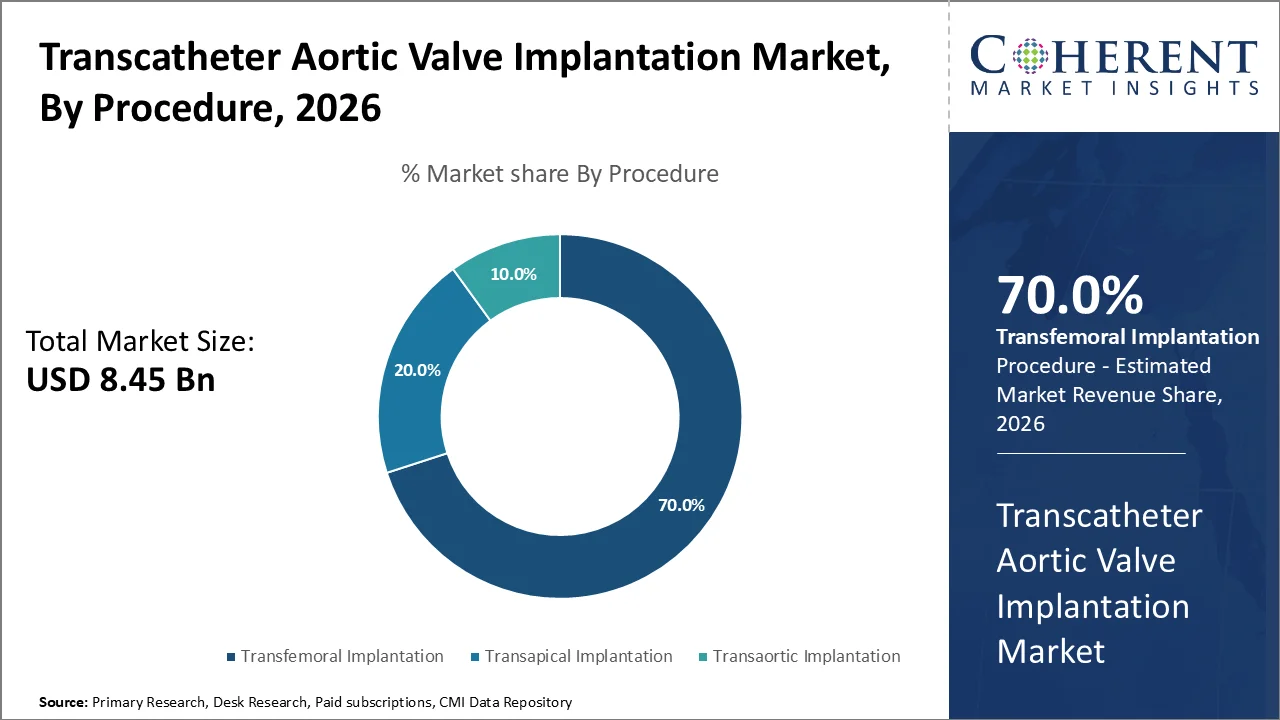
Why is Transfemoral Implantation Segment Acquiring the Largest Market Share?
Transfemoral implantation segment is projected to account for the largest share of procedure in 2026, representing approximately 70.0% of the total volume. Owing to its minimally invasive nature, superior clinical outcomes, as well as high adoption across major cardiac catheterization laboratories globally. Ghana has 10 cardiac catheterization laboratories (Cath labs) across nine healthcare facilities. Nine of these labs (90%) are located in Accra, while one (10%) is located in Kumasi.
Transfemoral Implantation has firmly made itself as the leading procedural approach in the global TAVI market, and its dominance is supported by a broad spectrum of clinical, technological, as well as patient preference-related factors. This way involves advancing the transcatheter heart valve through the femoral artery in the groin, hence eliminating the need for open-chest surgery as well as general anesthesia in most cases.
The procedure is broadly regarded as the standard of care for patients with severe aortic stenosis who are deemed inoperable or at high surgical risk, as recognized by major cardiology societies including the American College of Cardiology (ACC) and the European Society of Cardiology (ESC). Severe aortic stenosis affects about 3.4% of people aged 75 years and above in Europe and the United States. The number of cases varies from about 10 cases per 100,000 people in some populations.
- Current Industry Events of 2026
- Market Size Estimation
- Regional Breakdown
- Competitive Landscape
- Customer Intelligence
- Segmental Analysis
- Pricing Analysis
- Key Market Drivers, Challenges & Future Trends
- Customized Insights Section
Hospitals Segment holds the Largest Market Share
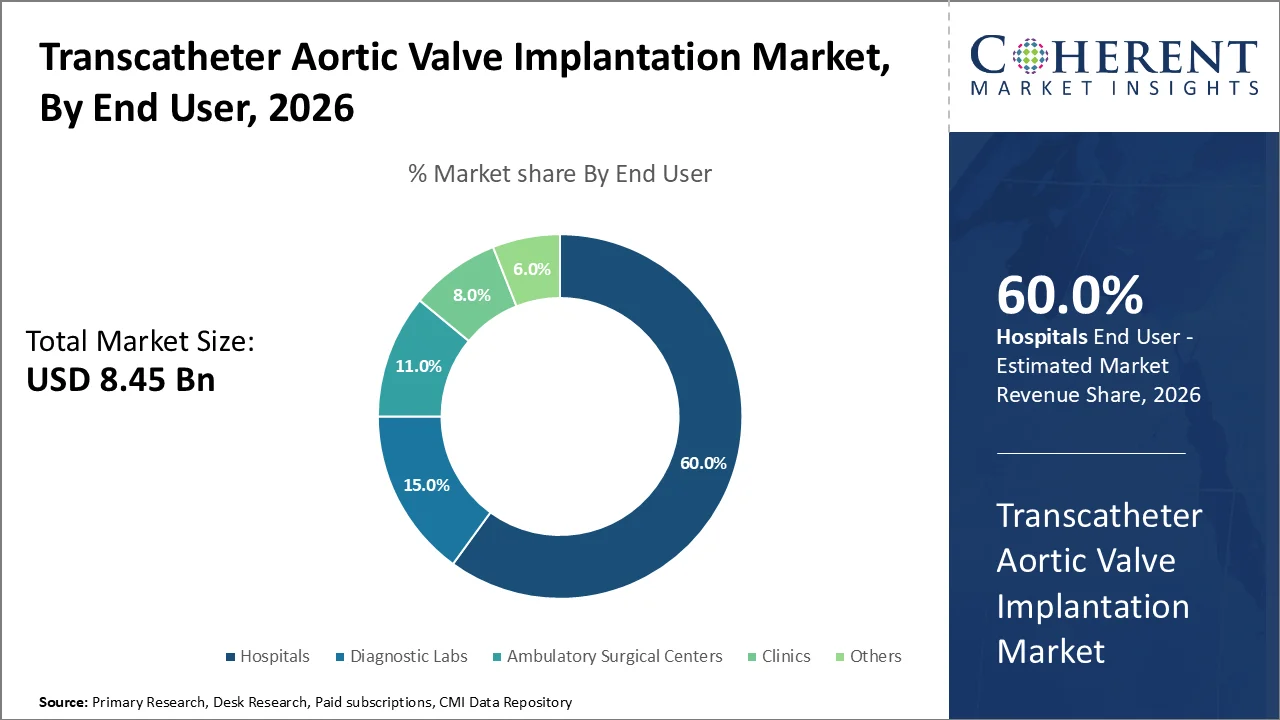
Based on end user, Hospitals segments dominates the market, accounting for a significant 60.0% share in 2026. Hospitals contribute the highest share in the TAVI market owing to their comprehensive infrastructure, multidisciplinary Heart Team capabilities, and the procedural complexity associated with transcatheter aortic valve implantation, which inherently demands a highly controlled and resource-intensive clinical setting.
TAVI is a sophisticated structural heart intervention that requires the simultaneous collaboration of interventional cardiologists, cardiac surgeons, anesthesiologists, echocardiographers, and specialized nursing staff all of whom are consistently available within a hospital environment.
This multidisciplinary team-based approach, strongly recommended by leading bodies such as the European Society of Cardiology (ESC) and the American College of Cardiology (ACC), mandates that TAVI procedures be conducted in facilities capable of providing full surgical backup, hybrid operating rooms, and intensive care monitoring, all of which are hallmarks of large tertiary and quaternary care hospitals.
Market Drivers
Balloon-Expandable Valve (BEV) Technology is transforming the Transcatheter Aortic Valve Implantation Industry
Balloon-expandable valves (BEVs) are used in Transcatheter Aortic Valve Implantation (TAVI). The valve is placed on a balloon catheter and expanded by inflating the balloon inside the heart. This brings the valve to be placed accurately and securely, making it suitable for patients with hard or unevenly calcified aortic valves. Over the years, Edwards Lifesciences has improved its SAPIEN valve series with smaller delivery systems, better sealing to reduce leaks, as well as anti-calcification tissue to improve durability.
These improvements have aid reduce moderate and severe valve leakage from about 6% with SAPIEN XT to less than 1% with SAPIEN 3. The latest SAPIEN 3 Ultra RESILIA valve uses special tissue that showed 70% less calcification in preclinical studies, helping the valve last longer. The SAPIEN platform holds about 55–60% of the U.S. TAVI market, and clinical studies have shown that it provides better outcomes than surgery for many high-, intermediate-, as well as low-risk patients.
Self-Expanding Valve (SEV) Technology: A major breakthrough in Transcatheter Aortic Valve Implantation
Self-expanding valves (SEVs) have a nitinol (nickel-titanium) frame that automatically expands to its normal shape at body temperature. They can fit different heart shapes, provide continuous support, with newer versions can be placed or removed if needed during the procedure.
Medtronic has improved its self-expanding valve technology through its CoreValve as well as Evolut platforms. The latest models have smaller delivery systems, can be repositioned during implantation, as well as has an outer tissue wrap to reduce valve leakage. These improvements have made the procedure safer and improved patient outcomes.
Current Events and Their Impact on the Transcatheter Aortic Valve Implantation Market
Current Event | Description and its Impact |
Expansion of TAVI Indications Through Regulatory Approvals and Clinical Guidelines (2025–2026) |
|
Government Investment in Structural Heart Disease Programs and Cardiovascular Care |
|
Transcatheter Aortic Valve Implantation Market Trends
- Perhaps the single most significant commercial and clinical trend reshaping the TAVI market is the ongoing expansion of approved indications toward low-surgical-risk and younger patients. Landmark clinical trials including PARTNER 3 and Evolut Low Risk showed non-inferiority or superiority of TAVI over surgical aortic valve replacement (SAVR) in low-risk patients, prompting regulatory agencies in the United States (FDA), Europe (CE Mark), and other major jurisdictions to broaden approval labels.
- Key advancements include the development of self-expanding vs. balloon-expandable valve platforms, repositionable and retrievable valves, low-profile delivery systems enabling alternative vascular access approaches, as well as valves with enhanced sealing mechanisms to minimize paravalvular leak (PVL) historically a significant limitation of early-generation TAVI devices. A study that reviewed 16 research papers found that balloon-expandable valves (BEV) reduced the risk of death from all causes by 11% compared with other valve types.
- The inclination of the clinical community toward minimalist TAVI encompassing transfemoral access under conscious sedation, same-day or next-day discharge protocols, and outpatient procedural settings is reducing procedural costs, improving patient throughput, and enhancing the overall value proposition of TAVI versus SAVR.
- As the first generation of TAVI patients now reaches 10+ years of follow-up, the accumulation of robust long-term structural valve deterioration (SVD) data is both a market driver and a critical differentiator. Emerging evidence generally supports favorable long-term durability of contemporary TAVI valves, though uncertainty remains in younger cohorts with longer life expectancies.
- The integration of artificial intelligence (AI), 3D imaging, CT-based computational modeling, and digital workflow platforms is transforming pre-procedural planning, intraoperative guidance, and post-procedural outcomes assessment in TAVI.
Regional Insights
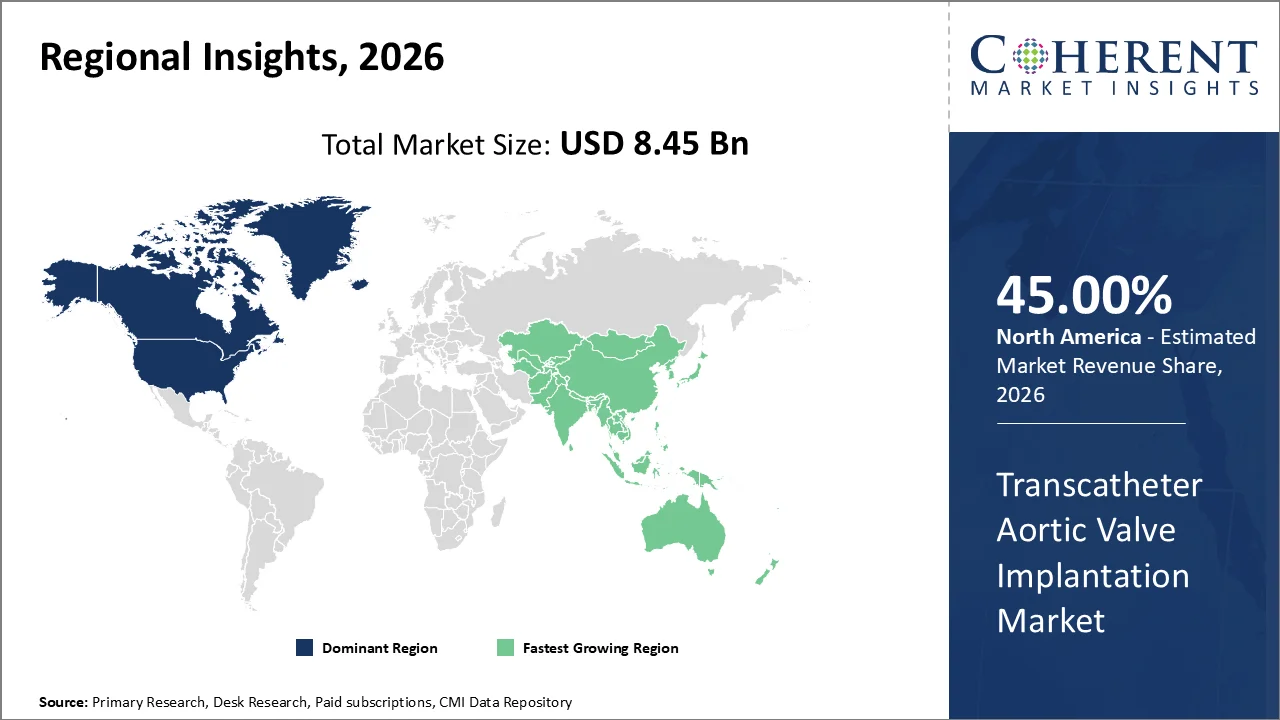
North America dominates owing to high procedural adoption rates
North America account 45.00% market share in 2026, owing to its high procedural adoption rates, and the presence of leading medical device manufacturers that continuously drive clinical innovation and patient access. The United States has the largest medical device manufacturers in the world. It accounts for more than 40% of the global medical technology market.
The United States, as the dominant contributor within this subsegment, benefits from the U.S. Food and Drug Administration's progressive regulatory framework that has systematically expanded TAVI indications from high-risk to intermediate-risk and, most recently, to low-risk surgical patients, hance substantially enlarging the eligible patient population.
According to the American College of Cardiology, TAVI procedures in the United States have surpassed surgical aortic valve replacement in annual procedural volume, reflecting a fundamental change in clinical preference driven by compelling trial outcomes.
Canada further supported this dominance through its publicly funded provincial health systems that have highly adopted TAVI into standard cardiac care pathways. The Society of Thoracic Surgeons and the American Association for Thoracic Surgery have jointly published rules endorsing TAVI for a broader patient demographic, which has directly translated into higher procedural volumes.
Asia Pacific Transcatheter Aortic Valve Implantation Market Trends
The Asia Pacific region is poised to be the fastest-growing region through 2026-2033, expanding at a CAGR of approximately 7.2%. Driven by rising cardiovascular disease burden, as well as increasing initiatives by government authorities focused at improving access to advanced cardiac interventions.
Countries including Japan, China, South Korea, Australia, etc., have witnessed exponential growth in TAVI adoption, supported by progressive regulatory approvals as well as national health insurance expansions that have made these procedures accessible to a broader patient population. China approved its first TAVI valve in 2017. The self-expanding and repositionable valve has been used in more than 10,000 procedures across China. This shows the high adoption of TAVI technology in the country.
The Pharmaceuticals and Medical Devices Agency (PMDA) of Japan has been progressively approving next-generation TAVI devices, while Ministry of Health, Labour and Welfare of Japan has incorporated TAVI procedures into its national health insurance reimbursement system, significantly reducing financial barriers for elderly Japanese patients suffering from severe aortic stenosis.
In September 2025, Medtronic launched its new Evolut FX+ transcatheter aortic valve in India. The device is used to treat patients with severe aortic stenosis and helps doctors perform future coronary procedures more easily. The Evolut FX+ TAVI system improves access to the coronary arteries while maintaining the performance of the Evolut™ valve platform. The device received approval from India’s CDSCO on June 10, 2025, allowing its launch in the Indian market.
Highly Sophisticated Cardiac Care Infrastructure is Accelerating the Transcatheter Aortic Valve Implantation Market Demand in U.S.
The U.S. contributes the highest share in the transcatheter aortic valve implantation (TAVI) market in North America, owing to its highly sophisticated cardiac care infrastructure, robust reimbursement landscape, and the sheer volume of aortic stenosis patients receiving interventional treatment across its extensive network of certified structural heart disease centers.
The United States has been the primary adopter of TAVI technology ever since the U.S. Food and Drug Administration approved the first transcatheter heart valve system, with subsequent approvals expanding indications across high-risk, intermediate-risk, and low-risk surgical patients, thereby dramatically broadening the eligible patient pool.
According to the American College of Cardiology's STS/ACC TVT Registry, tens of thousands of TAVI procedures are performed annually across hundreds of participating hospital sites throughout the country, reflecting the deep institutional penetration of this technology.
Centers for Medicare and Medicaid Services coverage determinations have been instrumental in ensuring that elderly Medicare beneficiaries who constitute the overwhelming majority of aortic stenosis patients can access TAVI without prohibitive out-of-pocket financial burdens.
China Transcatheter Aortic Valve Implantation Market Trends
China contributes the highest share in the transcatheter aortic valve implantation (TAVI) market in Asia Pacific owing to its massive geriatric population base, rapidly advancing interventional cardiology infrastructure, and strong governmental push toward minimally invasive cardiac care.
China's National Health Commission has consistently prioritized structural heart disease treatment within its national healthcare reform agenda, enabling widespread adoption of TAVI procedures across tier-one and tier-two hospital networks.
The country's aging demographic profile is a critical demand driver, with the National Bureau of Statistics of China reporting that individuals aged 60 and above accounted for over 280 million people by 2023, a segment disproportionately burdened by aortic stenosis.
Furthermore, the China Food and Drug Administration's accelerated approval pathways for novel TAVI devices including domestically manufactured valves from companies such as Venus Medtech and Peijia Medical have significantly reduced procedural costs while expanding patient access beyond major metropolitan centers.
Who are the Major Companies in Transcatheter Aortic Valve Implantation Industry
Some of the major key players in transcatheter aortic valve implantation market include, Edwards Lifesciences, Boston Scientific Corporartion, Jenavalve Technology, Inc., HLT, Inc., Meril Life Sciences Pvt. Ltd., Medtronic Plc., St. Jude Medical, Inc., Transcatheter Technologies GmbH, and SYMETIS SA.
Key News
- In July 2026, Carvolix presented clinical results of its TAVIPILOT AI software and TAVIPILOT Robot at the New York Valves: The Structural Heart Summit in June 2026. The AI-based and robotic technologies are designed to support TAVI procedures by helping doctors perform heart valve implantation more accurately and efficiently.
- In January 2025, Abbott launched Navitor Vision in India on January 28, 2025, for treating patients with severe aortic stenosis who have a high risk of surgery. It is the latest version of Abbott’s TAVI/TAVR system. The device includes improved visibility markers that help doctors see and place the heart valve more accurately during the TAVI procedure.
Market Report Scope
Transcatheter Aortic Valve Implantation Market Report Coverage
| Report Coverage | Details | ||
|---|---|---|---|
| Base Year: | 2025 | Market Size in 2026: | USD 8.45 Bn |
| Historical Data for: | 2020 To 2024 | Forecast Period: | 2026 To 2033 |
| Forecast Period 2026 to 2033 CAGR: | 9.72% | 2033 Value Projection: | USD 16.18 Bn |
| Geographies covered: |
| ||
| Segments covered: |
| ||
| Companies covered: | Edwards Lifesciences, Boston Scientific Corporartion, Jenavalve Technology, Inc., HLT, Inc., Meril Life Sciences Pvt. Ltd., Medtronic Plc., St. Jude Medical, Inc., Transcatheter Technologies GmbH, and SYMETIS SA. | ||
| Growth Drivers: |
| ||
| Restraints & Challenges: |
| ||
Analyst Opinion
- The transcatheter aortic valve implantation market is witnessing remarkable momentum, driven by the rising prevalence of aortic stenosis among the aging global population. Aortic stenosis becomes more common with age. It affects about 1–2% of adults above 65 years and more than 10% of people above 75 years.
- As minimally invasive procedures continue to gain preference over conventional open-heart surgeries, TAVI has emerged as a transformative solution offering reduced recovery time and lower procedural risks.
- Technological advancements in valve design, delivery systems, and imaging guidance have significantly enhanced procedural precision, thereby broadening the patient eligibility criteria beyond high-risk individuals to intermediate and low-risk populations.
- The increasing adoption of TAVI procedures across ambulatory surgical centers, alongside growing physician expertise, is further accelerating market expansion.
- Compelling opportunities exist in untapped emerging markets across Asia-Pacific and Latin America, where improving healthcare infrastructure and rising medical tourism are creating favorable conditions for market penetration.
Speak to the analyst
Want personalized insights?
Take the findings above to one of our principal consultants, or have the report rebuilt around the segments, geographies and competitors you actually track.
Market Segmentation
- By Procedure (Revenue, USD Bn, 2021-2033)
- Transfemoral Implantation
- Transapical Implantation
- Transaortic Implantation
- By End User (Revenue, USD Bn, 2021-2033)
- Hospitals
- Diagnostic Labs
- Ambulatory Surgical Centers
- Clinics
- Others
- By Region (Revenue, USD Bn, 2021-2033)
- North America
- U.S.
- Canada
- Latin America
- Brazil
- Mexico
- Argentina
- Rest of Latin America
- Europe
- Germany
- U.K.
- France
- Italy
- Spain
- Russia
- Rest of Europe
- Asia Pacific
- China
- India
- Japan
- Australia
- South Korea
- ASEAN
- Rest of Asia Pacific
- Middle East
- GCC
- Israel
- Rest of Middle East
- Africa
- South Africa
- Central Africa
- North Africa
- North America
Sources
Primary Research Interviews
- Interventional Cardiologists
- Cardiac Surgeons
- Medical Device Manufacturers
- Hospital Procurement Managers
- Others
Databases
- GlobalData Healthcare
- IQVIA Medical Device Intelligence
- Evaluate MedTech
- Clarivate Analytics
- Others
Magazines
- Cardiovascular Business Magazine
- Medical Device and Diagnostic Industry (MD+DI)
- Cardiac Interventions Today
- MedTech Insight
- Others
Journals
- Journal of the American College of Cardiology (JACC)
- European Heart Journal
- JACC: Cardiovascular Interventions
- The New England Journal of Medicine (NEJM)
- Others
Newspapers
- The Wall Street Journal (Healthcare Section)
- Financial Times (MedTech Coverage)
- Reuters Health
- Modern Healthcare
- Others
Associations
- Society of Thoracic Surgeons (STS)
- American College of Cardiology (ACC)
- European Association of Percutaneous Cardiovascular Interventions (EAPCI)
- Transcatheter Cardiovascular Therapeutics (TCT)
- Others
Public Domain Sources
- U.S. Food and Drug Administration (FDA) – Device Approvals & Clearances
- European Medicines Agency (EMA)
- World Health Organization (WHO) – Cardiovascular Disease Data
- ClinicalTrials.gov
- Others
Proprietary Elements
- CMI Data Analytics Tool
- Proprietary CMI Existing Repository of information for last 10 years
Get access to 250+ pages report
Every segment, forecast, competitor profile and data table behind the analysis above — available for instant download.
- ESOMAR Member
- ISO 9001:2015 Certified
- D-U-N-S Registered
- GDPR & CCPA Compliant
Missing comfort of reading report in your local language? Find your preferred language:
Transform your Strategy with Exclusive Trending Reports
Frequently Asked Questions
The Transcatheter Aortic Valve Implantation market is expected to reach USD 16.18 Bn in 2033.
Major players operating in the global Transcatheter Aortic Valve Implantation market include Edwards Lifesciences, Boston Scientific Corporartion, Jenavalve Technology, Inc., HLT, Inc., Meril Life Sciences Pvt. Ltd., Medtronic Plc., St. Jude Medical, Inc., Transcatheter Technologies GmbH, and SYMETIS SA.
Stringent regulatory approval processes and lengthy clinical trial requirements are the major factors that is expected to hamper growth of the market over the forecast period.
Increasing preference for minimally invasive procedures over open-heart surgery is driving growth of the global Transcatheter Aortic Valve Implantation market.
The Transcatheter Aortic Valve Implantation market is anticipated to grow at a CAGR of 9.72% between 2026 and 2033.
Among regions, North America is expected to account for a largest market share in the global Transcatheter Aortic Valve Implantation market over the forecast period.
The big five complications of TAVR are moderate-to-severe paravalvular leakage, major vascular and bleeding complications, and disabling stroke.