
Pharmaceutical Blenders Market Size and Share Analysis – 2026 To 2033
The Pharmaceutical Blenders Market size is anticipated to grow at a CAGR of 6.7%, with a market valuation of USD 843.8 Mn in 2026, and is expected to reach USD 1,328.93 Mn by 2033. The primary drivers are largely defined by the increasing demand for pharmaceutical manufacturing equipment, rising production of solid oral dosage forms, growing adoption of automated blending technologies, and stringent regulatory requirements for uniform mixing and consistent product quality. In 2025, the U.S. Food and Drug Administration (FDA) Center for Drug Evaluation and Research approved 46 novel drugs, 20 of which were first-in-class therapies (43%).
Key Takeaways
- The bin blenders segment is projected to capture the highest market share of 28.0% in 2026. The segment is growing due to increasing acceptance of closed-container blending systems, reduced risks of cross-contamination, the ease of transfer of materials, and better batch consistency. In January 2025, the U.S. FDA issued draft guidance for compliance with 21 CFR 211.110, and discussed batch uniformity, drug product integrity and advanced manufacturing process controls.
- The pharmaceutical application segment is expected to dominate the market with an estimated share of 82.0% in 2026. Growth in this segment is driven by expansion of pharmaceutical manufacturing capacity, growing demand for blending of active pharmaceutical ingredients (APIs) and excipients, tightening quality standards for manufacturing, and increasing investments in pharmaceutical processing equipment. In February 2025, Eli Lilly announced it would build four additional manufacturing facilities in the U.S. on top of its total commitments for manufacturing investments in the U.S. of more than USD 50 billion since 2020.
- North America is expected to account for a significant share of 35.0% in 2026. The growth of the region is driven by the presence of pharmaceutical manufacturing infrastructure, investments in state-of-the-art drug manufacturing plants and demand for GMP-compliant pharmaceutical processing equipment. According to the U.S. FDA, in October 2025, only 9% of API manufacturers were located in the U.S., compared with 22% in China and 44% in India.
Market Drivers
Expansion of Oral Solid Dosage Manufacturing is Driving Demand for Pharmaceutical Blenders
The Pharmaceutical Blenders Market is experiencing significant growth owing to the expansion of oral solid dosage manufacturing facilities and increasing production of tablets and capsules. Pharmaceutical manufacturers are investing in high capacity production lines to improve operational efficiency, maintain consistency in powder mixing and fulfilll growing demands for generic and branded medicines.
In September 2025, Biocon commissioned its first U.S. manufacturing site in New Jersey after investing more than USD 30 million. This plant has the capacity to produce 2 billion tablets per year, highlighting the magnitude of oral solid dosage manufacturing and the need for reliable powder processing and blending systems.
In April 2026, Novartis announced its seventh new U.S. manufacturing facility under its USD 23 billion manufacturing and R&D investment plan. The new 56,200-square-foot facility in North Carolina will focus on API manufacturing for solid dosage tablets, capsules, and RNA therapeutics.
Increasing Adoption of Advanced Manufacturing Technologies is Accelerating Pharmaceutical Blenders Market Growth
The increasing adoption of automated pharmaceutical manufacturing technologies is another major driver of the Pharmaceutical Blenders Market. Drugmakers are moving to digitally controlled and integrated processing systems to achieve better blend uniformity, less operator intervention, and better manufacturing consistency. Automated pharmaceutical blenders with programmable mixing parameters, process analytical technology (PAT) integration and real-time monitoring capabilities are becoming more important as manufacturers increasingly desire more process reliability and compliance with Good Manufacturing Practice (GMP) requirements.
The U.S. Food and Drug Administration (FDA) has a program for the designation of advanced manufacturing technologies, and the final guidance was published in December 2024. The program aims to encourage pharmaceutical manufacturers to embrace new production technologies which can make manufacturing more resilient, product higher quality and supply more reliable.
Current Events and Their Impact on the Pharmaceutical Blenders Market
Current Event | Description and its Impact |
India Implements Revised Schedule M Good Manufacturing Practice Requirements (January 2026) |
|
U.S. FDA Expands Quality Management Maturity Assessment Program (February 2026) |
|
- Current Industry Events of 2026
- Market Size Estimation
- Regional Breakdown
- Competitive Landscape
- Customer Intelligence
- Segmental Analysis
- Pricing Analysis
- Key Market Drivers, Challenges & Future Trends
- Customized Insights Section
Segmental Insights
Why Are Bin Blenders Acquiring the Largest Market Share?
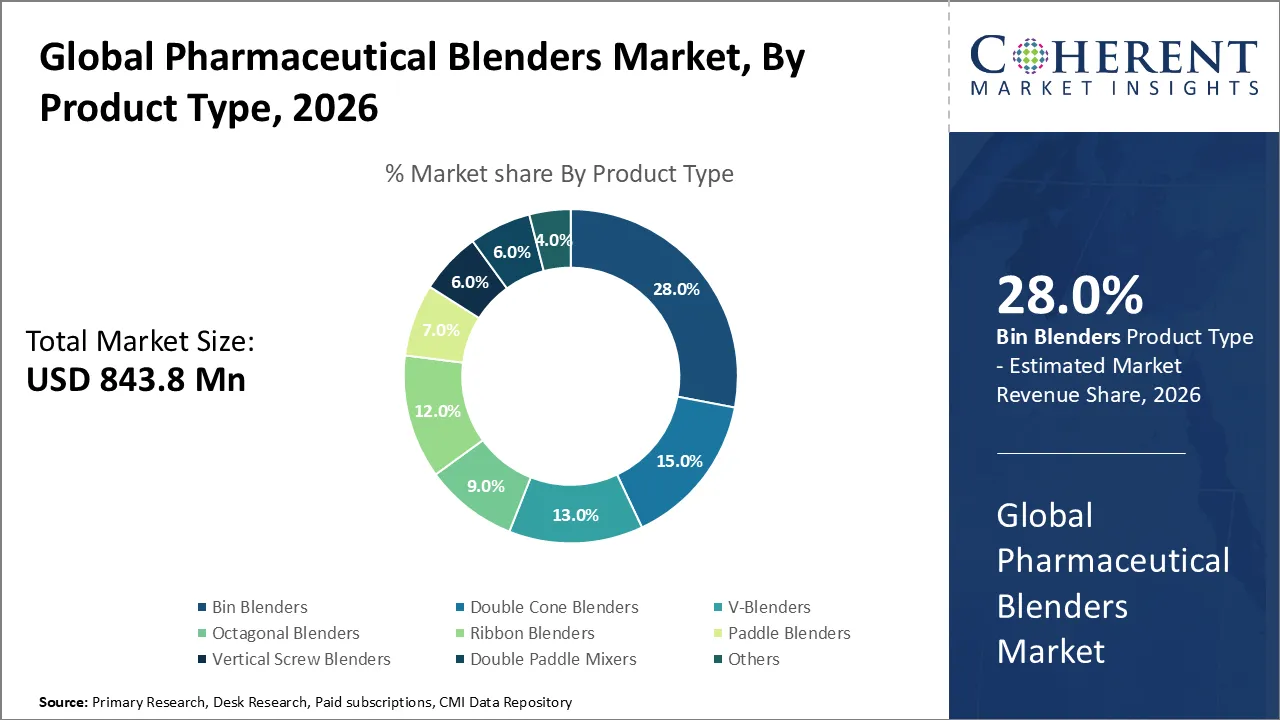
On the basis of product type, the bin blenders segment is projected to account for the largest Pharmaceutical Blenders Market share of 28.0% in 2026. The segment’s growth is attributed to the increasing demand for closed-container powder blending, less risk of cross-contamination, faster batch changeovers, and improved manufacturing efficiency. Bin blenders have interchangeable containers that are helpful in tablet and capsule making due to the flexibility in batch sizes, simplified handling of materials and consistent blending of active pharmaceutical ingredients (APIs) and excipients.
According to GEA Group, blending in intermediate bulk containers (IBCs) reduces loading and unloading time, the need to clean equipment and exposure to the material during pharmaceutical production. The company claims that the Prism blending technology improves the efficiency of blending and supports the use of advanced bin blending systems in multiproduct pharmaceutical manufacturing facilities.
As per the Government of India, 433 registrations and 380 applications have been received under the Revamped Pharmaceutical Technology Upgradation Assistance Scheme (RPTUAS) till November 2025, of which 192 have been approved, including 167 in FY 2025–26, as of January 2026.
Why Does the Pharmaceutical Application Segment Hold the Largest Market Share?
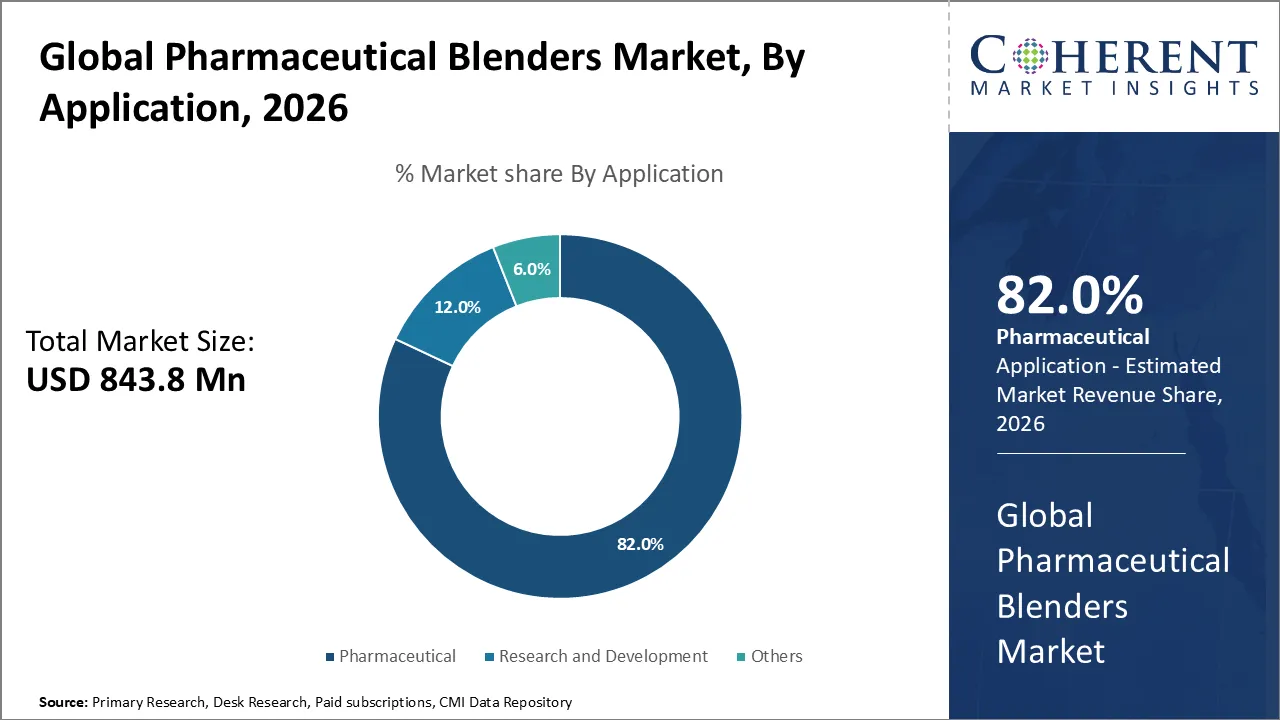
Based on application, the pharmaceutical segment is expected to account for the largest share in the Pharmaceutical Blenders Market, by 2026 with a share of 82.0%. The growth of the segment is driven by increasing manufacturing of pharmaceutical formulations like tablets, capsules, and others, growing demand for uniform distribution of APIs and excipients, and expansion of pharmaceutical manufacturing infrastructure. Pharmaceutical blenders are an essential piece of equipment to ensure uniform drug content, product quality and reproducibility of manufacturing in commercial and contract manufacturing facilities.
As per the Government of India, the 2025 review of the government found that in January 2026, there were more than 350 manufacturing units engaged in pharmaceutical manufacturing, including 28 greenfield locations that were newly set up under the Production Linked Incentive (PLI) Scheme. Scheme-supported production is indicative of the scale of pharmaceutical manufacturing operations and the equipment requirements that come with it, which accounted for 26.5 per cent of India’s total formulation exports in FY25.
India’s Ministry of Chemicals and Fertilizers announced in March 2026 that 38 greenfield bulk drug projects have been commissioned as of December 2025, contributing around 56,800 metric tons of annual manufacturing capacity for essential pharmaceutical raw materials.
Pharmaceutical Blenders Market Trends
- The growing utilization of continuous pharmaceutical blending systems is enhancing production efficiency, decreasing the consumption of materials and facilitating the development of oral solid dosage formulations. In January 2025, Gericke introduced its GFS LAB system, a series of modular continuous and semi-continuous blenders with interchangeable feeders for pharmaceutical formulation development.
- The growing use of Process Analytical Technology (PAT) and real-time blend monitoring is resulting in better content uniformity and process consistency. An article published in the International Journal of Pharmaceutics in February 2025 demonstrated that Raman and near-infrared (NIR) spectroscopy can detect changes in the concentration of APIs as low as 0.50% w/w, allowing for accurate monitoring of pharmaceutical powder blends.
- The growing adoption of simulation-based blender optimization is assisting pharmaceutical manufacturers to enhance the quality of powder mixing and reduce the costs of formulation development. Scalability between 5 L mini-batch and 2 L Turbula blenders is demonstrated using discrete element method (DEM) simulations to better predict blending performance and tablet quality. International Journal of Pharmaceutics, December 2024.
Regional Insights
North America Dominates Owing to Advanced Pharmaceutical Manufacturing Infrastructure and Increasing Domestic Production Investments
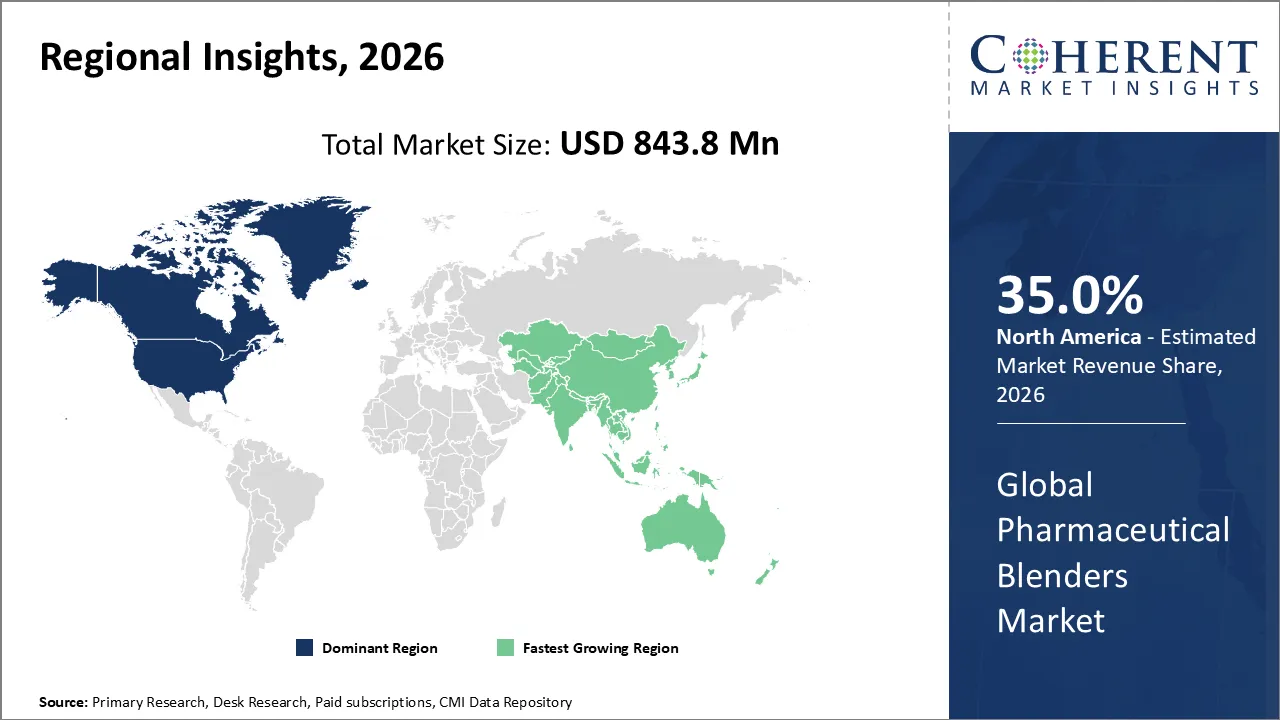
The North America region is anticipated to hold a major share of 35.0% in the global Pharmaceutical Blenders Market by the year 2026. The region’s growth is driven by increasing investments in domestic drug production, rising demand for automated, GMP-compliant pharmaceutical processing equipment, presence of leading drug manufacturers, and strong pharmaceutical manufacturing infrastructure.
In October 2025, Merck announced a USD 3 billion, 400,000-square-foot pharmaceutical manufacturing facility in Elkton, Virginia. The site will be used for both active pharmaceutical ingredient (API) manufacturing and drug product manufacturing, including small molecule manufacturing and testing. The expansion is expected to increase regional demand for pharmaceutical processing equipment including powder blending and material handling systems.
In June 2026, the U.S. Food and Drug Administration (FDA) selected seven companies to take part in its PreCheck Pilot Program, an initiative to improve domestic pharmaceutical manufacturing. Industry interest in building U.S. drug manufacturing capacity is underscored by more than 80 requests to participate received by the agency from February to March 2026.
Asia Pacific Pharmaceutical Blenders Market Trends
The Asia Pacific region is anticipated to grow the fastest in the Pharmaceutical Blenders Market during 2026-2033. The growth is driven by increasing production of generic drugs, rising pharmaceutical exports, cost-effective production capabilities, and increasing investments in automated drug manufacturing equipment. Countries such as India and China are ramping up their pharmaceutical manufacturing capabilities, which creates opportunities for high-capacity bin blenders, V-blenders and continuous powder blending systems.
According to the Economic Survey 2025-26, India exported USD 30.5 billion in pharmaceuticals in FY 2024-25, almost 16 times the USD 1.9 billion in FY 2000-01. Indian pharmaceutical products were exported to 191 countries, with about 50% of exports into highly regulated markets such as the US and Europe.
Expanding Domestic Pharmaceutical Manufacturing Investments Are Accelerating the Pharmaceutical Blenders Market in the United States
The U.S. Pharmaceutical Blenders Market is poised for significant growth driven by factors such as growing investments in pharmaceutical manufacturing in the domestic market, rising small-molecule drug manufacturing, and surging demand for automated and GMP-compliant blending systems. High-capacity bin blenders, continuous blenders and integrated powder processing equipment are opportunities as pharmaceutical manufacturers expand their domestic production capabilities.
In September 2026, Eli Lilly started construction on a USD 6.5 billion pharmaceutical manufacturing facility in Houston, Texas, to manufacture active pharmaceutical ingredients for oral GLP-1 medicines, including orforglipron, and other small-molecule therapeutics.
In October 2026, Bayer announced a USD 2.2 billion investment in a new pharmaceutical manufacturing facility in New Albany, Ohio, expected to create approximately 600 jobs. The company also reported more than USD 7 billion in U.S. pharmaceutical R&D and manufacturing expenditure over the preceding five years.
China Pharmaceutical Blenders Market Trends
The China Pharmaceutical Blenders Market is projected to witness substantial growth over the forecast period, driven by the rising pharmaceutical manufacturing capacity, increasing adoption of intelligent production systems, and government initiatives aimed at supporting advanced pharmaceutical manufacturing technologies. The increasing focus on automated formulation processes, manufacturing efficiency and strict product quality requirements is opening up opportunities for pharmaceutical blenders, mainly enclosed bin blenders, high-shear mixing systems and integrated powder processing equipment.
According to China’s Ministry of Industry and Information Technology (MIIT), the value added of the pharmaceutical industry among enterprises above the designated size grew at an average annual rate of 4.1% during the 14th Five-Year Plan period (2026-2030), accounting for about 3.6% of China’s industrial value added in September 2026.
In June 2026, GreenPine Pharmaceutical started production at its new RMB 1.1 billion pharmaceutical production base in Tianjin, which includes a high-end preparation smart factory and a patented medicine production center. The project includes four planned intelligent production lines for its patented medicine operations, alongside automated preparation equipment and digital manufacturing management systems.
Who are the Major Companies in Pharmaceutical Blenders Industry
Some of the major key players in Pharmaceutical Blenders Market are GEA Process Engineering Ltd, SERVOLIFT GmbH, Charles Ross and Son Company, KADY International, Frain Industries, Charles Ross & Son Company, ARDE Barinco, Inc., Admix, Inc., Reynolds Industries, Inc., and WAM Inc.
Key News
- In December 2025, Charles Ross & Son Company announced its ROSS DCB-5 Double Cone Tumble Blender, designed for high-precision blending of powders and high-density materials. The blender features a 5-cubic-foot vessel, a 3 HP drive motor, and a high-speed intensifier bar capable of operating at up to 1,520 rpm.
- In November 2025, GEA announced the Indian market introduction of its PERFORMA D rotary tablet press at CPHI/PMEC India 2025. The equipment is designed for large-scale pharmaceutical tablet production and supports integration with high-performance feeding and continuous blending technology capable of processing 600 kg per hour.
Market Report Scope
Pharmaceutical Blenders Market Report Coverage
Report Coverage | Details | ||
Base Year: | 2025 | Market Size in 2026: | USD 843.8 Mn |
Historical Data for: | 2020 to 2024 | Forecast Period: | 2026 to 2033 |
CAGR: | 6.7% | 2033 Value Projection: | USD 1,328.93 Mn |
Geographies covered: |
| ||
Segments covered: |
| ||
Companies covered: | GEA Process Engineering Ltd, SERVOLIFT GmbH, Charles Ross and Son Company, KADY International, Frain Industries, Charles Ross & Son Company, ARDE Barinco, Inc., Admix, Inc., Reynolds Industries, Inc., and WAM Inc. | ||
Growth Drivers: |
| ||
Restraints & Challenges: |
| ||
Analyst Opinion
- The Pharmaceutical Blenders Market is expected to benefit from the expansion of pharmaceutical manufacturing capacity and increasing investment in modern production infrastructure. According to the International Society for Pharmaceutical Engineering (ISPE), Frost & Sullivan’s industry outlook, published in June 2026, estimates that the global pharmaceutical industry will grow from around USD 1.63 trillion in 2025 to USD 1.72 trillion in 2026.
- The increasing emphasis on pharmaceutical quality assurance and supply-chain reliability will likely spur demand for advanced blending equipment. The U.S. Food and Drug Administration’s 2025 Drug Shortages Report says the agency prevented 330 potential drug shortages from happening in 2025, and only four new drug shortages were reported, the fewest in a decade. Such results underscore the value of strong pharmaceutical manufacturing practices, encouraging manufacturers to choose equipment with consistent mixing performance, automated process controls and improved batch reproducibility.
- The increasing complexity of international pharmaceutical manufacturing networks is likely to drive investment in validated and digitally integrated blending technologies. According to the U.S. FDA’s FY 2025 State of Pharmaceutical Quality Report, published in 2026, about 74% of the pre-approval manufacturing records requested under Section 704(a)(4) were submitted by foreign pharmaceutical facilities, notably in India and China.
Speak to the analyst
Want personalized insights?
Take the findings above to one of our principal consultants, or have the report rebuilt around the segments, geographies and competitors you actually track.
Market Segmentation
- By Product Type (Revenue, USD Mn, 2021-2033)
- Double Cone Blenders
- V-Blenders
- Octagonal Blenders
- Ribbon Blenders
- Paddle Blenders
- Vertical Screw Blenders
- Bin Blenders
- Double Paddle Mixers
- Others
- By Application (Revenue, USD Mn, 2021-2033)
- Pharmaceutical
- API Manufacturing
- Solid Formulations
- Liquid Formulations
- Ointment Formulations
- Research and Development
- Others (Food Manufacturing, Cosmetics Manufacturing)
- Pharmaceutical
- By Region (Revenue, USD Mn, 2021-2033)
- North America
- U.S.
- Canada
- Latin America
- Brazil
- Mexico
- Argentina
- Rest of Latin America
- Europe
- Germany
- U.K.
- France
- Italy
- Spain
- Russia
- Rest of Europe
- Asia Pacific
- China
- India
- Japan
- Australia
- South Korea
- ASEAN
- Rest of Asia Pacific
- Middle East
- GCC
- Israel
- Rest of Middle East
- Africa
- South Africa
- Central Africa
- North Africa
- North America
Sources
Primary Research Interviews
- Pharmaceutical manufacturing plant managers
- Pharmaceutical blending equipment manufacturers
- Pharmaceutical formulation and process development scientists
- Production heads from API and finished dosage manufacturing companies
- Pharmaceutical equipment design and automation engineers
- Quality assurance and Good Manufacturing Practice (GMP) compliance experts
- Procurement managers from pharmaceutical and contract manufacturing organizations (CMOs/CDMOs)
- Pharmaceutical process engineering consultants and industry key opinion leaders (KOLs)
Databases
- U.S. Food and Drug Administration (FDA)
- European Medicines Agency (EMA)
- World Health Organization (WHO)
- United States Pharmacopeia (USP)
- European Directorate for the Quality of Medicines & HealthCare (EDQM)
- United Nations Comtrade Database (UN Comtrade)
- Organisation for Economic Co-operation and Development (OECD)
- United Nations Industrial Development Organization (UNIDO)
Magazines
- Pharmaceutical Technology
- Pharmaceutical Manufacturing
- European Pharmaceutical Review
- Pharmaceutical Engineering Magazine
- Chemical Engineering
- Processing Magazine
Journals
- International Journal of Pharmaceutics
- AAPS PharmSciTech
- Journal of Pharmaceutical Sciences
- Powder Technology
- Advanced Powder Technology
- Pharmaceutical Development and Technology
- International Journal of Pharmaceutical Research
Newspapers
- The Wall Street Journal
- Financial Times
- Reuters
- The Economic Times
- The Hindu BusinessLine
- The New York Times
Associations
- International Society for Pharmaceutical Engineering (ISPE)
- Parenteral Drug Association (PDA)
- American Association of Pharmaceutical Scientists (AAPS)
- Pharmaceutical Research and Manufacturers of America (PhRMA)
- International Pharmaceutical Federation (FIP)
- International Society for Pharmacoepidemiology (ISPE)
- ASTM International
- European Federation of Pharmaceutical Industries and Associations (EFPIA)
Public Domain Sources
- Company Annual Reports and Investor Presentations
- Pharmaceutical Equipment Manufacturers' Product Catalogs and Technical Specifications
- Government Pharmaceutical Manufacturing and Industrial Production Reports
- FDA and EMA Regulatory Guidelines and GMP Publications
- Pharmaceutical Manufacturing Facility Expansion and Investment Announcements
- University Research Publications on Powder Blending and Pharmaceutical Formulation
- Patent Databases such as WIPO, USPTO, and Google Patents
- Publicly Available Pharmaceutical Equipment Validation and Process Optimization Studies
- Pharmaceutical Trade Statistics and Government Industrial Policy Publications
Proprietary Elements
- CMI Data Analytics Tool
- Proprietary CMI Existing Repository of Information for the Last 10 Years
Get access to 250+ pages report
Every segment, forecast, competitor profile and data table behind the analysis above — available for instant download.
- ESOMAR Member
- ISO 9001:2015 Certified
- D-U-N-S Registered
- GDPR & CCPA Compliant
Missing comfort of reading report in your local language? Find your preferred language:
Transform your Strategy with Exclusive Trending Reports
Frequently Asked Questions
The Pharmaceutical Blenders Market is expected to reach USD 1,328.93 Mn in 2033, increasing from USD 843.8 Mn in 2026.
Major players operating in the global Pharmaceutical Blenders Market include GEA Process Engineering Ltd, SERVOLIFT GmbH, Charles Ross & Son Company, KADY International, Frain Industries, ARDE Barinco, Inc., Admix, Inc., Reynolds Industries, Inc., and WAM Inc.
High initial investment and maintenance costs, stringent regulatory compliance requirements, cross-contamination risks, and complex equipment cleaning and validation processes are the key factors hampering market growth.
Increasing pharmaceutical manufacturing capacity, rising production of tablets and capsules, growing adoption of automated blending technologies, and stringent GMP requirements are driving growth of the Pharmaceutical Blenders Market.
The Pharmaceutical Blenders Market is anticipated to grow at a CAGR of 6.7% between 2026 and 2033.
North America is expected to account for the largest share of the global Pharmaceutical Blenders Market, with an estimated 35.0% market share in 2026.
Pharmaceutical blenders are specialized manufacturing equipment used to achieve uniform mixing of active pharmaceutical ingredients (APIs), excipients, powders, granules, and other formulation materials during pharmaceutical production.