

Global Process Analyzer Market Size and Forecast – 2026 To 2033
The global process analyzer market is expected to grow from USD 9,714.7 Mn in 2026 to USD 14,576.9 Mn by 2033, registering a compound annual growth rate (CAGR) of 6% from 2026 to 2033. The global process analyzer market is primarily driven by the increasing development of wastewater treatment infrastructure across the world.
For instance, on March 25, 2026, the Delhi government (India) announced an extensive roadmap to improve Delhi’s sewage treatment systems. An investment of around USD 1 billion was announced for the Delhi Jal Board to upgrade the sewage treatment infrastructure. (Source: Economic Times)
Key Takeaways of the Global Process Analyzer Market
- The gas analyzers segment is expected to account for 58.5% of the global process analyzer market share in 2026. The growing importance of process optimization for quality control is a major driver for gas analyzers. For instance, on April 15, 2026, Horse Powertrain deployed the Siemens Inspekto Visual Inspection system at its Skövde engine production plant through its Aurobay Technologies division. Powered by artificial intelligence (AI), the system automates quality checks at the engine inspection station, replacing a process previously performed by hand. (Source: Cision)
- The spectroscopic analyzers segment is estimated to capture 29.6% of the market share in 2026. The use of spectroscopic analyzers is gaining importance with the increasing requirement of stringent emission guidelines. On February 21, 2026, the National Capital Region (NCR), the Commission for Air Quality Management in NCR and Adjoining Areas (CAQM) issued Statutory Direction No. 98, proposing a uniform and more stringent particulate matter (PM) emission standard of 50 mg/Nm³ for identified industries across Delhi-NCR, India. (Source: PIB)
- The continuous sampling analyzers segment is projected to hold 69.9% of the global process analyzer market share in 2026. The segment growth is fueled by growth in green hydrogen and clean energy sectors. In March 2024, China invested USD 2 billion for the Inner Mongolia project. China is building a large wind-powered hydrogen production hub in Inner Mongolia as part of its national clean energy push. (Source: AIIB)
- North America is expected to dominate the global process analyzer market in 2026 with a share of 35.6%. The regional market is being driven by the growing demand for real-time analytics and lab testing. On December 4, 2024, Emerson announced the launch of the Rosemount 470XA Gas Chromatograph, designed to simplify natural gas analysis in custody transfer and other process applications. (Source: Emerson)
- Asia Pacific is expected to account for 28.9% share in 2026 and record the fastest growth over the forecast period. Rapid industrialization in Asia Pacific is a major catalyst for the process analyzer market in the region. On November 20, 2025, Datang Group launched commercial operations of the country’s first green hydrogen-integrated coal-to-chemicals complex in Duolun, Inner Mongolia. (Source: Fuel Cell Works)
- Decarbonization and Clean Energy: There has been a substantial increase in the production of green hydrogen, a process that requires accurate gas analysis to determine the purity and presence of any contaminants.
- Growth of Smart Manufacturing: Process analyzers are integrated with IoT devices and platforms for real-time surveillance and diagnostics. The integration of AI and machine learning with these systems facilitate predictive maintenance and optimization.
Segmental Insights
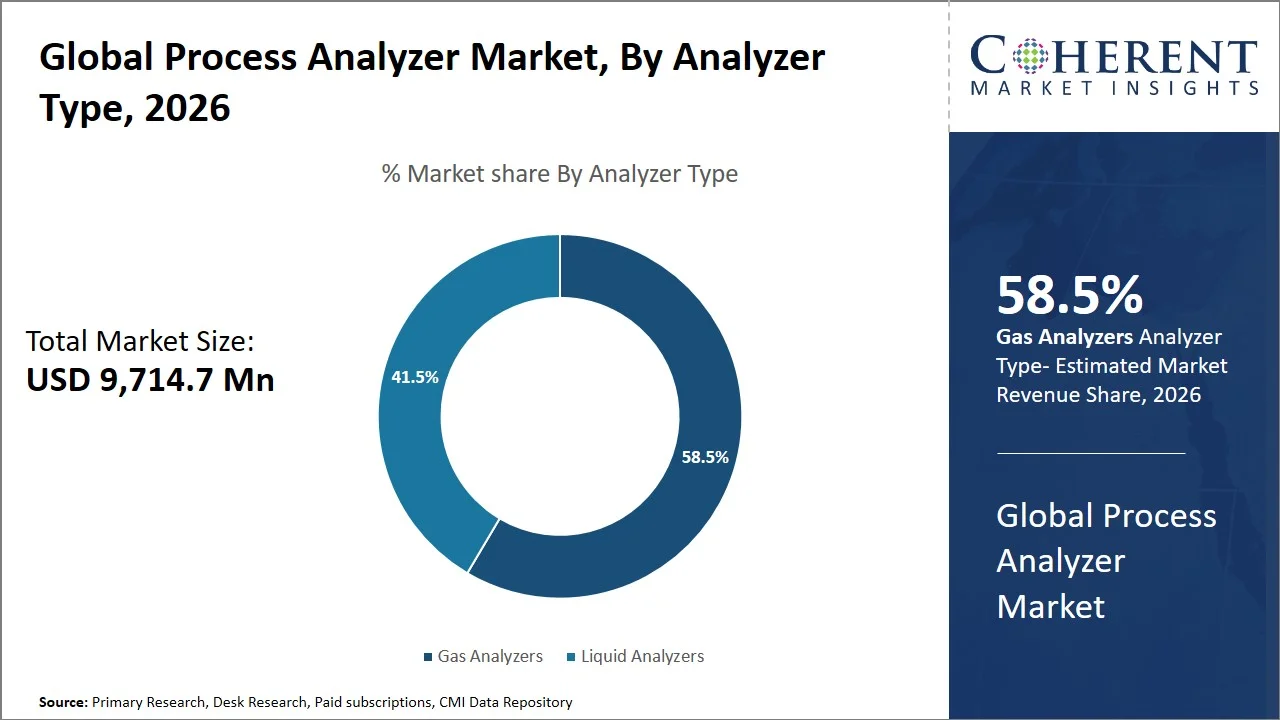
Why Does Gas Analyzers Segment Dominate the Global Process Analyzer Market?
The gas analyzers segment is expected to account for 58.5% of the global process analyzer market share in 2026. Industries are increasingly adopting gas analyzers detect early deviations and operational inefficiencies. Manufacturers are prioritizing quality control and process optimization to achieve waste reduction goals, lower costs and increased productivity. For instance, on March 13, 2026, Shell mentioned in a report the use of optical gas imaging cameras which visually detect methane release and high-flow samplers, which measure flow rate and methane concentration, to identify and quantify leaks, enabling targeted repairs.
(Source: Shell)
- Current Industry Events of 2026
- Market Size Estimation
- Regional Breakdown
- Competitive Landscape
- Customer Intelligence
- Segmental Analysis
- Pricing Analysis
- Key Market Drivers, Challenges & Future Trends
- Customized Insights Section
Why are Spectroscopic Analyzers the Most Preferred Technology?
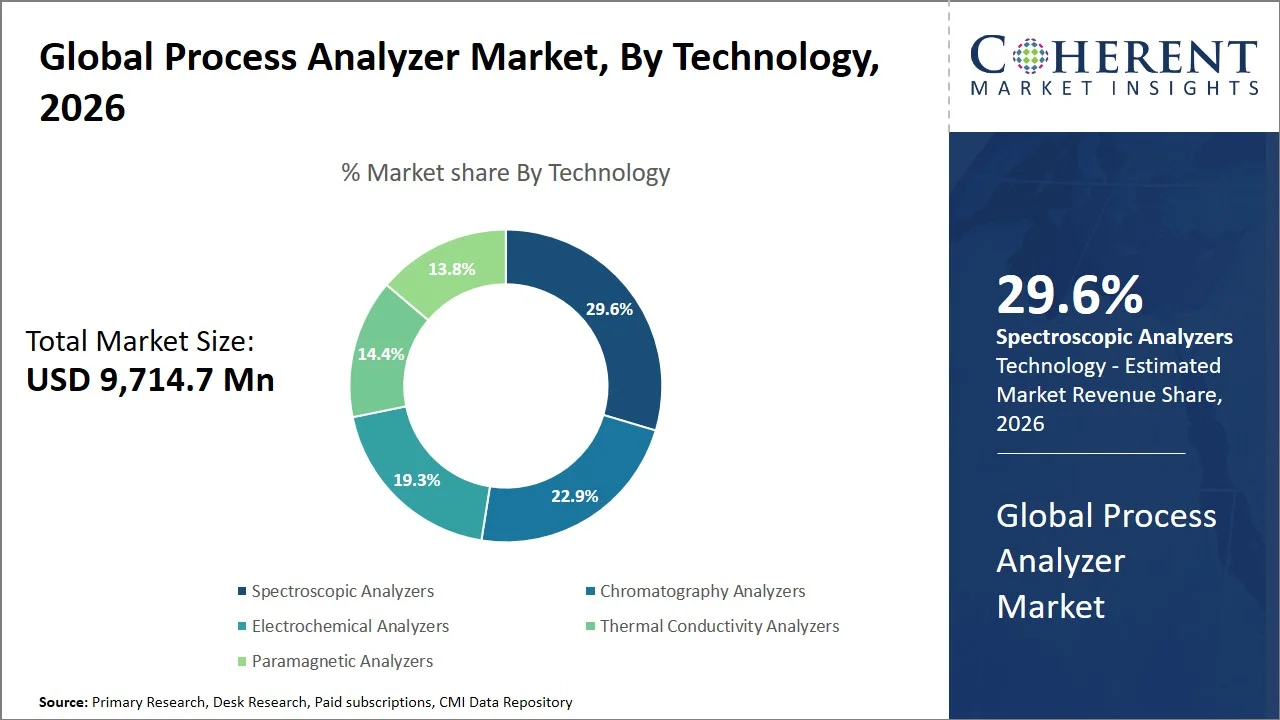
The spectroscopic analyzers segment is expected to account for 29.6% of the global process analyzer market share in 2026. The use of spectroscopic analyzers are growing due to strict regulations introduced by regulatory bodies. Governments are enforcing stricter limits on industrial emissions to reduce environmental impact. Most companies are adopting the use of analyzers to prevent penalties being issued and meet sustainability targets. On December 13, 2023, the European Parliament and the Council of the European Union (EU) reached an agreement on new emission standards for light- and heavy-duty vehicles. Pending formal adoption by both Parliament and Council, the new regulation will supersede the current Euro 6 regulation for passenger cars and vans, (EC) 715/2007, and the Euro VI regulation for trucks and buses, (EC) 595/2009. The latest mandates of the Euro 7 standards are set to take effect from November 2026.
Continuous Sampling Analyzers Segment Dominates the Global Process Analyzer Market
The continuous sampling analyzers segment is expected to account for 69.9% of the global process analyzer market share in 2026. The increase in green hydrogen production and clean energy in recent times are major driver for the segment. Green hydrogen calls for accurate measurement of gas composition which enables safe production and storage. The use of analyzers proves to be of utmost importance to monitor purity and detect impurities in the hydrogen stream. On April 25, 2026, Fortescue Ltd announced that it is expanding its green energy capacity in the Pilbara, with a USD 680 million investment to develop new green energy infrastructure, positioning the company to meet growing demand for green power from industry, including data centers.
(Source: Fortescue)
Currents Events and their Impact
Current Events | Description and its Impact |
Clean Air Act (U.S.) |
|
40 CFR Part 75 (U.S.) |
|
Global Process Analyzer Market Dynamics
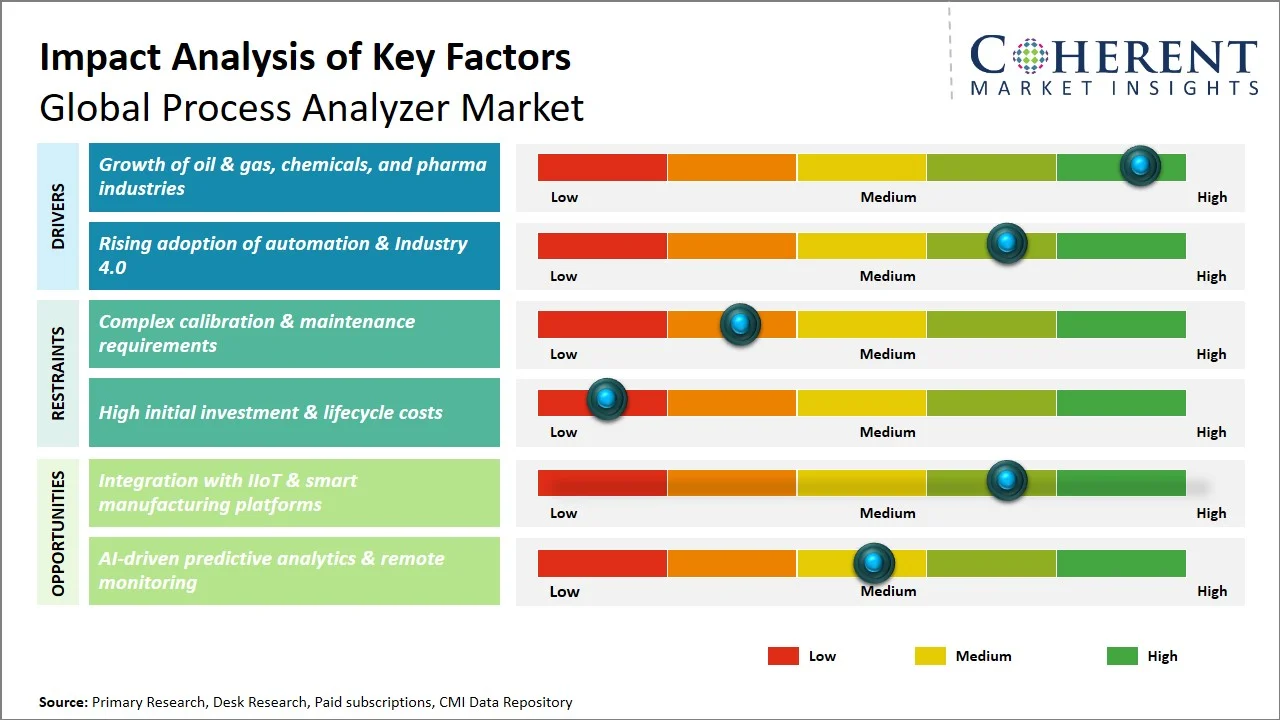
Market Drivers
- Growth of oil & gas, chemicals, and pharma industries: The oil & gas and pharmaceutical sectors are increasingly relying on real-time monitoring systems for efficiency, product quality and safety. Growing production levels and stricter emission guidelines are pushing industries to adopt advanced analytical tools for enhanced control and compliance. This is driving demand for process analyzers across the world. On April 27, 2026, Shell plc announced that it had entered into a definitive agreement to acquire ARC Resources Ltd., an energy company focused on the Montney shale basin in British Columbia and Alberta, Canada. (Source: Shell)
- Rising adoption of automation & Industry 4.0: Growth within the process analyzer sector shows clear momentum, supported by rising automation and Industry 4.0 implementation in manufacturing fields. With a focus on live performance tracking, tighter quality oversight, along with smoother operations, these tools now play a central role - helping meet rules while guiding choices through verified information. Connected systems involving intelligent sensors, Internet-linked networks, and deeper analytical methods increase appeal, making early issue detection possible while reducing interruptions. On January 6, 2026, Siemens and NVIDIA announced that these two companies are expanding their partnership to build the Industrial AI Operating System, helping customers revolutionize how they design, engineer, and operate physical systems. (Source: Siemens)
Emerging Trends
- Miniaturization and portability of analyzer devices: Compact, portable process analyzers now emerge from manufacturers, enabling real-time measurement at the location. Field applications gain advantage, especially within oil and gas or environmental sectors, due to minimal setup needs.
- Growing demand for environmental and regulatory compliance: As global standards for emissions and safety grow tighter, process analyzers see increasing use in tracking harmful substances without interruption. In fields like chemical manufacturing, electricity production, wastewater management, their role becomes more noticeable over time. Compliance depends on constant observation - technology adapts accordingly.
Regional Insights
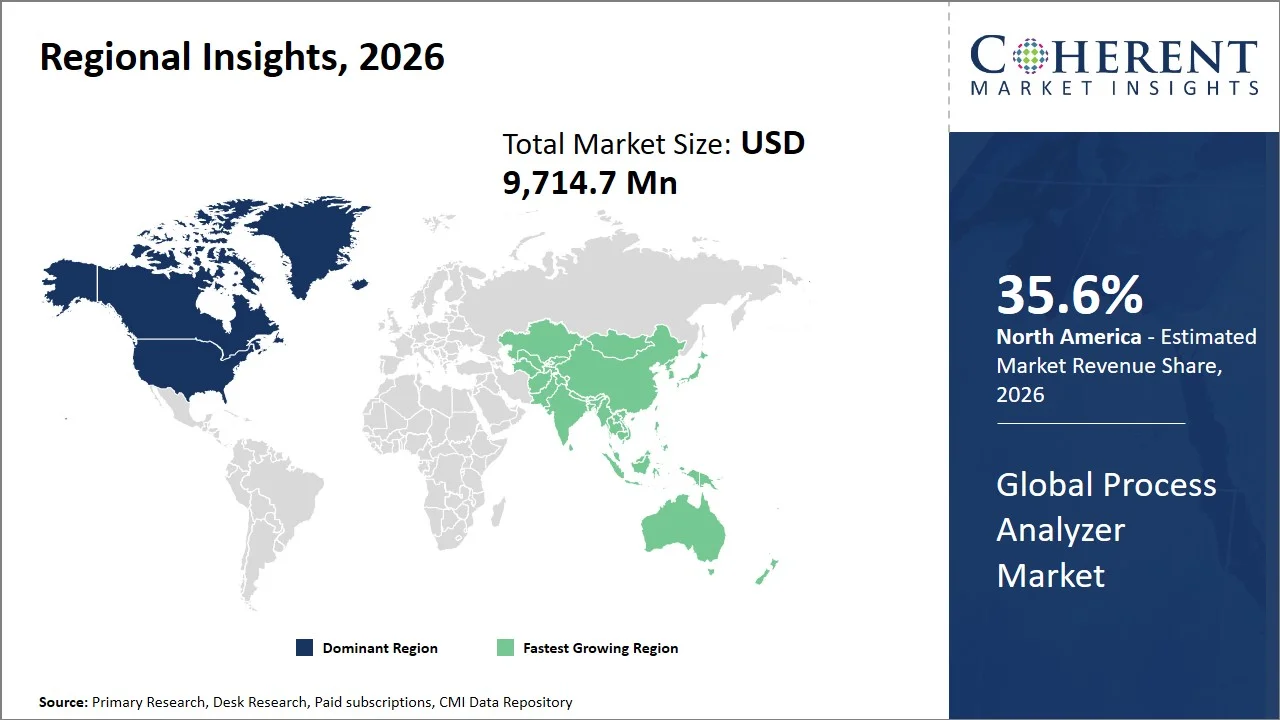
Why is North America a Strong Market for Process Analyzer?
North America is expected to account for a market share of 35.6% in 2026. Across North America, real-time analytics shape process analyzer adoption in clear ways. From the Permian Basin, live gas readings flow through inline chromatographs into cloud platforms so separation and mixing respond rapidly. Instead of waiting, Gulf Coast chemical plants link spectroscopic sensors to control networks that counteract raw material fluctuations immediately.
Meanwhile, electric providers in Texas connect exhaust gas monitors to energy grids, tuning burn rates and emission profiles without delay. Immediate feedback replaces slow laboratory analysis at every turn, steering day-to-day actions. On February 19, 2026, ABB announced the launch of its first fully integrated gas analyzer package for Carbon Capture, Utilization and Storage (CCUS) applications, combining three proven ABB technologies into a single, streamlined solution. (Source: Carbon Herald)
Why Does Asia Pacific Process Analyzer Market Exhibit High Growth?
Asia Pacific is expected to account for a market share of 28.9% in 2026 and is expected to register the fastest growth rate over the forecast period. Driven by fast-paced industrial growth, Asia Pacific stands out in deploying process analyzers at scale. Notably, huge refineries such as the Zhejiang Petrochemical Complex in China rely on extensive networks of online devices throughout cracking and blending operations, ensuring consistent quality amid vast production volumes. At India’s Jamnagar site operated by Reliance Industries, real-time monitoring systems are embedded across refining and chemical processing lines, supporting control over immense output levels. Within semiconductor fabrication, advanced plants managed by Taiwan Semiconductor Manufacturing Company apply highly precise gas and impurity detection tools to sustain accuracy required for nanoscale chipmaking.
On July 14, 2025, China’s Envision Energy launched the world’s largest green hydrogen and ammonia plant in Chifeng, Inner Mongolia. The plant sits in the Net-Zero Industrial Park. (Source: Carbon Credits)
Why is U.S. Emerging as a Major Hub in the Process Analyzer Market?
Emerging steadily, the U.S. now hosts growing activity around process analyzers due to targeted deployment in high-precision industries. At ExxonMobil’s Baytown site, inline systems fine-tune hydrocarbon flows without pause, driven by operational necessity rather than trend. Meanwhile, inside Intel’s semiconductor plants in Arizona, detection of trace gases happens so finely that impurities measured in billionths shape daily output. Not far removed, Amgen applies similar tools within biopharmaceutical production - where live data guides decisions during ongoing cell cultures instead of relying on delayed tests.
Further still, initiatives such as the Petra Nova project in Texas log emissions performance through constant monitoring of captured carbon dioxide volumes. Together, these examples form part of an expanding pattern where scale, technology demands, and precision converge quietly yet firmly under one national footprint.
Is China the Next Growth Engine for the Process Analyzer Market?
China is increasingly acting as a growth engine for process analyzers because of very specific, large-scale industrial deployments—for instance, the Zhejiang Petrochemical Complex operates thousands of online analyzers across refining and petrochemical units to manage continuous high-volume output, while Sinopec has equipped multiple refineries with real-time sulfur and composition analyzers to meet tighter national fuel standards. In semiconductors, fabs run by Semiconductor Manufacturing International Corporation deploy ultra-high purity gas analyzers to control contamination during wafer fabrication, and in environmental infrastructure, Beijing’s advanced wastewater plants use continuous ammonia and COD analyzers at each treatment stage, showing how China’s rapid scaling of complex industrial and environmental systems is directly driving analyzer demand.
Germany Process Analyzer Market Analysis and Trends
Germany process analyzer market is shaped by very specific, high-precision industrial use cases, for example, chemical giants like BASF deploy inline analyzers at Ludwigshafen to continuously monitor reaction yields and catalyst performance in complex chemical synthesis, while engineering firms like Siemens integrate advanced optical and electrochemical analyzers into automated production lines to ensure real-time process control under strict EU emission rules. In the food sector, breweries such as Bavarian State Brewery Weihenstephan use liquid analyzers to track fermentation parameters like dissolved oxygen and pH at every stage, and across Germany’s energy transition projects, hydrogen pilot plants rely on high-precision gas analyzers to measure purity levels for grid injection, reflecting how Germany’s focus on ultra-efficient, regulation-driven manufacturing directly translates into demand for highly accurate, real-time process analysis systems.
India process analyzer market is being shaped by very specific, large-scale industrial deployments tied to rapid manufacturing expansion, for example, refineries operated by Indian Oil Corporation use continuous gas chromatographs and sulfur analyzers across pipelines to meet Bharat Stage fuel norms, while pharma plants run by Sun Pharmaceutical Industries integrate inline analyzers to monitor parameters like pH and dissolved oxygen in real time during drug production. In infrastructure, thermal power plants and Flue Gas Desulfurization units deploy flue gas analyzers to track SO₂ and NOx emissions under Central Pollution Control Board mandates, and large urban wastewater facilities in cities like Delhi and Mumbai use online analyzers to continuously measure nitrates, Chemical Oxygen Demand, and heavy metals at multiple treatment stages. Additionally, ABB’s Bengaluru facility exports gas analyzer systems globally, showing how India is not just adopting but also manufacturing advanced analyzer technologies at scale
Global Process Analyzer Market - Regulatory Compliance
Regulation System | Regulatory Authority | Mandatory CEMS Requirements | Effluent / Water Discharge Monitoring Requirements |
U.S. – Clean Air Act (CAA) | EPA | Mandatory CEMS under 40 CFR Parts 60, 63, 75 for SO₂, NOx, CO₂, Hg | NPDES permits require continuous or periodic effluent monitoring |
European Union – Industrial Emissions Directive (IED 2010/75/EU) | European Commission / Member States | Continuous monitoring required for large combustion plants | Water discharge monitoring under EU Water Framework Directive |
China – MEE (Ministry of Ecology & Environment) | CPCB (Central Pollution Control Board) | Mandatory CEMS for SO₂, NOx, PM in highly polluting industries | Effluent standards under Water (Prevention & Control of Pollution) Act, 1974 |
China National ETS | MEE | Mandatory CEMS linked to national monitoring platform | Real-time wastewater monitoring in major industrial parks |
Japan – Air Pollution Control Act / Water Pollution Control Act | MOE Japan | Continuous stack monitoring required for specific large facilities | Strict effluent quality monitoring with reporting obligations |
How is Integration with IIoT & Smart Manufacturing Platforms Creating New Growth Opportunities in the Global Process Analyzer Market?
Integration with IIoT and smart manufacturing platforms is expanding opportunities for process analyzers through very specific industrial deployment. Refineries operated by Shell stream real-time sulfur and hydrocarbon data from inline analyzers into centralized cloud dashboards, allowing engineers to adjust blending ratios remotely within minutes. In semiconductor fabs run by Intel, gas purity analyzers are directly connected to IoT-enabled cleanroom systems that automatically trigger alarms and process shutdowns if contamination thresholds are exceeded.
Similarly, water utilities in smart cities like Singapore integrate continuous analyzers with SCADA and IoT networks to dynamically control treatment dosing based on live ammonia and turbidity readings, while chemical plants using Industry 4.0 setups link analyzers to predictive maintenance platforms that flag catalyst degradation before failures occur, turning analyzers from standalone instruments into fully connected decision-making nodes. On February 11, 2026, Emerson announced the launch of its Rosemount QX1000 Continuous Gas Analyzer. The QX1000 uses paramagnetic detection for O₂ and quantum cascade laser direct absorption spectroscopy for all other gases to meet stringent performance requirements. (Source: Emerson)
Market Players, Key Development, and Competitive Intelligence
Key Developments
- On May 13, 2025, Becton, Dickinson and Company announced the global commercial launch of the world's first cell analyzer featuring breakthrough spectral and real-time cell imaging technologies, enabling more researchers across a wider range of applications to uncover deeper insights and dynamics from cells once invisible in flow cytometry experiments, with increased ease and throughput.
- On January 22, 2025, Evident announced the launch of its next-generation Vanta Element handheld XRF analyzer series built for fast, accurate alloy identification in scrap sorting, metal manufacturing and precious metals testing.
Competitive Landscape
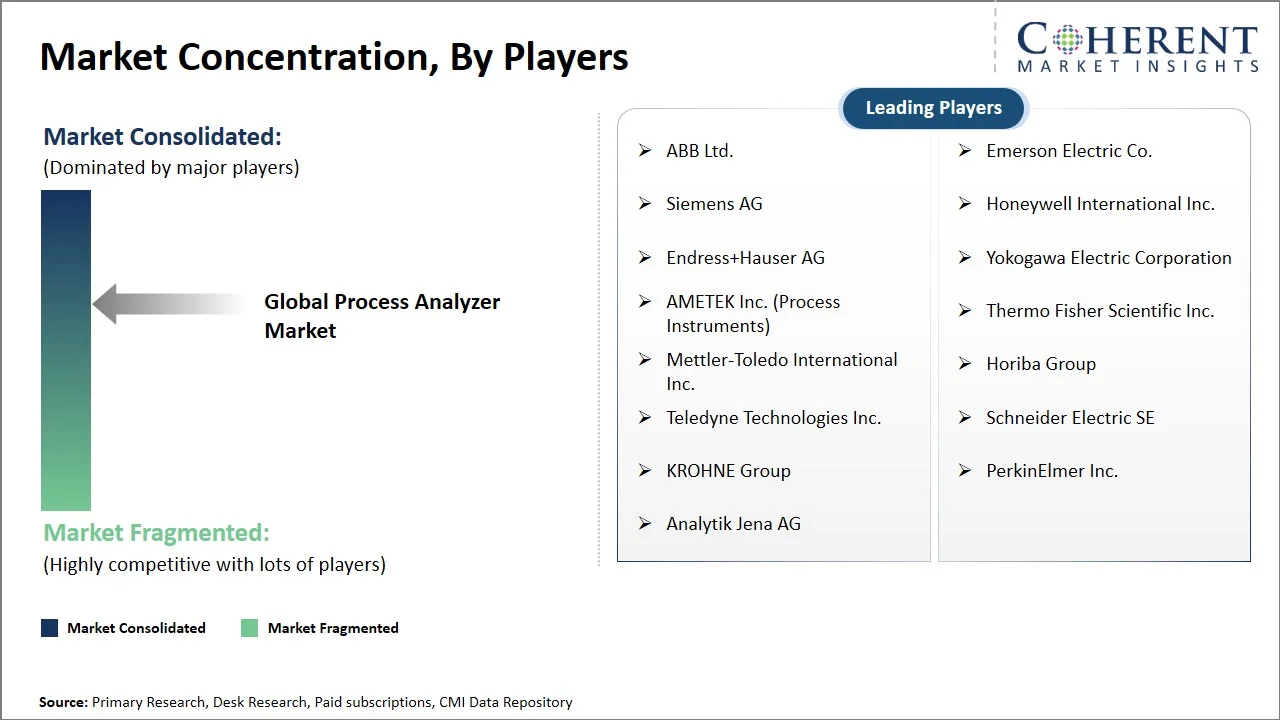
The competitive landscape of the global process analyzer market is moderately consolidated and dominated by global automation and instrumentation leaders such as ABB, Emerson Electric, Siemens, Honeywell, and Yokogawa Electric, which collectively hold a significant share of the market through integrated analyzer–automation ecosystems. These companies compete on advanced technologies such as laser-based gas analysis, AI-enabled process control, and IIoT integration, while also expanding through acquisitions and service-driven models to lock in long-term industrial contracts.
Market Report Scope
Process Analyzer Market Report Coverage
| Report Coverage | Details | ||
|---|---|---|---|
| Base Year: | 2025 | Market Size in 2026: | USD 9,714.7 Mn |
| Historical Data for: | 2020 To 2024 | Forecast Period: | 2026 To 2033 |
| Forecast Period 2026 to 2033 CAGR: | 6% | 2033 Value Projection: | USD 14,576.9 Mn |
| Geographies covered: |
| ||
| Segments covered: |
| ||
| Companies covered: | ABB Ltd., Emerson Electric Co., Siemens AG, Honeywell International Inc., Endress+Hauser AG, Yokogawa Electric Corporation, AMETEK Inc. (Process Instruments), Thermo Fisher Scientific Inc., Mettler-Toledo International Inc., Horiba Group, Teledyne Technologies Inc., Schneider Electric SE, KROHNE Group, PerkinElmer Inc., and Analytik Jena AG | ||
| Growth Drivers: |
| ||
| Restraints & Challenges: |
| ||
Analyst Opinion (Expert Opinion)
- The process analyzer market is a critical enabler of modern industrial automation rather than just a measurement segment, with its value increasingly tied to integration with control systems and real-time decision platforms. The strongest competitive advantage is shifting toward vendors that combine hardware accuracy with software intelligence, particularly those embedding analytics, diagnostics, and connectivity into analyzers used in refining, pharmaceuticals, and specialty chemicals. There is also a clear view that demand is being driven less by standalone instruments and more by system-wide optimization needs across continuous manufacturing environments.
- Looking ahead, the market is expected to evolve toward fully autonomous process monitoring systems where analyzers continuously feed AI-driven control loops with minimal human intervention. Growth will be strongly supported by expansion of green hydrogen projects, carbon capture facilities, and advanced semiconductor manufacturing, all of which require ultra-precise real-time monitoring. Wireless and cloud-connected analyzers are likely to become standard, while miniaturized, multi-parameter devices will replace multiple single-function units, making process analysis more integrated, faster, and cost-efficient across industries.
Speak to the analyst
Want personalized insights?
Take the findings above to one of our principal consultants, or have the report rebuilt around the segments, geographies and competitors you actually track.
Market Segmentation
- Analyzer Type Insights (Revenue, USD Million, 2021 - 2033)
- Gas Analyzers
- Natural Gas
- Biogas
- Biomethane
- Industrial Gases (O₂, N₂, CO₂)
- Hydrogen
- Toxic & Hazardous Gases (H₂S, CO)
- Emission Gases (NOx, SO₂)
- Liquid Analyzers
- Gas Analyzers
- Technology Insights (Revenue, USD Million, 2021 - 2033)
- Spectroscopic Analyzers
- Chromatography Analyzers
- Electrochemical Analyzers
- Thermal Conductivity Analyzers
- Paramagnetic Analyzers
- Sampling Type Insights (Revenue, USD Million, 2021 - 2033)
- Continuous Sampling Analyzers
- Batch Sampling Analyzers
- Installation Type Insights (Revenue, USD Million, 2021 - 2033)
- Fixed / Stationary Analyzers
- Portable / Handheld Analyzers
- Application Insights (Revenue, USD Million, 2021 - 2033)
- Process Monitoring
- Quality Control
- Environmental Monitoring
- Safety and Compliance Monitoring
- Others (Emission Monitoring, Leak Detection)
- End User Insights (Revenue, USD Million, 2021 - 2033)
- Oil and Gas
- Upstream
- Midstream
- Downstream
- Chemical and Petrochemical
- Pharmaceuticals and Biotechnology
- Water and Wastewater Treatment
- Power Generation
- Renewable Energy
- Food and Beverage
- Others (Pulp & Paper, Metals & Mining, etc.)
- Regional Insights (Revenue, USD Million, 2021 - 2033)
- North America
- U.S.
- Canada
- Latin America
- Brazil
- Argentina
- Mexico
- Rest of Latin America
- Europe
- Germany
- U.K.
- Spain
- France
- Italy
- Russia
- Rest of Europe
- Asia Pacific
- China
- India
- Japan
- Australia
- South Korea
- ASEAN
- Rest of Asia Pacific
- Middle East
- GCC Countries
- Israel
- Rest of Middle East
- Africa
- South Africa
- North Africa
- Central Africa
- North America
- Key Players Insights
- ABB Ltd.
- Emerson Electric Co.
- Siemens AG
- Honeywell International Inc.
- Endress+Hauser AG
- Yokogawa Electric Corporation
- AMETEK Inc. (Process Instruments)
- Thermo Fisher Scientific Inc.
- Mettler-Toledo International Inc.
- Horiba Group
- Teledyne Technologies Inc.
- Schneider Electric SE
- KROHNE Group
- PerkinElmer Inc.
- Analytik Jena AG
Sources
Primary Research Interviews
- Green Bond Issuers and Fund Managers
- Carbon Credit Trading Platform Executives
- Climate Finance Investment Bank Officials
- Sustainable Finance Technology Providers
Magazines
- Environmental Finance Magazine
- Climate Finance Review
- Green Finance & Investment
- Carbon Finance Magazine
- Sustainable Finance Weekly
Journals
- Journal of Climate Finance
- Environmental Economics and Policy Studies
- Climate Policy Journal
Associations
- Climate Bonds Initiative (CBI)
- International Capital Market Association (ICMA)
- Green Finance Institute
- Carbon Markets & Investors Association
- Task Force on Climate-related Financial Disclosures (TCFD)
Public Domain Sources
- UNFCCC Climate Finance Reports
- International Energy Agency (IEA) Climate Finance Database
- Green Climate Fund Publications
- European Investment Bank Climate Reports
- Climate Finance Leadership Initiative Reports
Proprietary Elements
- CMI Data Analytics Tool
- Proprietary CMI Existing Repository of information for last 10 years
Get access to 250+ pages report
Every segment, forecast, competitor profile and data table behind the analysis above — available for instant download.
- ESOMAR Member
- ISO 9001:2015 Certified
- D-U-N-S Registered
- GDPR & CCPA Compliant
Missing comfort of reading report in your local language? Find your preferred language:
Transform your Strategy with Exclusive Trending Reports
Frequently Asked Questions
The global process analyzer market is expected to stand at USD 9,714.7 Mn in 2026 and is expected to reach USD 14,576.9 Mn by 2033.
The CAGR of the global process analyzer market is projected to be 6% from 2026 to 2033.
Growth of oil & gas, chemicals, and pharma industries and Rising adoption of automation & Industry 4.0 are the major factors driving the growth of the global process analyzer market.
Complex calibration & maintenance requirements and High initial investment & lifecycle costs are the major factors hampering the growth of the global process analyzer market.
In terms of analyzer type, gas analyzers are estimated to dominate the market revenue share in 2026.
Volatility is high due to policy changes, energy price shifts, and uncertain demand for credits.
They track emissions like SOx, NOx, and CO₂ to ensure compliance with environmental standards.