

Global Green Hydrogen Market Size and Forecast – 2026-2033
According to Coherent Market Insights, the global green hydrogen market is estimated to be valued at USD 13.56 Bn in 2026 and is expected to reach USD 35.42 Bn by 2033, exhibiting a compound annual growth rate (CAGR) of 14.7% from 2026 to 2033.
Key Takeaways of the Green Hydrogen Market
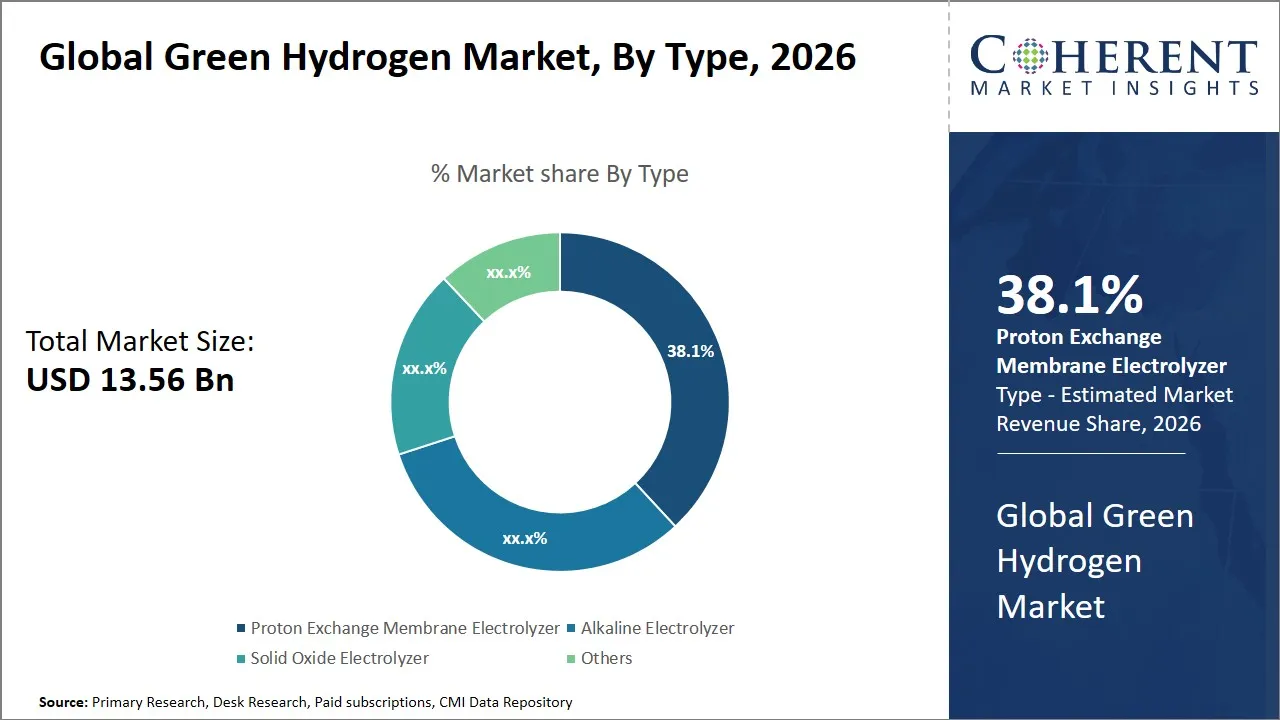
- The Proton Exchange Membrane (PEM) electrolyzers segment is expected to account for 38.1 % of the global green hydrogen market share in 2026.
- The solar energy segment is projected to capture 31.8 % of the global green hydrogen market share in 2026.
- The refining segment is expected to account for 31.5 % of the global green hydrogen market share in 2026.
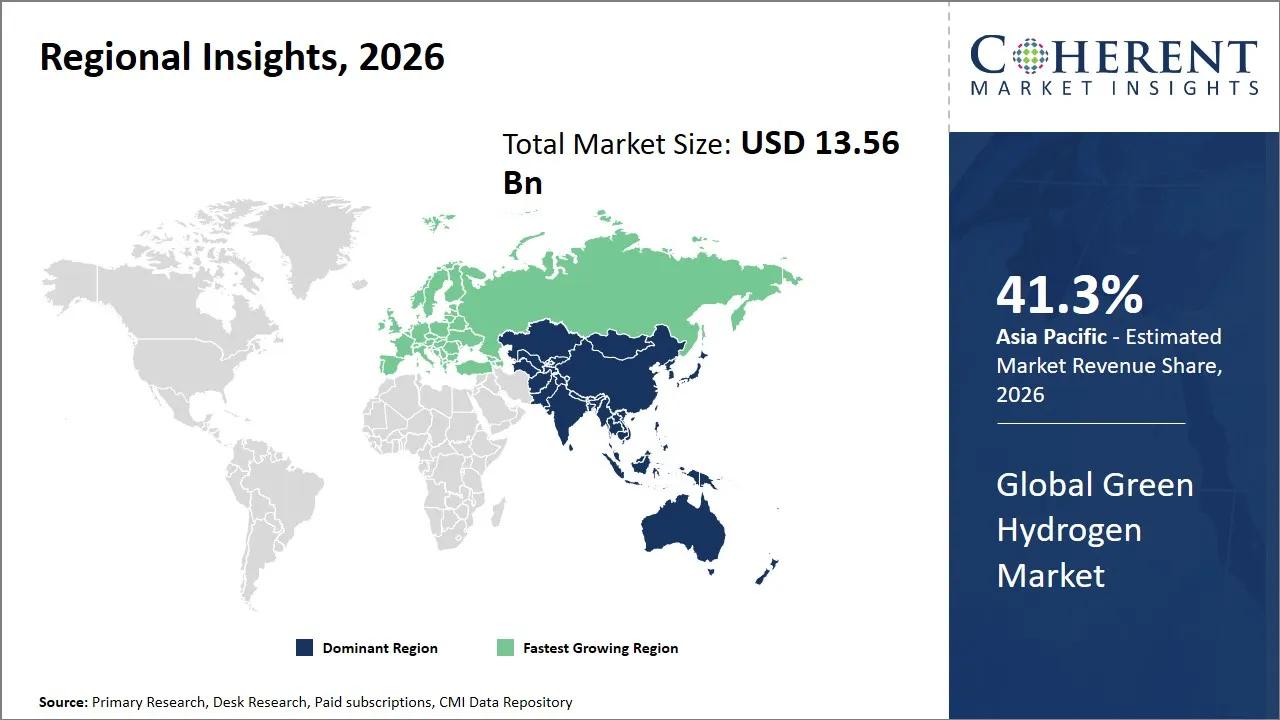
- The Asia Pacific region is expected to dominate the market with a 41.3 % share in 2026.
- The Europe region is anticipated to show the fastest growth in the market, contributing a 15.3 % share in 2026.
Market Overview
- Market trends indicate a strong shift toward sustainable energy solutions, with green hydrogen emerging as a key player in the decarbonization of heavy industries and long-duration energy storage.
- Advancements in hydrogen electrolyzer technologies and supportive government policies, such as subsidies and carbon reduction mandates, are accelerating the market expansion.
- Additionally, growing collaborations between public and private sectors are fostering innovation and driving the integration of green hydrogen into existing energy frameworks worldwide.
Current Events and Its Impact
Current Events | Description and its Impact |
Launch of India’s World‑Largest Green Ammonia Facility (Kakinada, 2026) |
|
South Africa’s Green Hydrogen Policy Momentum |
|
Segmental Insights
- Current Industry Events of 2026
- Market Size Estimation
- Regional Breakdown
- Competitive Landscape
- Customer Intelligence
- Segmental Analysis
- Pricing Analysis
- Key Market Drivers, Challenges & Future Trends
- Customized Insights Section
Why Does Proton Exchange Electrolyzer Membrane Dominate the Global Green Hydrogen Market in 2026?
Proton exchange membrane electrolyzers segment is expected to contribute 38.1% of the global green hydrogen market share in 2026, due to their superior efficiency, compact design, and operational flexibility. PEM electrolyzers are based on the use of a solid polymer electrolyte to make the electrochemical breakdown of water into hydrogen and oxygen, which gives them high response times and allows them to work at different energy inputs. Such flexibility is especially essential in the case of incorporation with renewable energy sources, which are by their nature intermittent, like solar and wind.
For instance, in 2025, PEM electrolyzes were deployed in a hydrogen fueling station in California, where they efficiently produced hydrogen on-site for fuel cell vehicles. This approach reduces the need for long-distance transportation of hydrogen, aligning with the push for sustainable and local hydrogen production across various industries.
Solar Energy Dominates the Global Green Hydrogen Market
Solar energy segment is set to hold 31.8% of the global green hydrogen market share in 2026, propelled by falling solar photovoltaic (PV) costs, widespread scalability, and global alignment with solar-centric renewable strategies. The feasibility of a direct coupling of solar energy systems with electrolyzers offers a tempting route to generate green hydrogen without using grid electricity, and to assure a hundred percent renewable source of the hydrogen.
The major factors that make solar energy eminent are its vast geographical coverage particularly in the sunny areas such as the Middle East, Australia as well as some parts of Africa and Asia where the solar farms can be practiced in large scale but at a relatively low cost. As PV panel efficiencies continue to increase and the total system costs have decreased significantly, hydrogen production projects, using solar energy, have ultimately become economically viable, especially in remote or off-grid regions, which would otherwise consume expensive fossil fuels.
Why is the Refining Sector Leading the Charge in Green Hydrogen Demand and Decarbonization?
The refining segment is set to hold 31.5% of the global green hydrogen market share in 2026, driven by its critical dependence on hydrogen for key processes and the urgent need to reduce carbon emissions. Historically, refineries have been large consumers of hydrogen, which is mainly generated through the use of fossil fuel by steam methane reforming. The continued increase in the availability of green hydrogen provides refineries with a short-term roadmap to the decarbonization of their operations and the ability to address the new regulatory and consumer demands.
The contribution of hydrogens to refining is manifold, as it occurs through hydrocracking, desulfurization of crude oil fractions, and upgrading of crude oil fractions, which is a primary process of achieving the fuel quality standards and environmental requirements. The green hydrogen enables the refiners to ensure continued functionality and at the same time reduce the carbon footprint of the hydrogen use.
Regional Insights
Asia Pacific Green Hydrogen Market Analysis and Trends
The Asia Pacific region is projected to lead the market with a 41.3% share in 2026, with its rising energy consumption, rising investments in renewable power generation capacity and the aggressive national policies to achieve sustainability. China, Japan, South Korea, and Australia are among the countries that are heavily investing in the green hydrogen projects in order to end the traditional reliance on fossil fuels and deal with the issue of pollution.
The areas rich in solar and wind energy resources render it a perfect option in production of electrolytic hydrogen and the rapid growth in industries demands quick and clean hydrogen energy. Governments are also encouraging government-business associations and spurring infrastructure improvements, such as hydrogen refueling stations and export terminals. The top industry players, such as Toshiba Energy Systems & Solutions, Mitsubishi Power and Ballard Power Systems are engaged in the development of integrated supply chains and technology innovation.
Europe Green Hydrogen Market Analysis and Trends
The Europe region is expected to exhibit the fastest growth in the market contributing 15.3% share in 2026, from the region’s proactive regulatory environment, robust renewable energy infrastructure, and strategic investments aimed at decarbonization. The European Union’s effort to be carbon neutral at the year 2050 has resulted in holistic policies that pan the development of green hydrogen which involves massive funding mechanisms and subsidies. The advantage of Europe integrated market ecosystem is due to the high number of renewable energy producers, manufacturers of electrolyzer, and final users in industrial, transportation, and power sectors.
National hydrogen strategies are followed by such countries as Germany, France and Netherlands, which allows government agencies, industrial giants, and research institutes to synergize. The major corporations like Siemens Energy, Air Liquide and ITM Power are the ones that are involved in the technological advancements and massive projects implementations. Also, the emphasis on the export of green hydrogen to the countries especially in Southeast Asia and North America further strengthens the leading role by mean of establishing cross-border cooperations and trade agreements.
Green Hydrogen Market Outlook for Key Countries
Germany Green Hydrogen Market Trends
Germany green hydrogen market is characterized by a good base of industries, extensive implementation of renewable energies, and an ambitious nation-level hydrogen strategy that puts a strong focus on the production and integration of green hydrogen. The government policies favor large-scale electrolyzer projects and other important infrastructure like hydrogen transport and storage.
This is the role of such German giants as Siemens Energy and Thyssenkrupp that focus on the production of cutting-edge electrolysis systems and the creation of hydrogen uses in steel production and mobility. Germanys focus on the development of innovation centers and internationalization of relations has increased its contribution to the formation of the European hydrogen market and export networks.
China Green Hydrogen Market Trends
The green hydrogen market in China can be described as the one that has aggressive government-driven policies that focus on the minimization of carbon emissions and the promotion of green energy technologies. The green hydrogen aspirations of Chinas rely on major investments in renewable energy infrastructure. The active energy conglomerates, like Sinopec, State grid corporation, and NEL Hydrogen, are working to scale the manufacturing of electrolyzers, and develop hydrogen fueling systems.
The nation is more focused on the decarbonization of industries and the use of hydrogen as a transportation fuel cell, which is accelerating the development of the market. The emphasis of Chinas on the domestic supply chain development and the reinforcement of regional partnerships contributes to making the market more resilient and innovative.
Is Japan Positioned to Lead the Global Green Hydrogen Market?
The demand for green hydrogen is a strategic vision that the Japanese market has in using hydrogen as a central part to its energy transition and long-term sustainability agenda. The government subsidy goes up to the integration and pioneering of renewable energy and to hydrogen-powered fuel cell vehicles and residential fuel cells. Companies like Kawasaki Heavy Industries and JGC Corporation are significant contributors, engaged in large-scale electrolyzer manufacturing and international green hydrogen value chains. Japan’s import strategy also reflects its ambition to secure stable energy resources while advancing cutting-edge hydrogen technologies.
Australia Green Hydrogen Market Trends
The green hydrogen market in Australia is influenced by the fact that the country boasts of renewable energy sources, especially solar and wind, and the regions have a good business environment to produce green hydrogen to be used either locally or for export. Cooperation between government and the private sector in terms of creating infrastructure and export logistics and particularly to the Asian markets is very important. The participants like Fortescue Future Industries and Woodside energy are notable and they actively invest in commercializing green hydrogen projects and technology. The trade relations of Australia have access to the geographical proximity to Asia Pacific, which strengthens the role of the state as a supplier of green hydrogen.
South Korea Green Hydrogen Market Trends
The South Korea green hydrogen market growth is driven by the national policies that focus on energy innovation and industrial change towards carbon neutrality. The government has set up extensive hydrogen roadmaps that include production of hydrogen, fuel cell technology and expansion of infrastructures.
Market participants such as Hyundai Motor Company and Doosan Fuel Cell are major drivers of the market, and they are interested in mobility solutions and stationary power applications using hydrogen. The strategic alliances and investments in foreign green hydrogen projects are intended to secure supply chains and trigger the development of the local markets by technological evolution and the expansion of the infrastructure of South Korea.
Electrolyzer Technology Economics
Parameter | Description | Impact |
CAPEX (Capital Expenditure) | The initial investment cost required for the purchase and installation of electrolyzers. | High CAPEX is a significant barrier to entry, but costs are declining with technological advancements and economies of scale. |
OPEX (Operating Expenditure) | The recurring costs of running the electrolyzer, including energy, labor, and maintenance costs. | OPEX is a critical factor, as energy costs represent a large portion. Lower OPEX improves the economic feasibility of green hydrogen. |
Electrolyzer Lifetime | The duration over which the electrolyzer can be used without significant degradation in performance. | Longer lifetimes reduce the annualized cost of the electrolyzer, making green hydrogen more cost-effective in the long term. |
Market Players, Key Development, and Competitive Intelligence
Key Developments
- In November 2025, Nel ASA strengthened its position in the green hydrogen market by winning a major contract for its PEM electrolyzer technology, securing a confirmed order worth more than USD 50 million for a 40 MW green hydrogen project in Norway. The order was placed by Kaupanes Hydrogen AS and HyFuel AS, with project development led by Hydrogen Solutions AS in partnership with regional stakeholders. The project will utilize Nel’s MC 500 modular PEM electrolyzer systems to enable renewable hydrogen production.
- In October 2025, Mangalore-based deep-tech startup Hydgen secured USD 5 million in a mix of equity and debt funding to accelerate its push toward decentralized, on-demand green hydrogen generation. This funding round was led by Transition VC, with participation from Cloudberry Pioneer Investments (Europe), Moringa Ventures (Singapore), and family offices from India and Singapore. The investment will be used to upgrade Hydgen's Mangaluru production facility to a semi-automated manufacturing line and increase its single-stack electrolyser capacity to 250 kW. The company also plans to expand operations in Japan, Europe, and the Middle East.
- In August 2025, Statkraft secured a lease for a piece of land in Shetland next to the abandoned Scatsta Airport to build its 400 MW green hydrogen-to-ammonia plant, Shetland Hydrogen Project 2. The project was going to use excess wind energy from local wind farms that are yet to be built and convert it into ammonia for use as marine fuel and fertilizer.
Top Strategies Followed by Global Green Hydrogen Market Players
Player Type | Strategic Focus | Example |
Established Market Leaders | Heavy investment in R&D and innovation | For example, Siemens Energy and Nel ASA are reputed to invest in the development of next-generation electrolyzers, which are significant in the generation of green hydrogen. These companies do not only strive at increasing efficiency of the electrolyzers but also at optimizing storage of hydrogen and the use of fuel cells. |
Mid-Level Players | Cost-effective solutions with balanced quality | Air Products and Chemicals which has entered into strategic partnership with large energy players such as Saudi Aramco and ACWA Power to push large-scale green hydrogen initiatives, such as the largest green hydrogen facility on the world in Neom, Saudi Arabia. |
Small-Scale Players | Niche specialization & innovative variants | An example is Plug Power specializing in the development of low cost hydrogen systems by taking advantage of economies of scale and enhancing the development of hydrogen fuel cells into diverse application, such as industrial processes, and material handling equipment such as forklifts. |
Market Report Scope
Green Hydrogen Market Report Coverage
| Report Coverage | Details | ||
|---|---|---|---|
| Base Year: | 2025 | Market Size in 2026: | USD 13.56 Bn |
| Historical Data for: | 2020 To 2024 | Forecast Period: | 2026 To 2033 |
| Forecast Period 2026 to 2033 CAGR: | 14.7% | 2033 Value Projection: | USD 35.42 Bn |
| Geographies covered: |
| ||
| Segments covered: |
| ||
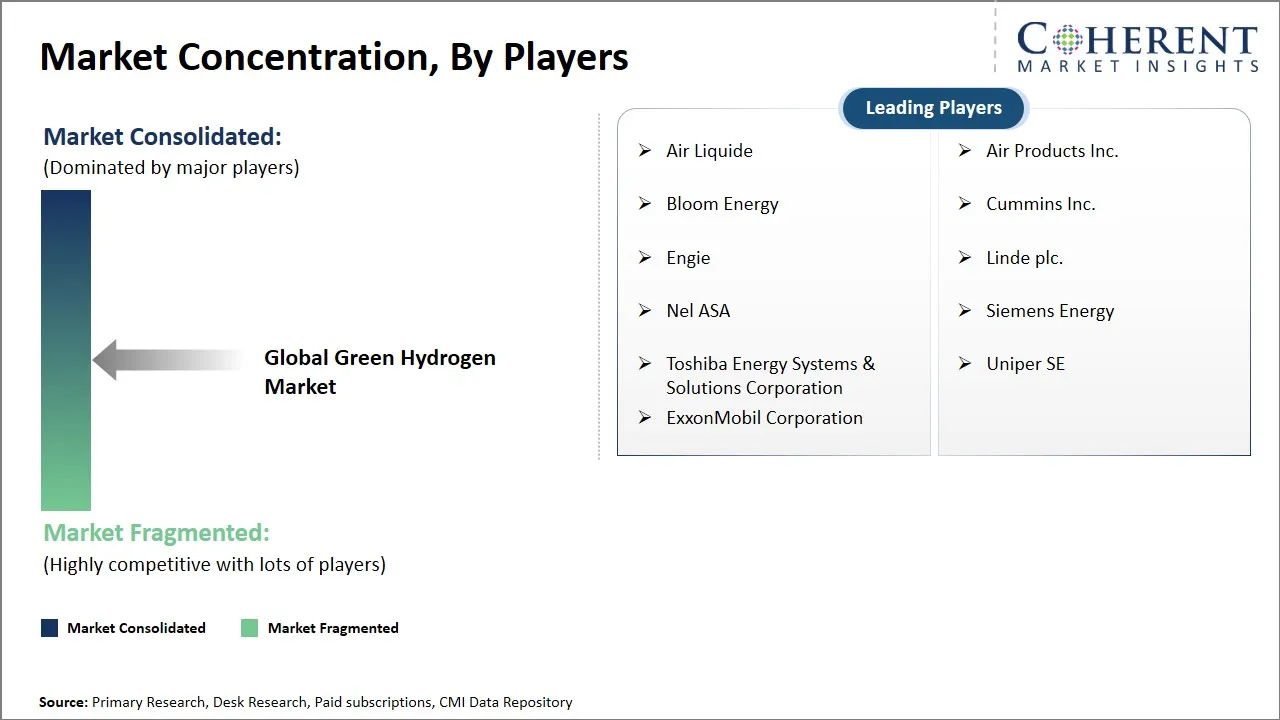
| Companies covered: | Air Liquide, Air Products Inc., Bloom Energy, Cummins Inc., Engie, Linde plc., Nel ASA, Siemens Energy, Toshiba Energy Systems & Solutions Corporation, Uniper SE, and ExxonMobil Corporation | ||
| Growth Drivers: |
| ||
| Restraints & Challenges: |
| ||
Green Hydrogen Market Dynamics
Green Hydrogen Market Driver - Increasing Demand for Sustainable Energy and Reduction of Carbon Emissions
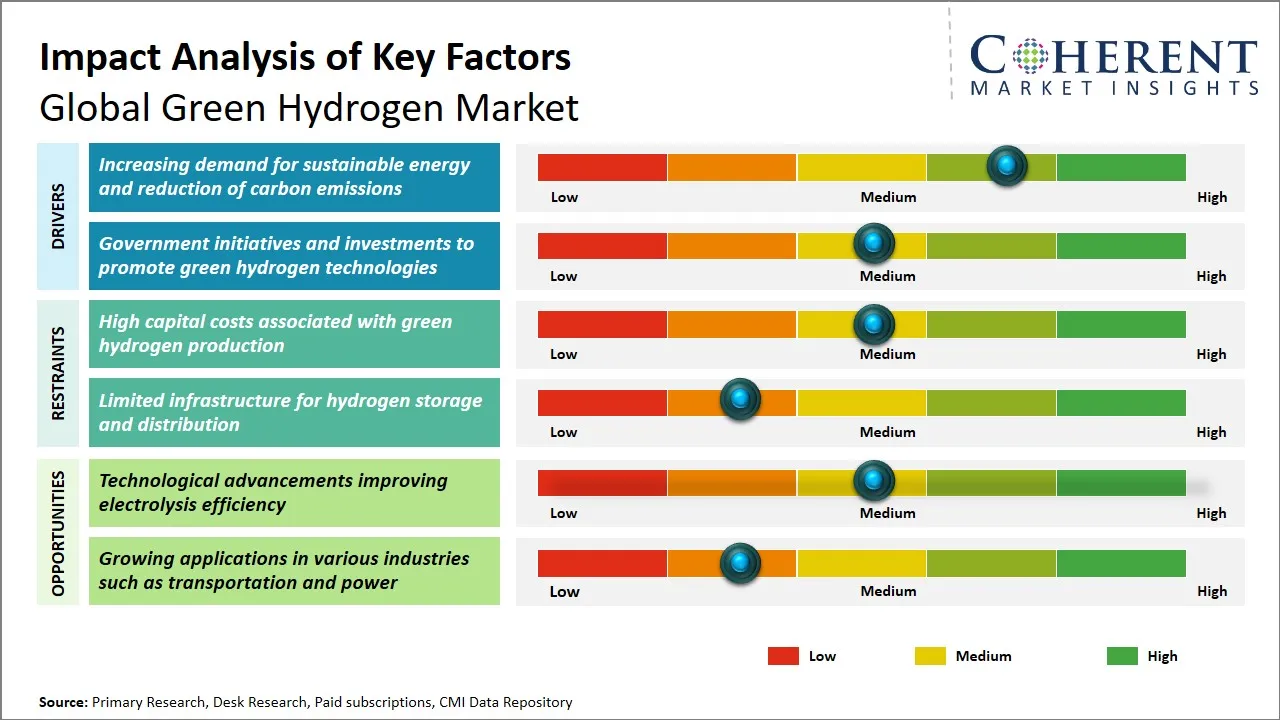
The growing world focus on the fight against climate change and the need to reach the state of net-zero emissions has boosted the necessity of green sources of energy, and green hydrogen becomes one of the most apparent solutions. Green hydrogen is generated by the electrolysis of water using renewable sources, unlike other common forms of hydrogen production technologies that are highly dependent on fossil fuels, hence, having a low-carbon footprint. Nations across the globe are also putting a stricter set of rules and bold plans to lower the production of commercial greenhouse gases and as such companies involved in transportation, heavy production and electricity generation are also finding cleaner methods.
An example is the Hydrogen Roadmap Europe that describes the decarbonization of industries such as heavy industry and transport through hydrogen. Some of these key projects are already announced, including the European Hydrogen Backbone project, which is supposed to create a hydrogen network across the continent.
Green Hydrogen Market Opportunity - Technological Advancements Improving Electrolysis Efficiency
One of the most significant opportunities in the global green hydrogen market lies in ongoing technological advancements aimed at enhancing the efficiency and cost-effectiveness of electrolysis, the primary method for producing green hydrogen. Electrolysis is the divide of water into hydrogen and oxygen by use of electricity that comes by electricity sources that tend to be renewed like wind and solar power. Recent advances in technologies of electrolyzer, namely proton exchange membrane (PEM), alkaline, and solid oxide electrolyzers are leading to significant enhancements of the energy conversion efficiency, longevity, and scalability.
For example, Nel Hydrogen is an example of the leader in enhancing PEM electrolyzers, which has massively cut on the cost of a kilogram of hydrogen produced. Their recent systems are very scaled, so that it is possible to integrate the production of green hydrogen with intermittent renewable energy sources such as solar and wind.
(Source: https://nelhydrogen.com/water-electrolysers-hydrogen-generators/)
Analyst Opinion (Expert Opinion)
- The green hydrogen market is at the verge of huge revolution, inspired by the world movement towards decarbonization and use of renewable energy. The experiences of the World Hydrogen Summit (2023) and Global Energy Transition Conference (2022) clarified the key improvements, and such companies as Nel Hydrogen and ITM Power are leading in the creation of new two-way electrolyzer technologies that will contribute to efficiency and cost reduction.
- The recent introduction of Nels of a large-scale electrolyzer that will allow generating green hydrogen at competitive prices is the evidence of the industry interest in making this form of energy more available. The talks at these conferences focused on the increased significance of the public-private partnership in financing infrastructure projects, the introduction of green hydrogen into current energy systems, in industrial processes in particular and transportation.
- There were challenges that were common including supply chain limitations and regulatory frameworks to enable large scale deployment. The companies practicing the strategy of cooperating with governments and investing into the development of production technologies are likely to have a competitive edge. Finally, the future development of the green hydrogen business will be determined by the capacity of the technology to be innovative constantly and to solve the issues of scalability and integration into the world energy systems.
Speak to the analyst
Want personalized insights?
Take the findings above to one of our principal consultants, or have the report rebuilt around the segments, geographies and competitors you actually track.
Market Segmentation
- Type Insights (Revenue, USD Bn, 2021 - 2033)
- Proton Exchange Membrane Electrolyzer
- Alkaline Electrolyzer
- Solid Oxide Electrolyzer
- Others
- Distribution Channel Insights (Revenue, USD Bn, 2021 - 2033)
- Solar Energy
- Wind Energy
- Others (hydropower, geothermal, and hybrid of solar & wind)
- End User Insights (Revenue, USD Bn, 2021 - 2033)
- Refining
- Ammonia
- Methanol
- Iron & Steel
- Others
- Regional Insights (Revenue, USD Bn, 2021 - 2033)
- North America
- U.S.
- Canada
- Latin America
- Brazil
- Argentina
- Mexico
- Rest of Latin America
- Europe
- Germany
- U.K.
- Spain
- France
- Italy
- Russia
- Rest of Europe
- Asia Pacific
- China
- India
- Japan
- Australia
- South Korea
- ASEAN
- Rest of Asia Pacific
- Middle East
- GCC Countries
- Israel
- Rest of Middle East
- Africa
- South Africa
- North Africa
- Central Africa
- North America
- Key Players Insights
- Air Liquide
- Air Products Inc.
- Bloom Energy
- Cummins Inc.
- Engie
- Linde plc.
- Nel ASA
- Siemens Energy
- Toshiba Energy Systems & Solutions Corporation
- Uniper SE
- ExxonMobil Corporation
Sources:
Primary Research Interviews
- CEO – Leading green hydrogen project developer (e.g., large electrolyzer-backed project or integrated green hydrogen/ammonia player).
- Supply Chain Director – Major hydrogen equipment and gas distributor (handling electrolyzers, compressors, storage, transport).
- Production Head – Green hydrogen plant operator (on-site industrial H₂ user or merchant green hydrogen producer).
- Sustainability/ESG Officer – Renewable energy or hydrogen certification authority (e.g., Guarantees of Origin / CertifHy-style scheme).
Stakeholders
- Manufacturers
- Electrolyzer OEMs (PEM, alkaline, SOEC).
- End-use Sectors
- Ammonia and fertilizers (green ammonia feedstock).
- Refineries (green hydrogen for hydrotreating and desulfurization).
- Steel (direct reduction of iron using hydrogen).
- Mobility (fuel cell vehicles, buses, trucks, trains, maritime).
- Power and gas grids (power-to-gas, blending into natural gas networks).
- Chemicals (methanol, synthetic fuels, other hydrogen-based chemicals).
- Regulatory & Certification Bodies
- National/Regional energy regulators and climate ministries defining hydrogen strategies and incentives.
- EU renewable hydrogen and RFNBO certification schemes (e.g., delegated acts, Guarantees of Origin).
- Safety and environmental regulators for hydrogen production, storage, and transport.
- E-commerce Platforms and Industrial Retailers
- Industrial equipment marketplaces listing small/mid-scale electrolyzers and hydrogen handling equipment.
- Specialty gas suppliers’ online portals (cylinders, packaged green hydrogen, lab-scale hydrogen).
- Technology Integration Players
- Advanced fuel cell system integrators using green hydrogen.
- Green ammonia, e-methanol, and e-fuels producers coupling CCU with green hydrogen.
- EPCs and engineering consultants designing large-scale hydrogen hubs and corridors.
Databases
- IEA Hydrogen and renewable integration databases (capacity, announced projects, costs).
- IRENA statistics and project trackers for green hydrogen and electrolysis.
- UN Comtrade Database – trade flows for hydrogen-related equipment and key components (e.g., electrolyzers, fuel cells) and hydrogen derivatives.
- Eurostat, ITC Trade Map, and national EXIM databases – imports/exports of hydrogen, ammonia, methanol, and related technology.
- BloombergNEF / similar energy transition datasets (capacity pipelines, LCOH benchmarking, auctions) – where accessible under license.
Magazines / Industry Periodicals
- Hydrogen Insight / Hydrogen Economist – project pipelines, policy developments, and technology updates.
- Recharge, PV Magazine, Windpower Monthly – coupling of renewables and green hydrogen projects.
- Chemical Engineering / Hydrocarbon Processing – use of green hydrogen in refineries and chemicals.
- Steel, shipping, and mobility-focused publications covering green hydrogen/green fuels uptake.
Journals
- International Journal of Hydrogen Energy – techno-economics, efficiency, and applications of green hydrogen.
- Applied Energy / Energy Policy – cost trajectories, policy support, and system integration studies.
- Renewable and Sustainable Energy Reviews – meta-analyses on green hydrogen and power-to-X.
- Journal of Cleaner Production – lifecycle assessment and sustainability of green hydrogen value chains.
- Energy & Environmental Science / Joule – advanced materials and electrolyzer technology developments.
Newspapers / Business Press
- Financial Times / The Wall Street Journal – large-scale hydrogen investment announcements and corporate strategies.
- Reuters / Bloomberg News – policy changes, auctions, and offtake contracts impacting global green hydrogen.
- Region-specific business dailies (e.g., Business Standard, Nikkei, Handelsblatt) – national hydrogen mission updates and local project pipelines.
Associations
- International Renewable Energy Agency (IRENA) – as a quasi-association knowledge hub for hydrogen.
- Global Hydrogen Industrial Association / regional hydrogen associations (e.g., European Hydrogen Association, Asia-Pacific Hydrogen Association).
- Fuel Cell and Hydrogen Energy Association (FCHEA).
- Renewable energy industry associations involved in hydrogen (solar, wind, and power-to-X working groups).
Public Domain Sources
- IEA – Global Hydrogen Review, technology reports, and policy databases for hydrogen.
- IRENA – Green hydrogen cost, deployment, and policy toolkits.
- European Commission – Fit-for-55, hydrogen and gas market decarbonization package, RFNBO rules, and hydrogen network initiatives.
- National hydrogen strategies (e.g., India’s National Green Hydrogen Mission, EU, US, Japan, Korea, Australia strategies).
- IPCC and UNFCCC documentation linking hydrogen to net-zero pathways.
Proprietary Elements
- CMI Data Analytics Tool, Proprietary CMI Existing Repository of information for last 8 years.
Get access to 250+ pages report
Every segment, forecast, competitor profile and data table behind the analysis above — available for instant download.
- ESOMAR Member
- ISO 9001:2015 Certified
- D-U-N-S Registered
- GDPR & CCPA Compliant
Missing comfort of reading report in your local language? Find your preferred language:
Transform your Strategy with Exclusive Trending Reports
Frequently Asked Questions
The global green hydrogen market is estimated to be valued at USD 13.56 Bn in 2026 and is expected to reach USD 35.42 Bn by 2033.
Green hydrogen is hydrogen produced using renewable energy sources like wind or solar, through the electrolysis of water, with minimal carbon emissions.
It is produced by using renewable electricity to power the electrolysis of water, separating hydrogen from oxygen.
The CAGR of global green hydrogen market is projected to be 14.7% from 2026 to 2033.
Increasing demand for sustainable energy and reduction of carbon emissions and government initiatives and investments to promote green hydrogen technologies are the major factors driving the growth of the global green hydrogen market.
High capital costs associated with green hydrogen production and limited infrastructure for hydrogen storage and distribution are the major factors hampering the growth of the global green hydrogen market.
In terms of type, proton exchange membrane electrolyzer is estimated to dominate the market revenue share in 2026.