

Hydropower Market Size and Forecast – 2026 to 2033
Global hydropower market is estimated to be valued at USD 279.51 Bn in 2026 and is expected to reach USD 406.60 Bn by 2033, exhibiting a compound annual growth rate (CAGR) of 5.5% from 2026 to 2033.
Key Takeaways
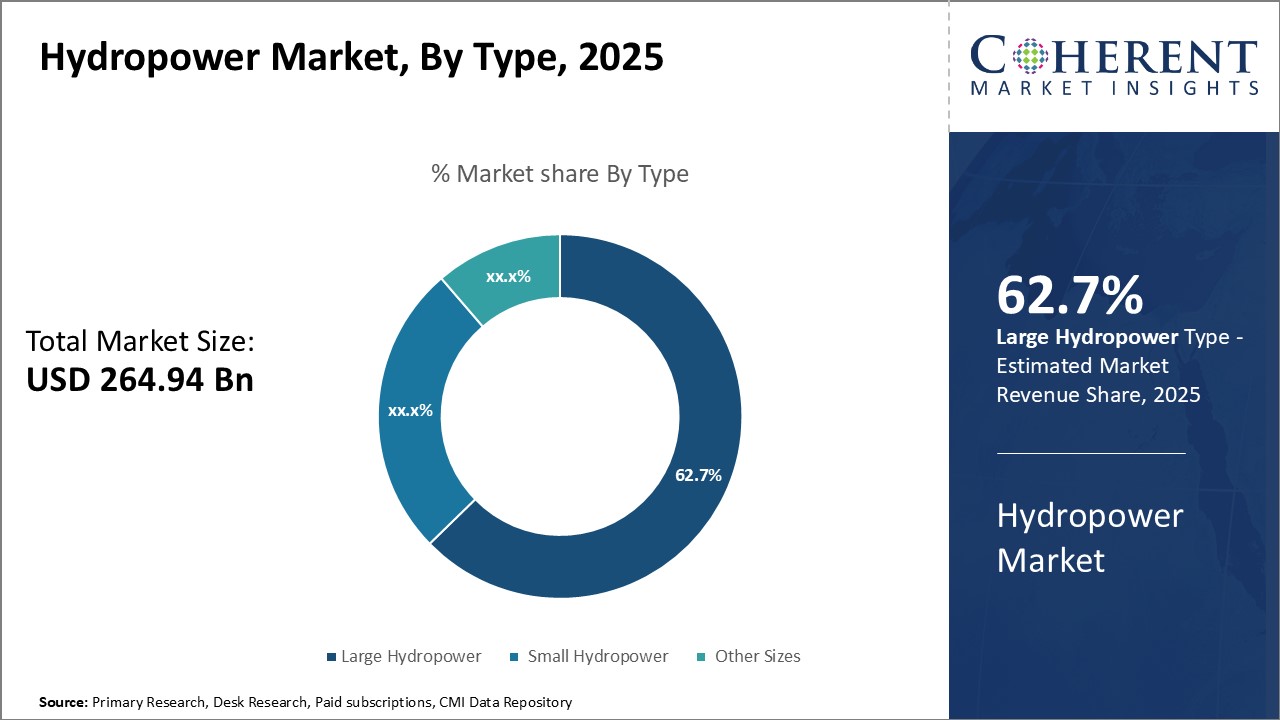
- By Type, Large Hydropower hold the largest market share of 63.7% in 2026 owing to its growing electricity demand.
- By Application, Industrial acquired the prominent market share of 44.8% in 2026 owing to the decarbonization and corporate sustainability targets.
- By Region, Asia Pacific dominates the overall market with an estimated share of 38.3% in 2026 owing to the rapid economic growth.
Market Overview
Countries are steadily expanding the hydropower market as they prioritize clean, reliable, and cost-effective electricity to meet rising energy demand. Hydropower serves as a cornerstone of global renewable energy because it delivers baseload power, enhances grid stability, and operates for long lifespans. Emerging economies are driving market growth by investing in modernization, pumped storage, and large-scale hydro projects. Supportive government policies, energy security goals, and the growing integration of renewable sources further accelerate the development of new and upgraded hydropower infrastructure.
Current Events and their Impact on the Hydropower Market
Current Events | Description and its impact |
Geopolitical Tensions and Transboundary Water Disputes |
|
Technological Advancements and Innovation |
|
Environmental and Climate Change Factors |
|
Segmental Insights
- Current Industry Events of 2026
- Market Size Estimation
- Regional Breakdown
- Competitive Landscape
- Customer Intelligence
- Segmental Analysis
- Pricing Analysis
- Key Market Drivers, Challenges & Future Trends
- Customized Insights Section
Hydropower Market Insights, By Type: Large Hydropower contribute the highest share of the market owing to its grid stability and flexibility needs.
Hydropower holds the largest market share of 63.7% in 2026. Countries and utilities are advancing large hydropower development to secure dependable, long-term electricity and accelerate the shift toward low-carbon energy systems. They rely on large hydro to deliver continuous power, strengthen grid stability, and facilitate the integration of other renewable sources. Many nations also build large dams to improve water management, support irrigation, and control floods. Ongoing technological improvements, rising electrification needs, and growing energy security priorities continue to drive strong momentum for large hydropower projects globally. For instance, in September 2025, Ethiopia launched Africa’s largest hydropower dam, intensifying tensions with Egypt, which fears reduced Nile flows despite Addis Ababa’s promises of fair water sharing.
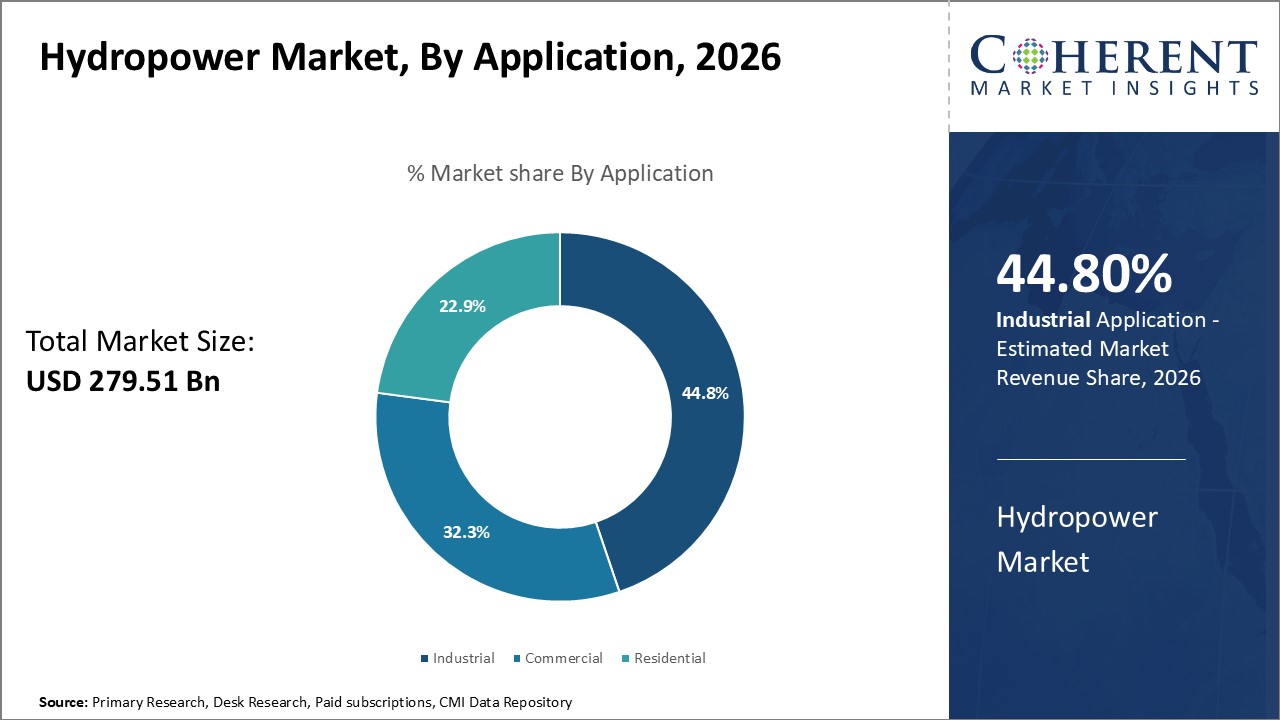
Hydropower Market Insights, By Application: Industrial contribute the highest share of the market owing to its electrification of industrial processes.
Industrial acquired the prominent market share of 44.8% in 2026. Manufacturers and heavy industries are driving the hydropower market as they look for steady, affordable, and low-carbon electricity to maintain continuous operations. Industrial users favor hydropower because it delivers reliable baseload power and stable long-term pricing, reducing operational risks. Companies increasingly rely on hydro to meet sustainability goals and cut emissions. As industrial processes become more electrified and demand for secure domestic energy rises, hydropower plays an even stronger role in supporting industrial expansion. For instance, in November 2025, Phoenix Group PLC, an IHC portfolio company, has partnered with Ethiopian Electric Power to launch a 30MW hydropower-powered mining facility at Bole Lemi Industrial Park in Addis Ababa.
Regional Insights
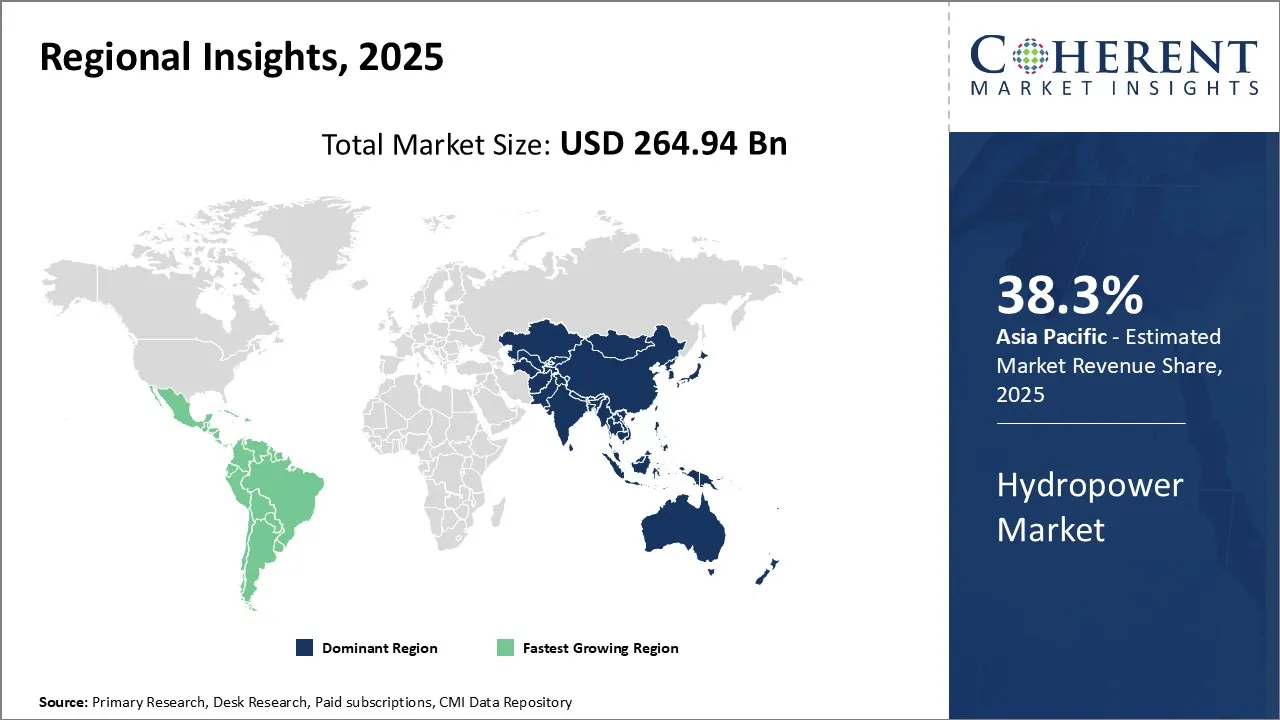
Asia Pacific Hydropower Market Trends
Asia Pacific dominates the overall market with an estimated share of 38.3% in 2026. Countries in the Asia Pacific are driving dynamic growth in the hydropower market by expanding renewable energy portfolios and modernizing aging infrastructure. They are prioritizing both large and small hydro projects to meet rising electricity demand and enhance grid reliability. Developers are advancing pumped storage to support increasing solar and wind capacity, while innovations in turbine technology, digital plant optimization, and cross-border power trade are reshaping the sector. Backed by government support and abundant water resources, hydropower continues to progress across the region. For instance, in November 2026, Arunachal Pradesh advanced its clean energy push as Deputy Chief Minister Chowna Mein launched the redesigned ‘DHPD 2.0’ identity for the Hydropower Development Department, unveiling it at the department’s first annual review to boost hydropower expansion.
North America Hydropower Market Trends
Utilities across North America are driving the evolution of the hydropower market by modernizing existing plants and adopting advanced technologies to enhance efficiency and flexibility. Operators are upgrading turbines, implementing digital monitoring, and deploying automation to extend plant lifespans and boost performance. Developers are also emphasizing small and distributed hydro projects to meet local energy demands and integrate renewables. With strong policy support for clean energy and rising demand for reliable, low-carbon power, hydropower continues to hold a central role in North America’s energy mix. For instance, in June 2026, the Philippines DOE and JICA have launched a technical cooperation project to support the country’s renewable energy goals by mapping potential large-scale hydropower projects nationwide.
India Hydropower Market Trends
The Indian government is driving significant growth in the hydropower market by emphasizing renewable energy expansion and energy security. Developers are advancing both large and small hydro projects to meet rising electricity demand and promote rural electrification. They are modernizing plants, implementing digital technologies, and improving efficiency to enhance performance.
In October 2026, India has announced a $77 billion plan to develop more than 76 gigawatts of hydropower from the Brahmaputra River Basin by 2047, the Central Electricity Authority (CEA) reported.
United States Hydropower Market Trends
Operators in the United States are driving the evolution of the hydropower market by modernizing existing plants to enhance efficiency, reliability, and grid integration. Utilities are upgrading turbines, implementing advanced control systems, and using digital monitoring to extend plant lifespans and optimize performance. Developers are also advancing small and distributed hydro projects to meet local energy needs and support renewable integration. Policymakers and industry stakeholders are promoting pumped storage and environmental improvements, strengthening hydropower’s role as a flexible, low-carbon, and reliable electricity source nationwide.
End-user Feedback and Unmet Needs in the Hydropower Market
- Reliability and Grid Integration: End-users highlight the need for consistent power output, particularly in regions with high renewable penetration. They seek advanced control systems and flexible operations that can support grid stability and respond quickly to demand fluctuations, ensuring uninterrupted electricity supply for both industrial and residential consumers.
- Modernization of Aging Infrastructure: Many hydropower plants operate with outdated equipment, leading to inefficiencies and higher maintenance costs. End-users demand modernization initiatives, including turbine upgrades, digital monitoring, and automation, to enhance performance, extend plant lifespans, and improve overall operational efficiency.
- Environmental and Social Considerations: Communities and industrial users emphasize sustainable practices. They seek hydropower solutions that minimize ecological impact, protect aquatic life, reduce displacement, and incorporate sediment management, ensuring projects align with social responsibility and environmental regulations.
Hydropower Market Trend
Modernization and Digitalization of Plants
Hydropower operators are increasingly focusing on upgrading aging infrastructure with advanced turbines, automation, and digital monitoring systems. These improvements enhance plant efficiency, reduce maintenance costs, and optimize output. Digital tools such as AI-based predictive maintenance and real-time performance monitoring help operators anticipate equipment issues and maximize energy production, while ensuring more reliable and cost-effective electricity supply across industrial and residential sectors.
Growth of Pumped Storage Projects
Pumped storage hydropower is gaining momentum as grids integrate higher shares of intermittent renewables like solar and wind. These projects store excess energy during low-demand periods and release it during peak consumption, supporting grid stability, frequency regulation, and energy reliability. Developers are increasingly exploring geographically suitable locations for large-scale and modular pumped storage systems to provide flexible, scalable solutions that complement existing hydropower capacity and support the overall transition to renewable energy.
Hydropower Market Opportunity
Expansion in Emerging Economies
Emerging markets in Asia, Africa, and Latin America present significant opportunities for hydropower development due to rising electricity demand, industrial growth, and abundant water resources. Governments in these regions are prioritizing renewable energy projects and rural electrification. Developers can invest in large, small, and micro-hydro projects, offering long-term power supply solutions while supporting local economic development, improving energy access, and fostering sustainable industrialization in regions with growing populations and infrastructure needs.
Market Report Scope
Hydropower Market Report Coverage
| Report Coverage | Details | ||
|---|---|---|---|
| Base Year: | 2025 | Market Size in 2026: | USD 279.51 Bn |
| Historical Data for: | 2020 To 2024 | Forecast Period: | 2026 To 2033 |
| Forecast Period 2026 to 2033 CAGR: | 5.5% | 2033 Value Projection: | USD 406.60 Bn |
| Geographies covered: |
| ||
| Segments covered: |
| ||
| Companies covered: | Siemens Energy, General Electric (GE), Voith GmbH & Co. KGaA, TOSHIBA CORPORATION, FLOVEL Energy Private Limited, ANDRITZ, Natel Energy, Gilkes, Bharat Heavy Electricals Limited, SNC-Lavalin Group, Kolektor, Mavel, a.s., Canyon Hydro, China Three Gorges, Alfa Laval, Hydro-Quebec, ABB, Engie | ||
| Growth Drivers: |
| ||
| Restraints & Challenges: |
| ||
Hydropower Market News
- In July 2025, the Hydropower Sustainability Alliance (HSA) has launched HydroSelect, a tool that helps developers, governments, investors, and stakeholders identify sustainable hydropower projects early, before major investments.
- In August 2025, the Gombe State Government has launched a 620KW small hydropower-solar PV hybrid system at Balanga Dam in Talasse, Balanga LGA.
- In August 2025, PPC announced a new tender for ground works and civil engineering as part of the EUR 430 million project, specifying that eligible firms must have completed at least one pumped storage hydropower station in the EU within the last ten years, with a capacity of at least 70 MW and a water head of 90–450 meters.
- In September 2025, the International Hydropower Association (IHA) and Eurelectric have launched the Paris Pledge, urging faster deployment of pumped storage hydropower (PSH) across Europe.
Analyst Opinion (Expert Opinion)
- Hydropower is experiencing a strong resurgence as an important tool for making modern power grids more flexible. According to the International Hydropower Association, global hydropower generation grew by 10% in 2024, reaching 4,578 TWh after several years affected by drought. Pumped-storage hydropower also expanded by 5% to 189 GW, showing that long-duration energy storage using water is both practical and rapidly growing.
- China illustrates this trend clearly. The country added 14.4 GW of new hydropower capacity last year, including 7.75 GW of pumped storage, indicating a strategic shift toward energy storage to support its fast-growing solar and wind generation. Worldwide, more than 1,075 GW of new hydropower capacity is currently in development, including around 600 GW of pumped storage and 475 GW of conventional projects.
- These developments challenge the common belief that hydropower is a “mature” technology with limited room for expansion. Instead, hydropower is becoming a key part of the clean-energy transition, providing both carbon-free baseload electricity and large-scale storage to stabilize intermittent renewables. Policymakers and investors who overlook this shift risk misunderstanding the direction of the energy system, as hydropower’s transformation is already well underway.
Speak to the analyst
Want personalized insights?
Take the findings above to one of our principal consultants, or have the report rebuilt around the segments, geographies and competitors you actually track.
Market Segmentation
- Type Insights (Revenue, USD Bn, 2021 - 2033)
- Large Hydropower
- Small Hydropower
- Other Sizes
- Application Insights (Revenue, USD Bn, 2021 - 2033)
- Residential
- Commercial
- Industrial
- Regional Insights (Revenue, USD Bn, 2021 - 2033)
- North America
- U.S.
- Canada
- Latin America
- Brazil
- Argentina
- Mexico
- Rest of Latin America
- Europe
- Germany
- U.K.
- Spain
- France
- Italy
- Russia
- Rest of Europe
- Asia Pacific
- China
- India
- Japan
- Australia
- South Korea
- ASEAN
- Rest of Asia Pacific
- Middle East & Africa
- GCC Countries
- Israel
- Rest of Middle East & Africa
- Key Players Insights
- Siemens Energy
- General Electric (GE)
- Voith GmbH & Co. KGaA
- TOSHIBA CORPORATION
- FLOVEL Energy Private Limited
- ANDRITZ
- Natel Energy
- Gilkes
- Bharat Heavy Electricals Limited
- SNC-Lavalin Group
- Kolektor
- Mavel, a.s.
- Canyon Hydro
- China Three Gorges
- Alfa Laval
- Hydro-Quebec
- ABB
- Engie
Sources
Primary Research interviews
- Executives from hydropower utilities, project developers, and grid operators (e.g., IHA member companies)
- Technical leads in hydropower plant modernization teams
- Policy makers or regulators in water‑energy nexus departments
Databases
- U.S. Department of Energy – Water Power Technologies Office (Hydropower Data Access)
- Oak Ridge National Laboratory (ORNL) HydroSource (via DOE reports)
- International Hydropower Association (IHA) World Hydropower Outlook
Magazines
- Hydro Review (industry‑focused publication)
- Hydro Review Worldwide (global hydropower magazine)
Journals
- Hydropower (MDPI open-access technical journal)
- Research papers from arXiv, such as “Hy-DAT: A Tool to Address Hydropower Modeling Gaps”
- “Condition monitoring and early diagnostics methodologies for hydropower plants”
Newspapers
- (None explicitly cited here — you can supplement with articles from established energy‑oriented newspapers or reputable news outlets covering hydropower developments.)
Associations
- International Hydropower Association (IHA)
- International Centre for Hydropower (ICH)
- Hydropower Sustainability Assessment Council (HSAP) / Hydropower Sustainability Assessment Protocol
- National Hydropower Association (NHA, USA)
Public Domain sources
- U.S. Hydropower Market Report by U.S. DOE
- DOE’s Hydropower Data Access and Analytics portal
Proprietary Elements
- CMI Data Analytics Tool
- Proprietary CMI Existing Repository of information for last 8 years
Get access to 250+ pages report
Every segment, forecast, competitor profile and data table behind the analysis above — available for instant download.
- ESOMAR Member
- ISO 9001:2015 Certified
- D-U-N-S Registered
- GDPR & CCPA Compliant
Missing comfort of reading report in your local language? Find your preferred language:
Transform your Strategy with Exclusive Trending Reports
Frequently Asked Questions
The Hydropower Market is estimated to be valued at USD 279.51 Bn in 2026, and is expected to reach USD 406.60 Bn by 2033.
The CAGR of the Hydropower Market is projected to be 5.5% from 2026 to 2033.
Rising concerns over greenhouse gas emissions and affordability and grid flexibility are the major factors driving the growth of global hydropower market.
High initial investment costs and lengthy approval and construction processes are the major factors hampering the growth of global hydropower market.
In terms of type, large hydropower segment is estimated to dominate the market in 2026.
Siemens Energy, General Electric (GE), Voith GmbH & Co. KGaA, TOSHIBA CORPORATION, FLOVEL Energy Private Limited, ANDRITZ, Natel Energy, Gilkes, Bharat Heavy Electricals Limited, SNC-Lavalin Group, Kolektor, Mavel, a.s., Canyon Hydro, China Three Gorges, Alfa Laval, Hydro-Quebec, ABB, Engie are the major players.
Asia Pacific is expected to lead the global hydropower market.