

Small Hydropower Market Size And Share Analysis - (2026-2033)
The global small hydropower market is estimated to be valued at USD 3.00 Bn in 2026 and is expected to reach USD 3.77 Bn by 2033, exhibiting a compound annual growth rate (CAGR) of 3.5% from 2026 to 2033.
Key Takeaways
- By Component, The Civil Construction Segment is projected to dominate the small hydropower market with a 36.8% share in 2026, driven by the extensive infrastructure required for project development.
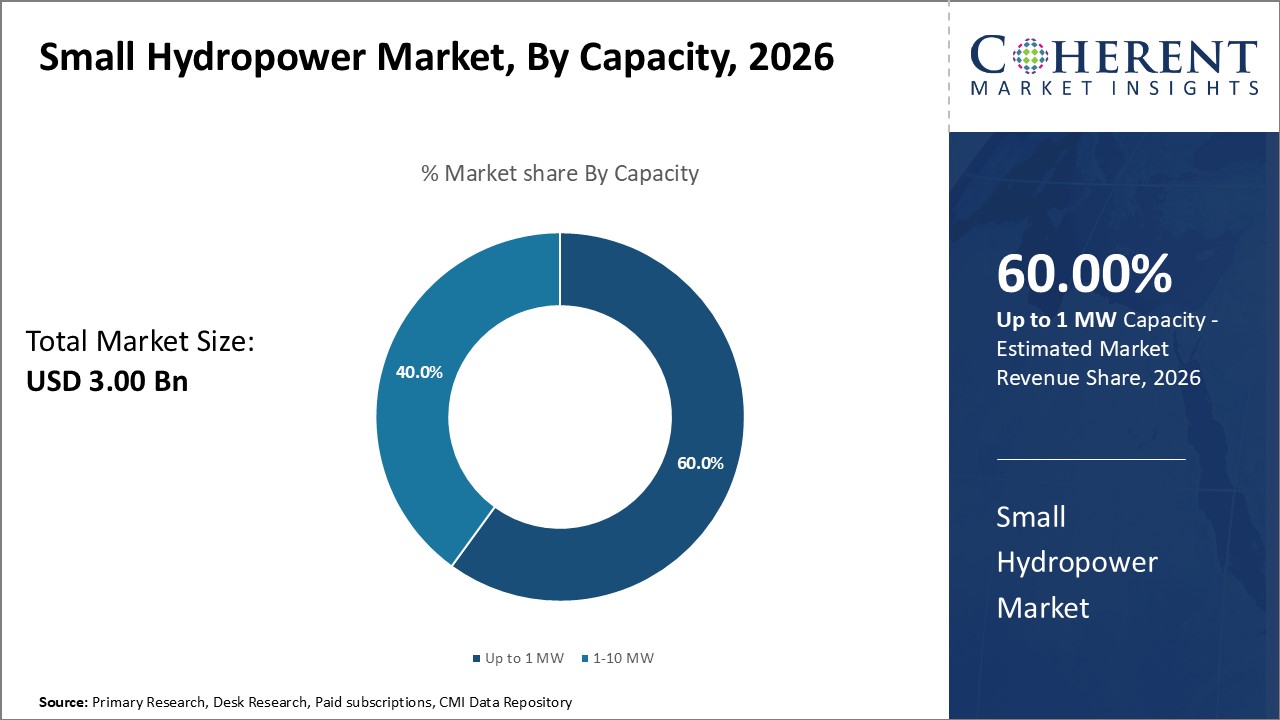
- By Capacity, the up to 1MW capacity segment is expected to account for 60% of the global market share in 2026, driven by its suitability for decentralized and off-grid power generation.
- By Type, The Micro Hydropower Systems are projected to lead the small hydropower market with a 61.1% share in 2026, owing to their compact design and scalability.
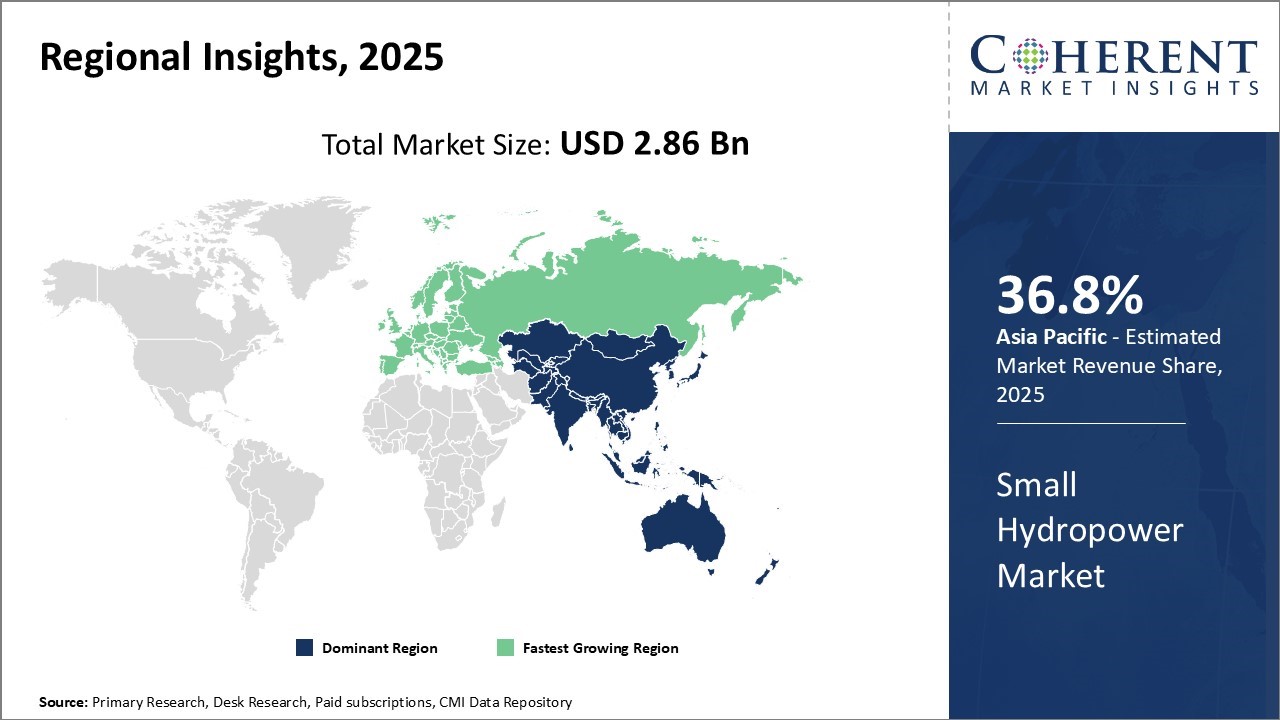
- By Regional Insight: Asia Pacific is expected to maintain its dominance in the small hydropower market with a 36.8% share in 2026.
Market Overview
The global small hydropower market is witnessing steady expansion, driven by increasing demand for renewable energy, rural electrification goals, and government incentives for sustainable infrastructure. Small hydropower systems offer cost-effective, low-impact solutions for decentralized power generation, especially in remote and off-grid areas. Civil construction remains the dominant component due to infrastructure intensity, while micro hydropower leads in type.
Current Events and its Impact on the Small Hydropower Market
Current Event | Description and its impact |
Global Push for Decentralized Renewable Energy |
|
Policy Incentives for Climate-Resilient Infrastructure |
|
Government Push for Decentralized Renewable Energy Projects |
|
Pricing Analysis – Small Hydropower Market
The pricing dynamics in the small hydropower market are influenced by multiple factors, including project capacity, site-specific conditions, regional regulations, and construction costs. On average, the cost of installing small hydropower systems ranges from $1,000 to $5,000 per kW, depending on the complexity of civil works and turbine technology.
Micro hydropower systems (up to 100 kW) generally fall on the lower end of this range, making them attractive for remote and off-grid applications, particularly in developing economies.
Civil construction constitutes the largest cost component up to 40–50% of total project expenditure due to the need for infrastructure such as dams, intake canals, and powerhouses. Turbines and electro-mechanical equipment also contribute significantly to upfront costs.
However, long operational lifespans (25–50 years) and minimal fuel or operational expenses make small hydropower highly cost-effective over time. Government subsidies, low-interest loans, and feed-in tariffs are further reducing barriers, encouraging broader adoption and price competitiveness.
- Current Industry Events of 2026
- Market Size Estimation
- Regional Breakdown
- Competitive Landscape
- Customer Intelligence
- Segmental Analysis
- Pricing Analysis
- Key Market Drivers, Challenges & Future Trends
- Customized Insights Section
Small Hydropower Market Trends
- Increasing demand for renewable energy sources
The global demand for renewable sources of energy has been steadily rising in the past few decades. Various factors such as the need to reduce carbon emissions to mitigate the risks of climate change, energy security concerns, and evolving consumer preferences have contributed to this rise in the demand for clean energy sources across both developed and developing world.
One such renewable technology that is gaining traction is small hydropower plants which can help harness the vast untapped hydropower potential available in many parts of the world. While large-scale hydroelectric plants have been providing clean energy for a long time, small hydropower plants offer certain advantages especially for off-grid applications in remote locations which large plants may not be economically viable for.
In June 2025, The Times of India reported that Nagaland’s power department inaugurated the 1 MW Ponglefo run-of-the-river hydroelectric project on the Likimo River in Kiphire district. The project, funded by the Ministry of New and Renewable Energy and North Eastern Council, is expected to generate around 3.9 million units annually, boosting rural electrification and economic development.
Challenges in the Small Hydropower Market
- High initial investment and infrastructure costs
One of the major challenges faced by this market is the high initial investment and infrastructure costs associated with setting up small hydropower plants. Developing the required civil infrastructure like dams, waterways, pipelines, etc. involves heavy capital expenditure.
Moreover, extensive feasibility studies, environmental impact assessments, and clearances from various government bodies also drive up the initial project costs. Accessing remote locations for hydropower projects in hilly and mountainous terrain poses additional challenges and increases development costs. The return on investment for small hydropower plants takes a longer gestation period due to the high capital expenses.
Opportunities in the Small Hydropower Market
- Technological advancements in hydropower efficiency
The global small hydropower market has been presented with significant opportunities owing to ongoing technological advancements that are improving hydropower efficiencies. Various players in the market are focusing on developing innovative turbine designs, renewable materials for civil works, and integrated hydropower solutions tailored to suit location-specific requirements. This is helping reduce infrastructure costs and construction time.
Advanced automation and remote monitoring systems are also enhancing operational efficiencies of small hydropower plants. The use of advanced composites and 3D printing technologies for manufacturing turbine components cuts downtime and maintenance expenses.
Global Small Hydropower Market Insights, By Component
The civil construction segment is projected to dominate the small hydropower market with a 36.8% share in 2026, driven by the extensive infrastructure required for project development. Core components such as dams, canals, intake structures, tunnels, and powerhouses form the backbone of any small hydropower installation.
The complexity and scale of civil works directly influence project timelines and capital costs, making it the most resource-intensive and strategically vital segment. Government support for rural electrification and green infrastructure is further accelerating civil construction activities globally.
Moreover, advancements in construction technologies and pre-fabricated modules are helping reduce time-to-deployment and enhance structural safety, reinforcing the segment’s leadership.
Global Small Hydropower Market Insights, By Capacity
The up to 1MW capacity segment is expected to account for 60% of the global market share in 2026, driven by its suitability for decentralized and off-grid power generation. These low-capacity plants are ideal for remote communities, agricultural areas, and local industries, offering cost-effective, sustainable, and location-specific power solutions. Their compact footprint and adaptability to natural stream flows make them environmentally friendly alternatives to large-scale hydro.
As electrification of rural and mountainous regions becomes a key priority for governments and NGOs, the demand for up to 1MW plants continues to rise, especially in Asia Pacific, Africa, and Latin America.
Global Small Hydropower Market Insights, By Type
Micro hydropower systems are projected to lead the small hydropower market with a 61.1% share in 2026, owing to their compact design and scalability. These systems, typically below 100 kW, are seeing rapid adoption in rural electrification projects, driven by advancements in turbine miniaturization and modular plug-and-play solutions. Their ability to be installed without large civil infrastructure makes them ideal for small rivers and irrigation canals, supporting clean energy access in underserved regions.
Governments and development agencies are increasingly funding micro-hydro projects due to their affordability, low maintenance, and community ownership models, positioning them as a cornerstone of sustainable rural development strategies.
Regional Insights
Asia Pacific Small Hydropower Market Trends and Analysis
Asia Pacific is expected to maintain its dominance in the global small hydropower market, accounting for an estimated 36.8% share in 2026. This leadership is primarily driven by the region’s favourable topography, abundant water resources, and accelerating demand for decentralized renewable energy.
Countries such as China, India, Nepal, and Vietnam are leading the charge with strategic investments in rural electrification, sustainable development, and climate-resilient infrastructure. Governments across the region are actively promoting small hydropower through subsidies, policy incentives, and fast-track project approvals, especially in remote and underserved areas.
Additionally, international financial institutions and development agencies are increasingly funding small hydro initiatives in Asia Pacific, reinforcing regional capacity building and technological transfer. With strong support for green energy integration, rising energy demand from growing rural populations, and continued modernization of power infrastructure, Asia Pacific is set to remain the epicentre of global small hydropower innovation, implementation, and growth.
Small hydropower market Dominating Countries
China and India
China leads the global small hydropower market, driven by its strategic focus on rural electrification, carbon reduction, and sustainable energy development. With over 45,000 small hydro stations nationwide, China accounts for the largest installed capacity globally. Government-led initiatives under the 14th Five-Year Plan prioritize the modernization and digitalization of small hydro assets, particularly in mountainous and remote regions.
Robust state funding, local manufacturing capabilities, and continuous technological advancements in turbine efficiency and automation are further accelerating deployment. China’s policy framework strongly supports decentralized renewable solutions, positioning it as a global hub for small hydropower innovation and scalability.
India closely follows, fuelled by its massive demand for off-grid energy access and commitment to expanding clean energy sources. Programs like the “Hydropower Development Policy” and “UJALA” promote small hydro installations in hilly, tribal, and rural belts. With over 7 GW of potential identified and multiple state-level subsidies in place, India is rapidly scaling small hydro as part of its energy transition roadmap.
In February 2026, The Economic Times (via The Times of India) reported that the Indian government is planning a new support scheme offering up to 30% central financial assistance on project costs for small hydropower producers. This initiative is aimed at encouraging renewable energy investments and enhancing decentralized power generation across India.
The Ministry of New and Renewable Energy (MNRE) provides targeted incentives, while public-private partnerships are enhancing project execution speed and affordability. India’s focus on sustainable development, combined with a supportive regulatory environment and abundant hydrological resources, reinforces its leadership in the global small hydropower landscape.
Market Report Scope
Small Hydropower Market Report Coverage
| Report Coverage | Details | ||
|---|---|---|---|
| Base Year: | 2025 | Market Size in 2026: | USD 3.00 Bn |
| Historical Data for: | 2020 To 2024 | Forecast Period: | 2026 To 2033 |
| Forecast Period 2026 to 2033 CAGR: | 3.5% | 2033 Value Projection: | USD 3.77 Bn |
| Geographies covered: |
| ||
| Segments covered: |
| ||
| Companies covered: | Andritz Hydro, GE Renewable Energy, Voith Hydro, Siemens AG, Alstom, Statkraft, Hydro-Québec, Sener Group, CNR (China National Renewable Energy), EDP Renewables, Tractebel, Bluegreen Energy, Hydro Tasmania, Energias de Portugal (EDP), and GEV (Green Energy Ventures) | ||
| Growth Drivers: |
| ||
| Restraints & Challenges: |
| ||
Analyst Viewpoint – Small Hydropower Market
- The global small hydropower market is driven by the rising demand for decentralized clean energy, government-led rural electrification initiatives, and favourable topographic conditions in developing regions. Small hydropower is viewed as a low-emission, cost-effective, and scalable renewable energy solution with long operational lifespans and minimal environmental impact.
- Experts highlight strong adoption in capacity segments up to 1 MW, which are well-suited for remote communities, agriculture, and small-scale industrial applications. Advancements in micro turbine technology and modular system design are enabling deployment in difficult terrain with limited civil infrastructure requirements.
- Asia Pacific continues to dominate the market, backed by significant investments from China, India, Nepal, and Vietnam, along with international support from development banks and multilateral agencies. Meanwhile, Latin America and Africa are emerging as high-potential regions due to growing demand for off-grid energy.
Small Hydropower Market: Key Development
- In May, 2025, the Prime Minister of Bhutan inaugurated the 18 MW Suchhu small hydropower plant in Sombaykha Haa on May 15, 2025, completed in 27 months at a cost of Nu 2,556 million. Strengthens Bhutan’s small hydropower capacity, improving grid resilience in rural areas during natural disasters, and sets momentum for an additional 86 MW under construction.
- In February, 2025, Arunachal Pradesh approved 35 small hydropower projects totalling 570.75 MW with an investment of ₹7,000 crore. Positions the region as a small hydropower hub, creates 7,500 jobs, and aligns with India’s renewable and self-reliance initiatives, unlocking major market expansion.
- In January, 2025, Indonesia’s state cabinet designated 2025–35 as the ‘Decade of Hydropower’ to exploit over 58,000 MW potential, emphasizing a mix of small- to large-scale projects. Signals robust government backing and regulatory clarity, accelerating investments and fast-tracking small hydropower deployments nationwide.
- In September 2024, a 500 kW hydropower unit was commissioned at Taylor Park Dam, Colorado, producing ~3.8 GWh annually. Demonstrates feasibility of retrofitting existing water infrastructure in North America, promoting low-impact, small-scale hydropower in developed markets.
- In August, 2024, the 47 GWh per year Flateland hydropower plant in Agder County, Norway, began operations on August 29, 2024, built in record time through local stakeholder partnerships. Serves as a model for efficient stakeholder collaboration and expedited project execution, enhancing investor confidence in European small hydropower.
Market Segmentation
- By Component Insights (Revenue, USD Bn, 2021 2033)
- Civil Construction
- Power Infrastructure
- Electromechanical Equipment
- Others
- By Capacity Insights (Revenue, USD Bn, 2021 2033)
- Up to 1 MW
- 1 10 MW
- By Type Insights (Revenue, USD Bn, 2021 2033)
- Micro Hydropower
- Mini Hydropower
- Regional Insights (Revenue, USD Bn, 2021 2033)
- North America
- U.S.
- Canada
- Latin America
- Brazil
- Argentina
- Mexico
- Rest of Latin America
- Europe
- Germany
- U.K.
- Spain
- France
- Italy
- Russia
- Rest of Europe
- Asia Pacific
- China
- India
- Japan
- Australia
- South Korea
- ASEAN
- Rest of Asia Pacific
- Middle East
- GCC Countries
- Israel
- Rest of Middle East
- Africa
- South Africa
- North Africa
- Central Africa
- Key Players Insights (Revenue, USD Bn, 2021 - 2033)
- Andritz Hydro
- GE Renewable Energy
- Voith Hydro
- Siemens AG
- Alstom
- Statkraft
- Hydro Québec
- Sener Group
- CNR (China National Renewable Energy)
- EDP Renewables
- Tractebel
- Bluegreen Energy
- Hydro Tasmania
- Energias de Portugal (EDP)
- GEV (Green Energy Ventures)
Sources
The Stakeholders Consulted
- Healthcare providers, including hospitals, diagnostic labs, and specialty clinics
- Health IT managers and digital health strategists
- Medical device manufacturers and AI-based software solution providers
- Regulatory bodies overseeing health technology standards (e.g., FDA, CDSCO)
- Academic institutions and clinical researchers involved in digital health innovation
- Data scientists and bioinformatics professionals focused on healthcare analytics
- Pharmaceutical and biotechnology companies utilizing virtual trial platforms
- System integrators and cloud infrastructure providers supporting healthcare simulations
Databases Opened
- U.S. Food & Drug Administration (FDA)
- Centers for Medicare & Medicaid Services (CMS)
- National Institutes of Health (NIH)
- World Health Organization (WHO)
- India Ministry of Health & Family Welfare
Magazines & Trade Publications
- Healthcare IT News
- MedTech Dive
- Health Data Management
- Medical Design & Outsourcing
- IEEE Pulse – Biomedical Engineering and Health Tech
- PharmaVOICE – R&D and Clinical Innovation Coverage
Scientific and Industry Journals
- Journal of Biomedical Informatics
- npj Digital Medicine
- The Lancet Digital Health
- IEEE Journal of Biomedical and Health Informatics
- Nature Computational Science
- Artificial Intelligence in Medicine
Newspapers & Media Outlets
- The Wall Street Journal – Health & Technology
- Bloomberg – Health Innovation and Biotech
- Reuters – Healthcare & Digital Transformation
- The Economic Times – Health Technology & Startups
- Business Standard – MedTech, Pharma & Policy
Associations and Regulatory Bodies
- U.S. Food and Drug Administration (FDA) – Digital Health Center of Excellence
- World Health Organization (WHO) – eHealth Technical Advisory Group
- Health Level Seven International (HL7)
- Digital Medicine Society (DiMe)
- Medical Device Innovation Consortium (MDIC)
- Central Drugs Standard Control Organization (CDSCO), India
Public Domain Sources
- European Commission – Digital Health and Data Strategy Reports
- National Health Service (NHS), UK – Digital Twin Pilot Programs
- World Bank – Health Infrastructure and Technology Access Data
- International Telecommunication Union (ITU) – AI for Health Reports
Proprietary Research Elements
- CMI Data Analytics Tool
- Proprietary CMI Repository of Market Data (covering past 8 years)
- CMI Expert Interviews and Transcripts (focused on healthcare IT adoption, digital twin platforms, and simulation-based decision-making)
Get access to 250+ pages report
Every segment, forecast, competitor profile and data table behind the analysis above — available for instant download.
- ESOMAR Member
- ISO 9001:2015 Certified
- D-U-N-S Registered
- GDPR & CCPA Compliant
Missing comfort of reading report in your local language? Find your preferred language:
Transform your Strategy with Exclusive Trending Reports
Frequently Asked Questions
The Small Hydropower Market size is estimated to be valued at USD 2.86 Bn in 2025, and is expected to reach USD 3.59 Bn by 2032.
The CAGR of the global Market is projected to be 3.3% from 2025 to 2032.
Increasing demand for renewable energy sources and government incentives and policies promoting small hydropower projects are the major factors driving the growth of the global market.
High initial investment and infrastructure costs and environmental and regulatory challenges are the major factors hampering the growth of the global small hydropower market.
In terms of component, the civil construction segment is estimated to dominate the market revenue share in 2025.
Andritz Hydro, GE Renewable Energy, Voith Hydro, Siemens AG, Alstom, Statkraft, Hydro-Québec, Sener Group, CNR (China National Renewable Energy), EDP Renewables, Tractebel, Bluegreen Energy, Hydro Tasmania, Energias de Portugal (EDP), and GEV (Green Energy Ventures) are the major players.
Asia Pacific is expected to lead the global small hydropower industry in 2025.