

Distributed Generation Market Size and Share Analysis - 2026 To 2033
The global distributed generation market is estimated to be valued at USD 429.0 Bn in 2026 and is projected to reach approximately USD 948.4 Bn by 2033, growing at a CAGR of 12.0% during the forecast period. This can be attributed to rising demand for reliable and decentralized power generation, increasing integration of renewable energy sources as well as supportive government policies promoting clean energy adoption.
Key Takeaways from the Distributed Generation Market Report
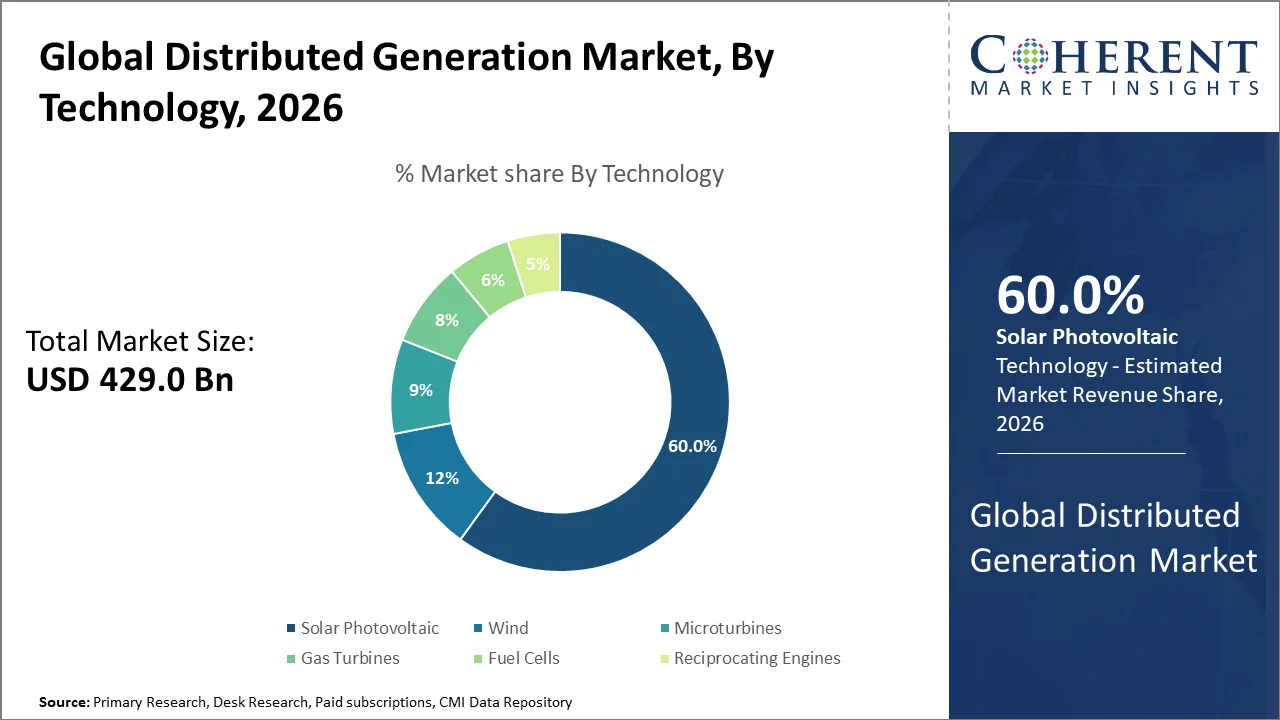
- Solar photovoltaic segment is expected to lead the market with a share of 60% in 2026 due to declining module costs, supportive government incentives, rapid rooftop solar deployment as well as increasing commercial and residential adoption. For example, according to the IEA (2025), global solar PV capacity additions exceeded 600 GW in 2025, reflecting strong worldwide adoption.
- Industrial segment is slated to account for the largest market revenue share of 45% in 2026 due to increasing adoption of onsite solar and CHP systems to reduce energy costs as well as improve energy security. According to the U.S. Department of Energy (DOE), 84% of nearly 80 GW of U.S. CHP capacity is installed in industrial applications.
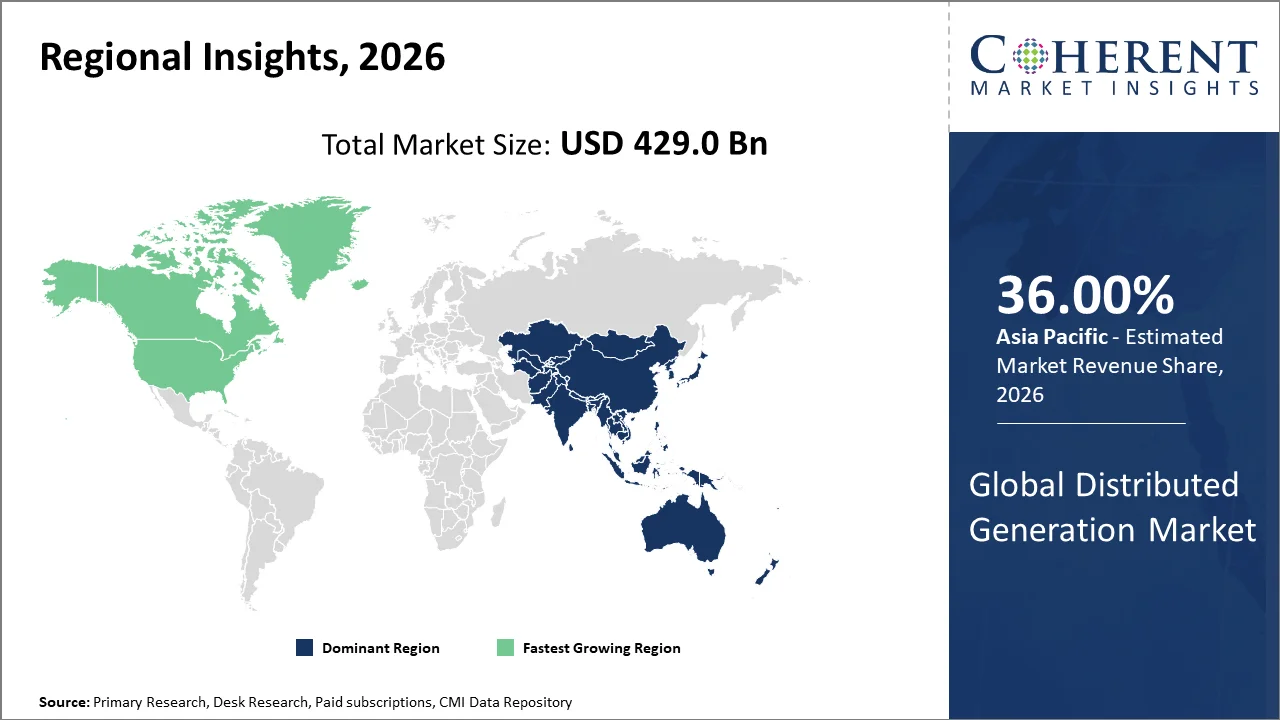
- Asia Pacific is projected to dominate the global distributed generation industry with a share of 36% in 2026, due to rapid industrialization, supportive renewable energy policies, and rising deployment of distributed energy systems across nations like China, India, and Japan. For example, China’s distributed photovoltaics accounted for 40% of its total solar PV capacity in 2024, highlighting rapid adoption of decentralized energy systems.
Distributed Generation Market Overview
The global distributed generation market is projected to grow rapidly during the forecast period. This growth is mostly due to increasing investments in renewable energy, rising demand for reliable and decentralized power generation, supportive government policies promoting clean energy adoption, and growing concerns over grid resilience and energy security.
Rapid advancements in solar photovoltaic systems, wind turbines, fuel cells, and energy storage technologies are also supporting market growth. In addition, rising adoption of microgrids, combined heat and power (CHP) systems, and distributed energy resources across residential, commercial, and industrial sectors is likely to create growth prospects for distributed generation market in the coming years.
Supportive government policies and incentives are expected to boost growth of distributed energy generation market. Government initiatives such as net metering, renewable energy incentives, tax benefits, and clean energy targets are encouraging investments in distributed generation projects. These policies are supporting rooftop solar installations and decentralized energy adoption across various regions.
Increasing adoption of smart grids, microgrids, and digital energy management systems is creating new opportunities for distributed generation. Advanced monitoring, automation, and energy management technologies allow efficient integration of multiple distributed energy resources.
Segmental Insights
Which Technology Leads the Global Distributed Generation Market?
Solar Photovoltaics Lead the Market with Nearly Three-Fifths Share
According to Coherent Market Insights’ distributed generation market analysis, solar photovoltaics segment is set to account for the largest revenue share of 60% in 2026. This dominance can be attributed to declining cost of solar panels, supportive government incentives, rapid advancements in photovoltaic technology, and increasing adoption of rooftop solar systems across residential, commercial, and industrial sectors.
Solar photovoltaic (PV) systems are being increasingly adopted worldwide due to their ability to generate clean electricity at lower costs. Continuous improvements in PV efficiency, declining module prices, supportive government policies, and growing awareness of renewable energy are encouraging residential, commercial, and industrial users to install solar systems.
For example, according to the International Renewable Energy Agency (IRENA), solar PV module prices have declined by around 90% since 2009. Similarly, global weighted average cost of electricity from newly commissioned solar PV projects fell by 12% in 2023, making solar one of the lowest-cost options for new power generation.
Rising demand for clean and decentralized electricity generation, along with favorable net metering policies as well as rising investments in renewable energy infrastructure, is also accelerating deployment of solar PV systems worldwide. In addition, integration of battery energy storage systems is improving the reliability of solar-based distributed generation, thereby boosting segment growth.
- Current Industry Events of 2026
- Market Size Estimation
- Regional Breakdown
- Competitive Landscape
- Customer Intelligence
- Segmental Analysis
- Pricing Analysis
- Key Market Drivers, Challenges & Future Trends
- Customized Insights Section
Who is the Leading End User of Distributed Generation Technologies?
Industrial Sector Continues to Drive Adoption of Distributed Generation Technologies
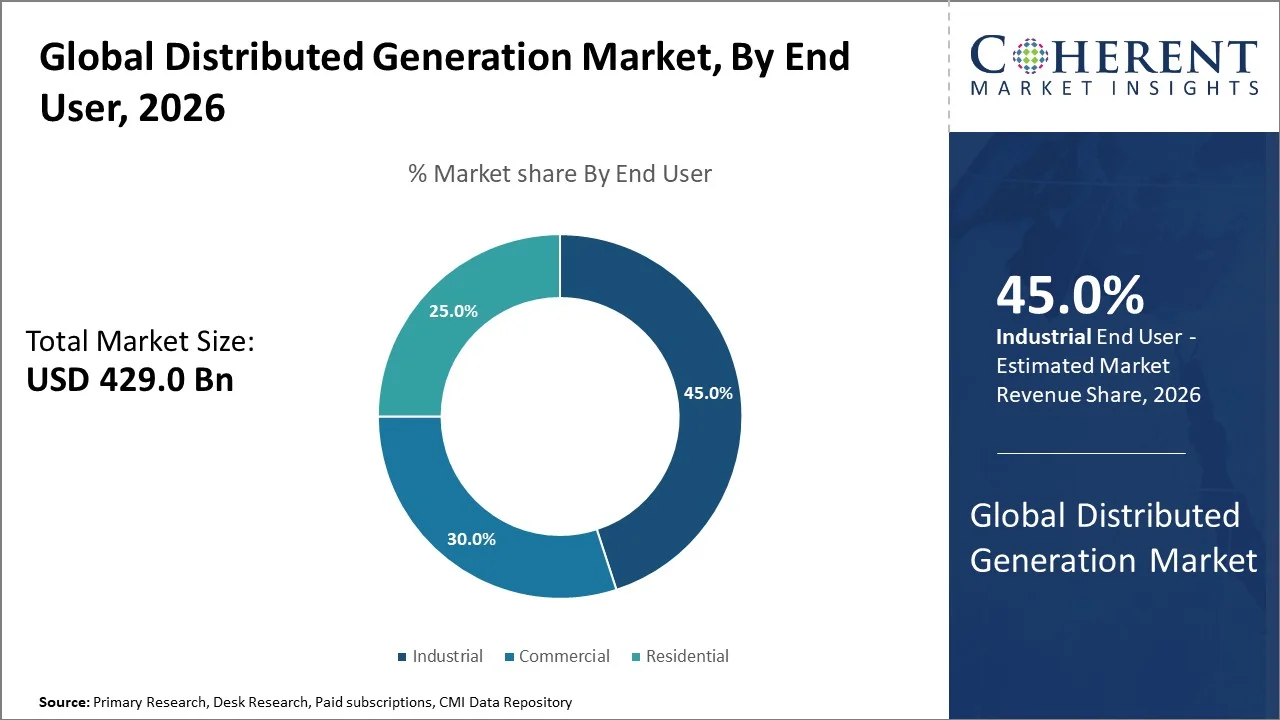
Based on end user, industrial segment is projected to account for 45% of the global distributed generation market share in 2026. This is mostly due to growing need for reliable and uninterrupted power supply across manufacturing facilities, oil and gas plants, mining operations, chemical industries, and other energy-intensive industries.
Industrial users are increasingly adopting distributed generation systems such as combined heat and power (CHP), gas turbines, and solar PV to reduce electricity costs, improve energy efficiency as well as minimize dependence on aging grid infrastructure. In addition, rising electricity prices, stringent emission regulations, and the need for operational continuity are encouraging industries to invest in on-site power generation solutions, thereby boosting segment growth.
Distributed Generation Market Growth Drivers
Rising Adoption of Renewable Energy Sources
Growing deployment of renewable technologies such as solar photovoltaic (PV), wind turbines, and biomass-based generation is accelerating distributed generation adoption. Falling costs of solar modules and improvements in renewable energy efficiency are making small-scale generation systems more affordable for residential, commercial, and industrial users.
According to the International Energy Agency (IEA), global renewable power capacity is projected to increase by almost 4,600 GW between 2025 and 2030. This rising adoption of renewable energy sources is expected to provide a strong impetus for the growth of distributed generation market during the forecast period.
Distributed Generation Market Opportunities
Rising Demand for Reliable and Resilient Power Supply
Growing demand for reliable and resilient power supply is expected to create lucrative growth opportunities for the distributed generation market. Increasing power outages, grid instability, aging transmission infrastructure, and the need for uninterrupted electricity are encouraging industrial, commercial as well as residential users to adopt distributed generation systems such as solar PV, combined heat and power (CHP), and microgrids. These systems improve energy resilience, reduce dependence on centralized power grids, and ensure continuous electricity supply during grid disruptions.
Distributed Generation Market Trends
Growing Integration of Battery Energy Storage Systems and Smart Grids
Increasing integration of battery energy storage systems (BESS) and smart grid technologies is a key trend in the distributed generation market. Battery storage helps store excess electricity generated from renewable sources such as solar and wind for use during periods of high demand or power outages, improving energy reliability and grid stability.
At the same time, smart grids enable real-time monitoring, efficient energy management, and seamless integration of distributed energy resources. As governments and utilities continue investing in modern grid infrastructure, this trend is expected to support the growth of the distributed generation market during the forecast period.
Current Events and Their Impact on the Distributed Generation Market
Current Event | Description and its Impact |
Record Growth in Global Distributed Solar PV (2025–2026) |
|
Faster Rooftop Solar Approvals in India |
|
Regional Insights
Asia Pacific Remains at the Epicenter of Distributed Generation Market Growth
Asia Pacific is expected to account for around 36% of the global distributed generation market share in 2026. This dominance is attributable to rapid expansion of renewable energy, rising electricity demand, supportive government policies as well as increasing investments in decentralized power systems. Growing adoption of rooftop solar and microgrids is also supporting market expansion in the region.
Rapid growth in renewable energy capacity is playing a key role in boosting Asia Pacific distributed generation market value. According to the accounting for nearly 71% of the global renewable capacity additions. The continued expansion of solar and wind projects is increasing the deployment of distributed generation systems across residential, commercial, and industrial sectors.
North America Becoming a Lucrative Market for Industry Players
North America is projected to create a plethora of growth opportunities for manufacturers of distributed generation technologies during the forecast period. This growth is mostly due to increasing investments in clean energy, rising adoption of rooftop solar and battery storage, favorable government incentives, and the need for a more reliable and resilient power supply.
Growing deployment of distributed solar power is spurring growth of North America distributed generation market. According to the while small-scale solar capacity continued to expand across homes and businesses. The rapid increase in solar installations is driving the adoption of distributed generation systems across the region.
Distributed Generation Market Outlook – Country-wise
China Distributed Generation Market Forecast
China is expected to remain the leading market for distributed generation technologies during the assessment period. This can be attributed to the country's continued expansion of distributed solar photovoltaic (PV) installations, supportive government policies promoting clean energy, large-scale investments in smart grid infrastructure as well as rising demand for reliable power in industrial and commercial sectors. The country's carbon neutrality goals and ongoing modernization of its electricity distribution network are also expected to fuel distributed generation deployment.
U.S. Distributed Generation Market Trends
The United States distributed generation market is forecast to exhibit strong growth during the forecast period. This is mainly due to due to increasing investments in grid resilience, rising adoption of combined heat and power (CHP) systems and battery energy storage, favorable net metering and tax incentive programs, and growing demand for backup power from commercial, industrial, and residential users. Rapid development of microgrids and the increasing frequency of extreme weather events are also supporting market growth.
Who are the Major Companies in the Distributed Generation Market?
Some of the major players in distributed generation market are Siemens AG, General Electric (U.S.), Schneider Electric SE, Mitsubishi Motors Corporation, Capstone, Activ Solar GmbH, Ballard Power Systems Inc., Fortis Wind Energy, GE Power & Water, Juwi Inc., Sharp Corporation, Cummins Inc. (U.S.), Caterpillar Inc. (U.S.).
Key Strategies Adopted by Industry Players
Leading manufacturers of distributed generation systems are adopting various organic and inorganic strategies to boost their revenue as well as gain a competitive edge in the industry. These include new product launches, collaborations, partnerships, mergers and acquisitions, and distribution agreements.
- In July 2026, Siemens announced a €300 million investment in Germany. The investment will expand production for energy and AI technologies.
- In February 2026, GE Vernova launched GridOS for Distribution, a unified grid orchestration solution. The platform helps utilities manage rising energy demand and integrate distributed energy resources (DERs).
- In June 2025, Siemens Energy and Eaton partnered to provide grid-independent, on-site power solutions for data centers. The collaboration supports the growth of distributed generation by helping reduce reliance on the central power grid.
Market Report Scope
Distributed Generation Market Report Coverage
| Report Coverage | Details | ||
|---|---|---|---|
| Base Year: | 2025 | Market Size in 2026: | USD 429.0 Bn |
| Historical Data for: | 2020 To 2024 | Forecast Period: | 2026 To 2033 |
| Forecast Period 2026 to 2033 CAGR: | 12.0% | 2033 Value Projection: | USD 948.4 Bn |
| Geographies covered: |
| ||
| Segments covered: |
| ||
| Companies covered: | Siemens AG, General Electric (U.S.), Schneider Electric SE, Mitsubishi Motors Corporation, and Capstone, Activ Solar GmbH, Ballard Power Systems Inc., Fortis Wind Energy, GE Power & Water, Juwi Inc., Sharp Corporation, Cummins Inc. (U.S.), Caterpillar Inc. (U.S.). | ||
| Growth Drivers: |
| ||
| Restraints & Challenges: |
| ||
Analyst Opinion (Expert Opinion)
- Distributed solar is leading market growth. Decreasing prices of solar power and batteries are promoting households and businesses to produce their own electricity. This will lead to an upsurge in demand for distributed generation solutions during the forecast period.
- Distributed solar is witnessing rapid growth. The This will create promising growth prospects for rooftop solar, battery storage, and energy management solutions.
- Government policies are backing up distributed generation adoption. Net metering programs, tax advantages, and clean energy goals are motivating investments in distributed generation. This will lead to increased revenues of the market during the forecast period.
- Energy reliability is becoming increasingly important. Increasing blackouts are raising the demand for on-site energy solutions with batteries. Higher adoption of resilient distributed generation systems will support market growth.
Speak to the analyst
Want personalized insights?
Take the findings above to one of our principal consultants, or have the report rebuilt around the segments, geographies and competitors you actually track.
Market Segmentation
- By Technology Insights (Revenue, USD Bn, 2021 - 2033)
- Wind
- Solar Photovoltaic
- Microturbines
- Gas Turbines
- Fuel Cells
- Reciprocating Engines
- By Application Insights (Revenue, USD Bn, 2021 - 2033)
- On-grid
- Off-grid
- By End User Insights (Revenue, USD Bn, 2021 - 2033)
- Industrial
- Commercial
- Residential
- By Region Insights (Revenue, USD Mn, 2021 - 2033)
- North America
- U.S.
- Canada
- Latin America
- Brazil
- Argentina
- Mexico
- Rest of Latin America
- Europe
- Germany
- U.K.
- Spain
- France
- Italy
- Russia
- Rest of Europe
- Asia Pacific
- China
- India
- Japan
- Australia
- South Korea
- ASEAN
- Rest of Asia Pacific
- Middle East
- GCC Countries
- Israel
- Rest of Middle East
- Africa
- South Africa
- North Africa
- Central Africa
- North America
Sources
Primary Research interviews
- Distributed generation system manufacturers
- EPC contractors and system integrators
- Utility companies and grid operators
- Renewable energy project developers
- Energy storage solution providers
- Government energy officials and policymakers
- Industry consultants and technology experts
- End users from residential, commercial, and industrial sectors
Databases
- International Energy Agency (IEA) Statistics
- U.S. Energy Information Administration (EIA)
- World Bank Open Data
- Eurostat Energy Database
- UN Comtrade Database
- International Renewable Energy Agency (IRENA) Statistics
- Our World in Data
- National Renewable Energy Laboratory (NREL) Data Resources
Magazines
- Power Magazine
- Renewable Energy World
- PV Magazine
- Microgrid Knowledge
- Energy Global
- Power Engineering International
Journals
- Applied Energy
- Renewable and Sustainable Energy Reviews
- Energy
- IEEE Transactions on Smart Grid
- Energy Policy
- International Journal of Electrical Power & Energy Systems
- Solar Energy
Newspapers
- Financial Times
- The Wall Street Journal
- The New York Times
- The Economic Times
- Business Standard
- The Guardian
Associations
- International Renewable Energy Agency (IRENA)
- International Energy Agency (IEA)
- IEEE Power & Energy Society (IEEE PES)
- Solar Energy Industries Association (SEIA)
- American Clean Power Association (ACP)
- Distributed Energy Resources Alliance (DERA)
- Global Solar Council
- World Bioenergy Association (WBA)
Public Domain sources
- U.S. Department of Energy (DOE)
- U.S. Energy Information Administration (EIA)
- International Energy Agency (IEA)
- International Renewable Energy Agency (IRENA)
- European Commission – Energy
- National Renewable Energy Laboratory (NREL)
- U.S. Environmental Protection Agency (EPA)
- Ministry of New and Renewable Energy (MNRE), Government of India
- World Bank
- United Nations
Proprietary Elements
- CMI Data Analytics Tool
- Proprietary CMI Existing Repository of information for last 8 years
Get access to 250+ pages report
Every segment, forecast, competitor profile and data table behind the analysis above — available for instant download.
- ESOMAR Member
- ISO 9001:2015 Certified
- D-U-N-S Registered
- GDPR & CCPA Compliant
Missing comfort of reading report in your local language? Find your preferred language:
Transform your Strategy with Exclusive Trending Reports
Frequently Asked Questions
The global market is estimated to be valued at USD 429.0 Bn in 2026.
The global Distributed Generation Market value is expected to reach USD 948.4 Bn by 2033.
The global market is poised to exhibit a CAGR of 12.0% from 2026 to 2033.
Major growth factors include rising demand for reliable and decentralized power generation, increasing adoption of renewable energy sources such as solar PV and wind, supportive government policies and incentives for clean energy deployment, and rising electricity demand from industrial and commercial sectors.
Solar photovoltaic segment is expected to lead the market with a share of 60% in 2026.
Some major companies in the distributed generation market include Siemens AG, General Electric (U.S.), Schneider Electric SE, Mitsubishi Motors Corporation, and Capstone, Activ Solar GmbH, Ballard Power Systems Inc., Fortis Wind Energy, GE Power & Water, Juwi Inc., Sharp Corporation, Cummins Inc. (U.S.), and Caterpillar Inc. (U.S.).
Asia Pacific, with a 36% share in 2026, is set to lead the market during the forecast period.