

Solar Photovoltaic Glass Market Size and Share Analysis- Growth Trends and Forecasts (2026-2033)
The Solar Photovoltaic Glass Market size is anticipated to grow at a CAGR of 28.5%, with USD 16.5 Bn in 2026, and is expected to reach USD 95.6 Bn in 2033. The key growth drivers are mainly the increasing installation of solar photovoltaic systems, increasing investment in renewable energy infrastructure, increasing adoption of bifacial and high-efficiency solar modules, and government policies toward clean energy generation. Solar photovoltaic glass is an important material to improve the light transmittance, protect the photovoltaic cells from the outside environment, and improve the durability and energy conversion efficiency of solar modules. The International Energy Agency (IEA) says global solar PV capacity additions rose by around 12% in 2025 to exceed 600 GW for the first time, taking the global cumulative solar PV capacity to about 2,800 GW.
Key Takeaways
- The crystalline modules segment is estimated to dominate the market with 90.0% in 2026. The segment’s growth is driven by the broad adoption of crystalline silicon technology, improvement of the module efficiency, scalability of silicon-based manufacturing and rapid transition to high-efficiency TOPCon and other n-type architectures.
- The anti-reflective coated glass segment is estimated to lead with 55.0% in 2026. The segment's growth is attributed to its ability to reduce surface reflection, increase solar-light transmission, increase module power output, and accommodate higher efficiency photovoltaic systems. An advanced anti-reflective glass coating had an average light transmittance of 96.86% and a reflectance of only 3.07% in a peer-reviewed study published in Applied Surface Science in 2025. The study demonstrated performance benefits of advanced AR coatings for photovoltaic applications.
- The utility segment is estimated to dominate the market with 62.0% in 2026. The segment’s growth is owing to the expansion of large-scale solar power plants, increasing renewable electricity demand, declining PV system costs, and continued development of high-capacity ground-mounted solar projects. According to Global Energy Monitor’s Global Solar Power Tracker, updated in February 2026, prospective utility-scale solar capacity grew by 17% in 2025 and surpassed 2.2 TW globally. In addition, more than 440 GW of utility-scale solar capacity was under construction worldwide.
- The Asia Pacific region is estimated to dominate the Solar Photovoltaic Glass Market with approximately 66.0% share in 2026. The regional growth is driven by large-scale deployment of solar PV, strong manufacturing capacity of photovoltaic modules and glass, rising utility-scale installations and significant solar investments across China, India, Japan and Australia. In 2026, IRENA’s Renewable Capacity Statistics reported that by the end of 2025, Asia had some 1,528.2 GW of solar PV installed capacity and Oceania had some 42.4 GW, making up about 65.9% of the 2,383.2 GW of global solar PV capacity.
Market Drivers
Rapid Expansion of Distributed and Rooftop Solar PV is Accelerating Demand for Photovoltaic Glass
The rapid growth in distributed solar PV installations is driving strong demand for solar photovoltaic glass for residential, commercial and industrial applications. Durable, high-transmission, anti-reflective, and tempered glass is increasingly required for rooftop systems to improve module efficiency while protecting the module from weather, mechanical loads, and long-term outdoor exposure.
In October 2025, the International Energy Agency released its Renewables 2025 report which projects that distributed solar PV applications will represent 42% of the global PV growth from 2025-2030. The IEA also notes that high retail electricity prices and supportive policies are important drivers for households and businesses to install distributed PV systems.
Shift Toward Glass-Glass and High-Efficiency Modules is Driving Solar Photovoltaic Glass Consumption
Another important driver for the solar photovoltaic glass market is the shift to bifacial, n-type and glass-glass photovoltaic modules. Glass-glass modules are different from conventional glass-backsheet modules in that they have glass on both the front and rear surfaces, thereby increasing the amount of photovoltaic glass per module and allowing for increased durability, bifacial power generation and longer operating life.
In June 2026, Fraunhofer ISE and Oxford PV announced new glass-glass perovskite-silicon tandem modules for rooftop and utility applications. The 491W rooftop module and 546W bifacial module both achieved module efficiency of 25.6%, incorporating advanced glass-glass construction into the next generation of high-performance photovoltaic modules.
Current Events and Their Impact
Current Event | Description and its Impact |
EU Reviews Anti-Dumping Measures on Chinese Solar Glass Imports (2025–2026) |
|
India Strengthens Domestic Solar Manufacturing through ALMM List-II Requirements (2026) |
|
- Current Industry Events of 2026
- Market Size Estimation
- Regional Breakdown
- Competitive Landscape
- Customer Intelligence
- Segmental Analysis
- Pricing Analysis
- Key Market Drivers, Challenges & Future Trends
- Customized Insights Section
Segmental Insights
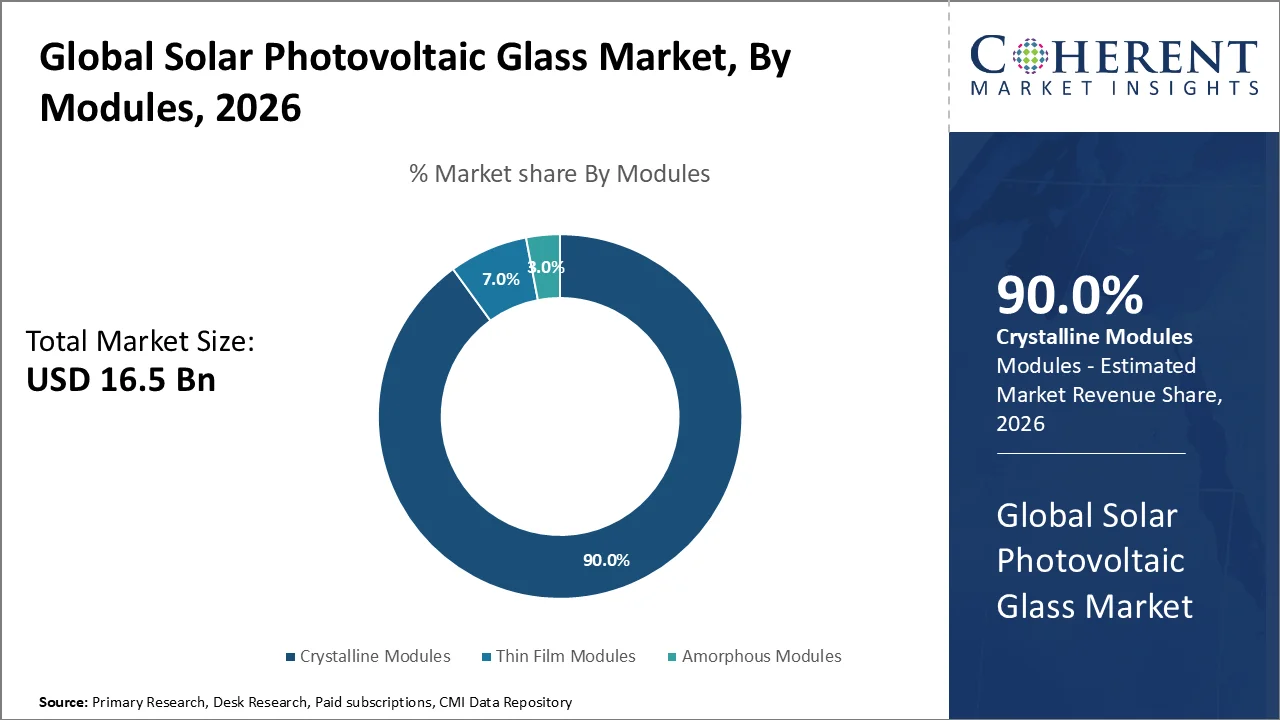
Why are Crystalline Modules Acquiring the Largest Share?
On the basis of module, the crystalline modules segment is projected to account for the largest Solar Photovoltaic Glass Market share of 90.0% in 2026. The segment’s growth is owing to the overwhelming adoption of crystalline-silicon PV technology, established manufacturing infrastructure, improving module efficiencies, and rapid commercialization of advanced n-type and TOPCon cell architectures.
According to the IEA Photovoltaic Power Systems Programme (IEA-PVPS), Trends in Photovoltaic Applications 2025 Fact Sheet, published in December 2025, crystalline-silicon technology accounted for approximately 98% of global PV module production.
In June 2026, JinkoSolar introduced its next-generation Tiger Neo 5.0 n-type TOPCon module at SNEC 2026. The new crystalline-silicon module delivers 700 W power output, 25.91% module efficiency, and power density exceeding 259 W/m².
Why is Anti-reflective Coated Glass Acquiring the Largest Share?
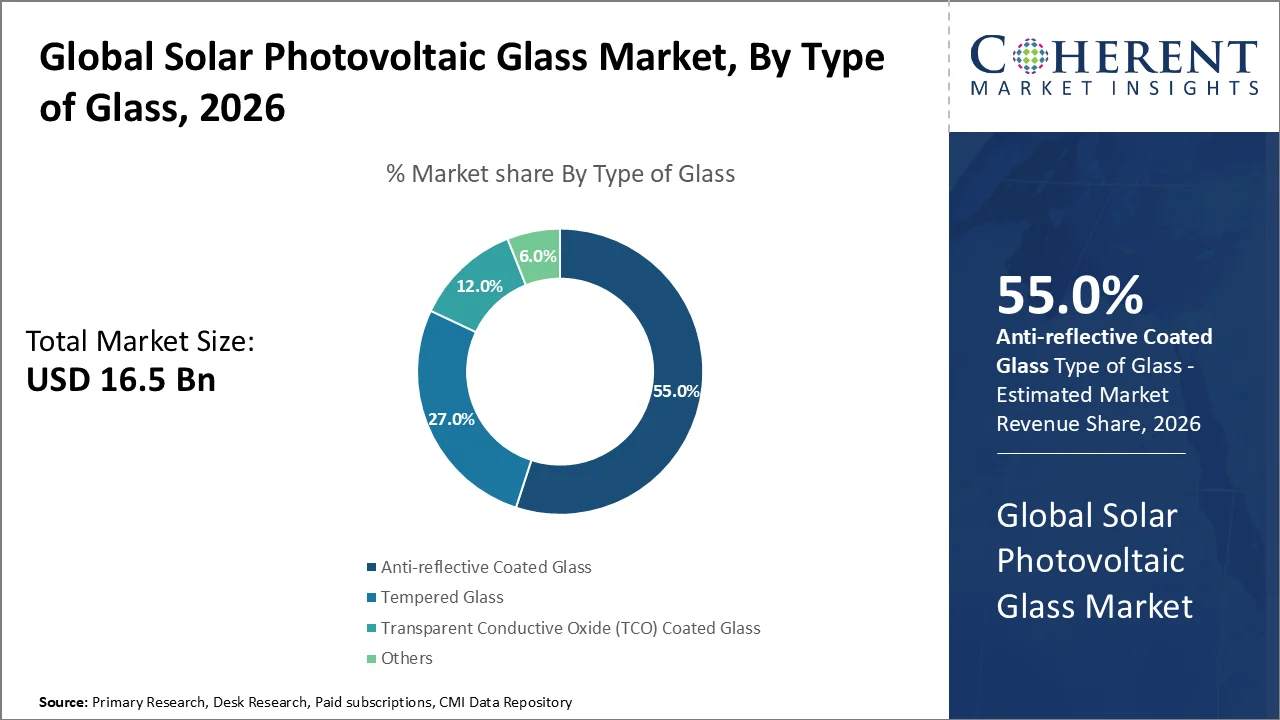
On the basis of type of glass, the anti-reflective coated glass segment is projected to account for the largest market share of 55.0% in 2026. The segment’s growth is owing to its ability to minimize reflection losses, increase solar-light transmission, enhance module power output, and improve energy yield across crystalline and other photovoltaic technologies.
A peer-reviewed study published in The European Physical Journal Plus on September 2, 2025, reported that the cover glasses of about 90% of commercial PV modules feature anti-reflective coatings, demonstrating the widespread integration of AR technology in modern photovoltaic modules.
In January 2026 study published in Optical and Quantum Electronics found that optimized SiO₂ anti-reflective coatings achieved transmittance of up to 95% and reflectance as low as 3%. Solar cells equipped with the coated glass demonstrated a 2% improvement in power-conversion efficiency compared with bare-glass devices.
Why does the Utility Segment Hold the Largest Market Share?
On the basis of application, the utility segment is projected to account for the largest Solar Photovoltaic Glass Market share of 62.0% in 2026. The segment’s dominance is owing to the large number of photovoltaic modules required for utility-scale solar farms, increasing development of multi-gigawatt projects, declining module costs, corporate power purchase agreements, and growing integration of solar-plus-storage systems.
According to the IEA Photovoltaic Power Systems Programme’s 2026 Snapshot of Global PV Markets, centralized PV installations increased from 369 GW in 2024 to 410 GW in 2025, accounting for 59% of all new global PV capacity installed during 2025.
In August 2026, LONGi announced that it will supply its Hi-MO 9 photovoltaic modules for a 71 MWp utility-scale solar portfolio being developed by Innovo Renewables in Italy. The portfolio is expected to generate around 110 GWh of renewable electricity annually, enough to meet the electricity requirements of more than 40,000 Italian households.
Solar Photovoltaic Glass Market Trends
- Increasing adoption of dual glass and glass-glass photovoltaic modules are driving consumption of solar photovoltaic glass. According to the International Technology Roadmap for Photovoltaics (ITRPV) 2026, the industry will shift from traditional glass-backsheet configurations, resulting in a growing importance of glass as a rear-cover material. This is backed up by bifacial and high efficiency module designs that require durable and highly transparent front and rear glass.
- The industry is moving toward thinner and lighter photovoltaic glass, helping manufacturers lower module weight, raw-material consumption, transportation costs, and embodied carbon. The ITRPV 2026 roadmap shows continued progress in the industry for thinner glass configurations as module manufacturers work to optimize material use with the confidence of mechanical strength and reliability.
- Improved optical performance of next-generation modules with growing use of advanced anti-reflective and surface textured photovoltaic glass. Fraunhofer ISE unveiled a tandem photovoltaic module with 34.2% efficiency in February 2026. Anti-reflection structures were nanoimprinted on the glass surface to reduce the reflection losses. This highlights the increasing importance of engineered photovoltaic glass for high efficiency module architectures.
Regional Insights
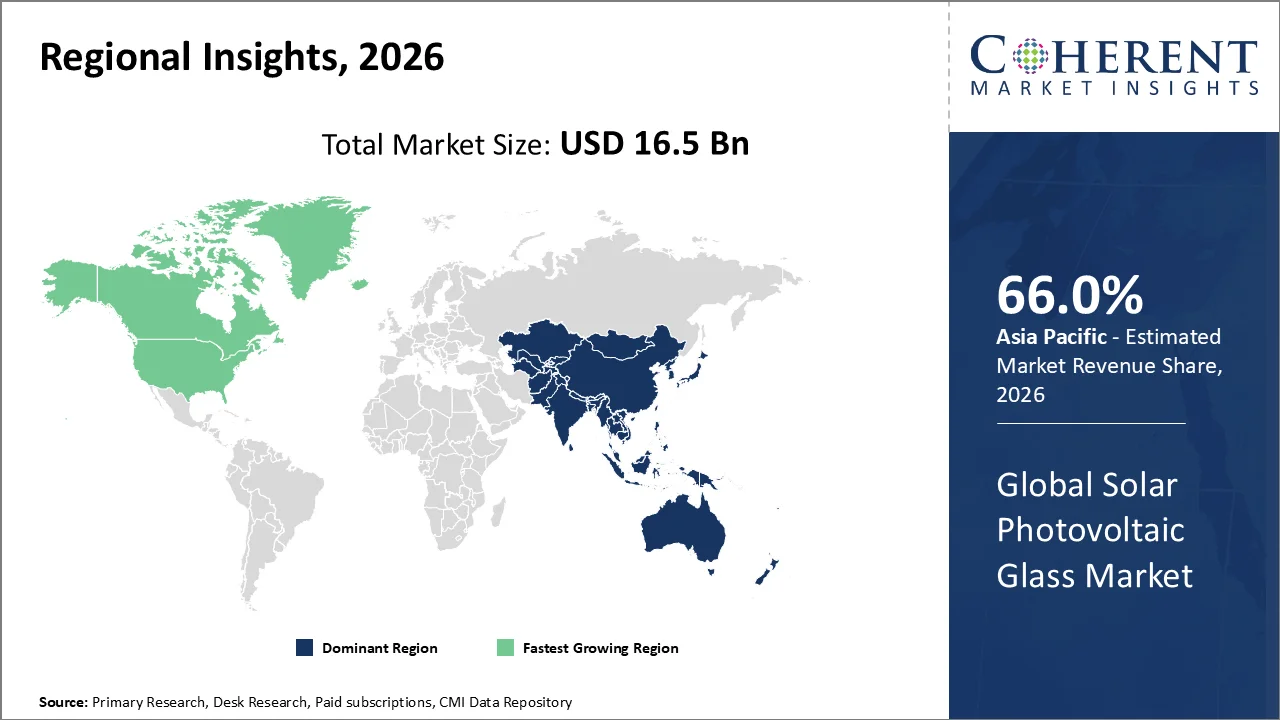
Asia Pacific Dominates Owing to Large-Scale Solar Deployment and Strong PV Manufacturing Base
The Asia Pacific region is estimated to account for the largest Solar Photovoltaic Glass Market share of approximately 66.0% in 2026. The region’s dominance is owing to massive solar capacity additions, a well-established photovoltaic manufacturing ecosystem, expanding utility-scale solar projects, and increasing deployment of high-efficiency and dual-glass modules across China, India, Japan, Australia, and Southeast Asia.
India is also strengthening regional demand. According to the Ministry of New and Renewable Energy (MNRE), India had 164.59 GW of cumulative solar power capacity as of July 31, 2026, including 122.57 GW of ground-mounted solar capacity and 30.74 GW of grid-connected rooftop solar.
North America Solar Photovoltaic Glass Market Trends
North America is expected to be one of the fastest-growing regions in the Solar Photovoltaic Glass Market over the forecast period. The regional growth is owing to accelerating utility-scale solar installations, expansion of domestic photovoltaic manufacturing, increasing solar-plus-storage projects, and demand for higher-efficiency crystalline and bifacial modules across the U.S., Canada, and Mexico.
According to the U.S. Energy Information Administration (EIA), on February 20, 2026, U.S. developers plan to add 43.4 GW of new utility-scale solar capacity during 2026, representing a 60% increase compared with the 27.2 GW added in 2025. Solar is projected to account for 51% of all new U.S. utility-scale generating capacity additions in 2026.
In August 2026, U.S.-based SOLARCYCLE reported progress in commercializing recycled photovoltaic glass and operates solar-module recycling capabilities across five sites in the U.S.
Domestic Solar Manufacturing Expansion is Accelerating the Solar Photovoltaic Glass Market in the United States
The U.S. Solar Photovoltaic Glass Market is witnessing strong growth owing to the expansion of domestic solar manufacturing, localization of photovoltaic supply chains, and increasing production of high-efficiency crystalline and heterojunction modules. The development of integrated manufacturing facilities is increasing the requirement for specialized solar glass, including high-transmission, tempered, patterned, and anti-reflective glass used in next-generation photovoltaic modules.
The EIA also stated in January 2026 that almost 70 GW of new solar generating capacity is scheduled to come online in the U.S. during 2026 and 2027, representing approximately a 49% increase in operating solar capacity compared with the end of 2025.
In June 2026, MSolar Manufacturing announced a USD 23.8 million investment to establish a vertically integrated solar manufacturing facility in Shenandoah County, Virginia. The 56,000-square-foot facility will manufacture solar glass, silicon cells, heterojunction (HJT) cells, and completed solar modules, directly strengthening domestic photovoltaic glass demand.
China Solar Photovoltaic Glass Market Trends
China continues to represent a major production and consumption center for the Solar Photovoltaic Glass Market owing to its large photovoltaic manufacturing ecosystem, extensive solar glass production capacity, established raw-material supply chain, and strong presence of vertically integrated PV manufacturers. In July 2026, Xinyi Solar reported that its operational solar-glass melting capacity reached 22,600 tonnes per day as of June 30, 2026.
Who are the Major Companies in Solar Photovoltaic Glass Industry
Some of the major key players in Solar Photovoltaic Glass Market are AGC Solar, Nippon Sheet Glass Co., Ltd., Taiwan Glass Ind. Corp., Xinyi Solar Holdings Ltd., Sisecam Flat Glass, Guardian Glass, Saint-Gobain Solar, Borosil Glass Works Ltd., Flat Glass Co., Ltd., Interfloat Corporation, Guangdong Golden Glass Technologies, Hecker Glastechnik GmbH & Co. KG, F solar GmbH, Emmvee Toughened Glass Private Limited, and Euroglas.
Key News
- In April 2026, NSG Group announced the successful demonstration of manufacturing float glass using cover glass recovered from end-of-life photovoltaic modules. The trial was conducted at NSG’s Chiba Plant using PV glass recovered through Tokuyama Corporation’s low-temperature thermal decomposition technology.
- In August 2026, Saint-Gobain and AGC announced plans to deploy what they describe as the world’s first large-scale hybrid electric furnace for flat-glass production at Saint-Gobain’s Avilés facility in Spain.
Market Report Scope
Solar Photovoltaic Glass Market Report Coverage
| Report Coverage | Details | ||
|---|---|---|---|
| Base Year: | 2025 | Market Size in 2026: | USD 16.5 Bn |
| Historical Data for: | 2020 To 2024 | Forecast Period: | 2026 To 2033 |
| Forecast Period 2026 to 2033 CAGR: | 28.5% | 2033 Value Projection: | USD 95.6 Bn |
| Geographies covered: |
| ||
| Segments covered: |
| ||
| Companies covered: | AGC Solar, Nippon Sheet Glass Co., Ltd., Taiwan Glass Ind. Corp., Xinyi Solar Holdings Ltd., Sisecam Flat Glass, Guardian Glass, Saint-Gobain Solar, Borosil Glass Works Ltd., Flat Glass Co., Ltd., Interfloat Corporation, Guangdong Golden Glass Technologies, Hecker Glastechnik GmbH & Co. KG, F solar GmbH, Emmvee Toughened Glass Private Limited, and Euroglas. | ||
| Growth Drivers: |
| ||
| Restraints & Challenges: |
| ||
Analyst Opinion
- The Solar Photovoltaic Glass Market is positioned for sustained structural growth as capital deployment into solar PV remains exceptionally strong. According to the International Energy Agency (IEA), investment in utility-scale and rooftop solar was expected to reach approximately USD 450 billion in 2025, making solar the largest single item in global energy investment spending. This investment pipeline is expected to sustain demand for tempered, high-transmission, anti-reflective, and dual-glass products used across new PV installations.
- Improving solar PV economics will remain an important underlying catalyst for photovoltaic glass consumption. According to IRENA’s Renewable Power Generation Costs in 2025 report, published July 2, 2026, the global levelized cost of electricity from solar PV stood at approximately USD 44/MWh in 2025. Competitive generation costs support continued development of large-scale and distributed PV projects, while increasing competition among module manufacturers is likely to push solar-glass suppliers toward thinner, stronger, higher-transmission, and value-added coated products.
- The market is also becoming geographically broader, which should reduce the photovoltaic glass industry’s dependence on a limited number of installation markets. The IEA’s Global Energy Review 2026 reported that 30 countries installed more than 1 GW of solar PV during 2025, almost twice the number recorded in 2020. This widening geographic adoption is expected to create a broader customer base for solar-glass manufacturers across emerging and developed markets, while supporting localized processing, coating, tempering, and module-glass supply chains.
Speak to the analyst
Want personalized insights?
Take the findings above to one of our principal consultants, or have the report rebuilt around the segments, geographies and competitors you actually track.
Market Segmentation
- By Modules (Revenue, USD Bn, 2026-2033)
- Thin Film Modules
- Crystalline Modules
- Amorphous Modules
- By Type of Glass (Revenue, USD Bn, 2026-2033)
- Anti-reflective Coated Glass
- Transparent Conductive Oxide (TCO) Coated Glass
- Tempered Glass
- Others
- By Application (Revenue, USD Bn, 2026-2033)
- Residential
- Building Panels
- Roof Panels
- Water Heaters
- Cookers
- Battery Chargers
- Others
- Non-residential
- Building Panels
- Roof Panels
- Solar Lasers
- Solar Vehicles
- Space Crafts and Space Stations
- Others
- Utility
- Solar Power Plants
- Residential
- Global Solar Photovoltaic Glass Market , By Region (Revenue, USD Bn, 2026-2033)
- North America
- U.S.
- Canada
- Latin America
- Brazil
- Mexico
- Argentina
- Rest of Latin America
- Europe
- Germany
- U.K.
- France
- Italy
- Spain
- Russia
- Rest of Europe
- Asia Pacific
- China
- India
- Japan
- Australia
- South Korea
- ASEAN
- Rest of Asia Pacific
- Middle East
- GCC
- Israel
- Rest of Middle East
- Africa
- South Africa
- Central Africa
- North Africa
- North America
- Key Players
- AGC Solar
- Nippon Sheet Glass Co., Ltd.
- Taiwan Glass Ind. Corp.
- Xinyi Solar Holdings Ltd.
- Sisecam Flat Glass
- Guardian Glass
- Saint-Gobain Solar
- Borosil Glass Works Ltd.
- Flat Glass Co., Ltd.
- Interfloat Corporation
- Guangdong Golden Glass Technologies
- Hecker Glastechnik GmbH & Co. KG
- F solar GmbH
- Emmvee Toughened Glass Private Limited
- Euroglas
Sources
Primary Research Interviews
- Solar photovoltaic glass manufacturers
- Solar module and cell manufacturers
- Glass coating, tempering, and processing specialists
- Solar project developers and EPC contractors
- Raw material and specialty glass suppliers
- Procurement managers from utility-scale and rooftop solar companies
- Distributors and photovoltaic component suppliers
- Key opinion leaders (KOLs) in solar PV technology and advanced glass materials
Databases
- International Energy Agency – Photovoltaic Power Systems Programme (IEA-PVPS)
- International Renewable Energy Agency (IRENA / IRENASTAT)
- U.S. Energy Information Administration (EIA)
- National Renewable Energy Laboratory (NREL)
- Eurostat
- UN Comtrade Database
- Ministry of New and Renewable Energy (MNRE), India
- National Energy Administration (NEA), China
Magazines
- PV Magazine
- PV Tech
- Solar Power World
- Glass International
- Glass Magazine
- Renewable Energy World
Journals
- Solar Energy Materials and Solar Cells
- Progress in Photovoltaics: Research and Applications
- Solar Energy
- Applied Energy
- Renewable Energy
- Journal of Non-Crystalline Solids
- Materials Science in Semiconductor Processing
Newspapers / Business News Sources
- Reuters
- Financial Times
- The Wall Street Journal
- The Economic Times
- Nikkei Asia
- South China Morning Post
Associations
- International Energy Agency Photovoltaic Power Systems Programme (IEA-PVPS)
- Solar Energy Industries Association (SEIA)
- SolarPower Europe
- Global Solar Council
- Glass for Europe
- National Solar Energy Federation of India (NSEFI)
- China Photovoltaic Industry Association (CPIA)
Public Domain Sources
- Company annual reports, investor presentations, and sustainability reports
- Government renewable energy and solar capacity publications
- Solar PV installation and electricity-generation statistics
- Customs and international trade data for solar glass and PV components
- University and national laboratory research publications
- Patent databases such as WIPO, USPTO, EPO, and Google Patents
- Solar glass manufacturing capacity and plant expansion announcements
- Regulatory, anti-dumping, localization, and renewable energy policy documents
- Technical standards related to photovoltaic modules and solar glass
Proprietary Elements
- CMI Data Analytics Tool, Proprietary CMI Existing Repository of Information for the Last 10 Years
Get access to 250+ pages report
Every segment, forecast, competitor profile and data table behind the analysis above — available for instant download.
- ESOMAR Member
- ISO 9001:2015 Certified
- D-U-N-S Registered
- GDPR & CCPA Compliant
Missing comfort of reading report in your local language? Find your preferred language:
Transform your Strategy with Exclusive Trending Reports
Frequently Asked Questions
The Solar Photovoltaic Glass Market is expected to reach USD 95.6 Billion in 2033, increasing from USD 16.5 Billion in 2026.
The Solar Photovoltaic Glass Market is anticipated to grow at a CAGR of 28.5% between 2026 and 2033.
The crystalline modules segment is estimated to account for the largest share of 98.0% in 2026, supported by widespread adoption of crystalline-silicon technology and high-efficiency n-type and TOPCon architectures.
The anti-reflective coated glass segment is estimated to lead with 55.0% share in 2026 due to its ability to reduce reflection losses, improve light transmission, and enhance photovoltaic module output.
The utility segment is estimated to account for the largest share of 62.0% in 2026, driven by the expansion of utility-scale solar power plants and high-capacity ground-mounted solar projects.
Solar photovoltaic glass is used across residential, non-residential, and utility applications, including building panels, roof panels, solar water heaters, battery chargers, solar vehicles, and solar power plants.
The market is expected to witness strong growth through 2033 owing to expanding solar installations, increasing adoption of glass-glass and bifacial modules, improving PV economics, and growing demand for high-transmission, anti-reflective, lightweight, and advanced solar glass. The widening adoption of solar PV across global markets is also expected to strengthen demand for localized glass processing, coating, and tempering capabilities.