

Gasification Market Size and Forecast — 2026-2033
The global gasification market is estimated to be valued at USD 612.60 Bn in 2026. The market is expected to reach USD 811.60 Bn by 2033, exhibiting a compound annual growth rate (CAGR) of 4.8% from 2026 to 2033.
Key Takeaways of the Gasification Market:
- The coal segment is projected to account for 41.6% of the global gasification market share in 2026.
- The fixed bed gasifiers segment is expected to represent 49.3% of the global gasification market share in 2026.
- The electricity generation segment is anticipated to account for 51.2% of the market share in 2026.
- Asia Pacific is projected to lead the global market with a 37.0% share in 2026, followed by the North America region, which is expected to hold a 25.0% share.
Market Overview:
Gasification is seeing increasing adoption across various end-use industries like chemical, liquid fuels, and power generation. The technology allows for more efficient utilization of lower grade feedstock and reduces dependency on fossil fuels. Rapid urbanization and growing energy demand from the industrial sector especially in Asia Pacific will drive the need for alternative energy sources. Many governments are supporting gasification projects as it helps in reducing emissions. Key players such as General Electric Company are investing heavily in R&D to develop advanced gasification systems that can process wide range of feedstock and achieve higher conversion rates.
Feedstock Insights
Feedstock Insights - Abundant supply and energy density drive coal's dominance
In terms of feedstock, the coal segment is expected to contribute 41.6% share of the market in 2026, owing to its abundant worldwide supply and high energy density. Coal has been used widely for power generation and in industries for decades due to availability in large reserves across major economies like China, the U.S., India, and Australia. The proven coal reserves can last for over 100 years based on current production levels. Each ton of coal also produces significantly more energy than an equivalent amount of other feedstock.
Technology Insights
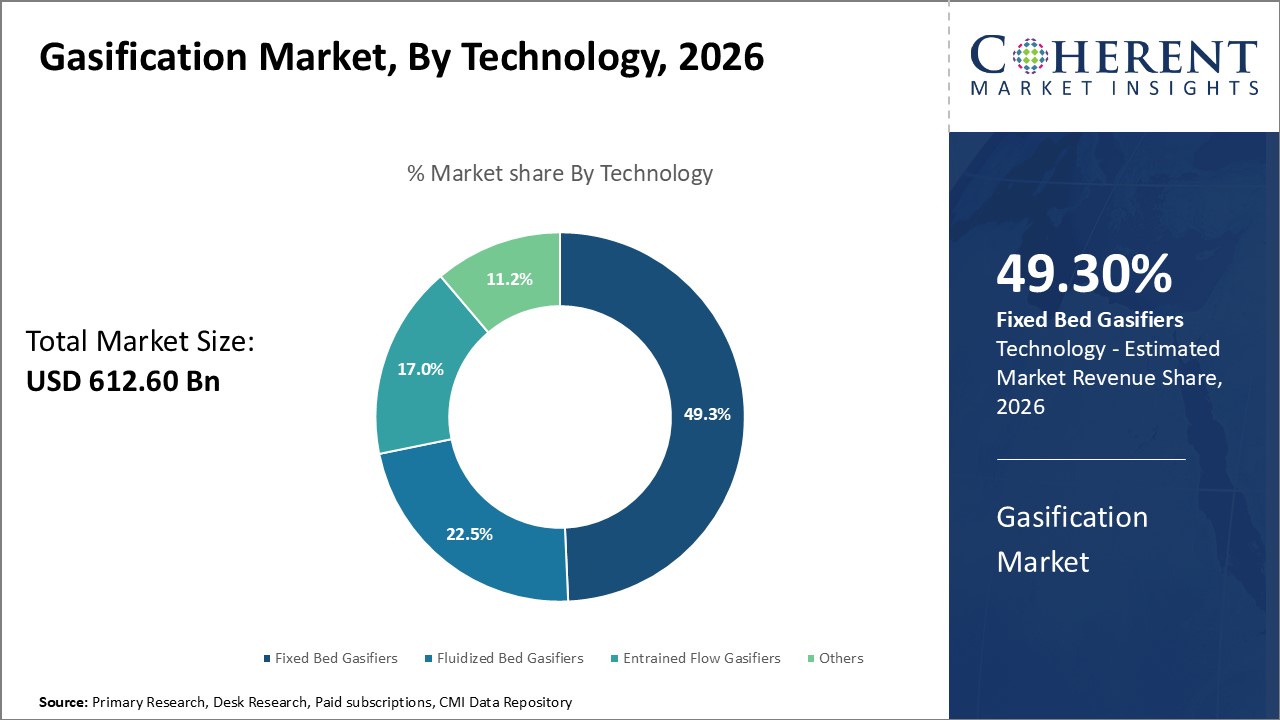
Technology Insights - Economies of scale drive fixed bed gasifiers' leadership
In terms of technology, the fixed bed gasifiers segment is expected to contribute 49.3% share of the market in 2026, owing to economies of scale. Fixed bed gasifiers are well suited for large-scale centralized gasification of coal and biomass. They have relatively simple design with lesser moving parts compared to other technologies. Plants based on fixed bed gasifiers offer operational flexibility to handle variations in feedstock quality and heating value. Over the decades, continuous technological improvements have enhanced their efficiency, syngas output, and reduced tar/ash formation.
Distribution Channel Insights
Distribution Channel Insights - Flexible generation drives the importance of the electricity segment
In terms of distribution channel, the electricity generation segment is expected to contribute 51.2% share of the market in 2026, owing to its flexible nature of power generation from syngas. Gasification followed by power generation is an excellent option for baseload electricity supply from coal. The syngas derived can be utilized for both combined cycle as well as simpler open cycle power production. Integrated gasification combined cycle (IGCC) power plants offer higher efficiencies than conventional pulverized coal plants. They also produce lower carbon emissions by allowing use of carbon capture technology more easily.
Regional Insights
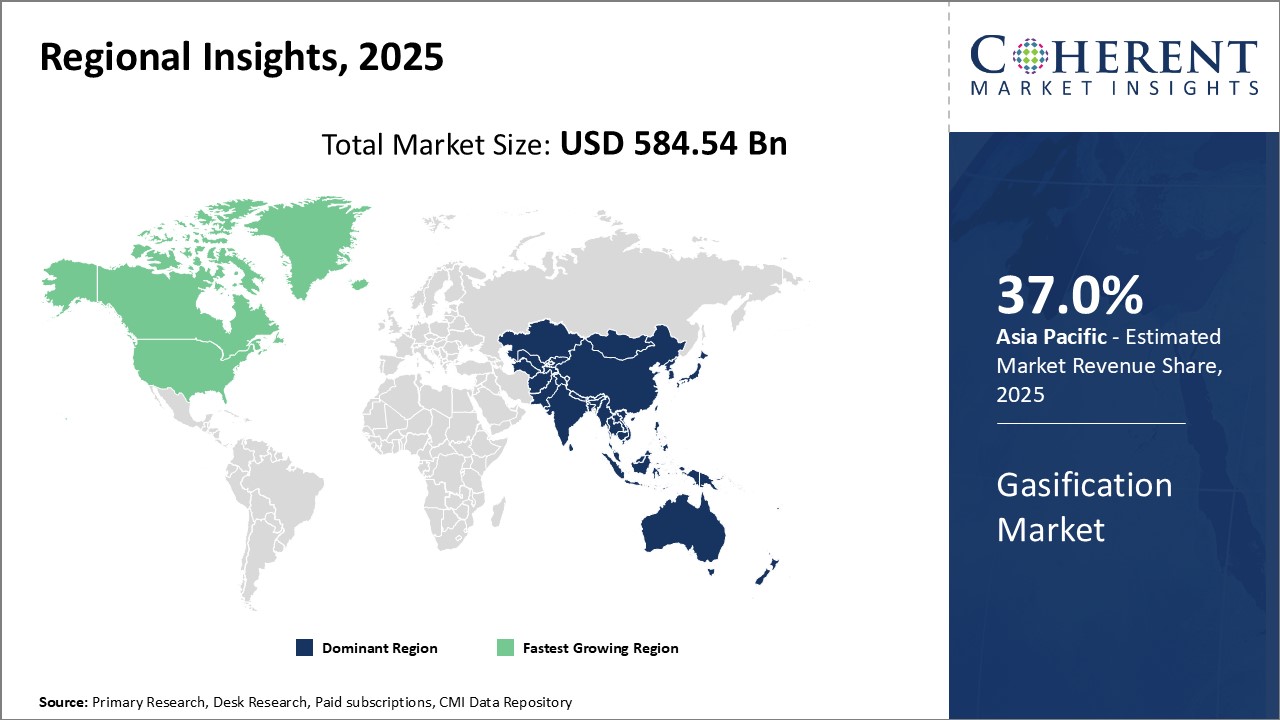
Asia Pacific Gasification Market Trends
The Asia Pacific region is expected to lead the market in 2026, accounting 37.0% of the market share. This dominance is driven by the significant presence of advanced gasification technology providers and project developers within the region. Countries like China have supported the adoption of gasification projects through incentives such as tax credits and subsidies. Additionally, government initiatives such as Action Plan for Promoting Clean and Efficient Use of Coal promoting clean coal usage and carbon capture technologies have further strengthened the market in this region.
North America Gasification Market Trends
North America is projected to hold a 25% market share in 2026 and is expected to show the fastest growth in the global gasification market. Meanwhile, many countries in North America are prioritizing the development of domestic energy resources to reduce reliance on fossil fuel imports. Nations such as the U.S. and China are advancing clean coal initiatives by leveraging integrated gasification combined cycle (IGCC) systems and carbon capture technologies.
Gasification Market Outlook for Key Countries
U.S. Gasification Market Trends
The U.S. gasification market is driven by significant investments in clean energy technologies, with a focus on reducing carbon emissions. In 2023, the U.S. government announced initiatives to enhance carbon capture and storage (CCS) technologies, which are crucial for gasification processes. This regulatory support is expected to boost the market growth.
China Gasification Market Trends
China is a leader in gasification technology, primarily due to its vast coal resources. The government has been promoting gasification as part of its strategy to reduce air pollution and transition to cleaner energy sources. In 2023, China launched several large-scale gasification projects such as Shenhua Ningxia Coal Industry Group Gasification Project aimed at converting coal to syngas, reflecting its commitment to sustainable energy.
Germany Gasification Market Trends
Germany gasification market is characterized by a strong emphasis on biomass and waste-to-energy technologies. The government has implemented policies to support renewable energy sources, including gasification. In 2023, Germany announced funding for innovative gasification projects that convert organic waste into energy, aligning with its environmental goals.
India Gasification Market Trends
India is increasingly embracing gasification technologies to meet its growing energy demands and decrease dependency on fossil fuels. To support this shift, the government has introduced initiatives like the National Biomass Mission – SAMARTH (Sustainable Agrarian Mission on Energy and Rural Technology), which focuses on promoting biomass gasification, especially in rural regions. In 2023, the country launched a dedicated biomass gasification program aimed at improving energy accessibility and fostering sustainability across underserved areas.
Japan Gasification Market Trends
Japan is focusing on gasification as part of its energy diversification strategy, especially following the Fukushima disaster. The country is investing in advanced gasification technologies to convert waste into energy. In 2023, Japan's Ministry of the Environment announced new funding for gasification projects that utilize municipal solid waste, promoting a circular economy.
Market Players, Key Development, and Competitive Intelligence
Key Developments:
- In December 2023, Air Liquide announced plans to construct, own, and operate a global carbon capture facility in Rotterdam, the Netherlands, utilizing its proprietary Cryocap technology. The new unit will be integrated into Air Liquide's hydrogen production plant located in the port of Rotterdam and linked to Porthos, one of Europe's largest carbon capture and storage infrastructures. This initiative aims to significantly reduce CO₂ emissions in the industrial area.
- In October 2023, Air Liquide revealed an investment of over USD 149.8 million to establish a new low-carbon industrial gas platform in Bécancour, Québec, Canada. This development will enhance the delivery of hydrogen, oxygen, nitrogen, and argon. The infrastructure will include an additional air separation unit, renewable oxygen and nitrogen production capabilities, and liquid storage facilities, complementing the existing 20 MW PEM electrolyser. The platform will also connect to the local pipeline network, further expanding Air Liquide's operations in low-carbon solutions.
- In January 2022, Indonesian President, Mr. Joko Widodo, inaugurated the construction of a US$ 2.3 billion coal gasification facility to reduce the nation's dependency on liquefied petroleum gas (LPG) imports and maximize its coal reserves. This plant, led by state-owned coal mining company, Bukit Asam, in collaboration with Air Products and Chemicals, Inc., a U.S.-based firm, will process 6 million tons of low-grade coal annually to produce 1.4 million tons of dimethyl ether (DME). The project is expected to cut Indonesia's liquefied natural gas imports by 1 million tons per year.
- In August 2021, Mitsubishi Power joined a collaborative study aimed at developing a commercial-scale supply chain for sustainable aviation fuel (SAF). This SAF will be produced using advanced wood biomass gasification, integrated with Fischer-Tropsch (FT) synthesis technology. Mitsubishi Power, a subsidiary of Mitsubishi Heavy Industries, contributes its expertise in energy solutions and innovative technologies to advance sustainable fuel production.
Top Strategies Followed by Global Gasification Market Players
- Established players in this market focus heavily on research and development to deliver innovative product solutions.
- For example, leading companies like GE, Shell, and Siemens invest over 5% of their annual revenues in R&D activities focused on process optimization, carbon capture, and syngas applications. They also form strategic partnerships with technology providers and end-use industries to pilot emerging gasification technologies. This allows them to commercialize new systems faster and strengthen their market position.
- Mid-level players in the industry aim to provide cost-competitive solutions without compromising on quality. They collaborate with research organizations and local component manufacturers to locally source raw materials and engineering expertise. This enables them to build affordable small-scale gasification plants tailored for distributed applications. Some players also partner with startup ventures engaged in developing gas cleaning and gas upgrading technologies. Such collaborations help bolster their technological capabilities.
- Small gasification companies focus on niche markets and adopt a specialized local approach. They leverage modern digital tools for remote monitoring and predictive maintenance of gasification units. Some partner with waste management firms and energy service companies to set up gasification-based waste-to-energy facilities near consumer cities. This helps gain faster market access and ensures localized value from syngas.
Emerging Startups - Global Gasification Industry Ecosystem
- Several startups are pioneering innovative gasification technologies to make the process more efficient and environment-friendly. Companies like Clean Energy Systems and Primenergy are developing smart sensing and AI-based solutions for advanced process control and syngas composition monitoring. This could optimize gasification operations and reduce emissions.
- Startups like Anthropic and Circulor focus on using Blockchain solutions to create a digital record of syngas carbon credits. This allows global power producers to offset their carbon footprint by buying verifiable emission reduction credits from gasification plants. Such initiatives are helping gasification gain ground in sustainable energy markets.
- Other emerging companies’ partner with research universities on projects involving plasma gasification. This novel process partially ionizes syngas intermediates using very high temperatures for complete waste treatment.
- Current Industry Events of 2026
- Market Size Estimation
- Regional Breakdown
- Competitive Landscape
- Customer Intelligence
- Segmental Analysis
- Pricing Analysis
- Key Market Drivers, Challenges & Future Trends
- Customized Insights Section
Market Report Scope
Gasification Market Report Coverage
| Report Coverage | Details | ||
|---|---|---|---|
| Base Year: | 2025 | Market Size in 2026: | USD 612.60 Bn |
| Historical Data for: | 2020 To 2024 | Forecast Period: | 2026 To 2033 |
| Forecast Period 2026 to 2033 CAGR: | 4.8% | 2033 Value Projection: | USD 811.60 Bn |
| Geographies covered: |
| ||
| Segments covered: |
| ||
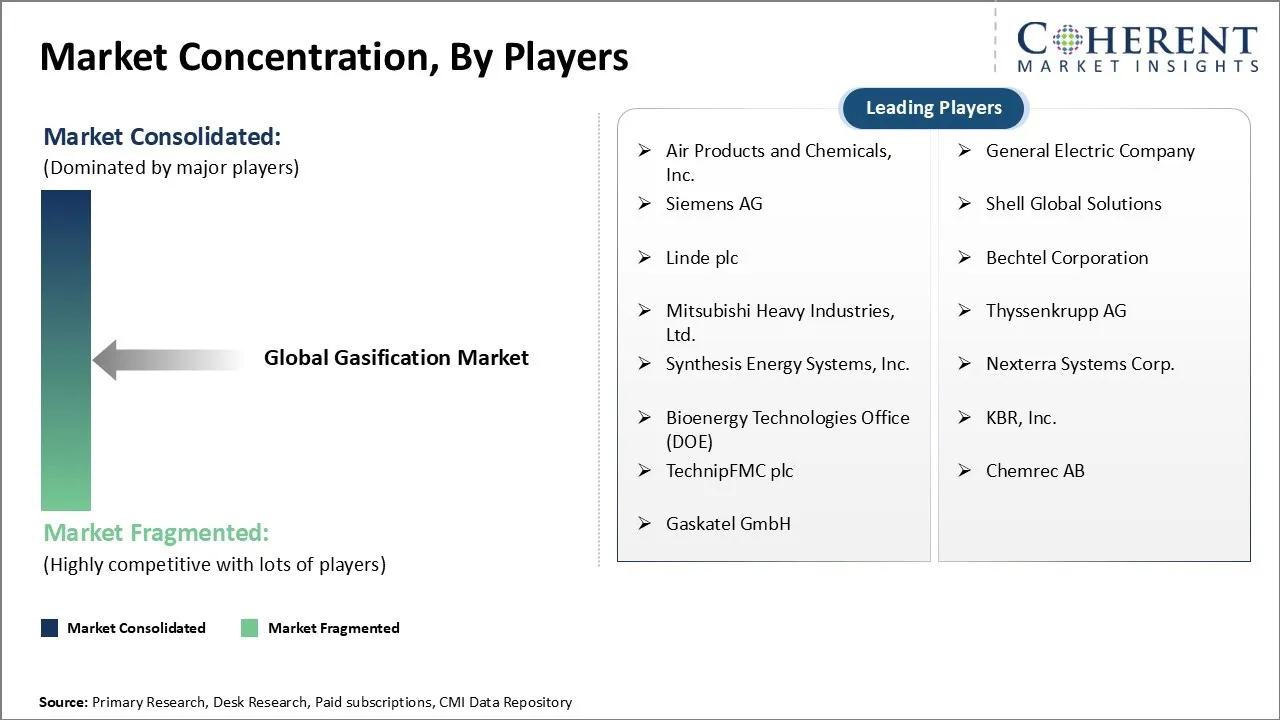
| Companies covered: | Air Products and Chemicals, Inc., General Electric Company, Siemens AG, Shell Global Solutions, Linde plc, Bechtel Corporation, Mitsubishi Heavy Industries, Ltd., Thyssenkrupp AG, Synthesis Energy Systems, Inc., Nexterra Systems Corp., Bioenergy Technologies Office (DOE), KBR, Inc., TechnipFMC plc, Chemrec AB, and Gaskatel GmbH | ||
| Growth Drivers: |
| ||
| Restraints & Challenges: |
| ||
Market Dynamics
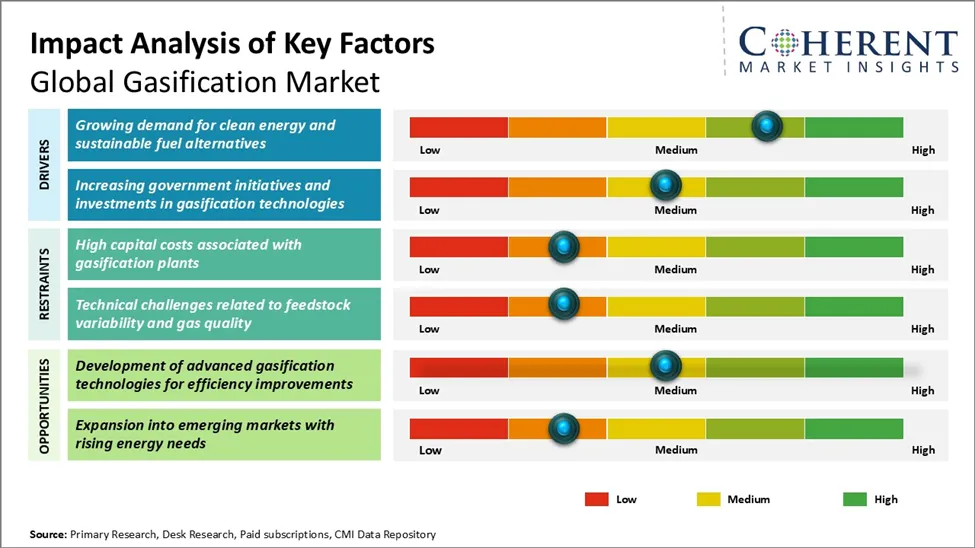
Growing demand for clean energy and sustainable fuel alternatives
The worldwide energy demand is growing exponentially with industrialization and urbanization happening at a rapid pace in developing countries. At the same time, there is a growing awareness about the negative impacts of fossil fuel usage such as greenhouse gas emissions, air pollution, and global warming. Countries are striving to reduce their dependence on fossil fuels and adopt clean technologies to produce energy from renewable and sustainable sources. Gasification is emerging as one of the promising technologies that can help address these dual challenges of meeting the rising energy demand while transitioning to a low carbon future.
Market Challenge - High capital costs associated with gasification plants
One of the major challenges faced by the market is the high capital costs associated with setting up gasification plants. Gasification plants require substantial investment for plant infrastructure such as air separation units, gas clean up units, gas turbine generators, and others. The capital costs per Megawatt of power generation through integrated gasification combined cycle technology is estimated to be around US$ 4,500/kW, which is significantly higher than the US$ 1,500-2,000/kW for a pulverized coal plant. Additionally, the costs of equipment such as gasifiers and syngas coolers add to the overall capital expenditure. The payback period for these investments tend to be long.
Market Opportunity - Development of advanced gasification technologies for efficiency improvements
One of the key opportunities for the market is the development of advanced gasification technologies that can help improve the efficiency and lower the costs of gasification processes. Significant research is underway to develop innovative gasifier designs that can handle different feedstocks and optimize the syngas output. Technologies such as entrained flow gasifiers, transport reactors, and spouted bed gasifiers offer greater throughput and efficiency. Similarly, the development of advanced syngas cleanup systems that can remove impurities like sulfur at lower costs can boost the economic viability of gasification projects. Gas turbine and engine manufacturers are also working on syngas-compatible equipment with higher thermal efficiencies.
Analyst Opinion (Expert Opinion)
- The global gasification market is estimated to grow at a steady pace driven by the increasing demand for cleaner sources of energy and growing emphasis on environment-friendly technologies. The market is driven by the ability of gasification to convert coal and biomass into syngas with lower emissions as compared to traditional combustion. Governments across regions are supporting gasification to reduce dependence on fossil fuels and lower carbon footprint. Asia Pacific currently dominates the market owing to the presence of major coal reserves and growing energy needs in China and India.
- These countries are expected to invest heavily in installing large-scale integrated gasification combined cycle (IGCC) plants in the coming years. North America is also expected to emerge as a major market for gasification technology supported by the region's stringent environmental norms. However, high capital costs involved in setting up gasification plants poses a challenge for widespread adoption. The availability of cheaper alternatives also restrains the market to some extent. But factors like declining renewable costs and government focus on cleaner energy offers opportunities for operators to provide competitive syngas and power solutions.
Speak to the analyst
Want personalized insights?
Take the findings above to one of our principal consultants, or have the report rebuilt around the segments, geographies and competitors you actually track.
Market Segmentation
- Feedstock Insights (Revenue, USD Bn, 2021 - 2033)
- Coal
- Biomass
- Natural Gas
- Waste
- Others
- Technology Insights (Revenue, USD Bn, 2021 - 2033)
- Fixed Bed Gasifiers
- Fluidized Bed Gasifiers
- Entrained Flow Gasifiers
- Others
- Distribution Channel Insights (Revenue, USD Bn, 2021 - 2033)
- Electricity Generation
- Chemical Production
- Fuel Production
- Others
- Regional Insights (Revenue, USD Bn, 2021 - 2033)
- North America
- U.S.
- Canada
- Latin America
- Brazil
- Argentina
- Mexico
- Rest of Latin America
- Europe
- Germany
- U.K.
- Spain
- France
- Italy
- Russia
- Rest of Europe
- Asia Pacific
- China
- India
- Japan
- Australia
- South Korea
- ASEAN
- Rest of Asia Pacific
- Middle East
- GCC Countries
- Israel
- Rest of Middle East
- Africa
- South Africa
- North Africa
- Central Africa
- North America
- Key Players Insights
- Air Products and Chemicals, Inc.
- General Electric Company
- Siemens AG
- Shell Global Solutions
- Linde plc
- Bechtel Corporation
- Mitsubishi Heavy Industries, Ltd.
- Thyssenkrupp AG
- Synthesis Energy Systems, Inc.
- Nexterra Systems Corp.
- Bioenergy Technologies Office (DOE)
- KBR, Inc.
- TechnipFMC plc
- Chemrec AB
- Gaskatel GmbH
Get access to 250+ pages report
Every segment, forecast, competitor profile and data table behind the analysis above — available for instant download.
- ESOMAR Member
- ISO 9001:2015 Certified
- D-U-N-S Registered
- GDPR & CCPA Compliant
Missing comfort of reading report in your local language? Find your preferred language:
Transform your Strategy with Exclusive Trending Reports
Frequently Asked Questions
The Gasification Market is estimated to be valued at USD 612.60 Bn in 2026, and is expected to reach USD 811.60 Bn by 2033.
The CAGR of the Gasification Market is projected to be 4.8% from 2026 to 2033.
Growing demand for clean energy and sustainable fuel alternatives and increasing government initiatives and investments in gasification technologies are the major factors driving the growth of the global gasification market.
High capital costs associated with gasification plants and technical challenges related to feedstock variability and gas quality are the major factors hampering the growth of the global gasification market.
In terms of feedstock, the coal segment is estimated to dominate the market revenue share in 2026.
Air Products and Chemicals, Inc., General Electric Company, Siemens AG, Shell Global Solutions, Linde plc, Bechtel Corporation, Mitsubishi Heavy Industries, Ltd., Thyssenkrupp AG, Synthesis Energy Systems, Inc., Nexterra Systems Corp., Bioenergy Technologies Office (DOE), KBR, Inc., TechnipFMC plc, Chemrec AB, and Gaskatel GmbH are the major players.
Asia Pacific is expected to lead the global gasification market in 2026.