

Global Advanced Energy Storage Market Size and Forecast – 2026 To 2033
The global advanced energy storage market is estimated to be valued at USD 26.39 Bn in 2026 and is expected to reach USD 51.42 Bn in 2033, exhibiting a compound annual growth rate (CAGR) of 10% from 2026 to 2033. The rapid scale-up of renewable energy integration, combined with accelerating electrification trends and increasing grid instability, is driving stronger demand for advanced energy storage solutions.
Rising renewable energy adoption is a major global growth driver, with energy storage demand closely linked to the need for managing power intermittency, making renewable integration a core factor supporting market expansion. For example, this rapid expansion is structurally increasing grid volatility, as solar and wind—expected to represent ~80% of new renewable capacity growth—are inherently variable and require storage for load balancing and peak shifting.
(Source: iea.org)
Key Takeaways of the Global Advanced Energy Storage Market
- Transportation segment is projected to hold 61.7 % of the advanced energy storage market, primarily driven by the rapid electrification of mobility. Electric vehicles (EVs), including passenger cars, buses, and commercial fleets, account for the largest share of battery demand. Global EV production crossed ~14 million units in 2024, with China alone contributing a dominant share, supported by strong policy incentives, charging infrastructure expansion, and OEM electrification commitments. This has made transportation the primary demand engine for advanced battery systems. (Source: iea.org)
- Lithium-ion batteries dominate the advanced energy storage market with an estimated 41.7% share in 2026, driven by superior energy density, long cycle life, and rapidly falling costs. Pack prices have declined by over 80% since 2013 (BNEF), enabling widespread adoption across EVs, grid storage, and industrial applications. Strong manufacturing scale and supply chain integration continue to reinforce lithium-ion’s cost and performance advantage over alternatives such as lead-acid and flow batteries. (Source: sciencedirect.com)
- Asia Pacific leads the market with a projected share of 35.6 % in 2026. China has the largest battery manufacturing scale in the world and the biggest EV manufacturing base such as BYD company, with other countries such as South Korea and Japan providing high-performance cell technology and system integration. This localized concentration is able to generate strong economies of scale and vertical integration. As an example, gigafactories enjoy the advantage of having local suppliers of cathodes, anodes, electrolytes, and separator materials, reducing the reliance on disaggregated world supply chains. (Source: sciencedirect.com, byd)
- North America is the fastest-growing regional market, accounting for a 23.4 % share in 2026, driven by strong policy support and rapid infrastructure expansion. The U.S. Inflation Reduction Act (IRA) has significantly accelerated domestic battery manufacturing and utility-scale storage deployment, with a strong and growing pipeline of planned and approved projects. Grid modernization efforts, renewable energy integration, and rising EV adoption are collectively driving faster deployment, making North America the region with the highest incremental capacity additions.
- Renewable Energy Integration Alignment: Rapid expansion of solar and wind power is increasing the need for advanced energy storage systems to manage intermittency, stabilize grids, and ensure reliable power supply across utility, commercial, and residential applications.
- Market Expansion Catalysts: Declining battery costs, improvements in lithium-ion and next-generation chemistries, and strong policy support for power grid system modernization and electrification are accelerating large-scale deployment of energy storage systems across transportation and power sectors.
- Profitability Outlook: Profitability is stronger for companies focused on utility-scale and EV-linked storage solutions, driven by high deployment volumes, recurring grid services revenue (like peak shaving and frequency regulation), and growing demand for long-duration and high-efficiency storage systems.
Segmental Insights
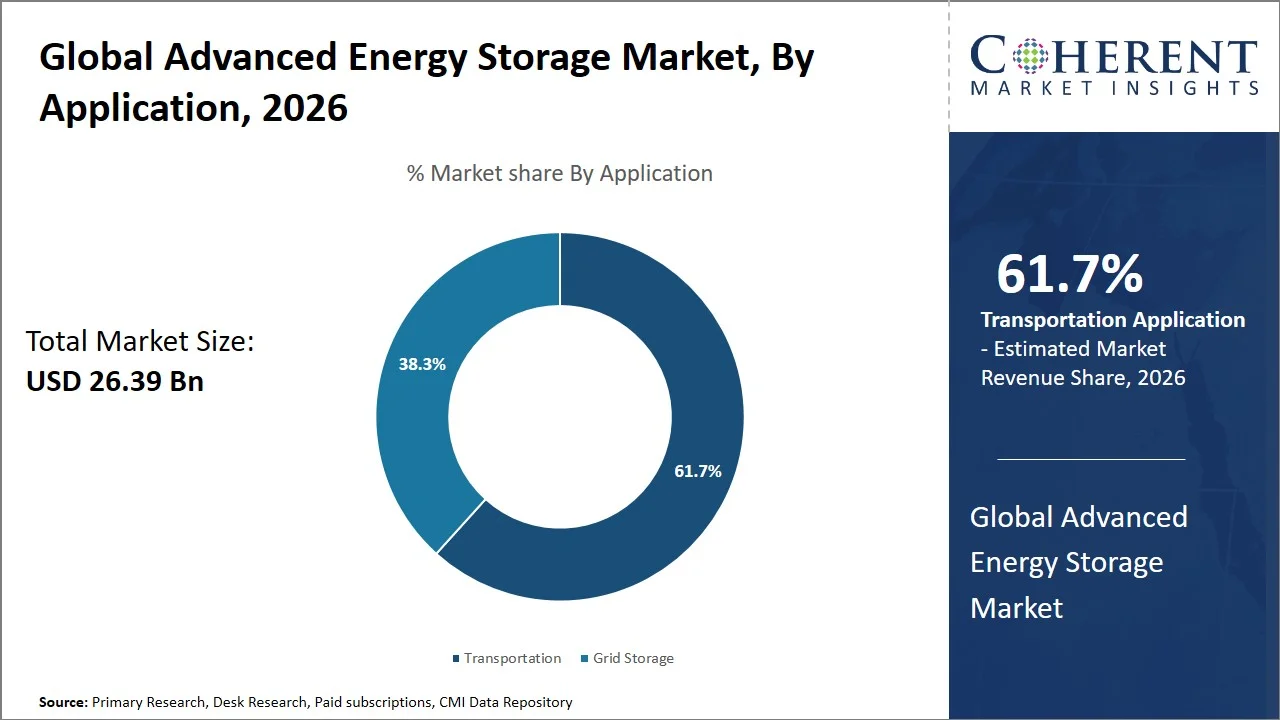
Why Does the Transportation Segment Dominate the Global Advanced Energy Storage Market?
The transportation segment is expected to contribute 61.7% of the advanced energy storage market share in 2026. Applications of energy storage systems in transportation provides a decrease in the use of fossil fuels, reduces greenhouse emissions, and enhances energy efficiency. Energy storage plays a critical role in transportation by enabling efficient power delivery for electric and hybrid vehicles as well as other low-emission mobility systems. Rising adoption of EVs and hybrid technologies is accelerating demand for higher-performance storage solutions, driving continuous innovation in battery efficiency, charging speed, and energy density.
In June 2025, Tesla entered into a USD 556.8 million (4 billion yuan) contract with China Kangfu International Leasing and Shanghai municipal government to build its first large-scale grid storage station in China. The plant will be powered by Megapack batteries produced by Tesla, which will be purchased at the newly opened factory in Shanghai, Megapack. This is further boosting the advanced energy system market share.
(Source: yicaiglobal.com)
- Current Industry Events of 2026
- Market Size Estimation
- Regional Breakdown
- Competitive Landscape
- Customer Intelligence
- Segmental Analysis
- Pricing Analysis
- Key Market Drivers, Challenges & Future Trends
- Customized Insights Section
Why are Lithium-Ion Batteries Technology the Most Preferred Product?
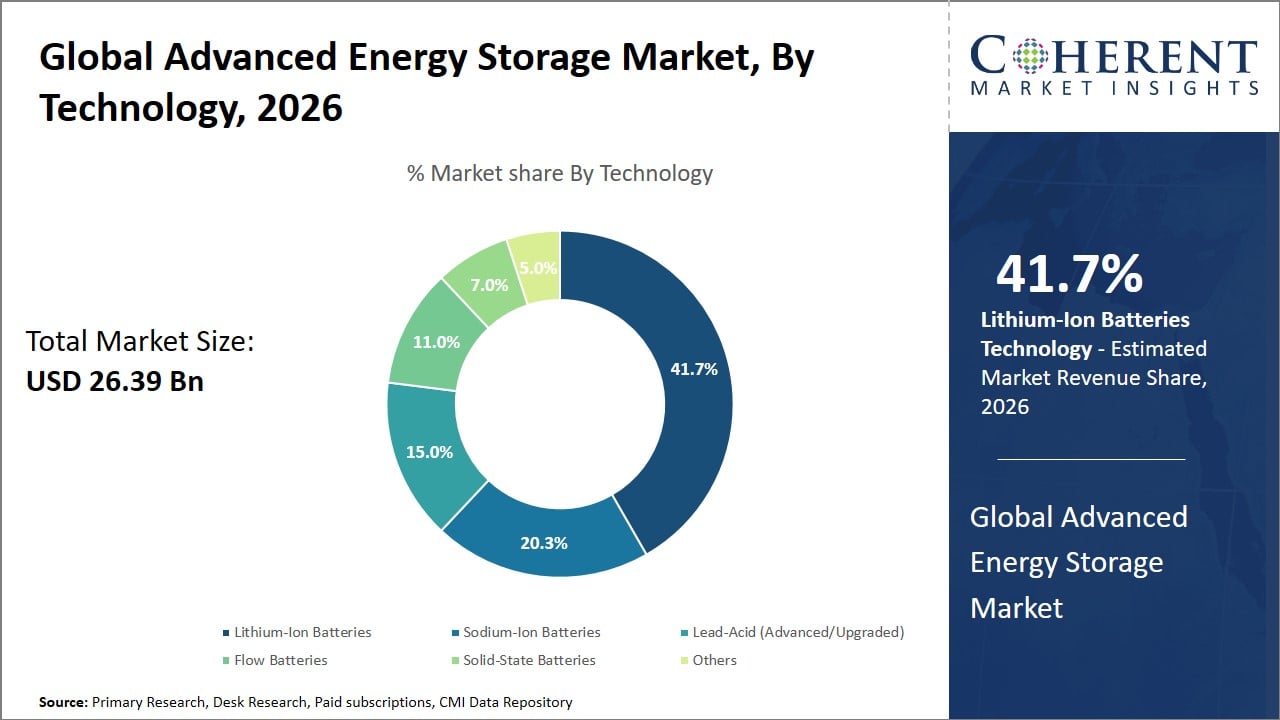
Lithium-ion batteries are now the dominant advanced energy storage technology, due to superior performance across cost, energy density, efficiency, scalability, and deployment speed, reinforced by widespread adoption in electric vehicles and grid-scale storage. By 2026, the Li-ion batteries are expected to capture 41.7% of the advanced energy storage market share in 2026.
Li-ion batteries have undergone one of the most rapid cost reductions in energy technology and are commercially unreachable in large-scale storage. Due to advancements in research and development and economies of scale in production, the cost of lithium-ion battery has dropped by more than USD 140 per kilowatt-hour by 2023; the most rapid cost reduction of any energy technology in history. Compared to lead acid batteries, lithium ion batteries had much higher energy densities, enabling them to be stacked into much lighter and smaller battery packs.
(Source: iea.org)
Currents Events and their Impact
Current Events | Description and its Impact |
Global expansion of grid-scale BESS projects (macro + industry shift) |
|
Government policy and regulatory reforms supporting energy storage (regulatory shift) |
|
(Source: Reuters, pib.gov. in)
Advanced Energy Storage Market Dynamics
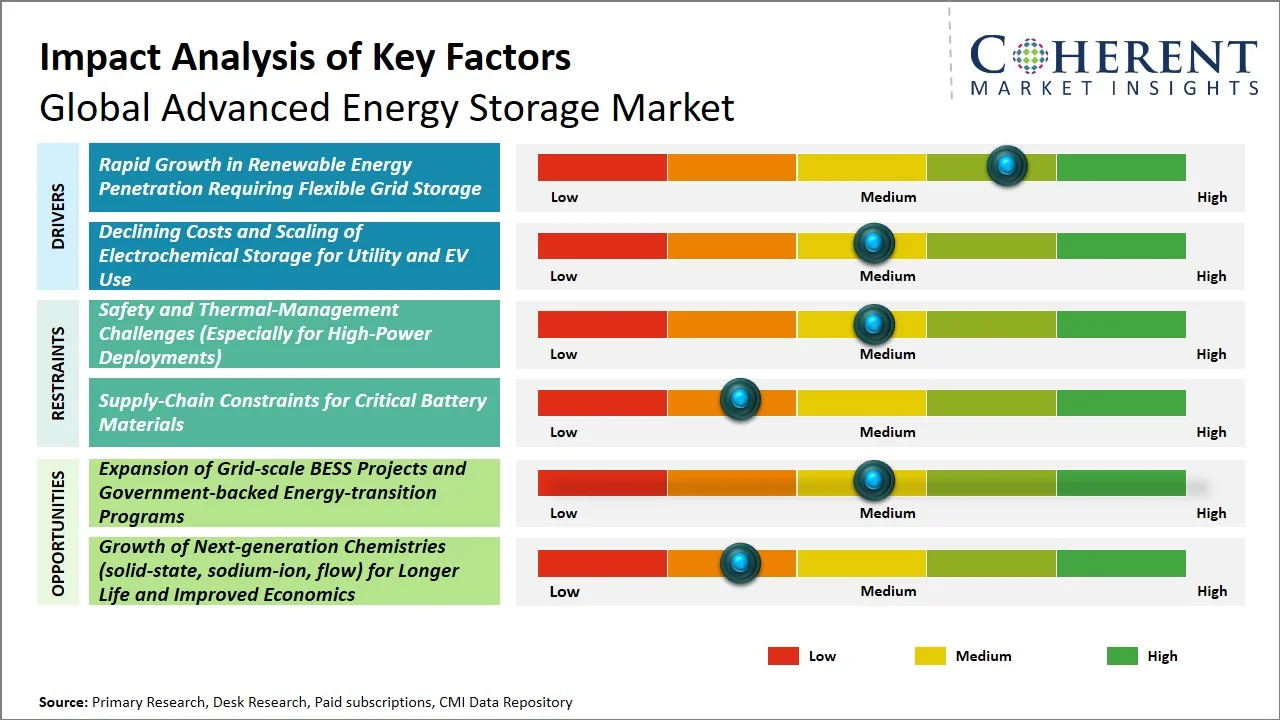
Market Driver
Rapid Growth in Renewable Energy Penetration Requiring Flexible Grid Storage
Solar and wind energy are intermittent, power systems must have fast-response and dispatchable capacity to stabilize the grid (frequency/voltage control) and curtailment, making grid-scale energy storage (BESS in particular) necessary. The IEA reports that energy storage will have to be increased significantly to match the requirements of net-zero; and that the additions of grid-scale battery storage are not yet in line with the Net Zero Scenario, and require more effort.
Battery storage in the power sector is reported by the IEA as the fastest-growing commercially available energy technology in 2023, with deployments increasing more than 42 GW around the world (including many other segments such as utility-scale and behind-the-meter) each year.
Declining costs and scaling of electrochemical storage for utility and EV use
Learning curves, scale of manufacture, and scale of supply-chain build-out make electrochemical storage costs lower. Reduced delivery costs enhance the project economics of both grid BESS and battery requirements associated with EVs/e-mobility-enabling sustained market growth. As an example, IRENA in its discussion of how storage contributes to grid flexibility, in its publication, Renewable Power Generation Costs in 2024, has evidence on deployment/cost trends on the storage landscape. The cost of battery storage decreased by 93 per cent between 2010 and 2024, decreasing to USD 192/kWh (2,571/kWh).
(Source: irena.org)
Emerging Trends
- Increasing Integration of Long-Duration Energy Storage Solutions: Grid operators and utilities are increasingly adopting long-duration energy storage (LDES) technologies such as flow batteries, solid-state batteries, and thermal storage systems to support renewable-heavy grids and manage intermittent solar and wind power more effectively.
- Shift Toward High Energy Density and Fast-Charging Battery Chemistries: The market is moving toward advanced lithium-ion variants (e.g., LFP, NMC 811) and next-generation chemistries like solid-state batteries to achieve higher energy density, faster charging cycles, and improved safety, driven largely by electric vehicle (EV) and portable energy storage demand.
Regional Insights
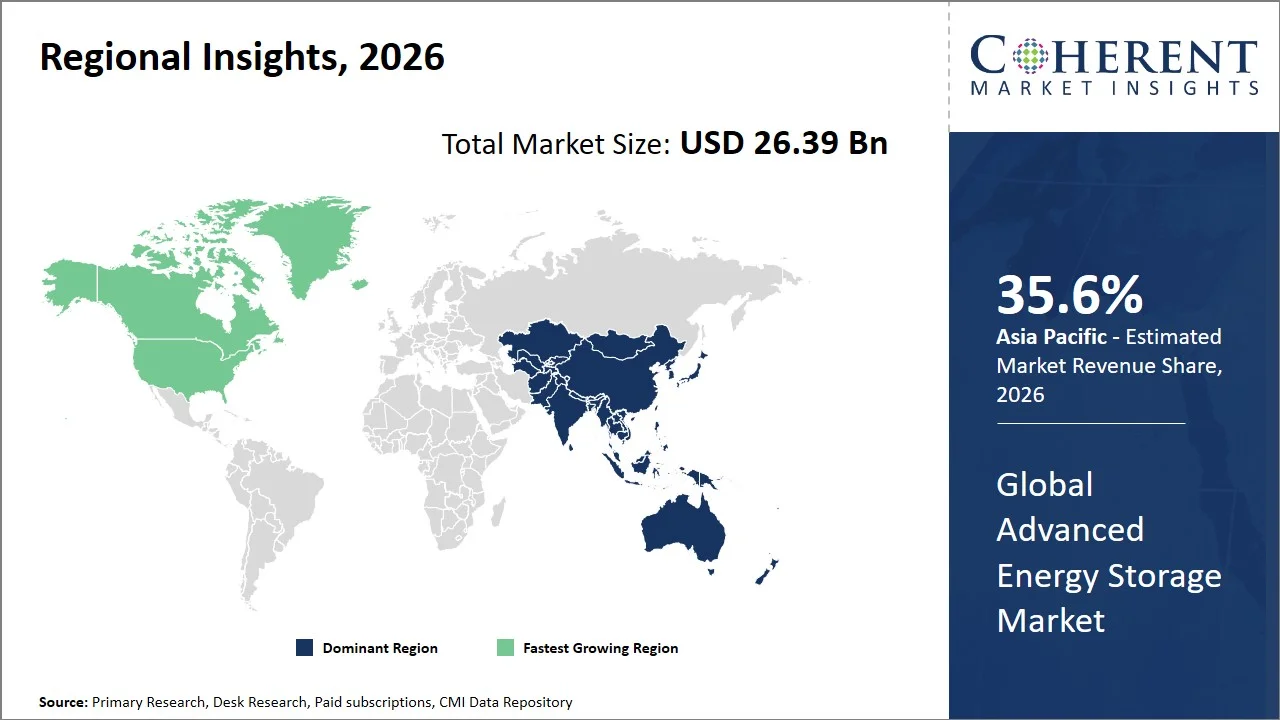
Why is Asia Pacific a Strong Market for Advanced Energy Storage?
Asia Pacific leads the advanced energy storage market, accounting for an estimated 35.6% share in 2026, because of structural demand, policy acceleration, and dominance of the supply chains. The region is undergoing a fast pace of development of renewable energy sources especially solar and wind, which by nature generate variability in power production and require large scale implementation of storage facilities to stabilize the grid, peak production, and frequency regulation.
A number of economies in the Asia Pacific region continue to have grid reliability issues and energy storage becomes an essential infrastructure need, as opposed to a discretionary investment. This trend is further enhanced by the aggressive decarbonization goals and trends towards electrification, making storage systems a critical facilitator of energy transition in the region.
The fact that India is a high-growth energy storage market is directly linked to its national-level clean energy policies. The government of India has established an explicit goal of 500 GW of power capacity of non-fossil fuels by the year 2030, comprising of solar, wind, hydro and nuclear energy. This goal has been repeatedly reiterated throughout policy discussions and industry analysis and recent statistics show that the nation is already above the halfway mark, with non-fossil resources supplying more than 50% of installed capacity.
(Source: economictimes.indiatimes.com)
Why Does North America Advanced Energy Storage Market Exhibit High Growth
North America is emerging as the most rapidly evolving region in the advanced energy storage market. And it has strong momentum due to structural demand, aggressive policy support, and large-scale commercial deployment. It is believed that the region will contribute 23.4% of the market share in 2026, with the U.S. being the undoubted growth engine.
One of the major distinguishing factors of North America is that its market has been propelled by policy especially in the U.S. Federal efforts like Inflation Reduction Act (IRA) have turned the economics of energy storage by providing investment tax credits including standalone storage incentives which have essentially enhanced project returns and provided access to large scale deployments.
(Source: energy.gov)
Global Advanced Energy Storage Market Outlook for Key Countries
Why is China Leading Innovation and Adoption in the Advanced Energy Storage Market?
The China advanced energy storage market is the first to innovate and adopt advanced energy storage because of its unparalleled scale, robust policy implementation, dominance of integrated supply chains and quick commercialization of emerging technologies. The nation has turned into the biggest international battery energy storage systems hub, with a huge proportion of new ones installed in the world.
China also leads in terms of the number of additions made on an annual basis globally. Recent grid-scale market monitoring data show that China has consistently provided a majority portion of world BESS installations often approximately 54% of monthly installations, fueled by massive utilities initiatives and fast renewable incorporation. As an illustration, over 50% of monthly installations worldwide in mid-2025 would be focused in China, continuing to assert its structural control in new capacity additions.
(Source: essnews.com)
Is Japan a Favorable Market for the Advanced Energy Storage Market?
Japan strengthens the region’s position with the help of technological sophistication and high-reliability applications. Advanced battery technologies, smart grid integration, and disaster resilient energy systems have been given attention in the country, especially in the wake of the energy security issue after the Fukushima incident.
The energy storage applications in Japan are focused on residential, commercial and grid-balancing where quality, safety, and life cycle are the key factors, rather than the cost. This has enabled Japan-based companies to come up with high quality, high performance solutions that can be exported to other developed markets, enhancing the technological supremacy of Asia Pacific in the world map.
As an example, the susceptibility of Japan to natural disasters e.g. earthquakes and massive blackouts has strengthened the rationale behind energy storage mechanisms as a key element of electric power resilience. The 2018 Hokkaido blackout showed the extent to which centralized grid failures can affect large areas, prompting the use of more battery energy storage systems that can provide instant backup and peak load control.
(Source: enax jp)
Is India Emerging as a Key Growth Hub for the Advanced Energy Storage Market?
India is emerging as one of the fastest-growing markets in the world, but the development is still at an early, execution-focused stage rather than a mature one. On the deployment side, the pace is picking up rapidly. India has issued 224 GWh of energy storage tenders between 2018 to 2025, with a big increase in 2025 alone, as ESS tendering to 236 GWh (up 1.4 times YoY) and standalone BESS 60 GWh (up 2025) Operational capacity remains low but the pipeline is immense, with 236 Gwh by 2032 and 400+ GWh long-term.
(Source: energy.economictimes.indiatimes.com)
Why Does Germany Top the Europe Advanced Energy Storage Market?
Germany is the European leader in advanced energy storage, due to its combination of high renewable penetration, good retail arbitrage economics, and grid constraint in the structure. Germany boasts one of the highest levels of rooftop solar penetration in Europe. This establishes a direct household and business requirement of batteries to maximize self-consumption. Germany has a dual market, residential, commercial & industrial (C&I), and utility-scale, unlike other countries in the EU, which only considered utility-scale storage, thereby boosting the number of volume deployments.
Role of Artificial intelligence (AI) into Advanced Energy Storage Market
The advent of artificial intelligence in enhanced systems of energy storage is assisting in streamlining its functionality, rendering it more dependable, efficient and economical. AI coupled with energy storage technologies is characterizing a new strategy in the way energy is stored, handled, and distributed. With the assistance of historical and real-time data, AI-driven technology can forecast the analytics of energy demand. The demand forecasting enables the energy storage system to maximize charging and discharge. The strains on the systems were minimized with the help of AI optimized smart charging that ensures the lithium-ion batteries have longer battery life, which saves costs by enhancing efficiency. Moreover, AI allows smart grids which automatically revise the flow of energy according to the supply and demand in the real-time, preventing energy wastage.
At Intersolar Europe 2025 (May 2025), Turbo Energy, a Spanish Nasdaq-listed energy storage company, launched two AI-enabled large-scale battery storage systems: Sunbox Industry and Sunbox Utility-Scale. Sunbox Industry is a modular commercial and industrial storage system with a capacity range from 100 kW / 172 kWh up to 3 MW / 15 MWh. It integrates hybrid inverters, predictive analytics, and real-time monitoring, which are designed to optimize energy usage and reduce operating costs by up to 30%.
(Source: pv-magazine.com)
How Expansion of Grid-Scale Battery Energy Storage Systems (BESS) and Government-Backed Energy Transition Programs are Driving Market Acceleration?
System operators and governments are expediting renewable integration and reliability planning, catalyzing massive BESS rollouts. These projects are expanding to include grid services including peak shifting, frequency regulation, and resilience. As an example, as the IEA grid-scale storage page notes, grid-scale battery storage additions and regional leadership (e.g., China leading additions in 2022) are highlighted. (Source: iea.org)
Renewable-rich markets have an increased demand on utility planners to sign contracts with grid-scale BESS to minimize curtailment and satisfy grid stability needs as renewable capacity grows.
Market Players, Key Development, and Competitive Intelligence
Key Developments
- In July 2025, Cygni Energy, India’s leading independent energy storage firm, inaugurated its fully automated Battery Energy Storage System (BESS) gigafactory in the E‑Mobility Valley at Maheshwaram. The LEED‑certified, 160,000 sq ft facility, built with over USD 12 Mn investment, boasts an initial output of 4.8 GWh, supporting grid-scale projects and EV battery needs. Phase II targets 10.8 GWh capacity by 2027 through USD 30 million in total investment and aims to generate 1,000+ jobs. The site integrates advanced labs, ML‑driven analytics, and modular designs to advance India’s clean‑energy infrastructure.
- In May 2025, Canada-based Charge Power Inc. and India’s battery specialist, PURE have embarked on a strategic partnership to deploy co-branded “Charge Power, Powered by PURE” energy storage systems across the U.S. and Canada. The move combines Charge Power’s regional integration and project execution expertise with PURE’s advanced lithium-ion platforms, fifth-gen power electronics, AI-driven monitoring, and multi-level thermal management.
- In May 2025, ABB launched its Battery Energy Storage Systems‑as‑a‑Service (BESS‑as‑a‑Service), a flexible, zero‑CapEx subscription model designed to accelerate industrial uptake of renewable energy. Under the scheme, ABB handles hardware, software, installation, and lifecycle support, enabling businesses from data centers to logistics hubs, to adopt battery storage via a quarterly fee.
- In May 2025, at the Huawei Technologies Co., Ltd. Partner Summit, Huawei launched its latest LUNA2000‑215 energy storage system (ESS) to enhance solar power reliability in Bangladesh. This system is designed with an intelligent liquid/air hybrid cooling system, the N+1 generation ESS achieves a 91.3 % round‑trip efficiency and includes Pack‑Level Optimization 0 for real-time balancing and improved longevity.
Competitive Landscape
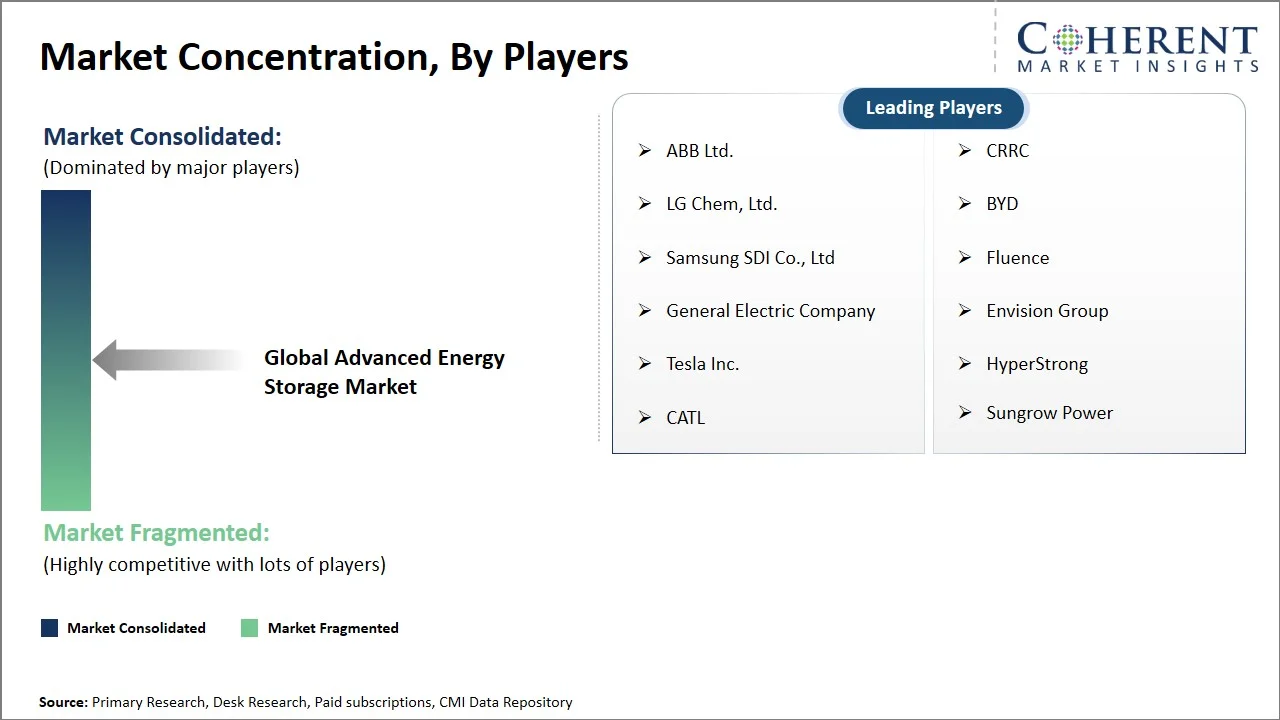
The advanced energy storage market is highly competitive, with global battery manufacturers, technology providers, utilities, and new-age startups competing through scale, technological innovation, and integration across the energy value chain. Established players leverage strong supply chain control, manufacturing scale, and deep expertise in battery chemistry to respond quickly to evolving demand driven by renewable energy integration and electrification trends. While lithium-ion players currently dominate, emerging companies focusing on next-generation and long-duration storage technologies are intensifying competition. Major areas of focus are:
- Advanced battery technologies and performance optimization
- Energy management software and system intelligence, including AI-driven battery management systems (BMS), grid integration platforms, and real-time energy optimization capabilities
- Supply chain control and vertical integration
- Strategic partnerships, project development, and ecosystem integration
Market Report Scope
Advanced Energy Storage Market Report Coverage
| Report Coverage | Details | ||
|---|---|---|---|
| Base Year: | 2025 | Market Size in 2026: | USD 26.39 Bn |
| Historical Data for: | 2020 To 2024 | Forecast Period: | 2026 To 2033 |
| Forecast Period 2026 to 2033 CAGR: | 10% | 2033 Value Projection: | USD 51.42 Bn |
| Geographies covered: |
| ||
| Segments covered: |
| ||
| Companies covered: | ABB Ltd., LG Chem, Ltd., Samsung SDI Co., Ltd, General Electric Company, and Tesla Inc., CATL, CRRC, BYD, Fluence, Envision Group, and HyperStrong, and Sungrow Power | ||
| Growth Drivers: |
| ||
| Restraints & Challenges: |
| ||
Analyst Opinion (Expert Opinion)
- The developed energy storage market is poised to become an energy infrastructure building block, as the global energy infrastructure transitions to large scale integration of renewables, electrification of transport, and growing grid instability. Although lithium-ion batteries are expected to persist in dominating the short term, as established supply chains are defined and costs are reducing, the long-term future of the industry will be more related to long-duration energy storage solutions like flow batteries, solid-state batteries, sodium-ion technologies, and hydrogen-based storage.
- The competitive environment will shift towards considering performance in lifecycle, safety, and storage duration rather than energy density and initial cost (especially in grid-scale and industrial applications).
- The most significant opportunities will emerge in grid-scale energy storage deployments integrated with solar and wind projects, particularly in high-growth markets such as China, the U.S., and India, where renewable capacity additions and grid reliability concerns are accelerating demand. In parallel, long-duration energy storage solutions will see strong uptake in North America and Europe, supported by decarbonization targets and policy incentives. Additionally, electric vehicle battery ecosystems in China and Europe will create opportunities in second-life battery applications and recycling, while commercial and industrial storage systems in India and Southeast Asia will gain traction due to high electricity costs and unreliable grid infrastructure, offering clear and immediate economic benefits.
- To gain a competitive edge, market players must prioritize securing raw material supply chains and reducing dependency on critical minerals through investments in recycling and alternative chemistries such as sodium-ion. At the same time, companies need to expand beyond lithium-ion by developing capabilities in next-generation and long-duration storage technologies to remain relevant in the post-2030 market. Strategic partnerships with utilities, renewable energy developers, and OEMs will be essential to deliver integrated energy storage solutions.
Speak to the analyst
Want personalized insights?
Take the findings above to one of our principal consultants, or have the report rebuilt around the segments, geographies and competitors you actually track.
Market Segmentation
- Application Insights (Revenue, USD Bn, 2021 - 2033)
- Transportation
- Grid Storage
- Technology Insights (Revenue, USD Bn, 2021 - 2033)
- Lithium-Ion Batteries
- Sodium-Ion Batteries
- Lead-Acid (Advanced/Upgraded)
- Flow Batteries
- Solid-State Batteries
- Others
- Regional Insights (Revenue, USD Bn, 2021 - 2033)
- North America
- U.S.
- Canada
- Latin America
- Brazil
- Argentina
- Mexico
- Rest of Latin America
- Europe
- Germany
- U.K.
- Spain
- France
- Italy
- Russia
- Rest of Europe
- Asia Pacific
- China
- India
- Japan
- Australia
- South Korea
- ASEAN
- Rest of Asia Pacific
- Middle East
- GCC Countries
- Israel
- Rest of Middle East
- Africa
- South Africa
- North Africa
- Central Africa
- North America
- Key Players Insights
- ABB Ltd.
- LG Chem, Ltd.
- Samsung SDI Co., Ltd
- General Electric Company
- Tesla Inc.
- CATL
- CRRC
- BYD
- Fluence
- Envision Group
- HyperStrong
- Sungrow Power
Sources
Primary Research Interviews
- Battery manufacturers (lithium-ion and flow battery specialists)
- Supply Chain Director of energy storage systems company
- Tesla (leading energy storage innovator)
- Sustainability Officer of battery industry certification body
Stakeholders
- Manufacturers of batteries and energy storage systems (e.g., LG Energy Solution, Samsung SDI, Panasonic, BYD, CATL)
- End-use Sectors
- Automotive OEMs and Tier 1 Suppliers (e.g., Tesla, General Electric for EV integration)
- Utilities and Grid Operators (e.g., Siemens, ABB, Fluence)
- Renewable Energy Producers (e.g., solar/wind integrators with storage)
- Consumer Electronics and Residential Storage Providers
- Regulatory & Certification Bodies: UL (safety standards for batteries), IEC (international electro-technical standards), NREL (U.S. energy labs), MNRE (India energy storage policies)
- E-commerce Platforms and Suppliers: Specialized industrial suppliers for battery components
- Technology Integration Players: Innovators in solid-state batteries and LDES (e.g., Form Energy, Proterra)
Databases
- UN Comtrade Database (HS Code 8507 for electric accumulators, HS 850760 for lithium-ion batteries)
- India Import Export (EXIM) Database (energy storage battery imports HS850760)
- USGS Mineral Commodity Summaries (lithium, cobalt for batteries)
- Eurostat Trade Statistics for Energy Storage Products
- USITC DataWeb for battery imports/exports
Magazines
- ESS News – Energy storage technology updates
- BEST (Batteries & Energy Storage Technology) – Battery trends
- Energy Storage News – Market dynamics
- Electrek – EV and grid storage applications
Journals
- Journal of Energy Storage – Systems integration and novel technologies
- Energy Storage (Wiley) – Thermal, chemical, and mechanical storage
- Applied Energy – Grid modeling and analysis
- Journal of Power Sources – Battery materials and performance
- Renewable and Sustainable Energy Reviews – Long-duration storage
Newspapers
- The Wall Street Journal – EV battery demand and supply chains
- Business Standard (India) – Battery imports and policy
- The Economic Times – India energy storage growth
Associations
- Energy Storage Association (UK)
- India Energy Storage Alliance (IESA)
- Long Duration Energy Storage Council (LDES Council)
- Electricity Storage Association (U.S., now part of ESA)
- International Electrotechnical Commission (IEC) Energy Storage Systems Committee
Public Domain Sources
- U.S. Department of Energy (DOE) – Battery recycling and grid guidelines
- EPA – Emissions from energy storage manufacturing
- NREL – Advanced energy storage reports
- IEA – Global energy storage and renewables integration
- OECD – Critical minerals for batteries trade
Proprietary Elements
- CMI Data Analytics Tool, Proprietary CMI Existing Repository of information for last 10 years.
Get access to 250+ pages report
Every segment, forecast, competitor profile and data table behind the analysis above — available for instant download.
- ESOMAR Member
- ISO 9001:2015 Certified
- D-U-N-S Registered
- GDPR & CCPA Compliant
Missing comfort of reading report in your local language? Find your preferred language:
Transform your Strategy with Exclusive Trending Reports
Frequently Asked Questions
The advanced energy storage market is estimated to be valued at USD 26.39 Bn in 2026, and is expected to reach USD 51.42 Bn by 2033.
The advanced energy storage market includes technologies that store energy for later use, primarily using electrochemical systems like lithium-ion batteries, solid-state batteries, flow batteries, and other emerging storage technologies used in grid, industrial, and mobility applications.
Lithium-ion batteries dominate the market due to high energy density, falling costs, strong supply chain maturity, and widespread use in EVs and grid-scale storage projects.
Rapid growth in renewable energy penetration requiring flexible grid storage, and declining costs and scaling of electrochemical storage for utility and EV use are the major factors driving the growth of the advanced energy storage market.
Safety and thermal-management challenges (especially for high-power deployments), and supply-chain constraints for critical battery materials are the major factor hampering the growth of global advanced energy storage market.
Climate policies drive investment in low-emission technologies, accelerating the demand for advanced energy storage to meet decarbonization and renewable integration goals.
The CAGR of the advanced energy storage market is projected to be 10% from 2026 to 2033.