

Renewable (Bio Jet) Fuel Market Size and Share Analysis -(2026 - 2033)
Renewable (Bio Jet) fuel market is estimated to be valued at USD 426.9 Mn in 2026 and is expected to reach USD 1,368.0 Mn in 2033, exhibiting a compound annual growth rate (CAGR) of 17.95% from 2026 to 2033.
Key Takeaways
- Based on Conversion Pathways, the Hydroprocesses Esters and Fatty Acids (HEFA) segment is expected to hold 67.3% share in 2026.
- Based on Feedstock, the Multiple Solid Waste segment is expected to lead the market with 37.8% share in 2026.
- Based on Region, North America is set to lead the renewable (bio jet fuel) market with 43% share in 2026. While, Asia Pacific is anticipated to be the fastest growing region.
Market Overview
Biomass based aviation fuels are considered as a promising alternative for conventional fossil fuel-based aviation fuels. Bio jet fuel is made from vegetable oils, sugars, animal fats and waste biomass, and can be used in existing aviation jet engines without any modification. The first test flight with bio jet fuel was completed in 2008 by Virgin Atlantic.
Current Events and Its Impacts on the Renewable (Bio Jet Fuel) Market
Current Event | Description and its Impact |
Technological Breakthroughs in Advanced Biofuels |
|
Aviation Industry Decarbonization Commitments and Market Dynamics |
|
Can Sustainable Aviation Fuel Scale from 0.5 million Tonnes in 2023 to 30 million Tonnes by 2030?
Year | Estimated SAF Production/Capacity | Key Drivers |
2023 | ~0.5 million tonnes | Mostly HEFA-based SAF (waste oils, fats). Limited commercial-scale plants. SAF cost ~2–4x conventional jet fuel. |
2025 | ~6–7 million tonnes (planned + operating) | Expansion in U.S. (Lanzajet, World Energy), Europe (Neste, TotalEnergies), Asia (EcoCeres, MRPL). Driven by blending mandates (EU 2% by 2025). |
2030 | ~24–30 million tonnes (IEA projection) | Strong policy support: EU 6% mandate, U.S. tax credits, ASEAN roadmap. Diversification of pathways: HEFA, Alcohol-to-Jet, Fischer-Tropsch, solar fuels. |
2050 (Target) | 200–250 million tonnes (various scenarios) | Needed to meet net-zero aviation goals. Requires massive scale-up, new feedstocks (algae, CO₂-to-fuel), and global infrastructure investment. |
- Current Industry Events of 2026
- Market Size Estimation
- Regional Breakdown
- Competitive Landscape
- Customer Intelligence
- Segmental Analysis
- Pricing Analysis
- Key Market Drivers, Challenges & Future Trends
- Customized Insights Section
Segmental Insights
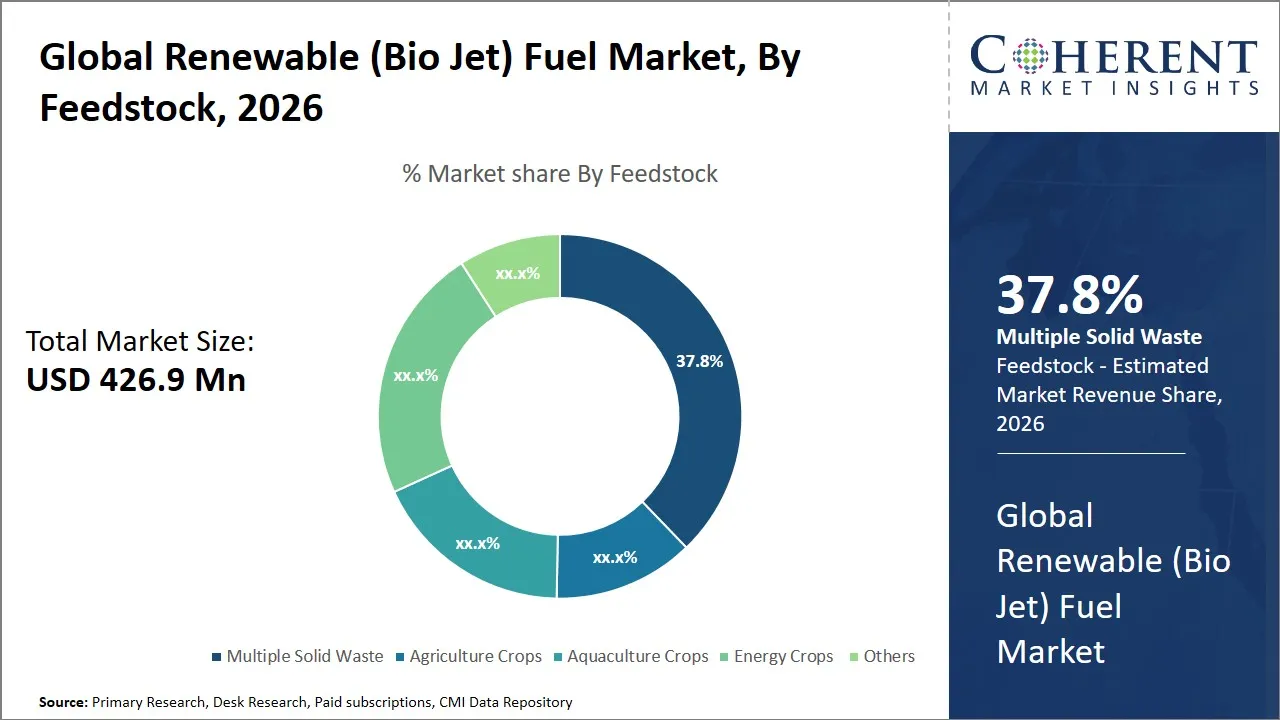
Renewable (Bio Jet) Fuel Market Insights, By Feedstock - MSW leads feedstocks, offering abundant, low-cost, and sustainable waste-to-energy aviation fuel
In terms of feedstock, the multiple solid waste segment is expected to lead the market with 37.8% share in 2026, driven by it accessibility, low-cost and extremely environmentally friendly, Converting trash from cities and businesses into jet fuel helps the environment by reducing the amount of trash that ends up in landfills, supporting the goals of a circular economy, and following government policies that encourage waste-to-energy solutions. This makes MSW the most important feedstock segment.
For instance, in November 2025, A research emphasizes municipal solid waste (MSW) as a principal feedstock for renewable jet fuel. Converting everyday trash into sustainable aviation fuel can reduce emissions by up to 90%, ease the burden on landfills, and help achieve circular economy goals. This makes MSW a leading, cost-effective way to decarbonize aviation around the world.
Renewable (Bio Jet) Fuel Market Insights, By Conversion Technology - HEFA dominates with certified, scalable, and cost-effective renewable jet fuel
In terms of conversion technology, the hydroprocesses esters and fatty acids (HEFA) segment is expected to hold 67.3% share in 2026, as they are commercially mature, can be made in large quantities, and meet ASTM standards. Airlines like HEFA because it works seamlessly with existing infrastructure, uses a variety of feedstocks like vegetable oils and animal fats, and makes aviation fuel that is affordable as well as beneficial for the environment.
For instance, in May 2025, Hydroprocessed Esters and Fatty Acids (HEFA) are directly involved in BP's taskforce to update the UK Defence Standard for renewable aviation fuel. HEFA is the most mature and widely certified SAF pathway. HEFA is the key to making military aviation standards match up with the global use of SAF because it is scalable, flexible with feedstocks, and has been shown to work with other SAF.
Regional Insights
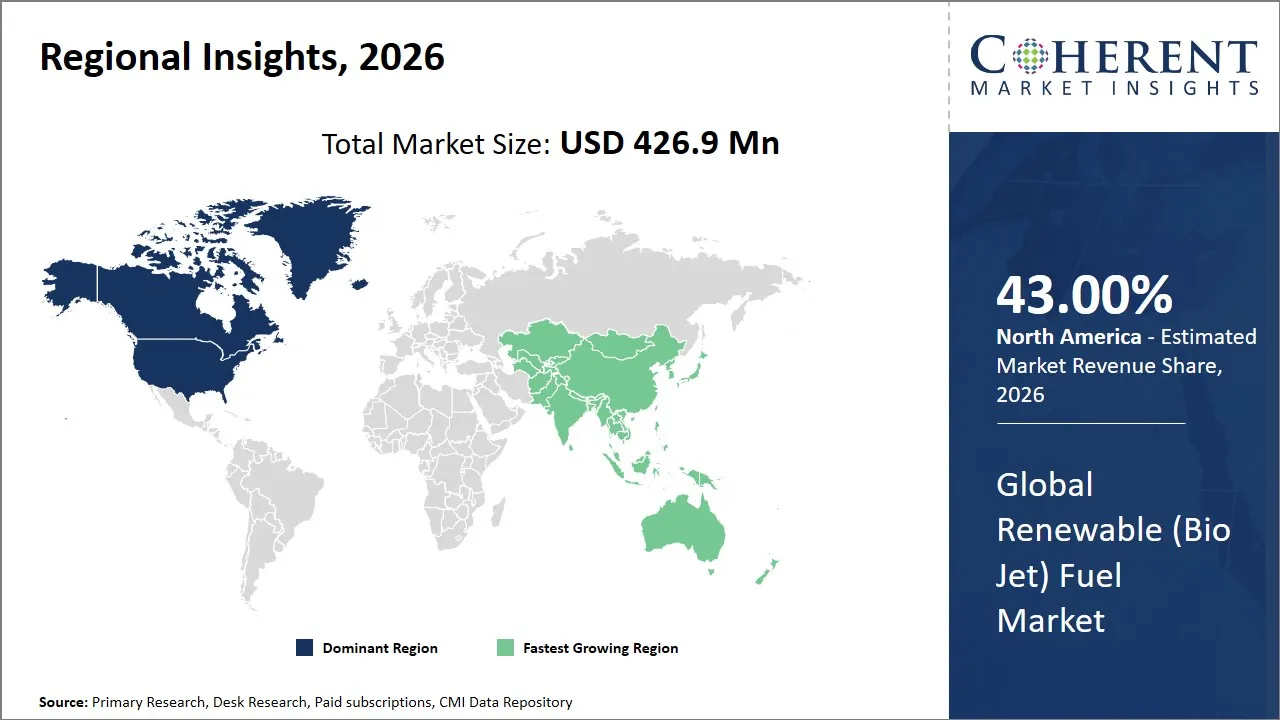
North America Renewable (Bio Jet) Fuel Market Analysis & Trends
North America is expected to dominate the Renewable (Bio Jet) Fuel market with 43% share in 2026, because of strong government incentives, tax credits, and the U.S. SAF Grand Challenge. Large airlines claim to reach net-zero goals, and major manufacturing plants make sure there is enough supply. These things make people want to use it, which helps the market grow and makes it more sustainable.
For instance, in February 2026, FedEx has received shipments of sustainable aviation fuel (SAF) at the Dallas Fort Worth and New York JFK airports. This is an important step forward in the use of renewable jet fuel. SAF is made from waste oils and residues. It helps FedEx reach its goal of being carbon-neutral by 2040 and reveals that a rising number of commercial airlines are using bio jet fuel.
Asia Pacific Renewable (Bio Jet) Fuel Market Analysis & Trends
Asia Pacific is expected to exhibit the fastest growth, due to aviation is growing quickly in China, India, and Southeast Asia, and governments are investing funds into SAF refining capacity. Innovations in feedstock, such as algae and residues, make it easier to scale up, which makes the region the fastest-growing contributor to global SAF adoption.
For instance, in January 2026, ASEAN announced that by 2050, it will make 8.5 million barrels of sustainable aviation fuel every day. This renewable jet fuel project demonstrates the seriousness that the region is about making aviation less polluting by using a variety of feedstocks and pathways. The roadmap puts ASEAN in an ideal position to be a major global supplier in the future SAF market.
Renewable (Bio Jet) Fuel Market Outlook Country-Wise
The U.S. Renewable (Bio Jet) Fuel Market Trends
In the U.S., the Renewable (Bio Jet) Fuel Market is strong in 2026 because of the Inflation Reduction Act's strong government incentives, the SAF Grand Challenge's goal of large-scale production, and major airlines' promises to go net-zero. These policies and investments make sure that supply grows, which leads to more adoption and strengthens America's position as a leader in sustainable aviation.
For instance, in July 2025, LanzaJet is expected to open its $200 million green jet fuel plant in Soperton, Georgia. The facility will convert ethanol into sustainable aviation fuel using the Alcohol-to-Jet pathway. Even though there are problems with policies and costs, the project increases the amount of renewable jet fuel available in the U.S. and helps the aviation industry reach its decarbonization goals.
India Renewable (Bio Jet) Fuel Market Trends
The Renewable (Bio Jet) Fuel Market in India is growing quickly owing to the rapid growth of aviation, government programs that encourage the use of SAF, and airlines' growing commitments to sustainability. Investing in refining capacity and a variety of feedstocks, such as agricultural waste, makes it possible to grow, making India a key player in the fastest-growing market in the Asia-Pacific region.
For instance, in January 2026, Mangalore Refinery & Petroleum Limited (MRPL) plans to start making 1% blended sustainable aviation fuel in Mangalore, India, in 2027. India is now making renewable jet fuel, which helps the aviation industry reach its goal of reducing carbon emissions. The project is in line with India's national SAF blending goals and makes India's role in the global clean energy transition stronger.
Market Report Scope
Renewable (Bio Jet) Fuel Market Report Coverage
| Report Coverage | Details | ||
|---|---|---|---|
| Base Year: | 2025 | Market Size in 2026: | USD 426.9 Mn |
| Historical Data for: | 2020 To 2024 | Forecast Period: | 2026 To 2033 |
| Forecast Period 2026 to 2033 CAGR: | 17.95% | 2033 Value Projection: | USD 1,368.0 Mn |
| Geographies covered: |
| ||
| Segments covered: |
| ||
| Companies covered: | Gevo, Inc., Red Rock Biofuels LLC, Honeywell International Inc., Virent Inc., Fulcrum BioEnergy, Inc., Neste Oil Corporation, AltAir Paramount LLC, S.G. Preston Company, SkyNRG BV, Eni SpA Total S.A., and BP PLC | ||
| Growth Drivers: |
| ||
| Restraints & Challenges: |
| ||
Renewable (Bio Jet) Fuel Market Driver
Carbon Reduction Mandates
The International Civil Aviation Organization (ICAO) and regional frameworks like the EU Fit for 55 and the U.S. SAF Grand Challenge are telling airlines to cut emissions by a lot. These rules put a lot of pressure on airlines to switch to sustainable aviation fuel (SAF). As airlines try to meet their carbon-neutral goals, the Renewable (Bio Jet) Fuel market demand rises sharply, since SAF is an ideal means to do this while still keeping global aviation running smoothly.
For instance, in January 2026, EcoCeres inaugurated Malaysia's first sustainable aviation fuel plant in Johor. It can make up to 420,000 tonnes of SAF, HVO, and renewable naphtha from waste feedstocks each year. EcoCeres has a capacity of 770,000 tonnes when you add its China facility. This helps Asia's renewable jet fuel supply and supports the region's goals for decarbonization and energy transition.
Lifecycle Emission Cuts (Up to 80% Reduction)
Compared to regular jet fuel, sustainable aviation fuel can reduce greenhouse gas emissions over the life of the plane by up to 80%. This huge drop makes SAF a key part of the aviation industry's plan to cut carbon emissions. Airlines and the government both agree that SAF is important for reaching net-zero goals, which makes people assured that it will be used in the long term. Investors and stakeholders recognize SAF's role in changing the aviation industry's sustainability profile and supporting climate commitments, which directly increases the Renewable (Bio Jet) Fuel Market value.
Renewable (Bio Jet) Fuel Market Opportunity
Incentives such as tax credits, subsidies, and blending mandates in the U.S., EU, and Asia-Pacific
Tax credits, subsidies, and blending mandates from the government in places like the U.S., EU, and Asia-Pacific are making it easier for SAF to be used. These steps lower production costs, encourage investment in refining capacity, and make sure there is always demand by requiring blending. With regard to this, producers are more confident about expanding their businesses. This supportive policy environment is an important factor in the Renewable (Bio Jet) Fuel Market forecast, ensuring it will help the market grow and stay stable over time.
Analyst Opinion (Expert Opinion)
- The market for Renewable (Bio Jet) Fuel, which is an important part of sustainable aviation fuel (SAF), continues to remain in the early stages of growing compared to the total demand for aviation fuel. In 2024, biojet fuels account for only a small part of all jet fuel use. Industry estimates showed that biojet made up less than one percent of all aviation fuel use. Even though its current market share is restricted, production has more than doubled in the last few years, as more conversion technologies are being used and feedstocks are being used in more ways.
- Technological pathways continue to be crucial for market growth. Hydroprocessed Esters and Fatty Acids (HEFA) fuels are the most prevalent sort of fuel produced. This is because there is already an extensive amount of infrastructure in place and many ASTM-approved methods for converting fuels. Fischer-Tropsch and Alcohol-to-Jet processes, on the other hand, open up new feedstock options beyond just waste and lipid resources.
- Regional development patterns show that North America and Europe have an abundance of capacity, due to policy mandates and airline sustainability commitments. Asia-Pacific is becoming a strategic growth area. Long-term offtake agreements with major airlines are one of the procurement strategies that are helping to support the expansion of production pipelines by making investments more certain and building more facilities.
- The market is making progress, but it continues to suffer structural problems, such as limited access to feedstock and infrastructure problems for blending and supply logistics. Commercial deployment is still limited by the economics of production compared to traditional jet fuels. At the same time, policy frameworks and regulatory requirements are having an increasing impact on how quickly these fuels are adopted.
Speak to the analyst
Want personalized insights?
Take the findings above to one of our principal consultants, or have the report rebuilt around the segments, geographies and competitors you actually track.
Recent Developments
- In February 2026, LanzaTech plans to build a £600 million facility in Humberside, UK, to make sustainable aviation fuel. The plant will convert industrial waste gases into ethanol through gas fermentation. Later, the ethanol will be turned into jet fuel through the Alcohol-to-Jet pathway. This project helps the UK reach its goal of reducing carbon emissions and greatly increases the amount of renewable bio jet fuel that can be made.
- In December 2025, Swiss International Air Lines and Synhelion signed a long-term deal for solar jet fuel. This renewable aviation fuel is made by using concentrated solar energy to convert CO₂ and water into syngas. It helps the goal of having no emissions. The deal makes Switzerland a leader in the production of solar-powered sustainable aviation fuel.
Market Segmentation
- By Conversion Technology
- Fischer TropschSynthetic Paraffinic Kerosene (FT-SPK)
- Hydroprocessed Esters and Fatty Acids (HEFA)
- Synthetic Iso-paraffin from Fermented Hydroprocessed Sugar (SIP)
- Alcohol to Jet SPK (ATJ-SPK)
- By Feedstock
- Agriculture Crops
- Aquaculture Crops
- Energy Crops
- Municipal Solid Waste
- Others (Animal Fats, Sugar, etc.)
- By Region
- North America
- U.S.
- Canada
- Latin America
- Brazil
- Argentina
- Mexico
- Rest of Latin America
- Europe
- Germany
- U.K.
- Spain
- France
- Italy
- Russia
- Rest of Europe
- Asia Pacific
- China
- India
- Japan
- Australia
- South Korea
- ASEAN
- Rest of Asia Pacific
- Middle East & Africa
- GCC Countries
- Israel
- Rest of Middle East & Africa
- North America
- Competitive Section
- Gevo, Inc.
- Red Rock Biofuels LLC
- Honeywell International Inc.
- Virent Inc.
- Fulcrum BioEnergy, Inc.
- Neste Oil Corporation
- AltAir Paramount LLC
- G. Preston Company
- SkyNRG BV
- Eni SpA Total S.A.
- BP PLC
Sources
Primary Research Interviews
- Bio jet Fuel Manufacturers & Producers (e.g., Neste, LanzaJet)
- Aviation Fuel Technology Providers
- Sustainable Aviation Fuel (SAF) Consultants
- Airlines & Fleet Sustainability Managers
- Industrial Renewable Fuel Engineers
- Energy Transition & Carbon Reduction Strategists
- Others
Databases
- Bloomberg Terminal
- Thomson Reuters Eikon
- IHS Markit
- FlightGlobal Insight
- Others
Magazines
- Aviation Week & Space Technology
- Fuel Oil News & SAF Bulletin
- Renewable Energy World
- Chemical Engineering Magazine
- Others
Journals
- Journal of Cleaner Production
- Renewable & Sustainable Energy Reviews
- Energy & Environmental Science
- Biomass and Bioenergy
- Others
Newspapers
- Financial Times
- The Wall Street Journal
- Reuters
- Bloomberg News
- The Guardian – Environment Section
- Others
Associations
- Sustainable Aviation Fuel Users Group (SAFUG)
- International Air Transport Association (IATA) – SAF Initiatives
- International Energy Agency (IEA) – Bioenergy Division
- Commercial Aviation Alternative Fuels Initiative (CAAFI)
- European Biofuels Technology Platform (EBTP)
- Others
Public Domain Sources
- U.S. Department of Energy (DOE) – Bioenergy Technologies Office
- International Energy Agency (IEA) – Bioenergy & Transport
- European Commission – Directorate-General for Energy
- World Bank Open Data – Energy & Environment
- National Renewable Energy Laboratory (NREL) – Aviation Fuel Research
- Others
Proprietary Elements
- CMI Data Analytics Tool
- Proprietary CMI Existing Repository of Information for the Last 8 Years
Get access to 250+ pages report
Every segment, forecast, competitor profile and data table behind the analysis above — available for instant download.
- ESOMAR Member
- ISO 9001:2015 Certified
- D-U-N-S Registered
- GDPR & CCPA Compliant
Missing comfort of reading report in your local language? Find your preferred language:
Transform your Strategy with Exclusive Trending Reports
Frequently Asked Questions
The global renewable/bio jet fuel market is estimated to be valued at USD 426.9 Mn in 2026, and is expected to reach USD 1,368.0 Mn by 2033.
Carbon reduction mandates and lifecycle emission cuts (up to 80% reduction) are expected to drive the market growth.
Hydroprocessed Esters and Fatty Acids (HEFA) Technology to dominate the market are the trends in the market.
High production cost is expected to hamper growth of the market over the forecast period.
Major players operating in the market include Gevo, Inc., Red Rock Biofuels LLC, Honeywell International Inc., Virent Inc., Fulcrum BioEnergy, Inc., Neste Oil Corporation, AltAir Paramount LLC, S.G. Preston Company, SkyNRG BV, Eni SpA Total S.A., and BP PLC
The market is estimated to grow at around 17.95 % CAGR in the forecast period (2026-2033).