

Offshore Support Vessels Market Size and Share Analysis - Growth Trends and Forecasts (2026-2033)
The Offshore Support Vessels Market size is anticipated to grow at a CAGR of 8.1%, with USD 23.08 Bn in 2026, and is expected to reach approximately USD 39.84 Bn in 2033. The primary drivers are largely defined by increasing offshore oil and gas exploration and production activities, expansion of offshore wind energy projects, rising investments in deepwater and ultra-deepwater developments, and growing demand for vessels supporting transportation, anchor handling, platform supply, subsea construction, and maintenance operations. Increasing development of offshore energy infrastructure, together with fleet modernization and the adoption of fuel-efficient, hybrid, and digitally enabled vessels. In April 2026, Colombo Dockyard PLC began construction of a next-generation cable-laying and repair vessel for France’s Orange Marine, marking a significant milestone in Sri Lanka’s advanced shipbuilding capabilities.
Key Takeaways
- The Anchor Handling Towing and Supply Vessel (AHTS) segment is likely to dominate the market with 39.4% in 2026. The segment’s growth is owing to its extensive use in anchor handling, rig towing and positioning, offshore supply operations, FPSO installation, mooring activities, and support for drilling campaigns. In February 2026, DOF Group agreed to acquire two high-end AHTS vessels with nearly 400 metric tonnes of bollard pull, with the overall transactions representing a net investment of approximately USD 100 million.
- The shallow water segment is set to lead with approximately 60.0% in 2026. The segment’s dominance is owing to the large concentration of fixed offshore platforms, comparatively lower project development costs, mature producing fields, and recurring demand for supply, maintenance, crew transfer, and construction support vessels. CNOOC development involves 79 wells and will achieve peak production at a rate of about 19,400 barrels of oil equivalent per day in 2026, showing the ongoing commitment to shallow water offshore production.
- North America is expected to dominate the Offshore Support Vessels Market with approximately 33.5% market share in 2026. The region’s leadership is supported by extensive offshore oil & gas infrastructure in the U.S. Gulf, continued deepwater field development, subsea tieback activity, and recurring demand for AHTS, PSV, construction, and maintenance vessels. According to the U.S. Bureau of Safety and Environmental Enforcement (BSEE), offshore oil production from the U.S. Outer Continental Shelf reached a record 714 million barrels in 2025, with major deepwater projects in the Gulf supporting the increase.
Market Drivers
Rising Deepwater and Ultra-Deepwater Developments are Accelerating Demand for High-Specification Offshore Support Vessels
The Offshore Support Vessels industry is driven by the exploitation of deepwater and ultra-deepwater oil and gas resources, which requires the need for AHTS vessels, platform supply vessels, construction support vessels, ROV support vessels, and IMR vessels. Deepwater projects typically involve the use of advanced subsea systems, floating production installations, long-distance logistical support, and high-pressure drilling conditions, thus requiring technologically advanced vessels.
In June 2026, Shell highlighted that its Sparta deep water project in the U.S. Gulf region was currently under development and that it was expected to generate up to 90,000 barrels of oil equivalent per day starting from 2028. The Sparta project has been developed to handle pressures of up to 20,000 psi in the reservoir, showing the increasing technical sophistication of the offshore projects and the need for high specification marine services.
Expansion of Offshore Wind Farms is Creating a New Long-Term Demand Base for Support Vessels
Offshore wind farms are increasingly offering a variety of markets for offshore support vessels other than traditional oil and gas projects. In light of construction of these facilities farther away from the coastline, developers need a number of vessels including service operation vessels, crew transfer vessels, construction vessels, cable support vessels, and multipurpose vessels for turbine installation.
In January 2025, Vattenfall contracted three large-scale service operation vessels through 10-year agreements with Louis Dreyfus Armateurs. One of the vessels will serve the DanTysk and Sandbank offshore wind farms, and another vessel will assist with the Nordlicht 1 and Nordlicht 2 wind farms, which have an aggregate capacity of approximately 1.6 GW.
Current Events and Their Impact
Current Event | Description and its Impact |
U.S. Government Expands Gulf Offshore Oil & Gas Leasing under the One Big Beautiful Bill Act (2026) |
|
U.K. Government's Record Offshore Wind CfD Auction Expands Future Marine-Support Requirements (2026) |
|
- Current Industry Events of 2026
- Market Size Estimation
- Regional Breakdown
- Competitive Landscape
- Customer Intelligence
- Segmental Analysis
- Pricing Analysis
- Key Market Drivers, Challenges & Future Trends
- Customized Insights Section
Segmental Insights
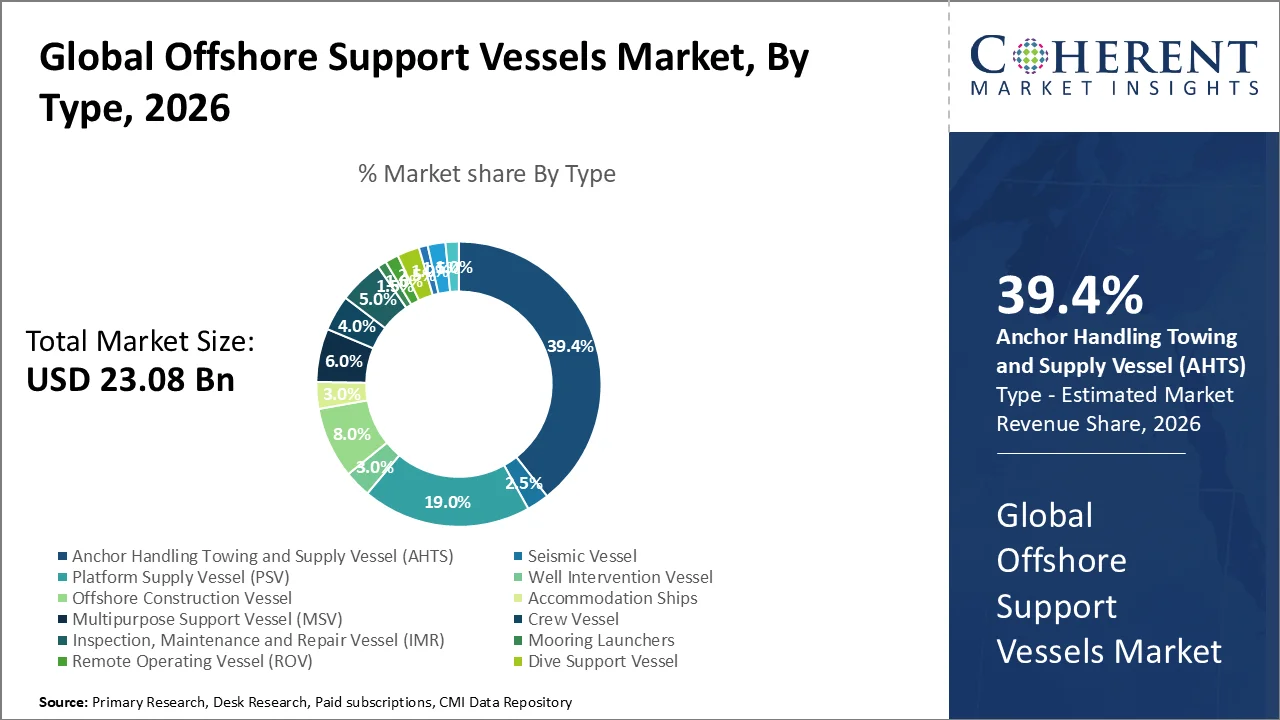
Why is Anchor Handling Towing and Supply Vessel (AHTS) Acquiring the Largest Share?
On the basis of type, the Anchor Handling Towing and Supply Vessel (AHTS) segment is projected to account for the largest Offshore Support Vessels Market share of 39.4% in 2026. The segment’s dominance is owing to the versatile role of AHTS vessels in anchor deployment and recovery, towing and positioning of offshore rigs, transportation of equipment and supplies, mooring operations, and support for offshore exploration and production activities.
Recent contracting activity supports the sustained requirement for these vessels. In June 2026, ABS Marine Services signed a charter agreement for its AHTS vessel MV ARTEMIS to support petroleum operations on India’s east coast. The contract has a firm duration of 1,825 days, or five years, with an option for an additional 1,825 days, indicating long-term utilization visibility for AHTS assets in offshore exploration and production operations.
Why is Shallow Water Holding the Largest Market Share?
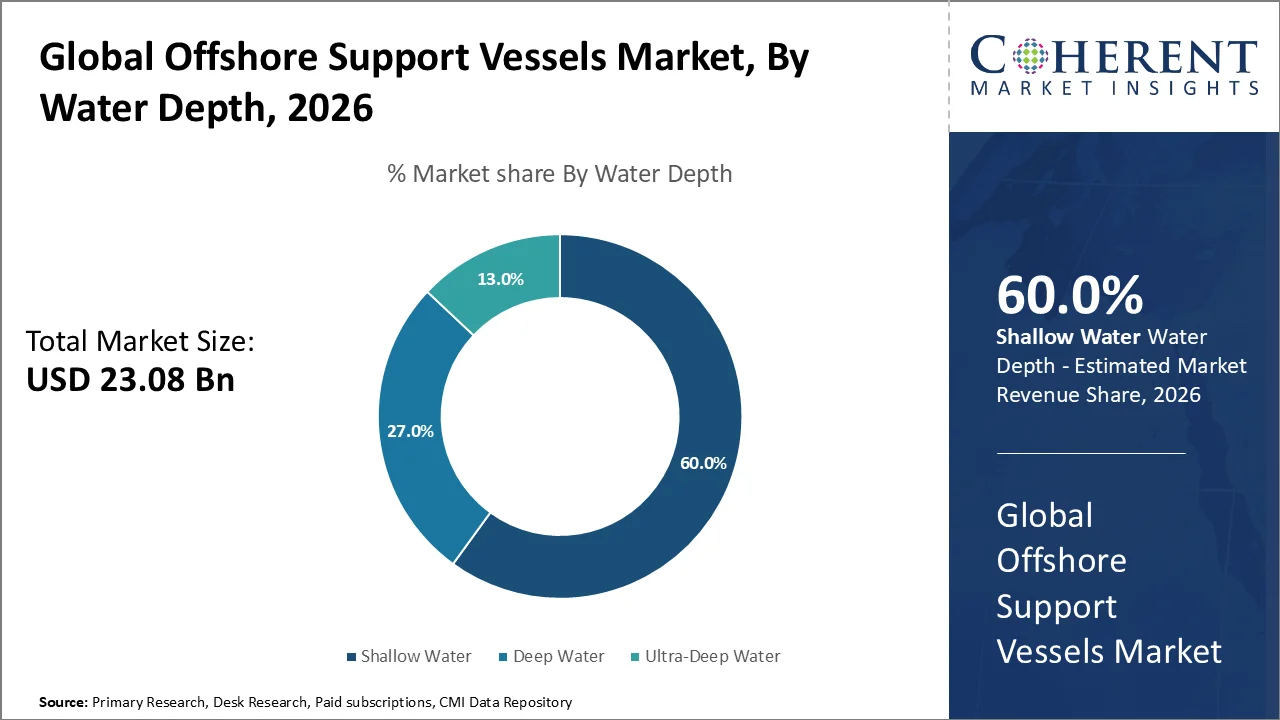
On the basis of water depth, the shallow water segment is projected to lead the Offshore Support Vessels Market with approximately 60.0% share in 2026. The segment’s dominance is owing to the extensive installed base of offshore platforms, comparatively lower exploration and production costs, proximity to existing infrastructure, and recurring requirements for platform supply, crew transportation, maintenance, well intervention, and field-development support.
RWE completed installation of all 100 monopile foundations at the 1.4 GW Sofia Offshore Wind Farm in the U.K. The project is located in water depths of only 20–35 meters, and its construction involved a 14-month offshore foundation-installation campaign followed by burial of approximately 360 km of array cables.
In January 2026, Cairn Oil & Gas announced a gas discovery at its Ambe block offshore India's west coast and stated that three wells are planned as part of its shallow-water drilling and development campaign. The company is advancing the asset under India's offshore development initiatives, demonstrating that shallow-water fields continue to attract new exploration and monetization activity.
Offshore Support Vessels Market Trends
- The growing trend towards battery-electric and other energy forms for offshore ships is influencing the fleet specifications in order to save on fuel and emissions. Bibby Marine’s future electric CSOV will be fitted with a 24.4 MWh LFP battery pack, charging capability at sea, and methanol-ready engines. The vessel is scheduled to enter service in 2027.
- The growing deployment of remote and autonomous offshore survey technologies is reducing dependence on conventionally crewed vessels for seabed mapping, inspection, and data-acquisition operations. In March 2026, Kongsberg and Fugro expanded their collaboration across Fugro’s growing uncrewed surface vessel fleet. Fugro’s Remote Operations Centres can support 24/7 offshore operations while reducing emissions by up to 95% compared with conventional vessel-based approaches.
- The rising demand for specialized SOVs and CSOVs for offshore wind operations is expanding the OSV market beyond traditional oil and gas activities. In March 2026, VARD delivered the Norwind Maestro directly into a 10-year offshore wind service contract at the Global Tech I wind farm in Germany. The vessel accommodates 90 people, including 60 wind technicians, reflecting increasing requirements for purpose-built offshore accommodation, logistics, maintenance, and walk-to-work capabilities.
Regional Insights
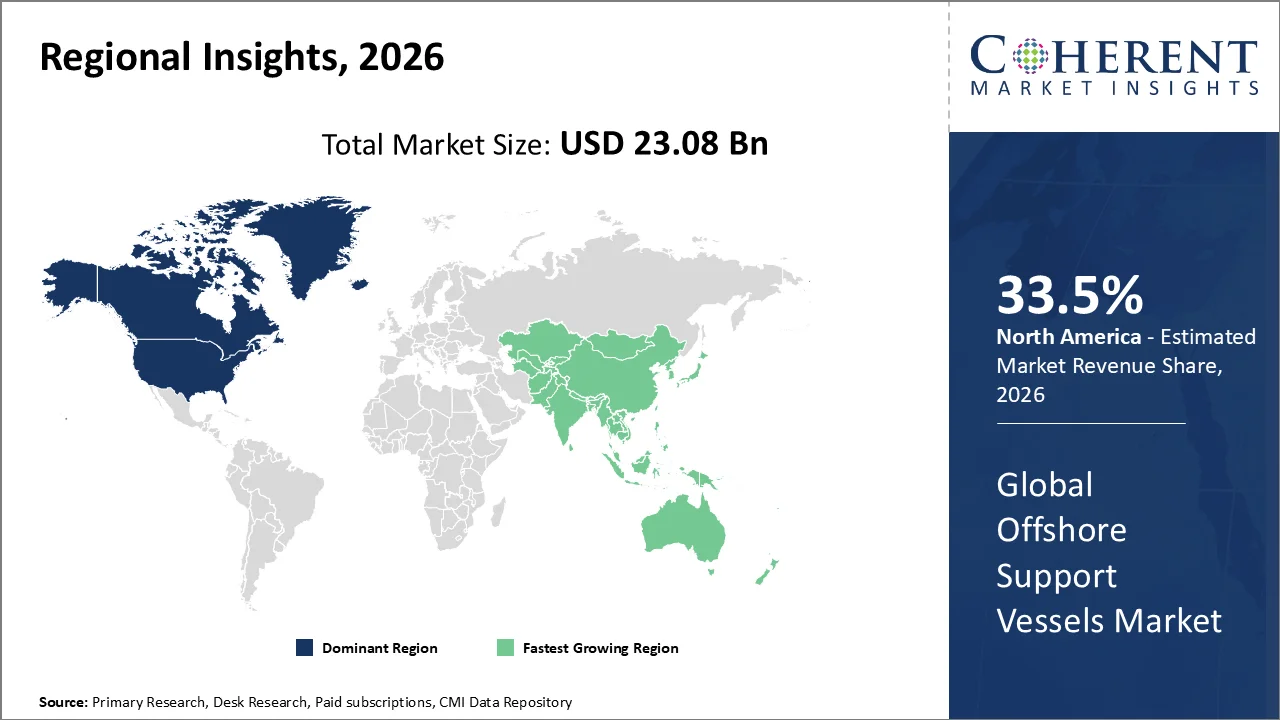
North America Dominates Owing to Strong Deepwater Oil & Gas Activity and Established Offshore Infrastructure
The North America region accounts for approximately 33.5% of the Offshore Support Vessels Market share in 2026. The region’s dominance is owing to its extensive offshore production infrastructure, continued development of deepwater fields in the U.S. Gulf, large installed base of floating production facilities, and sustained requirements for platform supply, anchor handling, subsea construction, inspection, maintenance, and well-support vessels.
Further evidence of offshore activity came on April 22, 2026, when Seadrill secured two U.S. Gulf drilling contracts with LLOG Exploration that added approximately USD 260 million to its contract backlog. The awards include a 365-day extension for West Neptune and a 270-day drilling program for West Vela, demonstrating continuing investment in deepwater drilling campaigns that require associated marine logistics and offshore vessel support.
In July 2026, bp commenced production from its Atlantis Major Facility Expansion project in the U.S. Gulf. The expansion adds approximately 10,000 barrels of oil equivalent per day (boe/d) of gross peak annualized production.
Asia Pacific Offshore Support Vessels Market Trends
Asia Pacific is expected to emerge as the fastest-growing region in the Offshore Support Vessels Market over the forecast period. Market assessments published in 2026 identify Asia Pacific as the fastest-growing regional OSV market, supported by increasing offshore exploration, expanding offshore wind development, growing energy demand, and investments in marine infrastructure across China, India, Malaysia, Indonesia, Australia, South Korea, Taiwan, and Vietnam.
According to the Energy Industries Council’s May 2025 APAC Offshore Wind Insight Report, Asia Pacific without China has 251 offshore wind projects with a total proposed capacity of 276 GW. Out of this pipeline, around 37% projects are floating offshore wind projects that need more anchoring, mooring, subsea construction, towing, inspection, and maintenance services than traditional fixed-bottom projects.
In March2025, PETRONAS announced first oil production at Gumusut-Kakap/Geronggong-Jagus East Phase 4 deepwater development off Malaysia and Brunei. This deepwater development project involves three oil producing wells and one water injection well linked to the Gumusut-Kakap Floating Production System.
Growing Deepwater Development and Subsea Activity is Strengthening the Offshore Support Vessels Market in the United States
The U.S. Offshore Support Vessels Market is witnessing sustained growth owing to continued deepwater oil and gas development in the Gulf, expansion of subsea tiebacks, and recurring demand for platform supply, anchor handling, construction, ROV, and inspection and maintenance vessels. New offshore production projects are particularly important because they generate vessel requirements during drilling, installation, commissioning, and subsequent field maintenance.
In January 2025, Shell commenced production from the Whale deepwater development, located in more than 8,600 feet (2,600 meters) of water. The development comprises 15 wells tied to subsea infrastructure and has an estimated peak production capacity of 100,000 barrels of oil equivalent per day, highlighting the scale of marine logistics, subsea installation, and long-term support requirements associated with U.S. deepwater projects.
China Offshore Support Vessels Market Trends
China is expected to witness strong growth in the Offshore Support Vessels Market, supported by expanding domestic offshore oil and gas production, rising offshore exploration expenditure, growing vessel operating activity, and modernization of marine-support fleets. The country's large Bohai Sea and South China Sea offshore production base creates recurring demand for AHTS vessels, PSVs, multipurpose vessels, standby vessels, and specialized offshore construction and maintenance assets.
The most direct evidence comes from China Oilfield Services Limited (COSL). During Q1 2026, COSL's marine-support vessels recorded 21,521 operating days, increasing 4.4% year-on-year. Within this total, AHTS vessel operating days increased 2.5% to 10,329 days, PSV operating days increased 6.3% to 6,182 days, and multipurpose-vessel operating days surged 55.3% to 722 days.
Who are the Major Companies in Offshore Support Vessels Industry
Some of the major key players in Offshore Support Vessels Market are maEdison Chouest Offshore, Abdon Callais Offshore, Havila Shipping ASA, Farstad Shipping ASA, Gulfmark Offshore Inc., Bourbon Offshore Marine services, and Island Offshore Management AS.
Key News
- In April 2026, BOURBON announced the addition of 13 offshore support vessels valued at more than USD 180 million, with 10 of the vessels already under contract.
- In February 2026, Island Offshore announced the successful launch of its new offshore energy construction vessel Island Evolution at Vard Braila. The newbuild is part of Island Offshore’s fleet-renewal program and is designed to strengthen the company’s capabilities across subsea construction and offshore energy operations.
Market Report Scope
Offshore Support Vessels Market Report Coverage
| Report Coverage | Details | ||
|---|---|---|---|
| Base Year: | 2025 | Market Size in 2026: | USD 23.08 Bn |
| Historical Data for: | 2020 To 2024 | Forecast Period: | 2026 To 2033 |
| Forecast Period 2026 to 2033 CAGR: | 8.1% | 2033 Value Projection: | USD 39.84 Bn |
| Geographies covered: |
| ||
| Segments covered: |
| ||
| Companies covered: | maEdison Chouest Offshore, Abdon Callais Offshore, Havila Shipping ASA, Farstad Shipping ASA, Gulfmark Offshore Inc., Bourbon Offshore Marine services, and Island Offshore Management AS. | ||
| Growth Drivers: |
| ||
| Restraints & Challenges: |
| ||
Analyst Opinion
- The Offshore Support Vessels (OSV) market is supported by sustained offshore oil & gas production, particularly across deepwater basins where PSVs, AHTS vessels, and multipurpose vessels are essential for platform supply, anchor handling, subsea operations, and field logistics. Global offshore oil production at 26.2 million barrels per day in 2025, representing around 27% of global oil production, with a further 3.3% increase expected in 2026.
- Limited fleet additions and an aging global OSV fleet are likely to support vessel utilization and charter economics over the medium term. Veson Nautical reported that PSV utilization was approximately 78% and AHTS utilization around 80% in 2025, while major operators such as Tidewater, Bourbon, and COSL were operating fleets with average ages of approximately 14–15 years. With newbuilding activity remaining relatively modest due to shipyard capacity constraints and high capital requirements, replacement requirements could tighten the availability of modern, fuel-efficient vessels as offshore activity strengthens.
- Offshore decommissioning is emerging as an additional long-term demand pool for support vessels, reducing the market’s dependence solely on new exploration projects. On August 13, 2026, the U.K. North Sea Transition Authority reported record UK Continental Shelf decommissioning expenditure of £2.6 billion in 2025, while the remaining decommissioning program was estimated at £43.4 billion; more than 1,000 additional wells are forecast to require decommissioning over the next five years.
Speak to the analyst
Want personalized insights?
Take the findings above to one of our principal consultants, or have the report rebuilt around the segments, geographies and competitors you actually track.
Market Segmentation
- By Type (Revenue, USD Bn, 2026-2033)
- Anchor Handling Towing and Supply Vessel (AHTS)
- Seismic Vessel
- Platform Supply Vessel (PSV)
- Well Intervention Vessel
- Offshore Construction Vessel
- Accommodation Ships
- Multipurpose Support Vessel (MSV)
- Crew Vessel
- Inspection, Maintenance and Repair Vessel (IMR)
- Mooring Launchers
- Remote Operating Vessel (ROV)
- Dive Support Vessel
- Chase Vessel
- Safety Standby/Utility Vessel
- Oil Terminal Support Vessel
- Others
- By Water Depth (Revenue, USD Bn, 2026-2033)
- Shallow Water
- Deep Water
- Ultra-Deep Water
- Global Offshore Support Vessels Market , By Region (Revenue, USD Bn, 2026-2033)
- North America
- U.S.
- Canada
- Latin America
- Brazil
- Mexico
- Argentina
- Rest of Latin America
- Europe
- Germany
- U.K.
- France
- Italy
- Spain
- Russia
- Rest of Europe
- Asia Pacific
- China
- India
- Japan
- Australia
- South Korea
- ASEAN
- Rest of Asia Pacific
- Middle East
- GCC
- Israel
- Rest of Middle East
- Africa
- South Africa
- Central Africa
- North Africa
- North America
- Key Players
- maEdison Chouest Offshore
- Abdon Callais Offshore
- Havila Shipping ASA
- Farstad Shipping ASA
- Gulfmark Offshore Inc.
- Bourbon Offshore Marine services
- Island Offshore Management AS
Sources
Primary Research Interviews
- Offshore support vessel owners and operators
- Offshore oil & gas exploration and production companies
- Vessel chartering and marine logistics managers
- Shipyard and offshore vessel manufacturers
- Offshore wind project developers and operators
- Marine engineering and vessel maintenance companies
- Procurement managers from offshore energy companies
- Offshore drilling contractors and subsea service providers
- Port authorities and marine terminal operator
- Key opinion leaders (KOLs) in offshore marine services
Databases
- World Bank
- International Energy Agency (IEA)
- U.S. Energy Information Administration (EIA)
- UN Trade and Development (UNCTAD)
- International Maritime Organization (IMO)
- OECD Maritime Transport Statistics
- U.S. Bureau of Ocean Energy Management (BOEM)
- UK North Sea Transition Authority (NSTA)
Magazines
- Offshore Magazine
- Offshore Engineer
- MarineLink
- Riviera Maritime Media
- Maritime Executive
- Offshore Energy
- Marine Log
Journals
- Ocean Engineering
- Marine Structures
- Journal of Marine Science and Engineering
- Ships and Offshore Structures
- Applied Ocean Research
- International Journal of Maritime Engineering
- Marine Policy
Newspapers
- Financial Times
- The Wall Street Journal
- Reuters
- Bloomberg
- The Guardian
- The Economic Times
Associations
- International Maritime Organization (IMO)
- International Marine Contractors Association (IMCA)
- International Support Vessel Owners’ Association (ISOA)
- International Association of Drilling Contractors (IADC)
- Offshore Marine Service Association (OMSA)
- Society for Underwater Technology (SUT)
- International Chamber of Shipping (ICS)
- BIMCO
Public Domain Sources
- Company Annual Reports and Investor Presentations
- Offshore Vessel Fleet and Chartering Updates
- Government Offshore Oil & Gas Licensing Publications
- Offshore Wind Project and Capacity Databases
- Shipbuilding and Vessel Delivery Announcements
- Maritime Safety and Environmental Regulations
- Offshore Field Development and Decommissioning Reports
- Port Authority and Marine Infrastructure Publications
- Company Press Releases and Contract Announcements
Proprietary Elements
- CMI Data Analytics Tool, Proprietary CMI Existing Repository of Information for the Last 10 Years
Get access to 250+ pages report
Every segment, forecast, competitor profile and data table behind the analysis above — available for instant download.
- ESOMAR Member
- ISO 9001:2015 Certified
- D-U-N-S Registered
- GDPR & CCPA Compliant
Missing comfort of reading report in your local language? Find your preferred language:
Transform your Strategy with Exclusive Trending Reports
Frequently Asked Questions
The Offshore Support Vessels Market is expected to reach USD 39.84 Billion in 2033, increasing from USD 23.08 Billion in 2026.
Offshore support vessels are specialized marine vessels used to support offshore oil & gas, offshore wind, subsea construction, drilling, maintenance, logistics, anchor handling, platform supply, and other offshore operations.
The Anchor Handling Towing and Supply Vessel (AHTS) segment is projected to hold the largest share of approximately 39.0% in 2026, owing to its extensive use in anchor handling, rig towing, positioning, offshore supply, mooring, and drilling-support operations.
The shallow water segment is expected to dominate with approximately 60.0% market share in 2026, supported by the large installed base of offshore platforms, comparatively lower development costs, and recurring vessel requirements for supply, maintenance, and crew transportation.
Offshore support vessels are extensively used for platform supply, anchor handling, rig towing, subsea construction, crew transportation, inspection, maintenance and repair, well intervention, offshore construction, and offshore wind operations.
The offshore oil & gas industry remains the major demand generator, while offshore wind is emerging as an important additional market as projects require service operation vessels, crew transfer vessels, construction vessels, and other specialized marine-support assets.
Major trends include the adoption of battery-electric and alternative-fuel vessels, remote and autonomous offshore technologies, and specialized SOVs and CSOVs for offshore wind operations.