

Coal Fired Power Generation Market Analysis & Forecast (2026-2033)
The Coal Fired Generation Market is anticipated to grow at a CAGR of 3.3% with USD 2,547.7 GW share in 2026 and is expected to reach USD 3,154.6 GW in 2033. Coal‑fired power remains a critical backbone of electricity systems, especially in major economies. In India, coal‑based plants contributed about 74–79 % of total power generation in early 2026, reflecting its central role in meeting baseload demand despite rapid renewable expansion. Official data show fossil fuels still made up 47.7 % of India’s installed generation capacity as of January 2026, with coal alone at 42.5 %. Meanwhile, in the U.S., coal’s share of electricity is projected to remain significant through 2026 even as cleaner sources grow, with plants well‑stocked to operate through the year according to the U.S. Energy Information Administration.
Key Takeaways:
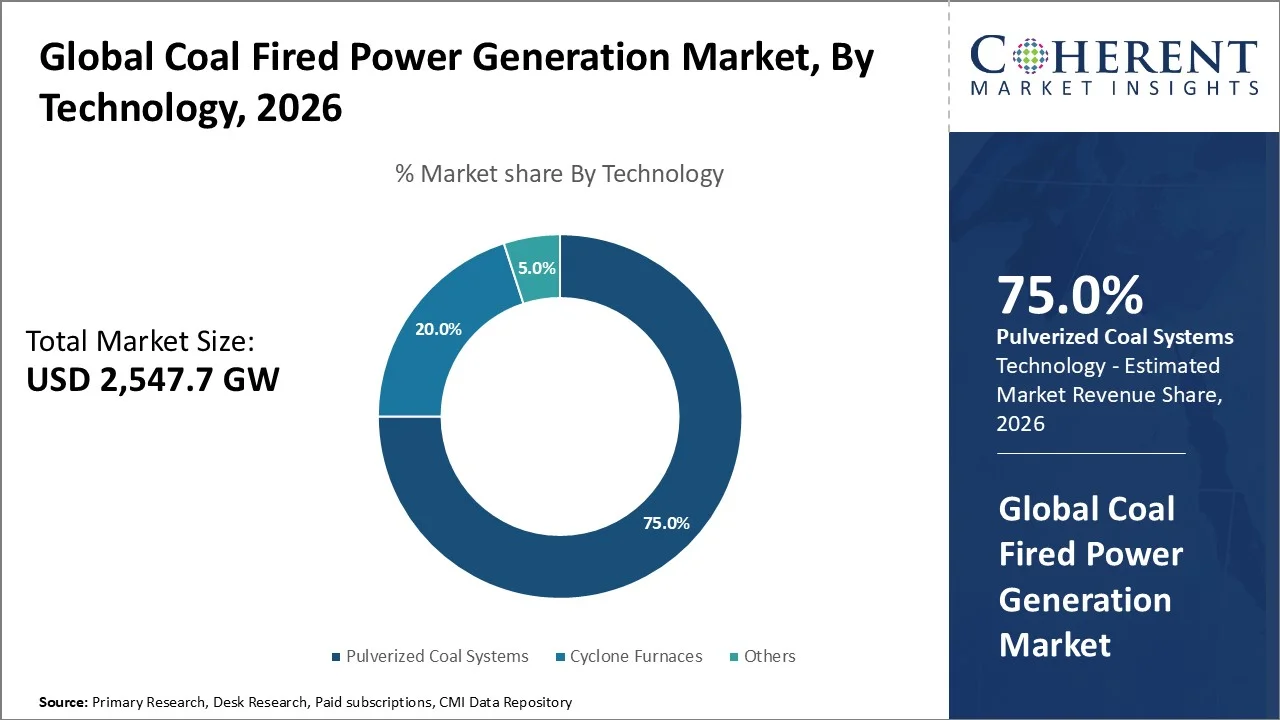
- Pulverized Coal Systems is expected to account the largest share of 75.0% in 2026, driven because they are the standard and most widely deployed coal-combustion technology and are well suited to large power plant sizes, where coal still matters for grid reliability. U.S. Energy Information and Administration notes that pulverized coal is ground into fine dust and burns very rapidly and efficiently in the furnace. Supporting continued relevance of this technology base, IEA reported global coal demand rose by 0.4% in 2025, while global electricity demand is forecast to grow at an average 3.6% annually during 2026–2030.
- Based on application, Commercial will dominate with 63.0% in 2026, supported by as the electricity use is highest in the commercial sector across all modeled cases, with commercial buildings driving incremental demand in the high-electricity-demand case. U.S. Energy Information and Administration’s Short-Term Energy Outlook also expect summer commercial power demand to grow 2.6% in 2026, reinforcing this segment’s dominance.
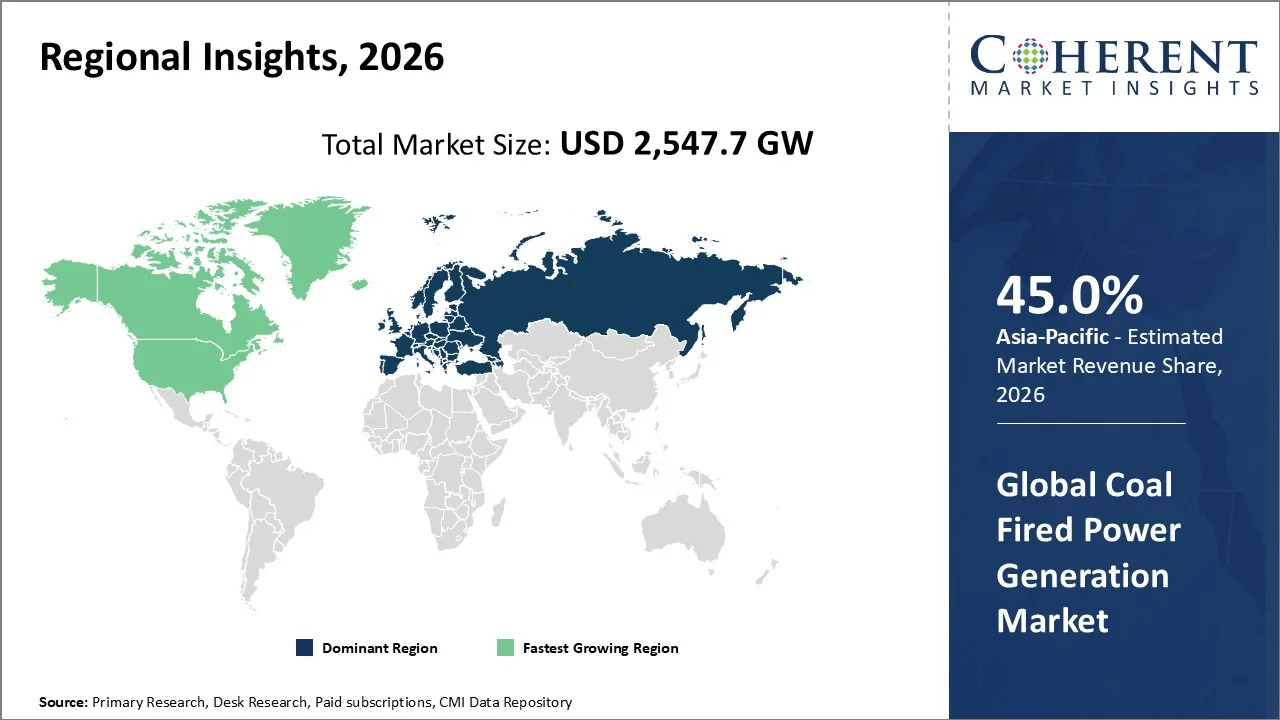
- Asia Pacific is expected to acquire the dominant share of 45.0% in 2026, attributed to high demand for energy, abundant domestic coal reserves, and export opportunities. For instance, in March 2026, according to the data published by the Government of India statistics confirm that coal stock levels at thermal plants are ~58.2 million tonnes, sufficient for ~19 days of operation at high load, showing ongoing reliance on coal plants to meet power demand.
Segmental Insights
Why is Pulverized Coal Systems Acquiring the Largest Market Share?
Pulverized Coal Systems is projected to account for the largest share of coal fired power generation in 2026, representing approximately 75.0% of the total volume. As the utility-scale coal power is still centered on conventional steam-cycle plants, while alternatives such as coal gasification remain limited. The U.S. EIA notes that nearly all coal-fired power plants use steam turbines, and it separately describes integrated gasification coal units as rare. That operating reality is also visible in current build-outs: India’s Ministry of Power reported on 16 March 2026 that the country had already commissioned 72,450 MW of supercritical units and 8,340 MW of ultra-supercritical units by 28 February 2026, underscoring the continued dominance of large steam-based coal platforms.
Two major drivers are sustaining this segment’s growth. First, grid reliability and fast-rising electricity demand in Asia continue to support coal-based generation: the IEA states global coal demand for power generation remains broadly stable at 5,964 Mt in 2025, with India’s power-sector coal demand estimated at 940 Mt and backed by 14 GW of new coal-fired units. Second, policymakers and utilities still favor higher-efficiency supercritical and ultra-supercritical pulverized-coal designs over older subcritical units because they reduce coal consumption and CO2 emissions per unit of electricity. Reflecting that preference, India has envisaged at least 97,000 MW of additional coal- and lignite-based thermal capacity by 2034-35, with 38,745 MW already under construction as of early 2026.
Recent project activity also shows that this technology remains the preferred route for new coal investments. For instance, on 12 February 2026, Bharat Heavy Electricals Limited secured a 2x660 MW Koradi supercritical thermal order from MAHAGENCO in Maharashtra, and on 13 February 2026 it secured another supercritical boiler-island package for 2x660 MW Raghunathpur Phase II in West Bengal. These back-to-back awards highlight continued capex momentum in pulverized-coal supercritical systems.
IEA; PIB; Science Direct; BHEL
- Current Industry Events of 2026
- Market Size Estimation
- Regional Breakdown
- Competitive Landscape
- Customer Intelligence
- Segmental Analysis
- Pricing Analysis
- Key Market Drivers, Challenges & Future Trends
- Customized Insights Section
Commercial holds the Largest Market Share
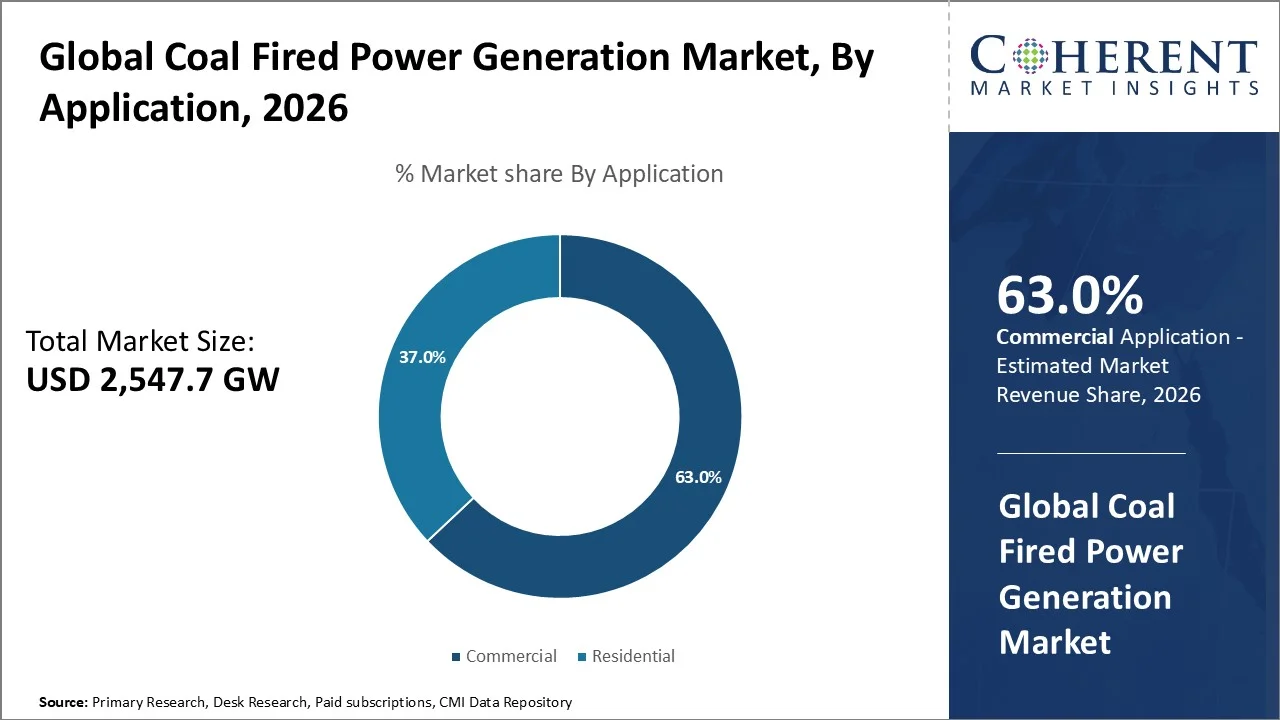
Based on application, commercial dominate the market, accounting for a significant 63.0% share in 2026, owing to rapid growth in commercial-building electricity demand. In the U.S., the EIA said in April 2026 that energy use in commercial buildings grows more rapidly than in the residential or industrial sectors, with data center server energy use as a major driver. EIA’s April 2026 STEO also expects summer commercial power demand to grow by 2.6% in 2026, faster than industrial demand growth of 0.9%. That directly supports stronger power offtake from reliable thermal sources where coal is still in the grid mix.
Furthermore, need for uninterrupted baseload and peak support keeps coal relevant for commercial users in coal-heavy markets. India’s Ministry of Power said in March 2026 that the country had 524 GW of installed generation capacity as of 28 February 2026, including about 248.5 GW thermal and 227.8 GW from coal and lignite. For instance, on 22 March 2026, coal-based plants held about 58.2 million tonnes of coal stock, enough for an average of 19 days at 85% PLF; by 6 April 2026, thermal-plant coal stocks stood at 55.18 million tonnes, sufficient for about 24 days based on recent consumption. That kind of supply buffer supports commercial customers that cannot tolerate outages.
A strong 2026 instance is the data-centre effect. In 2026 The IEA reported that data centres are expected to make up about 50% of U.S. electricity-demand growth out to 2030, while EIA reported data center load is emerging as the dominant driver of long-term U.S. electricity growth. Since data centres sit inside the commercial-building stock and require round-the-clock, high-quality power, they strengthen the commercial case for dispatchable coal-backed grids in markets where coal remains a major source.
Source: EIA; Government of India
Market Driver
Rapid Industrialization in Emerging Economies
Rapid industrialization in emerging economies can meaningfully drive growth in the coal‑fired power generation market by sharply increasing electricity demand that existing or planned low‑carbon sources cannot immediately meet. For instance, in 2026 according to the data published by the International Energy Agency (IEA) forecasts that global electricity use will grow at robust rates in 2025–26 (around 3.3–3.7% annually), largely propelled by industrial activity and electrification in developing countries like India and parts of Southeast Asia. During industrial expansion, heavy industries such as steel, cement and chemicals rely on abundant and affordable electricity; coal‑fired plants historically provide dependable baseload power to support this load even as renewables expand. In countries where grid infrastructure and storage are still developing, coal remains a go‑to option for reliable supply while electrification scales. Although coal’s global share may begin to decline in the long term, near‑term growth in power and industrial demand in emerging markets sustains coal’s role in the energy mix.
Rising Demand for Electricity
Rising electricity demand supports the coal fired power generation market growth because coal plants provide large-scale, dispatchable baseload and peak-support power when grids need dependable output beyond variable renewable supply. The IEA expects global electricity demand to grow at an average 3.6% per year during 2026–2030, after rising 3% in 2025, showing that power systems still need substantial firm generation as consumption expands.
Moreover, government data show total power generation reached 1,845.921 BU in FY 2025–26, of which coal-based generation was 1,250.189 BU. Additionally, in March 2026, the Government of India stated that coal stocks at coal-based plants were about 58.2 million tonnes, enough for roughly 19 days at 85% PLF, and that about 10,000 MW would be made available during April–June 2026 to manage summer demand. This demand growth also influences future capacity planning. India’s Ministry of Power has said the country may require about 307,000 MW of coal- and lignite-based thermal capacity by 2034–35, versus 211,855 MW installed as of 31 March 2023, and has envisaged at least 97,000 MW of additional coal/lignite-based thermal capacity. That is a direct policy signal that rising long-term electricity demand can sustain investment, utilization, and modernization in coal-fired generation.
Source: PIB; Government of India; IEA
Innovative Solutions Powering the Future of Coal Generation
Advanced steam cycle innovations are driving higher efficiency, lower emissions, and improved fuel utilization in coal power, reinforcing its competitiveness in evolving energy systems. Innovations such as supercritical and ultra-supercritical steam cycles are revolutionizing coal-fired power generation by improving thermal efficiency. These advanced boiler technologies enhance plant performance by increasing efficiency by up to 45% compared to traditional plants. By reducing fuel consumption and enhancing heat rate, these technologies make coal power more competitive and environmentally efficient. As of 2026, more plants are adopting these technologies, helping coal-fired plants maintain their role in the energy mix amidst growing demand for cleaner power.
Furthermore, modern supercritical units operate at higher pressures and temperatures, lifting thermal efficiency into the low to mid‑40% range (about 42–48%), compared with 33–37% efficiency in older subcritical plants meaning more electricity per unit of coal and lower fuel use and emissions per MWh. Empirical analysis shows ultra‑supercritical designs can improve power generation efficiency by roughly 6–7% and reduce carbon emissions per unit of output compared with conventional units.
Current Events and Their Impact on the Coal Fired Generation Market
Current Event | Description and its Impact |
Rising Government Initiatives |
|
Increasing in launch of Supportive Government Policies |
|
Regulatory Orders to Sustain Coal Plant Operations |
|
Coal Fired Generation Market Trends
- More efficient coal plants are still being added which is the major factor influencing the market expansion in the near future. New, more efficient coal plants are contributing to a more reliable power supply by improving overall performance and reducing operational costs. Their continued addition supports energy security, especially in regions with growing demand for electricity. NTPC stated in its 30 January 2026 Q3 FY26 earnings call that the group added 1,744 MW in the quarter, including 800 MW from the Patratu thermal power station. The Ministry of Power’s 2025–26 Annual Report also reports the revised SHAKTI policy earmarked 55 MTPA of coal linkages for 11,260 MW, supporting further thermal capacity addition.
- Biomass is being mixed with coal at more thermal power plants-: Biomass co-firing is helping coal plants reduce their environmental impact by utilizing renewable sources of energy alongside coal. This shift not only cuts emissions but also helps coal-fired plants contribute to sustainability goals. The Ministry of Power’s 2025–26 Annual Report states that by 31 December 2025, 72 thermal power plants, including 11 plants in NCR, had started biomass co-firing. Cumulative co-firing reached 40.20 lakh metric tons, and 24.76 lakh metric tons were co-fired in calendar year 2025, up 108% from the previous year.
- Coal plants are still being used to keep power supply stable. Coal-fired power plants continue to play a vital role in maintaining grid stability, especially during peak demand periods. Their reliability ensures that the energy supply remains uninterrupted, even as renewable energy sources fluctuate. The Ministry of Power reported that during 2025–26 up to December 2025, India generated 1,384.859 BU of electricity, while peak shortage was only 0.1% and energy shortage was 0.03%, showing coal-based generation is still important for grid reliability.
- Coal supply is getting stronger and import dependence is falling. Strengthening domestic coal supplies and reducing reliance on imports enhances energy security and helps stabilize coal prices. This contributes to a more sustainable and cost-effective coal industry, reducing vulnerabilities from global supply disruptions. The Ministry of Power’s 2025–26 Annual Report states that coal stock at power plants rose from 45.2 MT on 31 December 2024 to 53.5 MT on 31 December 2025. In the same period, imported coal for blending fell from 18.8 MT to 7.5 MT, a decline of about 60%.
- Coal plants are being upgraded to work alongside renewable energy. Upgrading coal plants to operate in synergy with renewable energy allows them to provide backup power when intermittent renewables are unavailable. This flexibility enhances grid reliability and facilitates the transition to cleaner energy systems. The Draft National Electricity Policy 2026 reports coal and gas stations may use alternative-fuel co-firing/blending and modernization for cleaner operation. Separately, the Ministry of Power released a transmission plan in March 2026 for integrating over 900 GW of non-fossil capacity by 2035–36, which increases the need for thermal plants to operate in a more flexible support role.
- Government policy is still supporting new coal-based generation where needed which is driving the growth of the market over the forecast period. Ongoing government support for coal generation ensures that new coal plants are being built where needed to meet energy demand. This policy framework helps maintain a steady energy supply, ensuring that coal continues to complement other power sources. The Ministry of Power reports the revised SHAKTI policy is designed to improve coal access, reduce import dependence, and support seamless thermal capacity addition. Under Window-I, coal linkages for 11,260 MW had already been earmarked to six states by December 2025.
Source: Ministry of Power
Regional Insights
Asia Pacific dominates owing to Reliance on Coal for Electricity Production
Asia Pacific account 45.0% market share in 2026, supported by vast electricity demand, extensive coal capacity, and slower transition away from coal compared to advanced economies. Coal continues to serve as a critical baseload source across key Asia‑Pacific economies such as China, India, and Southeast Asia, where coal’s share in electricity generation stayed high up to 48% in Southeast Asia in 2025, and above 50% in China and India even as renewables scale up, underscoring the region’s ongoing reliance on coal to ensure energy security and meet high industrial and residential power needs. China leads global coal fleet expansions with the most operational and under‑construction units, while India remains second globally for coal‑fired capacity and continues building new thermal plants to keep pace with rising consumption amid industrial growth.
Source: IEA
North America Coal Fired Generation Market Trends
The North America region is poised to be as the fastest-growing region through 2026-2033, owing grid-reliability concerns are slowing retirements, electricity demand is rising, and some coal units are being retained or modernized to support system stability. In the U.S., EIA said electricity demand is rising in 2026 and 2027, driven largely by large computing centers and data centers, while U.S. Department of Energy issued multiple 2026 emergency orders to keep coal and other thermal units available in markets such as Michigan, Pennsylvania, Indiana, Washington, and Colorado. At the same time, 2025 U.S. coal retirements were the lowest in 15 years because several closures were delayed, showing that coal plants are still being relied on for dispatchable backup and reliability support. In Canada, the coal story is less about expansion and more about selective retention of lower-emission coal assets such as SaskPower’s Boundary Dam CCS-equipped unit.
China: The Unstoppable Force Behind Asia-Pacific's Coal Power Future
The China coal fired power generation market dominates Asia Pacific due to both its scale of ongoing build‑out and its sheer reliance on coal within its electricity mix. Official analyses show China produces more coal than any other country about 4.8 billion short tons annually, which is over half of global production supporting its vast thermal power infrastructure. In 2025, China commissioned 78 GW of new coal power capacity, the highest annual addition in a decade and larger than India’s net additions over the past ten years, with over 290 GW still in the permitted or construction pipeline. One in every four tons of coal burnt globally for power generation is used in China, underscoring its outsized influence on regional coal markets. Government data also show that thermal (predominantly coal) power output grew in early 2026, with coal generation up about 4.2 % year‑on‑year in March, even as renewables expand. Despite ambitious expansion of wind and solar, coal continues to supply a majority share of China’s electricity more than half of total generation making the country a pivotal driver of Asia‑Pacific coal‑fired power dynamics heading into 2026.
U.S. Coal Fired Generation Market Trends
U.S. has become the biggest player in the North America coal fired power generation market in 2026 because it has the largest installed base, resource availability, and mature power infrastructure compared to countries like Canada and Mexico. The U.S. historically built a very large fleet of coal fired power plants, many of which are still operational. North America is a mature market, where existing coal plants continue to operated mainly for grid reliability and peak demand rather than new capacity additions. This legacy infrastructure giver the U.S. a much higher share than neighboring countries. The U.S. has significantly coal reserves, ensuring long-term fuel availability at relatively low cost. Coal’s abundance makes it a cost-effective and reliable energy source for electricity generation. This reduces dependency on imports and strengthens domestic coal-based generation. The U.S. has one of the largest electricity demands globally, driven by: industrial activity, commercial infrastructure, data centers and urban consumption.
- For instance, in April 2026, according to the data published by the U.S. Energy Information Administration, as of 2026, the U.S. has approximately 230 coal-fired power plants still operational, accounting for about 50% of North America’s total coal generation capacity. These plants contribute around 20% of total U.S. electricity generation, with western and Appalachian regions relying heavily on coal for grid stability during peak demand periods. Despite the trend of plant retirements, over 70 GW of coal-fired capacity remains active, mainly for reliability purposes.
- Furthermore, the U.S. holds an estimated 252 billion short tons of recoverable coal reserves as of 2026, representing approximately 25% of global coal reserves. Wyoming is home to the largest coal reserves, containing about 30% of the U.S.'s total reserves. The U.S. coal industry produces around 700 million short tons of coal annually. Due to these large reserves, the price of U.S. coal remains significantly lower compared to global markets, with an average price of USD 45 per short ton in 2026.
Source: EIA
Who are the Major Companies in Coal Fired Generation Market
Some of the major key players in Coal Fired Power Generation Market are American Electric Power Company, Inc., China Datang Corporation, China Huaneng Group, Dominion Energy Solutions, Duke Energy Corporation, E.ON SE, Eskom Holdings, SOC Ltd., Georgia Power Company, Jindal India Thermal Power Limited, Korea Electric Power Corporation, and National Thermal Power Corporation Limited
Key News
- In April 2026, Bharat Heavy Electricals Limited, largest engineering and manufacturing enterprise based in India signed a technology collaboration agreement with NANO Co. Ltd. of South Korea for plate-type SCR catalysts used in De-NOx applications in thermal power plants. BHEL said this will make it the first Indian company with technology and manufacturing capability for this catalyst type. For the coal-fired power generation market, this is a direct technology advancement in emissions control, supporting tighter NOx compliance and cleaner operation of existing and new thermal units.
Source: BHEL
- In March 2026, China Datang Corporation, electricity generation company completed a retrofit of its coal-fired plants, introducing ultra-supercritical boilers and optimizing operational efficiencies by 15% to support cleaner and more sustainable power generation. This technology advancement improves heat rates and reduces fuel consumption per unit, enhancing the long-term viability of coal-fired power in China.
- In March 2026, Eskom Holdings, a company focused on generating electricity with use of natural environment – water, coal, nuclear, wind, and liquid fuels announced that it would upgrade its coal-fired fleet with high-efficiency, low-emission (HELE) technologies, aiming to reduce the carbon footprint of its aging plants by 30% over the next five years. This investment helps secure the long-term reliability of South Africa’s energy grid.
- In February 2026, Korea Electric Power Corporation (KEPCO), electric power distribution company received approval for a new ultra-supercritical coal-fired plant in Busan, which will utilize state-of-the-art technology to achieve higher thermal efficiency and lower emissions. This will help Korea maintain its energy security while reducing coal consumption per unit of electricity generated.
Market Report Scope
Coal Fired Generation Market Report Coverage
| Report Coverage | Details | ||
|---|---|---|---|
| Base Year: | 2025 | Market Size in 2026: | USD 2,547.7 GW |
| Historical Data for: | 2020 To 2024 | Forecast Period: | 2026 To 2033 |
| Forecast Period 2026 to 2033 CAGR: | 3.3% | 2033 Value Projection: | USD 3,154.6 GW |
| Geographies covered: |
| ||
| Segments covered: |
| ||
| Companies covered: | American Electric Power Company, Inc., China Datang Corporation, China Huaneng Group, Dominion Energy Solutions, Duke Energy Corporation, E.ON SE, Eskom Holdings, SOC Ltd., Georgia Power Company, Jindal India Thermal Power Limited, Korea Electric Power Corporation, and National Thermal Power Corporation Limited | ||
Analyst Opinion
- The coal fired power generation market is no longer just a legacy power segment; in 2026, it remains a strategic reliability asset in countries where electricity demand is still rising faster than firm low-carbon alternatives can be deployed. In India, the Ministry of Power said 13.32 GW of new coal-based thermal capacity was awarded in FY 2025–26 till 30 November 2025, 7.21 GW was commissioned, total coal and lignite-based thermal capacity reached 226.23 GW, and another 40.35 GW was under construction. This indicates that coal is still being treated as a practical backbone for round-the-clock supply, especially in fast-growing economies where grid stability and energy security continue to outweigh a full-speed exit from thermal generation.
- In mature markets such as the U.S., coal-fired generation is increasingly a balancing and adequacy play rather than a major expansion story, but that does not make it irrelevant. The U.S. coal production to total 517 million short tons in 2026, while coal consumption for electricity generation in the second half of 2026 is forecast at 204 million short tons, only 6% lower than a year earlier. The real takeaway is that coal is losing share structurally, but it still holds value where dispatchable generation is needed during tight power conditions, seasonal peaks, or when gas and renewable output do not fully cover demand.
- Environmental compliance is becoming the line between coal assets that stay relevant and those that become economically or politically difficult to sustain. India’s Ministry of Power stated in March 2026 that flue gas desulfurization systems had been completed in 49 units totaling 24,130 MW, while 537 units totaling 2,11,540 MW had already been awarded or were under implementation. That scale of retrofit activity shows the market is shifting toward cleaner and more efficient coal operations, where plants that modernize are more likely to retain operating life, while non-compliant fleets may face faster obsolescence.
- The strongest near-term growth logic for coal-fired generation is now coming from adaptation, not from pure conventional expansion. India’s 2025–26 annual report said 72 thermal power plants had started biomass co-firing by 31 December 2025, with cumulative co-firing of 40.20 lakh metric tons, while government data showed coal stock at coal-based plants at 58.2 million tonnes on 22 March 2026, enough for about 19 days at 85% PLF. This suggests the future of coal power will be driven by plants that can secure fuel, reduce emissions intensity, and operate more flexibly alongside renewables, rather than by a simple return to old-style base-load growth.
Speak to the analyst
Want personalized insights?
Take the findings above to one of our principal consultants, or have the report rebuilt around the segments, geographies and competitors you actually track.
Coal Fired Generation Market Segmentation
- By Technology
- Pulverized Coal Systems
- Cyclone Furnace
- Others
- By Application
- Commercial
- Residential
- Global Coal Fired Generation Market, By Region
- North America
- U.S.
- Canada
- Latin America
- Brazil
- Mexico
- Argentina
- Rest of Latin America
- Europe
- Germany
- U.K.
- France
- Italy
- Spain
- Russia
- Rest of Europe
- Asia Pacific
- China
- India
- Japan
- Australia
- South Korea
- ASEAN
- Rest of Asia Pacific
- Middle East
- GCC
- Israel
- Rest of Middle East
- Africa
- South Africa
- Central Africa
- North Africa
- North America
Sources
Primary Research Interviews
- Interviews with plant operators and energy leaders to understand challenges in maintaining coal-fired plant efficiency and reliability.
- Insights from environmental consultants and regulators on the impact of emission standards and compliance requirements on coal generation.
- Discussions with coal suppliers and analysts on coal pricing trends, supply stability, and the effect on plant operating costs.
- Conversations with utility companies and engineers on innovations like biomass co-firing and carbon capture to improve sustainability in coal power plants.
Databases
- Platts (S&P Global)
- BNEF (Bloomberg New Energy Finance)
- IEA (International Energy Agency) Energy Statistics
- EIA (U.S. Energy Information Administration) Coal Data
- ICIS (International Chemical Information Service)
- Orbis
- Statista
- World Coal Database
Magazines
- Energy Source Magazine
- Electric Power Monthly (EIA)
- Energy Voice
- Utility Dive
- Power Engineering Magazine
- World Coal Magazine
- Coal Age Magazine
Journals
- Energy Policy (Elsevier)
- Journal of Cleaner Production (Elsevier)
- Fuel (Elsevier)
- Energy Economics (Elsevier)
- Renewable and Sustainable Energy Reviews (Elsevier)
- International Journal of Coal Geology
- Journal of Coal Science & Technology (Springer)
Newspapers
- The Wall Street Journal
- The Financial Times
- The New York Times (Energy Section)
- The Guardian (Energy and Environmental Section)
- China Daily (Energy Section)
- The Times of India (Energy Section)
- The Australian (Energy Section)
Associations
- National Mining Association (NMA)
- China National Coal Association (CNCA)
- International Journal of Coal Geology
- International Energy Agency (IEA)
- World Coal Association
- Global CCS Institute
- National Coal Association
- American Coal Council (ACC)
- Coal India Limited (CIL)
Public Domain Sources
- U.S. Department of Energy (DOE)
- International Energy Agency (IEA) Public Reports
- World Bank Reports
- National Renewable Energy Laboratory (NREL)
- U.S. EIA Coal Data
- Indian Ministry of Power (Public Reports)
- China National Energy Administration (NEA)
- U.S. Federal Energy Regulatory Commission (FERC) Reports
Proprietary Elements
- CMI Data Analytics Tool
- Proprietary CMI Existing Repository of information for last 10 years
Get access to 250+ pages report
Every segment, forecast, competitor profile and data table behind the analysis above — available for instant download.
- ESOMAR Member
- ISO 9001:2015 Certified
- D-U-N-S Registered
- GDPR & CCPA Compliant
Missing comfort of reading report in your local language? Find your preferred language:
Transform your Strategy with Exclusive Trending Reports
Frequently Asked Questions
The Coal Fired Generation Market is expected to reach USD 3,154.6 Giga Watts in 2033.
Major players operating in the global Coal Fired Generation Market include American Electric Power Company, Inc., China Datang Corporation, China Huaneng Group, Dominion Energy Solutions, Duke Energy Corporation, E.ON SE, Eskom Holdings, SOC Ltd., Georgia Power Company, Jindal India Thermal Power Limited, Korea Electric Power Corporation, and National Thermal Power Corporation Limited
The health issues associated with the coal-fired power generation are the major factor hampering the growth of the coal fired power generation market.
Rising demand for electricity and rapid industrialization in emerging economies are the major factors driving the growth of the coal fired power generation market
The Coal Fired Generation Market is anticipated to grow at a CAGR of 3.3% between 2026 and 2033.
Among regions, Asia Pacific is expected to account for a largest market share in the global Coal Fired Generation Market over the forecast period.