

Prismatic Lifepo4 Battery Market Size and Forecast
Prismatic Lifepo4 Battery Market Size and Forecast – 2026 – 2033
The Global Prismatic LiFePO4 Battery Market size is estimated to be valued at USD 4.1 billion in 2026 and is expected to reach USD 9.5 billion by 2033, exhibiting a compound annual growth rate (CAGR) of 12.8% from 2026 to 2033.
Overview
The growing demand for electric vehicles, renewable energy storage systems, and backup power solutions is driving the prismatic LiFePO4 battery market. These batteries are preferred for their high energy density, long cycle life, enhanced safety, and thermal stability compared to conventional lithium-ion batteries. Increasing investments in clean energy infrastructure and government incentives supporting EV adoption are further accelerating market growth. In addition, rising demand for lightweight and compact battery solutions in consumer electronics, marine, and industrial applications is boosting adoption. Technological advancements in battery management systems and manufacturing efficiency are also reducing costs, making prismatic LiFePO4 batteries more accessible across diverse end-use industries.
Key Takeaways
The 10–50 Ah battery segment holds the largest share in the prismatic LiFePO4 battery market because it offers an effective balance between energy density, compact size, and operational efficiency, making it suitable for electric two-wheelers, portable electronics, and small energy storage applications.
Energy storage systems represent the fastest-growing application segment, driven by expanding renewable energy projects, grid modernization initiatives, and increasing government incentives supporting battery-based energy storage infrastructure.
Asia Pacific dominates the global market with more than 45% share due to strong battery manufacturing capabilities in China and India, while North America is the fastest-growing region fueled by rapid electric vehicle adoption and supportive clean energy regulations.
Prismatic Lifepo4 Battery Market Segmentation Analysis
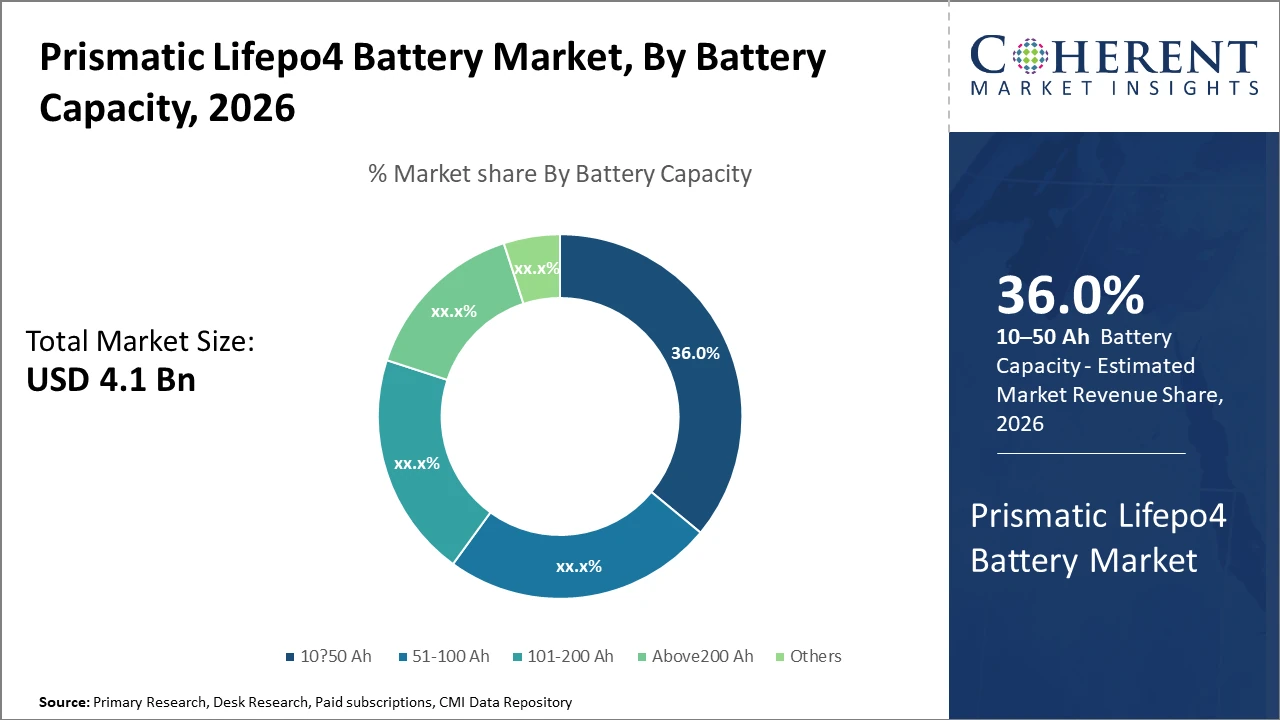
Prismatic Lifepo4 Battery Market Insights, By Battery Capacity
The 10–50 Ah prismatic LiFePO4 battery segment dominates the market with approximately 36% share due to its ideal balance of safety, compact size, lightweight structure, and energy efficiency for electric two-wheelers, portable electronics, and compact mobility applications. The 51–100 Ah segment is witnessing rapid growth as demand rises for electric motorcycles, small electric vehicles, and medium-scale energy storage systems requiring longer operational range. Batteries within the 101–200 Ah range are steadily expanding in specialized industrial and commercial equipment applications. Above 200 Ah batteries are primarily utilized in large renewable energy storage and grid-support systems but account for a smaller market share because of higher costs and larger installation requirements.
Prismatic Lifepo4 Battery Market Insights, By Application
Electric vehicles dominate the prismatic LiFePO4 battery market due to rapid global adoption of electric mobility solutions and increasingly stringent emission regulations promoting low-carbon transportation technologies. Expanding electric vehicle model availability and investments in charging infrastructure continue supporting strong market revenue growth in this segment. Energy storage systems are the fastest-growing application category because of rising renewable energy integration, grid modernization projects, and demand for reliable backup power solutions. Consumer electronics maintain steady demand for safe and durable battery technologies used in portable devices, while industrial equipment applications continue growing through deployment in backup systems and machinery. Emerging applications within aerospace, marine, and medical devices are also contributing to market diversification and innovation.
Prismatic Lifepo4 Battery Market Insights, By End Use Industry
The automotive industry dominates the prismatic LiFePO4 battery market because of the accelerating global transition toward electric mobility and increasing production of electric two-wheelers, passenger vehicles, and commercial electric transport systems. Rising adoption of electric vehicles and supportive government policies continue driving substantial market growth in this segment. Renewable energy is the fastest-growing end-use sector, fueled by expanding solar and wind energy storage deployments supported by government investments and grid modernization initiatives. Telecommunications maintain stable demand for reliable backup power systems supporting digital infrastructure expansion. Consumer goods applications continue growing steadily through portable electronics adoption, while military, aviation, and specialized industrial sectors represent emerging opportunities for advanced prismatic LiFePO4 battery technologies.
Prismatic Lifepo4 Battery Market Trends
Increasing deployment of grid-scale energy storage systems, particularly in Germany and other renewable-focused economies, is accelerating demand for safe and scalable prismatic LiFePO4 battery technologies.
Adoption of prismatic LiFePO4 batteries in commercial electric vehicles such as buses, trucks, and fleet transportation systems is rising rapidly, supported by expanding contracts and manufacturing investments from companies like CALB.
Growing use of modular battery pack designs is improving customization, energy efficiency, and price-performance optimization across consumer electronics, industrial equipment, and electric mobility applications, with companies such as LG Chem introducing advanced modular battery solutions.
Prismatic Lifepo4 Battery Market Insights, By Geography
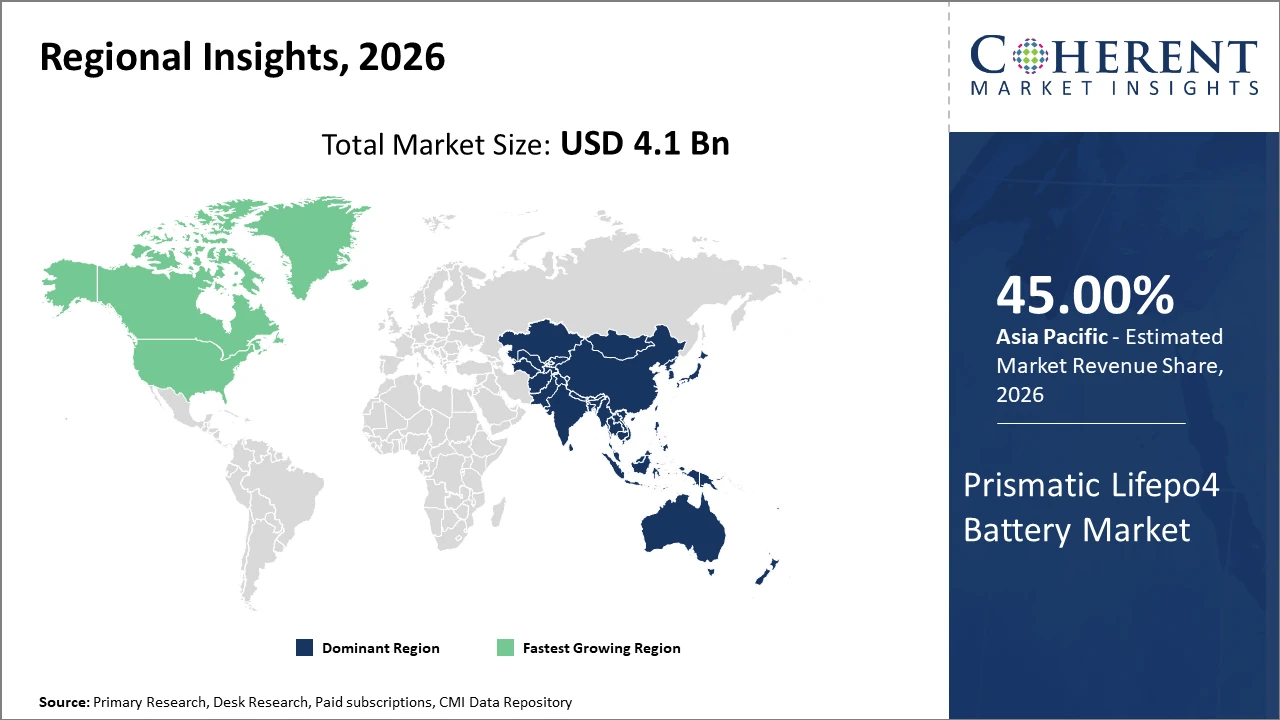
Asia Pacific Prismatic Lifepo4 Battery Market Analysis and Trends
Asia Pacific dominates the prismatic LiFePO4 battery market with more than 45% share due to its extensive battery manufacturing infrastructure, abundant raw material availability, and strong government support for electric mobility and renewable energy expansion. China and India lead regional growth through large-scale battery production facilities, increasing electric vehicle adoption, and growing investments in energy storage projects. Major companies such as CATL and BYD continue strengthening regional supply chains through technological innovation, manufacturing expansion, and strategic partnerships, reinforcing Asia Pacific’s leadership in global prismatic LiFePO4 battery production and commercialization.
North America Prismatic Lifepo4 Battery Market Analysis and Trends
North America is the fastest-growing region in the prismatic LiFePO4 battery market, registering a CAGR exceeding 14% due to rising electric vehicle adoption and growing investments in energy storage infrastructure. The United States is leading regional expansion through supportive federal policies, including the Inflation Reduction Act, which encourages domestic battery manufacturing, clean energy deployment, and electric mobility adoption. Increasing installations of renewable energy storage systems and rapid growth in electric vehicle sales are significantly boosting demand for prismatic LiFePO4 batteries. Major battery manufacturers and automotive companies are expanding production capacity, strengthening supply chains, and investing in advanced battery technologies to meet accelerating market demand across North America.
Prismatic Lifepo4 Battery Market Outlook for Key Countries
USA Prismatic Lifepo4 Battery Market Analysis and Trends
The United States prismatic LiFePO4 battery market is experiencing strong growth driven by expanding electric vehicle adoption and increasing deployment of utility-scale energy storage systems. Government incentives supporting clean transportation technologies, domestic battery manufacturing, and grid modernization initiatives are accelerating market expansion across automotive and renewable energy sectors. Rising investments in solar and wind energy storage projects are also increasing demand for high-performance lithium iron phosphate batteries. Companies such as Panasonic and CALB are expanding manufacturing facilities and research activities to meet growing demand. Continuous innovation in battery efficiency, safety, and sustainability is strengthening the country’s position as a major market hub.
Germany Prismatic Lifepo4 Battery Market Analysis and Trends
The Germany prismatic LiFePO4 battery market is growing steadily due to rising electric vehicle adoption, renewable energy integration, and industrial electrification initiatives. Demand for prismatic lithium iron phosphate batteries is increasing because of their superior thermal stability, long cycle life, and enhanced safety compared to traditional lithium-ion batteries. Government incentives supporting clean energy and carbon reduction targets are accelerating deployment across automotive, energy storage, and industrial sectors. German manufacturers and technology companies are investing in advanced battery management systems and localized battery production capabilities. In addition, expanding solar and wind energy installations are boosting the need for reliable energy storage systems powered by prismatic LiFePO4 batteries.
Analyst Opinion
Expansion of battery manufacturing capacity across Asia Pacific is significantly increasing supply availability, supporting rising global demand for prismatic LiFePO4 batteries in electric mobility and energy storage applications.
Declining battery prices resulting from raw material optimization and improved production efficiency are accelerating adoption across cost-sensitive sectors such as stationary energy storage and backup power systems.
Strong import growth in Europe reflects increasing deployment of prismatic LiFePO4 batteries in renewable energy infrastructure projects supported by government subsidies and decarbonization initiatives.
Expanding use cases in electric scooters, light electric vehicles, and off-grid energy systems are diversifying market demand and strengthening long-term growth opportunities for prismatic LiFePO4 battery technologies.
- Current Industry Events
- Market Size Estimation
- Regional Breakdown
- Competitive Landscape
- Customer Intelligence
- Segmental Analysis
- Pricing Analysis
- Key Market Drivers, Challenges & Future Trends
- Customized Insights Section
Market Scope
| Report Coverage | Details | ||
|---|---|---|---|
| Base Year: | 2025 | Market Size in 2026: | USD 4.1 billion |
| Historical Data for: | 2020 To 2024 | Forecast Period: | 2026 To 2033 |
| Forecast Period 2026 to 2033 CAGR: | 12.8% | 2033 Value Projection: | USD 9.5 billion |
| Geographies covered: |
| ||
| Segments covered: |
| ||
| Companies covered: | BYD Company Ltd., CATL, LG Chem Ltd., Hitachi Chemical Co. Ltd., EVE System Co. Ltd., Toshiba Corporation, Kokam Co. Ltd., Panasonic Corporation, A123 Systems LLC | ||
| Growth Drivers: |
| ||
Prismatic Lifepo4 Battery Market Growth Factors
The growth of the prismatic Lithium Iron Phosphate Battery market is strongly driven by rising demand for electric vehicles, supported by stricter environmental regulations and increasing consumer preference for sustainable transportation solutions. Government incentives and renewable energy investments are also accelerating adoption in stationary energy storage systems, particularly across Asia Pacific. Technological advancements improving battery durability and reducing degradation have extended battery lifespan, enhancing overall product value and replacement efficiency. Additionally, growing concerns regarding lithium-ion battery safety have increased preference for prismatic LiFePO4 batteries due to their superior thermal stability and lower fire risk, especially in telecommunications, industrial backup power, and energy storage applications.
Prismatic Lifepo4 Battery Market Development
In May 2025, BAK Battery introduced three key battery product lines: advanced cylindrical, polymer, and prismatic batteries.
Key Players
Leading Companies of the Market
BYD Company Ltd.
CATL
LG Chem Ltd.
Hitachi Co. Ltd.
EVE Systems Co. Ltd.
Toshiba Corporation
Panasonic Corporation
Kokam Co. Ltd.
A123 Systems LLC
Leading companies in the prismatic LiFePO4 battery market are adopting diverse competitive strategies focused on vertical integration, product innovation, and capacity expansion to strengthen their market positions. BYD utilized vertically integrated manufacturing operations to reduce production costs and improve supply chain resilience, supporting stronger market penetration and operational efficiency. Meanwhile, CATL introduced high-capacity prismatic battery cells specifically designed for electric buses and commercial vehicles, strengthening its presence in the electric mobility sector. Panasonic concentrated on improving battery energy density and performance for consumer electronics and energy storage applications, enabling the company to secure strategic partnerships across North America and Japan.
Prismatic Lifepo4 Battery Market Future Outlook
The prismatic LiFePO4 battery market is expected to witness substantial growth in the coming years due to rising demand for electric vehicles, renewable energy storage systems, and industrial electrification solutions. Increasing investments in battery manufacturing capacity, energy storage infrastructure, and clean transportation technologies will continue driving market expansion globally. Technological advancements improving energy density, charging speed, battery lifespan, and thermal stability are enhancing the competitiveness of prismatic LiFePO4 batteries compared to other lithium-ion chemistries. Government incentives promoting carbon neutrality and sustainable energy adoption are further accelerating commercialization. In addition, growing deployment of solar and wind power systems will strengthen demand for reliable long-duration battery storage solutions worldwide.
Prismatic Lifepo4 Battery Market Historical Analysis
The prismatic LiFePO4 battery market evolved from early lithium iron phosphate battery research focused on improving safety, thermal stability, and cycle life compared to conventional lithium-ion chemistries. During the 2000s, advancements in cathode materials and battery management systems enabled wider commercial adoption in portable electronics and industrial applications. Growing environmental concerns and increasing demand for electric vehicles accelerated large-scale development of prismatic battery formats because of their compact structure and efficient energy utilization. Over the past decade, renewable energy expansion, grid storage requirements, and electric mobility initiatives significantly boosted market growth. Continuous improvements in manufacturing efficiency and energy density further strengthened global adoption of prismatic LiFePO4 battery technologies.
Sources
Primary Research Interviews:
Market analysts, R&D directors, battery engineers, and regulatory experts involved in lithium battery innovation, energy density enhancement, thermal management systems, and sustainable battery recycling technologies.
Automotive manufacturers, industrial equipment companies, renewable energy developers, and utility operators implementing prismatic LiFePO4 batteries in electric mobility, grid storage, and backup power applications.
Magazines:
Battery Technology International – Insights into lithium battery advancements, energy storage systems, and battery manufacturing innovations.
PV Tech – Coverage of renewable energy storage integration, battery deployment trends, and solar storage technologies.
Energy Storage News – Updates on battery market developments, grid storage projects, and lithium iron phosphate technology advancements.
Journals:
Journal of Energy Storage – Research on battery performance, energy storage technologies, and lithium iron phosphate systems.
Journal of Power Sources – Studies focused on battery materials, charging technologies, and electrochemical energy storage systems.
Electrochimica Acta – Research on lithium-ion battery chemistry, battery lifecycle improvements, and advanced cathode technologies.
Newspapers:
Financial Times – Coverage of battery manufacturing investments, electric vehicle growth, and clean energy technology developments.
Reuters – Reporting on lithium battery production expansion, electric vehicle battery supply chains, and renewable energy storage projects.
Bloomberg – Insights into mergers, acquisitions, battery technology investments, and strategic developments among global battery manufacturers.
Associations:
Battery Council International – Standards, recycling initiatives, and battery technology industry developments.
International Energy Agency – Research updates, battery storage outlooks, and clean energy transition initiatives.
European Association for Storage of Energy – Policy developments, market intelligence, and advancements in energy storage and battery technologies.
Get access to 250+ pages report
Every segment, forecast, competitor profile and data table behind the analysis above — available for instant download.
- ESOMAR Member
- ISO 9001:2015 Certified
- D-U-N-S Registered
- GDPR & CCPA Compliant
Missing comfort of reading report in your local language? Find your preferred language:
Transform your Strategy with Exclusive Trending Reports
Frequently Asked Questions
Leading companies in the global Prismatic Lithium Iron Phosphate Battery market include BYD, CATL, Panasonic, and LG Chem, which maintain strong market positions through innovation, large-scale manufacturing, and integrated supply chain capabilities.
The global Prismatic LiFePO4 Battery market is projected to grow from USD 4.1 billion in 2026 to USD 9.5 billion by 2033, registering a CAGR of 12.8% during the forecast period due to increasing adoption across electric vehicles and energy storage systems.
The electric vehicle industry presents the largest growth opportunity, particularly across electric scooters, passenger vehicles, buses, and commercial transportation segments driven by global sustainability initiatives and zero-emission transportation policies.
Future trends are expected to focus on battery modularization, extended lifecycle performance, enhanced thermal safety, faster charging capabilities, and increasing integration into renewable energy storage and smart grid systems.
The market remains highly competitive with continuous technological advancements and aggressive capacity expansions. However, challenges including raw material supply fluctuations, lithium and phosphate pricing volatility, and increasing production costs continue to impact overall market dynamics.
Major companies commonly adopt strategies such as vertical integration, investment in advanced battery research, partnerships with automotive and energy companies, manufacturing expansion, and geographic diversification into high-growth emerging markets.