

Regenerative Fuel Cell Technologies Market Size and Forecast
Regenerative Fuel Cell Technologies Market Size and Forecast – 2026 – 2033
The Global Regenerative Fuel Cell Technologies Market size is estimated to be valued at USD 1.45 billion in 2026 and is expected to reach USD 3.98 billion by 2033, exhibiting a compound annual growth rate (CAGR) of 15.8% from 2026 to 2033.
Overview
The regenerative fuel cell technologies market is driven by the growing demand for efficient and sustainable energy storage solutions across renewable energy, aerospace, and grid applications. Increasing investments in hydrogen-based energy systems and the global transition toward low-carbon energy sources are accelerating market growth. These technologies enable long-duration energy storage by converting excess renewable energy into hydrogen and electricity, supporting grid stability and energy reliability. Rising adoption of solar and wind power, advancements in fuel cell efficiency, and government initiatives promoting clean hydrogen infrastructure are further boosting demand. In addition, expanding applications in space missions, defense, and remote power systems are supporting market expansion.
Key Takeaways
Proton exchange membrane regenerative fuel cells dominate the market with approximately 46% share due to their high energy efficiency, rapid response capability, and broad applicability across aerospace, defense, stationary power, and renewable energy storage systems.
Aerospace and defense represent the leading application segment, driven by increasing investments in advanced energy systems, lightweight power technologies, and long-duration energy storage solutions for space exploration and defense operations.
North America holds the largest regional market share because of advanced hydrogen infrastructure, strong government support, and extensive clean energy investments, while Asia Pacific is the fastest-growing region due to rising renewable energy integration, supportive hydrogen policies, and expanding industrial decarbonization initiatives.
Regenerative Fuel Cell Technologies Market Segmentation Analysis
Regenerative Fuel Cell Technologies Market Insights, By Technology
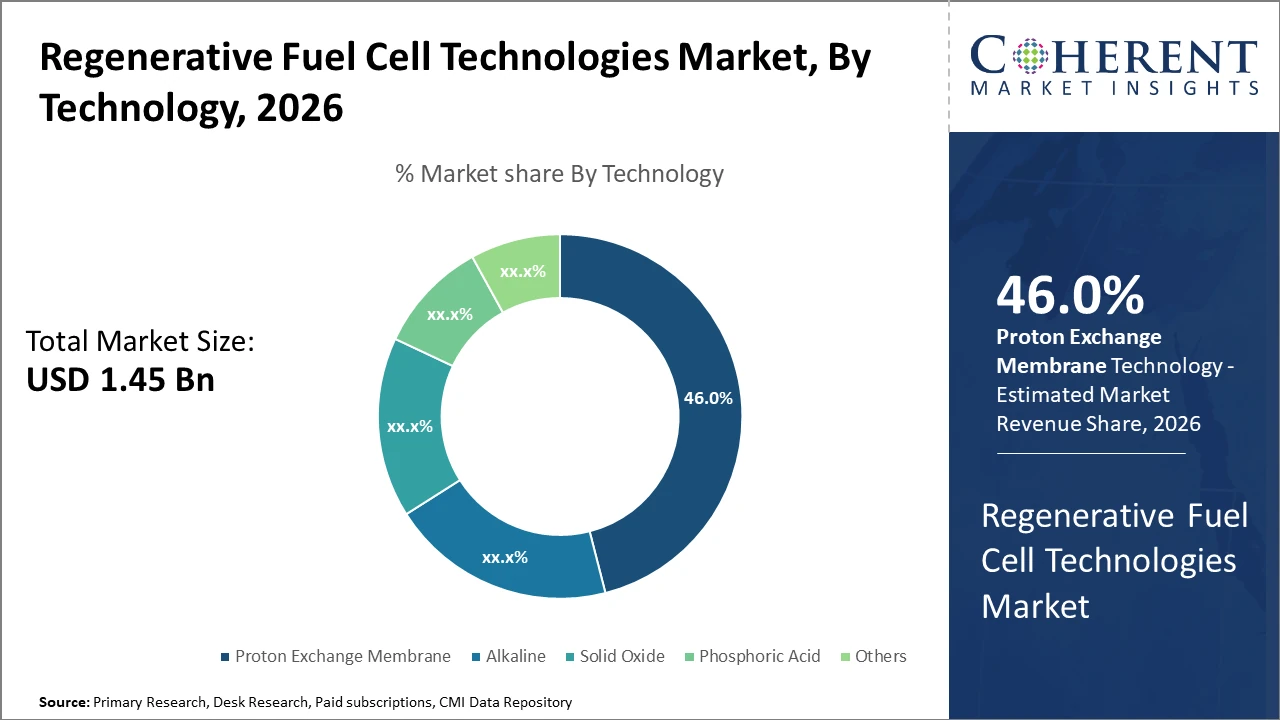
Proton exchange membrane fuel cells dominate the regenerative fuel cell technologies market with around 46% share due to their high proton conductivity, fast startup capability, compact design, and versatility across aerospace, defense, and stationary power applications. Continuous improvements in efficiency and reductions in catalyst costs further strengthen their market position. Solid oxide fuel cells are the fastest-growing segment because they operate at high temperatures, offer superior fuel flexibility, and provide long operational lifespans, making them suitable for industrial combined heat and power systems. Alkaline fuel cells maintain stable demand in aerospace applications because of their reliability and lower manufacturing costs, while phosphoric acid and other fuel cell technologies serve specialized backup and distributed power generation applications.
Regenerative Fuel Cell Technologies Market Insights, By Application
Aerospace and defense dominate the regenerative fuel cell technologies market with nearly 38% share due to rising demand for lightweight, energy-efficient, and long-duration power systems used in satellites, drones, spacecraft, and advanced military platforms. Government investments and research into next-generation propulsion and energy storage technologies continue supporting strong market growth in this segment. Stationary power is the fastest-growing application area because industries and utilities are increasingly adopting regenerative fuel cells for grid stabilization, renewable energy storage, and backup power solutions amid growing grid instability. Portable power applications maintain relevance in military and specialized electronics sectors, while transportation applications are gradually expanding through increasing interest in hydrogen-powered vehicles and auxiliary fuel cell power systems.
Regenerative Fuel Cell Technologies Market Insights, By Product Type
Fuel cell stacks dominate the regenerative fuel cell technologies market because they serve as the primary power-generating component responsible for system efficiency, performance, and energy conversion. Continuous advancements in stack architecture, catalyst materials, and thermal management technologies are improving durability while reducing overall operational costs. Bipolar plates represent the fastest-growing component segment due to innovations in lightweight composite materials and advanced manufacturing methods that enhance conductivity, corrosion resistance, and structural strength, particularly for aerospace and transportation applications. Membranes and electrodes are also experiencing steady growth as ongoing research focuses on improving proton exchange efficiency, system lifespan, and operational reliability. Other supporting components contribute to system integration, monitoring, and maintenance functions.
Regenerative Fuel Cell Technologies Market Trends
The regenerative fuel cell technologies market is increasingly adopting hybrid energy systems and modular designs, enabling broader deployment across stationary power, defense, aerospace, and renewable energy storage applications.
Advancements in modular bipolar plate manufacturing and lightweight component technologies are improving system durability, reducing maintenance downtime, and accelerating adoption in critical infrastructure and industrial power applications.
Expansion of green hydrogen production and hydrogen mobility initiatives, particularly in countries such as Japan, is strengthening demand for regenerative fuel cells integrated with renewable energy systems and long-duration energy storage networks.
Regenerative Fuel Cell Technologies Market Insights, By Geography
North America Regenerative Fuel Cell Technologies Market Analysis and Trends
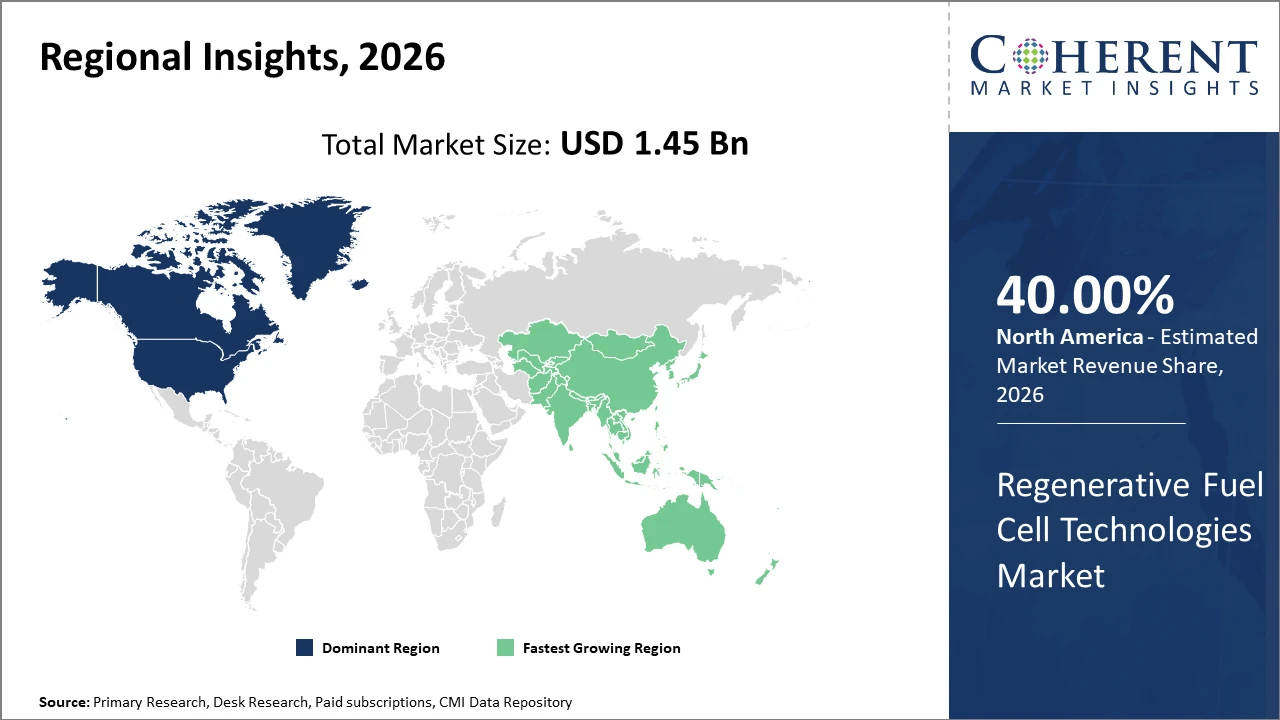
North America dominates the regenerative fuel cell technologies market due to advanced hydrogen infrastructure, strong government support, and substantial investments in clean energy innovation. The region accounts for nearly 40% of global market share, supported by policies such as the Inflation Reduction Act that encourage hydrogen production, renewable energy integration, and fuel cell deployment. Major aerospace, defense, and industrial companies continue investing in regenerative fuel cell systems for energy storage and backup power applications. Leading innovators such as Nuvera Fuel Cells and Plug Power are accelerating commercialization through advanced technology development, strategic partnerships, and large-scale hydrogen infrastructure projects across the region.
Asia Pacific Regenerative Fuel Cell Technologies Market Analysis and Trends
Asia Pacific is the fastest-growing region in the regenerative fuel cell technologies market, registering a CAGR exceeding 17% due to strong government incentives, rapid renewable energy deployment, and expanding industrial adoption of hydrogen-based energy systems. Countries such as China and India are investing heavily in hydrogen infrastructure, clean energy storage, and grid modernization projects to support decarbonization goals. Companies including AFC Energy and ITM Power are actively expanding partnerships and technology deployment across the region. Increasing renewable energy integration, industrial electrification, and supportive policy frameworks continue accelerating market expansion and strengthening Asia Pacific’s position in the global regenerative fuel cell ecosystem.
Regenerative Fuel Cell Technologies Market Outlook for Key Countries
USA Regenerative Fuel Cell Technologies Market Analysis and Trends
The United States regenerative fuel cell technologies market is driven by strong federal funding initiatives, expanding hydrogen infrastructure, and significant participation from the aerospace and defense industries. Government support for clean energy and advanced power systems continues accelerating research, commercialization, and deployment of regenerative fuel cell technologies across industrial and utility applications. The country benefits from advanced manufacturing capabilities, mature supply chains, and a highly concentrated technology expertise base. Major companies and research organizations are actively developing pilot projects involving regenerative fuel cells for next-generation aircraft, renewable energy storage, and defense systems. Continuous innovation in hydrogen-based power technologies is strengthening the nation’s leadership position in the global regenerative fuel cell market.
Germany Regenerative Fuel Cell Technologies Market Analysis and Trends
The Germany regenerative fuel cell technologies market is experiencing significant growth driven by the country’s strong focus on renewable energy transition and hydrogen economy development. Government initiatives supporting green hydrogen production, carbon neutrality targets, and clean energy infrastructure investments are accelerating adoption of regenerative fuel cell systems across industrial and utility sectors. German companies and research institutions are actively investing in proton exchange membrane and solid oxide fuel cell technologies to improve energy efficiency and long-duration storage capabilities. Increasing integration of renewable energy sources such as wind and solar power is further boosting demand for advanced hydrogen-based energy storage systems. Strategic collaborations and innovation programs continue shaping market expansion in Germany.
Analyst Opinion
Integration of regenerative fuel cells in aerospace, stationary power, and renewable energy systems is accelerating market adoption through improved efficiency, lightweight power generation, and long-duration energy storage capabilities.
Advancements in manufacturing processes, supply chain optimization, and material sourcing are reducing production costs and improving the commercial competitiveness of regenerative fuel cell technologies.
Rising investments from defense and space agencies are increasing deployment of regenerative fuel cells for mission-critical, weight-sensitive, and high-reliability energy applications.
Growing hydrogen infrastructure and renewable energy integration in Asia Pacific are significantly boosting regional deployment and shaping global market expansion trends.
- Current Industry Events
- Market Size Estimation
- Regional Breakdown
- Competitive Landscape
- Customer Intelligence
- Segmental Analysis
- Pricing Analysis
- Key Market Drivers, Challenges & Future Trends
- Customized Insights Section
Market Scope
| Report Coverage | Details | ||
|---|---|---|---|
| Base Year: | 2025 | Market Size in 2026: | USD 1.45 billion |
| Historical Data for: | 2020 To 2024 | Forecast Period: | 2026 To 2033 |
| Forecast Period 2026 to 2033 CAGR: | 15.8% | 2033 Value Projection: | USD 3.98 billion |
| Geographies covered: |
| ||
| Segments covered: |
| ||
| Companies covered: | Nuvera Fuel Cells, Ballard Power Systems, Plug Power Inc., FuelCell Energy Inc., Siemens Energy, AFC Energy plc, Energy Solutions AG, ITM Power Plc, Cummins Inc., General Electric | ||
| Growth Drivers: |
| ||
Regenerative Fuel Cell Technologies Market Growth Factors
The regenerative fuel cell technologies market is strongly driven by increasing government incentives supporting hydrogen infrastructure and clean energy development worldwide. Policies promoting decarbonization and renewable energy integration are accelerating adoption of regenerative fuel cell systems across industrial, utility, and transportation sectors. Technological advancements in proton exchange membrane fuel cells are improving energy density, operational durability, and overall system efficiency, helping reduce long-term operating costs. Rising deployment in aerospace applications is further supporting demand because regenerative fuel cells provide lightweight and high-performance onboard power solutions compared to conventional battery systems. In addition, growing grid instability and renewable energy expansion in Asia Pacific are increasing demand for regenerative fuel cells in stationary backup and grid-balancing applications.
Regenerative Fuel Cell Technologies Market Development
In September 2025, American Honda Motor Co., Inc. and Astrobotic Technology, Inc. signed a joint development agreement to create a scalable power solution for long-term lunar missions. The study will evaluate integrating Honda’s regenerative fuel cell system with Astrobotic’s Vertical Solar Array Technology and LunaGrid service to deliver continuous power during extended lunar darkness.
Key Players
Leading Companies of the Market
Nuvera Fuel Cells
Ballard Power Systems
Plug Power Inc.
FuelCell Energy Inc.
Siemens Energy
AFC Energy plc
ITM Power plc
General Electric
Cummins Inc.
Energy Solutions AG
Several major participants in the regenerative fuel cell technologies market are adopting strategic collaborations and innovation-driven expansion strategies to strengthen their competitive positioning. Ballard Power Systems established partnerships with aerospace manufacturers that significantly expanded the deployment of aerospace-specific regenerative fuel cell solutions in 2025, supporting advanced aircraft and defense energy applications. Simultaneously, Plug Power focused on product innovation, hydrogen ecosystem expansion, and vertical integration strategies to improve operational efficiency and accelerate commercialization. These initiatives contributed to stronger market penetration, enhanced technology capabilities, and increased revenue generation across clean energy, aerospace, and stationary power sectors globally.
Regenerative Fuel Cell Technologies Market Future Outlook
The regenerative fuel cell technologies market is expected to witness strong growth in the coming years due to increasing global investments in renewable energy, hydrogen infrastructure, and carbon reduction initiatives. Rising demand for long-duration energy storage solutions and efficient grid stabilization systems will accelerate adoption across utility, industrial, aerospace, and transportation sectors. Technological advancements in proton exchange membrane and solid oxide fuel cells are improving system efficiency, durability, and cost competitiveness. Governments worldwide are supporting clean hydrogen production and sustainable energy transition programs, creating favorable market conditions. In addition, growing integration of solar and wind energy with hydrogen-based storage systems is expected to drive continuous innovation and large-scale commercialization globally.
Regenerative Fuel Cell Technologies Market Historical Analysis
The regenerative fuel cell technologies market has evolved from early aerospace and defense research programs focused on efficient energy storage and power generation systems. During the late twentieth century, organizations such as NASA explored regenerative fuel cells for space missions due to their ability to generate electricity and recycle hydrogen and oxygen efficiently. Advancements in proton exchange membrane and solid oxide technologies during the 1990s and 2000s improved system reliability and energy efficiency, expanding commercial interest beyond aerospace applications. Growing global concerns regarding carbon emissions and fossil fuel dependence further accelerated development. In recent years, increasing investments in renewable energy integration and hydrogen infrastructure have significantly strengthened market growth worldwide.
Sources
Primary Research Interviews:
Market analysts, R&D directors, energy scientists, and regulatory experts involved in hydrogen economy development, fuel cell innovation, renewable energy integration, and long-duration energy storage technologies.
Utility companies, aerospace organizations, industrial energy users, and engineering firms implementing regenerative fuel cell systems for grid stabilization, backup power, and sustainable energy applications.
Magazines:
Fuel Cells Bulletin – Insights into hydrogen technologies, fuel cell developments, and renewable energy storage innovations.
Hydrogen Insight – Coverage of hydrogen economy trends, clean energy infrastructure, and fuel cell commercialization.
Power Engineering International – Updates on utility-scale energy systems, grid modernization, and advanced energy storage technologies.
Journals:
Journal of Power Sources – Research on fuel cell systems, electrolyzers, and hydrogen energy storage technologies.
International Journal of Hydrogen Energy – Studies focused on hydrogen production, regenerative fuel cells, and clean energy integration.
Energy Conversion and Management – Research on renewable energy systems, fuel cell efficiency, and sustainable power generation technologies.
Newspapers:
Financial Times – Coverage of renewable energy investments, hydrogen economy developments, and clean technology market trends.
Reuters – Reporting on regenerative fuel cell product launches, hydrogen infrastructure projects, and energy transition policies.
Bloomberg – Insights into mergers, acquisitions, R&D investments, and strategic developments among global clean energy and fuel cell companies.
Associations:
Fuel Cell & Hydrogen Energy Association – Standards, policy updates, and advancements in hydrogen and fuel cell technologies.
International Energy Agency – Research updates, renewable energy outlooks, and hydrogen transition initiatives.
Hydrogen Europe – Industry collaborations, regulatory developments, and innovation programs supporting hydrogen and regenerative fuel cell technologies.
Get access to 250+ pages report
Every segment, forecast, competitor profile and data table behind the analysis above — available for instant download.
- ESOMAR Member
- ISO 9001:2015 Certified
- D-U-N-S Registered
- GDPR & CCPA Compliant
Missing comfort of reading report in your local language? Find your preferred language:
Transform your Strategy with Exclusive Trending Reports
Frequently Asked Questions
Leading companies in the regenerative fuel cell technologies market include Nuvera Fuel Cells, Ballard Power Systems, Plug Power, and FuelCell Energy, recognized for strong technological innovation, strategic collaborations, and expanding commercialization activities across aerospace, defense, and renewable energy sectors.
The global regenerative fuel cell technologies market is projected to grow from USD 1.45 billion in 2026 to USD 3.98 billion by 2033, registering a compound annual growth rate (CAGR) of 15.8% during the forecast period.
Aerospace and defense represent the largest growth opportunity because of rising demand for lightweight, efficient, and long-duration power systems used in unmanned aerial vehicles, satellites, advanced aircraft, and space exploration applications.
Future market trends are expected to focus on modular regenerative fuel cell systems, hybrid energy integration, green hydrogen compatibility, and improved scalability for renewable energy storage and industrial power applications.
Future market trends are expected to focus on modular regenerative fuel cell systems, hybrid energy integration, green hydrogen compatibility, and improved scalability for renewable energy storage and industrial power applications.
Companies commonly adopt strategies such as partnerships with aerospace and energy firms, participation in government-funded hydrogen projects, investment in research and development, and diversification of applications across transportation, stationary power, and renewable energy storage sectors.