

Hydrogen Electrolyzer Market Size and Trends Forecast 2026 - 2033
The hydrogen electrolyzer market is estimated to be valued at USD 2.70 Bn in 2026 and is expected to reach USD 63.30 Bn by 2033, exhibiting a compound annual growth rate (CAGR) of 56.6% from 2026 to 2033.
Key Takeaways of the Hydrogen Electrolyzer Market
- The Proton Exchange Membrane (PEM) segment is expected to account for 38.4% of the market share in 2026.
- The 500 kW segment is expected to hold a 43.8% share of the market in 2026.
- The chemical industry segment is expected to account for 40.9% of the market share in 2026.
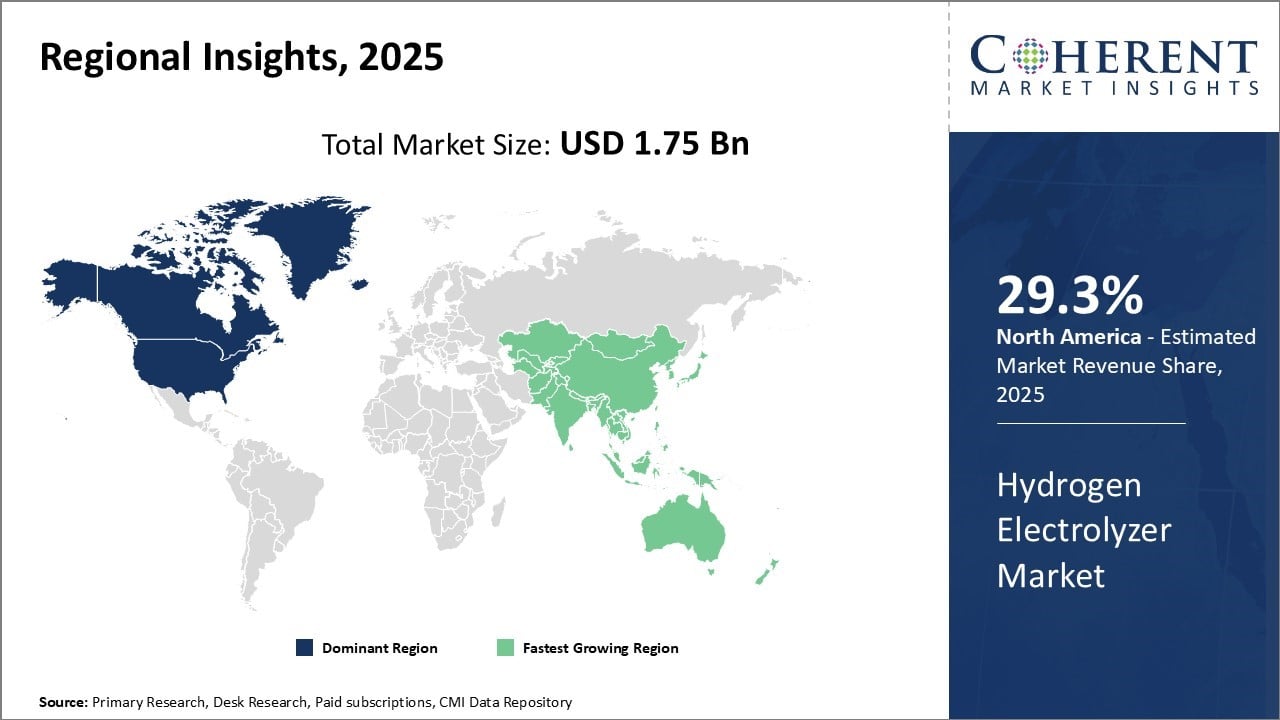
- North America is projected to top the market with 29. 3% share, followed by Asia Pacific with 22.0% share in 2026.
Market Overview
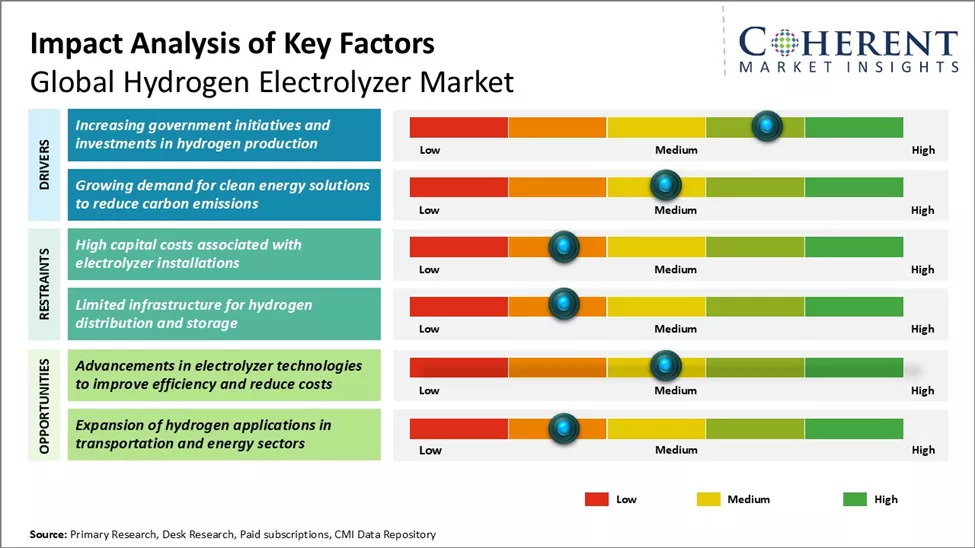
Increasing demand for zero-emission fuels and focus on the development of green hydrogen economy are supporting the market growth. The market is witnessing significant growth due to factors such as stringent emission norms, wide acceptance of fuel cell vehicles and stationary power generation, supportive government policies, and investments in hydrogen infrastructure projects. Rising awareness about environmental protection and sustainable energy production are further driving the demand for electrolyzers in various end-use industries such as automotive.
However, one of the key challenges faced by the market is the high capital costs associated with installing electrolyzer units.
Market Concentration and Competitive Landscape
Current Events and Their Impact on the Hydrogen Electrolyzer Market
Current Events | Description and its impact |
Geopolitical Trade Policies and Tariff Adjustments |
|
Material Supply Chain Volatility |
|
- Current Industry Events of 2026
- Market Size Estimation
- Regional Breakdown
- Competitive Landscape
- Customer Intelligence
- Segmental Analysis
- Pricing Analysis
- Key Market Drivers, Challenges & Future Trends
- Customized Insights Section
Market Trends
- Increasing Adoption of Renewable Energy Sources
The increasing adoption of renewable energy sources such as wind, solar, and hydropower is significantly propelling the growth of the hydrogen electrolyzer market. Hydrogen electrolyzers serve as critical components in the green hydrogen production process by using electricity derived from renewables to split water into hydrogen and oxygen through electrolysis. This clean hydrogen, free from carbon emissions, is emerging as a vital energy carrier capable of decarbonizing several hard-to-abate sectors including heavy industry, transportation, and energy storage.
For instance, according to the International Energy Agency (IEA), Modern bioenergy is today the largest source of renewable energy globally, with a more than 50% share of global use in 2023. Bioenergy is discussed separately, and this page is dedicated to other renewable technologies.
Segmental Insights
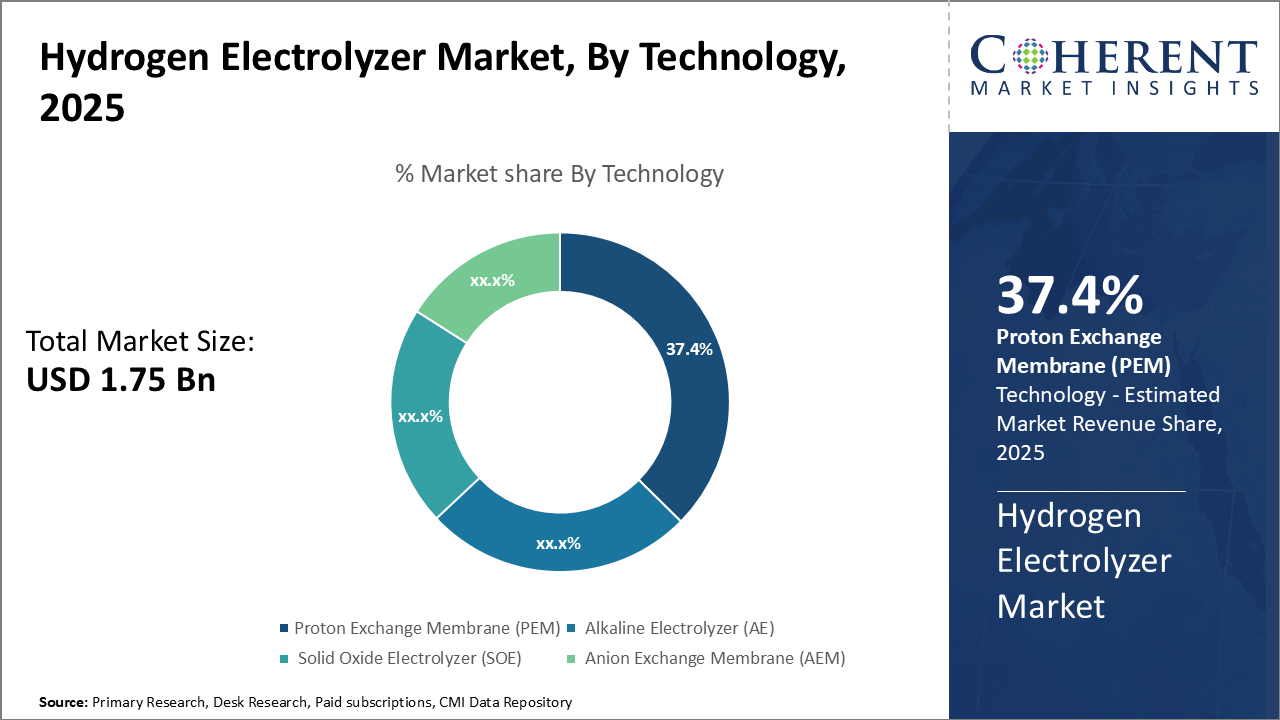
Hydrogen Electrolyzer Market Insights, By Technology: Flexibility Drives Proton Exchange Membrane (PEM) Technology Adoption
In terms of technology, the Proton Exchange Membrane (PEM) segment is expected to contribute 38.4% share of the market in 2026, owing to its flexibility in design and operation.
Proton Exchange Membrane (PEM) electrolyzers can operate at higher pressures over a wide range, from 5-30 bar. This flexibility allows PEM technology to cater to a variety of end-use applications. PEM also demonstrates improved dynamic response and can be shut down and restarted quicker as compared to other technologies. Its compact design makes PEM well-suited for small to medium scale decentralized hydrogen production near the point of use.
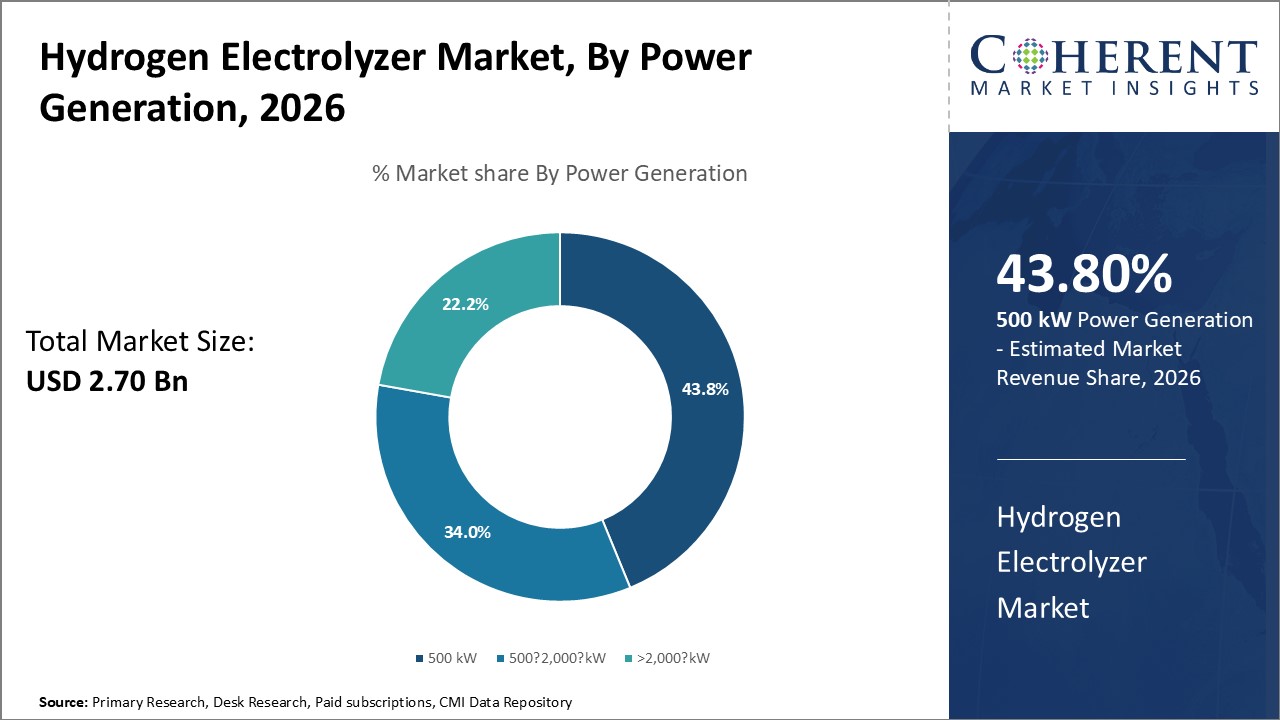
Hydrogen Electrolyzer Market Insights, By Power Generation : Power Capacity Drives Efficiency
In terms of power generation, the 500 kW segment is expected to contribute 43.8% share of the market in 2026, owing to optimal efficiency. Electrolyzer units with capacity in the 500-2,000 kW range offer maximum efficiency due to economies of scale.
Larger units above 2,000 kW have higher capital investments but marginal returns, while smaller below 500 kW units suffer from low load utilization factors. The 500-2,000 kW segment achieves high resource utilization as it can cater to both intermittent and scheduled demand cycles efficiently. These mid-sized plants can also be easily integrated within existing hydrogen infrastructure and transportation networks. The modular design allows the capacity to be scaled incrementally as hydrogen offtake grows.
Hydrogen Electrolyzer Market Insights, By End-use Industry: Chemical Applications Drive Consumption
In terms of end-use industry, the chemical industry segment is expected to contribute 40.9% share of the market in 2026, owing to vast hydrogen demand.
Hydrogen serves as a crucial feedstock and fuel in diverse chemical applications such as ammonia production, oil refining, and methanol synthesis. It is a fundamental industrial gas with immense and irreplaceable utility. The chemical sector relies on stable hydrogen supply to maintain operational continuity. Electrolytic hydrogen is poised to increasingly meet this bulk demand from the chemical industry. Its production can be easily scaled to match chemical plant requirements.
Emerging Innovations in the Hydrogen Electrolyzer Market
- Integration of Advanced Materials in Electrolyzer Components
- Research into highly conductive and durable catalyst layers, improved membranes, and corrosion-resistant bipolar plates is instrumental in extending electrolyzer lifetime and performance.
- For example, the adoption of nanostructured catalysts has resulted in enhanced catalytic activity, reducing the required catalyst loading and thus lowering costs.
- Research into highly conductive and durable catalyst layers, improved membranes, and corrosion-resistant bipolar plates is instrumental in extending electrolyzer lifetime and performance.
- Enhanced Capabilities that Reflect these Technological Trends
- Major players and emerging startups alike are unveiling new products with enhanced capabilities that reflect these technological trends.
- For example, recent Proton Exchange Membrane (PEM) electrolyzer models offer higher power densities and lower energy consumption per unit of hydrogen produced. Such products are tailored explicitly for coupling with large-scale renewable deployments, facilitating the creation of green hydrogen corridors and regional hydrogen hubs.
- Major players and emerging startups alike are unveiling new products with enhanced capabilities that reflect these technological trends.
Impacts of Artificial Intelligence (AI) on the Hydrogen Electrolyzer Market
The hydrogen electrolyzer market, pivotal for enabling clean energy transitions, is increasingly incorporating Artificial Intelligence (AI) to optimize processes, enhance product design, and scale sustainable energy solutions. AI’s integration offers transformative potential across production, operation, and maintenance stages, accelerating the adoption of green hydrogen on a global scale.
- Nel Hydrogen has advanced AI-driven solutions that improve user experience and operational outcomes for electrolyzer customers. Nel’s AI platform integrates machine learning models to optimize hydrogen output based on fluctuating renewable energy inputs, such as wind or solar power. This adaptive control system ensures maximal hydrogen production efficiency even in variable energy scenarios, directly benefiting end users who rely on consistent energy supply for industrial or mobility applications.
- Hydrogenics (now part of Cummins Inc.) employs AI-powered monitoring platforms in its electrolyzers to continuously track performance metrics. This implementation has significantly enhanced operational uptime and efficiency by enabling early fault detection and adaptive control strategies. By leveraging these capabilities, Hydrogenics delivers higher value and reliability, making green hydrogen production more financially viable.
Regional Insights
North America Hydrogen Electrolyzer Market Analysis and Trends
North America is expected hold a 29.3% share of the market in 2026, driven by substantial investments in hydrogen infrastructure and fuel-switching technologies. Countries like the U.S. and Canada have implemented initiatives to scale up green hydrogen production and integrate hydrogen-based solutions across industries.
For instance, several upcoming green hydrogen projects are expected to be developed across the U.S. over the next few years, reflecting a strong push toward clean energy initiatives and significant industry investment. States like Texas, Louisiana, California, and Wyoming are leading in green hydrogen development, reflecting a nationwide commitment to this clean energy source.
Asia Pacific Hydrogen Electrolyzer Market Analysis and Trends
The Asia Pacific region demonstrates the fastest growth in the market, with an estimated 22% of the market share in 2026. China’s emphasis on building a hydrogen economy, outlined in its 14th Five-Year Plan, has created significant opportunities for the adoption of electrolyzers.
Meanwhile, Japanese companies such as Toyota Tsusho, Air Liquide, and Panasonic are actively engaged in hydrogen initiatives, including large-scale projects and fuel cell investments, further accelerating the region's market expansion.
In February 2026, Malaysia's Sarawak province positioned itself as a renewable hydrogen hub through a comprehensive plan leveraging its renewable energy resources and aiming to catalyze clean energy growth across the Asia Pacific region and beyond.
U.S. Hydrogen Electrolyzer Market Analysis and Trends
The U.S. is witnessing a surge in hydrogen electrolyzer deployment, supported by government initiatives like the Hydrogen Production Tax Credit. This program aims to incentivize low-emission hydrogen production, with funding expected to accelerate project development. In 2023, the U.S. announced several large-scale hydrogen projects such as Plug Power's Green Hydrogen Projects, indicating a robust growth trajectory in the hydrogen electrolyzer market.
China Hydrogen Electrolyzer Market Analysis and Trends
China has rapidly become a leader in hydrogen electrolyzer capacity, driven by substantial government support and investment in renewable energy projects. By the end of 2023, China's installed electrolyzer capacity is expected to reach 1.2 gigawatts (GW), accounting for 50.5% of the global total, a significant increase from less than 10.5% in 2020 data reported by International Energy Agency in 2023.
A notable example of this expansion is Sinopec's 260 megawatt (MW) Kuqa project in Xinjiang, which began operations in 2023. This facility is currently the world's largest solar-to-hydrogen project, aiming to produce 20,000 tons of green hydrogen annually by utilizing solar power for electrolysis.
Japan Hydrogen Electrolyzer Market Analysis and Trends
Japan is advancing its hydrogen strategy with a focus on integrating hydrogen into its energy mix. The government has set a target to increase hydrogen supply to 3 million tons by 2030, according to data reported by Plug Power Inc. In 2023, Japan launched initiatives such as upgraded subsidy program for hydrogen fuel cell vehicle adoption to promote hydrogen fuel cell vehicles, further boosting the hydrogen electrolyzer market.
Germany Hydrogen Electrolyzer Market Analysis and Trends
Germany is a key player in the hydrogen electrolyzer market, focusing on green hydrogen production to meet its ambitious climate targets. The country plans to invest USD 9.418 billion in hydrogen technologies as part of its National Hydrogen Strategy. This investment is expected to enhance electrolyzer capacity significantly, supporting the transition to a low-carbon economy.
Pricing Analysis of the Hydrogen Electrolyzer Market
- End User Segmentation and Pricing Impact
- Industrial Hydrogen Production: Large industrial users such as refineries, fertilizer plants, and chemical manufacturers prioritize reliability and scale. They typically opt for alkaline or Proton Exchange Membrane (PEM) systems above 5 MW. Pricing is often customized, involving contract negotiation, volume discounts, and multi-year maintenance agreements. Cost per kW ranges roughly between USD 500 and USD 1,200.
- Utilities & Power Generation: Greenfield utility projects integrating hydrogen for grid balancing or synthetic fuel production typically prefer PEM electrolyzers due to flexibility and rapid load response. Prices here trend toward the premium spectrum (USD 1,000 – USD 1,600 / kW) to ensure performance.
- Transportation Fuel & Mobility: Hydrogen refueling stations and fuel cell vehicles require compact, highly responsive PEM electrolyzers, often in smaller capacity ranges (<1 MW). Price per kW is relatively higher (USD 1,200 – USD 1,800) due to smaller batch sizes and specialized integration.
- Residential & Small Commercial: Nascent market segment composed mostly of modular AEM and small PEM electrolyzers <100 kW. Prices can be steep (USD 2,000+ per kW) due to the lack of economies of scale, and early technology adoption costs.
Market Report Scope
Hydrogen Electrolyzer Market Report Coverage
| Report Coverage | Details | ||
|---|---|---|---|
| Base Year: | 2025 | Market Size in 2026: | USD 2.70 Bn |
| Historical Data for: | 2020 To 2024 | Forecast Period: | 2026 To 2033 |
| Forecast Period 2026 to 2033 CAGR: | 56.6%2033 Value Projection: | USD 63.30 Bn | |
| Geographies covered: |
| ||
| Segments covered: |
| ||
| Companies covered: | Siemens Energy AG, ITM Power plc, Nel ASA, Air Products and Chemicals, Inc., McPhy Energy S.A., Cummins Inc., Plug Power Inc., Thyssenkrupp AG, Ballard Power Systems Inc., Enel Green Power S.p.A., Hydrogenics (a Cummins Inc. company), Proton OnSite (a Nel ASA company), H2B2 Electrolysis Technologies, Green Hydrogen Systems A/S, and Anovion Battery Materials | ||
| Growth Drivers: |
| ||
| Restraints & Challenges: |
| ||
Hydrogen Electrolyzer Industry News
- In May 2025, ITM Power announced that the company had signed an agreement with a customer, confirming the selection as the supplier of over 300MW of electrolysers to produce green hydrogen for use in a power plant in the Asia Pacific (APAC) region, thereby avoiding carbon emissions.
- In March 2025, Nel Hydrogen US, a subsidiary of Nel ASA received a purchase order for one 2.5 MW containerized PEM unit for the Aberdeen Hydrogen Hub project in the north-east of Scotland. The scalable green hydrogen production, storage and distribution facility powered by renewable energy, is delivered through a joint venture between bp and Aberdeen City Council.
- In April 2025, Accelera by Cummins launched large-scale electrolyzer production in Guadalajara, Spain, aimed to boost Europe’s green hydrogen transition. The €50M facility produced up to 500MW of PEM electrolyzers annually, with plans to scale beyond 1GW. Sustainability is built in, with rooftop solar and geothermal systems meeting up to 70% of the site’s energy needs.
- In May 2025, Plug Power , a global leader in comprehensive hydrogen solutions, announced its hydrogen plant in Woodbine, Georgia produced 300 metric tons of liquid hydrogen in April 2025—the facility’s highest monthly output to date and a new benchmark for the U.S. hydrogen industry.
Analyst View
- The hydrogen electrolyzer market is positioned for significant transformative growth driven by the global transition toward clean and renewable energy sources. The increasing focus on decarbonization in industries such as transportation, power generation, and chemicals is a key driver propelling demand for green hydrogen production via electrolyzers. Government initiatives and supportive policies aimed at reducing carbon emissions further bolster adoption.
- However, high capital expenditure and operational costs related to electrolyzer technology currently act as notable restraints, limiting rapid market penetration, especially in developing regions.
- Technological advancements, including improvements in proton exchange membrane (PEM) and solid oxide electrolyzer cells (SOEC), present strong opportunities by enhancing efficiency and lowering costs. Increasing investments in research and development are anticipated to accelerate commercialization and scalability. Additionally, emerging applications such as hydrogen fueling stations and industrial hydrogen supply chains offer new revenue streams for market participants.
- Regionally, Asia Pacific is emerging as the fastest growing market, due to aggressive governmental commitments toward hydrogen economy roadmaps, coupled with extensive renewable energy capacity expansion. Europe continues to dominate, supported by mature infrastructure and robust policy frameworks prioritizing green hydrogen integration.
- North America is gaining momentum, driven by rising investments in clean energy projects and technological innovation hubs. Overall, while challenges remain, the hydrogen electrolyzer market’s outlook is optimistic, with evolving technologies and strategic policy support shaping its future trajectory.
Market Segmentation
- By Technology Insights (Revenue, USD Bn, 2021 2033)
- Proton Exchange Membrane (PEM)
- Alkaline Electrolyzer (AE)
- Solid Oxide Electrolyzer (SOE)
- Anion Exchange Membrane (AEM)
- By Power Generation Insights (Revenue, USD Bn, 2021 2033)
- 500 kW
- 500-2,000 kW
- 2,000 kW
- By End-use Industry Insights (Revenue, USD Bn, 2021 2033)
- Chemical Industry
- Refining
- Power Generation
- Others
- Regional Insights (Revenue, USD Bn, 2021 2033)
- North America
- U.S.
- Canada
- Latin America
- Brazil
- Argentina
- Mexico
- Rest of Latin America
- Europe
- Germany
- U.K.
- Spain
- France
- Italy
- Russia
- Rest of Europe
- Asia Pacific
- China
- India
- Japan
- Australia
- South Korea
- ASEAN
- Rest of Asia Pacific
- Middle East
- GCC Countries
- Israel
- Rest of Middle East
- Africa
- South Africa
- North Africa
- Central Africa
- Key Players Insights
- Siemens Energy AG
- ITM Power plc
- Nel ASA
- Air Products and Chemicals, Inc.
- McPhy Energy S.A.
- Cummins Inc.
- Plug Power Inc.
- Thyssenkrupp AG
- Ballard Power Systems Inc.
- Enel Green Power S.p.A.
- Hydrogenics (a Cummins Inc. company)
- Proton OnSite (a Nel ASA company)
- H2B2 Electrolysis Technologies
- Green Hydrogen Systems A/S
- Anovion Battery Materials
Sources
Primary Research Interviews
- Hydrogen Electrolyzer Manufacturers
- Industry Experts & Consultants
- Technology Providers in Electrolysis
- End-Users in Energy and Power Sector
- Others
Magazines
- Hydrogen Today Magazine
- Fuel Cell & Hydrogen Energy Association (FCHEA) Journal
- Renewable Energy World Magazine
- Green Technology Magazine
- Others
Journals
- International Journal of Hydrogen Energy
- Journal of Power Sources
- Energy Reports
- Others
Newspapers
- The Financial Times (Energy Section)
- The Wall Street Journal (Clean Energy Section)
- The Guardian (Sustainable Business)
- The Economic Times (Energy Section)
- Others
Associations
- Hydrogen Council
- Fuel Cell & Hydrogen Energy Association (FCHEA)
- International Partnership for Hydrogen and Fuel Cells in the Economy (IPHE)
- American Hydrogen Association
- Others
Public Domain Sources
- International Energy Agency (IEA)
- U.S. Department of Energy (DOE)
- European Commission Reports
- World Hydrogen Leaders Summit Publications
- Others
Proprietary Elements
- CMI Data Analytics Tool – Hydrogen electrolyzer Market
- CMI Existing Repository of Information for the Last 8 Years
*Definition: A hydrogen electrolyzer is an electrochemical device that uses electricity to split water into its constituent gases—hydrogen and oxygen—by driving the non-spontaneous process of electrolysis. It consists of an anode, cathode, and an electrolyte or membrane; when electric current is applied, water molecules at the anode release oxygen and protons, which pass through the membrane to the cathode, where they combine with electrons to form high-purity hydrogen gas.
Get access to 250+ pages report
Every segment, forecast, competitor profile and data table behind the analysis above — available for instant download.
- ESOMAR Member
- ISO 9001:2015 Certified
- D-U-N-S Registered
- GDPR & CCPA Compliant
Missing comfort of reading report in your local language? Find your preferred language:
Transform your Strategy with Exclusive Trending Reports
Frequently Asked Questions
The hydrogen electrolyzer market is estimated to be valued at USD 2.70 Bn in 2026, and is expected to reach USD 63.30 Bn by 2033.
The CAGR of the hydrogen electrolyzer market is projected to be 56.6% from 2026 to 2033.
Increasing government initiatives and investments in hydrogen production and growing demand for clean energy solutions to reduce carbon emissions are the major factors driving market growth for hydrogen electrolyzer.
High capital costs associated with electrolyzer installations and limited infrastructure for hydrogen distribution and storage are the major factors hampering the market growth for hydrogen electrolyzers.
In terms of technology, the Proton Exchange Membrane (PEM) is estimated to dominate the market revenue share in 2026.
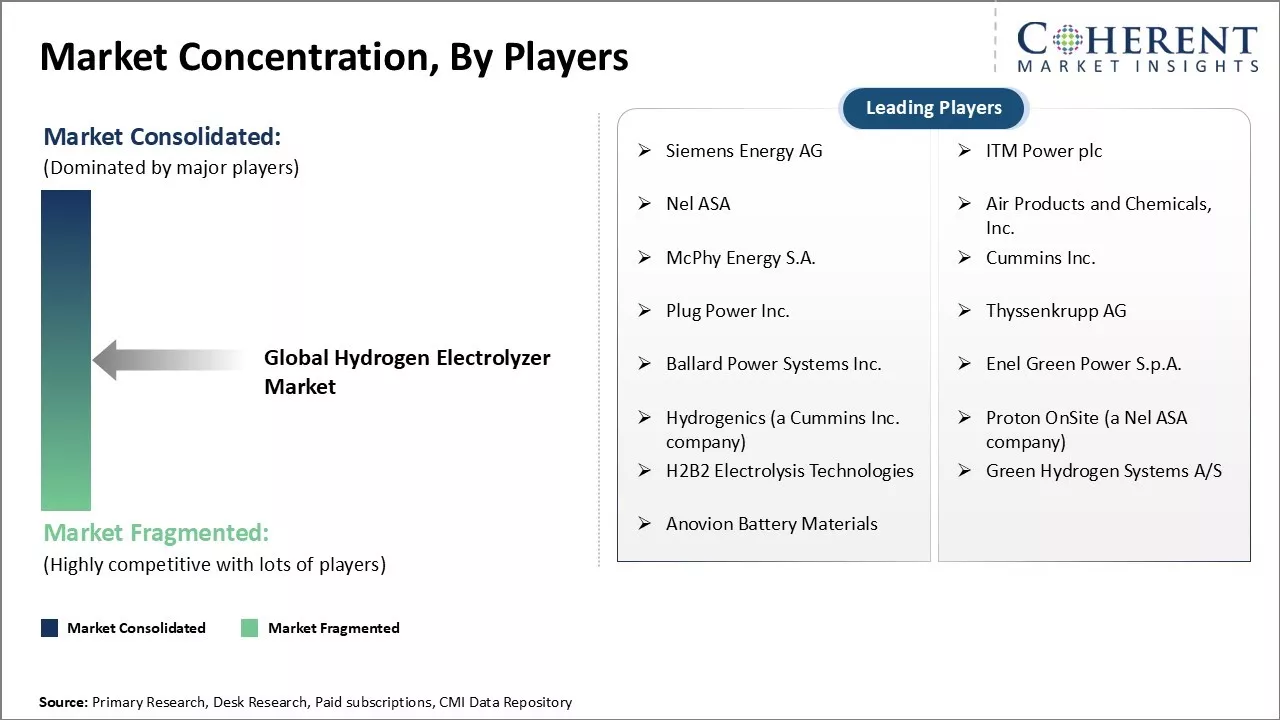
The major players operating in the global hydrogen electrolyzer market includes Siemens Energy AG, ITM Power plc, Nel ASA, Air Products and Chemicals, Inc., McPhy Energy S.A., Cummins Inc., Plug Power Inc., Thyssenkrupp AG, Ballard Power Systems Inc., Enel Green Power S.p.A., Hydrogenics (a Cummins Inc. company), Proton OnSite (a Nel ASA company), H2B2 Electrolysis Technologies, Green Hydrogen Systems A/S, and Anovion Battery Materials.
North America is expected to lead the hydrogen electrolyzer market in 2026.