

North America Pressure Pumping Market Size and Share Analysis - 2026 To 2033
The North America Pressure Pumping Market size is anticipated to grow at a CAGR of 2.6%, with an estimated market value of USD 33.98 Bn in 2026, and is expected to reach approximately USD 40.67 Bn by 2033. Market growth is primarily supported by continued hydraulic fracturing activity, development of unconventional oil and gas resources, increasing drilling and well-completion activities, and demand for higher-efficiency pressure pumping services across major North American shale basins. Technological advancements in pumping equipment, greater use of high-horsepower fleets, and operators’ focus on improving well productivity are also expected to support demand for pressure pumping services. The growing crude oil demand is also accelerating the industry’s growth. According to the U.S. Energy Information Administration (EIA), U.S. crude oil production reached a record 13.6 million barrels per day in 2025, while the Permian Basin alone produced approximately 6.6 million barrels per day, accounting for around 48% of total U.S. crude oil production.
Key Takeaways
- The horizontal wells segment is likely to dominate the North America pressure pumping market with 74.5% in 2026. The segment’s growth is owing to the extensive deployment of long-lateral horizontal wells, multi-stage completions, higher pressure-pumping intensity per well, and continued development of major shale formations.
- The hydraulic fracturing segment is set to lead the market with 69.0% in 2026. The segment’s growth is owing to increasing completion intensity, longer horizontal laterals, greater numbers of fracturing stages, higher proppant requirements, and adoption of electric and dual-fuel frac fleets. As an indication of the importance of hydraulic fracturing within North American completion services, ProPetro reported that hydraulic fracturing accounted for approximately 66.1% of its total revenues and operations as of March 31, 2026, while its available hydraulic fracturing capacity stood at approximately 1.25 million hydraulic horsepower.
- The unconventional resources segment is expected to dominate with 74.0% in 2026. The segment’s growth is owing to sustained development of shale and tight oil and gas formations, particularly across the Permian, Bakken, Eagle Ford, Haynesville, and Appalachia regions, where commercial production generally requires intensive stimulation and pressure-pumping services. According to the EIA, shale and tight formations in the Permian Basin produced approximately 6.0 million barrels per day of crude oil in December 2025, equivalent to 44% of total U.S. oil production, along with 22.2 Bcf/d of dry natural gas.
Market Drivers
Growing Natural Gas and LNG Demand is Supporting Gas-Basin Completion Activity
Liquefied Natural Gas (LNG) exports from the U.S. as well as the rising use of natural gas in the country have led to further exploitation of gas reserves in large basins including Haynesville, Appalachia, and the Permian basins, which depend heavily on fracking operations.
According to the EIA, the marketed natural gas production in the U.S. touched a record high of 118.5 Bcf/d in 2025, representing an increase of 5.3 Bcf/d over the year 2024. Appalachia, Permian, and Haynesville combined contributed to 67% of total marketed natural gas production in the U.S. and 81%.
Electrification and Automation of Fracturing Fleets are Accelerating Fleet Modernization
The North America pressure pumping industry is experiencing a technological shift from diesel fracturing fleets to electric fleets, automation of pumping systems, real-time monitoring, and digitally optimized well completions processes. This technology may increase efficiency in the usage of the equipment, operational consistency, efficiency in pumping, and site level productivity.
According to Halliburton's 2025 report, 50% of the North American fracturing fleet was converted to ZEUS electric pumps, illustrating the growing commercialization of the use of electric pressure pumps. ZEUS electric pumps by Halliburton are capable of delivering up to 5,000 hydraulic horsepower per pump, resulting in faster pumping but with fewer pumping units.
Current Events and Their Impact on the North America Pressure Pumping Market
Current Event | Description and its Impact |
U.S. EPA Eases Selected Oil & Gas Methane Compliance Requirements (2026) |
|
Canada Finalizes Enhanced Oil & Gas Methane Regulations (2025–2026) |
|
- Current Industry Events of 2026
- Market Size Estimation
- Regional Breakdown
- Competitive Landscape
- Customer Intelligence
- Segmental Analysis
- Pricing Analysis
- Key Market Drivers, Challenges & Future Trends
- Customized Insights Section
Segmental Insights
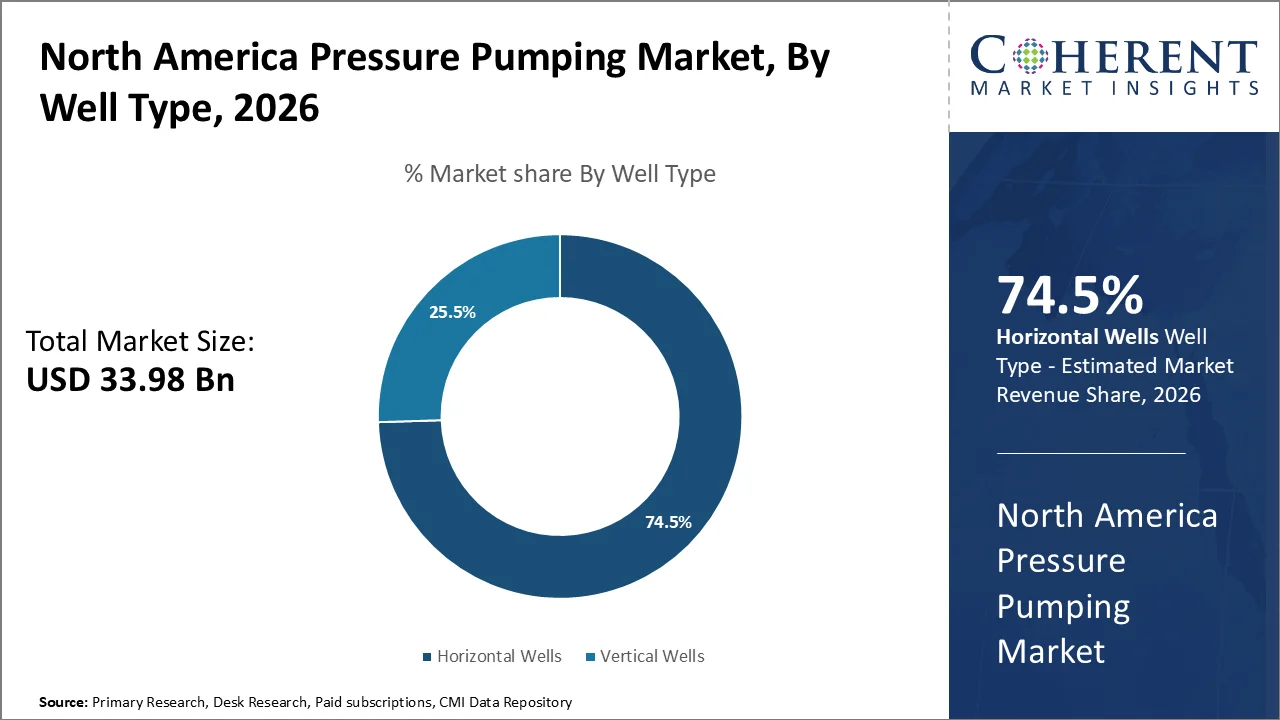
Why are Horizontal Wells Acquiring the Largest Share?
On the basis of well type, the horizontal wells segment is projected to account for the largest North America Pressure Pumping Market share of 74.5% in 2026. The segment’s growth is owing to greater reservoir contact, longer lateral sections, multi-stage completions, and the extensive development of shale and tight formations across the Permian, Montney, Bakken, Eagle Ford, and Appalachia.
According to the Canada Energy Regulator (CER), Canadian natural gas production averaged approximately 19.2 Bcf/d during the first five months of 2025, with Alberta and British Columbia accounting for around 59.4% and 38.9%, respectively. The CER specifically attributes continued production growth to expanded development of the Montney Formation, supported by advances in horizontal drilling and hydraulic fracturing.
In May 2026, Devon Energy acquired approximately 16,300 net undeveloped acres in the Delaware Basin for USD 2.6 billion. The acquired acreage adds approximately 400 net drilling locations normalized to two-mile horizontal laterals.
Why is Hydraulic Fracturing Acquiring the Largest Share?
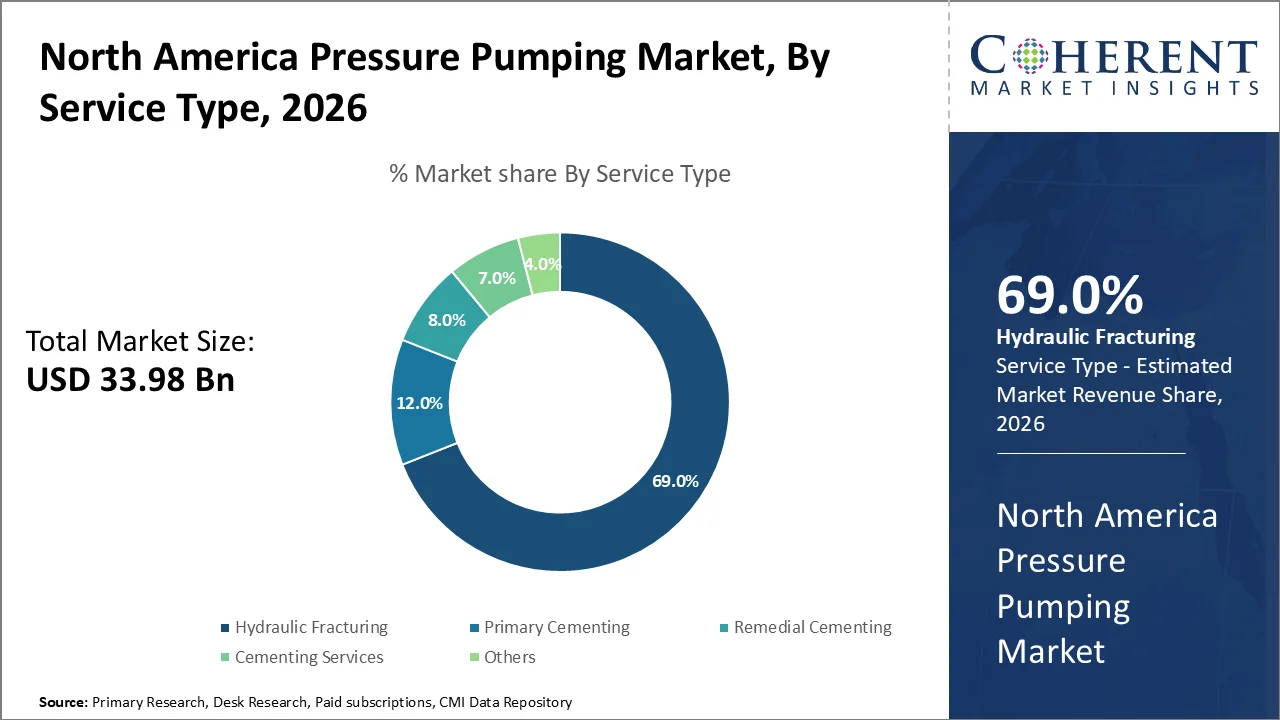
On the basis of service type, the hydraulic fracturing segment is expected to lead the North America Pressure Pumping Market with a 69.0% share in 2026. The segment’s dominance is owing to the widespread use of multi-stage fracturing in horizontal shale wells, increasing completion intensity, simultaneous well stimulation, and greater requirements for pumping horsepower, fracturing fluids, and proppants.
In its 2025 annual filing, Diamondback Energy reported drilling 463 gross operated horizontal wells and completing 503 gross operated horizontal wells during 2025. The corporation is expected to spend USD 3.05 to 3.27 billion on horizontal wells drilling and completion in 2026. This clearly indicates the level of investment in activities that need fracking services.
In May 2026, Halliburton exhibited the ZEUS IQ intelligent fracturing system at its 2026 Technology Showcase in Houston through its integration of ZEUS electric fracturing pumping unit, OCTIV Auto Frac system, ExpressAccess continuous pumping, and VoltaGrid power systems.
Why are Unconventional Resources Acquiring the Largest Share?
On the basis of resource type, the unconventional resources segment is expected to account for the largest North America Pressure Pumping Market share of 74.0% in 2026. The segment’s growth is owing to the high dependence of shale and tight reservoirs on horizontal drilling, multi-stage hydraulic fracturing, high-pressure stimulation, and repeated completion activities to achieve commercially viable hydrocarbon production.
According to the Canada Energy Regulator's Canada’s Energy Future 2026, tight gas already represented 68% of Canadian natural gas production in 2024, compared with only 28% in 2005. Under its Current Measures scenario, CER expects this share to increase further to 85% by 2035. The regulator notes that tight gas reservoirs typically require a combination of horizontal drilling and multi-stage hydraulic fracturing to achieve economic production rates.
In February 2026, Ovintiv completed its USD 2.7 billion acquisition of NuVista Energy, significantly expanding its position in the Alberta Montney, one of North America’s major unconventional oil and natural gas formations.
North America Pressure Pumping Market Trends
- The increasing transition from conventional diesel-powered pressure pumping fleets toward electric and dual-fuel fracturing systems is reshaping the North America market. These fleets save on the use of diesel fuel, reduce emissions, reduce noise pollution, and lower operation costs at the same time. According to ProPetro, by December 2025, ProPetro owned about 312,000 hydraulic horsepower of FORCE electrical equipment, which is five electric frac fleets. By the first quarter of 2026, there were four FORCE fleets under contract.
- The growing adoption of simul-frac and triple-frac completion techniques is increasing the amount of pressure pumping work performed simultaneously at multi-well pads. In 2025, Chevron planned to use triple-frac on nearly 50% of its Permian Basin wells, compared with around 25% in 2024.
- The increasing development of longer horizontal laterals is raising stimulation intensity per well and changing pressure pumping requirements across major shale basins. Permian Resources expects its average lateral length to reach approximately 11,000 feet in 2026, around 500 feet longer than in 2025, while its drilling and completion costs per foot are expected to decrease by around 8% year-on-year.
U.S. Dominates the North America Pressure Pumping Market
The U.S. is predicted to hold about an 82.5% share of the North America Pressure Pumping Market in 2026. The reason for this domination lies in the huge shale and tight-oil reserves of the country along with the high number of horizontal wells, multi-stage fracturing operations, and drilling activities in basins like the Permian, Eagle Ford, Bakken, Haynesville, and Appalachia.
Canada Pressure Pumping Market Trends
Canada is expected to remain a major contributor to the North America Pressure Pumping Market, driven particularly by growing unconventional natural gas and liquids-rich development across Alberta and British Columbia, including the Montney Formation. Increasing LNG export capacity and continued horizontal drilling are encouraging producers to maintain drilling and completion activity in western Canada.
Who are the Major Companies in North America Pressure Pumping Industry
Some of the major key players in North America Pressure Pumping Market are Halliburton, RPC, Inc., Baker Hughes, Calfrac Well Services Ltd, Schlumberger, Frac Tech Services, International Step Energy Services Ltd., Trican Well Services Ltd., Key Energy Services, Sanjel Energy Services, Liberty Oilfield Services, Consolidated Oil Well S2ervices, LLC Magnum Cementing Services, and Ltd. Nine Energy Services.
Key News
- In January 2026, Baker Hughes launched Kantori, an AI- and physics-based autonomous well construction platform integrating planning, execution, monitoring, and optimization workflows. The platform supports increasingly automated drilling and completion operations across upstream oil and gas projects.
- In May 2026, Nine Energy Service announced that cumulative sales of its Scorpion Composite Frac Plug surpassed 500,000 units. The company also opened a new wireline facility in the Haynesville to expand its participation in natural-gas well completion and multi-stage fracturing activity.
Market Report Scope
North America Pressure Pumping Market Report Coverage
| Report Coverage | Details | ||
|---|---|---|---|
| Base Year: | 2025 | Market Size in 2026: | USD 33.98 Bn |
| Historical Data for: | 2020 To 2024 | Forecast Period: | 2026 To 2033 |
| Forecast Period 2026 to 2033 CAGR: | 2.6% | 2033 Value Projection: | USD 40.67 Bn |
| Segments covered: |
| ||
| Companies covered: | Halliburton, RPC, Inc., Baker Hughes, Calfrac Well Services Ltd, Schlumberger, Frac Tech Services, International Step Energy Services Ltd., Trican Well Services Ltd., Key Energy Services, Sanjel Energy Services, Liberty Oilfield Services, Consolidated Oil Well S2ervices, LLC Magnum Cementing Services, and Ltd. Nine Energy Services. | ||
| Growth Drivers: |
| ||
| Restraints & Challenges: |
| ||
Analyst Opinion
- The North America pressure pumping market is increasingly being driven by completion efficiency and stimulation intensity rather than simply higher rig counts. According to the U.S. Energy Information Administration (EIA), Lower-48 active rig counts declined 5% in 2025 and wells drilled decreased 1%, yet U.S. crude oil production increased 3% to a record 13.6 million barrels per day. This indicates that longer laterals, optimized frac designs, and higher productivity per well are allowing pressure pumping demand to remain resilient even under disciplined drilling programs.
- The outlook for pressure pumping is also strengthening around natural-gas-focused unconventional basins as LNG export infrastructure expands. According to the Canada Energy Regulator, the highest level of natural gas production in Canada since its discovery was recorded at 19.0 Bcf/d in 2025, up by 3.8% from 2024, while production growth mainly came from the Montney region in Alberta and British Columbia. The first shipment of liquefied natural gas (LNG) from LNG Canada started in June 2025.
- The pressure pumping competitive landscape is moving towards the next generation of fleets that have reduced emissions and digitization capabilities, which will likely result in higher technology valuations per fracturing job. In July 2026, Liberty Energy launched its first digiPrime fleet in Canada and began operating its SLXRRY last mile sand slurry transport service to decrease costs of delivered sand, trucks, wear on roads, dust and emissions. This indicates that future market growth will increasingly favor providers capable of combining pressure pumping horsepower with automation, cleaner-fuel systems, and integrated proppant logistics.
Speak to the analyst
Want personalized insights?
Take the findings above to one of our principal consultants, or have the report rebuilt around the segments, geographies and competitors you actually track.
Market Segmentation
- By Well Type (Revenue, USD Bn, 2021-2033)
- Vertical Wells
- Horizontal Wells
- By Service Type (Revenue, USD Bn, 2021-2033)
- Cementing Services
- Remedial cementing
- Primary cementing
- Hydraulic fracturing
- Others
- By Resources Type (Revenue, USD Bn, 2021-2033)
- Unconventional
- Conventional
Sources
Primary Research Interviews
- Pressure pumping and hydraulic fracturing service providers
- Drilling, completion, and stimulation engineers
- Exploration & production (E&P) company completion managers
- Frac fleet and field operations managers
- Pressure pumping equipment manufacturers and technology providers
- Proppant, fracturing fluid, and oilfield chemical suppliers
- Well cementing and stimulation service providers
- Oilfield equipment distributors and rental service providers
Databases
- U.S. Energy Information Administration (EIA)
- Canada Energy Regulator (CER)
- Alberta Energy Regulator (AER)
- Baker Hughes North America Rig Count
- FracFocus Chemical Disclosure Registry
- Enverus
- S&P Global Commodity Insights
Magazines
- Journal of Petroleum Technology (JPT)
- Hart Energy
- World Oil
- Oil & Gas Journal
- E&P Magazine
Journals
- SPE Journal
- SPE Production & Operations
- Petroleum Science
- Geoenergy Science and Engineering
- Fuel
- Journal of Energy Resources Technology
Newspapers
- Reuters
- The Wall Street Journal
- Financial Times
- The Globe and Mail
- Calgary Herald
Associations
- Society of Petroleum Engineers (SPE)
- American Petroleum Institute (API)
- International Association of Drilling Contractors (IADC)
- Energy Workforce & Technology Council (EWTC)
- Canadian Association of Energy Contractors (CAOEC)
Public Domain Sources
- Company Annual Reports, SEC Filings, and Investor Presentations
- U.S. EIA Oil, Gas, Drilling, and Well Productivity Data
- Canada Energy Regulator and Alberta Energy Regulator Publications
- U.S. Environmental Protection Agency (EPA) Regulations
- Bureau of Land Management (BLM) Oil & Gas Leasing Data
- State Oil & Gas Regulatory Agency Publications
- Company Press Releases and Technology Launch Announcements
- Hydraulic Fracturing and Well Completion Technical Publications
- U.S. Patent and Trademark Office (USPTO) Patent Database
Proprietary Elements
- CMI Data Analytics Tool
- Proprietary CMI Existing Repository of Information for the Last 10 Years
Get access to 250+ pages report
Every segment, forecast, competitor profile and data table behind the analysis above — available for instant download.
- ESOMAR Member
- ISO 9001:2015 Certified
- D-U-N-S Registered
- GDPR & CCPA Compliant
Missing comfort of reading report in your local language? Find your preferred language:
Transform your Strategy with Exclusive Trending Reports
Frequently Asked Questions
The North America Pressure Pumping Market is expected to reach approximately USD 40.67 Bn by 2033, compared with USD 33.98 Bn in 2026.
Major players operating in the North America Pressure Pumping Market include Halliburton, RPC, Inc., Baker Hughes, Calfrac Well Services Ltd, Schlumberger, Frac Tech Services, International Step Energy Services Ltd., Trican Well Services Ltd., Key Energy Services, Sanjel Energy Services, Liberty Oilfield Services, Consolidated Oil Well S2ervices, LLC Magnum Cementing Services, and Ltd. Nine Energy Services.
The high capital investment and fleet maintenance costs, along with volatility in crude oil and natural gas prices, are among the major challenges hampering market growth.
The increasing development of shale and unconventional oil & gas resources, along with rising adoption of horizontal drilling and multi-stage hydraulic fracturing, is driving demand for pressure pumping services.
The North America Pressure Pumping Market is anticipated to grow at a CAGR of 2.6% between 2026 and 2033.
The U.S. is expected to dominate the North America Pressure Pumping Market, accounting for approximately 82.5% of the market share in 2026, supported by extensive shale development, horizontal drilling, and large-scale hydraulic fracturing activity.
The horizontal wells segment is expected to dominate with approximately 74.5% share in 2026, owing to longer laterals, greater reservoir contact, multi-stage completions, and extensive shale development.