

Well Intervention Market Size and Share Analysis - Growth Trends and Forecasts (2026–2033)
The Well Intervention Market size is anticipated to grow at a CAGR of 5.0%, increasing from USD 10.1 Bn in 2026 to USD 14.2 Bn by 2033. The market growth is primarily driven by rising investments in mature oil and gas fields, increasing demand for enhanced oil recovery, growing offshore exploration and production activities, and the need to improve production efficiency from aging wells. Well intervention helps operators conduct their activities such as maintenance, repairs, stimulation, diagnosis, and production optimization without having to undertake the process of abandonment or drilling of the wells. The growing use of modern technology such as the coiled tubing, wireline services, hydraulic workover unit, and well monitoring will help drive growth in the market. According to the International Energy Agency, global upstream oil and gas investment was expected to reach nearly USD 570 Bn in 2025.
Key Takeaways
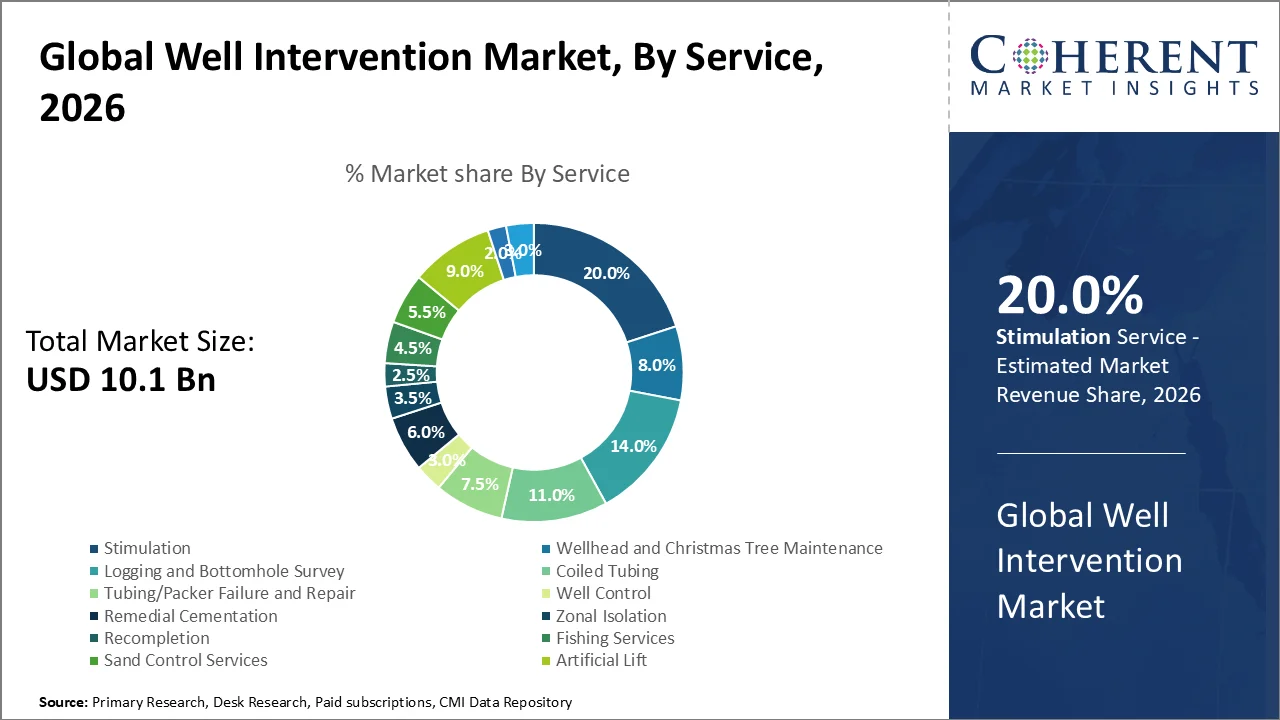
- The stimulation segment is likely to dominate the market with 20.0% in 2026. The segment’s growth is owing to the increasing use of acidizing, hydraulic fracturing, scale removal, and other production-enhancement treatments across mature and underperforming wells. As per International Energy Agency, global upstream oil and gas investments were expected to touch USD 569 Bn by 2025, of which around 40 percent would be invested in arresting the decline rates from existing oil and gas fields.
- The onshore segment is set to lead the market with 68.0% in 2026. The segment’s dominance is owing to the large installed base of land-based wells, lower equipment-mobilization costs, shorter service cycles, and recurring intervention requirements across mature and unconventional fields. The U.S. Energy Information Administration reported 918,481 producing oil and natural gas wells in the U.S. in 2024, while approximately 78% of producing wells generated 15 barrels of oil equivalent per day or less, highlighting the extensive base of low-producing wells that may require optimization, maintenance, and stimulation.
- The light intervention segment is expected to hold a larger market share of 57.0% in 2026. The domination of the light intervention category is due to the regular use of wireline, slickline, logging, perforation, well monitoring, valve repairs, and other light intervention activities that can be carried out without using a conventional workover rig. According to Expro, their light well circulation technology helped them restore the safety valves’ ability in four offshore wells with a 100% success ratio by utilizing 85% less acid, i.e., 46 barrels instead of 320 barrels that were used previously through the surface pumping process.
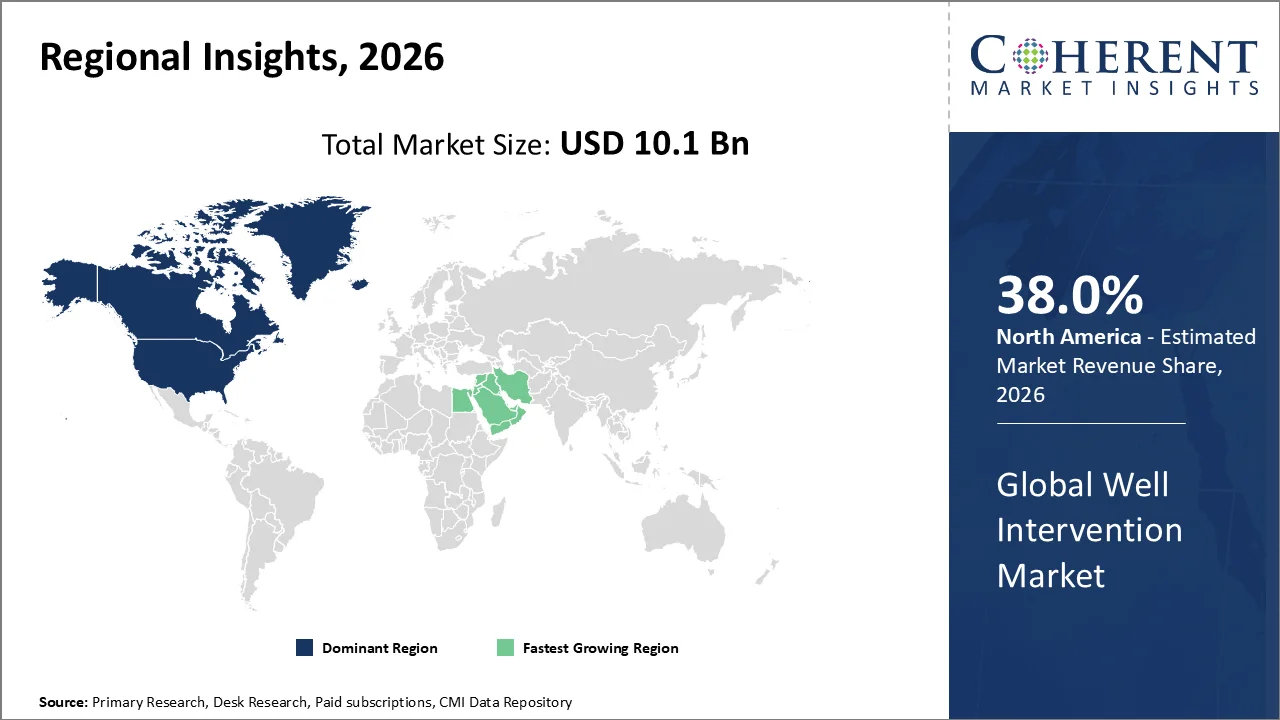
- The North American region is set to dominate the global well intervention market with 38.0% in 2026. The region’s leadership is owing to its large inventory of mature and unconventional wells, frequent production-decline management requirements, extensive shale operations, and high adoption of coiled tubing, stimulation, artificial lift, logging, and remedial well services. The U.S. Energy Information Administration reported that the Permian region produced approximately 6.6 million barrels of crude oil per day in 2025, accounting for 48% of total U.S. crude oil production.
Market Drivers
Increasing Focus on Mature-Field Optimization is Driving the Well Intervention Market
The increasing need to extend the productive life of mature oil and gas fields is a major driver of the well intervention market. As reservoir pressure declines and water production, scale deposition, tubing damage, and mechanical failures increase, operators require stimulation, recompletion, artificial-lift optimization, reperforation, and remedial services to maintain commercially viable production.
Petrobras’ 2026–2030 Business Plan allocates USD 69.2 billion to exploration and production projects. The firm will boost production by using better management of reservoirs, supplementary wells, and production systems, with particular emphasis on enhancing the longevity of mature assets. Well-interventions and subsea inspection are also part of the firm’s cost-efficient strategy, thus illustrating the way in which interventions have become an important part of the management of mature assets.
Expansion of Coiled Tubing and Rigless Technologies is Improving Intervention Efficiency
Adoption of coiled tubing and rigless techniques is taking place at an ever-increasing pace because through these technologies, one can carry out activities like well clean outs, acid stimulation, nitrogen lifting, logging, re-perforating and mechanical repairs, without having to deploy a traditional workover rig.
In October 2025, Baker Hughes was awarded a multi-year contract by Aramco to extend its operations on integrated underbalanced coiled tubing drilling throughout Saudi Arabia. As per the terms of this agreement, Baker Hughes is expected to boost its number of coiled tubing drilling rigs from four to ten, which is a 150% rise. This project involves both re-entry and greenfield drilling in existing as well as new gas fields.
Current Events and Their Impact on the Well Intervention Market
Current Event | Description and its Impact |
U.S. Government Mandates Expanded Gulf Offshore Lease Sales under the OBBBA (2025–2026) |
|
UK North Sea Transition Authority Intensifies Enforcement of Well-Decommissioning Deadlines (2025) |
|
- Current Industry Events of 2026
- Market Size Estimation
- Regional Breakdown
- Competitive Landscape
- Customer Intelligence
- Segmental Analysis
- Pricing Analysis
- Key Market Drivers, Challenges & Future Trends
- Customized Insights Section
Segmental Insights
Why is Stimulation Acquiring the Largest Share?
On the basis of service, the stimulation segment is projected to account for the largest Well Intervention Market share of 20.0% in 2026. The segment’s growth is owing to the increasing requirement to restore reservoir connectivity, improve hydrocarbon flow, address declining well productivity, and enhance recovery from mature and unconventional wells through acidizing, hydraulic fracturing, matrix stimulation, and other production-enhancement treatments.
ProPetro reported total available hydraulic-fracturing capacity of approximately 1.26 million hydraulic horsepower as of December 2025. This included 312,000 hydraulic horsepower of electric-powered equipment, representing five electric fracturing fleets. The company also highlighted increasing completion intensity in the Permian Basin, including longer horizontal laterals, more fracturing stages per lateral, and higher proppant volumes per well.
In September 2025, Baker Hughes announced a multi-year agreement with Petrobras to continue deploying the Blue Marlin and Blue Orca offshore stimulation vessels across Brazil’s pre-salt and post-salt fields.
Onshore Holds the Largest Market Share
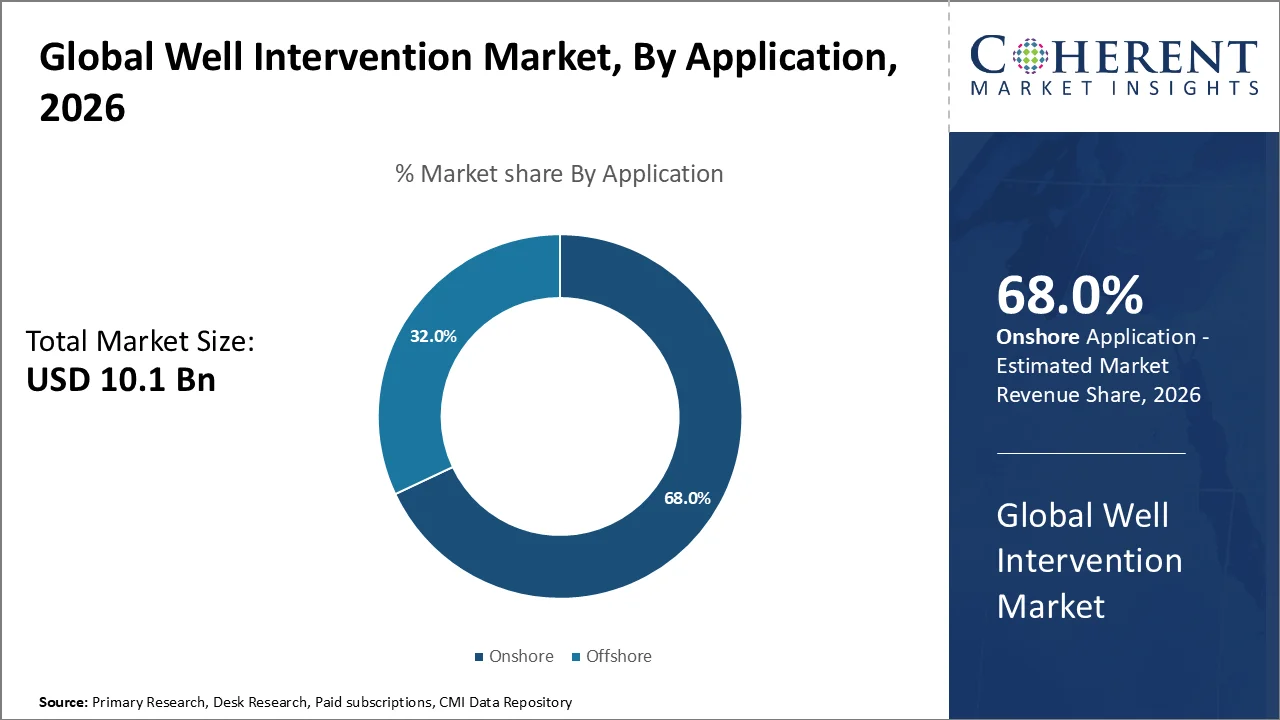
On the basis of application, the onshore segment is anticipated to lead the Well Intervention Market with a major 68.0% share in 2026. The segment’s dominance is owing to the considerably larger installed base of land-based wells, lower equipment-mobilization costs, easier wellsite accessibility, and frequent requirements for stimulation, artificial-lift repair, tubing maintenance, logging, reperforation, and remedial cementing.
Baker Hughes recorded 1,065 active international rigs in December 2025, comprising 845 land rigs and 220 offshore rigs. Land rigs therefore represented approximately 79.3% of international drilling activity, highlighting the considerably larger operating base supporting onshore completion, maintenance, and intervention services.
In January 2026, SLB secured two five-year contracts from Petroleum Development Oman to supply wellheads and artificial-lift technologies for operations in Oman’s Block 6 concession.
Why is Light Intervention Accounting for the Largest Share?
The light intervention segment is projected to account for the dominant Well Intervention Market share of 57.0% in 2026. The segment’s growth is owing to the frequent use of slickline, electric line, wireline logging, perforation, plug setting, valve manipulation, production diagnostics, and minor remedial operations that can be completed without mobilizing a conventional workover rig.
Oceaneering reports that its vessel-based intervention solutions can reduce project costs by up to 50% and have contributed to more than 15 million barrels of additional customer production. Its light-intervention systems are designed for operations in water depths of up to 10,000 feet and pressures of up to 10,000 psi, expanding the range of subsea wells that can be serviced without a traditional rig-based workover.
In October 2025, Oceaneering was awarded the riserless light well intervention contract by bp to carry out a multi-well mechanical wireline campaign at the Azeri-Chirag-Deepwater Gunashli field. In this campaign, the deepwater intervention system that has been mounted on a subsea construction vessel is being employed.
Well Intervention Market Trends
- The rising trend in the use of AI-based digital workflows is enhancing well-intervention plans, real-time interventions, consistency of operations, and post-job evaluation processes. According to Schlumberger Limited (SLB), about 80% of oil and gas production globally will be from mature assets by 2030, thereby enhancing the need for data-driven intervention tools.
- The increasing use of well re-entry and workover packages has been moving the industry from the purchase of services on an individual basis to complete intervention packages. In July 2026, Halliburton signed multi-year contracts with Aramco for around 285 onshore wells. The scope integrates oil re-entry, drilling, completions, and workover services under a single execution model, demonstrating operators’ preference for coordinated service programs that improve operating consistency and lower well-delivery costs.
- The rising use of compact and rigless intervention systems is enabling operators to restore production from mature wells located on platforms with restricted deck space and crane capacity. The CoilHose intervention technology was used by Expro in 2026 to service five offshore satellite wells in Trinidad and Tobago and bring these wells back online, even after 13 years of shutting down one particular well. This example clearly shows the increasing need for compact solutions capable of removing paraffin and scale, performing stimulations, and bringing old, abandoned wells back into production without the use of coiled tubing spreads.
Regional Insights
North America Dominates Owing to its Large Producing-Well Base and Advanced Oilfield Service Infrastructure
The North American region is projected to account for the largest Well Intervention Market share of 38.0% in 2026. The region’s dominance is owing to its extensive inventory of producing and mature wells, high unconventional oil and gas activity, frequent production-decline management requirements, and widespread adoption of coiled tubing, stimulation, artificial lift, logging, reperforation, and remedial well services.
Texas was responsible for production from 157,151 oil wells and 83,134 gas wells in December 2025. The production volumes were 4.08 million barrels of crude oil per day and 31.17 billion cubic feet of natural gas per day respectively, illustrating the magnitude of the producing asset base that needed to be maintained and optimized.
In July 2026, Weatherford announced the expansion of its Hi-VOL hydraulic jet pump technology across the Permian Basin. Following initial deployments in late 2025, the program expanded to 15 active units by the second quarter of 2026.
Middle East Well Intervention Market Trends
The Middle East region is expected to record the fastest growth in the Well Intervention Market, at an estimated CAGR of approximately 6.2% from 2026 to 2033. Growth is supported by major capacity-expansion programs, mature-field production optimization, unconventional gas development, water-injection projects, and increasing deployment of integrated coiled tubing and workover services.
The UAE is strengthening the regional growth outlook through ADNOC’s USD 150 billion capital-expenditure plan for 2026–2030. ADNOC is targeting crude oil production capacity of 5 million barrels per day by 2027, compared with approximately 4.85 million barrels per day, providing a substantial future base for well completion, maintenance, stimulation, and lifecycle-intervention services.
In March 2025, Aquaterra Energy secured a multi-million-dollar, multi-year contract from Intrepid Energy Limited to provide a customized subsea well intervention package for mature offshore oil wells in Nigeria.
Federal Recovery Funding and a Large Mature-Well Base are Accelerating the Well Intervention Market in the United States
The U.S. Well Intervention Market is experiencing constant growth due to the huge number of unconventional and mature producing wells, low production performance of existing wells, and increased use of stimulation, refracturing, coiled tubing, artificial lift, and advanced well diagnostics. More operators have become keen on improving production from existing wells due to the reduced prices of commodities and costs of drilling.
In July 2026, the U.S. Department of Energy announced up to USD 150 million in cost-shared funding for enhanced recovery from unconventional reservoirs, hydraulic-fracture characterization, well diagnostics, and produced-water technologies. The DOE stated that recovery rates from unconventional reservoirs are often below 10%, leaving a substantial volume of hydrocarbons technically unrecovered.
China Well Intervention Market Trends
China is expected to witness strong growth in the Well Intervention Market over the forecast period. The growth is owing to the country’s focus on improving recovery from mature fields, expanding unconventional oil and gas production, increasing offshore production, and deploying intelligent water injection, multi-zone completion, stimulation, and production-monitoring technologies.
PetroChina stated that it would implement plans to improve recovery rates at mature oil and gas fields while expanding development across the Songliao, Ordos, Junggar, Tarim, Sichuan, and Bohai Bay basins. The company estimates RMB 220.8 billion in Oil, Gas and New Energy capital expenditure for 2026, accounting for approximately 79% of its planned capital expenditure. This investment base is expected to support well stimulation, recompletion, logging, artificial-lift optimization, and other intervention activities.
Who are the Major Companies in Well Intervention Industry
Some of the major key players in Well Intervention Market are Schlumberger Limited, Baker Hughes Incorporate, Weatherford International Ltd., Trican Well Service Ltd., Superior Energy Services Inc., Halliburton Company, National Oilwell Varco Inc., and Precision Drilling Corporation.
Key News
- In July 2026, Precision Drilling announced that operating hours in its Completion and Production Services business increased by 25% year over year during the second quarter of 2026.
- In July 2026, NOV and Odfjell completed the first field deployment of the Rapid Emergency Disconnect System for offshore operations. The system reduced shear-close time to less than three seconds and enabled a complete emergency-disconnect sequence in under six seconds.
Market Report Scope
Well Intervention Market Report Coverage
| Report Coverage | Details | ||
|---|---|---|---|
| Base Year: | 2025 | Market Size in 2026: | USD 10.1 Bn |
| Historical Data for: | 2020 To 2024 | Forecast Period: | 2026 To 2033 |
| Forecast Period 2026 to 2033 CAGR: | 5.0% | 2033 Value Projection: | USD 14.2 Bn |
| Geographies covered: |
| ||
| Segments covered: |
| ||
| Companies covered: | Schlumberger Limited, Baker Hughes Incorporate, Weatherford International Ltd., Trican Well Service Ltd., Superior Energy Services Inc., Halliburton Company, National Oilwell Varco Inc., and Precision Drilling Corporation. | ||
| Growth Drivers: |
| ||
| Restraints & Challenges: |
| ||
Analyst Opinion
- The Well Intervention Market has a structurally resilient demand outlook because operators must continuously offset production decline from existing assets. The International Energy Agency’s September 2025 assessment of approximately 15,000 global oil and gas fields found that nearly 90% of annual upstream investment is directed toward offsetting production losses from existing fields. Without continued investment, global oil production could decline by approximately 5.5 million barrels per day annually, reinforcing long-term demand for stimulation, recompletion, artificial-lift optimization, and other production-restoration services.
- Offshore and unconventional wells are expected to remain high-value intervention opportunities because of their relatively steep production declines and complex operating conditions. The IEA reported that production from tight oil and shale gas could fall by more than 35% within the first year without investment, while smaller European offshore fields record average decline rates exceeding 15% annually. This supports recurring expenditure on coiled tubing, subsea intervention, well control, reperforation, zonal isolation, and stimulation technologies that can restore production without the cost and lead time of developing replacement fields.
- Mature-field life extension is becoming a central commercial strategy rather than a temporary maintenance activity. The Norwegian Offshore Directorate noted that there were 97 fields operating in Norway in the year 2025 and estimated an offshore investment worth around NOK 256 billion for 2026. Various fields have been found to operate between 10-30 years more than expected with some of them even extending up till 2040, resulting in a continuous need for integrity testing, wellhead servicing, logging, workover, and completions.
Speak to the analyst
Want personalized insights?
Take the findings above to one of our principal consultants, or have the report rebuilt around the segments, geographies and competitors you actually track.
Market Segmentation
- By Service (Revenue, USD Bn, 2021-2033)
- Wellhead and Christmas Tree Maintenance
- Logging and Bottomhole Survey
- Coiled Tubing
- Tubing/packer failure and repair
- Well Control
- Remedial Cementation
- Zonal Isolation
- Recompletion
- Fishing services
- Sand Control Services
- Stimulation
- Artificial Lift
- Reperforation
- Others
- By Application (Revenue, USD Bn, 2021-2033)
- Onshore
- Offshore
- By Category (Revenue, USD Bn, 2021-2033)
- Light Intervention
- Heavy Intervention
- By Region (Revenue, USD Bn, 2021-2033)
- North America
- U.S.
- Canada
- Latin America
- Brazil
- Mexico
- Argentina
- Rest of Latin America
- Europe
- Germany
- U.K.
- France
- Italy
- Spain
- Russia
- Rest of Europe
- Asia Pacific
- China
- India
- Japan
- Australia
- South Korea
- ASEAN
- Rest of Asia Pacific
- Middle East
- GCC
- Israel
- Rest of Middle East
- Africa
- South Africa
- Central Africa
- North Africa
- North America
Sources
Primary Research Interviews
- Oilfield service providers and well intervention contractors
- Coiled tubing, wireline, slickline, and hydraulic workover specialists
- Well stimulation, cementing, and artificial-lift service providers
- Production engineers, reservoir engineers, and well-integrity managers
- Drilling, completion, and intervention managers from oil and gas operators
- Subsea intervention equipment manufacturers and offshore vessel operators
- Procurement managers from national and international oil companies
- Independent well-control, fishing, and plug-and-abandonment specialists
- Key opinion leaders in mature-field optimization and enhanced oil recovery
Databases
- U.S. Energy Information Administration
- International Energy Agency
- Organization of the Petroleum Exporting Countries
- Baker Hughes Rig Count Database
- World Bank
- U.S. Bureau of Ocean Energy Management
- North Sea Transition Authority
- Norwegian Offshore Directorate
- Canada Energy Regulator
- Brazil National Agency of Petroleum, Natural Gas and Biofuels
- EMIS
- Dun & Bradstreet
- Panjiva
- Orbis
- Factiva
Magazines
- Offshore Magazine
- World Oil
- Journal of Petroleum Technology
- Oilfield Technology
- Oil Review Middle East
- Drilling Contractor
- Energy Voice
- Offshore Engineer
- Upstream
Journals
- SPE Production & Operations
- Journal of Petroleum Science and Engineering
- Petroleum Science
- International Journal of Oil, Gas and Coal Technology
- Journal of Natural Gas Science and Engineering
- Energy Reports
- Marine and Petroleum Geology
- Oil & Gas Science and Technology
- SPE Drilling & Completion
Newspapers
- Financial Times
- The Wall Street Journal
- Reuters
- Bloomberg
- The Guardian
- The Economic Times
- Arab News
- South China Morning Post
Associations
- Society of Petroleum Engineers
- International Association of Drilling Contractors
- Intervention and Coiled Tubing Association
- International Association of Oil & Gas Producers
- American Petroleum Institute
- Offshore Energies UK
- Energy Workforce & Technology Council
- International Well Control Forum
- International Association of Well Intervention Specialists
- Gulf Energy Information
Public Domain Sources
- Company annual reports, investor presentations, and regulatory filings
- Oil and gas operator production and capital-expenditure disclosures
- Government oil and gas production statistics and licensing databases
- National oil company development plans and project announcements
- Offshore lease-sale and field-development publications
- Well-integrity, decommissioning, and plug-and-abandonment regulations
- Company press releases covering intervention contracts and technology launches
- Technical papers and conference proceedings published by the Society of Petroleum Engineers
- Patent databases such as WIPO, USPTO, and Google Patents
- Environmental, safety, and well-control standards published by regulatory authorities
Proprietary Elements
- CMI Data Analytics Tool
- Proprietary CMI repository of historical market information for the last 10 years
Get access to 250+ pages report
Every segment, forecast, competitor profile and data table behind the analysis above — available for instant download.
- ESOMAR Member
- ISO 9001:2015 Certified
- D-U-N-S Registered
- GDPR & CCPA Compliant
Missing comfort of reading report in your local language? Find your preferred language:
Transform your Strategy with Exclusive Trending Reports
Frequently Asked Questions
The global Well Intervention Market is expected to reach USD 14.2 Bn by 2033, increasing from USD 10.1 Bn in 2026.
Major players operating in the global Well Intervention Market include Schlumberger Limited, Baker Hughes Incorporated, Weatherford International Ltd., Trican Well Service Ltd., Superior Energy Services Inc., Halliburton Company, National Oilwell Varco Inc., and Precision Drilling Corporation.
High investment and equipment deployment costs, operational risks in high-pressure and high-temperature wells, offshore mobilization expenses, skilled-workforce shortages, and volatile oil and gas prices are the major factors hampering market growth.
The increasing need to optimize production from mature fields, rising adoption of coiled tubing and rigless technologies, growing offshore production activities, increasing demand for enhanced oil recovery, and expanding well-maintenance requirements are driving the market.
The Well Intervention Market is anticipated to grow at a CAGR of 5.0% between 2026 and 2033.
North America is projected to dominate the global Well Intervention Market, accounting for approximately 38.0% of the market share in 2026. The region benefits from its large inventory of mature and unconventional wells and extensive adoption of stimulation, coiled tubing, artificial lift, and logging services.
The Middle East region is expected to record the fastest growth, at an estimated CAGR of approximately 6.2% from 2026 to 2033. Growth is supported by production-capacity expansion, unconventional gas development, mature-field optimization, and increasing investment in well-completion and intervention services.